
Leviticus 18:2

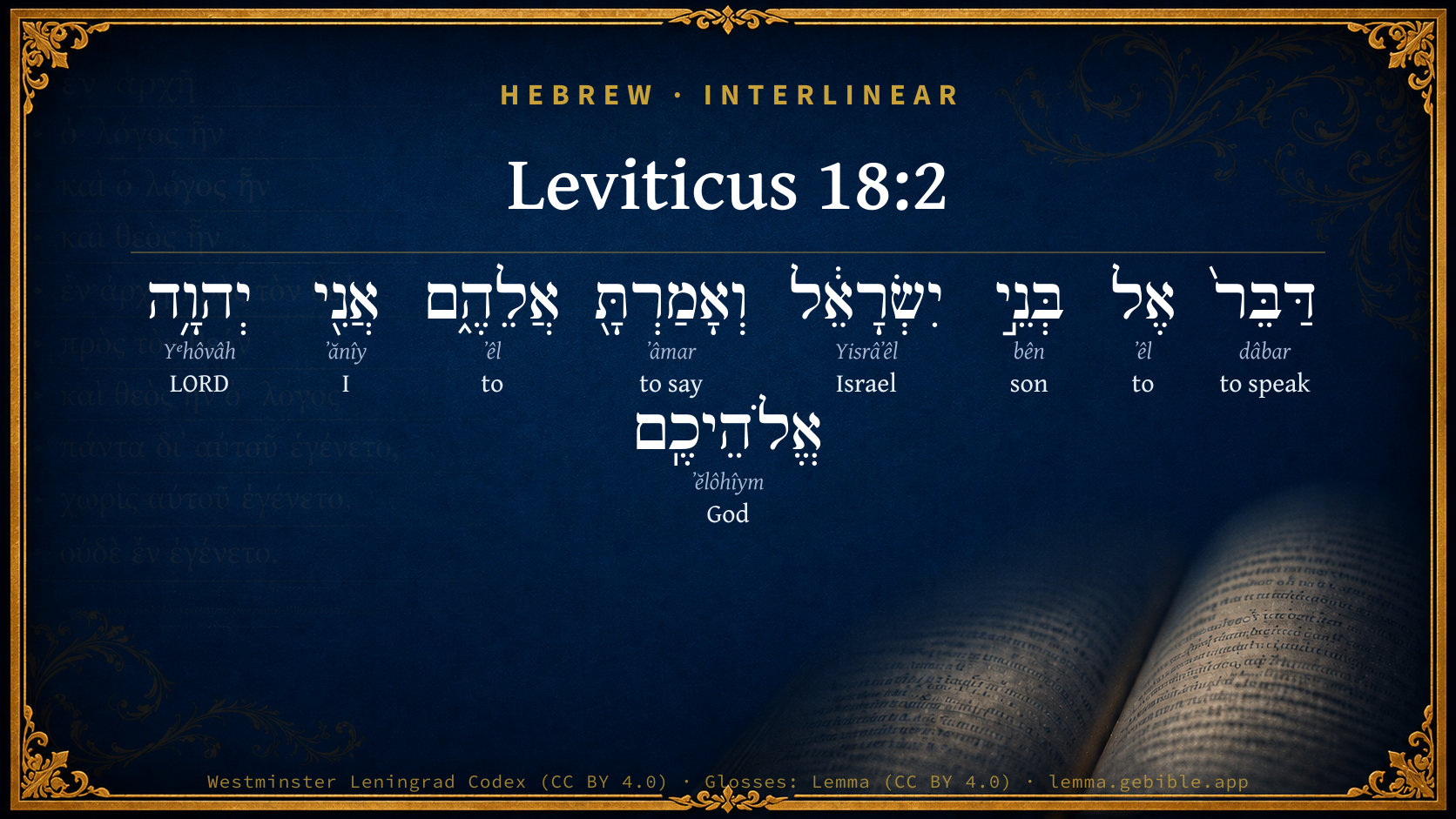
Hebrew (Westminster Leningrad Codex) Leviticus 18:2 appears in the Hebrew Old Testament. The text above is from the Westminster Leningrad Codex. Each word links to its Strong’s number, a concise gloss, and parsing drawn from the Open Scriptures Hebrew Bible morphology. Click any word for its full Brown-Driver-Briggs (BDB) entry.
Download image
Cite this verse

Leviticus 18:2 (World English Bible). Public Domain. Lemma interlinear Bible study tool, https://lemma.gebible.app/v/leviticus/18/2.

Show BibTeX & RIS
BibTeX
RIS
English Translation
"Speak to the children of Israel, and say to them, 'I am Yahweh your God.
World English Bible · Public Domain
Download a study sheet

One document with this verse’s original text, its word-by-word gloss line, the meaning frame, cross-references with their text, attributed commentary, and full source and license credits — printable, and it pastes into notes with its structure intact.

This verse Autodidact and up

Study sheet (.html) Plain text (.txt)

A passage Seminary Student

Up to 50 verses in one chapter. A passage sheet keeps up to 6 commentary sources and 12 cross-references per verse, in the order this page ranks them, and says so on the sheet whenever that leaves anything out. Ask for a single verse and you get the Autodidact verse sheet above.

Everything on this page stays free to read, with no account — the sheet is a download of what is already on screen, not access to it.

Want to remove ads? Support Godless Engineer
Compare translations 3

The same verse in 3 English versions, stacked beneath the original-language interlinear above. Click any original word for its lexicon entry.

Each is an independent rendering of the whole verse — the interlinear is not word-aligned to these translations.

Highlighted words mark where these versions differ — a whole-verse word diff, not a word-by-word alignment.

  • World English Bible Public Domain
    "Speak to the children of Israel, and say to them, 'I am Yahweh your God.
  • King James Version Public Domain
    Speak unto the children of Israel, and say unto them, I am the LORD your God.
  • unfoldingWord Literal Text CC BY-SA 4.0
    “Speak to the sons of Israel, and you shall say to them, ‘I Yahweh your God.

unfoldingWord Literal Text — © unfoldingWord, licensed CC BY-SA 4.0. Word-aligned USFM3 via Door43 (git.door43.org/unfoldingWord/en_ult).

Versions to compare (up to 4)

3 of 4 selected

Show all 18 translations

Every available English version of this verse, each an independent rendering of the whole verse.

  • World English Bible Public Domain
    "Speak to the children of Israel, and say to them, 'I am Yahweh your God.
  • Berean Standard Bible Public Domain
    “Speak to the Israelites and tell them: I am the LORD your God.
  • Majority Standard Bible Public Domain
    “Speak to the Israelites and tell them: I am the LORD your God.
  • King James Version Public Domain
    Speak unto the children of Israel, and say unto them, I am the LORD your God.
  • American Standard Version (1901) Public Domain
    Speak unto the children of Israel, and say unto them, I am Jehovah your God.
  • Revised Version (1885) Public Domain
    Speak unto the children of Israel, and say unto them, I am the LORD your God.
  • Geneva Bible (1599) Public Domain
    Speake vnto the children of Israel, and say vnto them, I am the Lord your God.
  • Douay-Rheims (1899) Public Domain
    Speak to the children of Israel, and thou shalt say to them: I am the Lord your God.
  • Young's Literal Translation Public Domain
    `Speak unto the sons of Israel, and thou hast said unto them, I `am' Jehovah your God;
  • Literal Standard Version CC BY-SA 4.0
    “Speak to the sons of Israel, and you have said to them: I [am] your God YHWH;
  • Unlocked Literal Bible CC BY-SA 4.0
    “Speak to the people of Israel and say to them, 'I am Yahweh your God.
  • unfoldingWord Literal Text CC BY-SA 4.0
    “Speak to the sons of Israel, and you shall say to them, ‘I Yahweh your God.
  • Darby Bible Public Domain
    Speak unto the children of Israel, and say unto them, I am Jehovah your God.
  • World Messianic Bible Public Domain
    “Speak to the children of Israel, and say to them, ‘I am the LORD your God.
  • Webster's Bible Public Domain
    Speak to the children of Israel, and say to them, I am the LORD your God.
  • Free Bible Version CC BY-SA 4.0
    “Tell the Israelites: I am the Lord your God.
  • Bible in Basic English Public Domain
    Say to the children of Israel, I am the Lord your God.
  • JPS Tanakh (1917) Public Domain
    Speak unto the children of Israel, and say unto them: I am the LORD your God.

Literal Standard Version (2020), Covenant Press — licensed CC BY-SA 4.0. Text via the HelloAO Bible API (eBible.org). Unlocked Literal Bible (unfoldingWord) — licensed CC BY-SA 4.0. Text via the HelloAO Bible API (eBible.org). unfoldingWord Literal Text — © unfoldingWord, licensed CC BY-SA 4.0. Word-aligned USFM3 via Door43 (git.door43.org/unfoldingWord/en_ult). Free Bible Version, Dr. Jonathan Gallagher — licensed CC BY-SA 4.0. Text via the HelloAO Bible API (eBible.org).

Word by word

More ways to search: Search by grammar → Find every occurrence → Compare this word →

Practice this passage: Drill this verse → Learn its vocabulary →

About this verse

These counts appear in no published source. They are computed here, from the morphology-tagged text and Lemma’s own curated glosses. What Lemma adds →

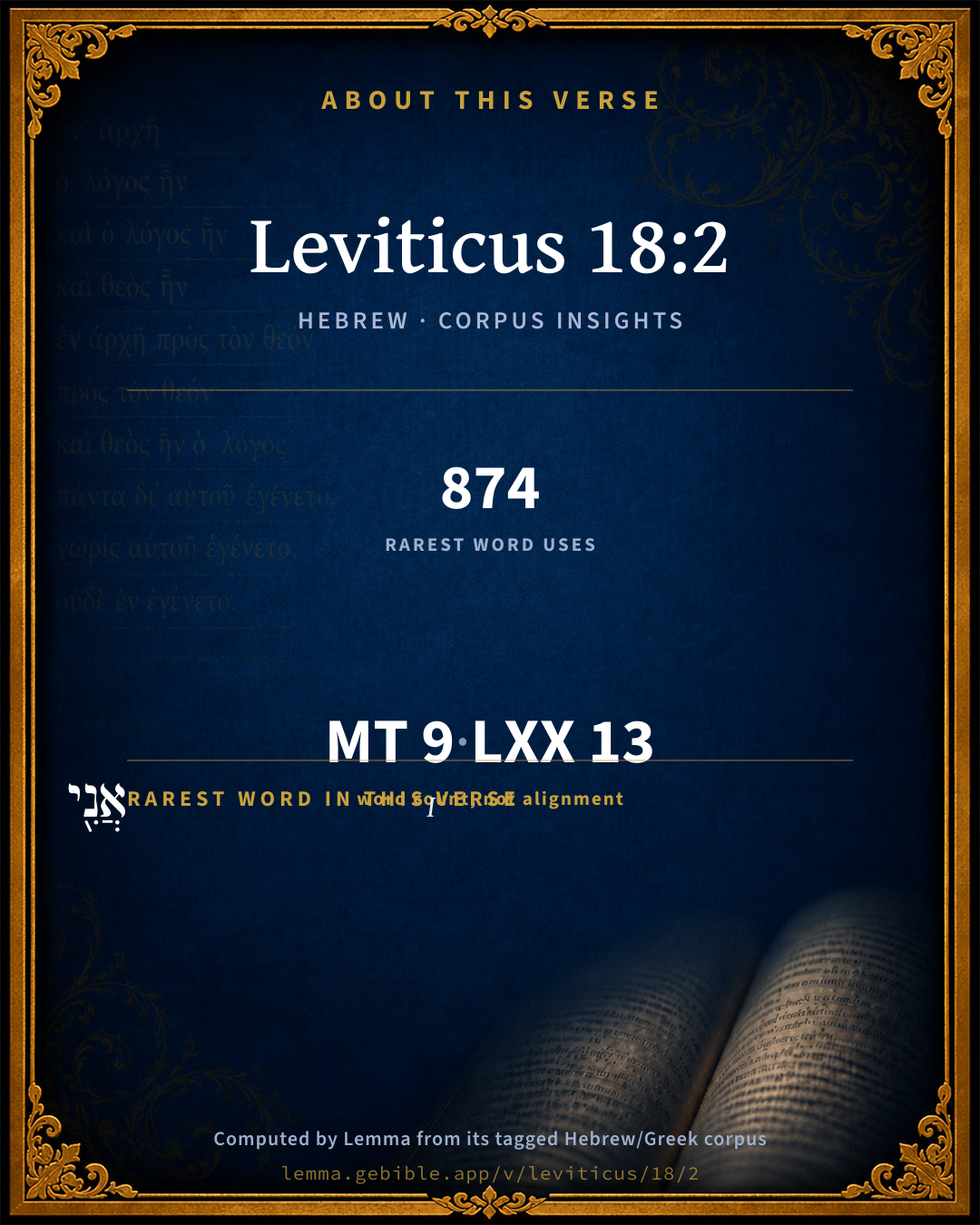
9
words
8
distinct lemmas
Pentateuch
section

Grammatical profile

  • 2 verbs
  • 4 nouns
  • 1 pronoun
  • 2 prepositions

Verb forms

  • דַּבֵּר֙ Piel · Imperative
  • וְאָמַרְתָּ֖ Qal · Sequential Perfect

Repetition

A word recurs within this verse — often emphatic in Hebrew:

  • אֶל to H413 ×2

Hebrew & Septuagint length

In English translation the verse runs 15 words from the Hebrew and 18 from the Septuagint (LXX English) — closely comparable.

A rough comparison of the two English renderings, which tokenize alike — not a word-level alignment.

Word counts can differ between the Hebrew and the Greek without any difference in meaning — e.g. the Hebrew direct-object marker אֵת has no separate Greek word, and Greek often adds the article ὁ.

In the original languages it is 9 Hebrew tokens and 13 Greek tokens — but the two are counted differently (Hebrew bundles its prefixes and suffixes into one token; the Greek is in lemma form), so that isn’t a like-for-like length.

Cross-references

13

Topical passages linked to Leviticus 18:2 in the Treasury of Scripture Knowledge — connected by theme and wording, ordered by reader-vote popularity; previews shown in the World English Bible.

  • Exodus 6:7 and I will take you to me for a people, and I will be to you a God; and you shall know that I am Yahweh your God, who brings you out from under the burdens of the Egyptians.
  • Leviticus 11:44 For I am Yahweh your God. Sanctify yourselves therefore, and be holy; for I am holy: neither shall you defile yourselves with any kind of creeping thing that moves on the earth.
  • Ezekiel 20:5 and tell them, Thus says the Lord Yahweh: In the day when I chose Israel, and swore to the seed of the house of Jacob, and made myself known to them in the land of Egypt, when I swore to them, saying, I am Yahweh your God;
  • Leviticus 20:7 "'Sanctify yourselves therefore, and be holy; for I am Yahweh your God.
  • Genesis 17:7 I will establish my covenant between me and you and your seed after you throughout their generations for an everlasting covenant, to be a God to you and to your seed after you.
  • Exodus 20:2 "I am Yahweh your God, who brought you out of the land of Egypt, out of the house of bondage.
  • Leviticus 18:4 You shall do my ordinances, and you shall keep my statutes, and walk in them: I am Yahweh your God.
  • Leviticus 19:3–4 "'Each one of you shall respect his mother and his father. You shall keep my Sabbaths. I am Yahweh your God.
  • Leviticus 19:10 You shall not glean your vineyard, neither shall you gather the fallen grapes of your vineyard; you shall leave them for the poor and for the foreigner. I am Yahweh your God.
  • Leviticus 19:34 The stranger who lives as a foreigner with you shall be to you as the native-born among you, and you shall love him as yourself; for you lived as foreigners in the land of Egypt. I am Yahweh your God.
  • Psalms 33:12 Blessed is the nation whose God is Yahweh, The people whom he has chosen for his own inheritance.
  • Ezekiel 20:7 I said to them, Cast you away every man the abominations of his eyes, and don't defile yourselves with the idols of Egypt; I am Yahweh your God.
  • Ezekiel 20:19–20 I am Yahweh your God: walk in my statutes, and keep my ordinances, and do them;

Cross-references courtesy of OpenBible.info (CC BY 4.0).

Hebrew and Greek witnesses Masoretic Hebrew ↔ Greek Septuagint

The same verse in the two great witnesses to the Old Testament, shown verse-for-verse.

These are two independent witnesses, not word-aligned to each other, and the Septuagint is shown in lemma (dictionary) form.

Hebrew Leviticus 18:2 Masoretic · Westminster Leningrad Codex

דַּבֵּר֙ אֶל בְּנֵ֣י יִשְׂרָאֵ֔ל וְאָמַרְתָּ֖ אֲלֵהֶ֑ם אֲנִ֖י יְהוָ֥ה אֱלֹהֵיכֶֽם

"Speak to the children of Israel, and say to them, 'I am Yahweh your God.

World English Bible · Public Domain

Greek LXX Leviticus 18:2 Septuagint · lemma form

λαλέω ὁ υἱός ἰσραήλ καί εἶπον πρός αὐτός ἐγώ κύριος ὁ θεός σύ

Speak to the children of Israel, and you shall say to them, I am the Lord your God.

LXX2012 (modern English Septuagint) · Public Domain

Hebrew: Westminster Leningrad Codex (CC BY 4.0). Greek: Septuagint (public domain); English from LXX2012 (modern English Septuagint) (Public Domain). How the Septuagint differs from the Hebrew →

Targum (Aramaic paraphrase)

2

The Targum is the ancient Jewish Aramaic paraphrase of the Hebrew Scriptures — an interpretive translation, not the Hebrew text itself. Onkelos (literal) and Pseudo-Jonathan (expansive) render the Torah, and Jonathan the Prophets. Coverage is partial: where no permissively-licensed English translation exists for a verse, only the Aramaic is shown. This is verse-level text, not a word-by-word alignment to the Hebrew.

  1. Targum Onkelos Torah (Genesis–Deuteronomy)
    מַלֵל עִם בְּנֵי יִשְׂרָאֵל וְתֵימַר לְהוֹן אֲנָא יְיָ אֱלָהָכוֹן

    (no public-domain English translation for this verse)

    Targum Onkelos — Aramaic: “Onkelos Genesis” (public domain); “Onkelos Exodus” (public domain); “Onkelos Leviticus” (public domain); “Onkelos Numbers” (public domain); “Onkelos Deuteronomy” (public domain). English: “Sefaria Community Translation” (CC0 1.0 (public-domain dedication)); “J.W. Etheridge. The Targums of Onkelos and Jonathan Ben Uzziel on the Pentateuch. London: Longmans, Green, 1862” (public domain). Text via Sefaria.

  2. Targum Pseudo-Jonathan Torah (Genesis–Deuteronomy)
    מַלֵיל עִם בְּנֵי יִשְרָאֵל וְתֵימַר לְהוֹן אֲנָא הוּא יְיָ אֱלָהָכוֹן

    Speak with the sons of Israel, and say to them, I am the Lord your God.

    Targum Pseudo-Jonathan — Aramaic: “Targum Jonathan on Genesis” (public domain); “Targum Jonathan on Exodus” (public domain); “Targum Jonathan on Leviticus” (public domain); “Targum Jonathan on Numbers” (public domain); “Targum Jonathan on Deuteronomy” (public domain). English: “The Targum of Jonathan ben Uzziel, trans. J. W. Etheridge, London, 1862” (public domain). Text via Sefaria.

Commentary

Notes on Leviticus 18:2 from classic Christian and Jewish commentators (each source and its license shown beneath its notes). The classic Christian expositions comment on the surrounding passage and are grouped to its opening verse, so a note may address several verses; the Jewish commentaries on the Tanakh (Rashi and others) are per-verse, so they appear only where the commentator wrote on this verse.

Lemma curates 59 commentaries, every one of them public domain or Creative Commons licensed, each selected and text-cleaned for this edition rather than reprinted as found. About our sources →

John Gill's Exposition

Speak unto the children of Israel,.... To the heads of their tribes, that they might deliver to them the following laws; or Moses is bid to publish them among them, either by word of mouth, or by writing, or both:

and say unto them, I am the Lord your God; with which they were to be introduced; showing the right he had to enact and enjoin such laws, since he was Jehovah, the Being of beings, and from whom they received their beings; their sovereign Lord and King, who had a right to rule over them, and command what he pleased; and also the obligation they lay under to him to regard them, and yield a cheerful obedience to them, since he was their God, not only that had made them, but had redeemed them out of Egypt; and who had made a covenant with them, and had taken special care of them, and had bestowed many wonderful favours on them; and for this purpose is this phrase often used in this chapter, and very frequently in the next. See Lev 18:2.

John Gill's Exposition of the Whole Bible (1746–1763) — public domain (CC PDM 1.0). Text via the HelloAO Bible API.

Trapp's Complete Commentary

John Trapp

Lev 18:2 Speak unto the children of Israel, and say unto them, I am the LORD your God.

Ver. 2. I am the Lord your God.] Your Maker and Master.

John Trapp, A Commentary or Exposition upon All the Books of the Old and New Testament (1647–1656) — public domain. Text from a community e-Sword module.

Joseph Benson's Commentary

Lev 18:2. Your God — Your sovereign and lawgiver. This is often repeated, because the things here forbidden were practised and allowed by the Gentiles, to whose custom he opposes divine authority and their obligation to obey his commands.

Joseph Benson's Commentary on the Old and New Testaments (1811–1818) — public domain. Text from a community e-Sword module.

Tyndale Open Study Notes

Tyndale Open Resources

18:2 Many Near Eastern treaties began with the name and titles of the ruler who was drawing up the treaty. The phrase I am the Lord your God gives the name of the Great King, Yahweh (English the Lord), followed by his title, your God (see also Exod 20:2; Deut 5:6). These words were an abbreviated way to invoke Israel’s covenant with God and all that it implied. By reminding the people that they were the Lord’s, these words carried an authority that required a response (Lev 11:44; 18:4-5). Chapter 18 begins and ends (18:30) with these words, and they appear frequently throughout chs 19–26.

Tyndale Open Study Notes — © Tyndale Open Resources, licensed CC BY-SA 4.0. Text via the HelloAO Bible API.

Ellicott's Commentary for English Readers

(2) I am the Lord your God.—The Lord is their recognised and sole sovereign, the children of Israel are therefore bound to obey His precepts, and not be led astray by the customs or statutes which prevailed among the people whose country they are to possess. Moreover, as He is holy, the Israelites, by faithfully obeying His sacred laws, will attain to that holiness which will bring them in communion with Him in whose image they were created. This phrase, which is so emphatically repeated twice more in this chapter (Lev_18:4; Lev_18:30), has only been used once before in this book. (See Lev_11:44.)

A Bible Commentary for English Readers, edited by Charles John Ellicott (1878–1897) — public domain. Text from a community e-Sword module.

The Cambridge Bible for Schools and Colleges

gen. ed. J. J. S. Perowne

2. Purity in remoter relationships.

The first Pentad: Relationships through marriage, Lev_18:16-19.

The second Pentad: Purity outside of the family, Lev_18:20-23.

To the exhortation concluding with ‘I am the Lord your God’ (Lev_18:30) he would add Lev_19:2 b, ‘Ye shall be holy,’ etc.

The arrangement in this ch. is better than in ch. 20, and the cases dealt with are more numerous. Ch. 20 contains no parallels to Lev_18:7; Lev_18:10; Lev_18:17 b, Lev_18:18, and has therefore been taken as representing an earlier code. On the other hand ch. 20, unlike ch. 18, mentions penalties for the offences, while such indications as it affords by the juxtaposition of ‘you’ in Lev_20:14 b, Lev_20:15 b, and ‘thou’ in Lev_20:16; Lev_20:19, and the duplicate clauses in Lev_18:10 suggest that whatever age may be ascribed to the code in ch. 20, as compared with that which appears in ch. 18, the former has at any rate been subjected to later editing.

The Cambridge Bible for Schools and Colleges (gen. ed. J. J. S. Perowne; Cambridge University Press, 1878–1918) — public domain. Text from a community e-Sword module.

Albert Barnes' Notes on the Bible

I am, the Lord your God - The frequent repetition of this formula in these parts of the Law may be intended to keep the Israelites in mind of their covenant with Yahweh in connection with the common affairs of life, in which they might be tempted to look at legal restrictions in a mere secular light.

Albert Barnes' Notes on the Bible (1834–1885) — public domain. Text from a community e-Sword/MySword module.

Haydock's Catholic Bible Commentary

God, to whom the right of giving laws belongs. (Du Hamel)

George Leo Haydock (1774–1849), Haydock's Catholic Family Bible and Commentary, 1859 edition — public domain. Excludes Psalms (Douay-Rheims chapter numbering differs from Protestant) and Deuterocanonical books (Catholic canon only).

Matthew Poole's English Annotations

Your Sovereign and Lawgiver. This is oft repeated here, because the things here forbidden were practised and allowed by the Gentiles, to whose custom he here opposeth Divine authority, and their obligation to obey his commands.

Matthew Poole's English Annotations on the Holy Bible (1683–1685) — public domain. Text from a community e-Sword/MySword module.

Whedon's Commentary on the Bible

Daniel D. Whedon

THE VICES OF EGYPT AND CANAAN PROHIBITED, Lev_18:1-5.

2. I am the Lord — In giving commandments, the authority of the Lawgiver is made prominent. See Lev_11:44, note.

Daniel D. Whedon (gen. ed.), Commentary on the Old and New Testaments (1874–1909) — public domain. Text from a community e-Sword module.

John Wesley's Explanatory Notes

Your God - Your sovereign, and lawgiver. This is often repeated because the things here forbidden were practiced and allowed by the gentiles, to whose custom he opposes divine authority and their obligation to obey his commands.

John Wesley, Explanatory Notes Upon the Whole Bible (1754–1765) — public domain. Text via the GEBible commentary corpus.

Rashi

Rabbi Shlomo Yitzchaki (Rashi)

אני ה' אלהיכם I AM THE LORD YOUR GOD — I am He Who spoke on Mount Sinai “I am the Lord thy God" and Whose kingship you then accepted; now, therefore, accept My decrees! Rabbi Judah han-Nasi said: It was manifest and known to Him that in the days of Ezra they would ultimately revolt against restricting sexual relations, He therefore came to them with a decree emphasized by the words: "I am The Lord your God" — understand well Who it is that imposes this decree upon you, — the Judge (אלהיכם) Whose function it is to punish but Who is certain also to give a reward ('‎ה‎) (cf. Sifra, Acharei Mot, Section 8 1).

Rashi on the Tanakh — English translations: “The Judaica Press complete Tanach with Rashi, translated by A. J. Rosenberg” (CC BY 4.0); “Pentateuch with Rashi's commentary by M. Rosenbaum and A.M. Silbermann, 1929-1934” (public domain); “The Metsudah Tanach series, Lakewood, N.J” (CC BY 4.0); and “The Book of Joshua, Metsudah Publications, 1997” (CC BY 4.0). Text via Sefaria.

Ramban (Nachmanides)

Rabbi Moshe ben Nachman (Ramban / Nachmanides)

SPEAK UNTO THE CHILDREN OF ISRAEL. Since this chapter deals with [the laws of] prohibited sexual intercourse which apply equally to all Israel, therefore He said only, Speak unto the children of Israel, and did not specify the priests but included them together. Therefore He said at first, I am the Eternal your G-d, just as He did in the Ten Commandments [which He began with the words, I am the Eternal thy G-d]. And the meaning of the verse, Speak unto the children of Israel, and say unto them: I am the Eternal your G-d, is as if He said, “Say unto them in My Name, ‘I am the Eternal your G-d.’” Similarly, Speak unto all the congregation of the children of Israel, and say unto them: Ye shall be holy, for I the Eternal your G-d am holy, [means: “say unto them in My Name, ‘Ye shall be holy'”].It is possible that the reason [why the verse does not say: “this is what G-d commanded,” is not because it means: “say unto them in My Name” as explained above, but] is rather as follows: When Moses came out from before the Eternal without the veil [on his face], and he came out, and spoke unto the children of Israel that which he was commanded, Verse 34. he did not need to say to them: “Thus said the Eternal,” for it was known to them that it was His spirit that spoke through him [Moses] and His word was upon his tongue, in My Name, I am the Eternal your G-d,” since it was known to them that Moses did not speak in his own name. and that he did not speak in his own name. Similarly, in many places in the Book of Deuteronomy it is stated in the same way, such as: And it shall come to pass, if ye shall hearken diligently unto My commandments, which I command you this day … that I will give the rain of your Land … And I will give grass in thy fields, and [it is known that] Moses is not the one who giveth rain upon the earth, and sendeth waters upon the fields, and makes the grass grow in the fields, but it is G-d, blessed be He [that does these things]. Similarly it is said, But the Eternal hath not given you a heart to know … And I have led you forty years in the desert … Ye have not eaten bread, neither have ye drunk wine or strong drink; that ye might know that I am the Eternal your G-d. …] clearly indicates that the expression in the following verse, And I have led you etc. is also a reference to the Eternal, and not to Moses. The meaning of the expression to love the Eternal your G-d, 11:13. [which is stated in the third person, when that same verse begins in the first person, And it shall come to pass, if ye shall hearken diligently unto My commandments], has already been explained.

Ramban (Nachmanides) on the Tanakh — English translation: “Commentary on the Torah by Ramban (Nachmanides). Translated and annotated by Charles B. Chavel. New York, Shilo Pub. House, 1971-1976” (CC BY 4.0). Text via Sefaria.

Ibn Ezra

Rabbi Abraham ibn Ezra

I am Adonoy, your God. This means that upon this condition I will be your God.

Ibn Ezra on the Tanakh — English translations: “Sefaria Community Translation” (CC0 1.0 (public-domain dedication)); “Yalkut, Sifsei Chachomim Chumash, Metsudah Publications, 2009” (CC BY 4.0); and “Commentary of Ibn Ezra on Isaiah - trans. by M. Friedlander, 1873” (public domain). Text via Sefaria.

Lesson kit

Teaching starters — assembled from the data on this page, not authored interpretation. Every prompt links to the verse data it draws on. Edit before teaching.

Leviticus, in the Pentateuch, opens this verse with 9 words (8 distinct Hebrew lemmas). Its most distinctive word is ʼănîy (“I”). A historical commentator’s framing appears above. Read the whole chapter for the surrounding context.

Discussion questions

  1. The word ʼănîy carries the sense “I.” How does it shape the verse?
  2. How does Exodus 6:7, which shares this passage’s theme, read alongside this verse?
  3. What does the repetition of “to” (2× in this one verse) do in this verse?
  4. The translations on this page render this verse differently — a whole-verse word diff, not a word-by-word alignment. What might account for the different wordings?
  5. «דַּבֵּר֙» is a Piel Imperative verb. How does that grammatical form shape the action described?
  6. Compare how John Gill's Exposition and Trapp's Complete Commentary read this verse. Where do they agree or differ?

Things to notice

Reading settings

Reading text

Shown beneath each verse's original-language words.

Old Testament
Old Testament edition

Read the OT as the Masoretic Hebrew (MT) or the Greek Septuagint (LXX).

English shown for the Greek Septuagint (in the Hebrew ↔ Greek comparison).

Comparing translations? Open the Compare panel on any verse page to stack up to four side by side.