Leviticus 18:5

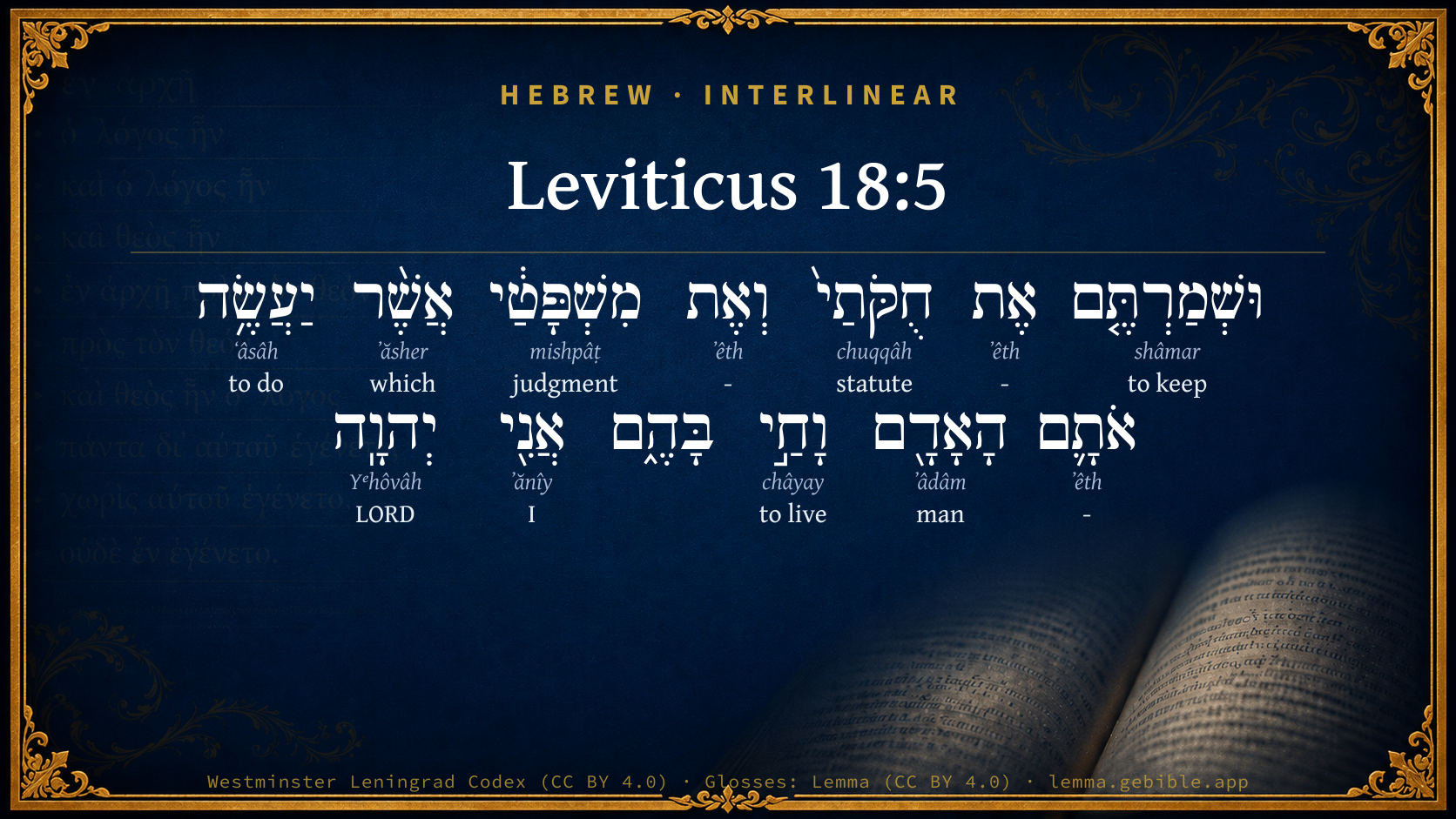
Hebrew (Westminster Leningrad Codex) Leviticus 18:5 appears in the Hebrew Old Testament. The text above is from the Westminster Leningrad Codex. Each word links to its Strong’s number, a concise gloss, and parsing drawn from the Open Scriptures Hebrew Bible morphology. Click any word for its full Brown-Driver-Briggs (BDB) entry.
Download image
Cite this verse

Leviticus 18:5 (World English Bible). Public Domain. Lemma interlinear Bible study tool, https://lemma.gebible.app/v/leviticus/18/5.

Show BibTeX & RIS
BibTeX
RIS
English Translation
You shall therefore keep my statutes and my ordinances; which if a man does, he shall live in them: I am Yahweh.
World English Bible · Public Domain
Download a study sheet

One document with this verse’s original text, its word-by-word gloss line, the meaning frame, cross-references with their text, attributed commentary, and full source and license credits — printable, and it pastes into notes with its structure intact.

This verse Autodidact and up

Study sheet (.html) Plain text (.txt)

A passage Seminary Student

Up to 50 verses in one chapter. A passage sheet keeps up to 6 commentary sources and 12 cross-references per verse, in the order this page ranks them, and says so on the sheet whenever that leaves anything out. Ask for a single verse and you get the Autodidact verse sheet above.

Everything on this page stays free to read, with no account — the sheet is a download of what is already on screen, not access to it.

Want to remove ads? Support Godless Engineer
Compare translations 3

The same verse in 3 English versions, stacked beneath the original-language interlinear above. Click any original word for its lexicon entry.

Each is an independent rendering of the whole verse — the interlinear is not word-aligned to these translations.

Highlighted words mark where these versions differ — a whole-verse word diff, not a word-by-word alignment.

  • World English Bible Public Domain
    You shall therefore keep my statutes and my ordinances; which if a man does, he shall live in them: I am Yahweh.
  • King James Version Public Domain
    Ye shall therefore keep my statutes, and my judgments: which if a man do, he shall live in them: I am the LORD.
  • unfoldingWord Literal Text CC BY-SA 4.0
    And you shall keep my statutes and my customs, which the man shall do them and he shall live by them. I Yahweh.

unfoldingWord Literal Text — © unfoldingWord, licensed CC BY-SA 4.0. Word-aligned USFM3 via Door43 (git.door43.org/unfoldingWord/en_ult).

Versions to compare (up to 4)

3 of 4 selected

Show all 18 translations

Every available English version of this verse, each an independent rendering of the whole verse.

  • World English Bible Public Domain
    You shall therefore keep my statutes and my ordinances; which if a man does, he shall live in them: I am Yahweh.
  • Berean Standard Bible Public Domain
    Keep My statutes and My judgments, for the man who does these things will live by them. I am the LORD.
  • Majority Standard Bible Public Domain
    Keep My statutes and My judgments, for the man who does these things will live by them. I am the LORD.
  • King James Version Public Domain
    Ye shall therefore keep my statutes, and my judgments: which if a man do, he shall live in them: I am the LORD.
  • American Standard Version (1901) Public Domain
    Ye shall therefore keep my statutes, and mine ordinances; which if a man do, he shall live in them: I am Jehovah.
  • Revised Version (1885) Public Domain
    Ye shall therefore keep my statutes, and my judgments: which if a man do, he shall live in them: I am the LORD.
  • Geneva Bible (1599) Public Domain
    Ye shall keepe therefore my statutes, and my iudgements, which if a man doe, he shall then liue in them: I am the Lord.
  • Douay-Rheims (1899) Public Domain
    Keep my laws and my judgments, which if a man do, he shall live in them. I am the Lord.
  • Young's Literal Translation Public Domain
    and ye have kept My statutes and My judgments which man doth and liveth in them; I `am' Jehovah.
  • Literal Standard Version CC BY-SA 4.0
    And you have kept My statutes and My judgments which man does and lives in them; I [am] YHWH.
  • Unlocked Literal Bible CC BY-SA 4.0
    Therefore you must keep my decrees and my laws. If a person obeys them, he will live because of them. I am Yahweh.
  • unfoldingWord Literal Text CC BY-SA 4.0
    And you shall keep my statutes and my customs, which the man shall do them and he shall live by them. I Yahweh.
  • Darby Bible Public Domain
    And ye shall observe my statutes and my judgments, by which the man that doeth them shall live: I am Jehovah.
  • World Messianic Bible Public Domain
    You shall therefore keep my statutes and my ordinances, which if a man does, he shall live in them. I am the LORD.
  • Webster's Bible Public Domain
    Ye shall therefore keep my statutes and my judgments: which if a man doeth, he shall live in them: I am the LORD.
  • Free Bible Version CC BY-SA 4.0
    If you keep my rules and do what I tell you, you will live. I am the Lord.
  • Bible in Basic English Public Domain
    So keep my rules and my decisions, which, if a man does them, will be life to him: I am the Lord.
  • JPS Tanakh (1917) Public Domain
    Ye shall therefore keep My statutes, and Mine ordinances, which if a man do, he shall live by them: I am the LORD.

Literal Standard Version (2020), Covenant Press — licensed CC BY-SA 4.0. Text via the HelloAO Bible API (eBible.org). Unlocked Literal Bible (unfoldingWord) — licensed CC BY-SA 4.0. Text via the HelloAO Bible API (eBible.org). unfoldingWord Literal Text — © unfoldingWord, licensed CC BY-SA 4.0. Word-aligned USFM3 via Door43 (git.door43.org/unfoldingWord/en_ult). Free Bible Version, Dr. Jonathan Gallagher — licensed CC BY-SA 4.0. Text via the HelloAO Bible API (eBible.org).

Word by word

More ways to search: Search by grammar → Find every occurrence → Compare this word →

Practice this passage: Drill this verse → Learn its vocabulary →

וָחַ֣י
châyay
H2425
“and · to live”
Conjunction + Verb, Qal, Sequential Perfect, 3rd Person, Masculine, Singular
Part of Speech
Conjunction + Verb
Stem
Qal
Form
Sequential Perfect
Person
3rd Person
Gender
Masculine
Number
Singular
Full BDB Definition

Origin: a primitive root [compare H2421 ]

TWOT: 644

to live, have life, remain alive, sustain life, live prosperously, live for ever, be quickened, be alive, be restored to life or health - (Qal) - to live - to have life - to continue in life, remain alive - to sustain life, to live on or upon - to live (prosperously) - to revive, be quickened - from sickness - from discouragement - from faintness - from death - (Piel) - to preserve alive, let live - to give life - to quicken, revive, refresh - to restore to life - to cause to grow - to restore - to revive - (Hiphil) - to preserve alive, let live - to quicken, revive - to restore (to health) - to revive - to restore to life

  1. וּשְׁמַרְתֶּ֤ם shâmar H8104 “and · to keep” Conjunction + Verb, Qal, Sequential Perfect, 2nd Person, Masculine, Plural
  2. אֶת ʼêth H853 “-” Particle, Direct Object
  3. חֻקֹּתַי֙ chuqqâh H2708 “statutes · my” Noun, Common, Both, Plural, Construct + Suffix, Personal, 1st Person, Common, Singular
  4. וְאֶת ʼêth H853 “and · -” Conjunction + Particle, Direct Object
  5. מִשְׁפָּטַ֔י mishpâṭ H4941 “judgments · my” Noun, Common, Masculine, Plural, Construct + Suffix, Personal, 1st Person, Common, Singular
  6. אֲשֶׁ֨ר ʼăsher H834 “which” Particle, Relative
  7. יַעֲשֶׂ֥ה ʻâsâh H6213 “to do” Verb, Qal, Imperfect, 3rd Person, Masculine, Singular
  8. אֹתָ֛ם ʼêth H853 “- · them” Particle, Direct Object + Suffix, Personal, 3rd Person, Masculine, Plural
  9. הָאָדָ֖ם ʼâdâm H120 “the · man” Particle, Definite Article + Noun, Common, Masculine, Singular, Absolute
  10. אֲנִ֖י ʼănîy H589 “I” Pronoun, Personal, 1st Person, Common, Singular
  11. יְהוָֽה Yᵉhôvâh H3068 “LORD” Noun, Proper

About this verse

These counts appear in no published source. They are computed here, from the morphology-tagged text and Lemma’s own curated glosses. What Lemma adds →

13
words
10
distinct lemmas
Pentateuch
section

Notable vocabulary

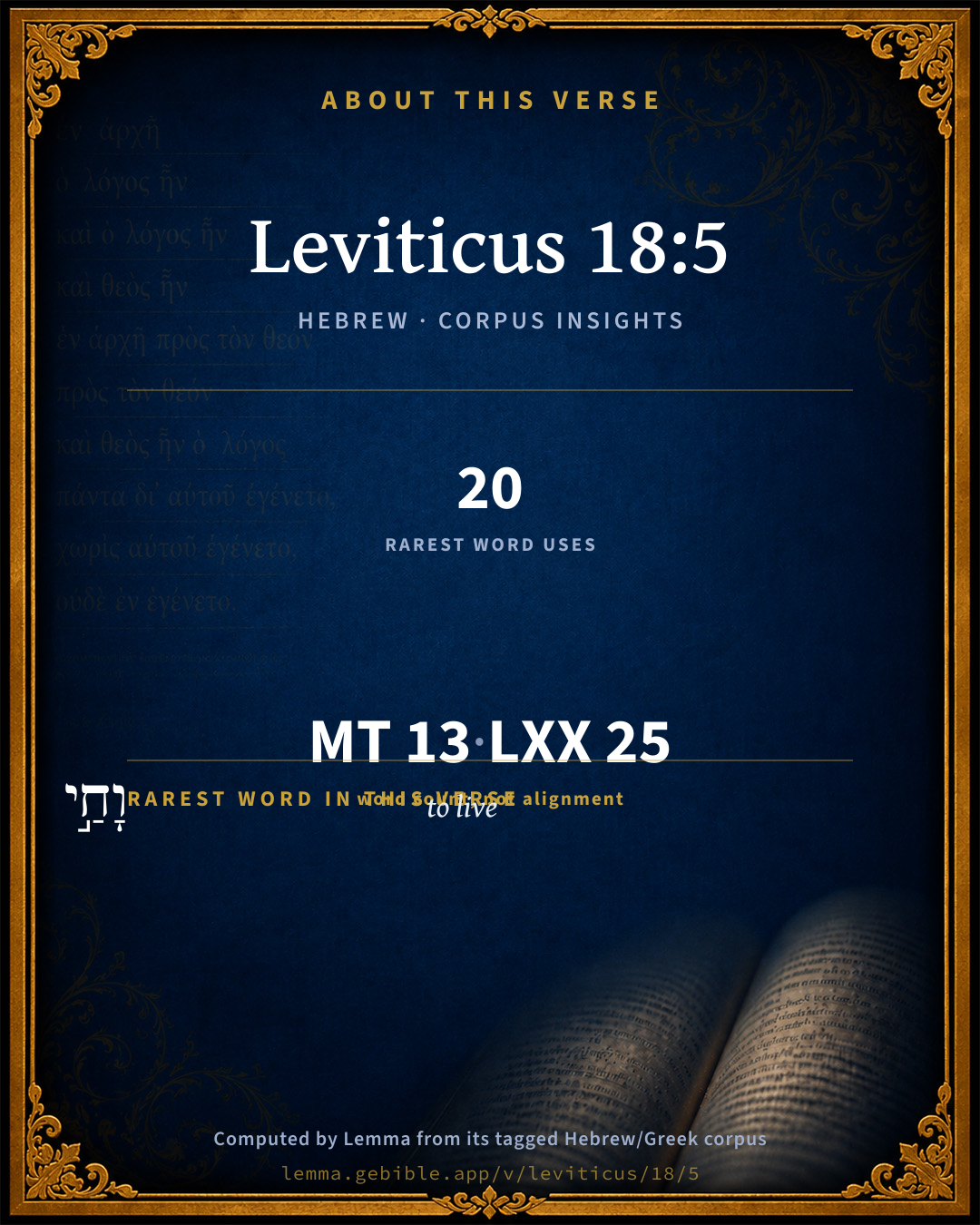
The rarest word here is וָחַ֣י to live H2425 — appearing just 20 times in the whole Hebrew Bible.

Shared distinctive vocabulary

וָחַ֣י to live H2425 occurs in 20 verses of the Hebrew Bible. Also found in:

Grammatical profile

  • 3 verbs
  • 4 nouns
  • 1 pronoun
  • 1 preposition
  • 4 particles

Verb forms

  • וּשְׁמַרְתֶּ֤ם Qal · Sequential Perfect
  • יַעֲשֶׂ֥ה Qal · Imperfect
  • וָחַ֣י Qal · Sequential Perfect

Hebrew & Septuagint length

In English translation the verse runs 22 words from the Hebrew and 30 from the Septuagint (LXX English) — closely comparable.

A rough comparison of the two English renderings, which tokenize alike — not a word-level alignment.

Word counts can differ between the Hebrew and the Greek without any difference in meaning — e.g. the Hebrew direct-object marker אֵת has no separate Greek word, and Greek often adds the article ὁ.

In the original languages it is 13 Hebrew tokens and 25 Greek tokens — but the two are counted differently (Hebrew bundles its prefixes and suffixes into one token; the Greek is in lemma form), so that isn’t a like-for-like length.

Cross-references

10

Topical passages linked to Leviticus 18:5 in the Treasury of Scripture Knowledge — connected by theme and wording, ordered by reader-vote popularity; previews shown in the World English Bible.

  • Galatians 3:12 The law is not of faith, but, "The man who does them will live by them."
  • Ezekiel 20:11 I gave them my statutes, and shown them my ordinances, which if a man do, he shall live in them.
  • Romans 10:5 For Moses writes about the righteousness of the law, "The one who does them will live by them."
  • Ezekiel 20:13 But the house of Israel rebelled against me in the wilderness: they didn't walk in my statutes, and they rejected my ordinances, which if a man keep, he shall live in them; and my Sabbaths they greatly profaned. Then I said I would pour out my wrath on them in the wilderness, to consume them.
  • Ezekiel 20:21 But the children rebelled against me; they didn't walk in my statutes, neither kept my ordinances to do them, which if a man do, he shall live in them; they profaned my Sabbaths. Then I said I would pour out my wrath on them, to accomplish my anger against them in the wilderness.
  • Luke 10:28 He said to him, "You have answered correctly. Do this, and you will live."
  • Exodus 6:2 God spoke to Moses, and said to him, "I am Yahweh;
  • Exodus 6:6 Therefore tell the children of Israel, 'I am Yahweh, and I will bring you out from under the burdens of the Egyptians, and I will rid you out of their bondage, and I will redeem you with an outstretched arm, and with great judgments:
  • Exodus 6:29 that Yahweh spoke to Moses, saying, "I am Yahweh. Speak to Pharaoh king of Egypt all that I speak to you."
  • Malachi 3:6 "For I, Yahweh, don't change; therefore you, sons of Jacob, are not consumed.

Cross-references courtesy of OpenBible.info (CC BY 4.0).

Hebrew and Greek witnesses Masoretic Hebrew ↔ Greek Septuagint

The same verse in the two great witnesses to the Old Testament, shown verse-for-verse.

These are two independent witnesses, not word-aligned to each other, and the Septuagint is shown in lemma (dictionary) form.

Hebrew Leviticus 18:5 Masoretic · Westminster Leningrad Codex

וּשְׁמַרְתֶּ֤ם אֶת חֻקֹּתַי֙ וְאֶת מִשְׁפָּטַ֔י אֲשֶׁ֨ר יַעֲשֶׂ֥ה אֹתָ֛ם הָאָדָ֖ם וָחַ֣י בָּהֶ֑ם אֲנִ֖י יְהוָֽה

You shall therefore keep my statutes and my ordinances; which if a man does, he shall live in them: I am Yahweh.

World English Bible · Public Domain

Greek LXX Leviticus 18:5 Septuagint · lemma form

καί φυλάσσω πᾶς ὁ πρόσταγμα ἐγώ καί πᾶς ὁ κρίμα ἐγώ καί ποιέω αὐτός ὅς ποιέω ἄνθρωπος ζάω ἐν αὐτός ἐγώ κύριος ὁ θεός σύ

So you⌃ shall keep all my ordinances, and all my judgments, and do them; which if a man do, he shall live in them: I am the Lord your God.

LXX2012 (modern English Septuagint) · Public Domain

Hebrew: Westminster Leningrad Codex (CC BY 4.0). Greek: Septuagint (public domain); English from LXX2012 (modern English Septuagint) (Public Domain). How the Septuagint differs from the Hebrew →

Targum (Aramaic paraphrase)

2

The Targum is the ancient Jewish Aramaic paraphrase of the Hebrew Scriptures — an interpretive translation, not the Hebrew text itself. Onkelos (literal) and Pseudo-Jonathan (expansive) render the Torah, and Jonathan the Prophets. Coverage is partial: where no permissively-licensed English translation exists for a verse, only the Aramaic is shown. This is verse-level text, not a word-by-word alignment to the Hebrew.

  1. Targum Onkelos Torah (Genesis–Deuteronomy)
    וְתִטְרוּן יָת קְיָמַי וְיָת דִינַי דִי יַעְבֵּד יָתְהוֹן אֲנָשָׁא וְיֵחֵי בְהוֹן לְחַיֵי עָלְמָא אֲנָא יְיָ

    (no public-domain English translation for this verse)

    Targum Onkelos — Aramaic: “Onkelos Genesis” (public domain); “Onkelos Exodus” (public domain); “Onkelos Leviticus” (public domain); “Onkelos Numbers” (public domain); “Onkelos Deuteronomy” (public domain). English: “Sefaria Community Translation” (CC0 1.0 (public-domain dedication)); “J.W. Etheridge. The Targums of Onkelos and Jonathan Ben Uzziel on the Pentateuch. London: Longmans, Green, 1862” (public domain). Text via Sefaria.

  2. Targum Pseudo-Jonathan Torah (Genesis–Deuteronomy)
    וְתִטְרוּן יַת קְיָמַי וְיַת סִדְרֵי דִינַי דְאִין יַעֲבֵיד יַתְהוֹן אֵינָשָׁא וְיֵיחֵי בְּהוֹן בְּחַיֵי עַלְמָא וְחוּלְקֵיהּ עִם צַדִיקַיָא אֲנָא יְיָ

    And you shall keep My statutes, and the order of My judgments, which if a man do he shall live in them, in the life of eternity, and his portion shall be with the just: I am the Lord.

    Targum Pseudo-Jonathan — Aramaic: “Targum Jonathan on Genesis” (public domain); “Targum Jonathan on Exodus” (public domain); “Targum Jonathan on Leviticus” (public domain); “Targum Jonathan on Numbers” (public domain); “Targum Jonathan on Deuteronomy” (public domain). English: “The Targum of Jonathan ben Uzziel, trans. J. W. Etheridge, London, 1862” (public domain). Text via Sefaria.

Commentary

Notes on Leviticus 18:5 from classic Christian and Jewish commentators (each source and its license shown beneath its notes). The classic Christian expositions comment on the surrounding passage and are grouped to its opening verse, so a note may address several verses; the Jewish commentaries on the Tanakh (Rashi and others) are per-verse, so they appear only where the commentator wrote on this verse.

Lemma curates 59 commentaries, every one of them public domain or Creative Commons licensed, each selected and text-cleaned for this edition rather than reprinted as found. About our sources →

Trapp's Complete Commentary

John Trapp

Lev 18:5 Ye shall therefore keep my statutes, and my judgments: which if a man do, he shall live in them: I [am] the LORD.

Ver. 5. He shall live in them.] As the flame lives in the oil, as the creature by his food, so the spiritual life is maintained by an evangelical keeping of God’s commandments. As on the contrary, every motion of the soul out of this way, tends to death; being as the motion of the fish out of his element.

John Trapp, A Commentary or Exposition upon All the Books of the Old and New Testament (1647–1656) — public domain. Text from a community e-Sword module.

Joseph Benson's Commentary

Lev 18:5. He shall live in them — Not only happily here, but eternally hereafter. This is added as a powerful argument why they should follow God’s commands rather than men’s examples, because their life and happiness depended upon it. And though in strictness, and according to the covenant of works, they could not challenge life for so doing, except their obedience was universal, perfect, constant, and perpetual, and therefore no man since the fall could be justified by the law; yet by the covenant of grace this life is promised to all that obey God’s commands sincerely. I am the Lord — Hebrew, I am Jehovah; that is, I am faithful to keep my covenant, and to fulfil my promises. See on Exo 6:3. I am the sovereign dispenser of life and death, and therefore they that keep my laws shall live.

Joseph Benson's Commentary on the Old and New Testaments (1811–1818) — public domain. Text from a community e-Sword module.

Geneva Bible (1599)

Geneva Bible translators

And therefore ye ought to serve me alone, as my people.

Geneva Bible (1599) marginal notes — public domain. Text via Bolls.life.

Jamieson, Fausset & Brown

Robert Jamieson, A. R. Fausset & David Brown

Ye shall therefore keep my statutes, and my judgments: which if a man do, he shall live in them--A special blessing was promised to the Israelites on condition of their obedience to the divine law; and this promise was remarkably verified at particular eras of their history, when pure and undefiled religion prevailed among them, in the public prosperity and domestic happiness enjoyed by them as a people. Obedience to the divine law always, indeed, ensures temporal advantages; and this, doubtless, was the primary meaning of the words, "which if a man do, he shall live in them." But that they had a higher reference to spiritual life is evident from the application made of them by our Lord (Luk 10:28) and the apostle (Rom 10:2).

Jamieson, Fausset & Brown — Commentary Critical and Explanatory on the Whole Bible (1871) — public domain (CC PDM 1.0). Text via the HelloAO Bible API.

Ellicott's Commentary for English Readers

(5) Ye shall therefore keep my statutes. Better, and ye shall keep my ordinances. The word here rendered by “statutes” is the same which the Authorised Version translates ordinances in Lev_18:3-4.

He shall live in them.—Better, he shall live by or through them; that is, by observing them the law abiding will live a happy and prosperous life, since disobedience will expose the offender to the penalty of death. The spiritual authorities in the time of the second Temple interpreted this clause to mean that he who obeys these laws shall have eternal life. Hence the ancient Chaldee Versions translate it, “Shall have life eternal.” This passage is quoted both in the Prophets (Eze_20:11; Eze_20:13; Eze_20:21; Neh_9:29) and by St. Paul (Rom_10:5; Gal_3:12), who contrasts this promise made to works with the promise of the Gospel made to faith.

A Bible Commentary for English Readers, edited by Charles John Ellicott (1878–1897) — public domain. Text from a community e-Sword module.

The Cambridge Bible for Schools and Colleges

gen. ed. J. J. S. Perowne

5. I am the Lord] For the significance of this often repeated expression, see pp. xlviii f.

The Cambridge Bible for Schools and Colleges (gen. ed. J. J. S. Perowne; Cambridge University Press, 1878–1918) — public domain. Text from a community e-Sword module.

John Gill's Exposition

Ye shall therefore keep my statutes, and my judgments,.... The same as before; these they were to keep in their minds and memories, and to observe them and do them:

which if a man do he shall live in them; live a long life in the land of Canaan, in great happiness and prosperity, see Deu 30:20; for as for eternal life, that was never intended to be had, nor was it possible it could be had and enjoyed by obedience to the law, which fallen man is unable to keep; but is what was graciously promised and provided the covenant of grace, before the world was, to come through Christ, as a free gift to all that believe in him, see Gal 3:11; though some Jewish writers interpret this of eternal life, as Jarchi, Aben Ezra, and Ben Gersom:

I am the Lord; that has enjoined these statutes and judgments, and promised life to the doers of them, able and faithful to perform what is promised.

John Gill's Exposition of the Whole Bible (1746–1763) — public domain (CC PDM 1.0). Text via the HelloAO Bible API.

Albert Barnes' Notes on the Bible

If a man keeps the “statutes” (i. e. the ordinances of Lev 18:4) and “judgments” of the divine law, he shall not be “cut off from his people” (compare Lev 18:29), he shall gain true life, the life which connects him with Yahweh through his obedience. See the margin reference and Luk 10:28; Rom 10:5; Gal 3:12.

Albert Barnes' Notes on the Bible (1834–1885) — public domain. Text from a community e-Sword/MySword module.

Haydock's Catholic Bible Commentary

Live in them, a long and happy life, (Chaldean) attended with grace and glory. (Lyranus) --- Jesus Christ and St. Paul explain it of eternal life. (Matthew xix. 17; Romans x. 5.) (Calmet)

George Leo Haydock (1774–1849), Haydock's Catholic Family Bible and Commentary, 1859 edition — public domain. Excludes Psalms (Douay-Rheims chapter numbering differs from Protestant) and Deuterocanonical books (Catholic canon only).

Matthew Poole's English Annotations

He shall live in them; not only happily here, but also eternally hereafter, as it is expounded Mat 19:17; Rom 10:5. This is added as a powerful argument why they should follow God’s commands rather than men’s examples, because their life and happiness depends upon the one, not the other. And though in strictness, and according to the law or covenant of works, they could not challenge life for doing, except their obedience was universal, perfect, constant, and perpetual, and therefore no man since the fall could be justified by the law, as the apostle affirms and proves, Ro 4; Ga 3; yet by the covenant of grace this life is promised to all that obey God’s commands sincerely, though not perfectly, 1Ti 4:8.

Matthew Poole's English Annotations on the Holy Bible (1683–1685) — public domain. Text from a community e-Sword/MySword module.

Whedon's Commentary on the Bible

Daniel D. Whedon

5. If a man do, he shall live — This important sentence contains the whole doctrine of justification by works. It is rendered more correctly and more emphatically in Eze_20:11; Eze_20:13; Eze_20:21, “he shall even live.” “The precepts of the law,” says Aquinas, “are not concerning things to be believed, but concerning things to be done.” Nevertheless, acceptable doing implies faith, while evangelical believing includes the subsequent doing of the will of God as the fruit of faith. As regards the life here promised, the Jewish interpreters themselves included in it more than mere earthly felicity in Canaan, (Deu_30:20,) and extended their view to a better life hereafter. The Palestine Targum renders it, “he shall live in them in the life of eternity;” that of Onkelos, “an everlasting life.” Says Tholuck, “Life seems to be a general promise, and length of days a particular species of felicity. In the New Testament this idea (of life) is always exalted into that of life blessed and eternal. See Mat_7:14; Mat_18:8-9; Luk_10:28.” Hence this is a plain intimation of the doctrine of a future life in the Pentateuch, which is denied by some superficial readers. St. Paul found “to be unto death” “the commandment which was ordained to life,” just as the murderer on the scaffold finds that the law against murder, designed to protect life, when transgressed, is “unto death.” The design and normal tendency of the law is life; but through man’s imperfection and disobedience the actual result is death. See Gal_3:21, note, and Joh_11:25, note.

In them — He shall live in the strength of, or by means of, these laws, in the faithful keeping of which is his fountain of life. But “he is a debtor to do the whole law.” Failure to do this renders “all the world guilty before God.”

Daniel D. Whedon (gen. ed.), Commentary on the Old and New Testaments (1874–1909) — public domain. Text from a community e-Sword module.

The Pulpit Commentary

Life in obedience.

The Apostle Paul, both in his letter to the Romans, (Rom_10:5) and in that to the Churches of Galatia, (Gal_3:12) brings this passage to prove that salvation under the Law was by obedience rather than by faith. We may approach the main thought of the text by two preliminary remarks on the relation of these two principles of life, showing the consistency of the Law and the gospel We maintain

I THAT, UNDER THE LAW, MERE CONFORMITY OF CONDUCT WITHOUT FAITH WAS UNACCEPTABLE TO GOD. it is a mistake to suppose that God"s requirements of his ancient people were satisfied with a purely mechanical obedience. They were not only to "walk in his ways," but they were also to "fear the Lord their God, and to love him and to serve him with all their heart and with all their soul. (Deu_10:12; see also Deu_6:5 Deu_11:13 Deu_30:16, Deu_30:20) They were not only to act righteously toward their neighbour, but to love him. (Lev_19:18) They were to "afflict their souls" on the Day of Atonement and Reconciliation. (Lev_16:29) There can be little doubt that it was the duty of the priests and Levites to instruct the Hebrew worshippers to present their sacrifice unto the Lord, believing and feeling that he was there to receive their offering and to accept their penitence and their faith.

II THAT, UNDER THE GOSPEL, A LIVING FAITH IS CONSTANTLY ASSOCIATED WITH ACTIVE OBEDIENCE. We are not saved by works, but by faith in Jesus Christ. (Rom_3:28 Rom_5:1 Eph_2:8, etc.) Yet the faith which saves is a "faith which worketh by love". (Gal_5:6 Jam_2:18, Jam_2:20, Jam_2:22, etc.)

But the primary truth which is taught in this passage is rather this

III THAT SPIRITUAL OBEDIENCE IS THE SECRET AND THE SOURCE OF TRUE HUMAN LIFE.

1. It is the secret of all real life. What is human life? In what does it actually consist? The life of the brute consists in the performance of its animal functions, in its outward, sensible existence. But the life of a man consists in something higher. We live when our souls live, when we live before God and unto him; if a man will do God"s will and keep his statutes and his judgments, he shall live in them; he will find his true life in the doing and the keeping of these; "this is life eternal, to know thee," etc. (Joh_17:3) To know God, to know him as he is revealed to us in Christ Jesus, to worship him, to rejoice in him, to love and to please him, to be gratefully and cheerfully obedient to his will in all things, this is human life; all else is immeasurably below it. There is nothing worth calling life apart from the holy and happy service of God; a spiritual not a servile obedience is the secret of life on earth.

2. It is also the source of the higher human life which is beyond. The Jew who kept God"s statutes not only found a true life in his obedience, but he also guided a true life through his obedience. God bestowed on him his Divine favour, conferred on him all those outward blessings which were then regarded as the highest token of the favour of the Eternal; he lived in the smile and the benediction of Jehovah. Our hope is brighter and more far-reaching than his. He had some glimmering of the blessedness beyond, but it was faint and feeble. We know that if our faith in a Divine Redeemer is manifested in a lasting spiritual obedience, we "shall live" a life of which the Jew had little thought, and of which we ourselves can only form some struggling anticipation. We know that if "we are faithful unto death," we shall have "a crown of life." The obedience of faith, continued to the end, will introduce us to the life which is

(1) one of celestial fullness;

(2) free from present care, sorrow, sin;

(3) everlasting. C.

The Pulpit Commentary (1880–1919), ed. H.D.M. Spence-Jones & Joseph S. Exell — public domain. Text from a community e-Sword module.

John Wesley's Explanatory Notes

He shall live in them - Not only happily here, but eternally hereafter. This is added as a powerful argument why they should follow God's commands, rather than mens examples, because their life and happiness depend upon it. And though in strictness, and according to the covenant of works they could not challenge life for so doing, except their obedience was universal, perfect, constant and perpetual, and therefore no man since the fall could be justified by the law, yet by the covenant of grace this life is promised to all that obey God's commands sincerely.

John Wesley, Explanatory Notes Upon the Whole Bible (1754–1765) — public domain. Text via the GEBible commentary corpus.

Rashi

Rabbi Shlomo Yitzchaki (Rashi)

'ושמרתם את חקתי וגו‎ YE SHALL THEREFORE KEEP MY ORDINANCES — [This is not a mere repetition of v. 4 but is intended] to include other details of the laws mentioned in this chapter which Scripture does not expressly mention. Another explanation is: Scripture makes this repetition in order to attach the commands of “observing" (שמירה) and "performing" (עשיה) to the חוקים, and the commands of שמירה and עשיה to the משפטים, for in v. 4 it uses the term עשיה only in connection with the משפטים, and that of שמירה only with reference to the חוקים (Sifra, Acharei Mot, Section 8 10).

וחי בהם means, THAT HE SHALL LIVE THROUGH THEM in the world to come (eternal life). For if you say it means that he shall live in this world, is it not a fact that in the end he must die! (Sifra, Acharei Mot, Section 8 10; cf. also Targ. Onkelos)

'אני ה‎ I AM THE LORD, Who am faithful to pay you your reward (Sifra, Acharei Mot, Section 8 10).

Rashi on the Tanakh — English translations: “The Judaica Press complete Tanach with Rashi, translated by A. J. Rosenberg” (CC BY 4.0); “Pentateuch with Rashi's commentary by M. Rosenbaum and A.M. Silbermann, 1929-1934” (public domain); “The Metsudah Tanach series, Lakewood, N.J” (CC BY 4.0); and “The Book of Joshua, Metsudah Publications, 1997” (CC BY 4.0). Text via Sefaria.

Lesson kit

Teaching starters — assembled from the data on this page, not authored interpretation. Every prompt links to the verse data it draws on. Edit before teaching.

Leviticus, in the Pentateuch, opens this verse with 13 words (10 distinct Hebrew lemmas). Its most distinctive word is châyay (“to live”). A historical commentator’s framing appears above. Read the whole chapter for the surrounding context.

Discussion questions

  1. What does “to live” (châyay) contribute to the verse as a whole?
  2. Genesis 3:22 shares the word «to live» with this verse. How do the two illuminate each other?
  3. The translations on this page render this verse differently — a whole-verse word diff, not a word-by-word alignment. What might account for the different wordings?
  4. The verb «וּשְׁמַרְתֶּ֤ם» is Qal Sequential Perfect. How does its form color the action?
  5. Reading how Trapp's Complete Commentary and Joseph Benson's Commentary read this verse, where do the two commentators agree and where do they part?

Things to notice

Reading settings

Reading text

Shown beneath each verse's original-language words.

Old Testament
Old Testament edition

Read the OT as the Masoretic Hebrew (MT) or the Greek Septuagint (LXX).

English shown for the Greek Septuagint (in the Hebrew ↔ Greek comparison).

Comparing translations? Open the Compare panel on any verse page to stack up to four side by side.