Leviticus 18:4

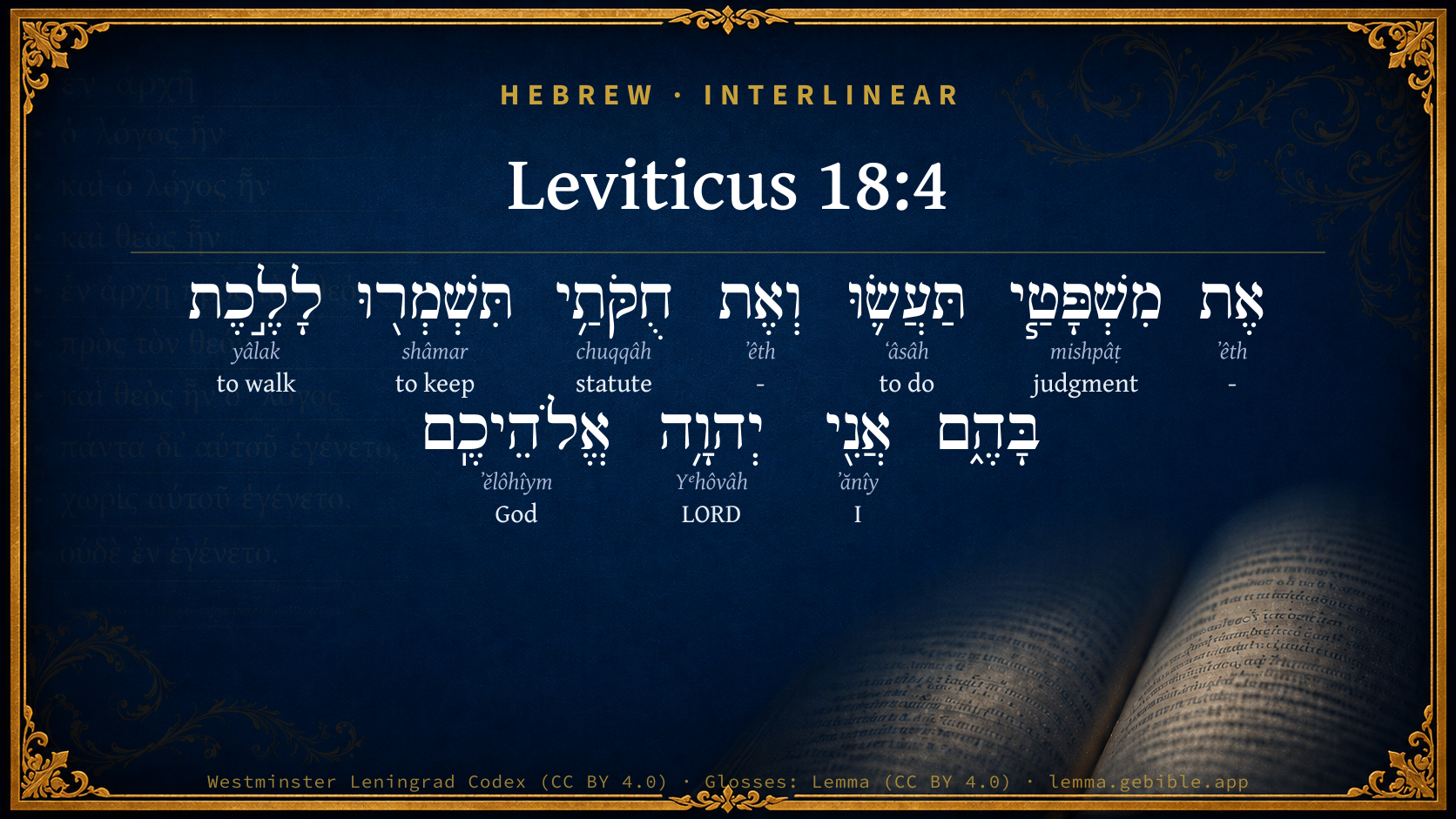
Hebrew (Westminster Leningrad Codex) Leviticus 18:4 appears in the Hebrew Old Testament. The text above is from the Westminster Leningrad Codex. Each word links to its Strong’s number, a concise gloss, and parsing drawn from the Open Scriptures Hebrew Bible morphology. Click any word for its full Brown-Driver-Briggs (BDB) entry.
Download image
Cite this verse

Leviticus 18:4 (World English Bible). Public Domain. Lemma interlinear Bible study tool, https://lemma.gebible.app/v/leviticus/18/4.

Show BibTeX & RIS
BibTeX
RIS
English Translation
You shall do my ordinances, and you shall keep my statutes, and walk in them: I am Yahweh your God.
World English Bible · Public Domain
Download a study sheet

One document with this verse’s original text, its word-by-word gloss line, the meaning frame, cross-references with their text, attributed commentary, and full source and license credits — printable, and it pastes into notes with its structure intact.

This verse Autodidact and up

Study sheet (.html) Plain text (.txt)

A passage Seminary Student

Up to 50 verses in one chapter. A passage sheet keeps up to 6 commentary sources and 12 cross-references per verse, in the order this page ranks them, and says so on the sheet whenever that leaves anything out. Ask for a single verse and you get the Autodidact verse sheet above.

Everything on this page stays free to read, with no account — the sheet is a download of what is already on screen, not access to it.

Want to remove ads? Support Godless Engineer
Compare translations 3

The same verse in 3 English versions, stacked beneath the original-language interlinear above. Click any original word for its lexicon entry.

Each is an independent rendering of the whole verse — the interlinear is not word-aligned to these translations.

Highlighted words mark where these versions differ — a whole-verse word diff, not a word-by-word alignment.

  • World English Bible Public Domain
    You shall do my ordinances, and you shall keep my statutes, and walk in them: I am Yahweh your God.
  • King James Version Public Domain
    Ye shall do my judgments, and keep mine ordinances, to walk therein: I am the LORD your God.
  • unfoldingWord Literal Text CC BY-SA 4.0
    My customs you shall do, and my statutes you shall keep, to walk in them. I Yahweh your God.

unfoldingWord Literal Text — © unfoldingWord, licensed CC BY-SA 4.0. Word-aligned USFM3 via Door43 (git.door43.org/unfoldingWord/en_ult).

Versions to compare (up to 4)

3 of 4 selected

Show all 18 translations

Every available English version of this verse, each an independent rendering of the whole verse.

  • World English Bible Public Domain
    You shall do my ordinances, and you shall keep my statutes, and walk in them: I am Yahweh your God.
  • Berean Standard Bible Public Domain
    You are to practice My judgments and keep My statutes by walking in them. I am the LORD your God.
  • Majority Standard Bible Public Domain
    You are to practice My judgments and keep My statutes by walking in them. I am the LORD your God.
  • King James Version Public Domain
    Ye shall do my judgments, and keep mine ordinances, to walk therein: I am the LORD your God.
  • American Standard Version (1901) Public Domain
    Mine ordinances shall ye do, and my statutes shall ye keep, to walk therein: I am Jehovah your God.
  • Revised Version (1885) Public Domain
    My judgments shall ye do, and my statutes shall ye keep, to walk therein: I am the LORD your God.
  • Geneva Bible (1599) Public Domain
    But do after my iudgements, and keepe mine ordinances, to walke therein: I am the Lord your God.
  • Douay-Rheims (1899) Public Domain
    You shall do my judgments, and shall observe my precepts, and shall walk in them. I am the Lord your God.
  • Young's Literal Translation Public Domain
    `My judgments ye do, and My statutes ye keep, to walk in them; I `am' Jehovah your God;
  • Literal Standard Version CC BY-SA 4.0
    You do My judgments and you keep My statutes, to walk in them; I [am] your God YHWH.
  • Unlocked Literal Bible CC BY-SA 4.0
    My laws are what you must do, and my commandments are what you must keep, so that you walk in them, because I am Yahweh your God.
  • unfoldingWord Literal Text CC BY-SA 4.0
    My customs you shall do, and my statutes you shall keep, to walk in them. I Yahweh your God.
  • Darby Bible Public Domain
    Mine ordinances shall ye do and my statutes shall ye observe to walk therein: I am Jehovah your God.
  • World Messianic Bible Public Domain
    You shall do my ordinances. You shall keep my statutes and walk in them. I am the LORD your God.
  • Webster's Bible Public Domain
    Ye shall perform my judgments, and keep my ordinances, to walk in them; I am the LORD your God.
  • Free Bible Version CC BY-SA 4.0
    Do what I tell you and keep my rules. I am the Lord your God.
  • Bible in Basic English Public Domain
    But you are to be guided by my decisions and keep my rules, and be guided by them: I am the Lord your God.
  • JPS Tanakh (1917) Public Domain
    Mine ordinances shall ye do, and My statutes shall ye keep, to walk therein: I am the LORD your God.

Literal Standard Version (2020), Covenant Press — licensed CC BY-SA 4.0. Text via the HelloAO Bible API (eBible.org). Unlocked Literal Bible (unfoldingWord) — licensed CC BY-SA 4.0. Text via the HelloAO Bible API (eBible.org). unfoldingWord Literal Text — © unfoldingWord, licensed CC BY-SA 4.0. Word-aligned USFM3 via Door43 (git.door43.org/unfoldingWord/en_ult). Free Bible Version, Dr. Jonathan Gallagher — licensed CC BY-SA 4.0. Text via the HelloAO Bible API (eBible.org).

Word by word

More ways to search: Search by grammar → Find every occurrence → Compare this word →

Practice this passage: Drill this verse → Learn its vocabulary →

חֻקֹּתַ֥י
chuqqâh
H2708
“statutes · my”
Noun, Common, Both, Plural, Construct + Suffix, Personal, 1st Person, Common, Singular
Part of Speech
Noun
Type
Common
Gender
Both
Number
Plural
State
Construct
Full BDB Definition

Origin: from H2706

TWOT: 728b

statute, ordinance, limit, enactment, something prescribed - statute
  1. אֶת ʼêth H853 “-” Particle, Direct Object
  2. מִשְׁפָּטַ֧י mishpâṭ H4941 “judgments · my” Noun, Common, Masculine, Plural, Construct + Suffix, Personal, 1st Person, Common, Singular
  3. תַּעֲשׂ֛וּ ʻâsâh H6213 “to do” Verb, Qal, Imperfect, 2nd Person, Masculine, Plural
  4. וְאֶת ʼêth H853 “and · -” Conjunction + Particle, Direct Object
  5. תִּשְׁמְר֖וּ shâmar H8104 “to keep” Verb, Qal, Imperfect, 2nd Person, Masculine, Plural
  6. לָלֶ֣כֶת yâlak H3212 “to walk” Preposition + Verb, Qal, Infinitive Construct
  7. אֲנִ֖י ʼănîy H589 “I” Pronoun, Personal, 1st Person, Common, Singular
  8. יְהוָ֥ה Yᵉhôvâh H3068 “LORD” Noun, Proper
  9. אֱלֹהֵיכֶֽם ʼĕlôhîym H430 “God(s) · your” Noun, Common, Masculine, Plural, Construct + Suffix, Personal, 2nd Person, Masculine, Plural

About this verse

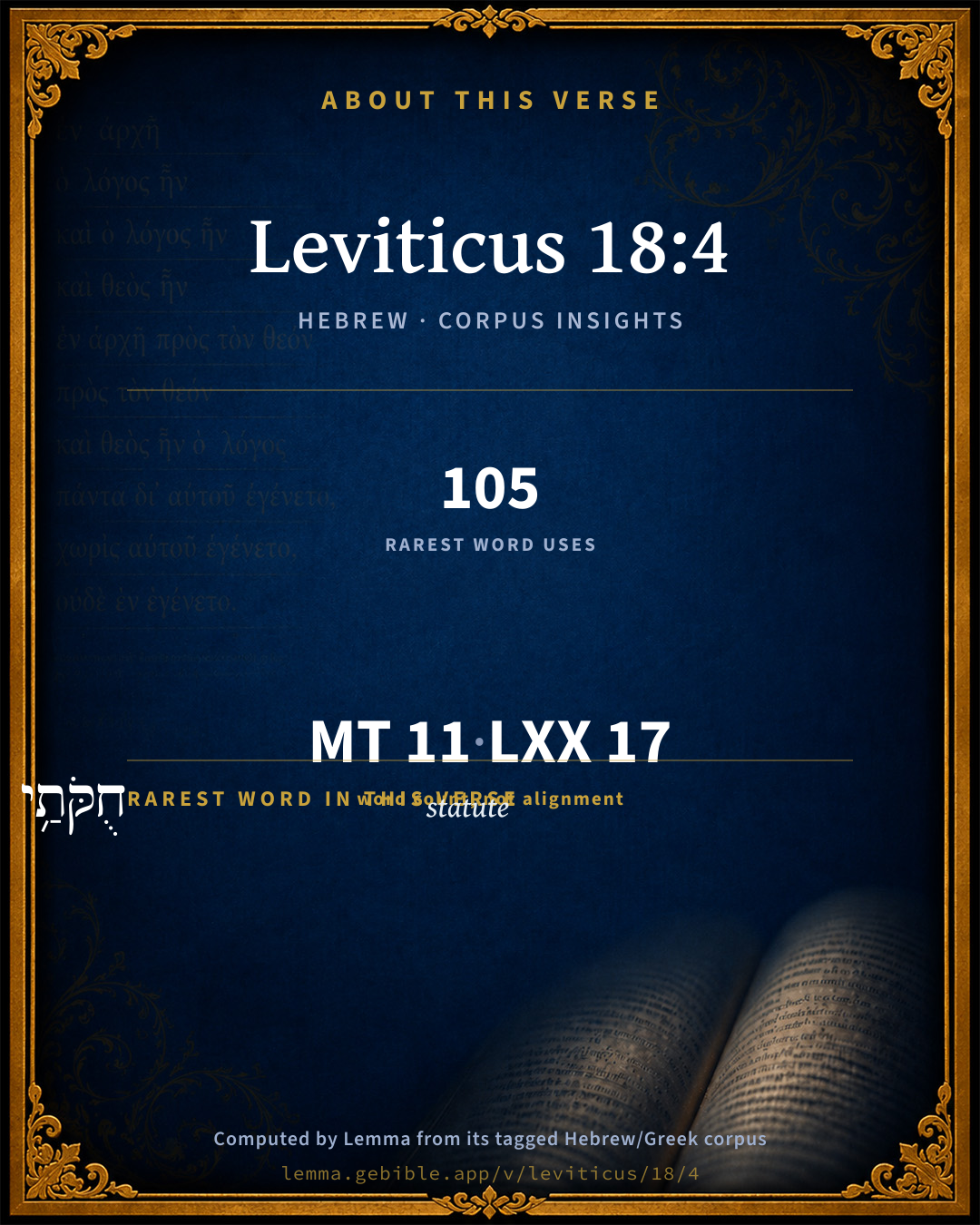
These counts appear in no published source. They are computed here, from the morphology-tagged text and Lemma’s own curated glosses. What Lemma adds →

11
words
9
distinct lemmas
Pentateuch
section

Grammatical profile

  • 3 verbs
  • 4 nouns
  • 1 pronoun
  • 1 preposition
  • 2 particles

Verb forms

  • תַּעֲשׂ֛וּ Qal · Imperfect
  • תִּשְׁמְר֖וּ Qal · Imperfect
  • לָלֶ֣כֶת Qal · Infinitive Construct

Hebrew & Septuagint length

In English translation the verse runs 20 words from the Hebrew and 21 from the Septuagint (LXX English) — closely comparable.

A rough comparison of the two English renderings, which tokenize alike — not a word-level alignment.

Word counts can differ between the Hebrew and the Greek without any difference in meaning — e.g. the Hebrew direct-object marker אֵת has no separate Greek word, and Greek often adds the article ὁ.

In the original languages it is 11 Hebrew tokens and 17 Greek tokens — but the two are counted differently (Hebrew bundles its prefixes and suffixes into one token; the Greek is in lemma form), so that isn’t a like-for-like length.

Cross-references

13

Topical passages linked to Leviticus 18:4 in the Treasury of Scripture Knowledge — connected by theme and wording, ordered by reader-vote popularity; previews shown in the World English Bible.

  • Leviticus 18:2 "Speak to the children of Israel, and say to them, 'I am Yahweh your God.
  • Leviticus 18:26 You therefore shall keep my statutes and my ordinances, and shall not do any of these abominations; neither the native-born, nor the stranger who lives as a foreigner among you;
  • Leviticus 19:37 You shall observe all my statutes, and all my ordinances, and do them. I am Yahweh.'"
  • Leviticus 20:22 "'You shall therefore keep all my statutes, and all my ordinances, and do them; that the land, where I am bringing you to dwell, may not vomit you out.
  • Deuteronomy 6:1 Now this is the commandment, the statutes, and the ordinances, which Yahweh your God commanded to teach you, that you might do them in the land where you go over to possess it;
  • Psalms 119:4 You have commanded your precepts, That we should fully obey them.
  • Ezekiel 20:19 I am Yahweh your God: walk in my statutes, and keep my ordinances, and do them;
  • Ezekiel 36:27 I will put my Spirit within you, and cause you to walk in my statutes, and you shall keep my ordinances, and do them.
  • John 15:14 You are my friends, if you do whatever I command you.
  • Deuteronomy 4:1–2 Now, Israel, listen to the statutes and to the ordinances, which I teach you, to do them; that you may live, and go in and possess the land which Yahweh, the God of your fathers, gives you.
  • Psalms 105:45 That they might keep his statutes, And observe his laws. Praise Yah!
  • Ezekiel 37:24 My servant David shall be king over them; and they all shall have one shepherd: they shall also walk in my ordinances, and observe my statutes, and do them.
  • Luke 1:6 They were both righteous before God, walking blamelessly in all the commandments and ordinances of the Lord.

Cross-references courtesy of OpenBible.info (CC BY 4.0).

Hebrew and Greek witnesses Masoretic Hebrew ↔ Greek Septuagint

The same verse in the two great witnesses to the Old Testament, shown verse-for-verse.

These are two independent witnesses, not word-aligned to each other, and the Septuagint is shown in lemma (dictionary) form.

Hebrew Leviticus 18:4 Masoretic · Westminster Leningrad Codex

אֶת מִשְׁפָּטַ֧י תַּעֲשׂ֛וּ וְאֶת חֻקֹּתַ֥י תִּשְׁמְר֖וּ לָלֶ֣כֶת בָּהֶ֑ם אֲנִ֖י יְהוָ֥ה אֱלֹהֵיכֶֽם

You shall do my ordinances, and you shall keep my statutes, and walk in them: I am Yahweh your God.

World English Bible · Public Domain

Greek LXX Leviticus 18:4 Septuagint · lemma form

ὁ κρίμα ἐγώ ποιέω καί ὁ πρόσταγμα ἐγώ φυλάσσω πορεύομαι ἐν αὐτός ἐγώ κύριος ὁ θεός σύ

You⌃ shall observe my judgments, and shall keep my ordinances, and shall walk in them: I am the Lord your God.

LXX2012 (modern English Septuagint) · Public Domain

Hebrew: Westminster Leningrad Codex (CC BY 4.0). Greek: Septuagint (public domain); English from LXX2012 (modern English Septuagint) (Public Domain). How the Septuagint differs from the Hebrew →

Targum (Aramaic paraphrase)

2

The Targum is the ancient Jewish Aramaic paraphrase of the Hebrew Scriptures — an interpretive translation, not the Hebrew text itself. Onkelos (literal) and Pseudo-Jonathan (expansive) render the Torah, and Jonathan the Prophets. Coverage is partial: where no permissively-licensed English translation exists for a verse, only the Aramaic is shown. This is verse-level text, not a word-by-word alignment to the Hebrew.

  1. Targum Onkelos Torah (Genesis–Deuteronomy)
    יָת דִינַי תַּעְבְּדוּן וְיָת קְיָמַי תִּטְרוּן לְהַלָכָא בְּהוֹן אֲנָא יְיָ אֱלָהָכוֹן

    (no public-domain English translation for this verse)

    Targum Onkelos — Aramaic: “Onkelos Genesis” (public domain); “Onkelos Exodus” (public domain); “Onkelos Leviticus” (public domain); “Onkelos Numbers” (public domain); “Onkelos Deuteronomy” (public domain). English: “Sefaria Community Translation” (CC0 1.0 (public-domain dedication)); “J.W. Etheridge. The Targums of Onkelos and Jonathan Ben Uzziel on the Pentateuch. London: Longmans, Green, 1862” (public domain). Text via Sefaria.

  2. Targum Pseudo-Jonathan Torah (Genesis–Deuteronomy)
    יַת סִדְרֵי דִינַי תַעַבְדוּן וְיַת קְיָימַי תִיטְרוּן לְהַלָכָא בְּהוֹן אֲנָא יְיָ אֱלָהָכוֹן

    but you shall perform the orders of My judgments, and observe My statutes to walk in them: I am the Lord your God.

    Targum Pseudo-Jonathan — Aramaic: “Targum Jonathan on Genesis” (public domain); “Targum Jonathan on Exodus” (public domain); “Targum Jonathan on Leviticus” (public domain); “Targum Jonathan on Numbers” (public domain); “Targum Jonathan on Deuteronomy” (public domain). English: “The Targum of Jonathan ben Uzziel, trans. J. W. Etheridge, London, 1862” (public domain). Text via Sefaria.

Commentary

Notes on Leviticus 18:4 from classic Christian and Jewish commentators (each source and its license shown beneath its notes). The classic Christian expositions comment on the surrounding passage and are grouped to its opening verse, so a note may address several verses; the Jewish commentaries on the Tanakh (Rashi and others) are per-verse, so they appear only where the commentator wrote on this verse.

Lemma curates 59 commentaries, every one of them public domain or Creative Commons licensed, each selected and text-cleaned for this edition rather than reprinted as found. About our sources →

Trapp's Complete Commentary

John Trapp

Lev 18:4 Ye shall do my judgments, and keep mine ordinances, to walk therein: I [am] the LORD your God.

Ver. 4. To walk therein.] Not to halt therein, nor to take a turn or two, or for a while, as Samson went with his parents till he met with a honeycomb; but indesinenter ambulabo, as David saith, {Psa 116:9} "Walk, and not be weary; run, and not faint," as those in Isa 40:31. "So run, that ye may obtain," saith the apostle. {1Co 9:24}

John Trapp, A Commentary or Exposition upon All the Books of the Old and New Testament (1647–1656) — public domain. Text from a community e-Sword module.

Joseph Benson's Commentary

Lev 18:4. My judgments — Though you do not see the particular reason of some of them, and though they be contrary to the laws and usages of the other nations.

Joseph Benson's Commentary on the Old and New Testaments (1811–1818) — public domain. Text from a community e-Sword module.

Tyndale Open Study Notes

Tyndale Open Resources

18:4-5 regulations . . . decrees: The Bible anticipated that the courts would need to interpret the laws that God had provided to apply them to different circumstances. Such interpretations became case laws; the body of these court decisions was called mishpatim in Hebrew (cp. “decrees” in 10:11). • Paul alludes to these verses in Rom 10:5 and Gal 3:12, where he contrasts the “way of faith” with the “way of law.”

Tyndale Open Study Notes — © Tyndale Open Resources, licensed CC BY-SA 4.0. Text via the HelloAO Bible API.

Ellicott's Commentary for English Readers

(4) Ye shall do my judgments.—The expression “my judgments and mine ordinances” is here used emphatically, in opposition to “their ordinances,” and has here the force of Mine only; just as the phrase “Him shalt thou serve” (Deu_6:13) is explained by Christ “Him only shalt thou serve” (Mat_4:10).

A Bible Commentary for English Readers, edited by Charles John Ellicott (1878–1897) — public domain. Text from a community e-Sword module.

John Gill's Exposition

Ye shall do my judgments,.... Which are just and right, and according to the rules of justice and equity; these are things, as Jarchi observes, which are said in the law with judgment, or are laws framed with the highest reason, even by the judgment of God himself, whose judgment is always according to truth: Aben Ezra thinks, these are the judicial laws in Exo 21:1; but though they may include them, they have more particular respect to the following laws:

and keep mine ordinances, to walk therein: which he had ordained and appointed of his own will and pleasure, which Jarchi calls the decree of the king, or which he decreed and determined as a king, having absolute power over his subjects to enact and enjoin what he pleased; wherefore some think these refer to ceremonial laws, which depended upon the will of the lawgiver, and were not founded in any natural sense or reason, wherefore it follows:

I am the Lord your God: who had a right to make what laws he pleased, being their Sovereign, and which they in gratitude as well as in justice ought to obey, he being their God, their covenant God, who had done great and good things for them.

John Gill's Exposition of the Whole Bible (1746–1763) — public domain (CC PDM 1.0). Text via the HelloAO Bible API.

Matthew Poole's English Annotations

My judgments and mine ordinances; mine universally, Deu 27:26; Gal 3:10; for though the words be indefinite, the matter is necessary; and mine solely, Deu 6:13, compared with Mat 4:10, and therefore those that here follow, though you do not see the particular reason of some of them, and though they be contrary to the laws and usages of the nations.

Matthew Poole's English Annotations on the Holy Bible (1683–1685) — public domain. Text from a community e-Sword/MySword module.

Whedon's Commentary on the Bible

Daniel D. Whedon

4. Judgments — Judicial utterances or legal precepts.

Daniel D. Whedon (gen. ed.), Commentary on the Old and New Testaments (1874–1909) — public domain. Text from a community e-Sword module.

John Wesley's Explanatory Notes

My judgments - Though you do not see the particular reason of some of them, and though they be contrary to the laws and usages of the other nations.

John Wesley, Explanatory Notes Upon the Whole Bible (1754–1765) — public domain. Text via the GEBible commentary corpus.

unfoldingWord translationNotes

Door43 World Missions Community

My laws are what you must do, and my commandments are what you must keep

These two phrases mean basically the same thing and emphasize that the people must obey everything that Yahweh has commanded them to do. You can translate this parallelism into one statement that conveys the requirement to keep all of Yahweh's commands. AT: "You must obey all of my laws and commandments" (See: Parallelism)

so that you walk in them

Obeying Yahweh's commandments is spoken of as if the commandments were a path on which the person walks. AT: "so that you conduct your behavior according to them" (See: Metaphor)

translationWords

law

command

walk

decree

obey

unfoldingWord translationNotes — © Distant Shores Media and the Door43 World Missions Community, licensed CC BY-SA 4.0. Source: git.door43.org/Door43/en_tn.

Rashi

Rabbi Shlomo Yitzchaki (Rashi)

את משפטי תעשו YE SHALL DO MY JUDGMENTS — Matters prescribed in the Torah which are in conformity with the human feeling of justice such as one feels ought to be ordained if they had not been already ordained by the Torah.

ואת חקתי תשמרו AND KEEP MINE ORDINANCES — matters which are decrees of the King (promulgated without any reason being stated) against which the evil inclination raises objections: "Why should we observe them and against which also the nations of the world raise objections, as e. g., the prohibition of eating swine’s flesh, of wearing clothes of a mixture of wool and linen, the purgatory power of "water mingled with the ashes of the Red Heifer" (טהרת מי חטאת) — therefore it is stated: "I", the Lord, have enacted this for you — you are not at liberty to evade the obligation (Yoma 67b).

ללכת בהם TO WALK IN THEM — do not free yourselves from their environment, i.e. that you must not say, I have acquired Jewish wisdom, now I will go and acquire the wisdom of the other peoples of the world in order to walk in their ways.

Rashi on the Tanakh — English translations: “The Judaica Press complete Tanach with Rashi, translated by A. J. Rosenberg” (CC BY 4.0); “Pentateuch with Rashi's commentary by M. Rosenbaum and A.M. Silbermann, 1929-1934” (public domain); “The Metsudah Tanach series, Lakewood, N.J” (CC BY 4.0); and “The Book of Joshua, Metsudah Publications, 1997” (CC BY 4.0). Text via Sefaria.

Ramban (Nachmanides)

Rabbi Moshe ben Nachman (Ramban / Nachmanides)

MINE ORDINANCES SHALL YE DO. “These are matters prescribed in the Torah which, even if they were not prescribed, one would know that they ought to be prescribed.” Thus the language of Rashi. And in the Torath Kohanim it is stated: 13:10. “These are matters written in the Torah which, even if they were not written, would deserve to have been written, such as robberies, forbidden sexual relationships, idolatry, bloodshed and blasphemy.”Now by way of the simple meaning of Scripture, the term mishpatai (Mine ordinances) is to be understood in its simple sense. It is a reference to the laws stated in the section of V’eileh Hamishpatim (And these are the ordinances) and in the whole Torah. Therefore He states here, which if a man do, he shall live by them, as these laws were given so that man should live, and for the development of countries, and peace among men, so that no one should cause harm to his fellowman or kill him. The prophet Ezekiel likewise mentioned many times with reference to these mishpatim (ordinances), which if a man do, he shall live by them, while of the Sabbath he says, to be a sign between Me and them., Verse 12. Similarly in the Book of Nehemiah it says, Thine ordinances, which if a man do, he shall live by them. But our Rabbis have said: “He shall live by them — but not die by them. This teaches that danger to life overrides the Sabbath laws and [all] the commandments.” And according to the Midrashic interpretation it means: 9:10. It is also mentioned here in Rashi. “He shall live by them — in the World to Come. Should you say it means that he shall live in this world, will he not in the end die!” must refer to eternal life. And if so, the expression which if a man do, he shall live by them refers back [not only to the mishpatim (ordinances), as we explained before, but] also to chukothai [“My statutes,” those laws for which no reason is given, but the observance of which also assures one eternal life].Know that man’s [reward in] life for the observance of the commandments is in accordance with his preparation for them. For he who fulfills the commandments not for their own sake, but in order to receive a reward, will be rewarded on account of them in this world with longevity, riches, possessions, and honor. It is concerning this [kind of observance of the laws of the Torah] that it is said, in her left hand are riches and honor, which the Rabbis interpreted to mean: “to those that stand on the left of it [i.e., to those who engage in the observance of the Torah not for its own sake], there are material riches and honor.” Similarly, those who engage in the observance of the commandments so as to merit by them reward in the World to Come, these being the people who serve G-d out of fear [of punishment], will be found worthy on account of their intention to be saved from the judgments that will come upon the wicked, and their souls shall abide in joyfulness [in life eternal]. But those who engage in the observance of the commandments out of love, as is right and proper, together with worldly occupation, similar to what is mentioned in the Torah in the section of Im Bechukothai,. Further, 26:3. And your threshing shall reach unto the vintage, Verse 5. they will merit good life in this world according to the usual nature of things, and in life eternal, in the World to Come, their merits will still be complete before them [since the reward they received in their lifetime will not reduce that which is to come to them in the hereafter]. But those who abandon altogether the concerns of this world and pay no attention to it, acting as if they themselves were not creatures of physical being, and all their thoughts and intentions are directed only to their Creator, just as was the case with Elijah, [these people] on account of their soul cleaving to the Glorious Name will live forever in body and soul, as is evidenced in Scripture concerning Elijah. and as is known of him in tradition, and as the Midrashim speak of Enoch. Many Midrashim describe his activity after his ascencion into heaven. See, however, Rashi ibid. and of those belonging to the World to Come who will rise at the resurrection. It is for this reason that on the subject of reward for observance of the commandments the verses speak [in various ways, such as]: that thy days may be long; that thou mayest live; and that thou mayest prolong thy days., 22:7. For these expressions include all kinds of life, each according to his due.

Ramban (Nachmanides) on the Tanakh — English translation: “Commentary on the Torah by Ramban (Nachmanides). Translated and annotated by Charles B. Chavel. New York, Shilo Pub. House, 1971-1976” (CC BY 4.0). Text via Sefaria.

Lesson kit

Teaching starters — assembled from the data on this page, not authored interpretation. Every prompt links to the verse data it draws on. Edit before teaching.

Leviticus, in the Pentateuch, opens this verse with 11 words (9 distinct Hebrew lemmas). Its most distinctive word is chuqqâh (“statute”). A historical commentator’s framing appears above. Read the whole chapter for the surrounding context.

Discussion questions

  1. What does “statute” (chuqqâh) contribute to the verse as a whole?
  2. How does Leviticus 18:2, which shares this passage’s theme, read alongside this verse?
  3. These translations render this verse differently; the difference is in the English rendering, not the original. What questions does that raise?
  4. «תַּעֲשׂ֛וּ» is a Qal Imperfect verb. How does that grammatical form shape the action described?
  5. Compare how Trapp's Complete Commentary and Joseph Benson's Commentary read this verse. Where do they agree or differ?

Things to notice

Reading settings

Reading text

Shown beneath each verse's original-language words.

Old Testament
Old Testament edition

Read the OT as the Masoretic Hebrew (MT) or the Greek Septuagint (LXX).

English shown for the Greek Septuagint (in the Hebrew ↔ Greek comparison).

Comparing translations? Open the Compare panel on any verse page to stack up to four side by side.