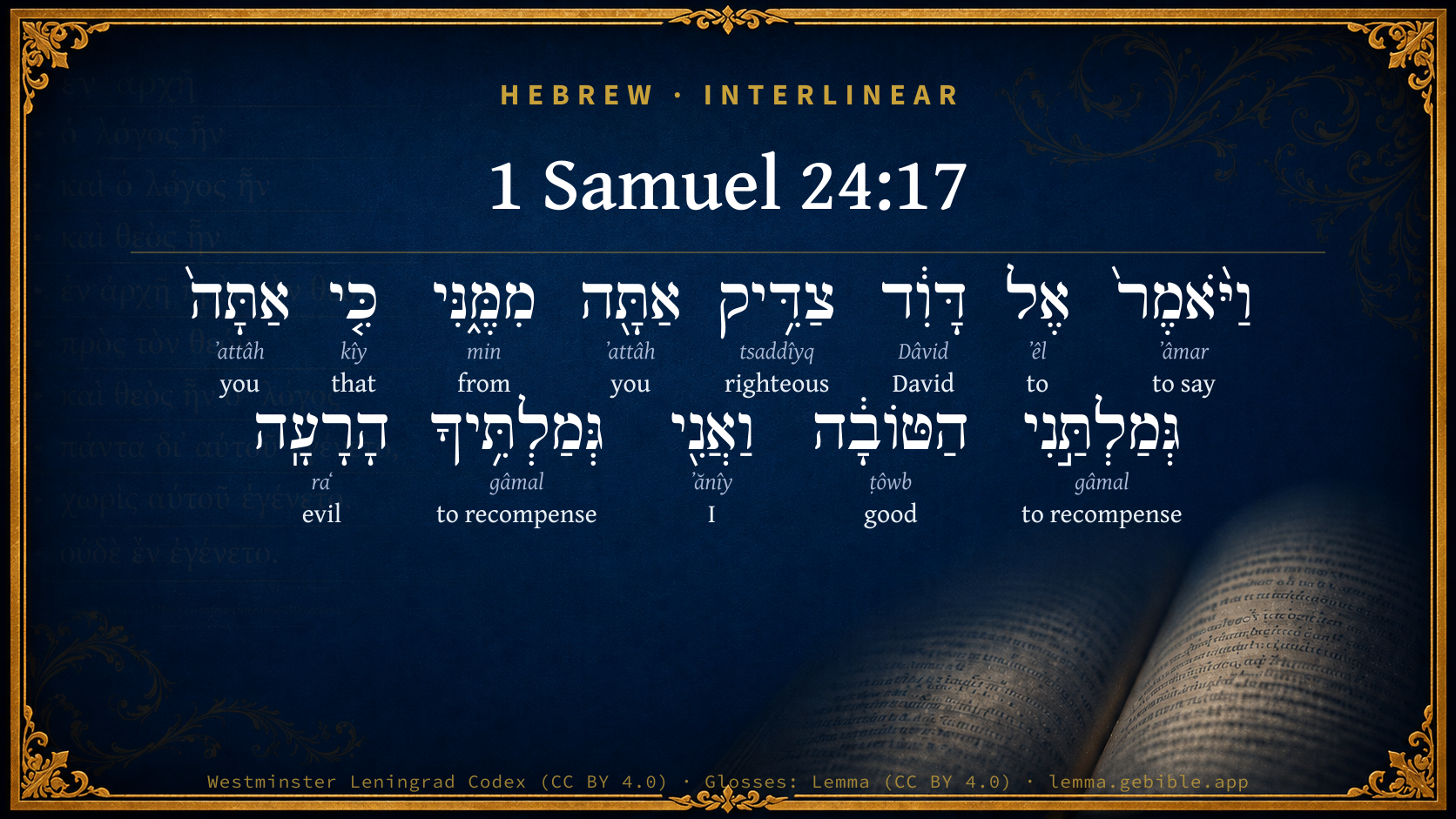
1 Samuel 24:17

Hebrew (Westminster Leningrad Codex) 1 Samuel 24:17 appears in the Hebrew Old Testament. The text above is from the Westminster Leningrad Codex. Each word links to its Strong’s number, a concise gloss, and parsing drawn from the Open Scriptures Hebrew Bible morphology. Click any word for its full Brown-Driver-Briggs (BDB) entry.
Download image
Cite this verse

1 Samuel 24:17 (World English Bible). Public Domain. Lemma interlinear Bible study tool, https://lemma.gebible.app/v/1-samuel/24/17.

Show BibTeX & RIS
BibTeX
RIS
English Translation
He said to David, You are more righteous than I; for you have rendered to me good, whereas I have rendered to you evil.
World English Bible · Public Domain
Download a study sheet

One document with this verse’s original text, its word-by-word gloss line, the meaning frame, cross-references with their text, attributed commentary, and full source and license credits — printable, and it pastes into notes with its structure intact.

This verse Autodidact and up

Study sheet (.html) Plain text (.txt)

A passage Seminary Student

Up to 50 verses in one chapter. A passage sheet keeps up to 6 commentary sources and 12 cross-references per verse, in the order this page ranks them, and says so on the sheet whenever that leaves anything out. Ask for a single verse and you get the Autodidact verse sheet above.

Everything on this page stays free to read, with no account — the sheet is a download of what is already on screen, not access to it.

Want to remove ads? Support Godless Engineer
Compare translations 3

The same verse in 3 English versions, stacked beneath the original-language interlinear above. Click any original word for its lexicon entry.

Each is an independent rendering of the whole verse — the interlinear is not word-aligned to these translations.

Highlighted words mark where these versions differ — a whole-verse word diff, not a word-by-word alignment.

  • World English Bible Public Domain
    He said to David, You are more righteous than I; for you have rendered to me good, whereas I have rendered to you evil.
  • King James Version Public Domain
    And he said to David, Thou art more righteous than I: for thou hast rewarded me good, whereas I have rewarded thee evil.
  • unfoldingWord Literal Text CC BY-SA 4.0
    And he said to David, “You more righteous than I. For you did good to me, but I did evil to you.

unfoldingWord Literal Text — © unfoldingWord, licensed CC BY-SA 4.0. Word-aligned USFM3 via Door43 (git.door43.org/unfoldingWord/en_ult).

Versions to compare (up to 4)

3 of 4 selected

Show all 18 translations

Every available English version of this verse, each an independent rendering of the whole verse.

  • World English Bible Public Domain
    He said to David, You are more righteous than I; for you have rendered to me good, whereas I have rendered to you evil.
  • Berean Standard Bible Public Domain
    and said to David, “You are more righteous than I, for you have rewarded me with good, though I have rewarded you with evil.
  • Majority Standard Bible Public Domain
    and said to David, “You are more righteous than I, for you have rewarded me with good, though I have rewarded you with evil.
  • King James Version Public Domain
    And he said to David, Thou art more righteous than I: for thou hast rewarded me good, whereas I have rewarded thee evil.
  • American Standard Version (1901) Public Domain
    And he said to David, Thou art more righteous than I; for thou hast rendered unto me good, whereas I have rendered unto thee evil.
  • Revised Version (1885) Public Domain
    And he said to David, Thou art more righteous than I: for thou hast rendered unto me good, whereas I have rendered unto thee evil.
  • Geneva Bible (1599) Public Domain
    Whe Dauid had made an end of speaking these words to Saul, Saul sayd, Is this thy voyce, my sonne Dauid? and Saul lift vp his voice, and wept,
  • Douay-Rheims (1899) Public Domain
    And when David had made an end of speaking these words to Saul, Saul said: Is this thy voice, my son David? And Saul lifted up his voice, and wept.
  • Young's Literal Translation Public Domain
    And he saith unto David, `More righteous thou `art' than I; for thou hast done me good, and I have done thee evil;
  • Literal Standard Version CC BY-SA 4.0
    And he says to David, “You [are] more righteous than I; for you have done me good, and I have done you evil;
  • Unlocked Literal Bible CC BY-SA 4.0
    He said to David, “You are more righteous than I am. For you have repaid me good, where I have repaid you evil.
  • unfoldingWord Literal Text CC BY-SA 4.0
    And he said to David, “You more righteous than I. For you did good to me, but I did evil to you.
  • Darby Bible Public Domain
    And he said to David, Thou art more righteous than I; for thou hast rewarded me good, whereas I have rewarded thee evil.
  • World Messianic Bible Public Domain
    He said to David, “You are more righteous than I; for you have done good to me, whereas I have done evil to you.
  • Webster's Bible Public Domain
    \\24:16\\And it came to pass when David had made an end of speaking these words to Saul, that Saul said, Is this thy voice, my son David? And Saul lifted up his voice, and wept.
  • Free Bible Version CC BY-SA 4.0
    He told David, “You are a better person than I am, because you have repaid me with good, but I have repaid you with evil.
  • Bible in Basic English Public Domain
    Now when David had said these words to Saul, Saul said, Is this your voice, David, my son? And Saul was overcome with weeping.
  • JPS Tanakh (1917) Public Domain
    (24-18) And he said to David: 'Thou art more righteous than I; for thou hast rendered unto me good, whereas I have rendered unto thee evil.

Literal Standard Version (2020), Covenant Press — licensed CC BY-SA 4.0. Text via the HelloAO Bible API (eBible.org). Unlocked Literal Bible (unfoldingWord) — licensed CC BY-SA 4.0. Text via the HelloAO Bible API (eBible.org). unfoldingWord Literal Text — © unfoldingWord, licensed CC BY-SA 4.0. Word-aligned USFM3 via Door43 (git.door43.org/unfoldingWord/en_ult). Free Bible Version, Dr. Jonathan Gallagher — licensed CC BY-SA 4.0. Text via the HelloAO Bible API (eBible.org).

Word by word

More ways to search: Search by grammar → Find every occurrence → Compare this word →

Practice this passage: Drill this verse → Learn its vocabulary →

גְּמַלְתַּ֣נִי
gâmal
H1580
“to recompense · me”
Verb, Qal, Perfect, 2nd Person, Masculine, Singular + Suffix, Personal, 1st Person, Common, Singular
Part of Speech
Verb
Stem
Qal
Form
Perfect
Person
2nd Person
Gender
Masculine
Number
Singular
Full BDB Definition

Origin: a primitive root

TWOT: 360

to deal fully with, recompense - (Qal) - to deal out to, do to - to deal bountifully with - to recompense, repay, requite - (Qal) to wean a child - (Qal) to ripen, bear ripe (almonds)
  1. וַיֹּ֨אמֶר֙ ʼâmar H559 “and · to say” Conjunction + Verb, Qal, Sequential Imperfect, 3rd Person, Masculine, Singular
  2. אֶל ʼêl H413 “to” Preposition
  3. דָּוִ֔ד Dâvid H1732 “David” Noun, Proper
  4. צַדִּ֥יק tsaddîyq H6662 “righteous” Adjective, Adjective, Masculine, Singular, Absolute
  5. אַתָּ֖ה ʼattâh H859 “you” Pronoun, Personal, 2nd Person, Masculine, Singular
  6. מִמֶּ֑נִּי min H4480 “from · me” Preposition + Suffix, Personal, 1st Person, Common, Singular
  7. כִּ֤י kîy H3588 “that” Conjunction
  8. אַתָּה֙ ʼattâh H859 “you” Pronoun, Personal, 2nd Person, Masculine, Singular
  9. הַטּוֹבָ֔ה ṭôwb H2896 “the · good” Particle, Definite Article + Adjective, Adjective, Feminine, Singular, Absolute
  10. וַאֲנִ֖י ʼănîy H589 “and · I” Conjunction + Pronoun, Personal, 1st Person, Common, Singular
  11. גְּמַלְתִּ֥יךָ gâmal H1580 “to recompense · you” Verb, Qal, Perfect, 1st Person, Common, Singular + Suffix, Personal, 2nd Person, Masculine, Singular
  12. הָרָעָֽה raʻ H7451 “the · evil” Particle, Definite Article + Noun, Common, Feminine, Singular, Absolute

About this verse

These counts appear in no published source. They are computed here, from the morphology-tagged text and Lemma’s own curated glosses. What Lemma adds →

13
words
11
distinct lemmas
Historical
section

Shared distinctive vocabulary

גְּמַלְתַּ֣נִי to recompense H1580 occurs in 32 verses of the Hebrew Bible. Also found in:

Grammatical profile

  • 3 verbs
  • 2 nouns
  • 2 adjectives
  • 3 pronouns
  • 2 prepositions
  • 1 conjunction

Verb forms

  • וַיֹּ֨אמֶר֙ Qal · Sequential Imperfect
  • גְּמַלְתַּ֣נִי Qal · Perfect
  • גְּמַלְתִּ֥יךָ Qal · Perfect

Repetition

Words recur within this verse — often emphatic in Hebrew:

  • גְּמַלְתַּ֣נִי to recompense H1580 ×2
  • אַתָּ֖ה you H859 ×2

Hebrew & Septuagint length

In English translation the verse runs 24 words from the Hebrew and 31 from the Septuagint (LXX English) — closely comparable.

A rough comparison of the two English renderings, which tokenize alike — not a word-level alignment.

Word counts can differ between the Hebrew and the Greek without any difference in meaning — e.g. the Hebrew direct-object marker אֵת has no separate Greek word, and Greek often adds the article ὁ.

Cross-references

7

Topical passages linked to 1 Samuel 24:17 in the Treasury of Scripture Knowledge — connected by theme and wording, ordered by reader-vote popularity; previews shown in the World English Bible.

  • Matthew 5:44 But I tell you, love your enemies, bless those who curse you, do good to those who hate you, and pray for those who mistreat you and persecute you,
  • 1 Samuel 26:21 Then said Saul, I have sinned: return, my son David; for I will no more do you harm, because my life was precious in your eyes this day: behold, I have played the fool, and have erred exceedingly.
  • Genesis 38:26 Judah acknowledged them, and said, "She is more righteous than I, because I didn't give her to Shelah, my son." He knew her again no more.
  • Romans 12:20–21 Therefore "If your enemy is hungry, feed him. If he is thirsty, give him a drink. For in doing so, you will heap coals of fire on his head."
  • Exodus 9:27 Pharaoh sent, and called for Moses and Aaron, and said to them, "I have sinned this time. Yahweh is righteous, and I and my people are wicked.
  • Psalms 37:6 He will make your righteousness go forth as the light, And your justice as the noon day sun.
  • Matthew 27:4 saying, "I have sinned in that I betrayed innocent blood." But they said, "What is that to us? You see to it."

Cross-references courtesy of OpenBible.info (CC BY 4.0).

Hebrew and Greek witnesses Masoretic Hebrew ↔ Greek Septuagint

The same verse in the two great witnesses to the Old Testament, shown verse-for-verse.

These are two independent witnesses, not word-aligned to each other, and the Septuagint is shown in lemma (dictionary) form.

Hebrew 1 Samuel 24:17 Masoretic · Westminster Leningrad Codex

וַיֹּ֨אמֶר֙ אֶל דָּוִ֔ד צַדִּ֥יק אַתָּ֖ה מִמֶּ֑נִּי כִּ֤י אַתָּה֙ גְּמַלְתַּ֣נִי הַטּוֹבָ֔ה וַאֲנִ֖י גְּמַלְתִּ֥יךָ הָרָעָֽה

He said to David, You are more righteous than I; for you have rendered to me good, whereas I have rendered to you evil.

World English Bible · Public Domain

Greek LXX 1 Samuel 24:17 Septuagint · lemma form

καί γίγνομαι ὡς συντελέω δαυίδ ὁ ῥῆμα οὗτος λαλέω πρός σαούλ καί εἶπον σαούλ εἰμί φωνή σύ οὗτος τέκνον δαυίδ καί αἴρω ὁ φωνή αὐτός σαούλ καί κλαίω

And it came to pass when David had finished speaking these words to Saul, that Saul said, Is this your voice, Son David? And Saul lifted up his voice, and wept.

LXX2012 (modern English Septuagint) · Public Domain

Hebrew: Westminster Leningrad Codex (CC BY 4.0). Greek: Septuagint (public domain); English from LXX2012 (modern English Septuagint) (Public Domain). How the Septuagint differs from the Hebrew →

Targum (Aramaic paraphrase)

1

The Targum is the ancient Jewish Aramaic paraphrase of the Hebrew Scriptures — an interpretive translation, not the Hebrew text itself. Onkelos (literal) and Pseudo-Jonathan (expansive) render the Torah, and Jonathan the Prophets. Coverage is partial: where no permissively-licensed English translation exists for a verse, only the Aramaic is shown. This is verse-level text, not a word-by-word alignment to the Hebrew.

  1. Targum Jonathan Prophets (Joshua–Malachi)
    וַהֲוָה כַּד שֵׁיצֵי דָוִד לְמַלָלָא יַת פִּתְגָמַיָא הָאִלֵין עִם שָׁאוּל וַאֲמַר שָׁאוּל הֲקָלָךְ דֵין בְּרִי דָוִד וַאֲרֵים שָׁאוּל קָלֵיהּ וּבְכָא:

    (no public-domain English translation for this verse)

    Targum Jonathan — Aramaic: “Mikraot Gedolot” (public domain). English: “Sefaria Community Translation” (CC0 1.0 (public-domain dedication)); “London "Chaldee Paraphrase," 1871” (public domain). Text via Sefaria.

Commentary

Notes on 1 Samuel 24:17 from classic Christian and Jewish commentators (each source and its license shown beneath its notes). The classic Christian expositions comment on the surrounding passage and are grouped to its opening verse, so a note may address several verses; the Jewish commentaries on the Tanakh (Rashi and others) are per-verse, so they appear only where the commentator wrote on this verse.

Lemma curates 59 commentaries, every one of them public domain or Creative Commons licensed, each selected and text-cleaned for this edition rather than reprinted as found. About our sources →

Trapp's Complete Commentary

John Trapp

1Sa 24:17 And he said to David, Thou [art] more righteous than I: for thou hast rewarded me good, whereas I have rewarded thee evil.

Ver. 17. Thou art more righteows than I.] This is a great mercy of God, and a great comfort to the godly, that their persecutors, convinced in their own consciences, are eftsoons forced to attest their innocency, and their own unrighteousness in acting against them. Thus - besides Maximinus and other of the ancient persecutors - the Papists could not but think and speak well of Luther, Bucer, Bradford, and others whom they persecuted, for their piety in life and patience at death. Si Luthero faverem ut viro bono, quod fatentur et hostes, &c., saith Erasmus. {a} At the digging up of Bucer’s bones in Cambridge, Dr Perne, vice-chancellor, made a sermon against him. Howbeit the same Perne, either immediately after his sermon, or before he went to it, striking himself on the breast, and in a manner weeping, wished at home at his house with all his heart that God would grant he might even then presently depart, and remain with Bucer; for he thought if any man’s soul were worthy of heaven, his in special to be most worthy. This was testified by Perne’s own familiar friends. {b}

{a} Tom. viii. epist.

{b} Act. and Mon., fol. 1780.

John Trapp, A Commentary or Exposition upon All the Books of the Old and New Testament (1647–1656) — public domain. Text from a community e-Sword module.

Joseph Benson's Commentary

1Sa 24:17-19. Thou art more righteous than I — He ingenuously acknowledges David’s integrity and his own iniquity. If a man find his enemy, will he let him go? — That is, he will certainly destroy him to save himself. Thy behaviour, therefore, shows that thou hast no enmity to me. Wherefore the Lord reward thee good — Because he thought himself not able to recompense so great a favour, he prays God to recompense it.

Joseph Benson's Commentary on the Old and New Testaments (1811–1818) — public domain. Text from a community e-Sword module.

Geneva Bible (1599)

Geneva Bible translators

Though he was a most cruel enemy to David, yet by his great gentleness his conscience compelled him to yield.

Geneva Bible (1599) marginal notes — public domain. Text via Bolls.life.

John Gill's Exposition

And he said to David, thou art more righteous than I,.... By which it appears he thought himself righteous, though David was more so; the righteousness of David was so glaring, that his enemy himself being judge acknowledges it, but will not confess his own wickedness, having no true sense of sin, nor real sorrow for it:

for thou hast rewarded me good; in times past, and now; heretofore in killing Goliath, fighting his battles for him against the Philistines, driving the evil spirit from him, by playing on the harp before him, and now by sparing his life, only cutting off the skirt of his garment, when he could with equal ease have cut off his head:

whereas I have rewarded thee evil: in seeking to take away his life at various times, by casting a javelin at him more than once, sending messengers to kill him, and hunting after him from place to place, to take him and slay him.

John Gill's Exposition of the Whole Bible (1746–1763) — public domain (CC PDM 1.0). Text via the HelloAO Bible API.

Haydock's Catholic Bible Commentary

Voice. He was at such a distance, as not to be able to distinguish his features. --- Wept. The greatest reprobates may sometimes feel sentiments of compunction, so that we need not here doubt of Saul’s sincerity. (Calmet) --- He might otherwise have turned upon David with his 3,000, and easily have seized his prey. (Haydock)

George Leo Haydock (1774–1849), Haydock's Catholic Family Bible and Commentary, 1859 edition — public domain. Excludes Psalms (Douay-Rheims chapter numbering differs from Protestant) and Deuterocanonical books (Catholic canon only).

Matthew Poole's English Annotations

Thou hast rewarded me good for the evil that I have designed and done to thee.

I have rewarded thee evil for thy good will to me.

Matthew Poole's English Annotations on the Holy Bible (1683–1685) — public domain. Text from a community e-Sword/MySword module.

John Wesley's Explanatory Notes

More righteous than I - He ingenuously acknowledges David's integrity, and his own iniquity.

John Wesley, Explanatory Notes Upon the Whole Bible (1754–1765) — public domain. Text via the GEBible commentary corpus.

unfoldingWord translationNotes

Door43 World Missions Community

you have done good to me

Saul acknowledges that David did show that he supported King Saul and was loyal to him by not killing him.

for you did not kill me when Yahweh had put me at your mercy

Saul acknowledges that David chose to show mercy and demonstrated his loyalty to King Saul as Yahweh's anointed.

translationWords

David

righteous

good

evil

declare

Yahweh

mercy

unfoldingWord translationNotes — © Distant Shores Media and the Door43 World Missions Community, licensed CC BY-SA 4.0. Source: git.door43.org/Door43/en_tn.

Lesson kit

Teaching starters — assembled from the data on this page, not authored interpretation. Every prompt links to the verse data it draws on. Edit before teaching.

1 Samuel, in the Historical, opens this verse with 13 words (11 distinct Hebrew lemmas). Its most distinctive word is gâmal (“to recompense”). A historical commentator’s framing appears above. Read the whole chapter for the surrounding context.

Discussion questions

  1. What does “to recompense” (gâmal) contribute to the verse as a whole?
  2. Genesis 21:8 shares the word «to recompense» with this verse. How do the two illuminate each other?
  3. “to recompense” occurs 2× in this one verse. What is the effect of the repetition?
  4. The translations on this page render this verse differently — a whole-verse word diff, not a word-by-word alignment. What might account for the different wordings?
  5. The verb «וַיֹּ֨אמֶר֙» is Qal Sequential Imperfect. How does its form color the action?
  6. Reading how Trapp's Complete Commentary and Joseph Benson's Commentary read this verse, where do the two commentators agree and where do they part?

Things to notice

  • These translations choose different wording for 6 words in this verse.
  • “to recompense” occurs 2× in this single verse.
  • 11 distinct Hebrew lemmas span 13 words in this verse.

Reading settings

Reading text

Shown beneath each verse's original-language words.

Old Testament
Old Testament edition

Read the OT as the Masoretic Hebrew (MT) or the Greek Septuagint (LXX).

English shown for the Greek Septuagint (in the Hebrew ↔ Greek comparison).

Comparing translations? Open the Compare panel on any verse page to stack up to four side by side.