Leviticus 19:36

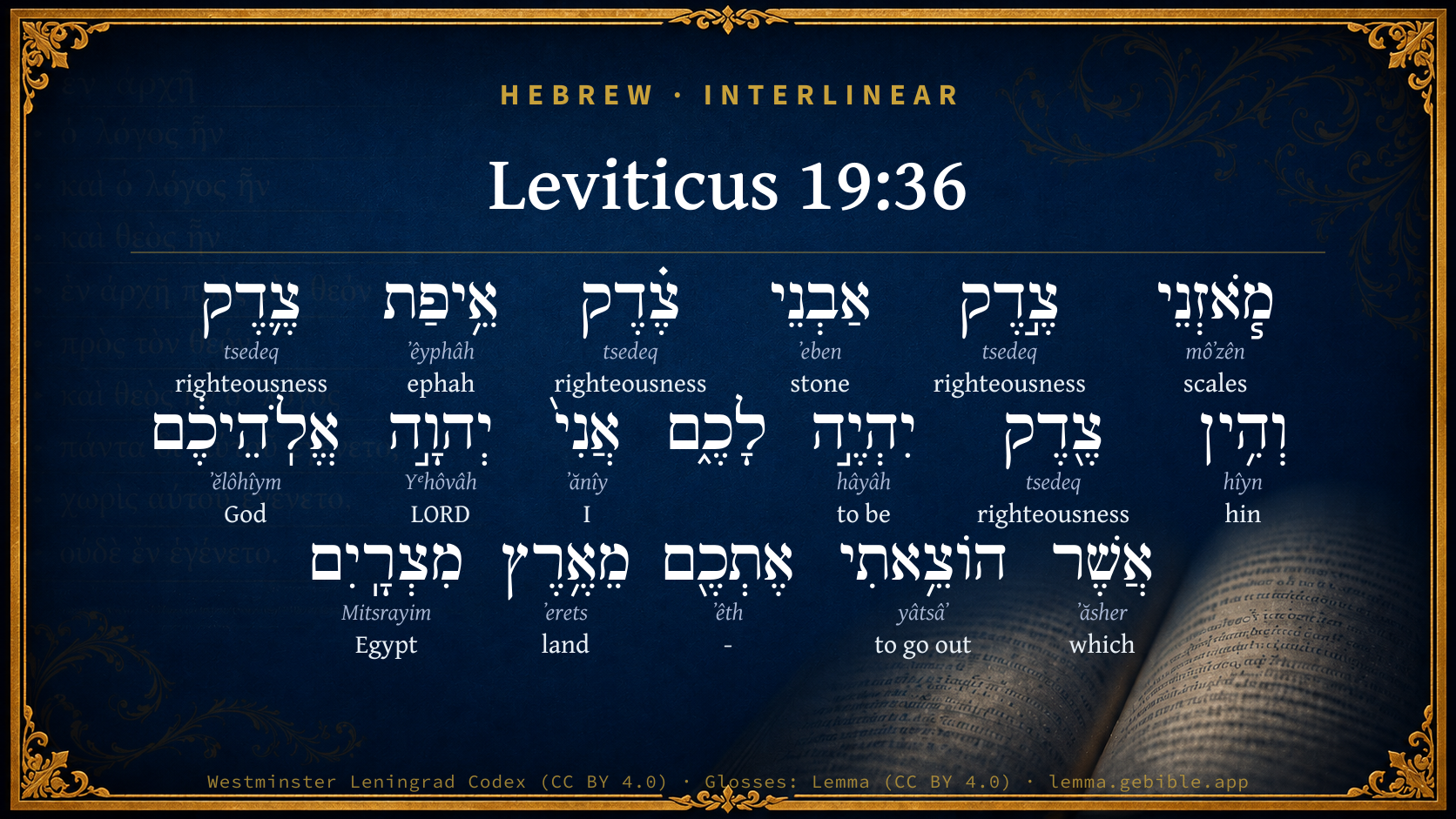
Hebrew (Westminster Leningrad Codex) Leviticus 19:36 appears in the Hebrew Old Testament. The text above is from the Westminster Leningrad Codex. Each word links to its Strong’s number, a concise gloss, and parsing drawn from the Open Scriptures Hebrew Bible morphology. Click any word for its full Brown-Driver-Briggs (BDB) entry.
Download image
Cite this verse

Leviticus 19:36 (World English Bible). Public Domain. Lemma interlinear Bible study tool, https://lemma.gebible.app/v/leviticus/19/36.

Show BibTeX & RIS
BibTeX
RIS
English Translation
Just balances, just weights, a just ephah, and a just hin, shall you have. I am Yahweh your God, who brought you out of the land of Egypt.
World English Bible · Public Domain
Highlights
  • 1 first appearance in the Hebrew Bible
Full analysis ↓
Download a study sheet

One document with this verse’s original text, its word-by-word gloss line, the meaning frame, cross-references with their text, attributed commentary, and full source and license credits — printable, and it pastes into notes with its structure intact.

This verse Autodidact and up

Study sheet (.html) Plain text (.txt)

A passage Seminary Student

Up to 50 verses in one chapter. A passage sheet keeps up to 6 commentary sources and 12 cross-references per verse, in the order this page ranks them, and says so on the sheet whenever that leaves anything out. Ask for a single verse and you get the Autodidact verse sheet above.

Everything on this page stays free to read, with no account — the sheet is a download of what is already on screen, not access to it.

Want to remove ads? Support Godless Engineer
Compare translations 3

The same verse in 3 English versions, stacked beneath the original-language interlinear above. Click any original word for its lexicon entry.

Each is an independent rendering of the whole verse — the interlinear is not word-aligned to these translations.

Highlighted words mark where these versions differ — a whole-verse word diff, not a word-by-word alignment.

  • World English Bible Public Domain
    Just balances, just weights, a just ephah, and a just hin, shall you have. I am Yahweh your God, who brought you out of the land of Egypt.
  • King James Version Public Domain
    Just balances, just weights, a just ephah, and a just hin, shall ye have: I am the LORD your God, which brought you out of the land of Egypt.
  • unfoldingWord Literal Text CC BY-SA 4.0
    Scales of righteousness, stones of righteousness, an ephah of righteousness, and a hin of righteousness shall belong to you. I Yahweh your God, who is bringing you from the land of Egypt.

unfoldingWord Literal Text — © unfoldingWord, licensed CC BY-SA 4.0. Word-aligned USFM3 via Door43 (git.door43.org/unfoldingWord/en_ult).

Versions to compare (up to 4)

3 of 4 selected

Show all 18 translations

Every available English version of this verse, each an independent rendering of the whole verse.

  • World English Bible Public Domain
    Just balances, just weights, a just ephah, and a just hin, shall you have. I am Yahweh your God, who brought you out of the land of Egypt.
  • Berean Standard Bible Public Domain
    You shall maintain honest scales and weights, an honest ephah, and an honest hin. I am the LORD your God, who brought you out of the land of Egypt.
  • Majority Standard Bible Public Domain
    You shall maintain honest scales and weights, an honest ephah, and an honest hin. I am the LORD your God, who brought you out of the land of Egypt.
  • King James Version Public Domain
    Just balances, just weights, a just ephah, and a just hin, shall ye have: I am the LORD your God, which brought you out of the land of Egypt.
  • American Standard Version (1901) Public Domain
    Just balances, just weights, a just ephah, and a just hin, shall ye have: I am Jehovah your God, who brought you out of the land of Egypt.
  • Revised Version (1885) Public Domain
    Just balances, just weights, a just ephah, and a just hin, shall ye have: I am the LORD your God, which brought you out of the land of Egypt.
  • Geneva Bible (1599) Public Domain
    You shall haue iust ballances, true weightes, a true Ephah, and a true Hin. I am the Lord your God, which haue brought you out of the lande of Egypt.
  • Douay-Rheims (1899) Public Domain
    Let the balance be just and the weights equal, the bushel just, and the sextary equal. I am the Lord your God, that brought you out of the land of Egypt.
  • Young's Literal Translation Public Domain
    righteous balances, righteous weights, a righteous ephah, and a righteous hin ye have; I `am' Jehovah your God, who hath brought you out from the land of Egypt;
  • Literal Standard Version CC BY-SA 4.0
    you have righteous balances, righteous weights, a righteous ephah, and a righteous hin; I [am] your God YHWH, who has brought you out from the land of Egypt;
  • Unlocked Literal Bible CC BY-SA 4.0
    You must use just scales, just weights, a just ephah, and a just hin. I am Yahweh your God, who brought you out of the land of Egypt.
  • unfoldingWord Literal Text CC BY-SA 4.0
    Scales of righteousness, stones of righteousness, an ephah of righteousness, and a hin of righteousness shall belong to you. I Yahweh your God, who is bringing you from the land of Egypt.
  • Darby Bible Public Domain
    just balances, just weights, a just ephah, and a just hin shall ye have: I am Jehovah your God, who brought you out of the land of Egypt.
  • World Messianic Bible Public Domain
    You shall have just balances, just weights, a just efah, and a just hin. I am the LORD your God, who brought you out of the land of Egypt.
  • Webster's Bible Public Domain
    Just balances, just weights, a just ephah, and a just hin shall ye have: I am the LORD your God, who brought you out of the land of Egypt.
  • Free Bible Version CC BY-SA 4.0
    Make sure your scales and weights are accurate, that your measures of ephah and hin are correct. I am the Lord your God who led you out of Egypt.
  • Bible in Basic English Public Domain
    Have true scales, true weights and measures for all things: I am the Lord your God, who took you out of the land of Egypt;
  • JPS Tanakh (1917) Public Domain
    Just balances, just weights, a just ephah, and a just hin, shall ye have: I am the LORD your God, who brought you out of the land of Egypt.

Literal Standard Version (2020), Covenant Press — licensed CC BY-SA 4.0. Text via the HelloAO Bible API (eBible.org). Unlocked Literal Bible (unfoldingWord) — licensed CC BY-SA 4.0. Text via the HelloAO Bible API (eBible.org). unfoldingWord Literal Text — © unfoldingWord, licensed CC BY-SA 4.0. Word-aligned USFM3 via Door43 (git.door43.org/unfoldingWord/en_ult). Free Bible Version, Dr. Jonathan Gallagher — licensed CC BY-SA 4.0. Text via the HelloAO Bible API (eBible.org).

Word by word

More ways to search: Search by grammar → Find every occurrence → Compare this word →

Practice this passage: Drill this verse → Learn its vocabulary →

מֹ֧אזְנֵי
môʼzên
H3976
“scales of”
Noun, Common, Masculine, Dual, Construct
Part of Speech
Noun
Type
Common
Gender
Masculine
Number
Dual
State
Construct
Full BDB Definition

Origin: from H239

TWOT: 58a

scales, balances
  1. צֶ֣דֶק tsedeq H6664 “righteousness” Noun, Common, Masculine, Singular, Absolute
  2. אַבְנֵי ʼeben H68 “stones of” Noun, Common, Feminine, Plural, Construct
  3. צֶ֗דֶק tsedeq H6664 “righteousness” Noun, Common, Masculine, Singular, Absolute
  4. אֵ֥יפַת ʼêyphâh H374 “ephah of” Noun, Common, Feminine, Singular, Construct
  5. צֶ֛דֶק tsedeq H6664 “righteousness” Noun, Common, Masculine, Singular, Absolute
  6. וְהִ֥ין hîyn H1969 “and · hin of” Conjunction + Noun, Common, Masculine, Singular, Construct
  7. צֶ֖דֶק tsedeq H6664 “righteousness” Noun, Common, Masculine, Singular, Absolute
  8. יִהְיֶ֣ה hâyâh H1961 “to be” Verb, Qal, Imperfect, 3rd Person, Masculine, Singular
  9. אֲנִי֙ ʼănîy H589 “I” Pronoun, Personal, 1st Person, Common, Singular
  10. יְהוָ֣ה Yᵉhôvâh H3068 “LORD” Noun, Proper
  11. אֱלֹֽהֵיכֶ֔ם ʼĕlôhîym H430 “God(s) · your” Noun, Common, Masculine, Plural, Construct + Suffix, Personal, 2nd Person, Masculine, Plural
  12. אֲשֶׁר ʼăsher H834 “which” Particle, Relative
  13. הוֹצֵ֥אתִי yâtsâʼ H3318 “to go out” Verb, Hiphil, Perfect, 1st Person, Common, Singular
  14. אֶתְכֶ֖ם ʼêth H853 “- · you” Particle, Direct Object + Suffix, Personal, 2nd Person, Masculine, Plural
  15. מֵאֶ֥רֶץ ʼerets H776 “from · land of” Preposition + Noun, Common, Both, Singular, Construct
  16. מִצְרָֽיִם Mitsrayim H4714 “Egypt” Noun, Proper

About this verse

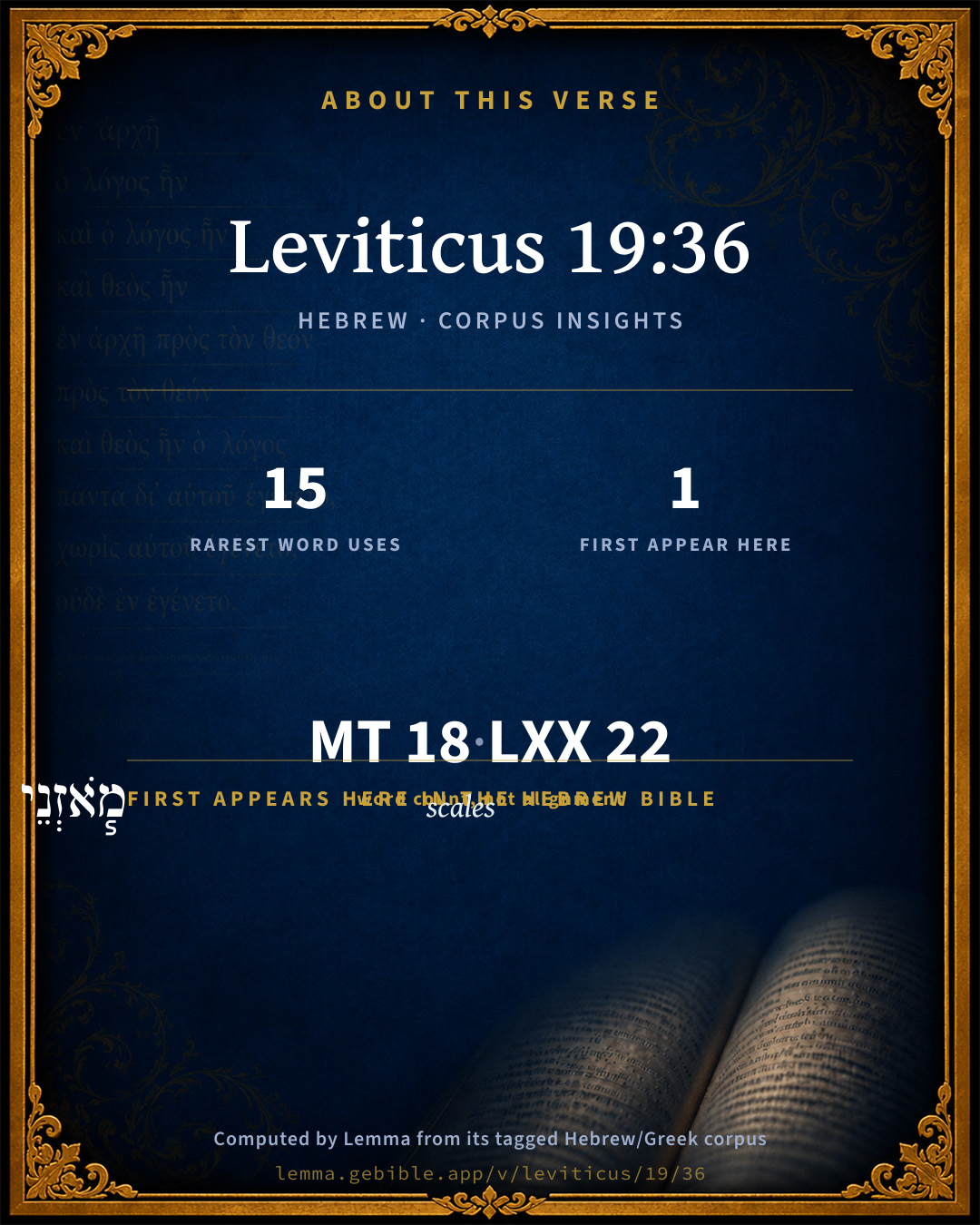
These counts appear in no published source. They are computed here, from the morphology-tagged text and Lemma’s own curated glosses. What Lemma adds →

18
words
14
distinct lemmas
Pentateuch
section

Notable vocabulary

The rarest word here is מֹ֧אזְנֵי scales H3976 — appearing just 15 times in the whole Hebrew Bible.

First appearance in Scripture

This word makes its first canonical appearance in the Hebrew Bible here:

  • מֹ֧אזְנֵי scales H3976

Shared distinctive vocabulary

מֹ֧אזְנֵי scales H3976 occurs in 15 verses of the Hebrew Bible. Also found in:

Grammatical profile

  • 2 verbs
  • 12 nouns
  • 1 pronoun
  • 1 preposition
  • 2 particles

Verb forms

  • יִהְיֶ֣ה Qal · Imperfect
  • הוֹצֵ֥אתִי Hiphil · Perfect

Repetition

A word recurs within this verse — often emphatic in Hebrew:

  • צֶ֣דֶק righteousness H6664 ×4

Hebrew & Septuagint length

In English translation the verse runs 28 words from the Hebrew and 29 from the Septuagint (LXX English) — closely comparable.

A rough comparison of the two English renderings, which tokenize alike — not a word-level alignment.

Word counts can differ between the Hebrew and the Greek without any difference in meaning — e.g. the Hebrew direct-object marker אֵת has no separate Greek word, and Greek often adds the article ὁ.

In the original languages it is 18 Hebrew tokens and 22 Greek tokens — but the two are counted differently (Hebrew bundles its prefixes and suffixes into one token; the Greek is in lemma form), so that isn’t a like-for-like length.

Cross-references

4

Topical passages linked to Leviticus 19:36 in the Treasury of Scripture Knowledge — connected by theme and wording, ordered by reader-vote popularity; previews shown in the World English Bible.

  • Exodus 20:2 "I am Yahweh your God, who brought you out of the land of Egypt, out of the house of bondage.
  • Proverbs 11:1 A false balance is an abomination to Yahweh, But accurate weights are his delight.
  • Deuteronomy 25:13–15 You shall not have in your bag diverse weights, a great and a small.
  • Proverbs 20:10 Differing weights and differing measures, Both of them alike are an abomination to Yahweh.

Cross-references courtesy of OpenBible.info (CC BY 4.0).

Hebrew and Greek witnesses Masoretic Hebrew ↔ Greek Septuagint

The same verse in the two great witnesses to the Old Testament, shown verse-for-verse.

These are two independent witnesses, not word-aligned to each other, and the Septuagint is shown in lemma (dictionary) form.

Hebrew Leviticus 19:36 Masoretic · Westminster Leningrad Codex

מֹ֧אזְנֵי צֶ֣דֶק אַבְנֵי צֶ֗דֶק אֵ֥יפַת צֶ֛דֶק וְהִ֥ין צֶ֖דֶק יִהְיֶ֣ה לָכֶ֑ם אֲנִי֙ יְהוָ֣ה אֱלֹֽהֵיכֶ֔ם אֲשֶׁר הוֹצֵ֥אתִי אֶתְכֶ֖ם מֵאֶ֥רֶץ מִצְרָֽיִם

Just balances, just weights, a just ephah, and a just hin, shall you have. I am Yahweh your God, who brought you out of the land of Egypt.

World English Bible · Public Domain

Greek LXX Leviticus 19:36 Septuagint · lemma form

ζυγόν δίκαιος καί στάθμιον δίκαιος καί χοῦς δίκαιος εἰμί σύ ἐγώ εἰμί κύριος ὁ θεός σύ ὁ ἐκἄγω σύ ἐκ γῆ αἴγυπτος

There shall be among you just balances and just weights and just liquid measure. I am the Lord your God, who brought you out of the land of Egypt.

LXX2012 (modern English Septuagint) · Public Domain

Hebrew: Westminster Leningrad Codex (CC BY 4.0). Greek: Septuagint (public domain); English from LXX2012 (modern English Septuagint) (Public Domain). How the Septuagint differs from the Hebrew →

Targum (Aramaic paraphrase)

2

The Targum is the ancient Jewish Aramaic paraphrase of the Hebrew Scriptures — an interpretive translation, not the Hebrew text itself. Onkelos (literal) and Pseudo-Jonathan (expansive) render the Torah, and Jonathan the Prophets. Coverage is partial: where no permissively-licensed English translation exists for a verse, only the Aramaic is shown. This is verse-level text, not a word-by-word alignment to the Hebrew.

  1. Targum Onkelos Torah (Genesis–Deuteronomy)
    מֹאזְנָוָן דִקְשׁוֹט מַתְקְלָן דִקְשׁוֹט מְכִילָן דִקְשׁוֹט וְהִינִין דִקְשׁוֹט יְהוֹן לְכוֹן אֲנָא יְיָ אֱלָהָכוֹן דִי אֲפֵּקִית יָתְכוֹן מֵאַרְעָא דְמִצְרָיִם

    (no public-domain English translation for this verse)

    Targum Onkelos — Aramaic: “Onkelos Genesis” (public domain); “Onkelos Exodus” (public domain); “Onkelos Leviticus” (public domain); “Onkelos Numbers” (public domain); “Onkelos Deuteronomy” (public domain). English: “Sefaria Community Translation” (CC0 1.0 (public-domain dedication)); “J.W. Etheridge. The Targums of Onkelos and Jonathan Ben Uzziel on the Pentateuch. London: Longmans, Green, 1862” (public domain). Text via Sefaria.

  2. Targum Pseudo-Jonathan Torah (Genesis–Deuteronomy)
    מוֹדְנָווּן דִקְשׁוֹט מַתְקְלִין דִקְשׁוֹט מְכִילוּ דִקְשׁוֹט וְקִיסְטִין דִקְשׁוֹט יְהֵי לְכוֹן אֲנָא יְיָ אֱלָהָכוֹן דְאַנְפָקִית יַתְכוֹן פְּרִיקִין מֵאַרְעָא דְמִצְרָיִם

    but balances of truth, weights of truth, measures of truth, and tankards of truth, shall yours be. I am the Lord our God who brought you redeemed from the land of Mizraim:

    Targum Pseudo-Jonathan — Aramaic: “Targum Jonathan on Genesis” (public domain); “Targum Jonathan on Exodus” (public domain); “Targum Jonathan on Leviticus” (public domain); “Targum Jonathan on Numbers” (public domain); “Targum Jonathan on Deuteronomy” (public domain). English: “The Targum of Jonathan ben Uzziel, trans. J. W. Etheridge, London, 1862” (public domain). Text via Sefaria.

Commentary

Notes on Leviticus 19:36 from classic Christian and Jewish commentators (each source and its license shown beneath its notes). The classic Christian expositions comment on the surrounding passage and are grouped to its opening verse, so a note may address several verses; the Jewish commentaries on the Tanakh (Rashi and others) are per-verse, so they appear only where the commentator wrote on this verse.

Lemma curates 59 commentaries, every one of them public domain or Creative Commons licensed, each selected and text-cleaned for this edition rather than reprinted as found. About our sources →

Trapp's Complete Commentary

John Trapp

Lev 19:36 Just balances, just weights, a just ephah, and a just hin, shall ye have: I [am] the LORD your God, which brought you out of the land of Egypt.

Ver. 36. Just balances.] See Pro 11:1; Pro 16:11; Pro 20:10.

John Trapp, A Commentary or Exposition upon All the Books of the Old and New Testament (1647–1656) — public domain. Text from a community e-Sword module.

Joseph Benson's Commentary

Lev 19:36. A just ephah and a just hin — These two measures are named as most common, the former for dry, the latter for moist things, but under them he manifestly comprehends all other measures.

Joseph Benson's Commentary on the Old and New Testaments (1811–1818) — public domain. Text from a community e-Sword module.

Geneva Bible (1599)

Geneva Bible translators

By these two measures he meaneth all others. Of Ephah, read Exod. 16:36, and of Hin, Exod. 29:40.

Geneva Bible (1599) marginal notes — public domain. Text via Bolls.life.

Adam Clarke's Commentary

Verse 36. Just balances] Scales, steel-yard, &c. Weights, אבנים abanim, stones, as the weights appear to have been originally formed out of stones. Ephah, hin, &c., see before.

Adam Clarke's Commentary on the Bible (1810–1826) — public domain. Text from a community e-Sword/MySword module.

Ellicott's Commentary for English Readers

(36) Just balances, just weights.—That is, they were to be the same for buying as for selling.

Just ephah.—The ephah is the dry measure, and contained ten omers. (See Lev_14:10.) It is the same measure as the bath is for liquids.

A just hin.—The hin, which was a measure for liquids, contained as much as seventy-two hen’s eggs. These two measures are here used as representative, including all other measures.

A Bible Commentary for English Readers, edited by Charles John Ellicott (1878–1897) — public domain. Text from a community e-Sword module.

John Gill's Exposition

Just balances, just weights,.... Which were for such sort of things as were bought and sold by weight, and these were to be according to the custom and usage which universally obtained among them, or were fixed and settled by them; they were to be neither lighter nor heavier; they were not to have one sort to buy with, and another to sell with, which was not just, and was an abomination to the Lord, Pro 11:1; for "weights", it is in the original text "stones", for those were formerly used in weighing, and were with us: hence it is still in use to say, so much by the stone. And according to Maimonides (w), the Jews were not to make their weights neither of iron, nor of lead, nor of the rest of metals, lest they should rust and become light, but of polished rock, and the like:

a just ephah, and a just hin, shall ye have; the first of these was the measure of things dry, as corn, and the like, the latter of things liquid, as oil and wine; the one held three seahs or pecks, or ten omers, Exo 16:36; or, according to a nicer calculation, the ephah held seven gallons, two quarts, and half a pint; and the other, according to some, held three quarts; but, as more exactly calculated, it held a wine gallon, and a little more than a quart; see Gill on Exo 30:24. Some Jewish writers (x) refer this to words, promises, and compacts, expressed by yea and nay, which they were to abide by; that their yea should be yea, and their nay, nay, Mat 5:37; that their affirmation should be just, and so their negation:

I am the Lord your God, which brought you out of the land of Egypt; and therefore were under great obligations to observe his commands, as follows.

(w) Hilchot Genibah, c. 8. sect. 4. (x) Torath Cohanim apud Yalkut in loc. Maimon. & Bartenora in Misn. Sheviith, c. 10. sect. 9.

John Gill's Exposition of the Whole Bible (1746–1763) — public domain (CC PDM 1.0). Text via the HelloAO Bible API.

Haydock's Catholic Bible Commentary

Weights. Hebrew, "stones of justice," for stone weights were formerly used, Proverbs xvi. 11. --- Bushel, &c. Hebrew, "a just epha, and a just hin." (Calmet)

George Leo Haydock (1774–1849), Haydock's Catholic Family Bible and Commentary, 1859 edition — public domain. Excludes Psalms (Douay-Rheims chapter numbering differs from Protestant) and Deuterocanonical books (Catholic canon only).

Matthew Poole's English Annotations

A just ephah, and a just hin; these two measures are named as most common, the former for dry, the latter for moist things; but under them he manifestly comprehends all other measures.

Matthew Poole's English Annotations on the Holy Bible (1683–1685) — public domain. Text from a community e-Sword/MySword module.

Whedon's Commentary on the Bible

Daniel D. Whedon

36. Balances are found on Egyptian monuments as early as the time of Joseph, and they are alluded to in the story of the purchase of the cave of Machpelah, Gen_23:16. Before coinage they were necessary to all payments of money. The weights at first were “stones,” which gave to them their name in later times, when lead was used. A parallel is found in England. The weights were carried in a bag suspended from the girdle. The habit of carrying a set of large weights to buy with and of smaller to sell with, sprang up very early. Inasmuch as there was a “shekel of the sanctuary” it is probable that The standard weights and measures were sacredly kept in the tabernacle by the priests. Num_3:47, note.

Ephah — This measure is the same as the bath, and according to Josephus it contains about eight and a half gallons; according to the rabbins less than four and a half.

Hin — This is estimated, in like manner, at about one and a half, or at about three quarters of a gallon. Since the dealings of man with his fellow in the marts of trade constitute a school for the development and discipline of moral character, they are not matters of indifference to the holy and just One. True holiness shines out in the measuring of tape and in the weighing of sugar more convincingly than in prayer and praise and conspicuous acts of beneficence. See Mat_5:16; and Php_2:15. “A book which talks in this language is a book which ought to be carefully preserved by the people. The Bible is not a sentimental book, dealing with abstract emotion, or confining itself to metaphysical mysteries. A religion that examines the balances and weights is a religion that may be trusted to attach a true value to praise and prayer. This is the strength of biblical doctrine.” — Joseph Parker.

Daniel D. Whedon (gen. ed.), Commentary on the Old and New Testaments (1874–1909) — public domain. Text from a community e-Sword module.

John Wesley's Explanatory Notes

A just ephah and a just hin - These two two measures are named as most common, the former for dry, the latter for moist things, but under them he manifestly comprehends all other measures.

John Wesley, Explanatory Notes Upon the Whole Bible (1754–1765) — public domain. Text via the GEBible commentary corpus.

Rashi

Rabbi Shlomo Yitzchaki (Rashi)

אבני צדק are stones used for weights wherewith one weighs.

איפת — The “Epha” is a certain dry measure.

והין — The “Hin” is a certain liquid measure.

אשר הוצאתי אתכם WHO BROUGHT YOU FORTH [FROM EGYPT] for this purpose, that you shall be honest in your actions (Sifra, Kedoshim, Chapter 8 10). Another explanation is: I distinguished in Egypt between those who were firstborn and those who were not firstborn (a matter which is hidden from human cognizance), I am also certain to exact punishment from him who secretly puts his weights in salt in order to take advantage of people who are not aware of it (cf. Bava Metzia 61b).

Rashi on the Tanakh — English translations: “The Judaica Press complete Tanach with Rashi, translated by A. J. Rosenberg” (CC BY 4.0); “Pentateuch with Rashi's commentary by M. Rosenbaum and A.M. Silbermann, 1929-1934” (public domain); “The Metsudah Tanach series, Lakewood, N.J” (CC BY 4.0); and “The Book of Joshua, Metsudah Publications, 1997” (CC BY 4.0). Text via Sefaria.

Lesson kit

Teaching starters — assembled from the data on this page, not authored interpretation. Every prompt links to the verse data it draws on. Edit before teaching.

Leviticus, in the Pentateuch, opens this verse with 18 words (14 distinct Hebrew lemmas). Its most distinctive word is môʼzên (“scales”). A historical commentator’s framing appears above. Read the whole chapter for the surrounding context.

Discussion questions

  1. The word môʼzên carries the sense “scales.” How does it shape the verse?
  2. This is the first place “scales” appears in Scripture (first appears here). What does its debut here establish?
  3. How does Job 6:2, which shares the word «scales», read alongside this verse?
  4. What does the repetition of “righteousness” (4× in this one verse) do in this verse?
  5. These translations render this verse differently. What is at stake in choosing one wording over another?
  6. «יִהְיֶ֣ה» is a Qal Imperfect verb. How does that grammatical form shape the action described?
  7. Compare how Trapp's Complete Commentary and Joseph Benson's Commentary read this verse. Where do they agree or differ?

Things to notice

Reading settings

Reading text

Shown beneath each verse's original-language words.

Old Testament
Old Testament edition

Read the OT as the Masoretic Hebrew (MT) or the Greek Septuagint (LXX).

English shown for the Greek Septuagint (in the Hebrew ↔ Greek comparison).

Comparing translations? Open the Compare panel on any verse page to stack up to four side by side.