
1 Samuel 19:3

Hebrew (Westminster Leningrad Codex) 1 Samuel 19:3 appears in the Hebrew Old Testament. The text above is from the Westminster Leningrad Codex. Each word links to its Strong’s number, a concise gloss, and parsing drawn from the Open Scriptures Hebrew Bible morphology. Click any word for its full Brown-Driver-Briggs (BDB) entry.
Download image
Cite this verse

1 Samuel 19:3 (World English Bible). Public Domain. Lemma interlinear Bible study tool, https://lemma.gebible.app/v/1-samuel/19/3.

Show BibTeX & RIS
BibTeX
RIS
English Translation
and I will go out and stand beside my father in the field where you are, and I will commune with my father of you; and if I see anything, I will tell you.
World English Bible · Public Domain
Download a study sheet

One document with this verse’s original text, its word-by-word gloss line, the meaning frame, cross-references with their text, attributed commentary, and full source and license credits — printable, and it pastes into notes with its structure intact.

This verse Autodidact and up

Study sheet (.html) Plain text (.txt)

A passage Seminary Student

Up to 50 verses in one chapter. A passage sheet keeps up to 6 commentary sources and 12 cross-references per verse, in the order this page ranks them, and says so on the sheet whenever that leaves anything out. Ask for a single verse and you get the Autodidact verse sheet above.

Everything on this page stays free to read, with no account — the sheet is a download of what is already on screen, not access to it.

Want to remove ads? Support Godless Engineer
Compare translations 3

The same verse in 3 English versions, stacked beneath the original-language interlinear above. Click any original word for its lexicon entry.

Each is an independent rendering of the whole verse — the interlinear is not word-aligned to these translations.

Highlighted words mark where these versions differ — a whole-verse word diff, not a word-by-word alignment.

  • World English Bible Public Domain
    and I will go out and stand beside my father in the field where you are, and I will commune with my father of you; and if I see anything, I will tell you.
  • King James Version Public Domain
    And I will go out and stand beside my father in the field where thou art, and I will commune with my father of thee; and what I see, that I will tell thee.
  • unfoldingWord Literal Text CC BY-SA 4.0
    And I myself will go out and stand at the hand of my father in the field where you there, and I myself will speak about you to my father, and I will see what, and I will declare to you.”

unfoldingWord Literal Text — © unfoldingWord, licensed CC BY-SA 4.0. Word-aligned USFM3 via Door43 (git.door43.org/unfoldingWord/en_ult).

Versions to compare (up to 4)

3 of 4 selected

Show all 18 translations

Every available English version of this verse, each an independent rendering of the whole verse.

  • World English Bible Public Domain
    and I will go out and stand beside my father in the field where you are, and I will commune with my father of you; and if I see anything, I will tell you.
  • Berean Standard Bible Public Domain
    I will go out and stand beside my father in the field where you are, so I can ask about you. And if I find out anything, I will tell you.”
  • Majority Standard Bible Public Domain
    I will go out and stand beside my father in the field where you are, so I can ask about you. And if I find out anything, I will tell you.”
  • King James Version Public Domain
    And I will go out and stand beside my father in the field where thou art, and I will commune with my father of thee; and what I see, that I will tell thee.
  • American Standard Version (1901) Public Domain
    and I will go out and stand beside my father in the field where thou art, and I will commune with my father of thee; and if I see aught, I will tell thee.
  • Revised Version (1885) Public Domain
    and I will go out and stand beside my father in the field where thou art, and I will commune with my father of thee; and if I see aught, I will tell thee.
  • Geneva Bible (1599) Public Domain
    And I will go out, and stand by my father in the fielde where thou art, and will commune with my father of thee, and I will see what he sayth, and will tell thee.
  • Douay-Rheims (1899) Public Domain
    And I will go out and stand beside my father in the field where thou art: and I will speak of thee to my father, and whatsoever I shall see, I will tell thee.
  • Young's Literal Translation Public Domain
    and I -- I go out, and have stood by the side of my father in the field where thou `art', and I speak of thee unto my father, and have seen what `is coming', and have declared to thee.'
  • Literal Standard Version CC BY-SA 4.0
    and I go out, and have stood by the side of my father in the field where you [are], and I speak of you to my father, and have seen what [is coming], and have declared [it] to you.”
  • Unlocked Literal Bible CC BY-SA 4.0
    I will go out and stand beside my father in the field where you are, and I will speak with my father about you. If I learn anything, I will tell you.”
  • unfoldingWord Literal Text CC BY-SA 4.0
    And I myself will go out and stand at the hand of my father in the field where you there, and I myself will speak about you to my father, and I will see what, and I will declare to you.”
  • Darby Bible Public Domain
    and I will go out and stand beside my father in the field where thou art, and will speak of thee with my father: and see what it is, and tell thee.
  • World Messianic Bible Public Domain
    I will go out and stand beside my father in the field where you are, and I will talk with my father about you; and if I see anything, I will tell you.”
  • Webster's Bible Public Domain
    And I will go out and stand beside my father in the field where thou art, and I will commune with my father of thee; and what I see, that I will tell thee.
  • Free Bible Version CC BY-SA 4.0
    I'll go out with my father and stand in the field near to where you are hiding. I'll talk to him about you and see what I can find out, then I'll let you know.”
  • Bible in Basic English Public Domain
    And I will go out and take my place by my father's side in the field near where you are; and I will get into talk with my father about you, and when I see how things are, I will give you word.
  • JPS Tanakh (1917) Public Domain
    And I will go out and stand beside my father in the field where thou art, and I will speak with my father of thee; and if I see aught, I will tell thee.'

Literal Standard Version (2020), Covenant Press — licensed CC BY-SA 4.0. Text via the HelloAO Bible API (eBible.org). Unlocked Literal Bible (unfoldingWord) — licensed CC BY-SA 4.0. Text via the HelloAO Bible API (eBible.org). unfoldingWord Literal Text — © unfoldingWord, licensed CC BY-SA 4.0. Word-aligned USFM3 via Door43 (git.door43.org/unfoldingWord/en_ult). Free Bible Version, Dr. Jonathan Gallagher — licensed CC BY-SA 4.0. Text via the HelloAO Bible API (eBible.org).

Word by word

More ways to search: Search by grammar → Find every occurrence → Compare this word →

Practice this passage: Drill this verse → Learn its vocabulary →

בַּשָּׂדֶה֙
sâdeh
H7704
“in/at the · field”
Preposition, Determined + Noun, Common, Masculine, Singular, Absolute
Part of Speech
Preposition + Noun
Type
Common
Gender
Masculine
Number
Singular
State
Absolute
Full BDB Definition

Origin: from an unused root meaning to spread out

TWOT: 2236a , 2236b

field, land - cultivated field - of home of wild beasts - plain (opposed to mountain) - land (opposed to sea)
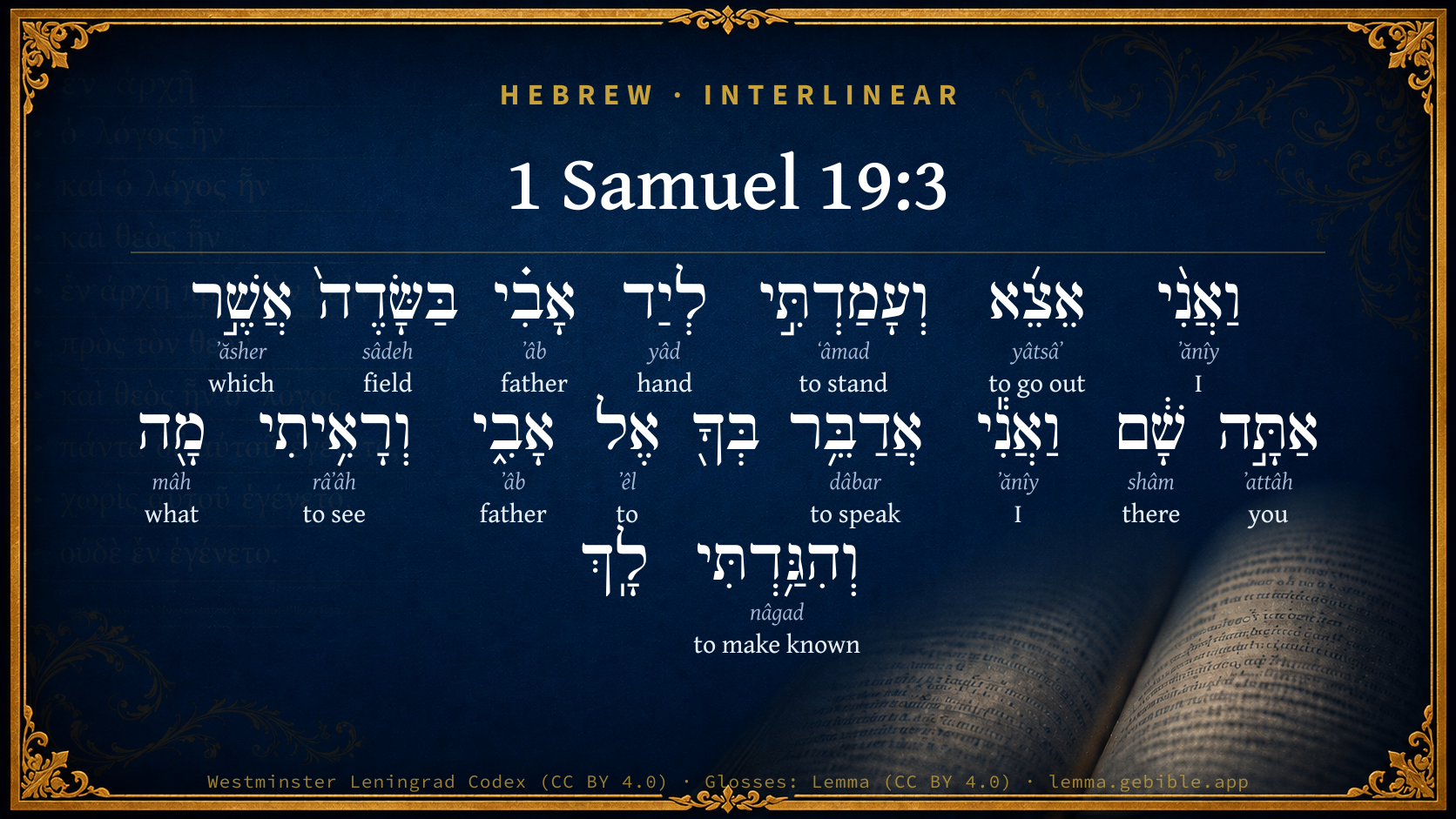
  1. וַאֲנִ֨י ʼănîy H589 “and · I” Conjunction + Pronoun, Personal, 1st Person, Common, Singular
  2. אֵצֵ֜א yâtsâʼ H3318 “to go out” Verb, Qal, Imperfect, 1st Person, Common, Singular
  3. וְעָמַדְתִּ֣י ʻâmad H5975 “and · to stand” Conjunction + Verb, Qal, Sequential Perfect, 1st Person, Common, Singular
  4. לְיַד yâd H3027 “to/for · hand of” Preposition + Noun, Common, Both, Singular, Construct
  5. אָבִ֗י ʼâb H1 “father · my” Noun, Common, Masculine, Singular, Construct + Suffix, Personal, 1st Person, Common, Singular
  6. אֲשֶׁ֣ר ʼăsher H834 “which” Particle, Relative
  7. אַתָּ֣ה ʼattâh H859 “you” Pronoun, Personal, 2nd Person, Masculine, Singular
  8. שָׁ֔ם shâm H8033 “there” Adverb
  9. וַאֲנִ֕י ʼănîy H589 “and · I” Conjunction + Pronoun, Personal, 1st Person, Common, Singular
  10. אֲדַבֵּ֥ר dâbar H1696 “to speak” Verb, Piel, Imperfect, 1st Person, Common, Singular
  11. אֶל ʼêl H413 “to” Preposition
  12. אָבִ֑י ʼâb H1 “father · my” Noun, Common, Masculine, Singular, Construct + Suffix, Personal, 1st Person, Common, Singular
  13. וְרָאִ֥יתִי râʼâh H7200 “and · to see” Conjunction + Verb, Qal, Sequential Perfect, 1st Person, Common, Singular
  14. מָ֖ה mâh H4100 “what” Particle, Interrogative
  15. וְהִגַּ֥דְתִּי nâgad H5046 “and · to make known” Conjunction + Verb, Hiphil, Sequential Perfect, 1st Person, Common, Singular

About this verse

These counts appear in no published source. They are computed here, from the morphology-tagged text and Lemma’s own curated glosses. What Lemma adds →

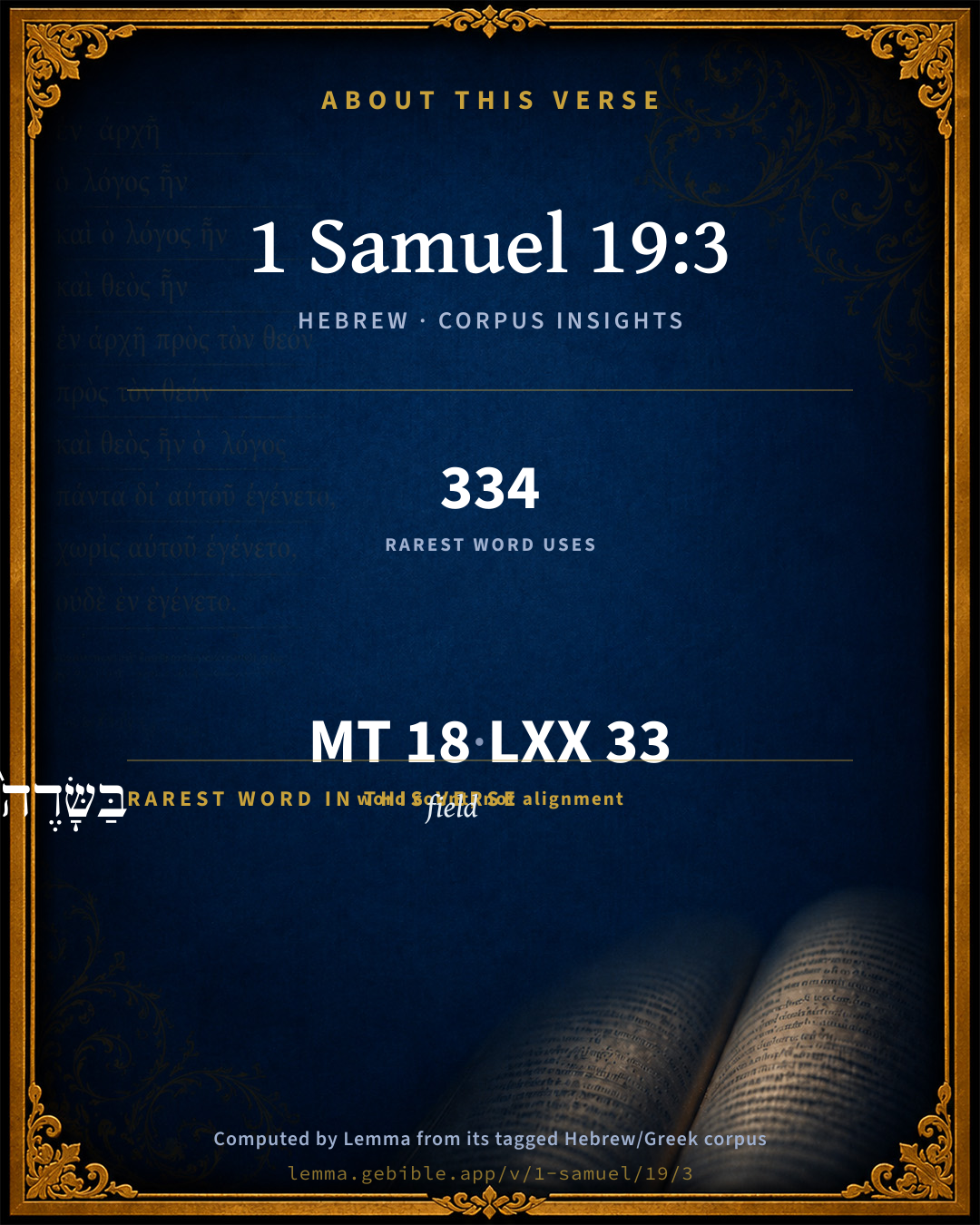
18
words
14
distinct lemmas
Historical
section

Grammatical profile

  • 5 verbs
  • 4 nouns
  • 3 pronouns
  • 3 prepositions
  • 1 adverb
  • 2 particles

Verb forms

  • אֵצֵ֜א Qal · Imperfect
  • וְעָמַדְתִּ֣י Qal · Sequential Perfect
  • אֲדַבֵּ֥ר Piel · Imperfect
  • וְרָאִ֥יתִי Qal · Sequential Perfect
  • וְהִגַּ֥דְתִּי Hiphil · Sequential Perfect

Repetition

Words recur within this verse — often emphatic in Hebrew:

  • אָבִ֗י father H1 ×2
  • וַאֲנִ֨י I H589 ×2

Hebrew & Septuagint length

In English translation the verse runs 34 words from the Hebrew and 40 from the Septuagint (LXX English) — closely comparable.

A rough comparison of the two English renderings, which tokenize alike — not a word-level alignment.

Word counts can differ between the Hebrew and the Greek without any difference in meaning — e.g. the Hebrew direct-object marker אֵת has no separate Greek word, and Greek often adds the article ὁ.

In the original languages it is 18 Hebrew tokens and 33 Greek tokens — but the two are counted differently (Hebrew bundles its prefixes and suffixes into one token; the Greek is in lemma form), so that isn’t a like-for-like length.

Cross-references

2

Topical passages linked to 1 Samuel 19:3 in the Treasury of Scripture Knowledge — connected by theme and wording, ordered by reader-vote popularity; previews shown in the World English Bible.

  • 1 Samuel 20:9 Jonathan said, Far be it from you; for if I should at all know that evil were determined by my father to come on you, then wouldn't I tell you that?
  • 1 Samuel 20:13 Yahweh do so to Jonathan, and more also, should it please my father to do you evil, if I don't disclose it to you, and send you away, that you may go in peace: and Yahweh be with you, as he has been with my father.

Cross-references courtesy of OpenBible.info (CC BY 4.0).

Hebrew and Greek witnesses Masoretic Hebrew ↔ Greek Septuagint

The same verse in the two great witnesses to the Old Testament, shown verse-for-verse.

These are two independent witnesses, not word-aligned to each other, and the Septuagint is shown in lemma (dictionary) form.

Hebrew 1 Samuel 19:3 Masoretic · Westminster Leningrad Codex

וַאֲנִ֨י אֵצֵ֜א וְעָמַדְתִּ֣י לְיַד אָבִ֗י בַּשָּׂדֶה֙ אֲשֶׁ֣ר אַתָּ֣ה שָׁ֔ם וַאֲנִ֕י אֲדַבֵּ֥ר בְּךָ֖ אֶל אָבִ֑י וְרָאִ֥יתִי מָ֖ה וְהִגַּ֥דְתִּי לָֽךְ

and I will go out and stand beside my father in the field where you are, and I will commune with my father of you; and if I see anything, I will tell you.

World English Bible · Public Domain

Greek LXX 1 Samuel 19:3 Septuagint · lemma form

καί ἐγώ ἐκἔρχομαι καί ἵστημι ἔχω ὁ πατήρ ἐγώ ἐν ἀγρός οὗ ἐάν εἰμί ἐκεῖ καί ἐγώ λαλέω περί σύ πρός ὁ πατήρ ἐγώ καί ὁράω ὅς τις ἐάν εἰμί καί ἀποἀγγέλλω σύ

And I will go forth, and stand near my father in the field where you shall be, and I will speak concerning you to my father; and I will see what his answer may be, and I will tell you.

LXX2012 (modern English Septuagint) · Public Domain

Hebrew: Westminster Leningrad Codex (CC BY 4.0). Greek: Septuagint (public domain); English from LXX2012 (modern English Septuagint) (Public Domain). How the Septuagint differs from the Hebrew →

Targum (Aramaic paraphrase)

1

The Targum is the ancient Jewish Aramaic paraphrase of the Hebrew Scriptures — an interpretive translation, not the Hebrew text itself. Onkelos (literal) and Pseudo-Jonathan (expansive) render the Torah, and Jonathan the Prophets. Coverage is partial: where no permissively-licensed English translation exists for a verse, only the Aramaic is shown. This is verse-level text, not a word-by-word alignment to the Hebrew.

  1. Targum Jonathan Prophets (Joshua–Malachi)
    וַאֲנָא אֶפּוֹק וְאֵקוּם לְוַת אַבָּא בְּחַקְלָא דְאַתְּ תַּמָן וַאֲנָא אֲמַלֵיל עֲלָךְ פִּתְגָמִין תַּקְנִין קֳדָם אַבָּא וְאֶחְזֵי מָה וַאֲחַוֵי לָךְ:

    (no public-domain English translation for this verse)

    Targum Jonathan — Aramaic: “Mikraot Gedolot” (public domain). English: “Sefaria Community Translation” (CC0 1.0 (public-domain dedication)); “London "Chaldee Paraphrase," 1871” (public domain). Text via Sefaria.

Commentary

Notes on 1 Samuel 19:3 from classic Christian and Jewish commentators (each source and its license shown beneath its notes). The classic Christian expositions comment on the surrounding passage and are grouped to its opening verse, so a note may address several verses; the Jewish commentaries on the Tanakh (Rashi and others) are per-verse, so they appear only where the commentator wrote on this verse.

Lemma curates 59 commentaries, every one of them public domain or Creative Commons licensed, each selected and text-cleaned for this edition rather than reprinted as found. About our sources →

Trapp's Complete Commentary

John Trapp

1Sa 19:3 And I will go out and stand beside my father in the field where thou [art], and I will commune with my father of thee; and what I see, that I will tell thee.

Ver. 3. And what Isee, that I will tell thee.] This was not treachery to his father, but true love to his friend, with whom he was in covenant, ad commoriendum et convivendum.

John Trapp, A Commentary or Exposition upon All the Books of the Old and New Testament (1647–1656) — public domain. Text from a community e-Sword module.

Joseph Benson's Commentary

1Sa 19:3-5. I will stand by my father in the field — In which it is likely Saul used to walk in the morning and take the fresh air. Thereabouts he advised David to lurk in some secret place; that he might speedily acquaint him with the issue of his discourse with his father, 1Sa 19:4-7. Jonathan spake good of David unto Saul — Which he could not do without hazard to himself. Herein, therefore, he performed the duty of a true friend and of a valiant man. He put his life in his hand — Or, in the greatest hazard: And slew the Philistine — He puts him in mind of that hazardous enterprise wherein he slew Goliath; in which David did indeed hazard his life greatly, for had he missed with his sling he must certainly have been slain.

Joseph Benson's Commentary on the Old and New Testaments (1811–1818) — public domain. Text from a community e-Sword module.

Geneva Bible (1599)

Geneva Bible translators

That I may give thee warning what to do.

Geneva Bible (1599) marginal notes — public domain. Text via Bolls.life.

Ellicott's Commentary for English Readers

(3) In the field.—No doubt some garden or quiet place, whither the king was in the habit of resorting with his friends and counsellors.

A Bible Commentary for English Readers, edited by Charles John Ellicott (1878–1897) — public domain. Text from a community e-Sword module.

The Cambridge Bible for Schools and Colleges

gen. ed. J. J. S. Perowne

3. in the field where thou art] Jonathan may have wished David to hear and judge for himself of Saul’s intention; or to be close at hand so that he might at once inform him of the result of his appeal.

The Cambridge Bible for Schools and Colleges (gen. ed. J. J. S. Perowne; Cambridge University Press, 1878–1918) — public domain. Text from a community e-Sword module.

John Gill's Exposition

And I will go out,.... In the morning, at the same time his father used to take his morning walk:

and stand beside my father in the field where thou art; on that side of him next to David, that he might not see him, and yet be so near, that David might hear what passed between them:

and I will commune with my father of thee; speak in favour of him, and endeavour to dissuade him from attempting to take away his life, which was of so much importance and usefulness in the commonwealth of Israel:

and what I see that I will tell thee; what David could not well hear he would inform him of, and what he could perceive in the countenance of Saul, as well as conclude from his words, that he would make known to David, that so he might know better what he had to do, and provide for his safety.

John Gill's Exposition of the Whole Bible (1746–1763) — public domain (CC PDM 1.0). Text via the HelloAO Bible API.

Haydock's Catholic Bible Commentary

Field. Saul would come thither, or Jonathan would sound his father’s disposition, and give David information in the place appointed. (Calmet)

Hand, in danger. (Menochius)

George Leo Haydock (1774–1849), Haydock's Catholic Family Bible and Commentary, 1859 edition — public domain. Excludes Psalms (Douay-Rheims chapter numbering differs from Protestant) and Deuterocanonical books (Catholic canon only).

Matthew Poole's English Annotations

In the field where thou art; in the field where my father useth to walk, where also I would have thee to hide thyself, that I may know where to find thee at hand, to acquaint thee with the success of my endeavours, that thou mayst accordingly either return to court, or speedily depart.

Matthew Poole's English Annotations on the Holy Bible (1683–1685) — public domain. Text from a community e-Sword/MySword module.

Whedon's Commentary on the Bible

Daniel D. Whedon

3. In the field where thou art — So that, in case Saul persisted in his fell purpose, David might see and hear for himself, and act accordingly; and also that Jonathan might have easier opportunity of communicating to him the result of his intercession.

Daniel D. Whedon (gen. ed.), Commentary on the Old and New Testaments (1874–1909) — public domain. Text from a community e-Sword module.

Rashi

Rabbi Shlomo Yitzchaki (Rashi)

Next to my father. Near my father; en ses aises in O.F.

Rashi on the Tanakh — English translations: “The Judaica Press complete Tanach with Rashi, translated by A. J. Rosenberg” (CC BY 4.0); “Pentateuch with Rashi's commentary by M. Rosenbaum and A.M. Silbermann, 1929-1934” (public domain); “The Metsudah Tanach series, Lakewood, N.J” (CC BY 4.0); and “The Book of Joshua, Metsudah Publications, 1997” (CC BY 4.0). Text via Sefaria.

Lesson kit

Teaching starters — assembled from the data on this page, not authored interpretation. Every prompt links to the verse data it draws on. Edit before teaching.

1 Samuel, in the Historical, opens this verse with 18 words (14 distinct Hebrew lemmas). Its most distinctive word is sâdeh (“field”). A historical commentator’s framing appears above. Read the whole chapter for the surrounding context.

Discussion questions

  1. What does “field” (sâdeh) contribute to the verse as a whole?
  2. How does 1 Samuel 20:9, which shares this passage’s theme, read alongside this verse?
  3. What does the repetition of “father” (2× in this one verse) do in this verse?
  4. The translations on this page render this verse differently — a whole-verse word diff, not a word-by-word alignment. What might account for the different wordings?
  5. «אֵצֵ֜א» is a Qal Imperfect verb. How does that grammatical form shape the action described?
  6. Compare how Trapp's Complete Commentary and Joseph Benson's Commentary read this verse. Where do they agree or differ?

Things to notice

Reading settings

Reading text

Shown beneath each verse's original-language words.

Old Testament
Old Testament edition

Read the OT as the Masoretic Hebrew (MT) or the Greek Septuagint (LXX).

English shown for the Greek Septuagint (in the Hebrew ↔ Greek comparison).

Comparing translations? Open the Compare panel on any verse page to stack up to four side by side.