
Leviticus 20:3

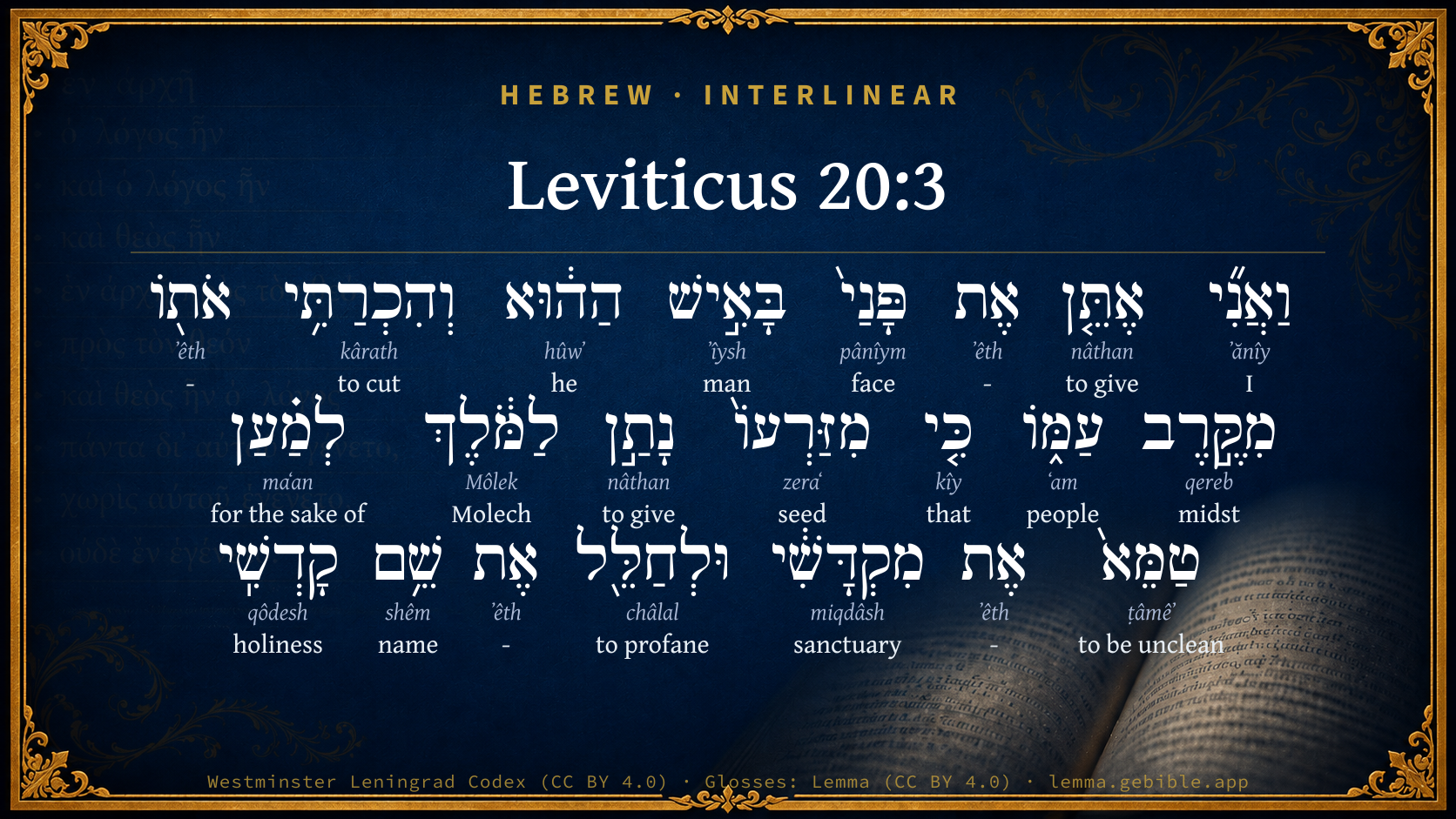
Hebrew (Westminster Leningrad Codex) Leviticus 20:3 appears in the Hebrew Old Testament. The text above is from the Westminster Leningrad Codex. Each word links to its Strong’s number, a concise gloss, and parsing drawn from the Open Scriptures Hebrew Bible morphology. Click any word for its full Brown-Driver-Briggs (BDB) entry.
Download image
Cite this verse

Leviticus 20:3 (World English Bible). Public Domain. Lemma interlinear Bible study tool, https://lemma.gebible.app/v/leviticus/20/3.

Show BibTeX & RIS
BibTeX
RIS
English Translation
I also will set my face against that person, and will cut him off from among his people because he has given of his seed to Molech, to defile my sanctuary, and to profane my holy name.
World English Bible · Public Domain
Download a study sheet

One document with this verse’s original text, its word-by-word gloss line, the meaning frame, cross-references with their text, attributed commentary, and full source and license credits — printable, and it pastes into notes with its structure intact.

This verse Autodidact and up

Study sheet (.html) Plain text (.txt)

A passage Seminary Student

Up to 50 verses in one chapter. A passage sheet keeps up to 6 commentary sources and 12 cross-references per verse, in the order this page ranks them, and says so on the sheet whenever that leaves anything out. Ask for a single verse and you get the Autodidact verse sheet above.

Everything on this page stays free to read, with no account — the sheet is a download of what is already on screen, not access to it.

Want to remove ads? Support Godless Engineer
Compare translations 3

The same verse in 3 English versions, stacked beneath the original-language interlinear above. Click any original word for its lexicon entry.

Each is an independent rendering of the whole verse — the interlinear is not word-aligned to these translations.

Highlighted words mark where these versions differ — a whole-verse word diff, not a word-by-word alignment.

  • World English Bible Public Domain
    I also will set my face against that person, and will cut him off from among his people because he has given of his seed to Molech, to defile my sanctuary, and to profane my holy name.
  • King James Version Public Domain
    And I will set my face against that man, and will cut him off from among his people; because he hath given of his seed unto Molech, to defile my sanctuary, and to profane my holy name.
  • unfoldingWord Literal Text CC BY-SA 4.0
    And I myself will set my face against that man, and I will cut him off from among his people, for he gave his seed to Molech, to make my Holy Place unclean and to profane my holy name.

unfoldingWord Literal Text — © unfoldingWord, licensed CC BY-SA 4.0. Word-aligned USFM3 via Door43 (git.door43.org/unfoldingWord/en_ult).

Versions to compare (up to 4)

3 of 4 selected

Show all 18 translations

Every available English version of this verse, each an independent rendering of the whole verse.

  • World English Bible Public Domain
    I also will set my face against that person, and will cut him off from among his people because he has given of his seed to Molech, to defile my sanctuary, and to profane my holy name.
  • Berean Standard Bible Public Domain
    And I will set My face against that man and cut him off from his people, because by giving his offspring to Molech, he has defiled My sanctuary and profaned My holy name.
  • Majority Standard Bible Public Domain
    And I will set My face against that man and cut him off from his people, because by giving his offspring to Molech, he has defiled My sanctuary and profaned My holy name.
  • King James Version Public Domain
    And I will set my face against that man, and will cut him off from among his people; because he hath given of his seed unto Molech, to defile my sanctuary, and to profane my holy name.
  • American Standard Version (1901) Public Domain
    I also will set my face against that man, and will cut him off from among his people; because he hath given of his seed unto Molech, to defile my sanctuary, and to profane my holy name.
  • Revised Version (1885) Public Domain
    I also will set my face against that man, and will cut him off from among his people; because he hath given of his seed unto Molech, to defile my sanctuary, and to profane my holy name.
  • Geneva Bible (1599) Public Domain
    And I will set my face against that man and cut him off from among his people, because he hath giuen his children vnto Molech, for to defile my Sanctuarie, and to pollute mine holy Name.
  • Douay-Rheims (1899) Public Domain
    And I will set my face against him: and I will cut him off from the midst of his people, because he hath given of his seed to Moloch, and hath defiled my sanctuary, and profaned my holy name.
  • Young's Literal Translation Public Domain
    and I -- I set My face against that man, and have cut him off from the midst of his people, for of his seed he hath given to the Molech, so as to defile My sanctuary, and to pollute My holy name.
  • Literal Standard Version CC BY-SA 4.0
    and I set My face against that man, and have cut him off from the midst of his people, for he has given to the Molech from his seed, so as to defile My sanctuary, and to defile My holy Name.
  • Unlocked Literal Bible CC BY-SA 4.0
    I also will set my face against that man and will cut him off from among his people because he has given his child to Molech, so as to defile my holy place and profane my holy name.
  • unfoldingWord Literal Text CC BY-SA 4.0
    And I myself will set my face against that man, and I will cut him off from among his people, for he gave his seed to Molech, to make my Holy Place unclean and to profane my holy name.
  • Darby Bible Public Domain
    And I will set my face against that man, and will cut him off from among his people; because he hath given of his seed unto Molech, so as to make my sanctuary unclean, and to profane my holy name.
  • World Messianic Bible Public Domain
    I also will set my face against that person, and will cut him off from among his people, because he has given of his offspring to Molech, to defile my sanctuary, and to profane my holy name.
  • Webster's Bible Public Domain
    And I will set my face against that man, and will cut him off from among his people; because he hath given of his seed to Molech, to defile my sanctuary, and to profane my holy name.
  • Free Bible Version CC BY-SA 4.0
    I will disown them and expel them from their people, because by sacrificing their children to Molech they have polluted my sanctuary and disgraced my reputation.
  • Bible in Basic English Public Domain
    And my face will be turned against that man, and he will be cut off from his people; because he has given his offspring to Molech, making my holy place unclean, and making my holy name common.
  • JPS Tanakh (1917) Public Domain
    I also will set My face against that man, and will cut him off from among his people, because he hath given of his seed unto Molech, to defile My sanctuary, and to profane My holy name.

Literal Standard Version (2020), Covenant Press — licensed CC BY-SA 4.0. Text via the HelloAO Bible API (eBible.org). Unlocked Literal Bible (unfoldingWord) — licensed CC BY-SA 4.0. Text via the HelloAO Bible API (eBible.org). unfoldingWord Literal Text — © unfoldingWord, licensed CC BY-SA 4.0. Word-aligned USFM3 via Door43 (git.door43.org/unfoldingWord/en_ult). Free Bible Version, Dr. Jonathan Gallagher — licensed CC BY-SA 4.0. Text via the HelloAO Bible API (eBible.org).

Word by word

More ways to search: Search by grammar → Find every occurrence → Compare this word →

Practice this passage: Drill this verse → Learn its vocabulary →

לַמֹּ֔לֶךְ
Môlek
H4432
“to/for the · Molech”
Preposition, Determined + Noun, Proper
Part of Speech
Preposition + Noun
Type
Proper
Full BDB Definition

Origin: from H4427

TWOT: 1199h

Molech = "king" - the god of the Ammonites and Phoenicians to whom some Israelites sacrificed their infants in the valley of Hinnom
  1. וַאֲנִ֞י ʼănîy H589 “and · I” Conjunction + Pronoun, Personal, 1st Person, Common, Singular
  2. אֶתֵּ֤ן nâthan H5414 “to give” Verb, Qal, Imperfect, 1st Person, Common, Singular
  3. אֶת ʼêth H853 “-” Particle, Direct Object
  4. פָּנַי֙ pânîym H6440 “face(s) · my” Noun, Common, Both, Plural, Construct + Suffix, Personal, 1st Person, Common, Singular
  5. בָּאִ֣ישׁ ʼîysh H376 “in/at the · man” Preposition, Determined + Noun, Common, Masculine, Singular, Absolute
  6. הַה֔וּא hûwʼ H1931 “the · he” Particle, Definite Article + Pronoun, Personal, 3rd Person, Masculine, Singular
  7. וְהִכְרַתִּ֥י kârath H3772 “and · to cut” Conjunction + Verb, Hiphil, Sequential Perfect, 1st Person, Common, Singular
  8. אֹת֖וֹ ʼêth H853 “- · him” Particle, Direct Object + Suffix, Personal, 3rd Person, Masculine, Singular
  9. מִקֶּ֣רֶב qereb H7130 “from · midst of” Preposition + Noun, Common, Masculine, Singular, Construct
  10. עַמּ֑וֹ ʻam H5971 “people · his” Noun, Common, Masculine, Singular, Construct + Suffix, Personal, 3rd Person, Masculine, Singular
  11. כִּ֤י kîy H3588 “that” Conjunction
  12. מִזַּרְעוֹ֙ zeraʻ H2233 “from · seed · his” Preposition + Noun, Common, Masculine, Singular, Construct + Suffix, Personal, 3rd Person, Masculine, Singular
  13. נָתַ֣ן nâthan H5414 “to give” Verb, Qal, Perfect, 3rd Person, Masculine, Singular
  14. לְמַ֗עַן maʻan H4616 “for the sake of” Preposition
  15. טַמֵּא֙ ṭâmêʼ H2930 “to be unclean” Verb, Piel, Infinitive Construct
  16. אֶת ʼêth H853 “-” Particle, Direct Object
  17. מִקְדָּשִׁ֔י miqdâsh H4720 “sanctuary · my” Noun, Common, Masculine, Singular, Construct + Suffix, Personal, 1st Person, Common, Singular
  18. וּלְחַלֵּ֖ל châlal H2490 “and · to profane” Conjunction + Preposition + Verb, Piel, Infinitive Construct
  19. אֶת ʼêth H853 “-” Particle, Direct Object
  20. שֵׁ֥ם shêm H8034 “name of” Noun, Common, Masculine, Singular, Construct
  21. קָדְשִֽׁי qôdesh H6944 “holiness · my” Noun, Common, Masculine, Singular, Construct + Suffix, Personal, 1st Person, Common, Singular

About this verse

These counts appear in no published source. They are computed here, from the morphology-tagged text and Lemma’s own curated glosses. What Lemma adds →

22
words
18
distinct lemmas
Pentateuch
section

Notable vocabulary

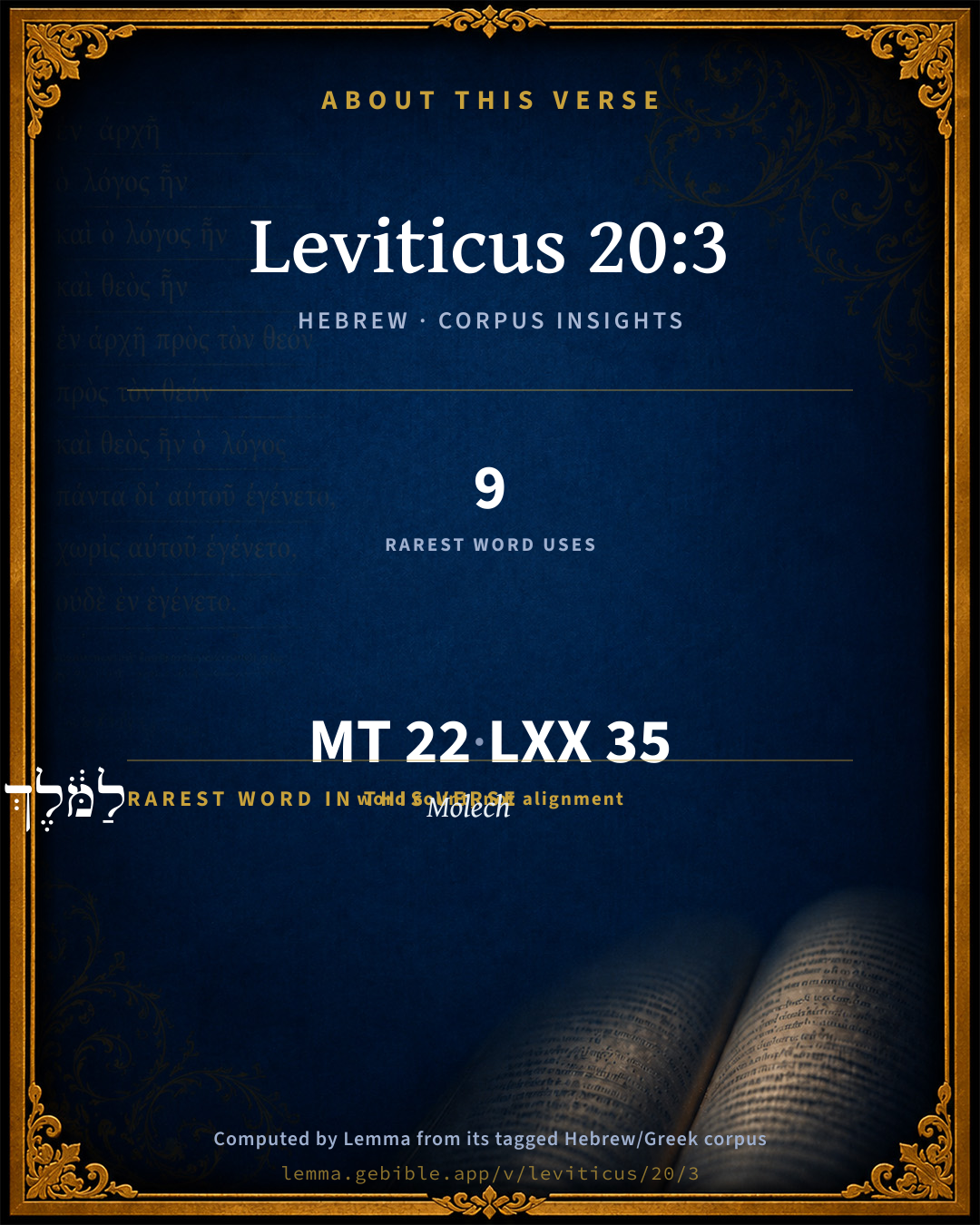
The rarest word here is לַמֹּ֔לֶךְ Molech H4432 — appearing just 9 times in the whole Hebrew Bible.

Shared distinctive vocabulary

לַמֹּ֔לֶךְ Molech H4432 occurs in 9 verses of the Hebrew Bible. Also found in:

Grammatical profile

  • 5 verbs
  • 9 nouns
  • 2 pronouns
  • 1 preposition
  • 1 conjunction
  • 4 particles

Verb forms

  • אֶתֵּ֤ן Qal · Imperfect
  • וְהִכְרַתִּ֥י Hiphil · Sequential Perfect
  • נָתַ֣ן Qal · Perfect
  • טַמֵּא֙ Piel · Infinitive Construct
  • וּלְחַלֵּ֖ל Piel · Infinitive Construct

Repetition

A word recurs within this verse — often emphatic in Hebrew:

  • אֶתֵּ֤ן to give H5414 ×2

Hebrew & Septuagint length

In English translation the verse runs 37 words from the Hebrew and 41 from the Septuagint (LXX English) — closely comparable.

A rough comparison of the two English renderings, which tokenize alike — not a word-level alignment.

Word counts can differ between the Hebrew and the Greek without any difference in meaning — e.g. the Hebrew direct-object marker אֵת has no separate Greek word, and Greek often adds the article ὁ.

In the original languages it is 22 Hebrew tokens and 35 Greek tokens — but the two are counted differently (Hebrew bundles its prefixes and suffixes into one token; the Greek is in lemma form), so that isn’t a like-for-like length.

Cross-references

9

Topical passages linked to Leviticus 20:3 in the Treasury of Scripture Knowledge — connected by theme and wording, ordered by reader-vote popularity; previews shown in the World English Bible.

  • Leviticus 18:21 "'You shall not give any of your children to sacrifice to Molech; neither shall you profane the name of your God: I am Yahweh.
  • Leviticus 17:10 "'Any man of the house of Israel, or of the strangers who live as foreigners among them, who eats any kind of blood, I will set my face against that soul who eats blood, and will cut him off from among his people.
  • Ezekiel 5:11 Therefore, as I live, says the Lord Yahweh, surely, because you have defiled my sanctuary with all your detestable things, and with all your abominations, therefore will I also diminish [you]; neither shall my eye spare, and I also will have no pity.
  • Ezekiel 23:38–39 Moreover this they have done to me: they have defiled my sanctuary in the same day, and have profaned my Sabbaths.
  • Leviticus 15:31 "'Thus you shall separate the children of Israel from their uncleanness, so they will not die in their uncleanness, when they defile my tabernacle that is in their midst.'"
  • Numbers 19:20 But the man who shall be unclean, and shall not purify himself, that soul shall be cut off from the midst of the assembly, because he has defiled the sanctuary of Yahweh: the water for impurity has not been sprinkled on him; he is unclean.
  • Ezekiel 20:39 As for you, house of Israel, thus says the Lord Yahweh: Go you, serve everyone his idols, and hereafter also, if you will not listen to me; but my holy name shall you no more profane with your gifts, and with your idols.
  • 2 Corinthians 6:16 What agreement has a temple of God with idols? For you are a temple of the living God. Even as God said, "I will dwell in them, and walk in them; and I will be their God, and they will be my people."
  • 1 Peter 3:12 For the eyes of the Lord are on the righteous, And his ears open to their prayer; But the face of the Lord is against those who do evil."

Cross-references courtesy of OpenBible.info (CC BY 4.0).

Hebrew and Greek witnesses Masoretic Hebrew ↔ Greek Septuagint

The same verse in the two great witnesses to the Old Testament, shown verse-for-verse.

These are two independent witnesses, not word-aligned to each other, and the Septuagint is shown in lemma (dictionary) form.

Hebrew Leviticus 20:3 Masoretic · Westminster Leningrad Codex

וַאֲנִ֞י אֶתֵּ֤ן אֶת פָּנַי֙ בָּאִ֣ישׁ הַה֔וּא וְהִכְרַתִּ֥י אֹת֖וֹ מִקֶּ֣רֶב עַמּ֑וֹ כִּ֤י מִזַּרְעוֹ֙ נָתַ֣ן לַמֹּ֔לֶךְ לְמַ֗עַן טַמֵּא֙ אֶת מִקְדָּשִׁ֔י וּלְחַלֵּ֖ל אֶת שֵׁ֥ם קָדְשִֽׁי

I also will set my face against that person, and will cut him off from among his people because he has given of his seed to Molech, to defile my sanctuary, and to profane my holy name.

World English Bible · Public Domain

Greek LXX Leviticus 20:3 Septuagint · lemma form

καί ἐγώ ἐπιἵστημι ὁ πρόσωπον ἐγώ ἐπί ὁ ἄνθρωπος ἐκεῖνος καί ἀποὀλλύω αὐτός ἐκ ὁ λαός αὐτός ὅτι ὁ σπέρμα αὐτός δίδωμι ἄρχων ἵνα μιαίνω ὁ ἅγιος ἐγώ καί βεβηλόω ὁ ὄνομα ὁ ἁγιάζω ἐγώ

And I will set my face against that man, and will cut him off from his people, because he has given of his seed to Moloch, to defile my sanctuary, and profane the name of them that are consecrated to me.

LXX2012 (modern English Septuagint) · Public Domain

Hebrew: Westminster Leningrad Codex (CC BY 4.0). Greek: Septuagint (public domain); English from LXX2012 (modern English Septuagint) (Public Domain). How the Septuagint differs from the Hebrew →

Targum (Aramaic paraphrase)

2

The Targum is the ancient Jewish Aramaic paraphrase of the Hebrew Scriptures — an interpretive translation, not the Hebrew text itself. Onkelos (literal) and Pseudo-Jonathan (expansive) render the Torah, and Jonathan the Prophets. Coverage is partial: where no permissively-licensed English translation exists for a verse, only the Aramaic is shown. This is verse-level text, not a word-by-word alignment to the Hebrew.

  1. Targum Onkelos Torah (Genesis–Deuteronomy)
    וַאֲנָא אֶתֵּן יָת רוּגְזִי בְגַבְרָא הַּהוּא וְאֱשֵׁיצֵי יָתֵהּ מִגוֹ עַמֵהּ אֲרֵי מִזַרְעֵהּ יְהַב לְמוֹלֶךְ בְּדִיל לְסָאָבָא יָת מַקְדְשִׁי וּלְאַחַלָא יָת שְׁמָא דְקוּדְשִׁי

    (no public-domain English translation for this verse)

    Targum Onkelos — Aramaic: “Onkelos Genesis” (public domain); “Onkelos Exodus” (public domain); “Onkelos Leviticus” (public domain); “Onkelos Numbers” (public domain); “Onkelos Deuteronomy” (public domain). English: “Sefaria Community Translation” (CC0 1.0 (public-domain dedication)); “J.W. Etheridge. The Targums of Onkelos and Jonathan Ben Uzziel on the Pentateuch. London: Longmans, Green, 1862” (public domain). Text via Sefaria.

  2. Targum Pseudo-Jonathan Torah (Genesis–Deuteronomy)
    וַאֲנָא אֶתֵּן פְּנוּיָיתָא לְמֶעֱסוֹק בְּגַבְרָא הַהוּא וְאֵישֵׁיצֵי יָתֵיהּ מִגוֹ עַמֵיהּ אֲרוּם מִזַרְעֵיהּ יְהַב לְפּוּלְחָנָא אוֹחֲרָא מִן בִּגְלַל לְסַאֲבָא יַת מַקְדָשִׁי וּלְאַפְסָא יַת שְׁמָא דְקוּדְשִׁי

    and I will cause a reverse, to make prosperity to cease with that man, and will cut him off from among his people; because he gave his offspring in strange worship to pollute My sanctuary and to profane My holy Name.

    Targum Pseudo-Jonathan — Aramaic: “Targum Jonathan on Genesis” (public domain); “Targum Jonathan on Exodus” (public domain); “Targum Jonathan on Leviticus” (public domain); “Targum Jonathan on Numbers” (public domain); “Targum Jonathan on Deuteronomy” (public domain). English: “The Targum of Jonathan ben Uzziel, trans. J. W. Etheridge, London, 1862” (public domain). Text via Sefaria.

Commentary

Notes on Leviticus 20:3 from classic Christian and Jewish commentators (each source and its license shown beneath its notes). The classic Christian expositions comment on the surrounding passage and are grouped to its opening verse, so a note may address several verses; the Jewish commentaries on the Tanakh (Rashi and others) are per-verse, so they appear only where the commentator wrote on this verse.

Lemma curates 59 commentaries, every one of them public domain or Creative Commons licensed, each selected and text-cleaned for this edition rather than reprinted as found. About our sources →

Trapp's Complete Commentary

John Trapp

Lev 20:3 And I will set my face against that man, and will cut him off from among his people; because he hath given of his seed unto Molech, to defile my sanctuary, and to profane my holy name.

Ver. 3. To defile my sanctuary.] Great sins do greatly pollute. See Lev 18:21.

John Trapp, A Commentary or Exposition upon All the Books of the Old and New Testament (1647–1656) — public domain. Text from a community e-Sword module.

Joseph Benson's Commentary

Lev 20:3. I will set my face against that man — Deal with him as an enemy, and make him a monument of my justice. To defile my sanctuary — Because the sanctuary was defiled by gross abominations committed in that city or land where God’s sanctuary was: or because by these actions they declared to all men that they esteemed the sanctuary and service of God abominable and vile, by preferring such odious idolatry before it. And to profane my name — Partly by despising it themselves, partly by disgracing it to others, and giving them occasion to blaspheme it, and to abhor the true religion.

Joseph Benson's Commentary on the Old and New Testaments (1811–1818) — public domain. Text from a community e-Sword module.

Geneva Bible (1599)

Geneva Bible translators

Read Lev. 17:10 and 18:21.

Geneva Bible (1599) marginal notes — public domain. Text via Bolls.life.

Ellicott's Commentary for English Readers

(3) And I will set my face against that man.—That is, make him feel my anger. (See Lev_17:10.)

And will cut him off.—As the preceding verse describes the offender as having been stoned to death by the people, the declaration on the part of God that He will cut off the sinner has occasioned some difficulty. Hence some take it simply to express the same thing—that the judicial execution is God’s mode of cutting off the sinner from his people. According to the administrators of the law during the second Temple, however, the legislator supposes a case where the man has been actually guilty of the crime, and that there has not been a sufficient amount of evidence to convict him. In that case God himself would interpose and cut the offender off. This is more in accordance with what follows.

To defile my sanctuary.—By sinning, the Israelites contracted defilement, and they defiled the sanctuary which was in their midst. (See Lev_15:31; Lev_16:16.) These very people, moreover, when they had sacrificed their children to Molech, afterwards came to the sanctuary to worship God (Jer_7:9-10; Eze_23:37-39).

Profane my holy name.—See Lev_18:21.

A Bible Commentary for English Readers, edited by Charles John Ellicott (1878–1897) — public domain. Text from a community e-Sword module.

John Gill's Exposition

And I will set my face against that man,.... Express resentment, anger, wrath, and indignation at him, see Psa 34:16,

and will cut him off from among his people: that is, supposing him to have been guilty of the above horrid crime, and there being not sufficient evidence given of it by witnesses, or the magistrates negligent in doing their duty; and the matter being known to God the omniscient, he, according this declaration, would deal with him himself, and cut him off out of the land of the living, from among his relations, friends, and neighbours, by his own immediate hand; otherwise the law before provided a penalty, which is death by stoning, whereby he would be effectually cut off from his people, and deprived of all natural, civil, and religious privileges in this life, and sent into everlasting punishment in another, unless forgiving grace should be vouchsafed:

because he hath given of his seed to Molech; an iniquity to be punished by the judge, and deserving of everlasting wrath and destruction:

to defile my sanctuary; not by doing this horrid action in it, but by coming into it, having done it; or by offering sacrifice in another place than where God had commanded, as well as such a sacrifice as was abominable to him, sacrifice being to be offered nowhere but on the altar of the Lord in the sanctuary. Jarchi interprets this of the congregation of Israel, which was sanctified to the Lord, in the midst of which this wickedness was committed, and with which they were polluted:

and to profane my holy name: by sacrificing to an idol, when sacrifice should be offered to God; and such a sacrifice as would cause the name of God, and his holy laws, and true religion, to be blasphemed and evil, spoken of among the Gentiles, Rom 2:23.

John Gill's Exposition of the Whole Bible (1746–1763) — public domain (CC PDM 1.0). Text via the HelloAO Bible API.

Haydock's Catholic Bible Commentary

I will thus execute vengeance upon him by the hands of his people; and, in case they neglect it, or the crime be secret, I will surely punish the guilty person, and all who may have consented to his wickedness, ver. 5. (Haydock) --- Face: Chaldean, "wrath," which manifests itself on the countenance. (Du Hamel)

George Leo Haydock (1774–1849), Haydock's Catholic Family Bible and Commentary, 1859 edition — public domain. Excludes Psalms (Douay-Rheims chapter numbering differs from Protestant) and Deuterocanonical books (Catholic canon only).

Matthew Poole's English Annotations

I will set my face against that man, i.e. deal with him as an enemy, and make him a monument of my justice, either by punishing him immediately and eminently, when the magistrate cannot or will not do it, or by adding to his corporal punishments my curse upon his soul and name. See Lev 17:10.

From among his people; from the number of his people, of what nation or kindred soever he was; or, from the land of the living.

To defile my sanctuary, which was done by this wickedness, either because such persons did, for the cover of their idolatry, come into God’s sanctuary, as the rest did; see Lev 15:31; or because the sanctuary was, and was said to be, defiled by gross abominations committed in that city or land where God’s sanctuary was; or because by these actions they did pronounce and declare to all men that they esteemed the sanctuary and service of God abominable and vile, by preferring such odious and pernicious idolatry before it.

And to profane my holy name; partly by despising it themselves, and partly by disgracing it to others, and giving them occasion to blaspheme it, and to abhor the true religion, because they saw it deserted and condemned by those that best knew it and once embraced it.

Matthew Poole's English Annotations on the Holy Bible (1683–1685) — public domain. Text from a community e-Sword/MySword module.

Whedon's Commentary on the Bible

Daniel D. Whedon

3. I will set my face — Should Israel connive at this horrible abomination, and through fear or motives of base and selfish policy refuse to execute my law, “I will be my own executioner,” says Jehovah.

Defile my sanctuary — It was not necessary to set up the service of Molech in the tabernacle in order to defile the abode of Jehovah, but any flagrant sin committed or permitted by Israel polluted the sanctuary.

Daniel D. Whedon (gen. ed.), Commentary on the Old and New Testaments (1874–1909) — public domain. Text from a community e-Sword module.

John Wesley's Explanatory Notes

I will set my face against that man - Deal with him as an enemy, and make him a monument of my justice. To defile my sanctuary - Because the sanctuary was defiled by gross abominations committed in that city or land where God's sanctuary was: or because by these actions they declared to all men that they esteemed the sanctuary and service of God abominable and vile, by preferring such odious idolatry before it. And to profane my name - Partly by despising it themselves, partly by disgracing it to others, and giving them occasion to blaspheme it, and to abhor the true religion.

John Wesley, Explanatory Notes Upon the Whole Bible (1754–1765) — public domain. Text via the GEBible commentary corpus.

Keil & Delitzsch

C. F. Keil & F. Delitzsch

By this punishment the nation only carried out the will of Jehovah; for He would cut off such a man (see at Lev 17:10 and Lev 18:21) for having defiled the sanctuary of Jehovah and desecrated the name of Jehovah, not because he had brought the sacrifice to Moloch into the sanctuary of Jehovah, as Movers supposes, but in the same sense in which all the sins of Israel defiled the sanctuary in their midst (Lev 15:31; Lev 16:16).

Keil & Delitzsch — Biblical Commentary on the Old Testament (1861–1891) — public domain (CC PDM 1.0). Text via the HelloAO Bible API. (Old Testament only.)

unfoldingWord translationNotes

Door43 World Missions Community

I also will set my face against that man

This idiom means he "firmly decided." AT: "I have made up my mind to oppose that man" (See: Idiom)

will set my face against

"will stare angrily at"

he has given his child

"he has sacrificed his child"

so as to defile my holy place and profane my holy name

"and by doing that, he has defiled my holy place and profaned my holy name"

profane my holy name

God's name represents God and his reputation. AT: "dishonor my reputation" or "dishonor me" (See: Metonymy and Metaphor)

close their eyes to

The phrase "to close their eyes" implies they "cannot see." This speaks of ignoring something as not seeing. AT: "disregard" or "ignore" (See: Metonymy)

who prostitutes himself in order to play the harlot with Molech

This phrase compares those who are unfaithful to Yahweh to prostitutes. AT: "who is unfaithful to Yahweh" (See: Metaphor)

translationWords

face

cut off

people group

Molech

defile

holy place

profane

holy

name

die

clan

prostitute

unfoldingWord translationNotes — © Distant Shores Media and the Door43 World Missions Community, licensed CC BY-SA 4.0. Source: git.door43.org/Door43/en_tn.

Rashi

Rabbi Shlomo Yitzchaki (Rashi)

אתן את פני ‎ is taken in the sense of, פנאי שלי, My leisure — I shall turn away from everything else that I am occupied with, and will busy Myself with him alone (Sifra, Kedoshim, Section 4 13; cf. Rashi on Leviticus 17:10).

באיש AGAINST THAT MAN — but not against the whole congregation if they thus sin (Sifra, Kedoshim, Section 4 13), for the community as a whole is never punished with excision.

כי מזרעו נתן למלך BECAUSE HE HATH GIVEN OF HIS SEED TO THE MOLECH — These words appear to be redundant since in v. 20 the nature of the sin is already mentioned, but because Scripture states (Deuteronomy 18:10) “[There shall not be found among you] any one that maketh his son or his daughter pass through the fire", one might think that this law applies only to ones children; whence do we know that it applies also to one’s son's son and one's daughter’s son? Because Scripture states here, “because he hath given of his offspring to the Molech". Whence do we know that illegitimate offspring are also included in this law? Because Scripture states again (v. 4) “when he giveth of his seed to the Molech” — whether legitimate or not (Sifra, Kedoshim, Section 4 6-7; Sanhedrin 64b).

למען טמא את מקדשי TO DEFILE MY מקדש — This means the “Congregation of Israel" which is sanctified to Me. The word מקדש does not imply the Sanctuary only but anything that is holy to God, as in the expression (Leviticus 21:23) “that he profane not my holy things (‎‎‏מקדשי‎).

Rashi on the Tanakh — English translations: “The Judaica Press complete Tanach with Rashi, translated by A. J. Rosenberg” (CC BY 4.0); “Pentateuch with Rashi's commentary by M. Rosenbaum and A.M. Silbermann, 1929-1934” (public domain); “The Metsudah Tanach series, Lakewood, N.J” (CC BY 4.0); and “The Book of Joshua, Metsudah Publications, 1997” (CC BY 4.0). Text via Sefaria.

Ramban (Nachmanides)

Rabbi Moshe ben Nachman (Ramban / Nachmanides)

BECAUSE HE HATH GIVEN OF HIS SEED UNTO MOLECH, TO DEFILE MY SANCTUARY — “The congregation of Israel which is sanctified unto Me.” This is Rashi’s language. I have already hinted at this, how on account of one man’s sin the congregation of Israel which is sanctified to His Great Name can become defiled. And the Sages have [also] already hinted at this in their homiletic interpretations when saying: “He who enjoys anything of this world without saying a benediction, is considered as if he had robbed the Holy One, blessed be He, and the congregation of Israel, as it is said, Whoso robbeth his father or his mother, and saith: ‘It is no transgression,’ the same is the companion of a destroyer. The expression his father refers only to the Holy One, blessed be He, and his mother refers only to the congregation of Israel. The same is the companion of the destroyer, he is a companion of Jeroboam, the son of Nebat, who caused Israel to sin, against their Father in heaven.” For the purpose of Creation was that people should offer their benediction over [its bounties] to the Great Name, assuring thereby the existence of the world, but if that is not done, the Great Name is raised on high and the Divine Presence is removed from Israel, and surely this happens all the more so when a person offers his seed to the Molech, and thereby causes that He abhor the pride of Jacob and His dwelling place [i.e., the Sanctuary]. This is the meaning of the expression, the people of the Land shall stone him with stones, for He did not say: “he shall surely be put to death; they shall stone him with stones,” as is mentioned in all such cases,. Also ibid., 24:16. but instead mentions the people of the Land, meaning to say that all the people of the Land — all Israel — are obliged to precede to stone him, for [having given of his seed to Molech] he has harmed everybody, because he has caused that the Divine Presence be removed from Israel. It is for this reason that Onkelos translated [the expression, the people of the Land]: “the people of the house of Israel,” for the term the Land alludes to the whole Land of Israel, not merely the land wherein the worshipper [of the Molech] happens to reside, this being similar [to the expression], for all the earth is Mine. The secret thereof you will also be able to understand from that which Scripture mentions with reference to [the punishment of] excision for worshipping the Molech, I also will set My face against that man, and again, then will I set My face against that man, meaning that My Great and Fearful Name will cut him off. The word “I” He did not mention in the case of excision for practicing the sorcery of the ov or the yide’oni, nor in the case of any other such punishment. I have already stated the reason for all this to all who understand.

Ramban (Nachmanides) on the Tanakh — English translation: “Commentary on the Torah by Ramban (Nachmanides). Translated and annotated by Charles B. Chavel. New York, Shilo Pub. House, 1971-1976” (CC BY 4.0). Text via Sefaria.

Lesson kit

Teaching starters — assembled from the data on this page, not authored interpretation. Every prompt links to the verse data it draws on. Edit before teaching.

Leviticus, in the Pentateuch, opens this verse with 22 words (18 distinct Hebrew lemmas). Its most distinctive word is Môlek (“Molech”). A historical commentator’s framing appears above. Read the whole chapter for the surrounding context.

Discussion questions

  1. How does “Molech” (Môlek) shape what this verse is saying?
  2. How does Leviticus 18:21, which shares the word «Molech», read alongside this verse?
  3. What does the repetition of “to give” (2× in this one verse) do in this verse?
  4. The translations on this page render this verse differently — a whole-verse word diff, not a word-by-word alignment. What might account for the different wordings?
  5. «אֶתֵּ֤ן» is a Qal Imperfect verb. How does that grammatical form shape the action described?
  6. Compare how Trapp's Complete Commentary and Joseph Benson's Commentary read this verse. Where do they agree or differ?

Things to notice

Reading settings

Reading text

Shown beneath each verse's original-language words.

Old Testament
Old Testament edition

Read the OT as the Masoretic Hebrew (MT) or the Greek Septuagint (LXX).

English shown for the Greek Septuagint (in the Hebrew ↔ Greek comparison).

Comparing translations? Open the Compare panel on any verse page to stack up to four side by side.