Leviticus 21:8

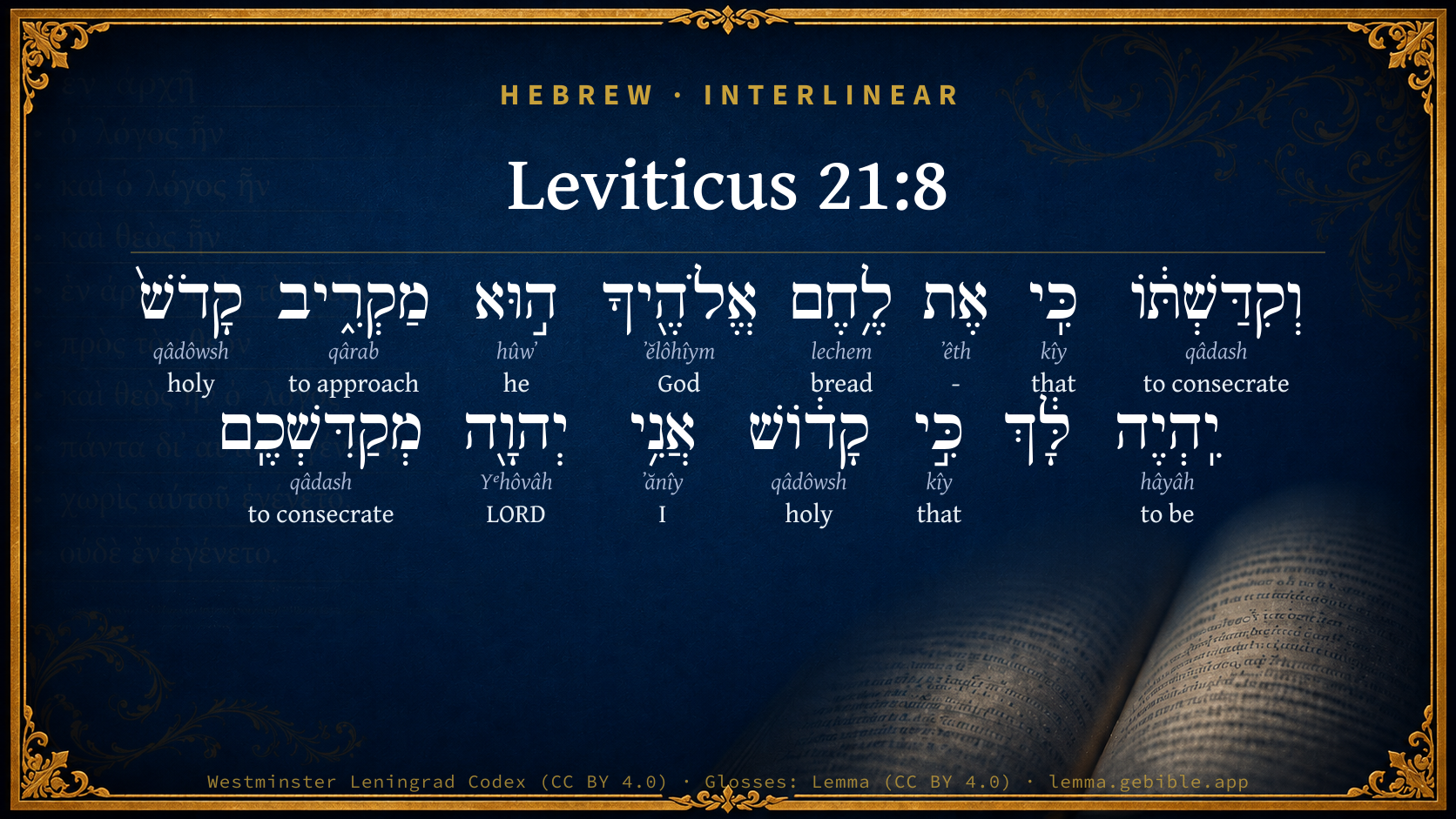
Hebrew (Westminster Leningrad Codex) Leviticus 21:8 appears in the Hebrew Old Testament. The text above is from the Westminster Leningrad Codex. Each word links to its Strong’s number, a concise gloss, and parsing drawn from the Open Scriptures Hebrew Bible morphology. Click any word for its full Brown-Driver-Briggs (BDB) entry.
Download image
Cite this verse

Leviticus 21:8 (World English Bible). Public Domain. Lemma interlinear Bible study tool, https://lemma.gebible.app/v/leviticus/21/8.

Show BibTeX & RIS
BibTeX
RIS
English Translation
You shall sanctify him therefore; for he offers the bread of your God: he shall be holy to you: for I Yahweh, who sanctify you, am holy.
World English Bible · Public Domain
Download a study sheet

One document with this verse’s original text, its word-by-word gloss line, the meaning frame, cross-references with their text, attributed commentary, and full source and license credits — printable, and it pastes into notes with its structure intact.

This verse Autodidact and up

Study sheet (.html) Plain text (.txt)

A passage Seminary Student

Up to 50 verses in one chapter. A passage sheet keeps up to 6 commentary sources and 12 cross-references per verse, in the order this page ranks them, and says so on the sheet whenever that leaves anything out. Ask for a single verse and you get the Autodidact verse sheet above.

Everything on this page stays free to read, with no account — the sheet is a download of what is already on screen, not access to it.

Want to remove ads? Support Godless Engineer
Compare translations 3

The same verse in 3 English versions, stacked beneath the original-language interlinear above. Click any original word for its lexicon entry.

Each is an independent rendering of the whole verse — the interlinear is not word-aligned to these translations.

Highlighted words mark where these versions differ — a whole-verse word diff, not a word-by-word alignment.

  • World English Bible Public Domain
    You shall sanctify him therefore; for he offers the bread of your God: he shall be holy to you: for I Yahweh, who sanctify you, am holy.
  • King James Version Public Domain
    Thou shalt sanctify him therefore; for he offereth the bread of thy God: he shall be holy unto thee: for I the LORD, which sanctify you, am holy.
  • unfoldingWord Literal Text CC BY-SA 4.0
    And you shall make him holy, for he is the one presenting the bread of your God. He shall be holy for you, because holy I, Yahweh, the one making you holy.

unfoldingWord Literal Text — © unfoldingWord, licensed CC BY-SA 4.0. Word-aligned USFM3 via Door43 (git.door43.org/unfoldingWord/en_ult).

Versions to compare (up to 4)

3 of 4 selected

Show all 18 translations

Every available English version of this verse, each an independent rendering of the whole verse.

  • World English Bible Public Domain
    You shall sanctify him therefore; for he offers the bread of your God: he shall be holy to you: for I Yahweh, who sanctify you, am holy.
  • Berean Standard Bible Public Domain
    You are to regard him as holy, since he presents the food of your God. He shall be holy to you, because I the LORD am holy—I who set you apart.
  • Majority Standard Bible Public Domain
    You are to regard him as holy, since he presents the food of your God. He shall be holy to you, because I the LORD am holy—I who set you apart.
  • King James Version Public Domain
    Thou shalt sanctify him therefore; for he offereth the bread of thy God: he shall be holy unto thee: for I the LORD, which sanctify you, am holy.
  • American Standard Version (1901) Public Domain
    Thou shalt sanctify him therefore; for he offereth the bread of thy God: he shall be holy unto thee: for I Jehovah, who sanctify you, am holy.
  • Revised Version (1885) Public Domain
    Thou shalt sanctify him therefore; for he offereth the bread of thy God: he shall be holy unto thee: for I the LORD, which sanctify you, am holy.
  • Geneva Bible (1599) Public Domain
    Thou shalt sanctifie him therefore, for he offereth the bread of thy God: he shall be holy vnto thee: for I the Lord, which sanctifie you, am holy.
  • Douay-Rheims (1899) Public Domain
    And offer the leaves of proposition. Let them therefore be holy, because I also am holy, the Lord, who sanctify them.
  • Young's Literal Translation Public Domain
    and thou hast sanctified him, for the bread of thy God he is bringing near; he is holy to thee; for holy `am' I, Jehovah, sanctifying you.
  • Literal Standard Version CC BY-SA 4.0
    and you have sanctified him, for he is bringing the bread of your God near. He is holy to you, for I, YHWH, sanctifying you, [am] holy.
  • Unlocked Literal Bible CC BY-SA 4.0
    You will set him apart, for he is the one who offers bread to your God. He must be holy to you, because I, Yahweh who makes you holy, am holy.
  • unfoldingWord Literal Text CC BY-SA 4.0
    And you shall make him holy, for he is the one presenting the bread of your God. He shall be holy for you, because holy I, Yahweh, the one making you holy.
  • Darby Bible Public Domain
    And thou shalt hallow him; for the bread of thy God doth he present: he shall be holy unto thee; for I, Jehovah, who hallow you am holy.
  • World Messianic Bible Public Domain
    Therefore you shall sanctify him, for he offers the bread of your God. He shall be holy to you, for I the LORD, who sanctify you, am holy.
  • Webster's Bible Public Domain
    Thou shalt sanctify him therefore, for he offereth the bread of thy God: he shall be holy to thee: for I the LORD, who sanctify you, am holy.
  • Free Bible Version CC BY-SA 4.0
    You shall consider him holy because he presents the food offerings to your God. He shall be holy to you, because I am holy. I am the Lord, and I chose you as my special people.
  • Bible in Basic English Public Domain
    And he is to be holy in your eyes, for by him the bread of your God is offered; he is to be holy in your eyes, for I the Lord, who make you holy, am holy.
  • JPS Tanakh (1917) Public Domain
    Thou shalt sanctify him therefore; for he offereth the bread of thy God; he shall be holy unto thee; for I the LORD, who sanctify you, am holy.

Literal Standard Version (2020), Covenant Press — licensed CC BY-SA 4.0. Text via the HelloAO Bible API (eBible.org). Unlocked Literal Bible (unfoldingWord) — licensed CC BY-SA 4.0. Text via the HelloAO Bible API (eBible.org). unfoldingWord Literal Text — © unfoldingWord, licensed CC BY-SA 4.0. Word-aligned USFM3 via Door43 (git.door43.org/unfoldingWord/en_ult). Free Bible Version, Dr. Jonathan Gallagher — licensed CC BY-SA 4.0. Text via the HelloAO Bible API (eBible.org).

Word by word

More ways to search: Search by grammar → Find every occurrence → Compare this word →

Practice this passage: Drill this verse → Learn its vocabulary →

קָדֹשׁ֙
qâdôwsh
H6918
“holy”
Adjective, Adjective, Masculine, Singular, Absolute
Part of Speech
Adjective
Type
Adjective
Gender
Masculine
Number
Singular
State
Absolute
Full BDB Definition

Origin: from H6942

TWOT: 1990b

sacred, holy, Holy One, saint, set apart
  1. וְקִדַּשְׁתּ֔וֹ qâdash H6942 “and · to consecrate · him” Conjunction + Verb, Piel, Sequential Perfect, 2nd Person, Masculine, Singular + Suffix, Personal, 3rd Person, Masculine, Singular
  2. כִּֽי kîy H3588 “that” Conjunction
  3. אֶת ʼêth H853 “-” Particle, Direct Object
  4. לֶ֥חֶם lechem H3899 “bread of” Noun, Common, Both, Singular, Construct
  5. אֱלֹהֶ֖יךָ ʼĕlôhîym H430 “God(s) · your” Noun, Common, Masculine, Plural, Construct + Suffix, Personal, 2nd Person, Masculine, Singular
  6. ה֣וּא hûwʼ H1931 “he” Pronoun, Personal, 3rd Person, Masculine, Singular
  7. מַקְרִ֑יב qârab H7126 “approaching” Verb, Hiphil, Participle Active, Masculine, Singular, Absolute
  8. יִֽהְיֶה hâyâh H1961 “to be” Verb, Qal, Imperfect, 3rd Person, Masculine, Singular
  9. כִּ֣י kîy H3588 “that” Conjunction
  10. קָד֔וֹשׁ qâdôwsh H6918 “holy” Adjective, Adjective, Masculine, Singular, Absolute
  11. אֲנִ֥י ʼănîy H589 “I” Pronoun, Personal, 1st Person, Common, Singular
  12. יְהוָ֖ה Yᵉhôvâh H3068 “LORD” Noun, Proper
  13. מְקַדִּשְׁכֶֽם qâdash H6942 “consecrating · you” Verb, Piel, Participle Active, Masculine, Singular, Construct + Suffix, Personal, 2nd Person, Masculine, Plural

About this verse

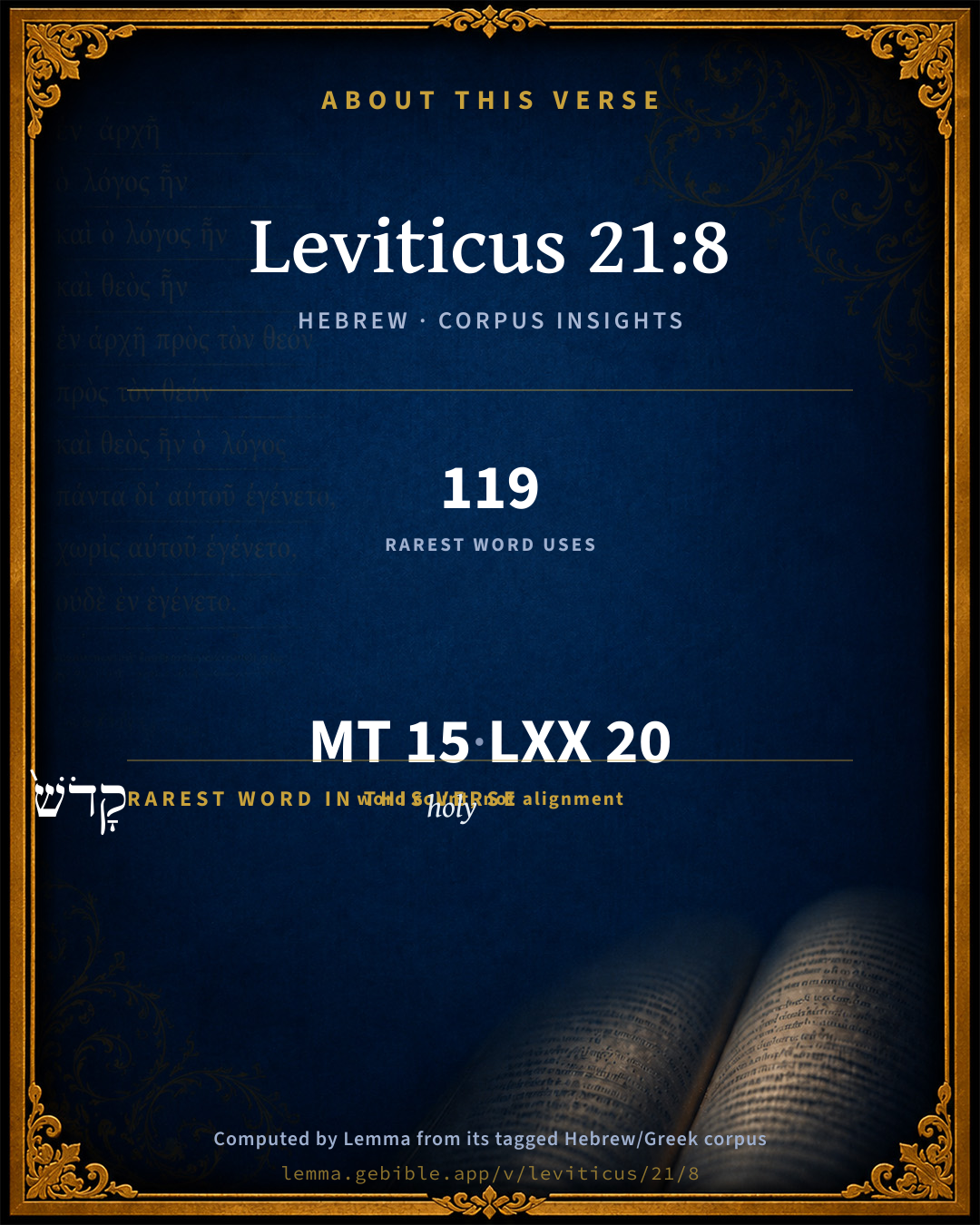
These counts appear in no published source. They are computed here, from the morphology-tagged text and Lemma’s own curated glosses. What Lemma adds →

15
words
11
distinct lemmas
Pentateuch
section

Grammatical profile

  • 4 verbs
  • 3 nouns
  • 2 adjectives
  • 2 pronouns
  • 1 preposition
  • 2 conjunctions
  • 1 particle

Verb forms

  • וְקִדַּשְׁתּ֔וֹ Piel · Sequential Perfect
  • מַקְרִ֑יב Hiphil · Participle Active
  • יִֽהְיֶה Qal · Imperfect
  • מְקַדִּשְׁכֶֽם Piel · Participle Active

Repetition

Words recur within this verse — often emphatic in Hebrew:

  • וְקִדַּשְׁתּ֔וֹ to consecrate H6942 ×2
  • קָדֹשׁ֙ holy H6918 ×2
  • כִּֽי that H3588 ×2

Hebrew & Septuagint length

In English translation the verse runs 27 words from the Hebrew and 27 from the Septuagint (LXX English) — the same length.

A rough comparison of the two English renderings, which tokenize alike — not a word-level alignment.

Word counts can differ between the Hebrew and the Greek without any difference in meaning — e.g. the Hebrew direct-object marker אֵת has no separate Greek word, and Greek often adds the article ὁ.

In the original languages it is 15 Hebrew tokens and 20 Greek tokens — but the two are counted differently (Hebrew bundles its prefixes and suffixes into one token; the Greek is in lemma form), so that isn’t a like-for-like length.

Cross-references

13

Topical passages linked to Leviticus 21:8 in the Treasury of Scripture Knowledge — connected by theme and wording, ordered by reader-vote popularity; previews shown in the World English Bible.

  • Leviticus 20:7–8 "'Sanctify yourselves therefore, and be holy; for I am Yahweh your God.
  • Leviticus 11:44–45 For I am Yahweh your God. Sanctify yourselves therefore, and be holy; for I am holy: neither shall you defile yourselves with any kind of creeping thing that moves on the earth.
  • Leviticus 19:2 "Speak to all the congregation of the children of Israel, and tell them, 'You shall be holy; for I Yahweh your God am holy.
  • Leviticus 21:6 They shall be holy to their God, and not profane the name of their God; for they offer the offerings of Yahweh made by fire, the bread of their God; therefore they shall be holy.
  • John 17:19 For their sakes I sanctify myself, that they themselves also may be sanctified in truth.
  • Hebrews 7:26 For such a high priest was fitting for us: holy, guiltless, undefiled, separated from sinners, and made higher than the heavens;
  • Exodus 19:10 Yahweh said to Moses, "Go to the people, and sanctify them today and tomorrow, and let them wash their garments,
  • Exodus 19:14 Moses went down from the mountain to the people, and sanctified the people; and they washed their clothes.
  • Exodus 28:41 You shall put them on Aaron your brother, and on his sons with him, and shall anoint them, and consecrate them, and sanctify them, that they may minister to me in the priest's office.
  • Exodus 29:1 "This is the thing that you shall do to them to make them holy, to minister to me in the priest's office: take one young bull and two rams without blemish,
  • Exodus 29:43–44 There I will meet with the children of Israel; and the place shall be sanctified by my glory.
  • John 10:36 Do you say of him whom the Father sanctified and sent into the world, 'You blaspheme,' because I said, 'I am the Son of God?'
  • Hebrews 10:29 How much worse punishment, do you think, will he be judged worthy of, who has trodden under foot the Son of God, and has counted the blood of the covenant with which he was sanctified an unholy thing, and has insulted the Spirit of grace?

Cross-references courtesy of OpenBible.info (CC BY 4.0).

Hebrew and Greek witnesses Masoretic Hebrew ↔ Greek Septuagint

The same verse in the two great witnesses to the Old Testament, shown verse-for-verse.

These are two independent witnesses, not word-aligned to each other, and the Septuagint is shown in lemma (dictionary) form.

Hebrew Leviticus 21:8 Masoretic · Westminster Leningrad Codex

וְקִדַּשְׁתּ֔וֹ כִּֽי אֶת לֶ֥חֶם אֱלֹהֶ֖יךָ ה֣וּא מַקְרִ֑יב קָדֹשׁ֙ יִֽהְיֶה לָּ֔ךְ כִּ֣י קָד֔וֹשׁ אֲנִ֥י יְהוָ֖ה מְקַדִּשְׁכֶֽם

You shall sanctify him therefore; for he offers the bread of your God: he shall be holy to you: for I Yahweh, who sanctify you, am holy.

World English Bible · Public Domain

Greek LXX Leviticus 21:8 Septuagint · lemma form

καί ἁγιάζω αὐτός ὁ δῶρον κύριος ὁ θεός σύ οὗτος προςφέρω ἅγιος εἰμί ὅτι ἅγιος ἐγώ κύριος ὁ ἁγιάζω αὐτός

And you shall hallow him; he offers the gifts of the Lord your God: he shall be holy, for I the Lord that sanctify them am holy.

LXX2012 (modern English Septuagint) · Public Domain

Hebrew: Westminster Leningrad Codex (CC BY 4.0). Greek: Septuagint (public domain); English from LXX2012 (modern English Septuagint) (Public Domain). How the Septuagint differs from the Hebrew →

Targum (Aramaic paraphrase)

2

The Targum is the ancient Jewish Aramaic paraphrase of the Hebrew Scriptures — an interpretive translation, not the Hebrew text itself. Onkelos (literal) and Pseudo-Jonathan (expansive) render the Torah, and Jonathan the Prophets. Coverage is partial: where no permissively-licensed English translation exists for a verse, only the Aramaic is shown. This is verse-level text, not a word-by-word alignment to the Hebrew.

  1. Targum Onkelos Torah (Genesis–Deuteronomy)
    וּתְקַדְשִׁנֵהּ אֲרֵי יָת קֻרְבַּן אֱלָהָךְ הוּא מְקָרֵב קַדִישׁ יְהֵא לָךְ אֲרֵי קַדִישׁ אֲנָא יְיָ מְקַדִשְׁכוֹן

    (no public-domain English translation for this verse)

    Targum Onkelos — Aramaic: “Onkelos Genesis” (public domain); “Onkelos Exodus” (public domain); “Onkelos Leviticus” (public domain); “Onkelos Numbers” (public domain); “Onkelos Deuteronomy” (public domain). English: “Sefaria Community Translation” (CC0 1.0 (public-domain dedication)); “J.W. Etheridge. The Targums of Onkelos and Jonathan Ben Uzziel on the Pentateuch. London: Longmans, Green, 1862” (public domain). Text via Sefaria.

  2. Targum Pseudo-Jonathan Torah (Genesis–Deuteronomy)
    וְתַקְדְשִׁינֵיהּ לְכַהֲנָא אֲרוּם יַת קוּרְבַּן אֱלָהָךְ הוּא מַקְרִיב קַדִישׁ יְהֵי לָךְ וְלָא תַפְסִינֵיהּ אֲרוּם קַדִישׁ אֲנָא יְיָ מְקַדִשְׁכוֹן

    Thou shalt sanctify him unto the priesthood; for the oblation itself of thy God he is to offer: he shall be holy to thee, and thou shalt not make him profane: I, the Lord who sanctify you, am holy.

    Targum Pseudo-Jonathan — Aramaic: “Targum Jonathan on Genesis” (public domain); “Targum Jonathan on Exodus” (public domain); “Targum Jonathan on Leviticus” (public domain); “Targum Jonathan on Numbers” (public domain); “Targum Jonathan on Deuteronomy” (public domain). English: “The Targum of Jonathan ben Uzziel, trans. J. W. Etheridge, London, 1862” (public domain). Text via Sefaria.

Commentary

Notes on Leviticus 21:8 from classic Christian and Jewish commentators (each source and its license shown beneath its notes). The classic Christian expositions comment on the surrounding passage and are grouped to its opening verse, so a note may address several verses; the Jewish commentaries on the Tanakh (Rashi and others) are per-verse, so they appear only where the commentator wrote on this verse.

Lemma curates 59 commentaries, every one of them public domain or Creative Commons licensed, each selected and text-cleaned for this edition rather than reprinted as found. About our sources →

Trapp's Complete Commentary

John Trapp

Lev 21:8 Thou shalt sanctify him therefore; for he offereth the bread of thy God: he shall be holy unto thee: for I the LORD, which sanctify you, [am] holy.

Ver. 8. Thou shalt sanctify him.] i.e., Thou, Moses, shalt command him to be sanctified, as Exo 19:10.

John Trapp, A Commentary or Exposition upon All the Books of the Old and New Testament (1647–1656) — public domain. Text from a community e-Sword module.

Joseph Benson's Commentary

Lev 21:8. Thou — O Moses, and whosoever shall succeed in thy place, to whom it belongs to see my laws observed, shalt take care that the priest be holy, and do not defile himself by any of these forbidden marriages.

Joseph Benson's Commentary on the Old and New Testaments (1811–1818) — public domain. Text from a community e-Sword module.

Scofield Reference Notes

C. I. Scofield

sanctify

Lev 21:8 illustrates the O.T. holiness or sanctification--a person set apart for the service of God.

sanctify

Heb. "qodesh." (See Scofield "Gen 2:3").

The Scofield Reference Bible (1917 edition), notes by C. I. Scofield — public domain. Text from a community e-Sword module.

Geneva Bible (1599)

Geneva Bible translators

Thou shalt count them holy and reverence them.

The showbread.

Geneva Bible (1599) marginal notes — public domain. Text via Bolls.life.

Ellicott's Commentary for English Readers

(8) Thou shalt sanctify him therefore.—This is addressed to the Jewish community. They are to take care that the priest does not contract such illegal marriages, and to sanctify him only who acts in obedience to these statutes. The Jewish priest is thus placed under the supervision of the people. His sacred office, and his duly performing the priestly functions. are their concern. If he refused to conform to the law of sanctity, the people, according to the administrators of the Law during the second Temple, were to compel him to do so by the penalty of administering to him the prescribed number of stripes.

He shall be holy unto thee.—On the other hand, when he acts in accordance with his sacred office, the people must reverence his holy person. Hence the administrators of the Law during the second Temple enacted that the priest is to take precedence on public occasions. Thus, when the people assemble, he opens the meeting by invoking God’s blessing. At the reading of the Law of God in the synagogue, he is called up first to the rostrum to read the first portion, and at table he recites the benedictions over the repast. This honour the Jews assign to the priests to this day.

A Bible Commentary for English Readers, edited by Charles John Ellicott (1878–1897) — public domain. Text from a community e-Sword module.

The Cambridge Bible for Schools and Colleges

gen. ed. J. J. S. Perowne

8. This v. has all the air of an insertion. It interrupts the transition from the character of the priest’s wife to that of his daughter; and ‘thou’ is harsh. Who is addressed? It may be an insertion (so Oxf. Hex.) by the compiler from an older code to enforce the sanctity of the priesthood.

the bread of thy God] See on Lev_21:6.

The Cambridge Bible for Schools and Colleges (gen. ed. J. J. S. Perowne; Cambridge University Press, 1878–1918) — public domain. Text from a community e-Sword module.

John Gill's Exposition

Thou shalt sanctify him therefore,.... In thought and word, as Aben Ezra, by thinking and speaking well of him; should esteem and reckon him a holy person, being in a sacred office, and honour him as such; and do all that can be done to preserve him from unholiness and impurity, and particularly from marrying with improper and unsuitable persons, such as would bring a scandal on him and his sacred office: this seems to be spoken to Moses, and so to the civil magistrate in succession, who were not to suffer such marriages to take place in the priesthood; and were not only to persuade from it, but to exercise their authority, and oblige them to put away such wives, and if they refused, to use severity; so Jarchi,""thou shalt sanctify him", whether he will or not; if he will not put her away, beat him and chastise him until he does put "her away",''see Ezr 2:62,

for he offereth the bread of the Lord; meaning not the shewbread he set in order before the Lord every week, but the various gift and sacrifices which were offered to God by him, and were acceptable to him as his food; and therefore he ought to be holy that drew nigh to God, and was employed in such service, see Lev 21:6,

he shall be holy unto thee; in thy account and estimation, and for thy service to offer holy sacrifices, and therefore should be careful of his holiness to preserve it:

for I the Lord, which sanctify you, am holy; in his nature, works, and ways, and who had separated them from all other people to be a holy people to him, and therefore they that ministered in holy things for them should be holy likewise.

John Gill's Exposition of the Whole Bible (1746–1763) — public domain (CC PDM 1.0). Text via the HelloAO Bible API.

Albert Barnes' Notes on the Bible

The people of Israel are now addressed. They are commanded to regard the priests, who perform for them the service of the altar, as holy in respect of their office.

Albert Barnes' Notes on the Bible (1834–1885) — public domain. Text from a community e-Sword/MySword module.

Haydock's Catholic Bible Commentary

And offer. Hebrew addresses this to Moses. "Thou shalt sanctify him, therefore, because he offereth the bread of thy God."

George Leo Haydock (1774–1849), Haydock's Catholic Family Bible and Commentary, 1859 edition — public domain. Excludes Psalms (Douay-Rheims chapter numbering differs from Protestant) and Deuterocanonical books (Catholic canon only).

Matthew Poole's English Annotations

Thou, O Moses, and whosoever shall succeed in thy place, to whom it belongs to see those and other of my laws observed, shall take care that the priest be holy, and do not defile himself by any of these forbidden marriages, though he would do it.

He shall be holy unto thee; either

1. In thy esteem, and therefore shall not give thee cause to think meanly and irreverently of him by his defiling or debasing of himself with irregular mixtures. Or,

2. To thy use or service, in whose name he is to act with God, and therefore shall preserve himself in a state of holiness and acceptation with God. For I the Lord am holy, and therefore my ministers must be such also.

Matthew Poole's English Annotations on the Holy Bible (1683–1685) — public domain. Text from a community e-Sword/MySword module.

John Wesley's Explanatory Notes

Thou - O Moses, and whosoever shall succeed in thy place, to whom it belongs to see my laws observed, shall take care that the priest be holy, and do not defile himself by any of these forbidden marriages.

John Wesley, Explanatory Notes Upon the Whole Bible (1754–1765) — public domain. Text via the GEBible commentary corpus.

Rashi

Rabbi Shlomo Yitzchaki (Rashi)

וקדשתו THOU SHALT SANCTIFY HIM — even against his will; it means that if he is not willing to divorce the woman whom he had illegally married flog him (מלקות ארבעים) and chastise him (מכות מרדות) until he divorces her (Sifra, Emor, Chapter 1 13; Yevamot 88b).

קדש יהיה לך HE SHALL BE HOLY UNTO THEE — holy unto thee: treat him with sanctity (as someone holy) — that he should be the first in all holy matters (e. g., the reading of the law) and that he should have the first right to recite the benedictions at a meal (המוציא and ברכת המזון) (Gittin 59b; cf. Rashi on Nedarim 62b).

Rashi on the Tanakh — English translations: “The Judaica Press complete Tanach with Rashi, translated by A. J. Rosenberg” (CC BY 4.0); “Pentateuch with Rashi's commentary by M. Rosenbaum and A.M. Silbermann, 1929-1934” (public domain); “The Metsudah Tanach series, Lakewood, N.J” (CC BY 4.0); and “The Book of Joshua, Metsudah Publications, 1997” (CC BY 4.0). Text via Sefaria.

Ramban (Nachmanides)

Rabbi Moshe ben Nachman (Ramban / Nachmanides)

FOR I THE ETERNAL, WHO SANCTIFY YOU, AM HOLY. The sense [of the plural form of you] is that it is addressed to the priests, just as He began, Say unto the priests. Or it may be that the expression I the Eternal, Who sanctify you means “Who sanctifies all of you — priests and [the rest of the] people,” and the meaning thereof is as follows: “Since the priest offers ‘the bread’ of your G-d, he shall be holy unto thee, for through him I sanctify all of you and make My Shechinah (Divine Glory) dwell in your Sanctuary.” It is possible by way of the Truth, [the mystic teachings of the Cabala] that the above phrase refers back to the beginning of [this] verse,. The sense of the whole verse is thus: “Sanctify him, and you likewise will become holy, because it is I the Eternal Who sanctifies you, and when he [the priest] performs the rites of the offerings to be acceptable upon Mine altar, he thereby sanctifies you and brings you nearer unto Me” (Ricanti). a matter which has already been explained.

Ramban (Nachmanides) on the Tanakh — English translation: “Commentary on the Torah by Ramban (Nachmanides). Translated and annotated by Charles B. Chavel. New York, Shilo Pub. House, 1971-1976” (CC BY 4.0). Text via Sefaria.

Lesson kit

Teaching starters — assembled from the data on this page, not authored interpretation. Every prompt links to the verse data it draws on. Edit before teaching.

Leviticus, in the Pentateuch, opens this verse with 15 words (11 distinct Hebrew lemmas). Its most distinctive word is qâdôwsh (“holy”). A historical commentator’s framing appears above. Read the whole chapter for the surrounding context.

Discussion questions

  1. What does “holy” (qâdôwsh) contribute to the verse as a whole?
  2. How does Leviticus 20:7–8, which shares this passage’s theme, read alongside this verse?
  3. What does the repetition of “to consecrate” (2× in this one verse) do in this verse?
  4. These translations render this verse differently; the difference is in the English rendering, not the original. What questions does that raise?
  5. «וְקִדַּשְׁתּ֔וֹ» is a Piel Sequential Perfect verb. How does that grammatical form shape the action described?
  6. Compare how Trapp's Complete Commentary and Joseph Benson's Commentary read this verse. Where do they agree or differ?

Things to notice

Reading settings

Reading text

Shown beneath each verse's original-language words.

Old Testament
Old Testament edition

Read the OT as the Masoretic Hebrew (MT) or the Greek Septuagint (LXX).

English shown for the Greek Septuagint (in the Hebrew ↔ Greek comparison).

Comparing translations? Open the Compare panel on any verse page to stack up to four side by side.