Ezekiel 5:8

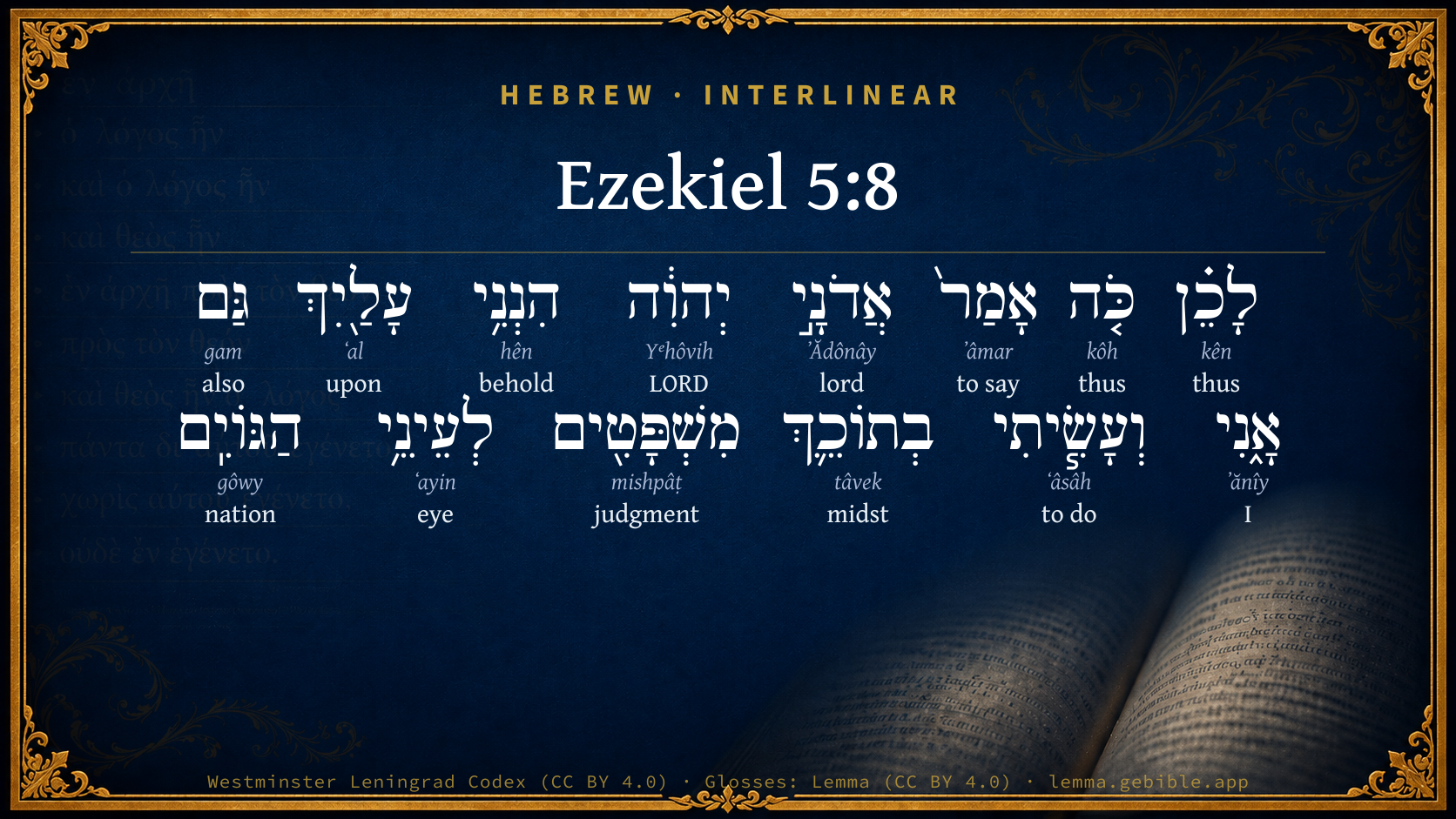
Hebrew (Westminster Leningrad Codex) Ezekiel 5:8 appears in the Hebrew Old Testament. The text above is from the Westminster Leningrad Codex. Each word links to its Strong’s number, a concise gloss, and parsing drawn from the Open Scriptures Hebrew Bible morphology. Click any word for its full Brown-Driver-Briggs (BDB) entry.
Download image
Cite this verse

Ezekiel 5:8 (World English Bible). Public Domain. Lemma interlinear Bible study tool, https://lemma.gebible.app/v/ezekiel/5/8.

Show BibTeX & RIS
BibTeX
RIS
English Translation
therefore thus says the Lord Yahweh: Behold, I, even I, am against you; and I will execute judgments in the midst of you in the sight of the nations.
World English Bible · Public Domain
Download a study sheet

One document with this verse’s original text, its word-by-word gloss line, the meaning frame, cross-references with their text, attributed commentary, and full source and license credits — printable, and it pastes into notes with its structure intact.

This verse Autodidact and up

Study sheet (.html) Plain text (.txt)

A passage Seminary Student

Up to 50 verses in one chapter. A passage sheet keeps up to 6 commentary sources and 12 cross-references per verse, in the order this page ranks them, and says so on the sheet whenever that leaves anything out. Ask for a single verse and you get the Autodidact verse sheet above.

Everything on this page stays free to read, with no account — the sheet is a download of what is already on screen, not access to it.

Want to remove ads? Support Godless Engineer
Compare translations 3

The same verse in 3 English versions, stacked beneath the original-language interlinear above. Click any original word for its lexicon entry.

Each is an independent rendering of the whole verse — the interlinear is not word-aligned to these translations.

Highlighted words mark where these versions differ — a whole-verse word diff, not a word-by-word alignment.

  • World English Bible Public Domain
    therefore thus says the Lord Yahweh: Behold, I, even I, am against you; and I will execute judgments in the midst of you in the sight of the nations.
  • King James Version Public Domain
    Therefore thus saith the Lord GOD; Behold, I, even I, am against thee, and will execute judgments in the midst of thee in the sight of the nations.
  • unfoldingWord Literal Text CC BY-SA 4.0
    therefore the Lord Yahweh says this, “Behold! I myself will act against you. I will execute judgments within your midst for the nations to see.

unfoldingWord Literal Text — © unfoldingWord, licensed CC BY-SA 4.0. Word-aligned USFM3 via Door43 (git.door43.org/unfoldingWord/en_ult).

Versions to compare (up to 4)

3 of 4 selected

Show all 18 translations

Every available English version of this verse, each an independent rendering of the whole verse.

  • World English Bible Public Domain
    therefore thus says the Lord Yahweh: Behold, I, even I, am against you; and I will execute judgments in the midst of you in the sight of the nations.
  • Berean Standard Bible Public Domain
    Therefore this is what the Lord GOD says: ‘Behold, I Myself am against you, Jerusalem, and I will execute judgments among you in the sight of the nations.
  • Majority Standard Bible Public Domain
    Therefore this is what the Lord GOD says: ‘Behold, I Myself am against you, Jerusalem, and I will execute judgments among you in the sight of the nations.
  • King James Version Public Domain
    Therefore thus saith the Lord GOD; Behold, I, even I, am against thee, and will execute judgments in the midst of thee in the sight of the nations.
  • American Standard Version (1901) Public Domain
    therefore thus saith the Lord Jehovah: Behold, I, even I, am against thee; and I will execute judgments in the midst of thee in the sight of the nations.
  • Revised Version (1885) Public Domain
    therefore thus saith the Lord GOD: Behold, I, even I, am against thee; and I will execute judgments in the midst of thee in the sight of the nations.
  • Geneva Bible (1599) Public Domain
    Therefore thus saith the Lord God, Beholde, I, euen I come against thee, and will execute iudgement in the middes of thee, euen in the sight of the nations.
  • Douay-Rheims (1899) Public Domain
    Therefore thus saith the Lord God: Behold I come against thee, and I myself will execute judgments in the midst of thee in the sight of the Gentiles.
  • Young's Literal Translation Public Domain
    Therefore, thus said the Lord Jehovah: Lo, I `am' against thee, even I, And I have done in thy midst judgments, Before the eyes of the nations.
  • Literal Standard Version CC BY-SA 4.0
    Therefore, thus said Lord YHWH: “Behold, I [am] against you, even I, || And I have done judgments in your midst, || Before the eyes of the nations.
  • Unlocked Literal Bible CC BY-SA 4.0
    therefore the Lord Yahweh says this, “Behold! I myself will act against you. I will execute judgments within your midst for the nations to see.
  • unfoldingWord Literal Text CC BY-SA 4.0
    therefore the Lord Yahweh says this, “Behold! I myself will act against you. I will execute judgments within your midst for the nations to see.
  • Darby Bible Public Domain
    therefore thus saith the Lord Jehovah: Behold, I, even I, am against thee, and will execute judgments in the midst of thee in the sight of the nations;
  • World Messianic Bible Public Domain
    therefore the Lord GOD says: ‘Behold, I, even I, am against you; and I will execute judgments among you in the sight of the nations.
  • Webster's Bible Public Domain
    Therefore thus saith the Lord GOD; Behold, I, even I, am against thee, and will execute judgments in the midst of thee in the sight of the nations.
  • Free Bible Version CC BY-SA 4.0
    So this is what the Lord God says: Watch out, because it's me who is condemning you, Jerusalem! I'm going to carry out my sentence against you while the other nations watch.
  • Bible in Basic English Public Domain
    For this cause the Lord has said: See, I, even I, am against you; and I will be judging among you before the eyes of the nations.
  • JPS Tanakh (1917) Public Domain
    therefore thus saith the Lord GOD: Behold, I, even I, am against thee, and I will execute judgments in the midst of thee in the sight of the nations.

Literal Standard Version (2020), Covenant Press — licensed CC BY-SA 4.0. Text via the HelloAO Bible API (eBible.org). Unlocked Literal Bible (unfoldingWord) — licensed CC BY-SA 4.0. Text via the HelloAO Bible API (eBible.org). unfoldingWord Literal Text — © unfoldingWord, licensed CC BY-SA 4.0. Word-aligned USFM3 via Door43 (git.door43.org/unfoldingWord/en_ult). Free Bible Version, Dr. Jonathan Gallagher — licensed CC BY-SA 4.0. Text via the HelloAO Bible API (eBible.org).

Word by word

More ways to search: Search by grammar → Find every occurrence → Compare this word →

Practice this passage: Drill this verse → Learn its vocabulary →

יְהוִ֔ה
Yᵉhôvih
H3069
“LORD”
Noun, Proper
Part of Speech
Noun
Type
Proper
Full BDB Definition

Origin: a variation of ( H3068 ) [used after ( H136 ), and pronounced by Jews as H430 , in order to prevent the repetition of the same sound, since they elsewhere pronounce 03068 as 0136]

TWOT: None

Jehovah - used primarily in the combination 'Lord Jehovah'
  1. לָכֵ֗ן kên H3651 “to/for · thus” Preposition + Adverb
  2. כֹּ֤ה kôh H3541 “thus” Adverb
  3. אָמַר֙ ʼâmar H559 “to say” Verb, Qal, Perfect, 3rd Person, Masculine, Singular
  4. אֲדֹנָ֣י ʼĂdônây H136 “Lord · my” Noun, Common, Masculine, Plural, Construct + Suffix, Personal, 1st Person, Common, Singular
  5. הִנְנִ֥י hên H2005 “behold · me” Particle, Demonstrative + Suffix, Personal, 1st Person, Common, Singular
  6. עָלַ֖יִךְ ʻal H5921 “upon · you” Preposition + Suffix, Personal, 2nd Person, Feminine, Singular
  7. גַּם gam H1571 “also” Particle, Accusative
  8. אָ֑נִי ʼănîy H589 “I” Pronoun, Personal, 1st Person, Common, Singular
  9. וְעָשִׂ֧יתִי ʻâsâh H6213 “and · to do” Conjunction + Verb, Qal, Sequential Perfect, 1st Person, Common, Singular
  10. בְתוֹכֵ֛ךְ tâvek H8432 “in/at · midst · your” Preposition + Noun, Common, Masculine, Singular, Construct + Suffix, Personal, 2nd Person, Feminine, Singular
  11. מִשְׁפָּטִ֖ים mishpâṭ H4941 “judgments” Noun, Common, Masculine, Plural, Absolute
  12. לְעֵינֵ֥י ʻayin H5869 “to/for · eyes of” Preposition + Noun, Common, Both, Dual, Construct
  13. הַגּוֹיִֽם gôwy H1471 “the · nations” Particle, Definite Article + Noun, Common, Masculine, Plural, Absolute

About this verse

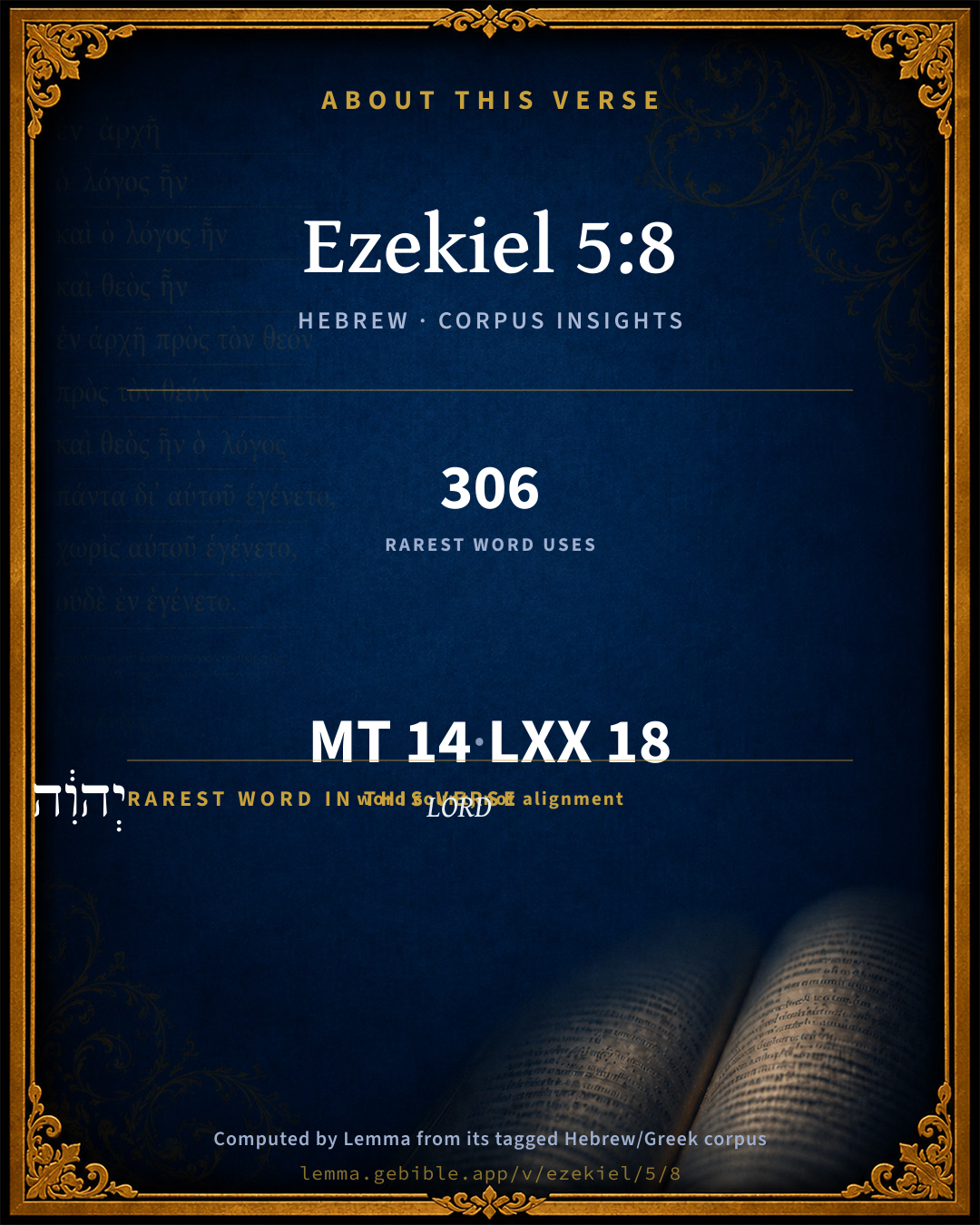
These counts appear in no published source. They are computed here, from the morphology-tagged text and Lemma’s own curated glosses. What Lemma adds →

14
words
14
distinct lemmas
Prophets
section

Grammatical profile

  • 2 verbs
  • 6 nouns
  • 1 pronoun
  • 1 preposition
  • 2 adverbs
  • 2 particles

Verb forms

  • אָמַר֙ Qal · Perfect
  • וְעָשִׂ֧יתִי Qal · Sequential Perfect

Hebrew & Septuagint length

In English translation the verse runs 29 words from the Hebrew and 21 from the Septuagint (LXX English) — closely comparable.

A rough comparison of the two English renderings, which tokenize alike — not a word-level alignment.

Word counts can differ between the Hebrew and the Greek without any difference in meaning — e.g. the Hebrew direct-object marker אֵת has no separate Greek word, and Greek often adds the article ὁ.

In the original languages it is 14 Hebrew tokens and 18 Greek tokens — but the two are counted differently (Hebrew bundles its prefixes and suffixes into one token; the Greek is in lemma form), so that isn’t a like-for-like length.

Cross-references

24

Topical passages linked to Ezekiel 5:8 in the Treasury of Scripture Knowledge — connected by theme and wording, ordered by reader-vote popularity; previews shown in the World English Bible.

  • Jeremiah 24:9 I will even give them up to be tossed back and forth among all the kingdoms of the earth for evil; to be a reproach and a proverb, a taunt and a curse, in all places where I shall drive them.
  • Ezekiel 15:7 I will set my face against them; they shall go forth from the fire, but the fire shall devour them; and you shall know that I am Yahweh, when I set my face against them.
  • Jeremiah 21:5 I myself will fight against you with an outstretched hand and with a strong arm, even in anger, and in wrath, and in great indignation.
  • Jeremiah 21:13 Behold, I am against you, O inhabitant of the valley, [and] of the rock of the plain, says Yahweh; you that say, Who shall come down against us? or who shall enter into our habitations?
  • Ezekiel 21:3 and tell the land of Israel, Thus says Yahweh: Behold, I am against you, and will draw forth my sword out of its sheath, and will cut off from you the righteous and the wicked.
  • Leviticus 26:17–46 I will set my face against you, and you will be struck before your enemies. Those who hate you will rule over you; and you will flee when no one pursues you.
  • Deuteronomy 29:20 Yahweh will not pardon him, but then the anger of Yahweh and his jealousy will smoke against that man, and all the curse that is written in this book shall lie on him, and Yahweh will blot out his name from under the sky.
  • Deuteronomy 29:23–28 [and that] the whole land of it is sulfur, and salt, [and] a burning, [that] it is not sown, nor bears, nor any grass grows therein, like the overthrow of Sodom and Gomorrah, Admah and Zeboiim, which Yahweh overthrew in his anger, and in his wrath:
  • 1 Kings 9:8–9 Though this house is so high, yet shall everyone who passes by it be astonished, and shall hiss; and they shall say, Why has Yahweh done thus to this land, and to this house?
  • Jeremiah 22:8–9 Many nations shall pass by this city, and they shall say every man to his neighbor, Why has Yahweh done thus to this great city?
  • Jeremiah 50:7 All who found them have devoured them; and their adversaries said, We are not guilty, because they have sinned against Yahweh, the habitation of righteousness, even Yahweh, the hope of their fathers.
  • Lamentations 2:5 The Lord is become as an enemy, he has swallowed up Israel; He has swallowed up all her palaces, he has destroyed his strongholds; He has multiplied in the daughter of Judah mourning and lamentation.
  • Lamentations 2:15–17 All that pass by clap their hands at you; They hiss and wag their head at the daughter of Jerusalem, [saying], Is this the city that men called The perfection of beauty, The joy of the whole earth?
  • Lamentations 3:3 Surely against me he turns his hand again and again all the day.
  • Ezekiel 11:9 I will bring you forth out of the midst of it, and deliver you into the hands of strangers, and will execute judgments among you.
  • Ezekiel 25:2–6 Son of man, set your face toward the children of Ammon, and prophesy against them:
  • Ezekiel 26:2–3 Son of man, because Tyre has said against Jerusalem, Aha, she is broken: the gate of the peoples; she is turned to me; I shall be replenished, now that she is laid waste:
  • Ezekiel 28:22 and say, Thus says the Lord Yahweh: Behold, I am against you, Sidon; and I will be glorified in the midst of you; and they shall know that I am Yahweh, when I shall have executed judgments in her, and shall be sanctified in her.
  • Ezekiel 29:6–7 All the inhabitants of Egypt shall know that I am Yahweh, because they have been a staff of reed to the house of Israel.
  • Ezekiel 35:3 and tell it, Thus says the Lord Yahweh: Behold, I am against you, Mount Seir, and I will stretch out my hand against you, and I will make you a desolation and an astonishment.
  • Ezekiel 35:10–15 Because you have said, These two nations and these two countries shall be mine, and we will possess it; whereas Yahweh was there:
  • Ezekiel 39:1 You, son of man, prophesy against Gog, and say, Thus says the Lord Yahweh: Behold, I am against you, Gog, prince of Rosh, Meshech, and Tubal:
  • Zechariah 14:2–3 For I will gather all nations against Jerusalem to battle; and the city will be taken, the houses rifled, and the women ravished. half of the city will go out into captivity, and the rest of the people will not be cut off from the city.
  • Matthew 22:7 When the king heard that, he was angry, and he sent his armies, destroyed those murderers, and burned their city.

Cross-references courtesy of OpenBible.info (CC BY 4.0).

Hebrew and Greek witnesses Masoretic Hebrew ↔ Greek Septuagint

The same verse in the two great witnesses to the Old Testament, shown verse-for-verse.

These are two independent witnesses, not word-aligned to each other, and the Septuagint is shown in lemma (dictionary) form.

Hebrew Ezekiel 5:8 Masoretic · Westminster Leningrad Codex

לָכֵ֗ן כֹּ֤ה אָמַר֙ אֲדֹנָ֣י יְהוִ֔ה הִנְנִ֥י עָלַ֖יִךְ גַּם אָ֑נִי וְעָשִׂ֧יתִי בְתוֹכֵ֛ךְ מִשְׁפָּטִ֖ים לְעֵינֵ֥י הַגּוֹיִֽם

therefore thus says the Lord Yahweh: Behold, I, even I, am against you; and I will execute judgments in the midst of you in the sight of the nations.

World English Bible · Public Domain

Greek LXX Ezekiel 5:8 Septuagint · lemma form

διά οὗτος ὅδε λέγω κύριος ἰδού ἐγώ ἐπί σύ καί ποιέω ἐν μέσος σύ κρίμα ἐνώπιον ὁ ἔθνος

Behold, I am against you, and I will execute judgment in the midst of you in the sight of the nations.

LXX2012 (modern English Septuagint) · Public Domain

Hebrew: Westminster Leningrad Codex (CC BY 4.0). Greek: Septuagint (public domain); English from LXX2012 (modern English Septuagint) (Public Domain). How the Septuagint differs from the Hebrew →

Targum (Aramaic paraphrase)

1

The Targum is the ancient Jewish Aramaic paraphrase of the Hebrew Scriptures — an interpretive translation, not the Hebrew text itself. Onkelos (literal) and Pseudo-Jonathan (expansive) render the Torah, and Jonathan the Prophets. Coverage is partial: where no permissively-licensed English translation exists for a verse, only the Aramaic is shown. This is verse-level text, not a word-by-word alignment to the Hebrew.

  1. Targum Jonathan Prophets (Joshua–Malachi)
    בְּכֵן כִּדְנַן אֲמַר יְיָ אֱלֹהִים הָא אֲנָא שָׁלַח רוּגְזִי עֲלָךְ אַף אֲנָא וְאַעֲבֵּיד בְּגַוִיךְ פּוּרְעֲנוּת דִינִין לְעֵינֵי עַמְמַיָא:

    (no public-domain English translation for this verse)

    Targum Jonathan — Aramaic: “Mikraot Gedolot” (public domain). English: “Sefaria Community Translation” (CC0 1.0 (public-domain dedication)); “London "Chaldee Paraphrase," 1871” (public domain). Text via Sefaria.

Commentary

Notes on Ezekiel 5:8 from classic Christian and Jewish commentators (each source and its license shown beneath its notes). The classic Christian expositions comment on the surrounding passage and are grouped to its opening verse, so a note may address several verses; the Jewish commentaries on the Tanakh (Rashi and others) are per-verse, so they appear only where the commentator wrote on this verse.

Lemma curates 59 commentaries, every one of them public domain or Creative Commons licensed, each selected and text-cleaned for this edition rather than reprinted as found. About our sources →

Trapp's Complete Commentary

John Trapp

Eze 5:8 Therefore thus saith the Lord GOD; Behold, I, even I, [am] against thee, and will execute judgments in the midst of thee in the sight of the nations.

Ver. 8. Behold, I, even I, am against thee.] Whether thou wilt believe it or not. Thou boldest it unlikely, but shalt find it true, and that I am very serious, not saying these things in terrorem only. Ecce me adversum te venientem, so some render it; Behold I am upon my march against thee, and will punish thee surely, severely, suddenly.

And will execute judgments.] For the non-execution of my judgments in the former sense taken. {as Eze 5:7}

In the sight of the nations.] In whose sight thou hast so sinned, and who will rejoice at thy sufferings.

John Trapp, A Commentary or Exposition upon All the Books of the Old and New Testament (1647–1656) — public domain. Text from a community e-Sword module.

Jamieson, Fausset & Brown

Robert Jamieson, A. R. Fausset & David Brown

I, even I--awfully emphatic. I, even I, whom thou thinkest to be asleep, but who am ever reigning as the Omnipotent Avenger of sin, will vindicate My righteous government before the nations by judgments on thee.

Jamieson, Fausset & Brown — Commentary Critical and Explanatory on the Whole Bible (1871) — public domain (CC PDM 1.0). Text via the HelloAO Bible API.

John Calvin's Commentaries

Now follows the threat, that God was prepared to take vengeance. Behold, I, even, I, am against you The particle גם, gam, “even,” is used as we in French say, yea, even: I, even I. We now see that the repetition is emphatic, as if God asserted a horrible destruction to be hanging over the Jews. For he wishes to inspire them with fear, since he assures them that he will prove an avenger. Though I do not receive Jerome’s comment, for he says, that angels and other ministers of God’s wrath are excluded, because God determined to destroy the Jews by himself. This we know to be false, for he made use of the Assyrians and Chaldeans. Since then those people were his scourges, it follows, that angels and men are not excluded when God pronounces himself an avenger. But he increases the weight of the punishment when he says, I, even I, am he with whom thou shalt have to do Now he adds, I will execute judgments, by which word jurisdiction, as they call it, is intended. What Jerome and those interpreters who follow him affirm is not correct, that by this name God’s justice is asserted, as if he meant, that he would not be cruel in exacting punishment, nor yet unjust nor too rigid. For to execute judgment means merely to exercise jurisdiction, and an earthly judge is said to exercise justice when he sits on his tribunal, even if he perverts justice and equity. This, indeed, cannot be the case with God, although the word allows of it. Besides, there is a suitable antithesis between the doctrinal judgments and the actual ones; God complained that the Jews did not execute his judgments: now he threatens that he himself would execute them, because he will vindicate his law by punishments.

The sum of the whole is that he will execute judgments in the midst of Jerusalem, because he will ascend a tribunal and compel the wicked to plead their cause, and to render an account of their life. God, therefore, then executed his judgments when he manifested his vengeance by means of the Chaldeans, and so famine was a part of his punishment, as well as the sword and the pestilence. For while he delays, he seems to have ceased from his duty, and then the impious indulge themselves as if he had forgotten to execute judgment. Therefore, in opposition to this, he denounces that he would execute judgments: as if he had said, I will appear as judge although you think me asleep. For he says, he will execute judgments in the midst of Jerusalem, before the eyes of the Gentiles, by which assertion he means, that their punishments would be remarkable, and such as might be easily considered by all the nations: for we know that the Gentiles were then blind, for they thought that good and evil happened by chance. But God affirms, that his judgments will be so manifest that the blind will be, as it were, eye-witnesses. Now it follows —

John Calvin's Commentaries (1540-1563) — public domain. Text from the Calvin Translation Society English edition (1840s-50s) via the Christian Classics Ethereal Library (ccel.org). Calvin's coverage is partial (roughly two-thirds of the Bible); uncommented books and verses are honest gaps, never fabricated. The 19th-century editor's footnotes and remarks are omitted so the notes are faithfully Calvin's own voice.

Ellicott's Commentary for English Readers

(8) In the sight of the nations.—The conspicuousness of Israel’s position (see under Eze_5:5) made it necessary that the punishment for their failure to keep God’s law should be as public as their sin. All had seen their unfaithfulness; all must see the consequent judgment.

A Bible Commentary for English Readers, edited by Charles John Ellicott (1878–1897) — public domain. Text from a community e-Sword module.

The Cambridge Bible for Schools and Colleges

gen. ed. J. J. S. Perowne

8. in the sight of the nations] The nations saw Israel’s wickedness, and they shall also see her judgments, and they shall know that Jehovah is God alone.

The Cambridge Bible for Schools and Colleges (gen. ed. J. J. S. Perowne; Cambridge University Press, 1878–1918) — public domain. Text from a community e-Sword module.

John Gill's Exposition

Therefore thus saith the Lord God, behold, even I, am against thee,.... Or, "behold, I am against thee, even I" (u); who am the Lord God omnipotent, great King, and a dreadful one; and a terrible thing it is for a people to have the mighty God against them; or for any to fall into the hands of the living God: this is repeated to show that it certainly was so; and that the Lord was set upon it; and determined to come forth against them in the way of his judgments, as follows:

and will execute judgments in the midst of thee, in the sight of the nations; that is, inflict punishments upon them for their disregard to his righteous judgments, which should take place in the midst of them, and consume them all around; and should be so manifest as to be seen by all the nations about them.

(u) "ecce ego ad te, etiam ego", Pagninus, Montanus; "ecce ego contra te, etiam ego", Starckius.

John Gill's Exposition of the Whole Bible (1746–1763) — public domain (CC PDM 1.0). Text via the HelloAO Bible API.

Albert Barnes' Notes on the Bible

Execute judgments - As upon the false gods of Egypt Exo 12:12; Num 33:4.

Albert Barnes' Notes on the Bible (1834–1885) — public domain. Text from a community e-Sword/MySword module.

Matthew Poole's English Annotations

Therefore; it is very just what God doth, he hath cause more than enough given him to do so.

Behold; take notice, and consider me, not as now for you, but against you. You look to the instruments, to the rod, but, behold, I am, even I am, against you, against thee, O Jerusalem.

Will execute judgments; I will act in severities that shall convince you it is my hand that wields the sword. You despised my holy law, my judgments as a rule of life, but you shall now feel my judgments that you shall die under. The Chaldeans will kill you, but I condemn you. They will be cruel, but I will be just in the execution; and who can be for thee, when I will be against thee in this dreadful manner?

In the sight of the nations; as notorious as thy sins, so shall thy punishment be. The very heathen shall see my hand in it, and own my justice.

Matthew Poole's English Annotations on the Holy Bible (1683–1685) — public domain. Text from a community e-Sword/MySword module.

Whedon's Commentary on the Bible

Daniel D. Whedon

8. Will execute judgments — Rebellion against the righteous decrees of Jehovah concerning right actions and acceptable worship brings upon the nation righteous decrees of punishment. In the Hebrew there is a word play which cannot be rendered into English.

Daniel D. Whedon (gen. ed.), Commentary on the Old and New Testaments (1874–1909) — public domain. Text from a community e-Sword module.

The Pulpit Commentary

Therefore, etc. The conjunction is emphatic. It was because Jerusalem, in her high estate had sinned so conspicuously that her punishment was to be equally conspicuous. (comp. Lam_4:6; Amo_3:2)

Opposed by God.

We are more familiar with the idea of our opposition to God than with that of his opposition to us, because he is long suffering and slow to anger, while we are rebellious and self-willed. But there is a point where infinite patience cannot restrain just wrath; where, indeed, without any conflict of Divine attributes, the very love of God must acquiesce in his resistance to our sinful conduct by stern measures. Then God is against us!

I GOD"S OPPOSITION IS PROVOKED BY MAN"S REBELLION.

1. God is not originally opposed to any of his creatures. "He hateth nothing that he hath made." Nor can we suppose that God turns against his children for reasons of his own apart from their conduct. There is no caprice in the heart of the Immutable. It seems to some men in their deepening adversity, as blow after blow falls upon them, that God has become their enemy. This is a trial to faith; but true faith should survive and cry in the tempest of trouble, "Though he slay me, yet will I trust in him.

2. The cause of Gods opposition lies in men alone. Ours is the change, not his. The Israelites in the wilderness "provoked" him to wrath. As he is always graciously inclined, it always lies with us to determine whether he shall be our Friend or our Enemy. It is fearful to make an Enemy of our best Friend. But can we expect that persistent neglect, deepening into disobedience, and disobedience pushed to the extremity of rebellion, should be regarded with indifference by the Lord of heaven and earth?

II THE OPPOSITION OF GOD IS UNSPEAKABLY DREADFUL. It is dangerous for man to run counter to the will of God; it is fatal for God to rouse himself in opposition to man. The man who falls on the chosen Stone is bruised, but he on whom it falls will be ground to powder. (Mat_21:44) There is in this a Divine activity. The sinner does not suffer only negatively, by privation, by the loss of Divine grace. His doom is more than to be cast into the outer darkness, and to be left there in a God-deserted solitude. That would be bad enough. But it must be remembered that God is active, and is ever making his will felt by his children. If a man swallows arsenic, the poison will work in him by the exercise of its own corrosive properties. In opposing the laws of nature we bring those laws into active play against us. It is like running in face of an express train. The result is incomparably worse than running against a dead wall. The dreadfulness of the Divine opposition thus encountered is only to be measured by the might and energy of God. The very fact that he loves us, instead or mitigating the horror of the opposition, must heighten it, for no plea can soften the blow when love itself acquiesces in it. If a hard master punished we might hope to soften him, but if a God of love is against us there is no further appeal.

III THE DIVINE OPPOSITION IS A LESSON FOR ALL WHO WITNESS IT. The judgments were to be executed "in the sight of the nations." This would add to the humiliation of the Jews. It would be a shock to the self-complacency that was founded on the notion that for the sake of his own honour among the heathen God would uphold his chosen people. That notion was a delusion. God"s honour is not maintained by protecting his people in their sin. It is more manifest in the impartial execution of justice without any rebate on the ground of favouritism. God is not honoured now by the simple security of his Church, but by the purity of it. It is better for the cause of righteousness that fallen Christians should be shamed and cast out, than that they should be petted and spared and their wickedness hushed up. The fall and judgment of the Jews proclaimed to all the world the unbiassed righteousness of God. Certainly, if the chosen people were not spared, no sinners can hope to escape except by the way of deliverance God has made through Christ.

Divine antagonism.

That is a lawless state of society in which every man"s hand is against his neighbour. Yet no observer of human life is insensible to the prevalence of enmity, rivalry, opposition of various kinds, among all communities of men. "There are many adversaries" is a complaint which every man has made in his time. Men become accustomed to this, and regard it as a natural accompaniment of social life. But it is something very different when the almighty and righteous Lord addresses a man or a community, and says, "Behold I, even I, am against thee.

I THE STRANGENESS AND WONDER OF THIS ATTITUDE. That the heathen, who construct the character of their gods upon the lines of their own character, should depict them as hostile, seems natural enough. But that enlightened theists should be surprised at such a representation as that of the text, is a consequence of the conceptions which reason and revelation alike have taught them to form of God. Is not God on our side? Does he not represent himself as favourable to the sons of men using his power for their protection, their deliverance, their aid? How, then, can a merciful and benevolent God be in any sense against us?

II THE EXPLANATION AND REASONABLENESS OF THIS ATTITUDE. It is clear that the Creator and Lord of all cannot be expected to alter the principles of his government in order to accommodate himself to the follies and the caprices of his creatures. If a man throws himself into mid-ocean, or into the crater of a burning volcano, nature is against him, and he must perish. If a man by his own action contracts disease, he must suffer. Gravitation is not to be suspended because a foolhardy fanatic flings himself from a tower. Nor are chemical laws to be abolished because one ignorantly swallows poison. In all such cases, we may say with reverence, "God is against those who act in such and such a manner." Similarly in the moral realm. The spiritual universe is so constituted that men cannot violate moral law without suffering, cannot defy God with impunity. Those who sin must sooner or later learn the fact, which no reasoning of theirs can affect, that God is against them.

III THE IMMEDIATE PURPOSE OF THIS ATTITUDE. It is evident that, if all things were made easy and pleasant for the sinner, if there were no check and no chastisement for his sin, such an arrangement would not be for the sinner"s real good. On the contrary, he would be encouraged to persevere in his evil courses. But the sinner, finding that God is against him, is in many cases by this very fact led to consider his ways. His experience "gives him pause." There follows from this consciousness of punishment the state of mind known as "conviction of sin," and conviction of sin may lead to repentance and to submission. Finding that, by setting himself against God, the sinner sets God against him, he may be led to submission; he may ask himself, "Why should I not have God with me instead of against me?" The beginning of the process may partake of a selfish regard for his own interests, but he may be led on to see something better than this to discern the justice, the propriety, the moral excellence of subjection to and harmony with the will which ever accords with perfect righteousness, wisdom, and love.

IV THE ULTIMATE CONSEQUENCE AND RESULT OF THIS ATTITUDE. No one who reflects upon the character of the God of infinite justice and benevolence can suppose that he can take a pleasure in a posture of antagonism and hostility against anything that he has made, far less against man, whom he created in his own likeness, to show forth his own glory. His aim is ever to bring his intelligent and voluntary creatures into harmony with his own nature; to recover and restore, not to overwhelm with destruction; to bring his children to exclaim, "If God be for us, who can be against as? T.

The Pulpit Commentary (1880–1919), ed. H.D.M. Spence-Jones & Joseph S. Exell — public domain. Text from a community e-Sword module.

Rashi

Rabbi Shlomo Yitzchaki (Rashi)

I too You betrayed Me, and I too, behold I am upon you.

Rashi on the Tanakh — English translations: “The Judaica Press complete Tanach with Rashi, translated by A. J. Rosenberg” (CC BY 4.0); “Pentateuch with Rashi's commentary by M. Rosenbaum and A.M. Silbermann, 1929-1934” (public domain); “The Metsudah Tanach series, Lakewood, N.J” (CC BY 4.0); and “The Book of Joshua, Metsudah Publications, 1997” (CC BY 4.0). Text via Sefaria.

Lesson kit

Teaching starters — assembled from the data on this page, not authored interpretation. Every prompt links to the verse data it draws on. Edit before teaching.

Ezekiel, in the Prophets, opens this verse with 14 words (14 distinct Hebrew lemmas). Its most distinctive word is Yᵉhôvih (“LORD”). A historical commentator’s framing appears above. Read the whole chapter for the surrounding context.

Discussion questions

  1. How does “LORD” (Yᵉhôvih) shape what this verse is saying?
  2. Jeremiah 24:9 shares this passage’s theme. How do the two illuminate each other?
  3. These translations render this verse differently. What is at stake in choosing one wording over another?
  4. The verb «אָמַר֙» is Qal Perfect. How does its form color the action?
  5. Reading how Trapp's Complete Commentary and Jamieson, Fausset & Brown read this verse, where do the two commentators agree and where do they part?

Things to notice

Reading settings

Reading text

Shown beneath each verse's original-language words.

Old Testament
Old Testament edition

Read the OT as the Masoretic Hebrew (MT) or the Greek Septuagint (LXX).

English shown for the Greek Septuagint (in the Hebrew ↔ Greek comparison).

Comparing translations? Open the Compare panel on any verse page to stack up to four side by side.