Leviticus 22:32

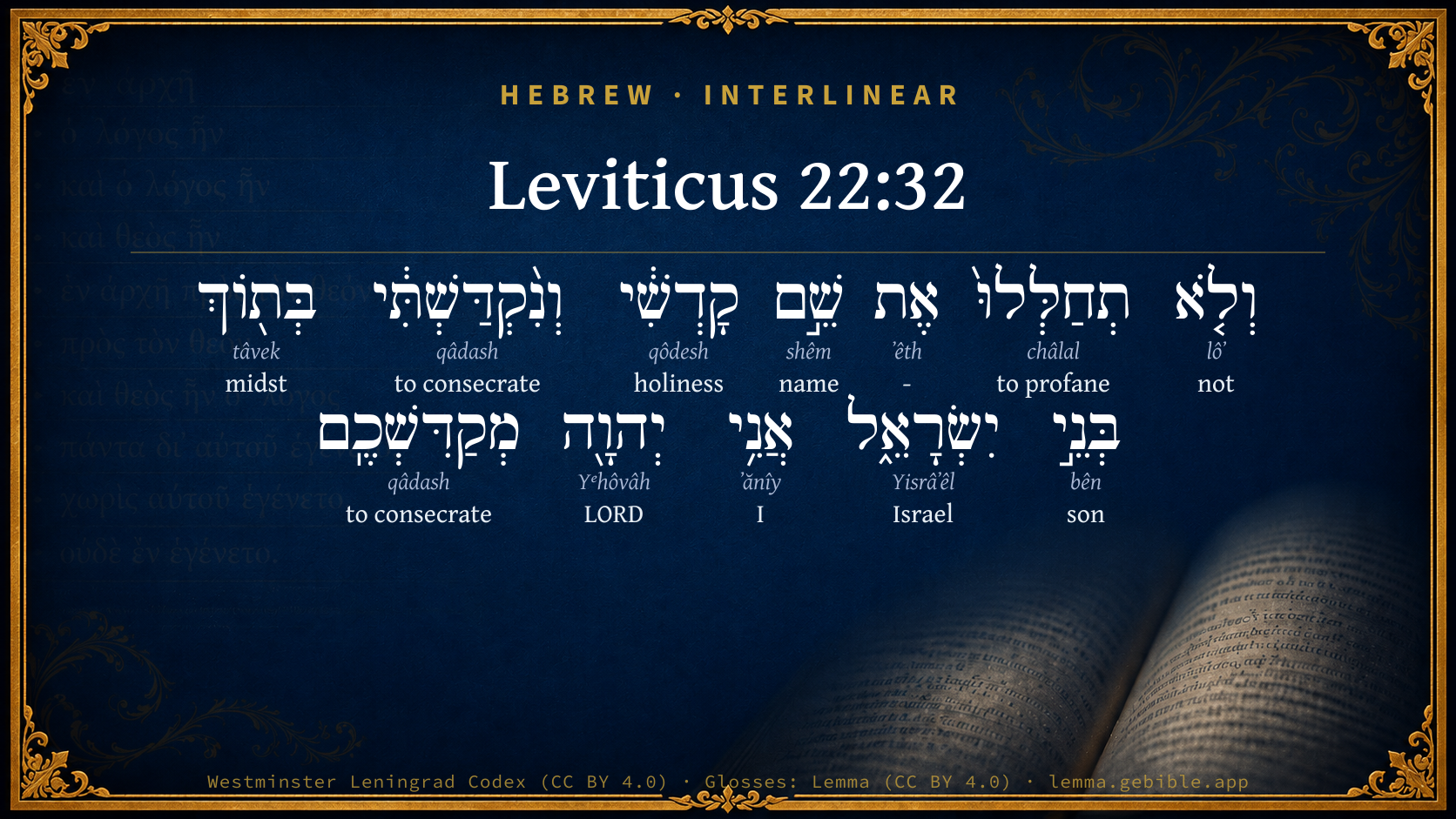
Hebrew (Westminster Leningrad Codex) Leviticus 22:32 appears in the Hebrew Old Testament. The text above is from the Westminster Leningrad Codex. Each word links to its Strong’s number, a concise gloss, and parsing drawn from the Open Scriptures Hebrew Bible morphology. Click any word for its full Brown-Driver-Briggs (BDB) entry.
Download image
Cite this verse

Leviticus 22:32 (World English Bible). Public Domain. Lemma interlinear Bible study tool, https://lemma.gebible.app/v/leviticus/22/32.

Show BibTeX & RIS
BibTeX
RIS
English Translation
You shall not profane my holy name, but I will be made holy among the children of Israel. I am Yahweh who makes you holy,
World English Bible · Public Domain
Download a study sheet

One document with this verse’s original text, its word-by-word gloss line, the meaning frame, cross-references with their text, attributed commentary, and full source and license credits — printable, and it pastes into notes with its structure intact.

This verse Autodidact and up

Study sheet (.html) Plain text (.txt)

A passage Seminary Student

Up to 50 verses in one chapter. A passage sheet keeps up to 6 commentary sources and 12 cross-references per verse, in the order this page ranks them, and says so on the sheet whenever that leaves anything out. Ask for a single verse and you get the Autodidact verse sheet above.

Everything on this page stays free to read, with no account — the sheet is a download of what is already on screen, not access to it.

Want to remove ads? Support Godless Engineer
Compare translations 3

The same verse in 3 English versions, stacked beneath the original-language interlinear above. Click any original word for its lexicon entry.

Each is an independent rendering of the whole verse — the interlinear is not word-aligned to these translations.

Highlighted words mark where these versions differ — a whole-verse word diff, not a word-by-word alignment.

  • World English Bible Public Domain
    You shall not profane my holy name, but I will be made holy among the children of Israel. I am Yahweh who makes you holy,
  • King James Version Public Domain
    Neither shall ye profane my holy name; but I will be hallowed among the children of Israel: I am the LORD which hallow you,
  • unfoldingWord Literal Text CC BY-SA 4.0
    And you shall not profane the name of my holiness, but I will show myself to be holy in the midst of the sons of Israel. I Yahweh, the one making you holy,

unfoldingWord Literal Text — © unfoldingWord, licensed CC BY-SA 4.0. Word-aligned USFM3 via Door43 (git.door43.org/unfoldingWord/en_ult).

Versions to compare (up to 4)

3 of 4 selected

Show all 18 translations

Every available English version of this verse, each an independent rendering of the whole verse.

  • World English Bible Public Domain
    You shall not profane my holy name, but I will be made holy among the children of Israel. I am Yahweh who makes you holy,
  • Berean Standard Bible Public Domain
    You must not profane My holy name. I must be acknowledged as holy among the Israelites. I am the LORD who sanctifies you,
  • Majority Standard Bible Public Domain
    You must not profane My holy name. I must be acknowledged as holy among the Israelites. I am the LORD who sanctifies you,
  • King James Version Public Domain
    Neither shall ye profane my holy name; but I will be hallowed among the children of Israel: I am the LORD which hallow you,
  • American Standard Version (1901) Public Domain
    And ye shall not profane my holy name; but I will be hallowed among the children of Israel: I am Jehovah who halloweth you,
  • Revised Version (1885) Public Domain
    And ye shall not profane my holy name; but I will be hallowed among the children of Israel: I am the LORD which hallow you,
  • Geneva Bible (1599) Public Domain
    Neither shall ye pollute mine holy Name, but I will be halowed among the children of Israel. I the Lord sanctifie you,
  • Douay-Rheims (1899) Public Domain
    Profane not my holy name, that I may be sanctified in the midst of the children of Israel. I am the Lord who sanctify you,
  • Young's Literal Translation Public Domain
    and ye do not pollute My holy name, and I have been hallowed in the midst of the sons of Israel; I `am' Jehovah, sanctifying you,
  • Literal Standard Version CC BY-SA 4.0
    and you do not defile My holy Name, and I have been hallowed in the midst of the sons of Israel; I [am] YHWH, sanctifying you,
  • Unlocked Literal Bible CC BY-SA 4.0
    You must not profane my holy name. I must be acknowledged as holy by the people of Israel. I am Yahweh who makes you holy,
  • unfoldingWord Literal Text CC BY-SA 4.0
    And you shall not profane the name of my holiness, but I will show myself to be holy in the midst of the sons of Israel. I Yahweh, the one making you holy,
  • Darby Bible Public Domain
    And ye shall not profane my holy name; but I will be hallowed among the children of Israel: I am Jehovah who do hallow you,
  • World Messianic Bible Public Domain
    You shall not profane my holy name, but I will be made holy among the children of Israel. I am the LORD who makes you holy,
  • Webster's Bible Public Domain
    Neither shall ye profane my holy name; but I will be hallowed among the children of Israel: I am the LORD who hallow you,
  • Free Bible Version CC BY-SA 4.0
    Don't disgrace my holy character. I must be accepted as holy by you. I am the Lord who makes you holy.
  • Bible in Basic English Public Domain
    And do not make my holy name common; so that it may be kept holy by the children of Israel: I am the Lord who make you holy,
  • JPS Tanakh (1917) Public Domain
    And ye shall not profane My holy name; but I will be hallowed among the children of Israel: I am the LORD who hallow you,

Literal Standard Version (2020), Covenant Press — licensed CC BY-SA 4.0. Text via the HelloAO Bible API (eBible.org). Unlocked Literal Bible (unfoldingWord) — licensed CC BY-SA 4.0. Text via the HelloAO Bible API (eBible.org). unfoldingWord Literal Text — © unfoldingWord, licensed CC BY-SA 4.0. Word-aligned USFM3 via Door43 (git.door43.org/unfoldingWord/en_ult). Free Bible Version, Dr. Jonathan Gallagher — licensed CC BY-SA 4.0. Text via the HelloAO Bible API (eBible.org).

Word by word

More ways to search: Search by grammar → Find every occurrence → Compare this word →

Practice this passage: Drill this verse → Learn its vocabulary →

תְחַלְּלוּ֙
châlal
H2490
“to profane”
Verb, Piel, Imperfect, 2nd Person, Masculine, Plural
Part of Speech
Verb
Stem
Piel
Form
Imperfect
Person
2nd Person
Gender
Masculine
Number
Plural
Full BDB Definition

Origin: a primitive root [compare H2470 ]

TWOT: 660 , 661

to profane, defile, pollute, desecrate, begin - (Niphal) - to profane oneself, defile oneself, pollute oneself - ritually - sexually - to be polluted, be defiled - (Piel) - to profane, make common, defile, pollute - to violate the honour of, dishonour - to violate (a covenant) - to treat as common - (Pual) to profane (name of God) - (Hiphil) - to let be profaned - to begin - (Hophal) to be begun - to wound (fatally), bore through, pierce, bore - (Qal) to pierce - (Pual) to be slain - (Poel) to wound, pierce - (Poal) to be wounded - (Piel) to play the flute or pipe

  1. וְלֹ֤א lôʼ H3808 “and · not” Conjunction + Particle, Negative
  2. אֶת ʼêth H853 “-” Particle, Direct Object
  3. שֵׁ֣ם shêm H8034 “name of” Noun, Common, Masculine, Singular, Construct
  4. קָדְשִׁ֔י qôdesh H6944 “holiness · my” Noun, Common, Masculine, Singular, Construct + Suffix, Personal, 1st Person, Common, Singular
  5. וְנִ֨קְדַּשְׁתִּ֔י qâdash H6942 “and · to consecrate” Conjunction + Verb, Niphal, Sequential Perfect, 1st Person, Common, Singular
  6. בְּת֖וֹךְ tâvek H8432 “in/at · midst of” Preposition + Noun, Common, Masculine, Singular, Construct
  7. בְּנֵ֣י bên H1121 “sons of” Noun, Common, Masculine, Plural, Construct
  8. יִשְׂרָאֵ֑ל Yisrâʼêl H3478 “Israel” Noun, Proper
  9. אֲנִ֥י ʼănîy H589 “I” Pronoun, Personal, 1st Person, Common, Singular
  10. יְהוָ֖ה Yᵉhôvâh H3068 “LORD” Noun, Proper
  11. מְקַדִּשְׁכֶֽם qâdash H6942 “consecrating · you” Verb, Piel, Participle Active, Masculine, Singular, Construct + Suffix, Personal, 2nd Person, Masculine, Plural

About this verse

These counts appear in no published source. They are computed here, from the morphology-tagged text and Lemma’s own curated glosses. What Lemma adds →

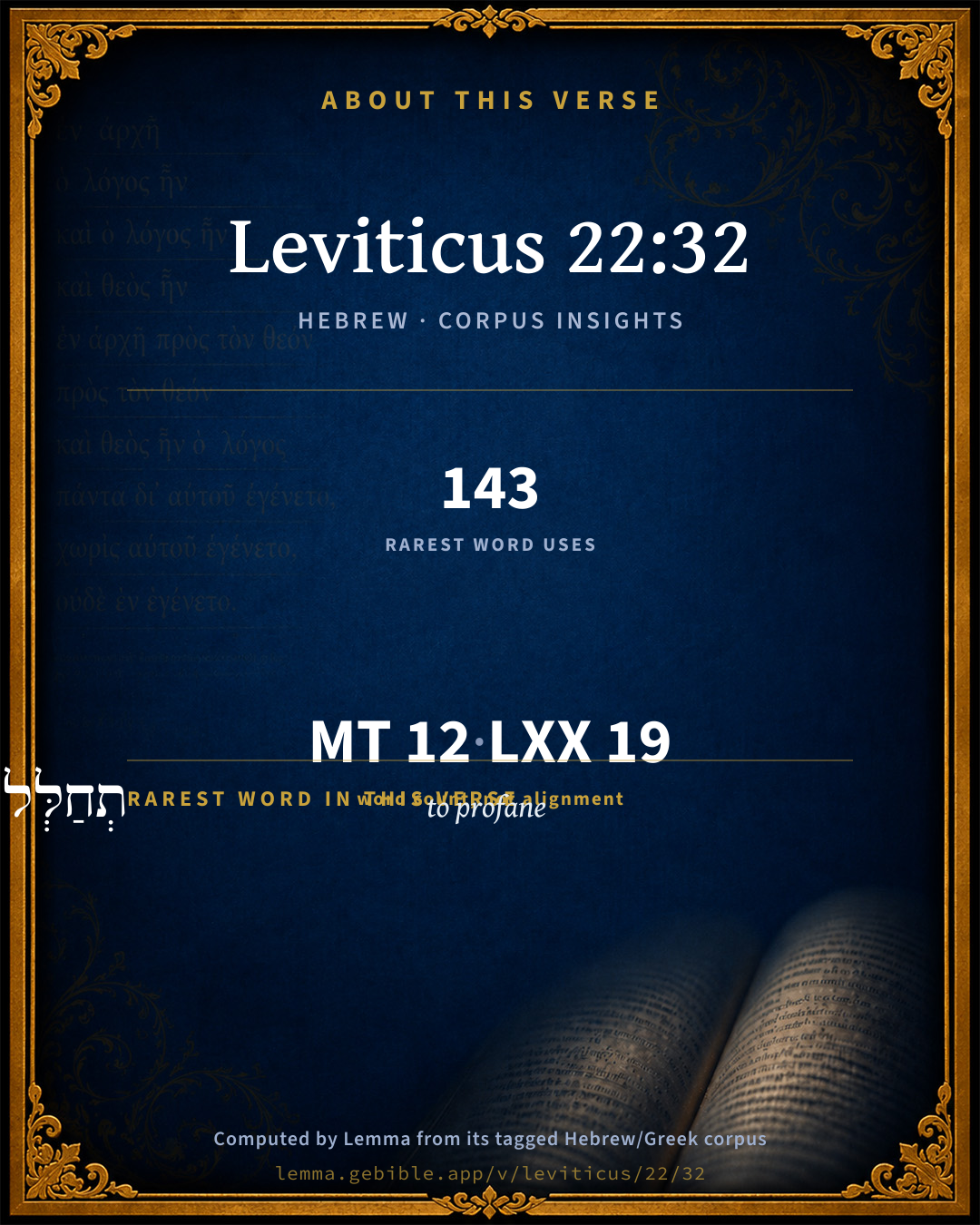
12
words
11
distinct lemmas
Pentateuch
section

Grammatical profile

  • 3 verbs
  • 6 nouns
  • 1 pronoun
  • 2 particles

Verb forms

  • תְחַלְּלוּ֙ Piel · Imperfect
  • וְנִ֨קְדַּשְׁתִּ֔י Niphal · Sequential Perfect
  • מְקַדִּשְׁכֶֽם Piel · Participle Active

Repetition

A word recurs within this verse — often emphatic in Hebrew:

  • וְנִ֨קְדַּשְׁתִּ֔י to consecrate H6942 ×2

Hebrew & Septuagint length

In English translation the verse runs 25 words from the Hebrew and 31 from the Septuagint (LXX English) — closely comparable.

A rough comparison of the two English renderings, which tokenize alike — not a word-level alignment.

Word counts can differ between the Hebrew and the Greek without any difference in meaning — e.g. the Hebrew direct-object marker אֵת has no separate Greek word, and Greek often adds the article ὁ.

In the original languages it is 12 Hebrew tokens and 19 Greek tokens — but the two are counted differently (Hebrew bundles its prefixes and suffixes into one token; the Greek is in lemma form), so that isn’t a like-for-like length.

Cross-references

13

Topical passages linked to Leviticus 22:32 in the Treasury of Scripture Knowledge — connected by theme and wording, ordered by reader-vote popularity; previews shown in the World English Bible.

  • Luke 11:2 He said to them, "When you pray, say, 'Our Father in heaven, May your name be kept holy. May your Kingdom come. May your will be done on Earth, as it is in heaven.
  • Leviticus 18:21 "'You shall not give any of your children to sacrifice to Molech; neither shall you profane the name of your God: I am Yahweh.
  • Leviticus 10:3 Then Moses said to Aaron, "This is what Yahweh spoke of, saying, "'I will show myself holy to those who come near me, And before all the people I will be glorified.'" Aaron held his peace.
  • Leviticus 22:2 "Tell Aaron and his sons to separate themselves from the holy things of the children of Israel, which they make holy to me, and that they not profane my holy name. I am Yahweh.
  • Matthew 6:9 Pray like this: 'Our Father in heaven, may your name be kept holy.
  • John 17:17 Sanctify them in your truth. Your word is truth.
  • Exodus 19:5–6 Now therefore, if you will indeed obey my voice, and keep my covenant, then you shall be my own possession from among all peoples; for all the earth is mine;
  • Leviticus 20:8 You shall keep my statutes, and do them. I am Yahweh who sanctifies you.
  • Leviticus 21:8 You shall sanctify him therefore; for he offers the bread of your God: he shall be holy to you: for I Yahweh, who sanctify you, am holy.
  • Leviticus 21:15 He shall not profane his seed among his people: for I am Yahweh who sanctifies him.'"
  • Isaiah 5:16 But Yahweh of Hosts is exalted in justice, And God the Holy One is sanctified in righteousness.
  • 1 Corinthians 1:2 to the assembly of God which is at Corinth; those who are sanctified in Christ Jesus, called to be saints, with all who call on the name of our Lord Jesus Christ in every place, both theirs and ours:
  • Leviticus 22:16 and so cause them to bear the iniquity that brings guilt, when they eat their holy things: for I am Yahweh who sanctifies them.'"

Cross-references courtesy of OpenBible.info (CC BY 4.0).

Hebrew and Greek witnesses Masoretic Hebrew ↔ Greek Septuagint

The same verse in the two great witnesses to the Old Testament, shown verse-for-verse.

These are two independent witnesses, not word-aligned to each other, and the Septuagint is shown in lemma (dictionary) form.

Hebrew Leviticus 22:32 Masoretic · Westminster Leningrad Codex

וְלֹ֤א תְחַלְּלוּ֙ אֶת שֵׁ֣ם קָדְשִׁ֔י וְנִ֨קְדַּשְׁתִּ֔י בְּת֖וֹךְ בְּנֵ֣י יִשְׂרָאֵ֑ל אֲנִ֥י יְהוָ֖ה מְקַדִּשְׁכֶֽם

You shall not profane my holy name, but I will be made holy among the children of Israel. I am Yahweh who makes you holy,

World English Bible · Public Domain

Greek LXX Leviticus 22:32 Septuagint · lemma form

καί οὐ βεβηλόω ὁ ὄνομα ὁ ἅγιος καί ἁγιάζω ἐν μέσος ὁ υἱός ἰσραήλ ἐγώ κύριος ὁ ἁγιάζω σύ

And you⌃ shall not profane the name of the Holy One, and I will be sanctified in the midst of the children of Israel. I am the Lord that sanctifies you,

LXX2012 (modern English Septuagint) · Public Domain

Hebrew: Westminster Leningrad Codex (CC BY 4.0). Greek: Septuagint (public domain); English from LXX2012 (modern English Septuagint) (Public Domain). How the Septuagint differs from the Hebrew →

Targum (Aramaic paraphrase)

2

The Targum is the ancient Jewish Aramaic paraphrase of the Hebrew Scriptures — an interpretive translation, not the Hebrew text itself. Onkelos (literal) and Pseudo-Jonathan (expansive) render the Torah, and Jonathan the Prophets. Coverage is partial: where no permissively-licensed English translation exists for a verse, only the Aramaic is shown. This is verse-level text, not a word-by-word alignment to the Hebrew.

  1. Targum Onkelos Torah (Genesis–Deuteronomy)
    וְלָא תְחַלְלוּן יָת שְׁמָא דְקוּדְשַׁי וְאִתְקַדַשׁ בְּגוֹ בְּנֵי יִשְׂרָאֵל אֲנָא יְיָ מְקַדִשְּׁכוֹן

    (no public-domain English translation for this verse)

    Targum Onkelos — Aramaic: “Onkelos Genesis” (public domain); “Onkelos Exodus” (public domain); “Onkelos Leviticus” (public domain); “Onkelos Numbers” (public domain); “Onkelos Deuteronomy” (public domain). English: “Sefaria Community Translation” (CC0 1.0 (public-domain dedication)); “J.W. Etheridge. The Targums of Onkelos and Jonathan Ben Uzziel on the Pentateuch. London: Longmans, Green, 1862” (public domain). Text via Sefaria.

  2. Targum Pseudo-Jonathan Torah (Genesis–Deuteronomy)
    וְלָא תִפְסוּן יַת שְׁמָא דְקוּדְשִׁי וְאֶתְקַדֵשׁ בְּגוֹ בְּנֵי יִשְרָאֵל אֲנָא יְיָ מְקַדִשְׁכוֹן

    Nor shall you profane My Holy Name, that I may be hallowed among the children of Israel. I am the Lord who sanctify you,

    Targum Pseudo-Jonathan — Aramaic: “Targum Jonathan on Genesis” (public domain); “Targum Jonathan on Exodus” (public domain); “Targum Jonathan on Leviticus” (public domain); “Targum Jonathan on Numbers” (public domain); “Targum Jonathan on Deuteronomy” (public domain). English: “The Targum of Jonathan ben Uzziel, trans. J. W. Etheridge, London, 1862” (public domain). Text via Sefaria.

Commentary

Notes on Leviticus 22:32 from classic Christian and Jewish commentators (each source and its license shown beneath its notes). The classic Christian expositions comment on the surrounding passage and are grouped to its opening verse, so a note may address several verses; the Jewish commentaries on the Tanakh (Rashi and others) are per-verse, so they appear only where the commentator wrote on this verse.

Lemma curates 59 commentaries, every one of them public domain or Creative Commons licensed, each selected and text-cleaned for this edition rather than reprinted as found. About our sources →

Trapp's Complete Commentary

John Trapp

Lev 22:32 Neither shall ye profane my holy name; but I will be hallowed among the children of Israel: I [am] the LORD which hallow you,

Ver. 32. My holy name.] "Holy, and" therefore "reverend." {Psa 111:9} Holiness hath honour.

John Trapp, A Commentary or Exposition upon All the Books of the Old and New Testament (1647–1656) — public domain. Text from a community e-Sword module.

Joseph Benson's Commentary

Lev 22:32. I will be hallowed — Or, sanctified, either by you, in keeping my holy commands, or upon you, in executing my holy and righteous judgments. I will manifest myself to be a holy God, that will not bear the transgression of my laws. I am the Lord who hallow you — Who have separated you to myself as a special people.

Joseph Benson's Commentary on the Old and New Testaments (1811–1818) — public domain. Text from a community e-Sword module.

Geneva Bible (1599)

Geneva Bible translators

For whosoever doth otherwise than God commandeth polluted his Name.

Geneva Bible (1599) marginal notes — public domain. Text via Bolls.life.

Adam Clarke's Commentary

Verse 32. Neither shall ye profane my holy name] God's name is profaned or rendered common when we treat his commands as we often do those of our fellows, when they do not appear to have self-interest to recommend them. He therefore profanes God's holy name who does not both implicitly believe and conscientiously obey all his words and all his precepts.

I will be hallowed among the children of Israel] The words children of Israel, בני ישראל beney Yishrael, which so frequently occur, should be translated either the descendants or posterity of Israel, or the people of Israel. The word children has a tendency to beget a false notion, especially in the minds of young people, and lead them to think that children, in the proper sense of the word, i. e., little ones, are meant.

Adam Clarke's Commentary on the Bible (1810–1826) — public domain. Text from a community e-Sword/MySword module.

John Gill's Exposition

That brought you out of the land of Egypt, to be your God,.... Whereby he showed himself to be their covenant God and Father, who had a kind and gracious regard unto them, and which laid them under obligation to fear, serve, and worship him as their God:

I am the Lord; that hath sovereign right unto them, and claim upon them, and therefore they ought to be subject to his will, and observe his laws ordinances.

Next: Leviticus Chapter 23

John Gill's Exposition of the Whole Bible (1746–1763) — public domain (CC PDM 1.0). Text via the HelloAO Bible API.

Matthew Poole's English Annotations

Neither shall ye profane my holy name; either by despising me and my command yourselves, or by giving others occasion to profane them.

Hallowed, or sanctified: either by you in keeping my holy commands, or upon you in executing my holy and righteous judgments, Lev 10:3; Isa 26:15. I will manifest myself to be a holy God, that will not bear the transgression of my laws.

Which hallow you, by separating you from all the world unto myself and service, by giving you holy laws, and my Holy Spirit to enable and incline you to keep them; and therefore you have the more reason to hallow me and keep my commands, and are the more inexcusable if you transgress them.

Matthew Poole's English Annotations on the Holy Bible (1683–1685) — public domain. Text from a community e-Sword/MySword module.

Whedon's Commentary on the Bible

Daniel D. Whedon

32. I will be hallowed — “Reverence is the very basis of lofty character, and is the guarantee of the purity of society. When our worship falls, our conduct will go down along with it. The loftier the prayer, the tenderer will be the common speech of the day. If the children of God do not hallow him, the enemy never will. God, so to say, depends upon the loyalty of his own people for his position (reputation) in the world.” — Joseph Parker. I will be regarded in your hearts, and treated in your worship, as infinitely glorious and perfectly holy. A threefold motive is applied. First, the sovereignty of Jehovah, the author of the covenant and the God of salvation. Secondly, which hallow you — The calling of Israel from polytheism to monotheism, the giving of God’s holy law on Sinai, and the revelation of his own holy character as a model, were strong incentives to obedience and purity. In addition to these motives there follows a third.

Daniel D. Whedon (gen. ed.), Commentary on the Old and New Testaments (1874–1909) — public domain. Text from a community e-Sword module.

John Wesley's Explanatory Notes

Hallowed, or sanctified, either by you in keeping my holy commands, or upon you in executing my holy and righteous judgments. I will manifest myself to be an holy God that will not bear the transgression of my laws.

John Wesley, Explanatory Notes Upon the Whole Bible (1754–1765) — public domain. Text via the GEBible commentary corpus.

Rashi

Rabbi Shlomo Yitzchaki (Rashi)

ולא תחללו YE SHALL NOT PROFANE [MY HOLY NAME], by transgressing My commands willfully. Having regard to what is implied in the statement: You shall not profane [My holy name] (viz., that it must be hallowed), what is the meaning of ונקדשתי? But, this implies a positive act of sanctification: Abandon yourself to martyrdom and hallow My name! I might think that this command applies even to the Israelite when he is alone (i. e., when no other Israelites are present when the heathen bids him transgress a Divine command)! Scripture, however, states: בתוך בני ישראל [AND I SHALL BE SANCTIFIED] AMIDST THE CHILDREN OF ISRAEL. — And when offering oneself to martyrdom, one should offer himself with the firm determination (lit., under the condition) to die if necessary, for he who abandons himself on condition (i. e. cherishing the hope) that God will not exact the sacrifice and that a miracle will happen to save him will have no miracle wrought for him; for thus we find in the case of Chananyah, Mishael and Azariah that they did not offer themselves for martyrdom expecting a miracle, as it is said (Daniel 3:17, 18) “[And God whom we serve is able to deliver us from the burning fiery furnace and He will deliver us out of thy hand, O king]. But if not, be it known unto thee that we will not serve thy gods etc. — Whether He saves us or whether he does not save, “be it known unto thee etc.” (Sifra, Emor, Chapter 9 5)

Rashi on the Tanakh — English translations: “The Judaica Press complete Tanach with Rashi, translated by A. J. Rosenberg” (CC BY 4.0); “Pentateuch with Rashi's commentary by M. Rosenbaum and A.M. Silbermann, 1929-1934” (public domain); “The Metsudah Tanach series, Lakewood, N.J” (CC BY 4.0); and “The Book of Joshua, Metsudah Publications, 1997” (CC BY 4.0). Text via Sefaria.

Ramban (Nachmanides)

Rabbi Moshe ben Nachman (Ramban / Nachmanides)

AND I WILL BE HALLOWED AMONG THE CHILDREN OF ISRAEL. The meaning thereof according to the opinion of our Rabbis 9:4: “When it states, And I will be hallowed it means: ‘be ready to die and hallow My Name.’” is that it constitutes a positive commandment, that we sanctify His Name by observing the commandments, and that [under certain circumstances] we submit to death rather than transgress them. This is the explanation of the following verse, That brought you out of the land of Egypt to be your G-d, which is a reason including all the commandments, meaning that it is fitting for them to sanctify His Name because we are His servants whom He has redeemed from Egypt.

Ramban (Nachmanides) on the Tanakh — English translation: “Commentary on the Torah by Ramban (Nachmanides). Translated and annotated by Charles B. Chavel. New York, Shilo Pub. House, 1971-1976” (CC BY 4.0). Text via Sefaria.

Lesson kit

Teaching starters — assembled from the data on this page, not authored interpretation. Every prompt links to the verse data it draws on. Edit before teaching.

Leviticus, in the Pentateuch, opens this verse with 12 words (11 distinct Hebrew lemmas). Its most distinctive word is châlal (“to profane”). A historical commentator’s framing appears above. Read the whole chapter for the surrounding context.

Discussion questions

  1. How does “to profane” (châlal) shape what this verse is saying?
  2. How does Luke 11:2, which shares this passage’s theme, read alongside this verse?
  3. What does the repetition of “to consecrate” (2× in this one verse) do in this verse?
  4. These translations render this verse differently. What is at stake in choosing one wording over another?
  5. «תְחַלְּלוּ֙» is a Piel Imperfect verb. How does that grammatical form shape the action described?
  6. Compare how Trapp's Complete Commentary and Joseph Benson's Commentary read this verse. Where do they agree or differ?

Things to notice

Reading settings

Reading text

Shown beneath each verse's original-language words.

Old Testament
Old Testament edition

Read the OT as the Masoretic Hebrew (MT) or the Greek Septuagint (LXX).

English shown for the Greek Septuagint (in the Hebrew ↔ Greek comparison).

Comparing translations? Open the Compare panel on any verse page to stack up to four side by side.