
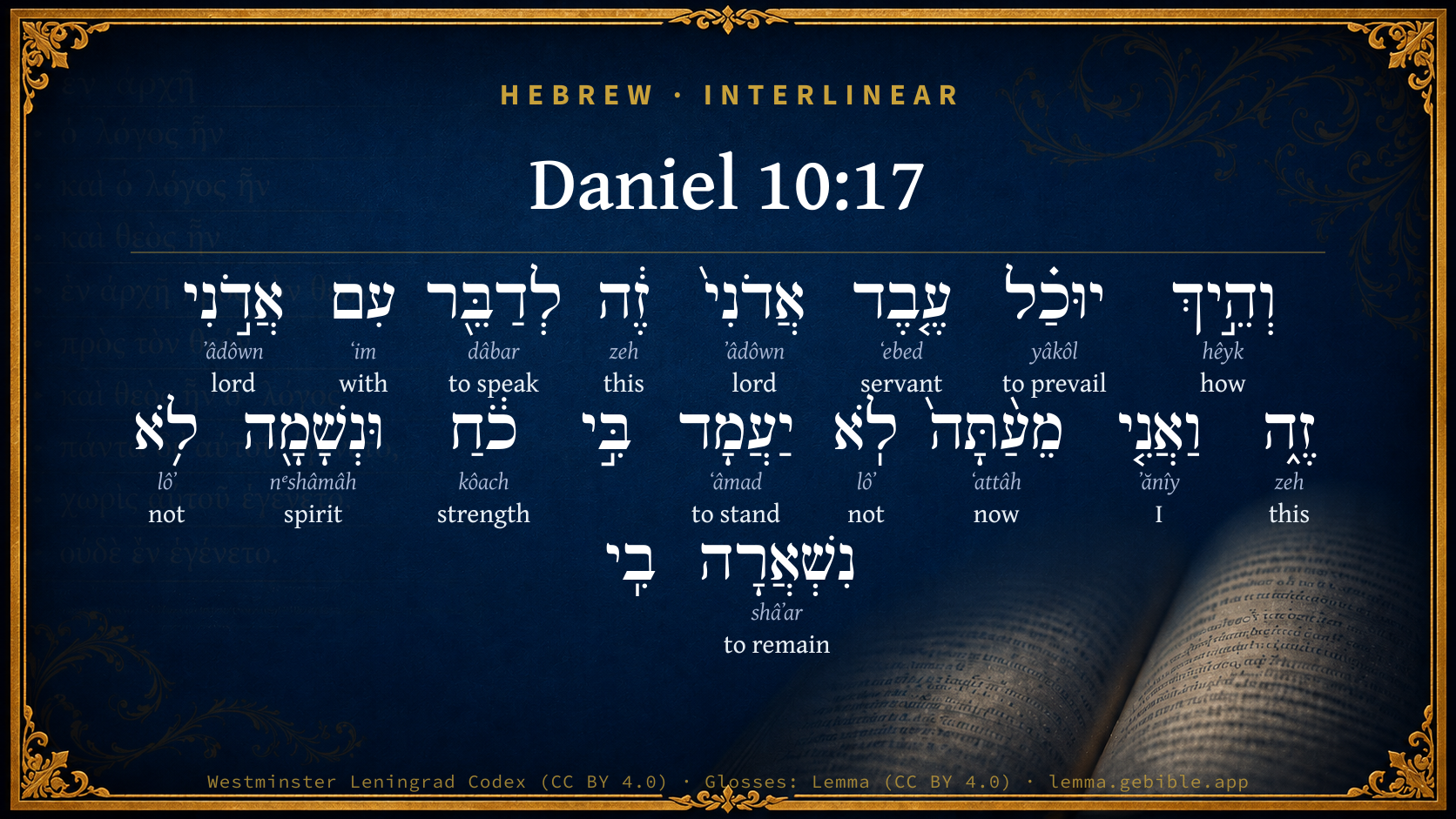
Daniel 10:17

Hebrew (Westminster Leningrad Codex) Daniel 10:17 appears in the Hebrew Old Testament. The text above is from the Westminster Leningrad Codex. Each word links to its Strong’s number, a concise gloss, and parsing drawn from the Open Scriptures Hebrew Bible morphology. Click any word for its full Brown-Driver-Briggs (BDB) entry.
Download image
Cite this verse

Daniel 10:17 (World English Bible). Public Domain. Lemma interlinear Bible study tool, https://lemma.gebible.app/v/daniel/10/17.

Show BibTeX & RIS
BibTeX
RIS
English Translation
For how can the servant of this my lord talk with this my lord? for as for me, immediately there remained no strength in me, neither was there breath left in me.
World English Bible · Public Domain
Download a study sheet

One document with this verse’s original text, its word-by-word gloss line, the meaning frame, cross-references with their text, attributed commentary, and full source and license credits — printable, and it pastes into notes with its structure intact.

This verse Autodidact and up

Study sheet (.html) Plain text (.txt)

A passage Seminary Student

Up to 50 verses in one chapter. A passage sheet keeps up to 6 commentary sources and 12 cross-references per verse, in the order this page ranks them, and says so on the sheet whenever that leaves anything out. Ask for a single verse and you get the Autodidact verse sheet above.

Everything on this page stays free to read, with no account — the sheet is a download of what is already on screen, not access to it.

Want to remove ads? Support Godless Engineer
Compare translations 3

The same verse in 3 English versions, stacked beneath the original-language interlinear above. Click any original word for its lexicon entry.

Each is an independent rendering of the whole verse — the interlinear is not word-aligned to these translations.

Highlighted words mark where these versions differ — a whole-verse word diff, not a word-by-word alignment.

  • World English Bible Public Domain
    For how can the servant of this my lord talk with this my lord? for as for me, immediately there remained no strength in me, neither was there breath left in me.
  • King James Version Public Domain
    For how can the servant of this my lord talk with this my lord? for as for me, straightway there remained no strength in me, neither is there breath left in me.
  • unfoldingWord Literal Text CC BY-SA 4.0
    How can such a servant of my lord talk with such as my lord? As for me, there remains now no strength in me, and there is no breath left in me.”

unfoldingWord Literal Text — © unfoldingWord, licensed CC BY-SA 4.0. Word-aligned USFM3 via Door43 (git.door43.org/unfoldingWord/en_ult).

Versions to compare (up to 4)

3 of 4 selected

Show all 18 translations

Every available English version of this verse, each an independent rendering of the whole verse.

  • World English Bible Public Domain
    For how can the servant of this my lord talk with this my lord? for as for me, immediately there remained no strength in me, neither was there breath left in me.
  • Berean Standard Bible Public Domain
    How can I, your servant, speak with you, my lord? Now I have no strength, nor is any breath left in me.”
  • Majority Standard Bible Public Domain
    How can I, your servant, speak with you, my lord? Now I have no strength, nor is any breath left in me.”
  • King James Version Public Domain
    For how can the servant of this my lord talk with this my lord? for as for me, straightway there remained no strength in me, neither is there breath left in me.
  • American Standard Version (1901) Public Domain
    For how can the servant of this my lord talk with this my lord? for as for me, straightway there remained no strength in me, neither was there breath left in me.
  • Revised Version (1885) Public Domain
    For how can the servant of this my lord talk with this my lord? for as for me, straightway there remained no strength in me, neither was there breath left in me.
  • Geneva Bible (1599) Public Domain
    For howe can the seruant of this my Lord talke with my Lord being such one? for as for me, straight way there remained no strength in me, neither is there breath left in me.
  • Douay-Rheims (1899) Public Domain
    And how can the servant of my lord speak with my lord? for no strength remaineth in me, moreover my breath is stopped.
  • Young's Literal Translation Public Domain
    And how is the servant of this my lord able to speak with this my lord? as for me, henceforth there remaineth in me no power, yea, breath hath not been left in me.
  • Literal Standard Version CC BY-SA 4.0
    And how is the servant of this my lord able to speak with this my lord? As for me, from now on there remains in me no power, indeed, breath has not been left in me.
  • Unlocked Literal Bible CC BY-SA 4.0
    I am your servant. How can I talk with my master? For I now have no strength, and there is no breath left in me.”
  • unfoldingWord Literal Text CC BY-SA 4.0
    How can such a servant of my lord talk with such as my lord? As for me, there remains now no strength in me, and there is no breath left in me.”
  • Darby Bible Public Domain
    And how can the servant of this my lord talk with this my lord? for as for me, straightway there remaineth no strength in me, neither is there breath left in me.
  • World Messianic Bible Public Domain
    For how can the servant of this my lord talk with this my lord? For as for me, immediately there remained no strength in me. There was no breath left in me.”
  • Webster's Bible Public Domain
    For how can the servant of this my lord talk with this my lord? for as for me, immediately there remained no strength in me, neither is there breath left in me.
  • Free Bible Version CC BY-SA 4.0
    How can I, your servant, speak to you, my lord? I have no strength, and I can hardly breathe.”
  • Bible in Basic English Public Domain
    For how may this servant of my lord have talk with my lord? for, as for me, straight away my strength went from me and there was no breath in my body.
  • JPS Tanakh (1917) Public Domain
    For how can this servant of my lord talk with this my lord? for as for me, straightway there remained no strength in me, neither was there breath left in me.'

Literal Standard Version (2020), Covenant Press — licensed CC BY-SA 4.0. Text via the HelloAO Bible API (eBible.org). Unlocked Literal Bible (unfoldingWord) — licensed CC BY-SA 4.0. Text via the HelloAO Bible API (eBible.org). unfoldingWord Literal Text — © unfoldingWord, licensed CC BY-SA 4.0. Word-aligned USFM3 via Door43 (git.door43.org/unfoldingWord/en_ult). Free Bible Version, Dr. Jonathan Gallagher — licensed CC BY-SA 4.0. Text via the HelloAO Bible API (eBible.org).

Word by word

More ways to search: Search by grammar → Find every occurrence → Compare this word →

Practice this passage: Drill this verse → Learn its vocabulary →

וְהֵ֣יךְ
hêyk
H1963
“and · how”
Conjunction + Particle, Interrogative
Part of Speech
Conjunction + Particle
Type
Interrogative
Full BDB Definition

Origin: another form for H349

TWOT: 492

how
  1. יוּכַ֗ל yâkôl H3201 “to prevail” Verb, Qal, Imperfect, 3rd Person, Masculine, Singular
  2. עֶ֤בֶד ʻebed H5650 “servant of” Noun, Common, Masculine, Singular, Construct
  3. אֲדֹנִי֙ ʼâdôwn H113 “lord · my” Noun, Common, Masculine, Singular, Construct + Suffix, Personal, 1st Person, Common, Singular
  4. זֶ֔ה zeh H2088 “this” Pronoun, Demonstrative, Masculine, Singular
  5. לְדַבֵּ֖ר dâbar H1696 “to speak” Preposition + Verb, Piel, Infinitive Construct
  6. עִם ʻim H5973 “with” Preposition
  7. אֲדֹ֣נִי ʼâdôwn H113 “lord · my” Noun, Common, Masculine, Singular, Construct + Suffix, Personal, 1st Person, Common, Singular
  8. זֶ֑ה zeh H2088 “this” Pronoun, Demonstrative, Masculine, Singular
  9. וַאֲנִ֤י ʼănîy H589 “and · I” Conjunction + Pronoun, Personal, 1st Person, Common, Singular
  10. מֵעַ֨תָּה֙ ʻattâh H6258 “from · now” Preposition + Adverb
  11. לֹֽא lôʼ H3808 “not” Particle, Negative
  12. יַעֲמָד ʻâmad H5975 “to stand” Verb, Qal, Imperfect, 3rd Person, Masculine, Singular
  13. כֹ֔חַ kôach H3581 “strength” Noun, Common, Masculine, Singular, Absolute
  14. וּנְשָׁמָ֖ה nᵉshâmâh H5397 “and · spirit” Conjunction + Noun, Common, Feminine, Singular, Absolute
  15. לֹ֥א lôʼ H3808 “not” Particle, Negative
  16. נִשְׁאֲרָה shâʼar H7604 “to remain” Verb, Niphal, Perfect, 3rd Person, Feminine, Singular

About this verse

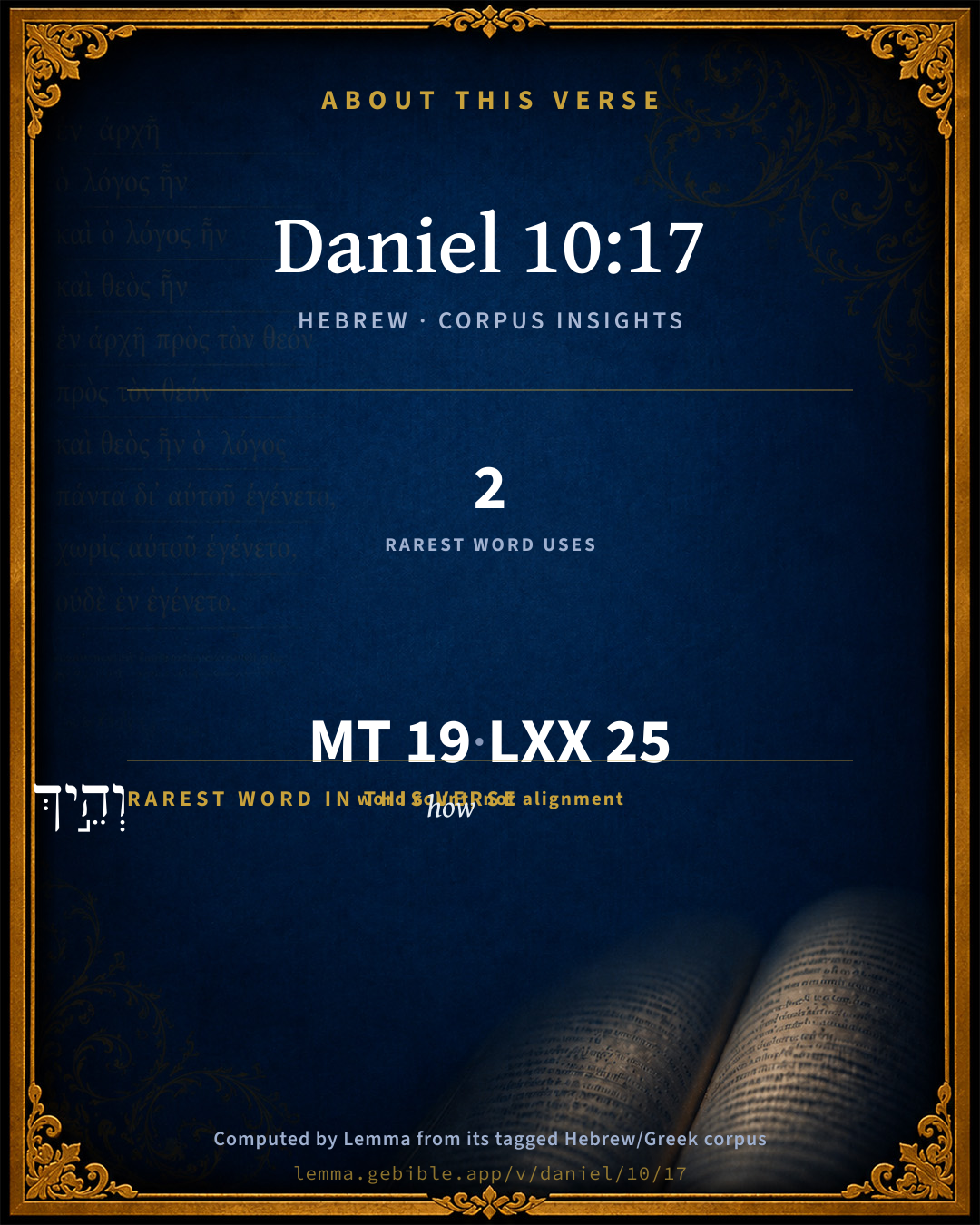
These counts appear in no published source. They are computed here, from the morphology-tagged text and Lemma’s own curated glosses. What Lemma adds →

19
words
14
distinct lemmas
Prophets
section

Notable vocabulary

The rarest word here is וְהֵ֣יךְ how H1963 — appearing just 2 times in the whole Hebrew Bible.

Shared distinctive vocabulary

וְהֵ֣יךְ how H1963 occurs in 2 verses of the Hebrew Bible. Also found in:

Grammatical profile

  • 4 verbs
  • 5 nouns
  • 3 pronouns
  • 3 prepositions
  • 1 adverb
  • 3 particles

Verb forms

  • יוּכַ֗ל Qal · Imperfect
  • לְדַבֵּ֖ר Piel · Infinitive Construct
  • יַעֲמָד Qal · Imperfect
  • נִשְׁאֲרָה Niphal · Perfect

Repetition

Words recur within this verse — often emphatic in Hebrew:

  • אֲדֹנִי֙ lord H113 ×2
  • זֶ֔ה this H2088 ×2
  • לֹֽא not H3808 ×2

Hebrew & Septuagint length

In English translation the verse runs 32 words from the Hebrew and 36 from the Septuagint (LXX English) — closely comparable.

A rough comparison of the two English renderings, which tokenize alike — not a word-level alignment.

Word counts can differ between the Hebrew and the Greek without any difference in meaning — e.g. the Hebrew direct-object marker אֵת has no separate Greek word, and Greek often adds the article ὁ.

In the original languages it is 19 Hebrew tokens and 25 Greek tokens — but the two are counted differently (Hebrew bundles its prefixes and suffixes into one token; the Greek is in lemma form), so that isn’t a like-for-like length.

Cross-references

9

Topical passages linked to Daniel 10:17 in the Treasury of Scripture Knowledge — connected by theme and wording, ordered by reader-vote popularity; previews shown in the World English Bible.

  • Exodus 24:10–11 They saw the God of Israel. Under his feet was like a paved work of sapphire stone, like the skies for clearness.
  • Isaiah 6:1–5 In the year that king Uzziah died, I saw the Lord sitting on a throne, high and lifted up; and his train filled the temple.
  • Genesis 32:20 You shall say, 'Not only that, but behold, your servant, Jacob, is behind us.'" For, he said, "I will appease him with the present that goes before me, and afterward I will see his face. Perhaps he will accept me."
  • Exodus 33:20 He said, "You cannot see my face, for man may not see me and live."
  • Judges 6:22 Gideon saw that he was the angel of Yahweh; and Gideon said, Alas, Lord Yahweh! because I have seen the angel of Yahweh face to face.
  • Judges 13:21–23 But the angel of Yahweh did no more appear to Manoah or to his wife. Then Manoah knew that he was the angel of Yahweh.
  • Matthew 22:43–44 He said to them, "How then does David in the Spirit call him Lord, saying,
  • Mark 12:36 For David himself said in the Holy Spirit, 'The Lord said to my Lord, Sit at my right hand, Until I make your enemies the footstool of your feet.'
  • John 1:18 No one has seen God at any time. The one and only Son, who is in the bosom of the Father, he has declared him.

Cross-references courtesy of OpenBible.info (CC BY 4.0).

Hebrew and Greek witnesses Masoretic Hebrew ↔ Greek Septuagint

The same verse in the two great witnesses to the Old Testament, shown verse-for-verse.

These are two independent witnesses, not word-aligned to each other, and the Septuagint is shown in lemma (dictionary) form.

Hebrew Daniel 10:17 Masoretic · Westminster Leningrad Codex

וְהֵ֣יךְ יוּכַ֗ל עֶ֤בֶד אֲדֹנִי֙ זֶ֔ה לְדַבֵּ֖ר עִם אֲדֹ֣נִי זֶ֑ה וַאֲנִ֤י מֵעַ֨תָּה֙ לֹֽא יַעֲמָד בִּ֣י כֹ֔חַ וּנְשָׁמָ֖ה לֹ֥א נִשְׁאֲרָה בִֽי

For how can the servant of this my lord talk with this my lord? for as for me, immediately there remained no strength in me, neither was there breath left in me.

World English Bible · Public Domain

Greek LXX Daniel 10:17 Septuagint · lemma form

καί πῶς δύναμαι ὁ παῖς λαλέω μετά ὁ κύριος αὐτός καί ἐγώ ἀσθενέω καί οὐ εἰμί ἐν ἐγώ ἰσχύς καί πνεῦμα οὐ καταλείπω ἐν ἐγώ

And how shall your servant be able, O my lord, to speak with this my lord? and as for me, from henceforth strength will not remain in me, and there is no breath left in me.

LXX2012 (modern English Septuagint) · Public Domain

On this verse, The Pulpit Commentary discusses the Septuagint’s reading. Read the note in Commentary ↓

Hebrew: Westminster Leningrad Codex (CC BY 4.0). Greek: Septuagint (public domain); English from LXX2012 (modern English Septuagint) (Public Domain). How the Septuagint differs from the Hebrew →

Commentary

Notes on Daniel 10:17 from classic Christian and Jewish commentators (each source and its license shown beneath its notes). The classic Christian expositions comment on the surrounding passage and are grouped to its opening verse, so a note may address several verses; the Jewish commentaries on the Tanakh (Rashi and others) are per-verse, so they appear only where the commentator wrote on this verse.

Lemma curates 59 commentaries, every one of them public domain or Creative Commons licensed, each selected and text-cleaned for this edition rather than reprinted as found. About our sources →

Trapp's Complete Commentary

John Trapp

Dan 10:17 For how can the servant of this my lord talk with this my lord? for as for me, straightway there remained no strength in me, neither is there breath left in me.

Ver. 17. For how can the servant of this my lord.]. Qui tantulus sum, et tam imbecillis. God’s praying servants use to speak as broken men. They well understand, (1.) Their distance; (2.) Dependence.

Talk with this my lord.] Prayer is a holy interparlance with the divine Majesty: εντευξις. {1Ti 2:1}

Neither is there breath in me.] I am hardly able to bear up or breathe. Human frailty cannot endure God’s presence without fainting. {Rev 1:17}

John Trapp, A Commentary or Exposition upon All the Books of the Old and New Testament (1647–1656) — public domain. Text from a community e-Sword module.

Jamieson, Fausset & Brown

Robert Jamieson, A. R. Fausset & David Brown

this . . . this my lord--to avoid the tautology in English Version, join rather "this," with "servant," "How can this servant of my lord (that is, how can I who am so feeble) talk with this my lord (who is so majestic)?" Thus Daniel gives the reason why he is so overwhelmed with awe [MAURER].

Jamieson, Fausset & Brown — Commentary Critical and Explanatory on the Whole Bible (1871) — public domain (CC PDM 1.0). Text via the HelloAO Bible API.

Adam Clarke's Commentary

Verse 17. Neither is there breath] He could not breathe freely; he was almost suffocated with sorrow.

Adam Clarke's Commentary on the Bible (1810–1826) — public domain. Text from a community e-Sword/MySword module.

Ellicott's Commentary for English Readers

(17) For how.—The whole verse must be regarded as addressed by Daniel to the angel. On the phrase “neither is there any breath in me” comp. 1Ki_17:17. Here we may notice the same fear which possessed Isaiah at the time of his vision (Isa_6:5).

A Bible Commentary for English Readers, edited by Charles John Ellicott (1878–1897) — public domain. Text from a community e-Sword module.

The Cambridge Bible for Schools and Colleges

gen. ed. J. J. S. Perowne

17. talk with this my lord] with a being so glorious and terrible.

and as for me, straightway &c.] either from now (i.e. from just now) there remaineth &c. (so most commentators); or (Keil) from now (i.e. henceforth) there will remain no strength in me,—so paralysed, viz. am I. The latter rendering is in accordance with the meaning of ‘from now’ elsewhere; the former expresses a thought harmonizing better with the clause which follows. ‘Remain’ is lit. stand, i.e. maintain itself: cf. Ecc_2:9; and ḳûm in Jos_2:11.

neither is there breath, &c.] a hyperbole. Cf. (of actual death) 1Ki_17:17; also, with ‘spirit’ for ‘breath,’ of the effects of fear, as here, Jos_2:11; and of wonder, 1Ki_10:5.

The Cambridge Bible for Schools and Colleges (gen. ed. J. J. S. Perowne; Cambridge University Press, 1878–1918) — public domain. Text from a community e-Sword module.

John Gill's Exposition

For how can the servant of this my lord talk with this my lord?.... Or, "talk with that my lord?" (z) pointing to the man clothed in linen, who appeared so glorious, and whom Daniel knew to be more than a man; and therefore he, who was a mere mortal sinful man, and reckoned himself a servant of the angel of the Lord that was now before him, and had touched him, and was conversing with him, and to whom he was greatly inferior, must be very unfit and unworthy to have conversation with one that was infinitely above him; "with such an one", his Lord, as Noldius (a) renders it, as Christ the Son of God, the Head of angels, King of kings, and Lord of lords; what was he, dust and ashes, that he should speak unto him, or be admitted to any discourse with him? so sensible was he of the greatness of Christ, and of his own frailty, sinfulness, and nothingness;

for as for me, straightway there remained no strength in me; as soon as ever he saw this great and glorious person; See Gill on Dan 10:8,

neither is there breath left in me: when he fainted away, and became like a dead man; and though he was raised up again, and set upon his feet, and had a little recovered his speech, yet it was with great difficulty that he breathed and spoke; as it is with men when their spirits are greatly oppressed, it is as if their life and soul were gone out of them, and they move more like dead than living men.

(z) "cum domino meo illo", Pagninus, Montanus, Munster, Junius & Tremellius. (a) Concord. Ebr. Part. p. 353.

John Gill's Exposition of the Whole Bible (1746–1763) — public domain (CC PDM 1.0). Text via the HelloAO Bible API.

Albert Barnes' Notes on the Bible

For how card the servant of this my lord - Acknowledging his humble and lowly condition and rank in the presence of an angel - a messenger now sent from heaven.

Neither is there breath left in me - That is, he was utterly overcome and prostrate. He felt that he was incapable of speaking in the presence of one who tied descended from God.

Albert Barnes' Notes on the Bible (1834–1885) — public domain. Text from a community e-Sword/MySword module.

Matthew Poole's English Annotations

The condition of the church under the gospel is a better dispensation than the law and the prophets, when God spake often by angels; but now by his Son, and that not in angelical shape and splendour, but as a mean man, in a meek and humble garb, and most familiar, Isa 61:1-3; Joh 13:5; Act 3:22.

Matthew Poole's English Annotations on the Holy Bible (1683–1685) — public domain. Text from a community e-Sword/MySword module.

Whedon's Commentary on the Bible

Daniel D. Whedon

17. For — Rather, And. In addition to the pains of disappointed hope (Dan_10:15-16) he is overawed by the splendor and majesty of this heavenly visitor notwithstanding his gracious assurances. (See note Dan_10:11.)

Daniel D. Whedon (gen. ed.), Commentary on the Old and New Testaments (1874–1909) — public domain. Text from a community e-Sword module.

The Pulpit Commentary

For how can the servant of this my lord talk with this my lord? for as for me, straightway there remained no strength in me, neither is there breath left in me. The LXX does not preserve the peculiar use of the demonstrative which we have here. Theodotion has it in the second case only; the Peshitta retains it; but the Vulgate omits it altogether. The rendering of neshama by pneuma in the Greek versions may be noted. Jerome renders, halitus. The Aramaic influence is seen in (hayeh) instead of (ayeh). How can the servant," etc., exhibits respect and humility. For as for me, etc. This seems not to be part of Daniel"s address to the angel, but a note which he has added to indicate his condition while he was speaking. - Neither is there breath left in me. There is no certainty whether this is to be taken in the physical or metaphysical sense; whether we should regard the prophet as declaring that awe deprived him of the power of breath, or he felt his consciousness so numbed as that he seemed to be without it.

The Pulpit Commentary (1880–1919), ed. H.D.M. Spence-Jones & Joseph S. Exell — public domain. Text from a community e-Sword module.

Keil & Delitzsch

C. F. Keil & F. Delitzsch

Therefore he may not talk with this Lord, i.e., with Him who appeared before him in such dread majesty; and he is yet in such a state, since all strength has departed from him and his breath has gone, that he fears he must die; cf. Kg1 17:17. Then once more one like the appearance of a man touched him. אדם כּמראה is in reality = אדם בּני כּדּמוּת: both forms of expression leave the person of him who touched him undefined, and only state that the touching proceeded from some one who was like a man, or that it was such as proceeds from men, and are like the expression used in Dan 10:19, "a hand touched me." From this it does not follow that he who spoke to him touched him, but only that it was a spiritual being, who appeared like to a man. After thus being touched for the third time (Dan 10:18), the encouragement of the angel that talked with him imparted to him full strength, so that he could calmly listen to and observe his communication.

Keil & Delitzsch — Biblical Commentary on the Old Testament (1861–1891) — public domain (CC PDM 1.0). Text via the HelloAO Bible API. (Old Testament only.)

Rashi

Rabbi Shlomo Yitzchaki (Rashi)

this servant of my lord He refers to himself as a servant, and to the angel as “my lord,” i.e., to say, How will your servant be able to speak with you?

Rashi on the Tanakh — English translations: “The Judaica Press complete Tanach with Rashi, translated by A. J. Rosenberg” (CC BY 4.0); “Pentateuch with Rashi's commentary by M. Rosenbaum and A.M. Silbermann, 1929-1934” (public domain); “The Metsudah Tanach series, Lakewood, N.J” (CC BY 4.0); and “The Book of Joshua, Metsudah Publications, 1997” (CC BY 4.0). Text via Sefaria.

Lesson kit

Teaching starters — assembled from the data on this page, not authored interpretation. Every prompt links to the verse data it draws on. Edit before teaching.

Daniel, in the Prophets, opens this verse with 19 words (14 distinct Hebrew lemmas). Its most distinctive word is hêyk (“how”). A historical commentator’s framing appears above. Read the whole chapter for the surrounding context.

Discussion questions

  1. The word hêyk carries the sense “how.” How does it shape the verse?
  2. 1 Chronicles 13:12 shares the word «how» with this verse. How do the two illuminate each other?
  3. “lord” occurs 2× in this one verse. What is the effect of the repetition?
  4. These translations render this verse differently. What is at stake in choosing one wording over another?
  5. The verb «יוּכַ֗ל» is Qal Imperfect. How does its form color the action?
  6. Reading how Trapp's Complete Commentary and Jamieson, Fausset & Brown read this verse, where do the two commentators agree and where do they part?

Things to notice

Reading settings

Reading text

Shown beneath each verse's original-language words.

Old Testament
Old Testament edition

Read the OT as the Masoretic Hebrew (MT) or the Greek Septuagint (LXX).

English shown for the Greek Septuagint (in the Hebrew ↔ Greek comparison).

Comparing translations? Open the Compare panel on any verse page to stack up to four side by side.