
Genesis 27:24

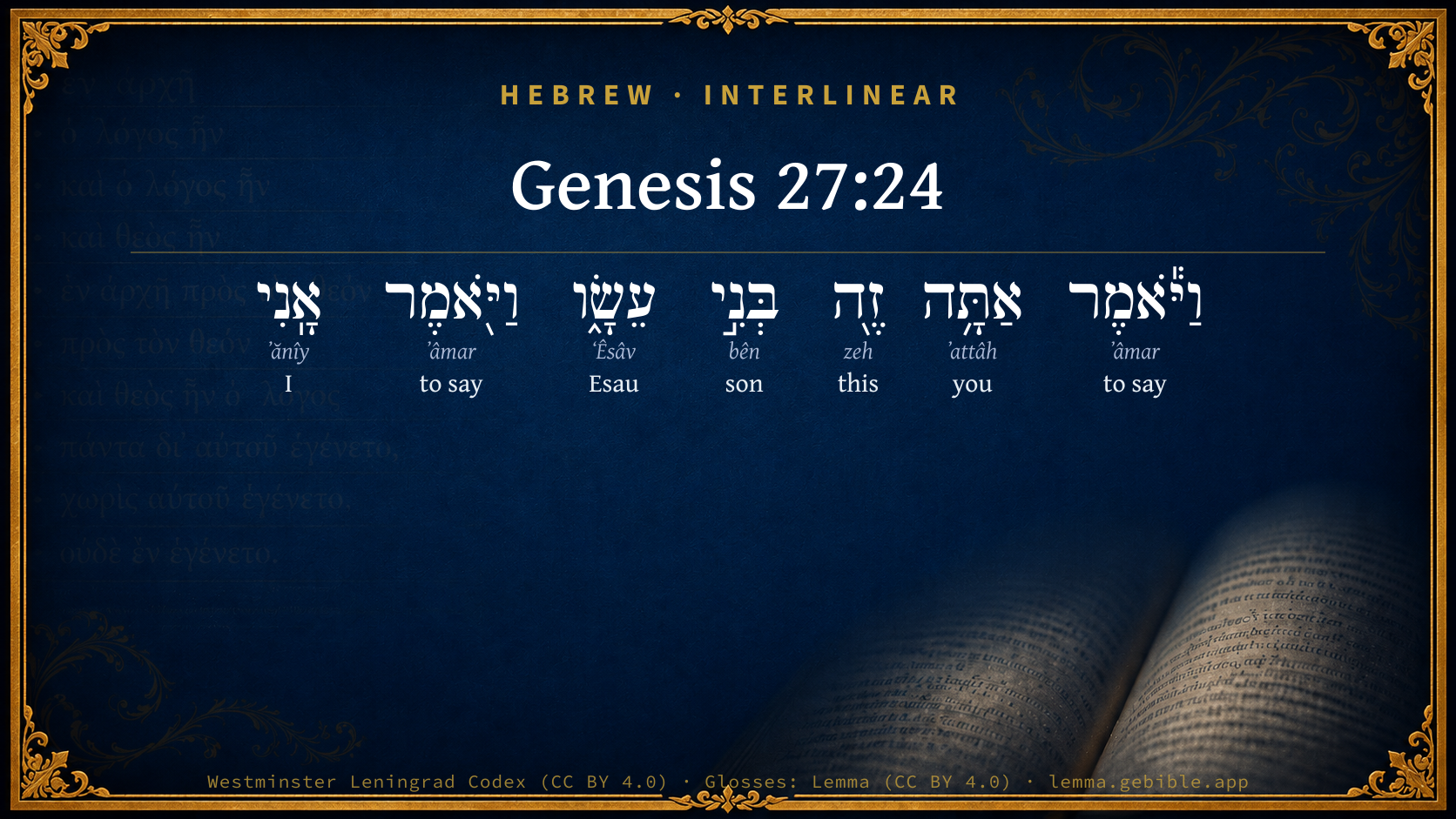
Hebrew (Westminster Leningrad Codex) Genesis 27:24 appears in the Hebrew Old Testament. The text above is from the Westminster Leningrad Codex. Each word links to its Strong’s number, a concise gloss, and parsing drawn from the Open Scriptures Hebrew Bible morphology. Click any word for its full Brown-Driver-Briggs (BDB) entry.
Download image
Cite this verse

Genesis 27:24 (World English Bible). Public Domain. Lemma interlinear Bible study tool, https://lemma.gebible.app/v/genesis/27/24.

Show BibTeX & RIS
BibTeX
RIS
English Translation
He said, "Are you really my son Esau?" He said, "I am."
World English Bible · Public Domain
Download a study sheet

One document with this verse’s original text, its word-by-word gloss line, the meaning frame, cross-references with their text, attributed commentary, and full source and license credits — printable, and it pastes into notes with its structure intact.

This verse Autodidact and up

Study sheet (.html) Plain text (.txt)

A passage Seminary Student

Up to 50 verses in one chapter. A passage sheet keeps up to 6 commentary sources and 12 cross-references per verse, in the order this page ranks them, and says so on the sheet whenever that leaves anything out. Ask for a single verse and you get the Autodidact verse sheet above.

Everything on this page stays free to read, with no account — the sheet is a download of what is already on screen, not access to it.

Want to remove ads? Support Godless Engineer
Compare translations 3

The same verse in 3 English versions, stacked beneath the original-language interlinear above. Click any original word for its lexicon entry.

Each is an independent rendering of the whole verse — the interlinear is not word-aligned to these translations.

Highlighted words mark where these versions differ — a whole-verse word diff, not a word-by-word alignment.

  • World English Bible Public Domain
    He said, "Are you really my son Esau?" He said, "I am."
  • King James Version Public Domain
    And he said, Art thou my very son Esau? And he said, I am.
  • unfoldingWord Literal Text CC BY-SA 4.0
    But he said, “ you really my son Esau?” And he said, “I.”

unfoldingWord Literal Text — © unfoldingWord, licensed CC BY-SA 4.0. Word-aligned USFM3 via Door43 (git.door43.org/unfoldingWord/en_ult).

Versions to compare (up to 4)

3 of 4 selected

Show all 17 translations

Every available English version of this verse, each an independent rendering of the whole verse.

  • World English Bible Public Domain
    He said, "Are you really my son Esau?" He said, "I am."
  • Berean Standard Bible Public Domain
    Again he asked, “Are you really my son Esau?” And he replied, “I am.”
  • Majority Standard Bible Public Domain
    Again he asked, “Are you really my son Esau?” And he replied, “I am.”
  • King James Version Public Domain
    And he said, Art thou my very son Esau? And he said, I am.
  • American Standard Version (1901) Public Domain
    And he said, Art thou my very son Esau? And he said, I am.
  • Revised Version (1885) Public Domain
    And he said, Art thou my very son Esau? And he said, I am.
  • Geneva Bible (1599) Public Domain
    Againe he sayd, Art thou that my sonne Esau? Who answered, Yea.
  • Young's Literal Translation Public Domain
    and saith, `Thou art he -- my son Esau?' and he saith, `I `am'.'
  • Literal Standard Version CC BY-SA 4.0
    and says, “You are he—my son Esau?” And he says, “I [am].”
  • Unlocked Literal Bible CC BY-SA 4.0
    He said, “Are you really my son Esau?” He replied, “I am.”
  • unfoldingWord Literal Text CC BY-SA 4.0
    But he said, “ you really my son Esau?” And he said, “I.”
  • Darby Bible Public Domain
    And he said, Art thou really my son Esau? And he said, It is I.
  • World Messianic Bible Public Domain
    He said, “Are you really my son Esau?” He said, “I am.”
  • Webster's Bible Public Domain
    And he said, Art thou my very son Esau? And he said, I am.
  • Free Bible Version CC BY-SA 4.0
    “It's really you, my son Esau?” he asked again. “Yes, it's me,” Jacob replied.
  • Bible in Basic English Public Domain
    And he said, Are you truly my son Esau? And he said, I am.
  • JPS Tanakh (1917) Public Domain
    And he said: 'Art thou my very son Esau?' And he said: 'I am.'

Literal Standard Version (2020), Covenant Press — licensed CC BY-SA 4.0. Text via the HelloAO Bible API (eBible.org). Unlocked Literal Bible (unfoldingWord) — licensed CC BY-SA 4.0. Text via the HelloAO Bible API (eBible.org). unfoldingWord Literal Text — © unfoldingWord, licensed CC BY-SA 4.0. Word-aligned USFM3 via Door43 (git.door43.org/unfoldingWord/en_ult). Free Bible Version, Dr. Jonathan Gallagher — licensed CC BY-SA 4.0. Text via the HelloAO Bible API (eBible.org).

Word by word

More ways to search: Search by grammar → Find every occurrence → Compare this word →

Practice this passage: Drill this verse → Learn its vocabulary →

About this verse

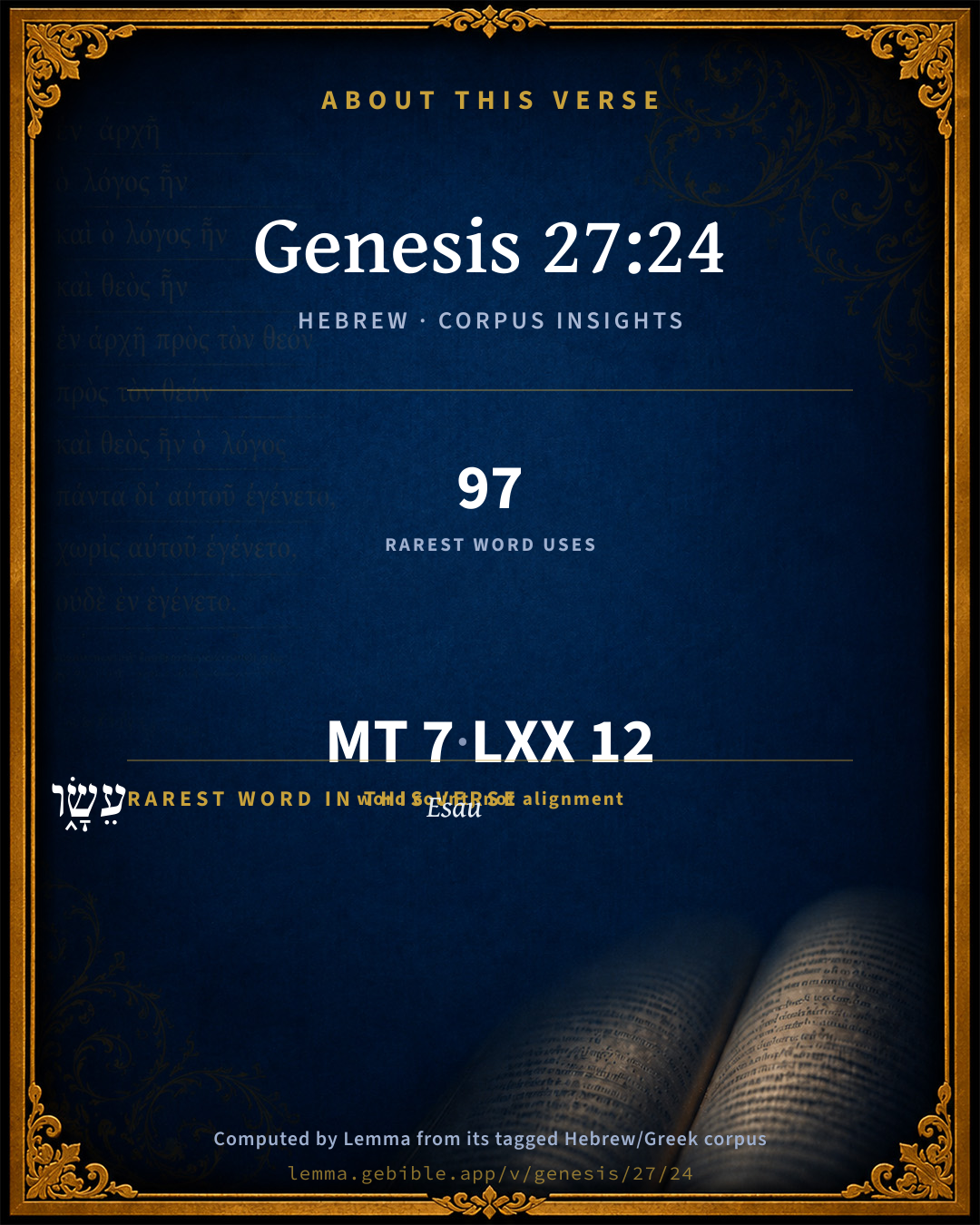
These counts appear in no published source. They are computed here, from the morphology-tagged text and Lemma’s own curated glosses. What Lemma adds →

7
words
6
distinct lemmas
Pentateuch
section

Grammatical profile

  • 2 verbs
  • 2 nouns
  • 3 pronouns

Verb forms

  • וַיֹּ֕אמֶר Qal · Sequential Imperfect
  • וַיֹּ֖אמֶר Qal · Sequential Imperfect

Repetition

A word recurs within this verse — often emphatic in Hebrew:

  • וַיֹּ֕אמֶר to say H559 ×2

Hebrew & Septuagint length

In English translation the verse runs 12 words from the Hebrew and 13 from the Septuagint (LXX English) — closely comparable.

A rough comparison of the two English renderings, which tokenize alike — not a word-level alignment.

Word counts can differ between the Hebrew and the Greek without any difference in meaning — e.g. the Hebrew direct-object marker אֵת has no separate Greek word, and Greek often adds the article ὁ.

In the original languages it is 7 Hebrew tokens and 12 Greek tokens — but the two are counted differently (Hebrew bundles its prefixes and suffixes into one token; the Greek is in lemma form), so that isn’t a like-for-like length.

Cross-references

13

Topical passages linked to Genesis 27:24 in the Treasury of Scripture Knowledge — connected by theme and wording, ordered by reader-vote popularity; previews shown in the World English Bible.

  • Colossians 3:9 Don't lie to one another, seeing that you have put off the old man with his doings,
  • Proverbs 12:22 Lying lips are an abomination to Yahweh, But those who do the truth are his delight.
  • Ephesians 4:25 Therefore, putting away falsehood, speak truth each one with his neighbor. For we are members one of another.
  • 1 Samuel 21:2 David said to Ahimelech the priest, The king has commanded me a business, and has said to me, Let no man know anything of the business about which I send you, and what I have commanded you: and I have appointed the young men to such and such a place.
  • 1 Samuel 21:13 He changed his behavior before them, and feigned himself mad in their hands, and scrabbled on the doors of the gate, and let his spittle fall down on his beard.
  • 1 Samuel 27:10 Achish said, Against whom have you made a raid today? David said, Against the South of Judah, and against the South of the Jerahmeelites, and against the South of the Kenites.
  • Job 13:7–8 Will you speak unrighteously for God, And talk deceitfully for him?
  • Job 15:5 For your iniquity teaches your mouth, And you choose the language of the crafty.
  • Proverbs 12:19 Truth's lips will be established forever, But a lying tongue is only momentary.
  • Proverbs 30:8 Remove far from me falsehood and lies. Give me neither poverty nor riches. Feed me with the food that is needful for me;
  • Zechariah 8:16 These are the things that you shall do: speak every man the truth with his neighbor. Execute the judgment of truth and peace in your gates,
  • Romans 3:7–8 For if the truth of God through my lie abounded to his glory, why am I also still judged as a sinner?
  • 2 Samuel 14:5 The king said to her, What ails you? She answered, Of a truth I am a widow, and my husband is dead.

Cross-references courtesy of OpenBible.info (CC BY 4.0).

Hebrew and Greek witnesses Masoretic Hebrew ↔ Greek Septuagint

The same verse in the two great witnesses to the Old Testament, shown verse-for-verse.

These are two independent witnesses, not word-aligned to each other, and the Septuagint is shown in lemma (dictionary) form.

Hebrew Genesis 27:24 Masoretic · Westminster Leningrad Codex

וַיֹּ֕אמֶר אַתָּ֥ה זֶ֖ה בְּנִ֣י עֵשָׂ֑ו וַיֹּ֖אמֶר אָֽנִי

He said, "Are you really my son Esau?" He said, "I am."

World English Bible · Public Domain

Greek LXX Genesis 27:24 Septuagint · lemma form

καί εἶπον σύ εἰμί ὁ υἱός ἐγώ ησαυ ὁ δέ εἶπον ἐγώ

and he said, Are you my son Esau? and he said, I am.

LXX2012 (modern English Septuagint) · Public Domain

Hebrew: Westminster Leningrad Codex (CC BY 4.0). Greek: Septuagint (public domain); English from LXX2012 (modern English Septuagint) (Public Domain). How the Septuagint differs from the Hebrew →

Targum (Aramaic paraphrase)

2

The Targum is the ancient Jewish Aramaic paraphrase of the Hebrew Scriptures — an interpretive translation, not the Hebrew text itself. Onkelos (literal) and Pseudo-Jonathan (expansive) render the Torah, and Jonathan the Prophets. Coverage is partial: where no permissively-licensed English translation exists for a verse, only the Aramaic is shown. This is verse-level text, not a word-by-word alignment to the Hebrew.

  1. Targum Onkelos Torah (Genesis–Deuteronomy)
    וַאֲמַר אַתְּ דֵּין בְּרִי עֵשָׂו וַאֲמַר הָא אֲנָא

    (no public-domain English translation for this verse)

    Targum Onkelos — Aramaic: “Onkelos Genesis” (public domain); “Onkelos Exodus” (public domain); “Onkelos Leviticus” (public domain); “Onkelos Numbers” (public domain); “Onkelos Deuteronomy” (public domain). English: “Sefaria Community Translation” (CC0 1.0 (public-domain dedication)); “J.W. Etheridge. The Targums of Onkelos and Jonathan Ben Uzziel on the Pentateuch. London: Longmans, Green, 1862” (public domain). Text via Sefaria.

  2. Targum Pseudo-Jonathan Torah (Genesis–Deuteronomy)
    וַאֲמַר אַנְתְּ הוּא דֵין בְּרִי עֵשָו וַאֲמַר אֲנָא

    And he said, But art thou my son Esau? And he said, I am.

    Targum Pseudo-Jonathan — Aramaic: “Targum Jonathan on Genesis” (public domain); “Targum Jonathan on Exodus” (public domain); “Targum Jonathan on Leviticus” (public domain); “Targum Jonathan on Numbers” (public domain); “Targum Jonathan on Deuteronomy” (public domain). English: “The Targum of Jonathan ben Uzziel, trans. J. W. Etheridge, London, 1862” (public domain). Text via Sefaria.

Commentary

Notes on Genesis 27:24 from classic Christian and Jewish commentators (each source and its license shown beneath its notes). The classic Christian expositions comment on the surrounding passage and are grouped to its opening verse, so a note may address several verses; the Jewish commentaries on the Tanakh (Rashi and others) are per-verse, so they appear only where the commentator wrote on this verse.

Lemma curates 59 commentaries, every one of them public domain or Creative Commons licensed, each selected and text-cleaned for this edition rather than reprinted as found. About our sources →

Trapp's Complete Commentary

John Trapp

Gen 27:24 And he said, [Art] thou my very son Esau? And he said, I [am].

Ver. 24. Art thou my very son Esau? And he said, I am.] Thus one sin entertained fetcheth in another; a lie especially, which, being a tinkerly, blushful sin, is either denied by the liar, who is ashamed to be taken with it, or else covered by another and another lie, as we see here in Jacob, who, being once over shoes, will be over boots too, but he will persuade his father that he is his very son Esau.

John Trapp, A Commentary or Exposition upon All the Books of the Old and New Testament (1647–1656) — public domain. Text from a community e-Sword module.

Geneva Bible (1599)

Geneva Bible translators

Hebrew, I am.

Geneva Bible (1599) marginal notes — public domain. Text via Bolls.life.

John Gill's Exposition

And said, art thou my very son Esau?.... Still having some doubt on his mind whether he really was so or not, because of his voice:

and he said, I am; as for the observation of Jarchi upon this, in order to excuse Jacob from lying, that he does not say, "I am Esau", only "I", it will not do, since it is an answer to Isaac's question, with a design to deceive him; and he intended by it that he should understand him as he did, that he was really Esau.

John Gill's Exposition of the Whole Bible (1746–1763) — public domain (CC PDM 1.0). Text via the HelloAO Bible API.

The Pulpit Commentary

Vers. 24-26. And he said (showing that a feeling of uneasy suspicion yet lingered in his mind), Art thou my very son Esau? Luther wonders how Jacob was able to brazen it out; adding, "I should probably have run away in terror, and let the dish fall;" but, instead of that, he added one more lie to those which had preceded, saying with undisturbed composure, I am equivalent to an English yes; upon which the blind old patriarch requested that the proffered dainties might be set before him. Having partaken of the carefully-disguised kid"s flesh, and drunk an exhilarating cup of wine, he further desired that his favorite son should approach his bed, saying, Come near now, and kiss me, my son a request dictated more by paternal affection (Keil, Kalisch) than by lingering doubt which required reassurance (Lange).

The Pulpit Commentary (1880–1919), ed. H.D.M. Spence-Jones & Joseph S. Exell — public domain. Text from a community e-Sword module.

Keil & Delitzsch

C. F. Keil & F. Delitzsch

After his father, in order to get rid of his suspicion about the voice, had asked him once more, "Art thou really my son Esau?" and Jacob had replied, "I am" (אני = yes), he told him to hand him the savoury dish that he might eat. After eating, he kissed his son as a sing of his paternal affection, and in doing so he smelt the odour of his clothes, i.e., the clothes of Esau, which were thoroughly scented with the odour of the fields, and then imparted his blessing (Gen 27:27-29). The blessing itself is thrown, as the sign of an elevated state of mind, into the poetic style of parallel clauses, and contains the peculiar forms of poetry, such as ראה for הנּה, הוה for היה, etc. The smell of the clothes with the scent of the field suggested to the patriarch's mind the image of his son's future prosperity, so that he saw him in possession of the promised land and the full enjoyment of its valuable blessings, having the smell of the field which Jehovah blessed, i.e., the garden of paradise, and broke out into the wish, "God (Ha-Elohim, the personal God, not Jehovah, the covenant God) give thee from the dew of heaven, and the fat fields of the earth, and plenty of corn and wine," i.e., a land blessed with the dew of heaven and a fruitful soil.

In Eastern countries, where there is so little rain, the dew is the most important prerequisite for the growth of the fruits of the earth, and is often mentioned therefore as a source of blessing (Deu 33:13, Deu 33:28; Hos 14:6; Zac 8:12). In משׁמנּי, notwithstanding the absence of the Dagesh from the שׁ, the מ is the prep. מן, as the parallel מטּל proves; and שׁמנּים both here and in Gen 27:39 are the fat (fertile) districts of a country. The rest of the blessing had reference to the future pre-eminence of his son. He was to be lord not only over his brethren (i.e., over kindred tribes), but over (foreign) peoples and nations also. The blessing rises here to the idea of universal dominion, which was to be realized in the fact that, according to the attitude assumed by the people towards him as their lord, it would secure to them either a blessing or a curse. If we compare this blessing with the promises which Abraham received, there are two elements of the latter which are very apparent; viz., the possession of the land, in the promise of the rich enjoyment of its produce, and the numerous increase of posterity, in the promised dominion over the nations. The third element, however, the blessing of the nations in and through the seed of Abraham, is so generalized in the expression, which is moulded according to Gen 12:3, "Cursed be every one that curseth thee, and blessed be he that blesseth thee," that the person blessed is not thereby declared to be the medium of salvation to the nations. Since the intention to give the blessing to Esau the first-born did not spring from proper feelings towards Jehovah and His promises, the blessing itself, as the use of the word Elohim instead of Jehovah or El Shaddai (cf. Gen 28:3) clearly shows, could not rise to the full height of the divine blessings of salvation, but referred chiefly to the relation in which the two brothers and their descendants would stand to one another, the theme with which Isaac's soul was entirely filled. It was only the painful discovery that, in blessing against his will, he had been compelled to follow the saving counsel of God, which awakened in him the consciousness of his patriarchal vocation, and gave him the spiritual power to impart the "blessing of Abraham" to the son whom he had kept back, but whom Jehovah had chosen, when he was about to send him away to Haran (Gen 28:3-4).

Keil & Delitzsch — Biblical Commentary on the Old Testament (1861–1891) — public domain (CC PDM 1.0). Text via the HelloAO Bible API. (Old Testament only.)

unfoldingWord translationNotes

Door43 World Missions Community

He said

Isaac asks this question before blessing his son. AT: "But first Isaac asked" (See: Order of Events)

eat of your game

The word "game" refers to a wild animal that people hunt and kill. See how "game" was translated in Genesis 27:7.

he drank

"Isaac drank it"

translationWords

Esau

Isaac

bless

Jacob

wine

unfoldingWord translationNotes — © Distant Shores Media and the Door43 World Missions Community, licensed CC BY-SA 4.0. Source: git.door43.org/Door43/en_tn.

Rashi

Rabbi Shlomo Yitzchaki (Rashi)

ויאמר אני AND HE SAID I AM — He did not say, “I am Esau”, but “It is I”.

Rashi on the Tanakh — English translations: “The Judaica Press complete Tanach with Rashi, translated by A. J. Rosenberg” (CC BY 4.0); “Pentateuch with Rashi's commentary by M. Rosenbaum and A.M. Silbermann, 1929-1934” (public domain); “The Metsudah Tanach series, Lakewood, N.J” (CC BY 4.0); and “The Book of Joshua, Metsudah Publications, 1997” (CC BY 4.0). Text via Sefaria.

Radak

Rabbi David Kimhi (Radak)

ולא...ויאמר אתה זה, this is a form of a question, even though it is not accompanied by the letter ה in front of the word אתה which we would have expected to introduce such a question. We find a similar construction in Kings I 1,24 אתה ומרת אדניה ימלוך אחרי? “did you (King David) say that “Adoniah will rule after me?” There are numerous similar constructions in Scripture. The reason why Yaakov phrased this as a question was that he was still not convinced that it was Esau because the voice [as well as the mode of speech. Ed.] was so similar to that of Yaakov. He was afraid of appearing as swindling Esau to whom he had promised the blessing, if he we were to bless Yaakov instead, although he loved Yaakov dearly. This is why he still continued with the examination.

Radak on the Tanakh — English translations: “Sefaria Community Translation” (CC0 1.0 (public-domain dedication)); “Eliyahu Munk, HaChut Hameshulash” (CC BY 4.0); “Rabbi Mike Feuer, Jerusalem Anthology” (CC BY 4.0); and “R. David Kimhi on the first book of Psalms, Translated by R.G. Finch, London, 1919” (public domain). Text via Sefaria.

Lesson kit

Teaching starters — assembled from the data on this page, not authored interpretation. Every prompt links to the verse data it draws on. Edit before teaching.

Genesis, in the Pentateuch, opens this verse with 7 words (6 distinct Hebrew lemmas). Its most distinctive word is ʻÊsâv (“Esau”). A historical commentator’s framing appears above. Read the whole chapter for the surrounding context.

Discussion questions

  1. The word ʻÊsâv carries the sense “Esau.” How does it shape the verse?
  2. How does Colossians 3:9, which shares this passage’s theme, read alongside this verse?
  3. What does the repetition of “to say” (2× in this one verse) do in this verse?
  4. These translations render this verse differently. What is at stake in choosing one wording over another?
  5. «וַיֹּ֕אמֶר» is a Qal Sequential Imperfect verb. How does that grammatical form shape the action described?
  6. Compare how Trapp's Complete Commentary and Geneva Bible (1599) read this verse. Where do they agree or differ?

Things to notice

Reading settings

Reading text

Shown beneath each verse's original-language words.

Old Testament
Old Testament edition

Read the OT as the Masoretic Hebrew (MT) or the Greek Septuagint (LXX).

English shown for the Greek Septuagint (in the Hebrew ↔ Greek comparison).

Comparing translations? Open the Compare panel on any verse page to stack up to four side by side.