
Leviticus 26:45

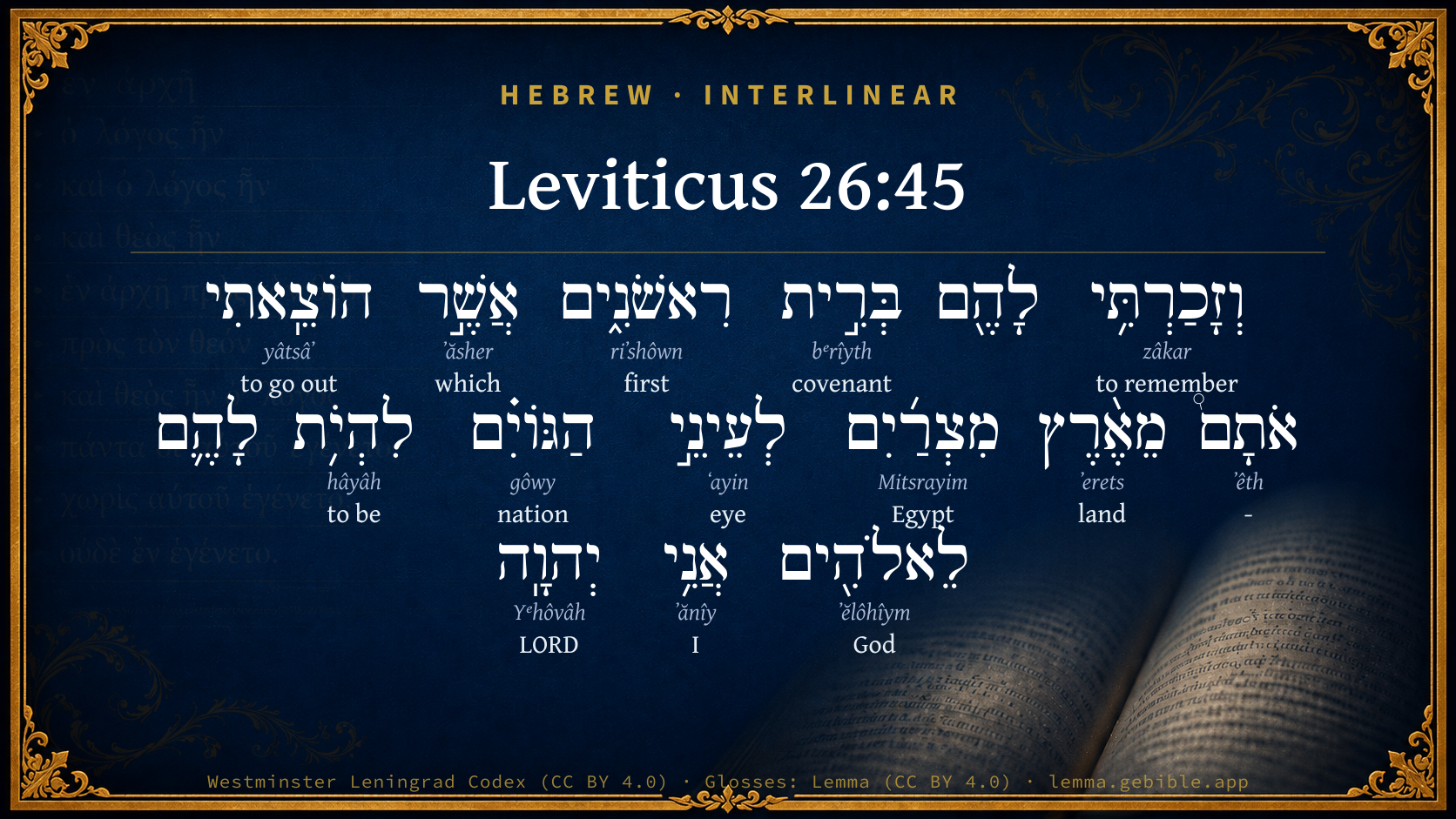
Hebrew (Westminster Leningrad Codex) Leviticus 26:45 appears in the Hebrew Old Testament. The text above is from the Westminster Leningrad Codex. Each word links to its Strong’s number, a concise gloss, and parsing drawn from the Open Scriptures Hebrew Bible morphology. Click any word for its full Brown-Driver-Briggs (BDB) entry.
Download image
Cite this verse

Leviticus 26:45 (World English Bible). Public Domain. Lemma interlinear Bible study tool, https://lemma.gebible.app/v/leviticus/26/45.

Show BibTeX & RIS
BibTeX
RIS
English Translation
but I will for their sake remember the covenant of their ancestors, whom I brought forth out of the land of Egypt in the sight of the nations, that I might be their God. I am Yahweh.'"
World English Bible · Public Domain
Download a study sheet

One document with this verse’s original text, its word-by-word gloss line, the meaning frame, cross-references with their text, attributed commentary, and full source and license credits — printable, and it pastes into notes with its structure intact.

This verse Autodidact and up

Study sheet (.html) Plain text (.txt)

A passage Seminary Student

Up to 50 verses in one chapter. A passage sheet keeps up to 6 commentary sources and 12 cross-references per verse, in the order this page ranks them, and says so on the sheet whenever that leaves anything out. Ask for a single verse and you get the Autodidact verse sheet above.

Everything on this page stays free to read, with no account — the sheet is a download of what is already on screen, not access to it.

Want to remove ads? Support Godless Engineer
Compare translations 3

The same verse in 3 English versions, stacked beneath the original-language interlinear above. Click any original word for its lexicon entry.

Each is an independent rendering of the whole verse — the interlinear is not word-aligned to these translations.

Highlighted words mark where these versions differ — a whole-verse word diff, not a word-by-word alignment.

  • World English Bible Public Domain
    but I will for their sake remember the covenant of their ancestors, whom I brought forth out of the land of Egypt in the sight of the nations, that I might be their God. I am Yahweh.'"
  • King James Version Public Domain
    But I will for their sakes remember the covenant of their ancestors, whom I brought forth out of the land of Egypt in the sight of the heathen, that I might be their God: I am the LORD.
  • unfoldingWord Literal Text CC BY-SA 4.0
    But I will remember for them the covenant of the first, whom I brought them out from the land of Egypt to the eyes of the nations to be God to them. I am Yahweh.’”

unfoldingWord Literal Text — © unfoldingWord, licensed CC BY-SA 4.0. Word-aligned USFM3 via Door43 (git.door43.org/unfoldingWord/en_ult).

Versions to compare (up to 4)

3 of 4 selected

Show all 18 translations

Every available English version of this verse, each an independent rendering of the whole verse.

  • World English Bible Public Domain
    but I will for their sake remember the covenant of their ancestors, whom I brought forth out of the land of Egypt in the sight of the nations, that I might be their God. I am Yahweh.'"
  • Berean Standard Bible Public Domain
    But for their sake I will remember the covenant with their fathers, whom I brought out of the land of Egypt in the sight of the nations, that I might be their God. I am the LORD.”
  • Majority Standard Bible Public Domain
    But for their sake I will remember the covenant with their fathers, whom I brought out of the land of Egypt in the sight of the nations, that I might be their God. I am the LORD.”
  • King James Version Public Domain
    But I will for their sakes remember the covenant of their ancestors, whom I brought forth out of the land of Egypt in the sight of the heathen, that I might be their God: I am the LORD.
  • American Standard Version (1901) Public Domain
    but I will for their sakes remember the covenant of their ancestors, whom I brought forth out of the land of Egypt in the sight of the nations, that I might be their God: I am Jehovah.
  • Revised Version (1885) Public Domain
    but I will for their sakes remember the covenant of their ancestors, whom I brought forth out of the land of Egypt in the sight of the nations, that I might be their God: I am the LORD.
  • Geneva Bible (1599) Public Domain
    But I will remember for them the couenant of olde when I brought them out of ye land of Egypt in the sight of the heathen that I might be their God: I am the Lord.
  • Douay-Rheims (1899) Public Domain
    And I will remember my former covenant, when I brought them out of the land of Egypt, in the sight of the Gentiles, to be their God. I am the Lord. These are the judgments, and precepts, and laws, which the Lord gave between him and the children of Israel in mount Sinai by the hand of Moses.
  • Young's Literal Translation Public Domain
    then I have remembered for them the covenant of the ancestors, whom I brought forth out of the land of Egypt before the eyes of the nations to become their God; I `am' Jehovah.'
  • Literal Standard Version CC BY-SA 4.0
    then I have remembered for them the covenant of the ancestors, whom I brought forth out of the land of Egypt before the eyes of the nations to become their God; I [am] YHWH.”
  • Unlocked Literal Bible CC BY-SA 4.0
    But for their sakes I will call to mind the covenant with their ancestors, whom I brought out of the land of Egypt in the sight of the nations, so that I might be their God. I am Yahweh.”
  • unfoldingWord Literal Text CC BY-SA 4.0
    But I will remember for them the covenant of the first, whom I brought them out from the land of Egypt to the eyes of the nations to be God to them. I am Yahweh.’”
  • Darby Bible Public Domain
    But I will remember toward them the covenant with their ancestors whom I brought forth out of the land of Egypt before the eyes of the nations, that I might be their God: I am Jehovah.
  • World Messianic Bible Public Domain
    But I will for their sake remember the covenant of their ancestors, whom I brought out of the land of Egypt in the sight of the nations, that I might be their God. I am the LORD.’”
  • Webster's Bible Public Domain
    But I will for their sakes remember the covenant of their ancestors, whom I brought out of the land of Egypt in the sight of the heathen, that I might be their God: I am the LORD.
  • Free Bible Version CC BY-SA 4.0
    Because of them I will renew the agreement I made with their fathers, those I led out of Egypt as the other nations watched, in order that I might be their God. I am the Lord.”
  • Bible in Basic English Public Domain
    And because of them I will keep in mind the agreement which I made with their fathers, whom I took out of the land of Egypt before the eyes of the nations, to be their God: I am the Lord.
  • JPS Tanakh (1917) Public Domain
    But I will for their sakes remember the covenant of their ancestors, whom I brought forth out of the land of Egypt in the sight of the nations, that I might be their God: I am the LORD.

Literal Standard Version (2020), Covenant Press — licensed CC BY-SA 4.0. Text via the HelloAO Bible API (eBible.org). Unlocked Literal Bible (unfoldingWord) — licensed CC BY-SA 4.0. Text via the HelloAO Bible API (eBible.org). unfoldingWord Literal Text — © unfoldingWord, licensed CC BY-SA 4.0. Word-aligned USFM3 via Door43 (git.door43.org/unfoldingWord/en_ult). Free Bible Version, Dr. Jonathan Gallagher — licensed CC BY-SA 4.0. Text via the HelloAO Bible API (eBible.org).

Word by word

More ways to search: Search by grammar → Find every occurrence → Compare this word →

Practice this passage: Drill this verse → Learn its vocabulary →

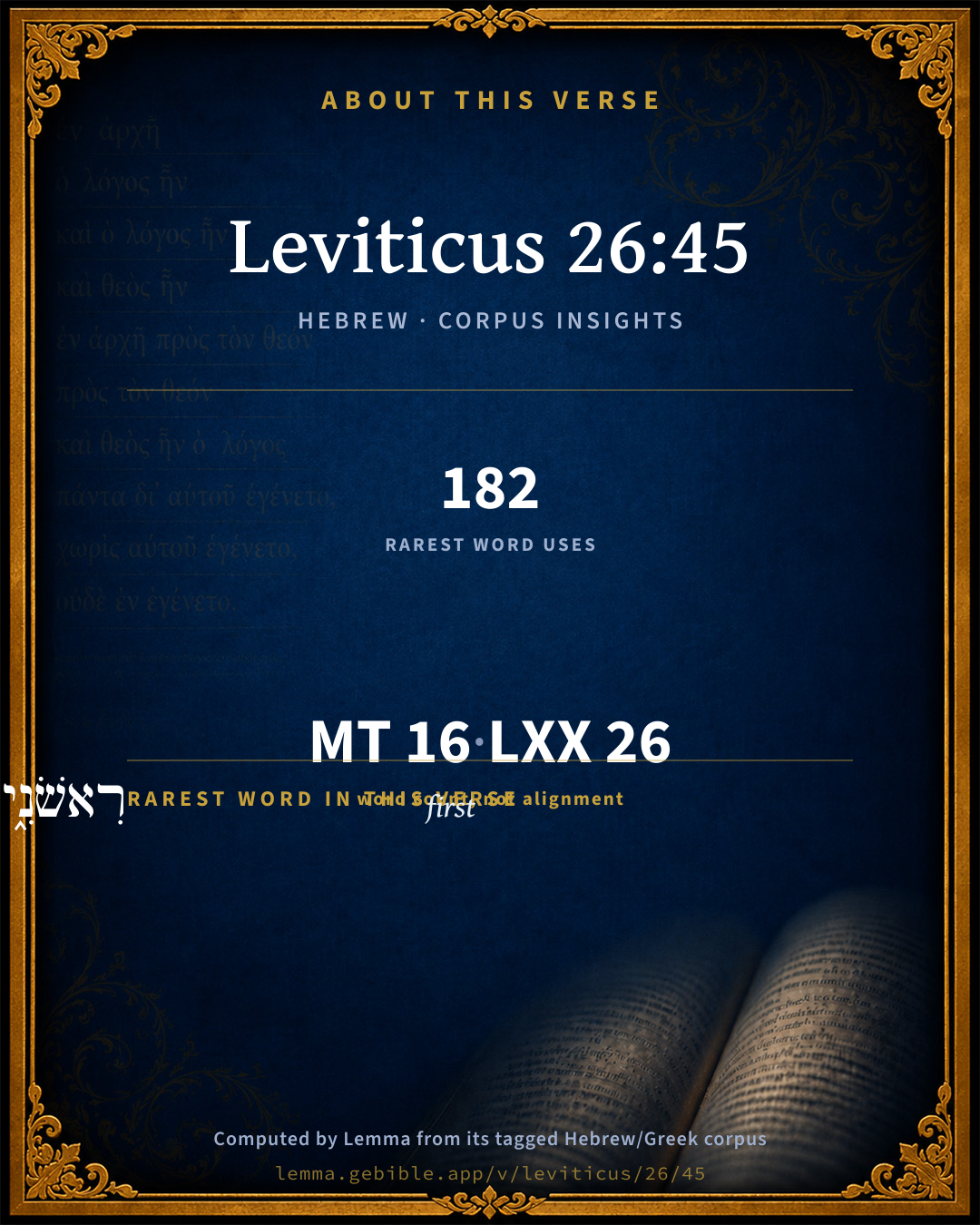
רִאשֹׁנִ֑ים
riʼshôwn
H7223
“first”
Adjective, Adjective, Masculine, Plural, Absolute
Part of Speech
Adjective
Type
Adjective
Gender
Masculine
Number
Plural
State
Absolute
Full BDB Definition

Origin: from H7221

TWOT: 2097c

first, primary, former (adjective) - former (of time) - ancestors - former things - foremost (of location) - first (in time) - first, chief (in degree) - first, before, formerly, at first (adverb)
  1. וְזָכַרְתִּ֥י zâkar H2142 “and · to remember” Conjunction + Verb, Qal, Sequential Perfect, 1st Person, Common, Singular
  2. בְּרִ֣ית bᵉrîyth H1285 “covenant of” Noun, Common, Feminine, Singular, Construct
  3. אֲשֶׁ֣ר ʼăsher H834 “which” Particle, Relative
  4. הוֹצֵֽאתִי yâtsâʼ H3318 “to go out” Verb, Hiphil, Perfect, 1st Person, Common, Singular
  5. אֹתָם֩ ʼêth H853 “- · them” Particle, Direct Object + Suffix, Personal, 3rd Person, Masculine, Plural
  6. מֵאֶ֨רֶץ ʼerets H776 “from · land of” Preposition + Noun, Common, Both, Singular, Construct
  7. מִצְרַ֜יִם Mitsrayim H4714 “Egypt” Noun, Proper
  8. לְעֵינֵ֣י ʻayin H5869 “to/for · eyes of” Preposition + Noun, Common, Both, Dual, Construct
  9. הַגּוֹיִ֗ם gôwy H1471 “the · nations” Particle, Definite Article + Noun, Common, Masculine, Plural, Absolute
  10. לִהְיֹ֥ת hâyâh H1961 “to be” Preposition + Verb, Qal, Infinitive Construct
  11. לֵאלֹהִ֖ים ʼĕlôhîym H430 “to/for · God(s)” Preposition + Noun, Common, Masculine, Plural, Absolute
  12. אֲנִ֥י ʼănîy H589 “I” Pronoun, Personal, 1st Person, Common, Singular
  13. יְהוָֽה Yᵉhôvâh H3068 “LORD” Noun, Proper

About this verse

These counts appear in no published source. They are computed here, from the morphology-tagged text and Lemma’s own curated glosses. What Lemma adds →

16
words
14
distinct lemmas
Pentateuch
section

Grammatical profile

  • 3 verbs
  • 7 nouns
  • 1 adjective
  • 1 pronoun
  • 2 prepositions
  • 2 particles

Verb forms

  • וְזָכַרְתִּ֥י Qal · Sequential Perfect
  • הוֹצֵֽאתִי Hiphil · Perfect
  • לִהְיֹ֥ת Qal · Infinitive Construct

Hebrew & Septuagint length

In English translation the verse runs 37 words from the Hebrew and 34 from the Septuagint (LXX English) — closely comparable.

A rough comparison of the two English renderings, which tokenize alike — not a word-level alignment.

Word counts can differ between the Hebrew and the Greek without any difference in meaning — e.g. the Hebrew direct-object marker אֵת has no separate Greek word, and Greek often adds the article ὁ.

In the original languages it is 16 Hebrew tokens and 26 Greek tokens — but the two are counted differently (Hebrew bundles its prefixes and suffixes into one token; the Greek is in lemma form), so that isn’t a like-for-like length.

Cross-references

18

Topical passages linked to Leviticus 26:45 in the Treasury of Scripture Knowledge — connected by theme and wording, ordered by reader-vote popularity; previews shown in the World English Bible.

  • Leviticus 25:38 I am Yahweh your God, who brought you forth out of the land of Egypt, to give you the land of Canaan, and to be your God.
  • Leviticus 22:33 who brought you out of the land of Egypt, to be your God. I am Yahweh."
  • Psalms 98:2–3 Yahweh has made known his salvation. He has openly shown his righteousness in the sight of the nations.
  • Ezekiel 20:9 But I worked for my name's sake, that it should not be profaned in the sight of the nations, among which they were, in whose sight I made myself known to them, in bringing them forth out of the land of Egypt.
  • Ezekiel 20:22 Nevertheless I withdrew my hand, and worked for my name's sake, that it should not be profaned in the sight of the nations, in whose sight I brought them forth.
  • Genesis 12:2 I will make of you a great nation. I will bless you, and make your name great. You will be a blessing.
  • Genesis 15:18 In that day Yahweh made a covenant with Abram, saying, "To your seed have I given this land, from the river of Egypt to the great river, the river Euphrates:
  • Genesis 17:7–8 I will establish my covenant between me and you and your seed after you throughout their generations for an everlasting covenant, to be a God to you and to your seed after you.
  • Exodus 2:24 God heard their groaning, and God remembered his covenant with Abraham, with Isaac, and with Jacob.
  • Exodus 6:8 I will bring you into the land which I swore to give to Abraham, to Isaac, and to Jacob; and I will give it to you for a heritage: I am Yahweh.'"
  • Exodus 19:5–6 Now therefore, if you will indeed obey my voice, and keep my covenant, then you shall be my own possession from among all peoples; for all the earth is mine;
  • Exodus 20:2 "I am Yahweh your God, who brought you out of the land of Egypt, out of the house of bondage.
  • Ezekiel 20:14 But I worked for my name's sake, that it should not be profaned in the sight of the nations, in whose sight I brought them out.
  • Luke 1:72–73 To show mercy towards our fathers, To remember his holy covenant,
  • Romans 11:12 Now if their fall is the riches of the world, and their loss the riches of the Gentiles; how much more their fullness?
  • Romans 11:23–26 They also, if they don't continue in their unbelief, will be grafted in, for God is able to graft them in again.
  • Romans 11:28–29 Concerning the Gospel, they are enemies for your sake. But concerning the election, they are beloved for the fathers' sake.
  • 2 Corinthians 3:15–16 But to this day, when Moses is read, a veil lies on their heart.

Cross-references courtesy of OpenBible.info (CC BY 4.0).

Hebrew and Greek witnesses Masoretic Hebrew ↔ Greek Septuagint

The same verse in the two great witnesses to the Old Testament, shown verse-for-verse.

These are two independent witnesses, not word-aligned to each other, and the Septuagint is shown in lemma (dictionary) form.

Hebrew Leviticus 26:45 Masoretic · Westminster Leningrad Codex

וְזָכַרְתִּ֥י לָהֶ֖ם בְּרִ֣ית רִאשֹׁנִ֑ים אֲשֶׁ֣ר הוֹצֵֽאתִי אֹתָם֩ מֵאֶ֨רֶץ מִצְרַ֜יִם לְעֵינֵ֣י הַגּוֹיִ֗ם לִהְיֹ֥ת לָהֶ֛ם לֵאלֹהִ֖ים אֲנִ֥י יְהוָֽה

but I will for their sake remember the covenant of their ancestors, whom I brought forth out of the land of Egypt in the sight of the nations, that I might be their God. I am Yahweh.'"

World English Bible · Public Domain

Greek LXX Leviticus 26:45 Septuagint · lemma form

καί μιμνήσκω αὐτός ὁ διαθήκη ὁ πρότερος ὅτε ἐκἄγω αὐτός ἐκ γῆ αἴγυπτος ἐκ οἶκος δουλεία ἔναντι ὁ ἔθνος ὁ εἰμί αὐτός θεός ἐγώ εἰμί κύριος

And I will remember their former covenant, when I brought them out of the land of Egypt, out of the house of bondage before the nation, to be their God; I am the Lord.

LXX2012 (modern English Septuagint) · Public Domain

Hebrew: Westminster Leningrad Codex (CC BY 4.0). Greek: Septuagint (public domain); English from LXX2012 (modern English Septuagint) (Public Domain). How the Septuagint differs from the Hebrew →

Targum (Aramaic paraphrase)

2

The Targum is the ancient Jewish Aramaic paraphrase of the Hebrew Scriptures — an interpretive translation, not the Hebrew text itself. Onkelos (literal) and Pseudo-Jonathan (expansive) render the Torah, and Jonathan the Prophets. Coverage is partial: where no permissively-licensed English translation exists for a verse, only the Aramaic is shown. This is verse-level text, not a word-by-word alignment to the Hebrew.

  1. Targum Onkelos Torah (Genesis–Deuteronomy)
    וְדָכִירְנָא לְהוֹן קְיַם קַדְמָאֵי דִי אַפֵּקִית יָתְהוֹן מֵאַרְעָא דְמִצְרַיִם לְעֵינֵי עַמְמַיָא לְמֶהֱוֵי לְהוֹן לֵאלָהָא אֲנָא יְיָ

    (no public-domain English translation for this verse)

    Targum Onkelos — Aramaic: “Onkelos Genesis” (public domain); “Onkelos Exodus” (public domain); “Onkelos Leviticus” (public domain); “Onkelos Numbers” (public domain); “Onkelos Deuteronomy” (public domain). English: “Sefaria Community Translation” (CC0 1.0 (public-domain dedication)); “J.W. Etheridge. The Targums of Onkelos and Jonathan Ben Uzziel on the Pentateuch. London: Longmans, Green, 1862” (public domain). Text via Sefaria.

  2. Targum Pseudo-Jonathan Torah (Genesis–Deuteronomy)
    וּדְכִירְנָא לְהוֹן קְיַים דְקַיֵימִית עִם אֲבָהַתְהוֹן קֳדָמַי בִּזְמַן דִפְרִיקִית וְאַפֵּיקִית יַתְהוֹן פְּרִיקִין מֵאַרְעָא דְמִצְרַיִם וְחַמְיַין כָּל עַמְמַיָא יַת כָּל גְּבוּרְתָּא דַעֲבָדִית לְהוֹן מְטוֹל לְמֶהֱוֵי לְהוֹן לֶאֱלָהָא אֲנָא יְיָ

    And I will remember with them the covenant which I confirmed before Me with their fathers in the time that I brought them out redeemed from the land of Mizraim; when all the nations beheld all the mighty acts which I wrought for them, that I might be their God; I, the Lord.

    Targum Pseudo-Jonathan — Aramaic: “Targum Jonathan on Genesis” (public domain); “Targum Jonathan on Exodus” (public domain); “Targum Jonathan on Leviticus” (public domain); “Targum Jonathan on Numbers” (public domain); “Targum Jonathan on Deuteronomy” (public domain). English: “The Targum of Jonathan ben Uzziel, trans. J. W. Etheridge, London, 1862” (public domain). Text via Sefaria.

Commentary

Notes on Leviticus 26:45 from classic Christian and Jewish commentators (each source and its license shown beneath its notes). The classic Christian expositions comment on the surrounding passage and are grouped to its opening verse, so a note may address several verses; the Jewish commentaries on the Tanakh (Rashi and others) are per-verse, so they appear only where the commentator wrote on this verse.

Lemma curates 59 commentaries, every one of them public domain or Creative Commons licensed, each selected and text-cleaned for this edition rather than reprinted as found. About our sources →

Geneva Bible (1599)

Geneva Bible translators

Made to their forefathers.

Geneva Bible (1599) marginal notes — public domain. Text via Bolls.life.

Ellicott's Commentary for English Readers

(45) But I will for their sakes remember the covenant.—Better, And will remember unto them the covenant, that is, as their God He will execute to them the covenant which He made with their ancestors. This verse is therefore closely connected with the preceding verse.

A Bible Commentary for English Readers, edited by Charles John Ellicott (1878–1897) — public domain. Text from a community e-Sword module.

John Gill's Exposition

These are the statutes, and judgments, and laws,.... Which refer not only to those in this chapter, but in all the preceding chapters in this book, and respect them all, whether ceremonial, moral, or judicial, which may be signified by these three words:

which the Lord made between him and the children of Israel; the Targums of Onkelos and Jonathan are,"between his Word and the children of Israel:"

in Mount Sinai; or near it, in the wilderness of it, while the children of Israel lay encamped about it:

by the hand of Moses; they were first delivered to him, and by means of him to the people.

Next: Leviticus Chapter 27

John Gill's Exposition of the Whole Bible (1746–1763) — public domain (CC PDM 1.0). Text via the HelloAO Bible API.

Haydock's Catholic Bible Commentary

Moses. What has been hitherto recorded, was mostly prescribed by God at Mount Sinai, as some of the following laws were also. (Calmet) --- It would seem as if this were the conclusion of Leviticus. We must remember, however, that these divisions were not introduced by Moses, as he wrote his five books without any interruption, like one verse. So St. John seems to conclude his Gospel, (chap. xx. 31.) though he afterwards adds another chapter. (Haydock)

George Leo Haydock (1774–1849), Haydock's Catholic Family Bible and Commentary, 1859 edition — public domain. Excludes Psalms (Douay-Rheims chapter numbering differs from Protestant) and Deuterocanonical books (Catholic canon only).

Matthew Poole's English Annotations

For their sakes, or rather, to or for them, i.e. for their good or benefit; for surely, if one considers what is said before concerning the wickedness of this people, he cannot say this deliverance was given them for their sakes, but must rather say with the prophet, Eze 36:22,32, not for your sake, O house of Israel, &c.

Matthew Poole's English Annotations on the Holy Bible (1683–1685) — public domain. Text from a community e-Sword/MySword module.

Whedon's Commentary on the Bible

Daniel D. Whedon

45. The covenant of their ancestors included certain earthly blessings of a national character, the trusteeship of the oracles of God, the adoption as his first-born, the glory, and the promises. All spiritual blessings in Christ are theirs, also, on condition of accepting him as their Messiah, and special providential care over Israel till that time. This promise is now in process of fulfilment in a most marvellous manner. The Jews have existed as a nation without a country and without a king more than eighteen centuries, resisting absorption into the nations among which they have been scattered, and assimilation to their character and faith.

Daniel D. Whedon (gen. ed.), Commentary on the Old and New Testaments (1874–1909) — public domain. Text from a community e-Sword module.

Keil & Delitzsch

C. F. Keil & F. Delitzsch

He would therefore remember the covenant with the forefathers, whom He had brought out of Egypt before the eyes of the nations, to be a God to them; and He would renew the covenant with the fathers to them (the descendants), to gather them again out of the heathen, and adopt them again as His nation (cf. Deu 30:3-5). In this way the judgment would eventually turn to a blessing, if they would bend in true repentance under the mighty hand of their God.

Keil & Delitzsch — Biblical Commentary on the Old Testament (1861–1891) — public domain (CC PDM 1.0). Text via the HelloAO Bible API. (Old Testament only.)

Rashi

Rabbi Shlomo Yitzchaki (Rashi)

ברית ראשנים THE COVENANT OF THE ANCESTORS — i. e. of the twelve Tribes (cf. Sifra, Bechukotai, Chapter 8 10).

Rashi on the Tanakh — English translations: “The Judaica Press complete Tanach with Rashi, translated by A. J. Rosenberg” (CC BY 4.0); “Pentateuch with Rashi's commentary by M. Rosenbaum and A.M. Silbermann, 1929-1934” (public domain); “The Metsudah Tanach series, Lakewood, N.J” (CC BY 4.0); and “The Book of Joshua, Metsudah Publications, 1997” (CC BY 4.0). Text via Sefaria.

Ramban (Nachmanides)

Rabbi Moshe ben Nachman (Ramban / Nachmanides)

AND I WILL FOR THEIR SAKES REMEMBER THE COVENANT OF THEIR ANCESTORS. This means that I will remember it for their sakes whether in the Land or outside the Land, both in the [first] exile alluded to here and likewise throughout all generations. This is the sense of the expression in the sight of the nations [And I will for their sakes remember the covenant of their ancestors … in the sight of the nations], for He will do [good] to them because of His Great Name, so that it be not profaned among the nations, but not for their sake, since they have not repented, and [thus] their iniquities have not been forgiven. And so did our Rabbis say: 8:10. “I will not reject them in the days of Vespasian. Neither will I abhor them in the days of Greece. [Neither will I abhor them] to destroy them utterly, and to break My covenant with them in the days of Haman. For I am the Eternal their G-d in the days of Gog and Magog.”

Ramban (Nachmanides) on the Tanakh — English translation: “Commentary on the Torah by Ramban (Nachmanides). Translated and annotated by Charles B. Chavel. New York, Shilo Pub. House, 1971-1976” (CC BY 4.0). Text via Sefaria.

Ibn Ezra

Rabbi Abraham ibn Ezra

I shall remember for them. Forever.

The covenant of their ancestors (first ones). This is the covenant made at Sinai, and it is called the generation of the “first ones” in contrast to their descendants who will be exiled in the land of their enemies. Some say “the covenant of the first ones” refers to the Patriarchs, and “whom I brought out” refers to those about whom I swore to their forefathers that I would take their sons out of slavery. However, the first explanation seems correct to me.

Ibn Ezra on the Tanakh — English translations: “Sefaria Community Translation” (CC0 1.0 (public-domain dedication)); “Yalkut, Sifsei Chachomim Chumash, Metsudah Publications, 2009” (CC BY 4.0); and “Commentary of Ibn Ezra on Isaiah - trans. by M. Friedlander, 1873” (public domain). Text via Sefaria.

Lesson kit

Teaching starters — assembled from the data on this page, not authored interpretation. Every prompt links to the verse data it draws on. Edit before teaching.

Leviticus, in the Pentateuch, opens this verse with 16 words (14 distinct Hebrew lemmas). Its most distinctive word is riʼshôwn (“first”). A historical commentator’s framing appears above. Read the whole chapter for the surrounding context.

Discussion questions

  1. The word riʼshôwn carries the sense “first.” How does it shape the verse?
  2. How does Leviticus 25:38, which shares this passage’s theme, read alongside this verse?
  3. The translations on this page render this verse differently — a whole-verse word diff, not a word-by-word alignment. What might account for the different wordings?
  4. «וְזָכַרְתִּ֥י» is a Qal Sequential Perfect verb. How does that grammatical form shape the action described?
  5. Compare how Geneva Bible (1599) and Ellicott's Commentary for English Readers read this verse. Where do they agree or differ?

Things to notice

Reading settings

Reading text

Shown beneath each verse's original-language words.

Old Testament
Old Testament edition

Read the OT as the Masoretic Hebrew (MT) or the Greek Septuagint (LXX).

English shown for the Greek Septuagint (in the Hebrew ↔ Greek comparison).

Comparing translations? Open the Compare panel on any verse page to stack up to four side by side.