Numbers 5:3

Hebrew (Westminster Leningrad Codex) Numbers 5:3 appears in the Hebrew Old Testament. The text above is from the Westminster Leningrad Codex. Each word links to its Strong’s number, a concise gloss, and parsing drawn from the Open Scriptures Hebrew Bible morphology. Click any word for its full Brown-Driver-Briggs (BDB) entry.
Download image
Cite this verse

Numbers 5:3 (World English Bible). Public Domain. Lemma interlinear Bible study tool, https://lemma.gebible.app/v/numbers/5/3.

Show BibTeX & RIS
BibTeX
RIS
English Translation
Both male and female shall you put out, outside of the camp shall you put them; that they not defile their camp, in the midst of which I dwell."
World English Bible · Public Domain
Download a study sheet

One document with this verse’s original text, its word-by-word gloss line, the meaning frame, cross-references with their text, attributed commentary, and full source and license credits — printable, and it pastes into notes with its structure intact.

This verse Autodidact and up

Study sheet (.html) Plain text (.txt)

A passage Seminary Student

Up to 50 verses in one chapter. A passage sheet keeps up to 6 commentary sources and 12 cross-references per verse, in the order this page ranks them, and says so on the sheet whenever that leaves anything out. Ask for a single verse and you get the Autodidact verse sheet above.

Everything on this page stays free to read, with no account — the sheet is a download of what is already on screen, not access to it.

Want to remove ads? Support Godless Engineer
Compare translations 3

The same verse in 3 English versions, stacked beneath the original-language interlinear above. Click any original word for its lexicon entry.

Each is an independent rendering of the whole verse — the interlinear is not word-aligned to these translations.

Highlighted words mark where these versions differ — a whole-verse word diff, not a word-by-word alignment.

  • World English Bible Public Domain
    Both male and female shall you put out, outside of the camp shall you put them; that they not defile their camp, in the midst of which I dwell."
  • King James Version Public Domain
    Both male and female shall ye put out, without the camp shall ye put them; that they defile not their camps, in the midst whereof I dwell.
  • unfoldingWord Literal Text CC BY-SA 4.0
    From male up to female you shall send, to the outside of the camp you shall send them. And they shall not make unclean their camp, where I am dwelling in the midst of them.”

unfoldingWord Literal Text — © unfoldingWord, licensed CC BY-SA 4.0. Word-aligned USFM3 via Door43 (git.door43.org/unfoldingWord/en_ult).

Versions to compare (up to 4)

3 of 4 selected

Show all 18 translations

Every available English version of this verse, each an independent rendering of the whole verse.

  • World English Bible Public Domain
    Both male and female shall you put out, outside of the camp shall you put them; that they not defile their camp, in the midst of which I dwell."
  • Berean Standard Bible Public Domain
    You must send away male and female alike; send them outside the camp so they will not defile their camp, where I dwell among them.”
  • Majority Standard Bible Public Domain
    You must send away male and female alike; send them outside the camp so they will not defile their camp, where I dwell among them.”
  • King James Version Public Domain
    Both male and female shall ye put out, without the camp shall ye put them; that they defile not their camps, in the midst whereof I dwell.
  • American Standard Version (1901) Public Domain
    both male and female shall ye put out, without the camp shall ye put them; that they defile not their camp, in the midst whereof I dwell.
  • Revised Version (1885) Public Domain
    both male and female shall ye put out, without the camp shall ye put them; that they defile not their camp, in the midst whereof I dwell.
  • Geneva Bible (1599) Public Domain
    Both male and female shall ye put out: out of the hoste shall yee put them, that they defile not their tentes among whome I dwell.
  • Douay-Rheims (1899) Public Domain
    Whether it be man or woman, cast ye them out of the camp, lest they defile it when I shall dwell with you.
  • Young's Literal Translation Public Domain
    from male unto female ye do send out; unto the outside of the camp ye do send them; and they defile not their camps in the midst of which I do tabernacle.'
  • Literal Standard Version CC BY-SA 4.0
    you send out from male even to female; you send them to the outside of the camp and they do not defile their camps in the midst of which I dwell.”
  • Unlocked Literal Bible CC BY-SA 4.0
    Whether male or female, you must send them out of the camp. They must not defile the camp, because I live in it.”
  • unfoldingWord Literal Text CC BY-SA 4.0
    From male up to female you shall send, to the outside of the camp you shall send them. And they shall not make unclean their camp, where I am dwelling in the midst of them.”
  • Darby Bible Public Domain
    both male and female shall ye put out; outside the camp shall ye put them, that they defile not their camps, in the midst whereof I dwell.
  • World Messianic Bible Public Domain
    You shall put both male and female outside of the camp so that they don’t defile their camp, in the midst of which I dwell.”
  • Webster's Bible Public Domain
    Both male and female shall ye put out, without the camp shall ye put them; that they defile not their camps, in the midst of which I dwell.
  • Free Bible Version CC BY-SA 4.0
    Whether male or female, you must expel them so they won't make their camp unclean, for that is where I live with them.”
  • Bible in Basic English Public Domain
    Male or female they are to be put outside the tent-circle, so that they may not make unclean my resting-place among them.
  • JPS Tanakh (1917) Public Domain
    both male and female shall ye put out, without the camp shall ye put them; that they defile not their camp, in the midst whereof I dwell.'

Literal Standard Version (2020), Covenant Press — licensed CC BY-SA 4.0. Text via the HelloAO Bible API (eBible.org). Unlocked Literal Bible (unfoldingWord) — licensed CC BY-SA 4.0. Text via the HelloAO Bible API (eBible.org). unfoldingWord Literal Text — © unfoldingWord, licensed CC BY-SA 4.0. Word-aligned USFM3 via Door43 (git.door43.org/unfoldingWord/en_ult). Free Bible Version, Dr. Jonathan Gallagher — licensed CC BY-SA 4.0. Text via the HelloAO Bible API (eBible.org).

Word by word

More ways to search: Search by grammar → Find every occurrence → Compare this word →

Practice this passage: Drill this verse → Learn its vocabulary →

נְקֵבָה֙
nᵉqêbâh
H5347
“woman”
Noun, Common, Feminine, Singular, Absolute
Part of Speech
Noun
Type
Common
Gender
Feminine
Number
Singular
State
Absolute
Full BDB Definition

Origin: from H5344

TWOT: 1409b

female - woman, female child - female animal
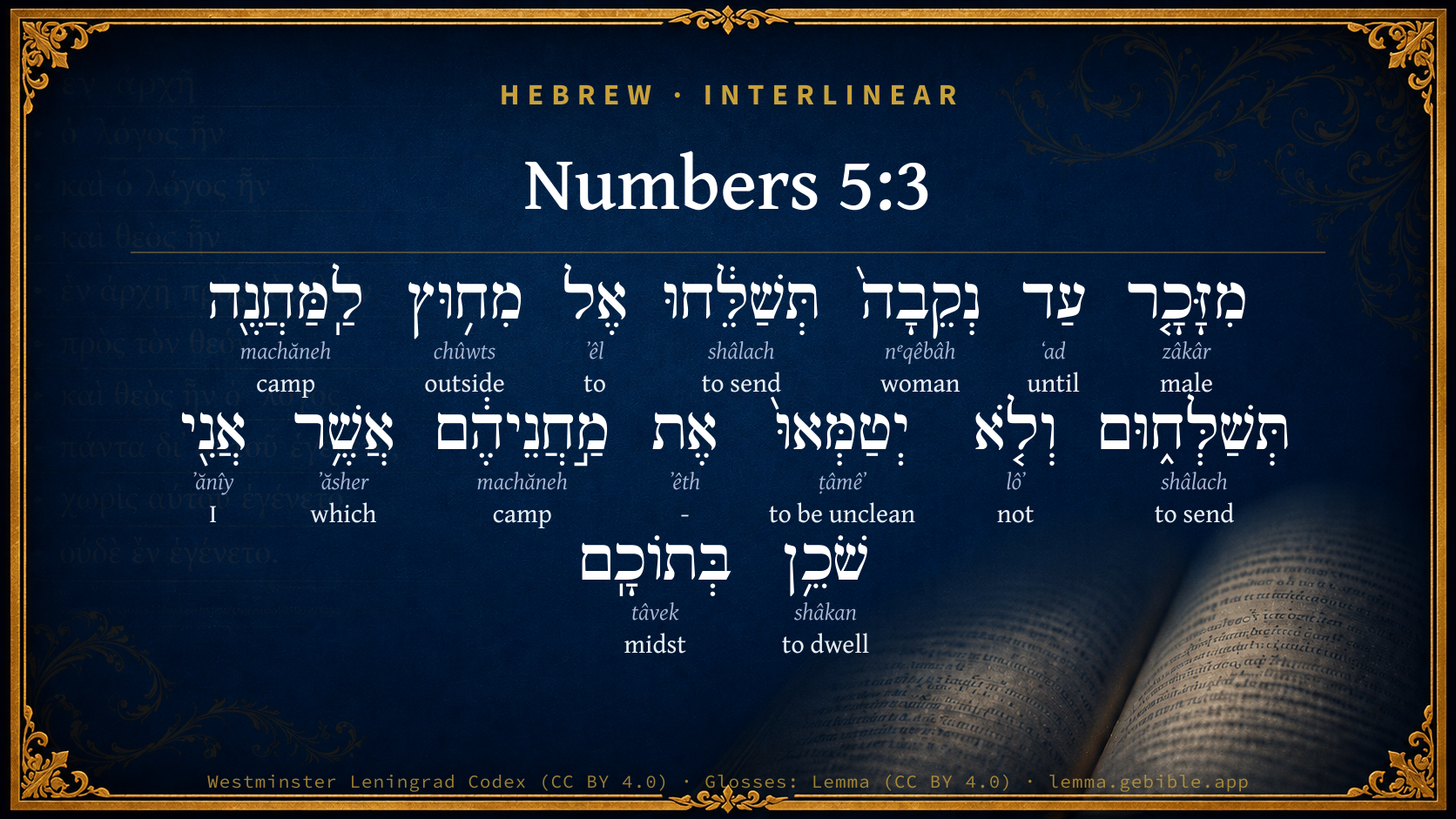
  1. מִזָּכָ֤ר zâkâr H2145 “from · male” Preposition + Noun, Common, Masculine, Singular, Absolute
  2. עַד ʻad H5704 “until” Preposition
  3. תְּשַׁלֵּ֔חוּ shâlach H7971 “to send” Verb, Piel, Imperfect, 2nd Person, Masculine, Plural
  4. אֶל ʼêl H413 “to” Preposition
  5. מִח֥וּץ chûwts H2351 “from · outside” Preposition + Noun, Common, Masculine, Singular, Absolute
  6. לַֽמַּחֲנֶ֖ה machăneh H4264 “to/for the · camp” Preposition, Determined + Noun, Common, Both, Singular, Absolute
  7. תְּשַׁלְּח֑וּם shâlach H7971 “to send · them” Verb, Piel, Imperfect, 2nd Person, Masculine, Plural + Suffix, Personal, 3rd Person, Masculine, Plural
  8. וְלֹ֤א lôʼ H3808 “and · not” Conjunction + Particle, Negative
  9. יְטַמְּאוּ֙ ṭâmêʼ H2930 “to be unclean” Verb, Piel, Imperfect, 3rd Person, Masculine, Plural
  10. אֶת ʼêth H853 “-” Particle, Direct Object
  11. מַ֣חֲנֵיהֶ֔ם machăneh H4264 “camps · their” Noun, Common, Both, Plural, Construct + Suffix, Personal, 3rd Person, Masculine, Plural
  12. אֲשֶׁ֥ר ʼăsher H834 “which” Particle, Relative
  13. אֲנִ֖י ʼănîy H589 “I” Pronoun, Personal, 1st Person, Common, Singular
  14. שֹׁכֵ֥ן shâkan H7931 “dwelling” Verb, Qal, Participle Active, Masculine, Singular, Absolute
  15. בְּתוֹכָֽם tâvek H8432 “in/at · midst · their” Preposition + Noun, Common, Masculine, Singular, Construct + Suffix, Personal, 3rd Person, Masculine, Plural

About this verse

These counts appear in no published source. They are computed here, from the morphology-tagged text and Lemma’s own curated glosses. What Lemma adds →

16
words
14
distinct lemmas
Pentateuch
section

Notable vocabulary

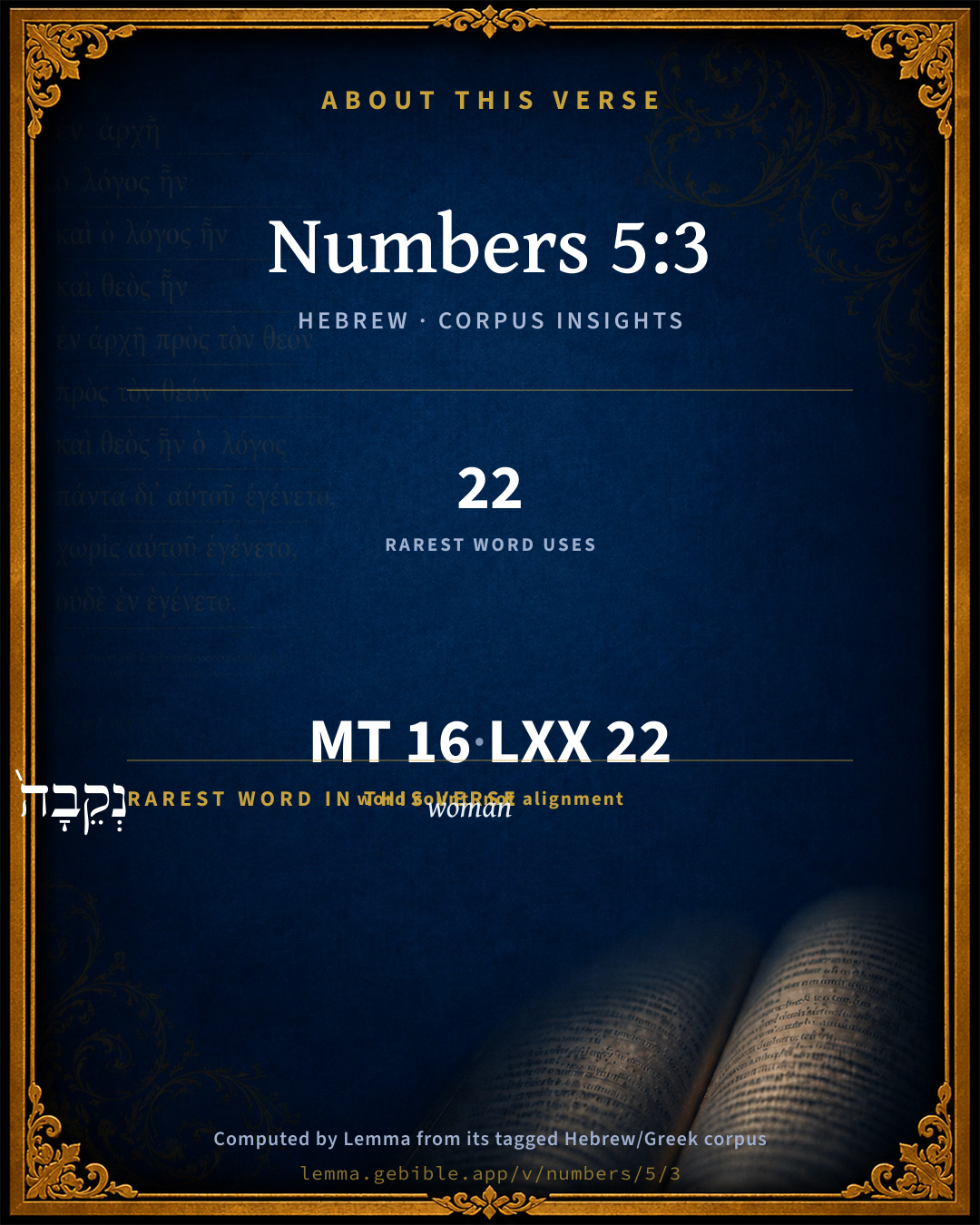
The rarest word here is נְקֵבָה֙ woman H5347 — appearing just 22 times in the whole Hebrew Bible.

Shared distinctive vocabulary

נְקֵבָה֙ woman H5347 occurs in 22 verses of the Hebrew Bible. Also found in:

Grammatical profile

  • 4 verbs
  • 6 nouns
  • 1 pronoun
  • 2 prepositions
  • 3 particles

Verb forms

  • תְּשַׁלֵּ֔חוּ Piel · Imperfect
  • תְּשַׁלְּח֑וּם Piel · Imperfect
  • יְטַמְּאוּ֙ Piel · Imperfect
  • שֹׁכֵ֥ן Qal · Participle Active

Repetition

Words recur within this verse — often emphatic in Hebrew:

  • תְּשַׁלֵּ֔חוּ to send H7971 ×2
  • לַֽמַּחֲנֶ֖ה camp H4264 ×2

Hebrew & Septuagint length

In English translation the verse runs 29 words from the Hebrew and 24 from the Septuagint (LXX English) — closely comparable.

A rough comparison of the two English renderings, which tokenize alike — not a word-level alignment.

Word counts can differ between the Hebrew and the Greek without any difference in meaning — e.g. the Hebrew direct-object marker אֵת has no separate Greek word, and Greek often adds the article ὁ.

In the original languages it is 16 Hebrew tokens and 22 Greek tokens — but the two are counted differently (Hebrew bundles its prefixes and suffixes into one token; the Greek is in lemma form), so that isn’t a like-for-like length.

Cross-references

16

Topical passages linked to Numbers 5:3 in the Treasury of Scripture Knowledge — connected by theme and wording, ordered by reader-vote popularity; previews shown in the World English Bible.

  • Deuteronomy 23:14 for Yahweh your God walks in the midst of your camp, to deliver you, and to give up your enemies before you; therefore shall your camp be holy, that he may not see an unclean thing in you, and turn away from you.
  • Leviticus 26:11–12 I will set my tent among you: and my soul won't abhor you.
  • Numbers 35:34 You shall not defile the land which you inhabit, in the midst of which I dwell: for I, Yahweh, dwell in the midst of the children of Israel.
  • Psalms 68:18 You have ascended on high. You have led away captives. You have received gifts among men, Yes, among the rebellious also, that Yah God might dwell there.
  • Revelation 21:3 I heard a loud voice out of heaven saying, "Behold, God's dwelling is with people, and he will dwell with them, and they will be his people, and God himself will be with them as their God.
  • Numbers 19:22 Whatever the unclean person touches shall be unclean; and the soul that touches it shall be unclean until even.
  • 1 Kings 7:3 It was covered with cedar above over the forty-five beams, that were on the pillars; fifteen in a row.
  • Isaiah 12:6 Cry aloud and shout, you inhabitant of Zion; for great in the midst of you is the Holy One of Israel!"
  • Haggai 2:13–14 Then Haggai said, "If one who is unclean by reason of a dead body touch any of these, will it be unclean?" The priests answered, "It will be unclean."
  • 1 Corinthians 5:7–13 Purge out the old yeast, that you may be a new lump, even as you are unleavened. For indeed Christ, our Passover, has been sacrificed in our place.
  • 2 Corinthians 6:16–17 What agreement has a temple of God with idols? For you are a temple of the living God. Even as God said, "I will dwell in them, and walk in them; and I will be their God, and they will be my people."
  • 2 Thessalonians 3:6 Now we command you, brothers, in the name of our Lord Jesus Christ, that you withdraw yourselves from every brother who walks in rebellion, and not after the tradition which they received from us.
  • Titus 3:10 Avoid a factious man after a first and second warning;
  • Hebrews 12:15–16 looking carefully lest there be any man who falls short of the grace of God; lest any root of bitterness springing up trouble you, and thereby the many be defiled;
  • 2 John 1:10–11 If anyone comes to you, and doesn't bring this teaching, don't receive him into your house, and don't welcome him,
  • Revelation 21:27 There will in no way enter into it anything profane, or one who causes an abomination or a lie, but only those who are written in the Lamb's book of life.

Cross-references courtesy of OpenBible.info (CC BY 4.0).

Hebrew and Greek witnesses Masoretic Hebrew ↔ Greek Septuagint

The same verse in the two great witnesses to the Old Testament, shown verse-for-verse.

These are two independent witnesses, not word-aligned to each other, and the Septuagint is shown in lemma (dictionary) form.

Hebrew Numbers 5:3 Masoretic · Westminster Leningrad Codex

מִזָּכָ֤ר עַד נְקֵבָה֙ תְּשַׁלֵּ֔חוּ אֶל מִח֥וּץ לַֽמַּחֲנֶ֖ה תְּשַׁלְּח֑וּם וְלֹ֤א יְטַמְּאוּ֙ אֶת מַ֣חֲנֵיהֶ֔ם אֲשֶׁ֥ר אֲנִ֖י שֹׁכֵ֥ן בְּתוֹכָֽם

Both male and female shall you put out, outside of the camp shall you put them; that they not defile their camp, in the midst of which I dwell."

World English Bible · Public Domain

Greek LXX Numbers 5:3 Septuagint · lemma form

ἀπό ἀρσενικός ἕως θηλυκός ἐκ ἀποστέλλω ἔξω ὁ παρεμβολή καί οὐ μή μιαίνω ὁ παρεμβολή αὐτός ἐν ὅς ἐγώ καταγίγνομαι ἐν αὐτός

Whether male or female, send them forth out of the camp; and they shall not defile their camps in which I dwell among them.

LXX2012 (modern English Septuagint) · Public Domain

Hebrew: Westminster Leningrad Codex (CC BY 4.0). Greek: Septuagint (public domain); English from LXX2012 (modern English Septuagint) (Public Domain). How the Septuagint differs from the Hebrew →

Targum (Aramaic paraphrase)

2

The Targum is the ancient Jewish Aramaic paraphrase of the Hebrew Scriptures — an interpretive translation, not the Hebrew text itself. Onkelos (literal) and Pseudo-Jonathan (expansive) render the Torah, and Jonathan the Prophets. Coverage is partial: where no permissively-licensed English translation exists for a verse, only the Aramaic is shown. This is verse-level text, not a word-by-word alignment to the Hebrew.

  1. Targum Onkelos Torah (Genesis–Deuteronomy)
    מִדְכַר עַד נוּקְבָא תְּשַׁלְחוּן לְמִבָּרָא לְמַשְׁרִיתָא תְּשַׁלְחֻנוּן וְלָא יְסַאֲבוּן יָת מַשְׁרִיתְהוֹן דִי שְׁכִינְתִּי שַׁרְיָא בֵינֵיהוֹן

    (no public-domain English translation for this verse)

    Targum Onkelos — Aramaic: “Onkelos Genesis” (public domain); “Onkelos Exodus” (public domain); “Onkelos Leviticus” (public domain); “Onkelos Numbers” (public domain); “Onkelos Deuteronomy” (public domain). English: “Sefaria Community Translation” (CC0 1.0 (public-domain dedication)); “J.W. Etheridge. The Targums of Onkelos and Jonathan Ben Uzziel on the Pentateuch. London: Longmans, Green, 1862” (public domain). Text via Sefaria.

  2. Targum Pseudo-Jonathan Torah (Genesis–Deuteronomy)
    מִדְכוּרָא וְעַד נוּקְבָא תְּשַׁלְחוּן לְמִבָּרָא לְמַשְׁרִיתָא תִּפְטוּרוּנוּן וְלָא יְסַאֲבוּן יַת מַשִׁרְיַיתְהוֹן דִשְׁכִינַת קוּדְשָׁא שַׁרְיָא בֵּינֵיהוֹן

    From a male to a female thou shalt send them away, and separate them without the camp, that they may not defile their tents; for the Shekinah of My Holiness dwelleth among you.

    Targum Pseudo-Jonathan — Aramaic: “Targum Jonathan on Genesis” (public domain); “Targum Jonathan on Exodus” (public domain); “Targum Jonathan on Leviticus” (public domain); “Targum Jonathan on Numbers” (public domain); “Targum Jonathan on Deuteronomy” (public domain). English: “The Targum of Jonathan ben Uzziel, trans. J. W. Etheridge, London, 1862” (public domain). Text via Sefaria.

Commentary

Notes on Numbers 5:3 from classic Christian and Jewish commentators (each source and its license shown beneath its notes). The classic Christian expositions comment on the surrounding passage and are grouped to its opening verse, so a note may address several verses; the Jewish commentaries on the Tanakh (Rashi and others) are per-verse, so they appear only where the commentator wrote on this verse.

Lemma curates 59 commentaries, every one of them public domain or Creative Commons licensed, each selected and text-cleaned for this edition rather than reprinted as found. About our sources →

Trapp's Complete Commentary

John Trapp

Num 5:3 Both male and female shall ye put out, without the camp shall ye put them; that they defile not their camps, in the midst whereof I dwell.

Ver. 3. Without the camp shall ye put them.] Evildoers are to be suspended, excommunicated, {1Co 5:13} which text showeth plainly the truth of this ceremony.

John Trapp, A Commentary or Exposition upon All the Books of the Old and New Testament (1647–1656) — public domain. Text from a community e-Sword module.

Joseph Benson's Commentary

Num 5:3. That they defile not the camp — By which God would intimate the danger of being made guilty by other men’s sins, and the duty of avoiding intimate converse with wicked men. I dwell — By my special and gracious presence.

Joseph Benson's Commentary on the Old and New Testaments (1811–1818) — public domain. Text from a community e-Sword module.

Geneva Bible (1599)

Geneva Bible translators

There were three manner of tents: of the Lord, of the Levites, and of the Israelites.

Or, in a place out of the host.

Geneva Bible (1599) marginal notes — public domain. Text via Bolls.life.

John Gill's Exposition

Both male and female shall ye put out,.... Whether leprous, or profluvious, or defiled by touching a dead carcass: by this law, Miriam, when leprous, was put out of the camp, Num 12:14,

without the camp shall ye put them; which is repeated that it might be taken notice of, and punctually observed:

that they defile not their camps; of which there were four, the camps of Judah, Reuben, Ephraim, and Dan:

in the midst whereof I dwell; for the tabernacle, which was the dwelling place of the Lord, was in the midst of the camps of Israel; they were pitched on the four quarters of it; and this is a reason why impure persons were not suffered to be in the camp of Israel, because of the presence of God in the tabernacle so near them, to whom all, impurity is loathsome, and not to be permitted in his sight; and though this was ceremonial, it was typical of the uncleanness of sin, which is abominable to him, and renders persons unfit for communion with him, and with his people.

John Gill's Exposition of the Whole Bible (1746–1763) — public domain (CC PDM 1.0). Text via the HelloAO Bible API.

Haydock's Catholic Bible Commentary

It. Hebrew, "their camps, in the midst of which I dwell." (Calmet)

George Leo Haydock (1774–1849), Haydock's Catholic Family Bible and Commentary, 1859 edition — public domain. Excludes Psalms (Douay-Rheims chapter numbering differs from Protestant) and Deuterocanonical books (Catholic canon only).

Matthew Poole's English Annotations

By which caution God would intimate the possibility and danger of men’s being made guilty by other men’s sins, and the necessary duty of avoiding intimate converse with wicked men.

In the midst whereof I dwell, by my special and gracious presence; and therefore the permission of such impurities is the greater injury and provocation to me, as being done in my sight, and reflecting dishonour upon my name.

Matthew Poole's English Annotations on the Holy Bible (1683–1685) — public domain. Text from a community e-Sword/MySword module.

Whedon's Commentary on the Bible

Daniel D. Whedon

3. Without the camp — We are not to suppose that these impure persons were left without shelter. Severe indeed, and inhuman, would this banishment of morally innocent persons be, if there were no provision made for their comfort. Pest-houses specially set apart for lepers outside the towns are found in Palestine to this day. Dr. Robinson mentions one opposite the Zion gate of Jerusalem. May it not be because all manner of spiritual leprosies and impurities are without the camp that we are to go forth thence bearing Christ’s reproach? Heb_13:13.

In the midst whereof I dwell — This is the chief reason for the sanitary ceremonial and moral cleansing of the camp. It also typically enforced the practice of moral purity: “Cleansing themselves from all filthiness of the flesh and spirit.”

Daniel D. Whedon (gen. ed.), Commentary on the Old and New Testaments (1874–1909) — public domain. Text from a community e-Sword module.

The Pulpit Commentary

That they defile not their camps, in the midst whereof I dwell. Cleanliness, decency, and the anxious removal even of unwitting pollutions were things due to God himself, and part of the awful reverence to be paid to his presence in the midst of Israel. It is of course easy to depreciate the value of such outward cleanness, as compared with inward; but when we consider the frightful prevalence of filthiness in Christian countries

(1) of person and dress,

(2) of talk,

(3) of habit in respect of things not so much sinful as uncleanly,

we may indeed acknowledge the heavenly wisdom of these regulations, and the incalculable value of the tone of mind engendered by them. With the Jews "cleanliness" was not "next to godliness," it was part of godliness.

The Pulpit Commentary (1880–1919), ed. H.D.M. Spence-Jones & Joseph S. Exell — public domain. Text from a community e-Sword module.

John Wesley's Explanatory Notes

That they defile not the camp - By which God would intimate the danger of being made guilty by other mens sins, and the duty of avoiding intimate converse with wicked men. I dwell - By my special and gracious presence.

John Wesley, Explanatory Notes Upon the Whole Bible (1754–1765) — public domain. Text via the GEBible commentary corpus.

Lesson kit

Teaching starters — assembled from the data on this page, not authored interpretation. Every prompt links to the verse data it draws on. Edit before teaching.

Numbers, in the Pentateuch, opens this verse with 16 words (14 distinct Hebrew lemmas). Its most distinctive word is nᵉqêbâh (“woman”). A historical commentator’s framing appears above. Read the whole chapter for the surrounding context.

Discussion questions

  1. The word nᵉqêbâh carries the sense “woman.” How does it shape the verse?
  2. Genesis 1:27 shares the word «woman» with this verse. How do the two illuminate each other?
  3. “to send” occurs 2× in this one verse. What is the effect of the repetition?
  4. These translations render this verse differently; the difference is in the English rendering, not the original. What questions does that raise?
  5. The verb «תְּשַׁלֵּ֔חוּ» is Piel Imperfect. How does its form color the action?
  6. Reading how Trapp's Complete Commentary and Joseph Benson's Commentary read this verse, where do the two commentators agree and where do they part?

Things to notice

Reading settings

Reading text

Shown beneath each verse's original-language words.

Old Testament
Old Testament edition

Read the OT as the Masoretic Hebrew (MT) or the Greek Septuagint (LXX).

English shown for the Greek Septuagint (in the Hebrew ↔ Greek comparison).

Comparing translations? Open the Compare panel on any verse page to stack up to four side by side.