
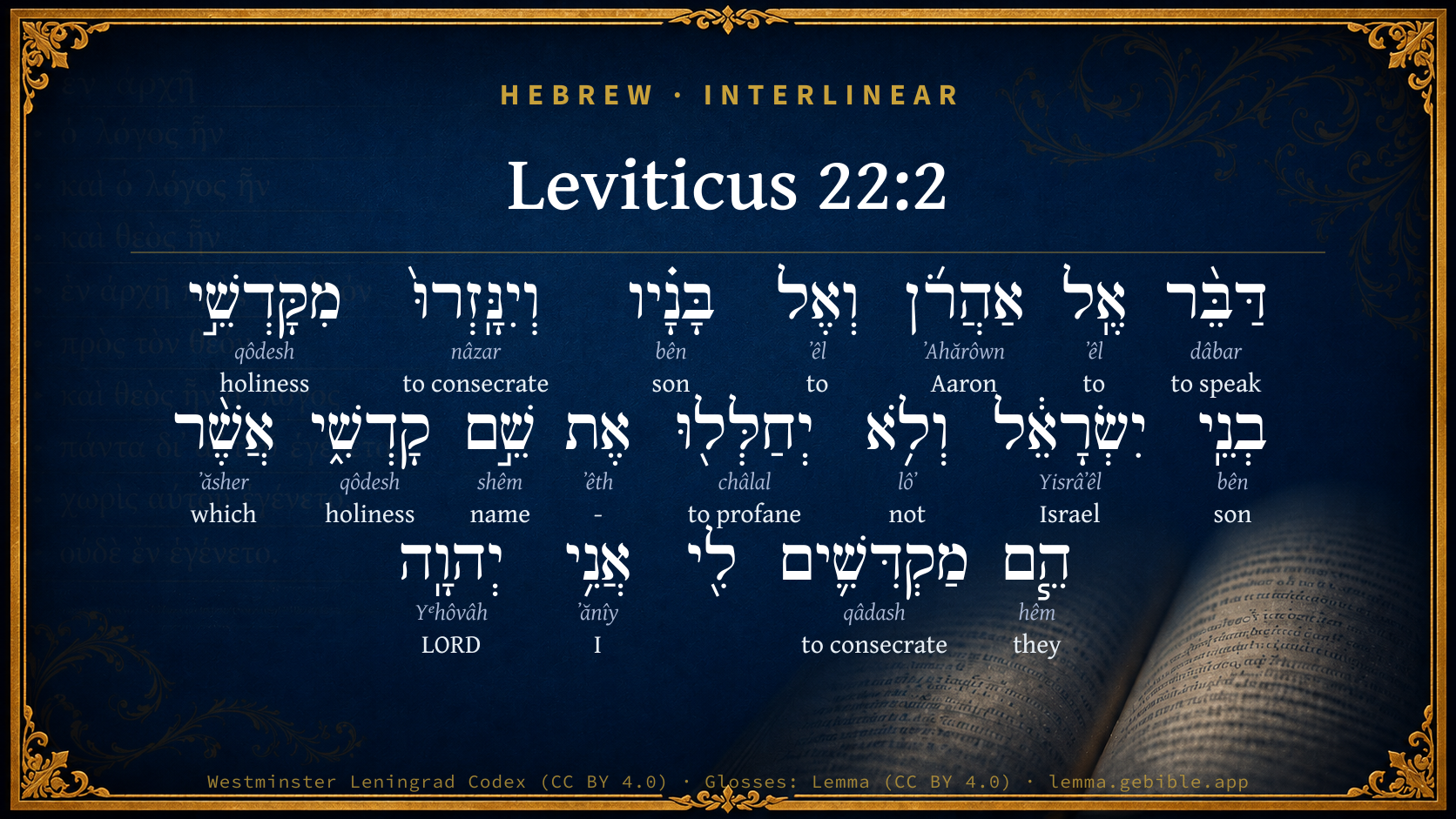
Leviticus 22:2

Hebrew (Westminster Leningrad Codex) Leviticus 22:2 appears in the Hebrew Old Testament. The text above is from the Westminster Leningrad Codex. Each word links to its Strong’s number, a concise gloss, and parsing drawn from the Open Scriptures Hebrew Bible morphology. Click any word for its full Brown-Driver-Briggs (BDB) entry.
Download image
Cite this verse

Leviticus 22:2 (World English Bible). Public Domain. Lemma interlinear Bible study tool, https://lemma.gebible.app/v/leviticus/22/2.

Show BibTeX & RIS
BibTeX
RIS
English Translation
"Tell Aaron and his sons to separate themselves from the holy things of the children of Israel, which they make holy to me, and that they not profane my holy name. I am Yahweh.
World English Bible · Public Domain
Download a study sheet

One document with this verse’s original text, its word-by-word gloss line, the meaning frame, cross-references with their text, attributed commentary, and full source and license credits — printable, and it pastes into notes with its structure intact.

This verse Autodidact and up

Study sheet (.html) Plain text (.txt)

A passage Seminary Student

Up to 50 verses in one chapter. A passage sheet keeps up to 6 commentary sources and 12 cross-references per verse, in the order this page ranks them, and says so on the sheet whenever that leaves anything out. Ask for a single verse and you get the Autodidact verse sheet above.

Everything on this page stays free to read, with no account — the sheet is a download of what is already on screen, not access to it.

Want to remove ads? Support Godless Engineer
Compare translations 3

The same verse in 3 English versions, stacked beneath the original-language interlinear above. Click any original word for its lexicon entry.

Each is an independent rendering of the whole verse — the interlinear is not word-aligned to these translations.

Highlighted words mark where these versions differ — a whole-verse word diff, not a word-by-word alignment.

  • World English Bible Public Domain
    "Tell Aaron and his sons to separate themselves from the holy things of the children of Israel, which they make holy to me, and that they not profane my holy name. I am Yahweh.
  • King James Version Public Domain
    Speak unto Aaron and to his sons, that they separate themselves from the holy things of the children of Israel, and that they profane not my holy name in those things which they hallow unto me: I am the LORD.
  • unfoldingWord Literal Text CC BY-SA 4.0
    “Speak to Aaron and to his sons, and they shall be separated from the holy things of the sons of Israel, which they making holy to me, and they shall not profane the name of my holiness. I Yahweh.

unfoldingWord Literal Text — © unfoldingWord, licensed CC BY-SA 4.0. Word-aligned USFM3 via Door43 (git.door43.org/unfoldingWord/en_ult).

Versions to compare (up to 4)

3 of 4 selected

Show all 18 translations

Every available English version of this verse, each an independent rendering of the whole verse.

  • World English Bible Public Domain
    "Tell Aaron and his sons to separate themselves from the holy things of the children of Israel, which they make holy to me, and that they not profane my holy name. I am Yahweh.
  • Berean Standard Bible Public Domain
    “Tell Aaron and his sons to treat with respect the sacred offerings that the Israelites have consecrated to Me, so that they do not profane My holy name. I am the LORD.
  • Majority Standard Bible Public Domain
    “Tell Aaron and his sons to treat with respect the sacred offerings that the Israelites have consecrated to Me, so that they do not profane My holy name. I am the LORD.
  • King James Version Public Domain
    Speak unto Aaron and to his sons, that they separate themselves from the holy things of the children of Israel, and that they profane not my holy name in those things which they hallow unto me: I am the LORD.
  • American Standard Version (1901) Public Domain
    Speak unto Aaron and to his sons, that they separate themselves from the holy things of the children of Israel, which they hallow unto me, and that they profane not my holy name: I am Jehovah.
  • Revised Version (1885) Public Domain
    Speak unto Aaron and to his sons, that they separate themselves from the holy things of the children of Israel, which they hallow unto me, and that they profane not my holy name: I am the LORD.
  • Geneva Bible (1599) Public Domain
    Speake vnto Aaron, and to his sonnes, that they be separated from the holy thinges of the children of Israel, and that they pollute not mine holy name in those things, which they hallowe vnto me: I am the Lord.
  • Douay-Rheims (1899) Public Domain
    Speak to Aaron and to his sons, that they beware of those things that are consecrated of the children of Israel, and defile not the name of the things sanctified to me, which they offer. I am the Lord.
  • Young's Literal Translation Public Domain
    `Speak unto Aaron, and unto his sons, and they are separated from the holy things of the sons of Israel, and they pollute not My holy name in what they are hallowing to Me; I `am' Jehovah.
  • Literal Standard Version CC BY-SA 4.0
    “Speak to Aaron and to his sons, and they are separated from the holy things of the sons of Israel, and they do not defile My holy Name in what they are hallowing to Me; I [am] YHWH.
  • Unlocked Literal Bible CC BY-SA 4.0
    “Speak to Aaron and to his sons, tell them to keep away from the holy things of the people of Israel, which they set apart to me. They must not profane my holy name. I am Yahweh.
  • unfoldingWord Literal Text CC BY-SA 4.0
    “Speak to Aaron and to his sons, and they shall be separated from the holy things of the sons of Israel, which they making holy to me, and they shall not profane the name of my holiness. I Yahweh.
  • Darby Bible Public Domain
    Speak unto Aaron, and to his sons, that they separate themselves from the holy things of the children of Israel, and that they profane not my holy name in the things that they hallow unto me: I am Jehovah.
  • World Messianic Bible Public Domain
    “Tell Aaron and his sons to separate themselves from the holy things of the children of Israel, which they make holy to me, and that they not profane my holy name. I am the LORD.
  • Webster's Bible Public Domain
    Speak to Aaron and to his sons, that they separate themselves from the holy things of the children of Israel, and that they profane not my holy name in those things which they hallow to me: I am the LORD.
  • Free Bible Version CC BY-SA 4.0
    “Tell Aaron and his sons to be dedicated when dealing with the holy offerings that the Israelites have dedicated to me, so that they don't dishonor my holy character. I am the Lord.
  • Bible in Basic English Public Domain
    Give orders to Aaron and to his sons to keep themselves separate from the holy things of the children of Israel which they give to me, and not to make my holy name common: I am the Lord,
  • JPS Tanakh (1917) Public Domain
    Speak unto Aaron and to his sons, that they separate themselves from the holy things of the children of Israel, which they hallow unto Me, and that they profane not My holy name: I am the LORD.

Literal Standard Version (2020), Covenant Press — licensed CC BY-SA 4.0. Text via the HelloAO Bible API (eBible.org). Unlocked Literal Bible (unfoldingWord) — licensed CC BY-SA 4.0. Text via the HelloAO Bible API (eBible.org). unfoldingWord Literal Text — © unfoldingWord, licensed CC BY-SA 4.0. Word-aligned USFM3 via Door43 (git.door43.org/unfoldingWord/en_ult). Free Bible Version, Dr. Jonathan Gallagher — licensed CC BY-SA 4.0. Text via the HelloAO Bible API (eBible.org).

Word by word

More ways to search: Search by grammar → Find every occurrence → Compare this word →

Practice this passage: Drill this verse → Learn its vocabulary →

וְיִנָּֽזְרוּ֙
nâzar
H5144
“and · to consecrate”
Conjunction + Verb, Niphal, Imperfect, 3rd Person, Masculine, Plural
Part of Speech
Conjunction + Verb
Stem
Niphal
Form
Imperfect
Person
3rd Person
Gender
Masculine
Number
Plural
Full BDB Definition

Origin: a primitive root

TWOT: 1340

to dedicate, consecrate, separate - (Niphal) to dedicate oneself, devote oneself - (Hiphil) to keep sacredly separate - (Hiphil) to be a Nazarite, live as a Nazarite
  1. דַּבֵּ֨ר dâbar H1696 “speak” Verb, Piel, Imperative, 2nd Person, Masculine, Singular
  2. אֶֽל ʼêl H413 “to” Preposition
  3. אַהֲרֹ֜ן ʼAhărôwn H175 “Aaron” Noun, Proper
  4. וְאֶל ʼêl H413 “and · to” Conjunction + Preposition
  5. בָּנָ֗יו bên H1121 “sons · his” Noun, Common, Masculine, Plural, Construct + Suffix, Personal, 3rd Person, Masculine, Singular
  6. מִקָּדְשֵׁ֣י qôdesh H6944 “from · holy things of” Preposition + Noun, Common, Masculine, Plural, Construct
  7. בְנֵֽי bên H1121 “sons of” Noun, Common, Masculine, Plural, Construct
  8. יִשְׂרָאֵ֔ל Yisrâʼêl H3478 “Israel” Noun, Proper
  9. וְלֹ֥א lôʼ H3808 “and · not” Conjunction + Particle, Negative
  10. יְחַלְּל֖וּ châlal H2490 “to profane” Verb, Piel, Imperfect, 3rd Person, Masculine, Plural
  11. אֶת ʼêth H853 “-” Particle, Direct Object
  12. שֵׁ֣ם shêm H8034 “name of” Noun, Common, Masculine, Singular, Construct
  13. קָדְשִׁ֑י qôdesh H6944 “holiness · my” Noun, Common, Masculine, Singular, Construct + Suffix, Personal, 1st Person, Common, Singular
  14. אֲשֶׁ֨ר ʼăsher H834 “which” Particle, Relative
  15. הֵ֧ם hêm H1992 “they” Pronoun, Personal, 3rd Person, Masculine, Plural
  16. מַקְדִּשִׁ֛ים qâdash H6942 “consecrating” Verb, Hiphil, Participle Active, Masculine, Plural, Absolute
  17. אֲנִ֥י ʼănîy H589 “I” Pronoun, Personal, 1st Person, Common, Singular
  18. יְהוָֽה Yᵉhôvâh H3068 “LORD” Noun, Proper

About this verse

These counts appear in no published source. They are computed here, from the morphology-tagged text and Lemma’s own curated glosses. What Lemma adds →

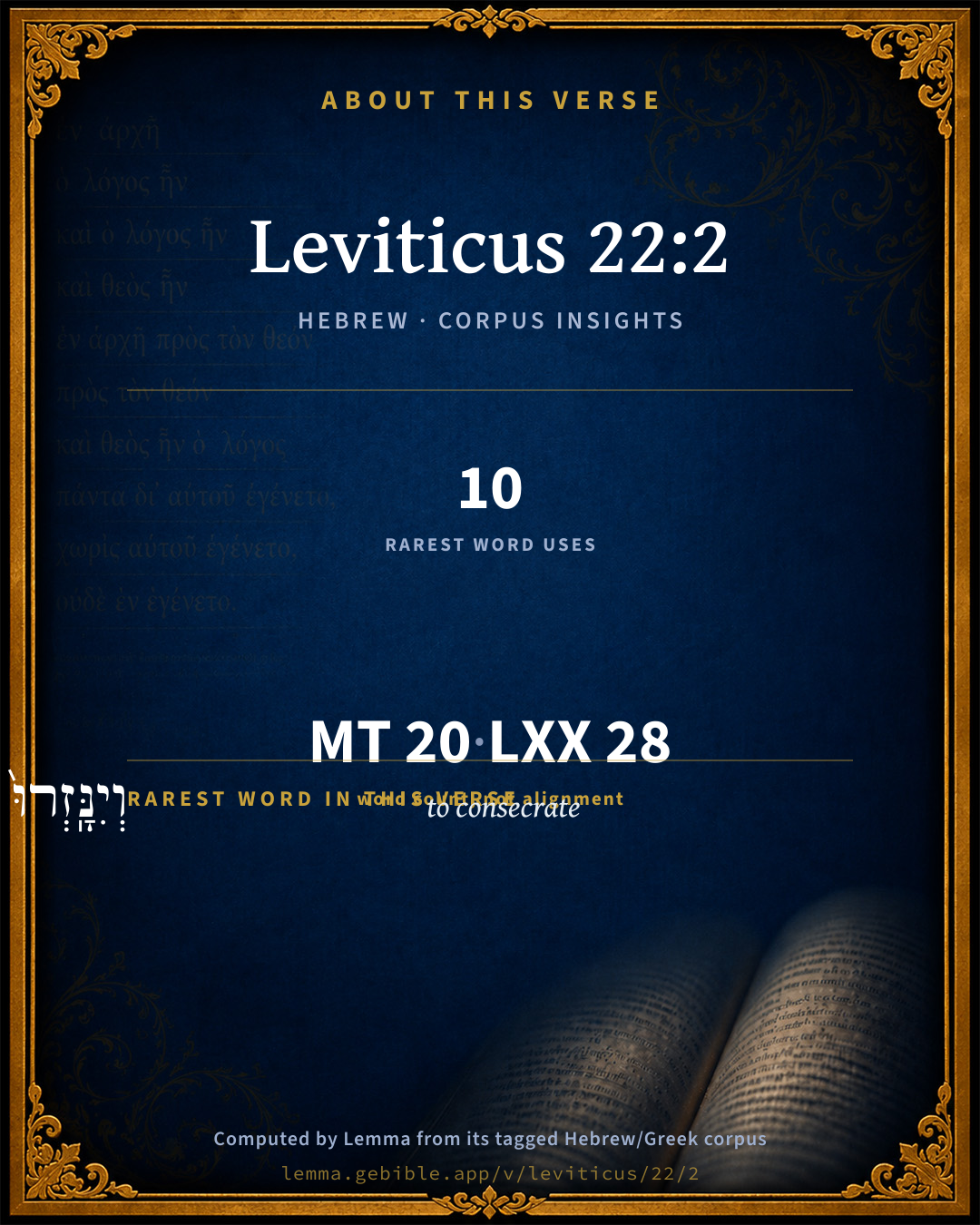
20
words
16
distinct lemmas
Pentateuch
section

Notable vocabulary

The rarest word here is וְיִנָּֽזְרוּ֙ to consecrate H5144 — appearing just 10 times in the whole Hebrew Bible.

Shared distinctive vocabulary

וְיִנָּֽזְרוּ֙ to consecrate H5144 occurs in 10 verses of the Hebrew Bible. Also found in:

Grammatical profile

  • 4 verbs
  • 8 nouns
  • 2 pronouns
  • 3 prepositions
  • 3 particles

Verb forms

  • דַּבֵּ֨ר Piel · Imperative
  • וְיִנָּֽזְרוּ֙ Niphal · Imperfect
  • יְחַלְּל֖וּ Piel · Imperfect
  • מַקְדִּשִׁ֛ים Hiphil · Participle Active

Repetition

Words recur within this verse — often emphatic in Hebrew:

  • בָּנָ֗יו son H1121 ×2
  • מִקָּדְשֵׁ֣י holiness H6944 ×2
  • אֶֽל to H413 ×2

Hebrew & Septuagint length

In English translation the verse runs 34 words from the Hebrew and 43 from the Septuagint (LXX English) — closely comparable.

A rough comparison of the two English renderings, which tokenize alike — not a word-level alignment.

Word counts can differ between the Hebrew and the Greek without any difference in meaning — e.g. the Hebrew direct-object marker אֵת has no separate Greek word, and Greek often adds the article ὁ.

In the original languages it is 20 Hebrew tokens and 28 Greek tokens — but the two are counted differently (Hebrew bundles its prefixes and suffixes into one token; the Greek is in lemma form), so that isn’t a like-for-like length.

Cross-references

12

Topical passages linked to Leviticus 22:2 in the Treasury of Scripture Knowledge — connected by theme and wording, ordered by reader-vote popularity; previews shown in the World English Bible.

  • Leviticus 18:21 "'You shall not give any of your children to sacrifice to Molech; neither shall you profane the name of your God: I am Yahweh.
  • Deuteronomy 15:19 All the firstborn males that are born of your herd and of your flock you shall sanctify to Yahweh your God: you shall do no work with the firstborn of your herd, nor shear the firstborn of your flock.
  • Exodus 13:12 that you shall set apart to Yahweh all that opens the womb, and every firstborn which you have that comes from an animal. The males shall be Yahweh's.
  • Exodus 28:38 It shall be on Aaron's forehead, and Aaron shall bear the iniquity of the holy things, which the children of Israel shall make holy in all their holy gifts; and it shall be always on his forehead, that they may be accepted before Yahweh.
  • Leviticus 19:12 "'You shall not swear by my name falsely, and profane the name of your God. I am Yahweh.
  • Leviticus 22:32 You shall not profane my holy name, but I will be made holy among the children of Israel. I am Yahweh who makes you holy,
  • Numbers 18:32 You shall bear no sin by reason of it, when you have heaved from it the best of it: and you shall not profane the holy things of the children of Israel, that you not die.
  • Leviticus 15:31 "'Thus you shall separate the children of Israel from their uncleanness, so they will not die in their uncleanness, when they defile my tabernacle that is in their midst.'"
  • Leviticus 20:3 I also will set my face against that person, and will cut him off from among his people because he has given of his seed to Molech, to defile my sanctuary, and to profane my holy name.
  • Leviticus 21:6 They shall be holy to their God, and not profane the name of their God; for they offer the offerings of Yahweh made by fire, the bread of their God; therefore they shall be holy.
  • Leviticus 22:3–6 Tell them, 'If anyone of all your seed throughout your generations approaches the holy things, which the children of Israel make holy to Yahweh, having his uncleanness on him, that soul shall be cut off from before me. I am Yahweh.
  • Numbers 6:3–8 he shall separate himself from wine and strong drink. He shall drink no vinegar of wine, or vinegar of fermented drink, neither shall he drink any juice of grapes, nor eat fresh grapes or dried.

Cross-references courtesy of OpenBible.info (CC BY 4.0).

Hebrew and Greek witnesses Masoretic Hebrew ↔ Greek Septuagint

The same verse in the two great witnesses to the Old Testament, shown verse-for-verse.

These are two independent witnesses, not word-aligned to each other, and the Septuagint is shown in lemma (dictionary) form.

Hebrew Leviticus 22:2 Masoretic · Westminster Leningrad Codex

דַּבֵּ֨ר אֶֽל אַהֲרֹ֜ן וְאֶל בָּנָ֗יו וְיִנָּֽזְרוּ֙ מִקָּדְשֵׁ֣י בְנֵֽי יִשְׂרָאֵ֔ל וְלֹ֥א יְחַלְּל֖וּ אֶת שֵׁ֣ם קָדְשִׁ֑י אֲשֶׁ֨ר הֵ֧ם מַקְדִּשִׁ֛ים לִ֖י אֲנִ֥י יְהוָֽה

"Tell Aaron and his sons to separate themselves from the holy things of the children of Israel, which they make holy to me, and that they not profane my holy name. I am Yahweh.

World English Bible · Public Domain

Greek LXX Leviticus 22:2 Septuagint · lemma form

εἶπον ἀαρών καί ὁ υἱός αὐτός καί προςἔχω ἀπό ὁ ἅγιος ὁ υἱός ἰσραήλ καί οὐ βεβηλόω ὁ ὄνομα ὁ ἅγιος ἐγώ ὅσος αὐτός ἁγιάζω ἐγώ ἐγώ κύριος

Speak to Aaron and to his sons, and let them take heed concerning the holy things of the children of Israel, so they shall not profane my holy name in any of the things which they consecrate to me: I am the Lord.

LXX2012 (modern English Septuagint) · Public Domain

On this verse, Haydock's Catholic Bible Commentary discusses the Septuagint’s reading. Read the note in Commentary ↓

Hebrew: Westminster Leningrad Codex (CC BY 4.0). Greek: Septuagint (public domain); English from LXX2012 (modern English Septuagint) (Public Domain). How the Septuagint differs from the Hebrew →

Targum (Aramaic paraphrase)

2

The Targum is the ancient Jewish Aramaic paraphrase of the Hebrew Scriptures — an interpretive translation, not the Hebrew text itself. Onkelos (literal) and Pseudo-Jonathan (expansive) render the Torah, and Jonathan the Prophets. Coverage is partial: where no permissively-licensed English translation exists for a verse, only the Aramaic is shown. This is verse-level text, not a word-by-word alignment to the Hebrew.

  1. Targum Onkelos Torah (Genesis–Deuteronomy)
    מַלֵיל עִם אַהֲרֹן וְעִם בְּנוֹהִי וְיִפָּרְשׁוּן מִקוּדְשַׁיָא דִבְנֵי יִשְׂרָאֵל וְלָא יְחַלוּן יָת שְׁמָא דְקוּדְשִׁי דִי אִנוּן מְקַדְשִׁין קֳדָמַי אֲנָא יְיָ

    (no public-domain English translation for this verse)

    Targum Onkelos — Aramaic: “Onkelos Genesis” (public domain); “Onkelos Exodus” (public domain); “Onkelos Leviticus” (public domain); “Onkelos Numbers” (public domain); “Onkelos Deuteronomy” (public domain). English: “Sefaria Community Translation” (CC0 1.0 (public-domain dedication)); “J.W. Etheridge. The Targums of Onkelos and Jonathan Ben Uzziel on the Pentateuch. London: Longmans, Green, 1862” (public domain). Text via Sefaria.

  2. Targum Pseudo-Jonathan Torah (Genesis–Deuteronomy)
    מַלֵיל עִם אַהֲרן וְעִם בְּנוֹי וְיִתְפַּרְשׁוּן מִקוּדְשַׁיָא דִבְנֵי יִשְרָאֵל וְלָא יִפְסוּן יַת שְׁמָא דְקוּדְשִׁי דְהִינוּן מְקַדְשִׁין קֳדָמַי אֲנָא יְיָ

    Speak with Aharon and with his sons, that they keep apart from the consecrated things of the children of Israel, and profane not the Name of My Holiness (in whatever) they hallow before Me: I am the Lord.

    Targum Pseudo-Jonathan — Aramaic: “Targum Jonathan on Genesis” (public domain); “Targum Jonathan on Exodus” (public domain); “Targum Jonathan on Leviticus” (public domain); “Targum Jonathan on Numbers” (public domain); “Targum Jonathan on Deuteronomy” (public domain). English: “The Targum of Jonathan ben Uzziel, trans. J. W. Etheridge, London, 1862” (public domain). Text via Sefaria.

Commentary

Notes on Leviticus 22:2 from classic Christian and Jewish commentators (each source and its license shown beneath its notes). The classic Christian expositions comment on the surrounding passage and are grouped to its opening verse, so a note may address several verses; the Jewish commentaries on the Tanakh (Rashi and others) are per-verse, so they appear only where the commentator wrote on this verse.

Lemma curates 59 commentaries, every one of them public domain or Creative Commons licensed, each selected and text-cleaned for this edition rather than reprinted as found. About our sources →

Trapp's Complete Commentary

John Trapp

Lev 22:2 Speak unto Aaron and to his sons, that they separate themselves from the holy things of the children of Israel, and that they profane not my holy name [in those things] which they hallow unto me: I [am] the LORD.

Ver. 2. That they separate.] Though priests, yet they may not hold themselves privileged above others to commit sin, but are the rather obliged to duty. Why should any Chrysostom have cause to say, Non arbitror inter sacerdotes multos esse qui salvi fiant, I do not think that many of our ministers can he saved, it is well if any? or any Campian to exclaim, Ministris eorum nihil vilias?

John Trapp, A Commentary or Exposition upon All the Books of the Old and New Testament (1647–1656) — public domain. Text from a community e-Sword module.

Joseph Benson's Commentary

Lev 22:2. That they separate themselves — When any uncleanness is upon them, as appears from Lev 22:3-4. From the holy things — This is the first caution. No priest, or other person, was to presume to eat any part of a consecrated victim, while he was under any degree of legal uncleanness. Neither were they, in that state, to eat of the first-fruits, which were also consecrated to God, Num 18:12. But they might eat of the tithes, which were allowed for their constant maintenance. That they profane not what they — The children of Israel; hallow — It ill became the priests to profane or pollute what the people hallowed.

Joseph Benson's Commentary on the Old and New Testaments (1811–1818) — public domain. Text from a community e-Sword module.

Tyndale Open Study Notes

Tyndale Open Resources

22:2-6 The priest’s portions of the sacred offerings were regarded as “most holy” (see 2:3) and were not to come into contact with anything unclean (11:1–15:33). Accordingly, any descendant of Aaron who was unclean was forbidden to eat this food.

Tyndale Open Study Notes — © Tyndale Open Resources, licensed CC BY-SA 4.0. Text via the HelloAO Bible API.

Geneva Bible (1599)

Geneva Bible translators

Meaning, that the Priests abstain from eating, so long as they are polluted.

Geneva Bible (1599) marginal notes — public domain. Text via Bolls.life.

Adam Clarke's Commentary

Verse 2. Speak unto Aaron and to his sons, that they separate themselves] The same subject is continued in this chapter as in the preceding, with this addition, that besides the perfection of the priests, it was indispensably necessary that the sacrifices also should be perfect. In the service of God, according to the law, neither an imperfect offering nor an imperfect offerer could be admitted. What need then of a mediator between a holy God and sinful men! And can we expect that any of our services, however sincere and well-intentioned, can be accepted, unless offered on that living Altar that sanctifies the gift?

Adam Clarke's Commentary on the Bible (1810–1826) — public domain. Text from a community e-Sword/MySword module.

Ellicott's Commentary for English Readers

(2) Separate themselves from the holy things of the children of Israel.—As parts of the sacrifices offered by the Israelites belonged to the priests, they are here warned that (see Lev_7:20-21) they are not to consider themselves absolutely entitled to them under all circumstances, and that there are times when they must abstain from them.

In those things which they hallow unto me.—That is, in their treatment of the sacrifices which the children of Israel have consecrated and offered to the Lord.

A Bible Commentary for English Readers, edited by Charles John Ellicott (1878–1897) — public domain. Text from a community e-Sword module.

The Cambridge Bible for Schools and Colleges

gen. ed. J. J. S. Perowne

2. separate] not of course in the full sense of the word. What is meant is that whenever they are in a condition of ceremonial impurity they must be careful not to come into contact with holy things.

The Cambridge Bible for Schools and Colleges (gen. ed. J. J. S. Perowne; Cambridge University Press, 1878–1918) — public domain. Text from a community e-Sword module.

John Gill's Exposition

Speak unto Aaron and to his sons,.... The priests; the children of Israel or the common people are not mentioned, as having no concern in the following laws about eating holy things:

that they separate themselves from the holy things of the children of Israel; both from offering their lawful sacrifices, which was the business of their office when pure, and chiefly from eating that part of them which was their due, and was allowed them; neither of these they were to do, particularly the latter, when they were in any uncleanness, as the following words show:

and that, they profane not my holy name in those things which they hallow unto me; which the children of Israel set apart and devoted to his service; which they would do, by eating their part of them when unclean, and thereby show little reverence to that holy name to which they were devoted; or which the priests themselves sanctified, by offering them to him; for Jarchi says, this takes in the holiness of the priests themselves; but the former seems best, and is confirmed in Lev 22:3,

I am the Lord; who is holy himself, and whose holy things these are, and will be sanctified by those that draw nigh unto him.

John Gill's Exposition of the Whole Bible (1746–1763) — public domain (CC PDM 1.0). Text via the HelloAO Bible API.

Albert Barnes' Notes on the Bible

“Speak ... that they so abstain from touching the holy things (i. e. the sacrificial food of all kinds) of the children of Israel which they consecrate unto me, that they profane not my holy name.” This law related to the daily life and the ordinary food of the priests.

Albert Barnes' Notes on the Bible (1834–1885) — public domain. Text from a community e-Sword/MySword module.

Haydock's Catholic Bible Commentary

Offer. He does not speak of such things as fell to the share of the priests; (Menochius) but orders them to behave with great reverence when they perform their sacred offices, lest others should take occasion to treat the name of God and holy things with disrespect. Hebrew and Septuagint, "let them not profane my holy name, which they are bound to sanctify; or in what they consecrate to me." Such things must not be used for ordinary purposes. (St. Basil, ser. de Bapt. ii. 2, and 3.)

George Leo Haydock (1774–1849), Haydock's Catholic Family Bible and Commentary, 1859 edition — public domain. Excludes Psalms (Douay-Rheims chapter numbering differs from Protestant) and Deuterocanonical books (Catholic canon only).

Matthew Poole's English Annotations

That they separate themselves, to wit, when any uncleanness is upon them, as it appears from Lev 22:3,4. From the holy things, i.e. from eating of those parts of the offerings which belong to them. Only of the tithes they might eat in that case.

Which they hallow; either the children of Israel, or the priests; for both of them did in their kinds hallow, consecrate, or offer them to God. But the former seems more probable, both because they were mentioned here and Lev 22:3, where they are said to hallow, &c., and because this makes the argument stronger, it ill became the priests to profane or pollute what the people did hallow.

Matthew Poole's English Annotations on the Holy Bible (1683–1685) — public domain. Text from a community e-Sword/MySword module.

Whedon's Commentary on the Bible

Daniel D. Whedon

REVERENCE FOR HOLY THINGS, Lev_23:1-16.

2. Separate themselves — They were to abstain from treating the holy things, or offerings of the people, as things unconsecrated and common. By appropriating what was sacred to Jehovah, without the warrant of an express command, like that requiring them to eat the most holy things, (Lev_2:3, note,) they would profane his holy name, or degrade his majesty, and tarnish his purity in the eyes of the people.

Daniel D. Whedon (gen. ed.), Commentary on the Old and New Testaments (1874–1909) — public domain. Text from a community e-Sword module.

John Wesley's Explanatory Notes

Separate themselves - When any uncleanness is upon them, as appears from ver. 3, 4. From the holy things - From eating of those parts of the offerings, which belong to them. Only of the tithes they might eat. They - The children of Israel. And it ill became the priests to profane or pollute what the people did hallow.

John Wesley, Explanatory Notes Upon the Whole Bible (1754–1765) — public domain. Text via the GEBible commentary corpus.

Rashi

Rabbi Shlomo Yitzchaki (Rashi)

וינזרו THAT THEY KEEP AWAY [FROM THE HOLY THINGS etc.] — The term נזר always denotes “keeping aloof". Similarly it is said (Ezekiel 14:7) "and he separates himself (וינזר) from following Me”; (Isaiah 1:4) "They are gone away (נזורו) backward”. The meaning of this verse therefore is: they (the priests) shall keep aloof from the holy things during the time of their uncleanness (Sifra, Emor, Section 4 1).

וינזרו מקדשי בני ישראל אשר הם מקדשים לי. ולא יחללו את שם קדשי — Invert the words of the verse in the order here set forth and explain it accordingly.

אשר הם מקדשים לי WHICH THEY HALLOW UNTO ME — This is intended to include in the prohibition the holy things of the priests themselves (i. e. הם refers to אהרן ובניו not to ‎‎בני ישראל‎) (Sifra, Emor, Section 4 1).

Rashi on the Tanakh — English translations: “The Judaica Press complete Tanach with Rashi, translated by A. J. Rosenberg” (CC BY 4.0); “Pentateuch with Rashi's commentary by M. Rosenbaum and A.M. Silbermann, 1929-1934” (public domain); “The Metsudah Tanach series, Lakewood, N.J” (CC BY 4.0); and “The Book of Joshua, Metsudah Publications, 1997” (CC BY 4.0). Text via Sefaria.

Ramban (Nachmanides)

Rabbi Moshe ben Nachman (Ramban / Nachmanides)

SPEAK UNTO AARON AND TO HIS SONS, THAT THEY SEPARATE THEMSELVES FROM THE HOLY THINGS OF THE CHILDREN OF ISRAEL, AND THAT THEY PROFANE NOT MY HOLY NAME, WHICH THEY HALLOW UNTO ME. “Transpose the verse. 2. and that they profane not My holy Name. 3. which they hallow unto Me. Now since the sense of the verse is that when the priests are in a state of impurity, they are to separate themselves from the holy things which the Israelites have hallowed to G-d’s Name, such as the offerings and the heave-offering, etc., then phrase 3 should follow phrase 1, since the word “they” (in phrase 3) refers back to “the children of Israel” at the end of phrase 1. In other words, since the word “they” in phrase 3 means “the children of Israel” mentioned in phrase 1, and the word “they” in phrase 2 definitely means “the priests,” why did Scripture place phrase 2 between phrases 1 and 3, which both refer to the children of Israel? Therefore Rashi, by way of interpretation, transposed the phrases to be read in this order: 1, 3, 2. This transposed order is followed in the J.P.S. translation. and interpret it thus: ‘that they [the priests when in a state of impurity] separate themselves from the holy things of the children of Israel, which they [the children of Israel] hallow unto Me, and that they [the priests] profane not My holy Name.’ Which they hallow unto Me, this comes to include things hallowed by the priests themselves.” This is Rashi’s language.But if we explain which they hallow unto Me as referring to [the things] which the priests themselves hallow, then there is no need for this transposition! have hallowed, it was necessary to transpose the phrases, as explained above. But if, as Rashi now suggests, the verse speaks of two kinds of hallowed things — those hallowed by Israelites and those made holy by the priests — then the word “they” in phrase 3 (see Note 81) no longer refers back to “the children of Israel” in phrase 1, and there is no need to transpose the order of the phrases! Hence the last sentence in Rashi contradicts his previous explanation! Rather, [according to this final interpretation mentioned by Rashi, the whole verse can be explained in the order it is written without transposing the phrases, in the following way:] Scripture is stating: “that they [the priests] separate themselves from the holy things of the children of Israel, and that they [the priests] profane not by means of them [i.e., the holy things] My holy Name [through eating them in a state of impurity], and that which they [the priests themselves] hallow unto Me” [they should also not profane], meaning that they [the priests] should not profane the holy things which Aaron and his sons themselves hallow unto Me [and thus there is no need for transposing the verse.]! And in the Torath Kohanim it is interpreted as follows: 4:1. “That they separate themselves from the holy things of the children of Israel. For the holy things of the children of Israel [the priests] are liable to punishment for [eating] pigul, means an offering which has been rendered unfit through certain improper intentions at the time it was slaughtered or offered, namely if the ministering person had in mind to eat it, or to burn upon the altar the parts that must be burnt, after the expiration of the prescribed time” (“The Commandments,” Vol. II, p. 121). See there for the whole commandment about the prohibition of eating pigul. nothar, is meat of offerings which is left over beyond the time assigned for its consumption. See ibid., pp. 119-120, about this prohibition of eating nothar. or when in a state of impurity, but they are not liable for [eating] pigul, nothar, or when in a state of impurity if they are holy things of non-Jews. The holy things of the children of Israel. From this I would only know that [the priests when in a state of impurity are not to eat of] the holy things of the children of Israel. How do I know [that this prohibition applies also to] the holy things which they themselves have hallowed? From the expression, which they hallow unto Me, which includes all of them” [even those of the priests themselves]. But there [in the Torath Kohanim] no mention is made at all of a transposition of the verse [as Rashi said]! And by the way of the Truth, [the mystic teachings of the Cabala], which they hallow unto Me, I am the Eternal means that the priests are not to profane the Name which is hallowed to Him, since His Name is upon the Sanctuary of the Eternal [and therefore they should not cause My Presence to depart therefrom when they profane the holy things]. I have already alluded to this in the section of ‘V’yikchu Li Terumah’ (And they take for Me an offering).

Ramban (Nachmanides) on the Tanakh — English translation: “Commentary on the Torah by Ramban (Nachmanides). Translated and annotated by Charles B. Chavel. New York, Shilo Pub. House, 1971-1976” (CC BY 4.0). Text via Sefaria.

Lesson kit

Teaching starters — assembled from the data on this page, not authored interpretation. Every prompt links to the verse data it draws on. Edit before teaching.

Leviticus, in the Pentateuch, opens this verse with 20 words (16 distinct Hebrew lemmas). Its most distinctive word is nâzar (“to consecrate”). A historical commentator’s framing appears above. Read the whole chapter for the surrounding context.

Discussion questions

  1. How does “to consecrate” (nâzar) shape what this verse is saying?
  2. Leviticus 15:31 shares the word «to consecrate» with this verse. How do the two illuminate each other?
  3. “son” occurs 2× in this one verse. What is the effect of the repetition?
  4. These translations render this verse differently. What is at stake in choosing one wording over another?
  5. The verb «דַּבֵּ֨ר» is Piel Imperative. How does its form color the action?
  6. Reading how Trapp's Complete Commentary and Joseph Benson's Commentary read this verse, where do the two commentators agree and where do they part?

Things to notice

Reading settings

Reading text

Shown beneath each verse's original-language words.

Old Testament
Old Testament edition

Read the OT as the Masoretic Hebrew (MT) or the Greek Septuagint (LXX).

English shown for the Greek Septuagint (in the Hebrew ↔ Greek comparison).

Comparing translations? Open the Compare panel on any verse page to stack up to four side by side.