
Exodus 22:27

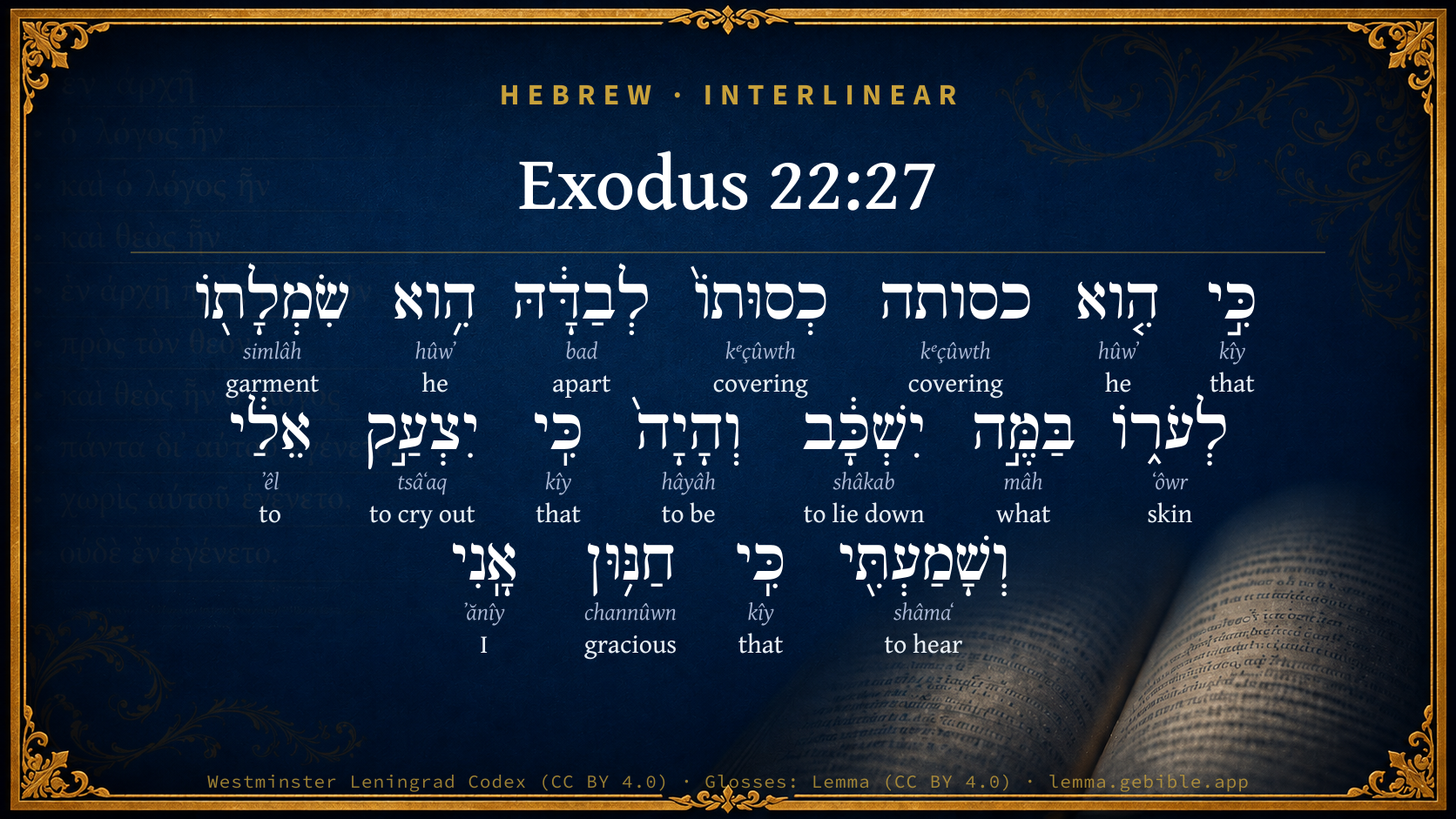
Hebrew (Westminster Leningrad Codex) Exodus 22:27 appears in the Hebrew Old Testament. The text above is from the Westminster Leningrad Codex. Each word links to its Strong’s number, a concise gloss, and parsing drawn from the Open Scriptures Hebrew Bible morphology. Click any word for its full Brown-Driver-Briggs (BDB) entry.
Download image
Cite this verse

Exodus 22:27 (World English Bible). Public Domain. Lemma interlinear Bible study tool, https://lemma.gebible.app/v/exodus/22/27.

Show BibTeX & RIS
BibTeX
RIS
English Translation
for that is his only covering, it is his garment for his skin. What would he sleep in? It will happen, when he cries to me, that I will hear, for I am gracious.
World English Bible · Public Domain
Highlights
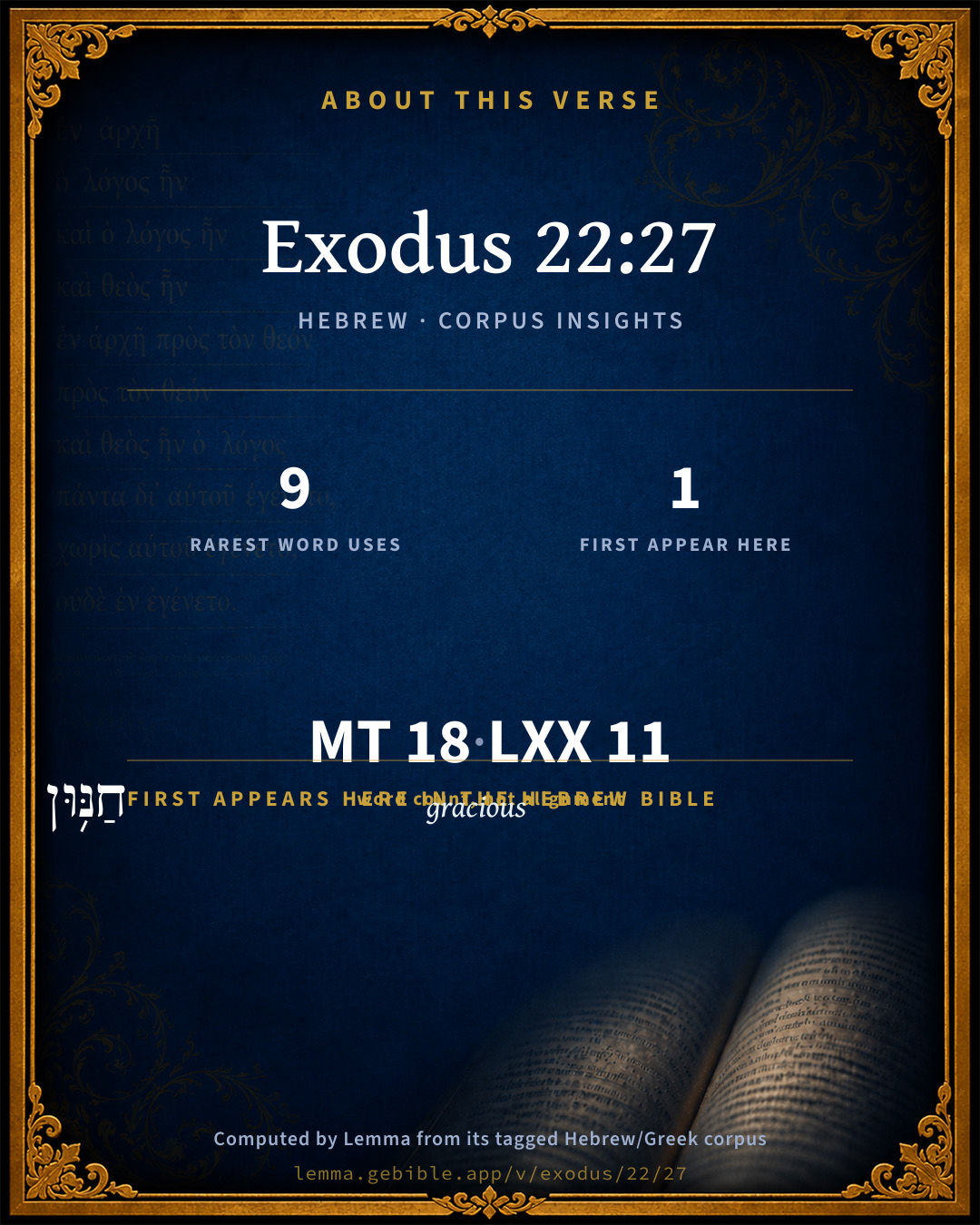
  • 1 first appearance in the Hebrew Bible
Full analysis ↓
Download a study sheet

One document with this verse’s original text, its word-by-word gloss line, the meaning frame, cross-references with their text, attributed commentary, and full source and license credits — printable, and it pastes into notes with its structure intact.

This verse Autodidact and up

Study sheet (.html) Plain text (.txt)

A passage Seminary Student

Up to 50 verses in one chapter. A passage sheet keeps up to 6 commentary sources and 12 cross-references per verse, in the order this page ranks them, and says so on the sheet whenever that leaves anything out. Ask for a single verse and you get the Autodidact verse sheet above.

Everything on this page stays free to read, with no account — the sheet is a download of what is already on screen, not access to it.

Want to remove ads? Support Godless Engineer
Compare translations 3

The same verse in 3 English versions, stacked beneath the original-language interlinear above. Click any original word for its lexicon entry.

Each is an independent rendering of the whole verse — the interlinear is not word-aligned to these translations.

Highlighted words mark where these versions differ — a whole-verse word diff, not a word-by-word alignment.

  • World English Bible Public Domain
    for that is his only covering, it is his garment for his skin. What would he sleep in? It will happen, when he cries to me, that I will hear, for I am gracious.
  • King James Version Public Domain
    For that is his covering only, it is his raiment for his skin: wherein shall he sleep? and it shall come to pass, when he crieth unto me, that I will hear; for I am gracious.
  • unfoldingWord Literal Text CC BY-SA 4.0
    for it is his only covering; it is his clothing for his skin. In what will he lie down? And it will be when he cries to me, that I will hear him, for I am gracious.

unfoldingWord Literal Text — © unfoldingWord, licensed CC BY-SA 4.0. Word-aligned USFM3 via Door43 (git.door43.org/unfoldingWord/en_ult).

Versions to compare (up to 4)

3 of 4 selected

Show all 18 translations

Every available English version of this verse, each an independent rendering of the whole verse.

  • World English Bible Public Domain
    for that is his only covering, it is his garment for his skin. What would he sleep in? It will happen, when he cries to me, that I will hear, for I am gracious.
  • Berean Standard Bible Public Domain
    because his cloak is the only covering he has for his body. What else will he sleep in? And if he cries out to Me, I will hear, for I am compassionate.
  • Majority Standard Bible Public Domain
    because his cloak is the only covering he has for his body. What else will he sleep in? And if he cries out to Me, I will hear, for I am compassionate.
  • King James Version Public Domain
    For that is his covering only, it is his raiment for his skin: wherein shall he sleep? and it shall come to pass, when he crieth unto me, that I will hear; for I am gracious.
  • American Standard Version (1901) Public Domain
    for that is his only covering, it is his garment for his skin: wherein shall he sleep? And it shall come to pass, when he crieth unto me, that I will hear; for I am gracious.
  • Revised Version (1885) Public Domain
    for that is his only covering, it is his garment for his skin: wherein shall he sleep? and it shall come to pass, when he crieth unto me, that I will hear; for I am gracious.
  • Geneva Bible (1599) Public Domain
    For that is his couering only, and this is his garment for his skin: wherin shall he sleepe? therefore when he crieth vnto mee, I will heare him: for I am mercifull.
  • Douay-Rheims (1899) Public Domain
    For that same is the only thing wherewith he is covered, the clothing of his body, neither hath he any other to sleep in: if he cry to me, I will hear him, because I am compassionate.
  • Young's Literal Translation Public Domain
    for it alone is his covering, it `is' his garment for his skin; wherein doth he lie down? and it hath come to pass, when he doth cry unto Me, that I have heard, for I `am' gracious.
  • Literal Standard Version CC BY-SA 4.0
    for it is his only covering, it [is] his garment for his skin; wherein does he lie down? And it has come to pass, when he cries to Me, that I have heard, for I [am] gracious.
  • Unlocked Literal Bible CC BY-SA 4.0
    for that is his only covering; it is his garment for his body. What else can he sleep in? When he calls out to me, I will hear him, for I am compassionate.
  • unfoldingWord Literal Text CC BY-SA 4.0
    for it is his only covering; it is his clothing for his skin. In what will he lie down? And it will be when he cries to me, that I will hear him, for I am gracious.
  • Darby Bible Public Domain
    for that is his only covering, his garment for his skin: on what shall he lie down? And it shall come to pass, when he crieth unto me, that I will hear; for I am gracious.
  • World Messianic Bible Public Domain
    for that is his only covering, it is his garment for his skin. What would he sleep in? It will happen, when he cries to me, that I will hear, for I am gracious.
  • Webster's Bible Public Domain
    For that is his only covering, it is his raiment for his skin: wherein shall he sleep? and it shall come to pass, when he crieth to me, that I will hear; for I am gracious.
  • Free Bible Version CC BY-SA 4.0
    because it's the only clothing he has for his body. What would he sleep in otherwise? If he calls out to me for help, I will listen, for I am considerate.
  • Bible in Basic English Public Domain
    For it is the only thing he has for covering his skin; what is he to go to sleep in? and when his cry comes up to me, I will give ear, for my mercy is great.
  • JPS Tanakh (1917) Public Domain
    (22-26) for that is his only covering, it is his garment for his skin; wherein shall he sleep? and it shall come to pass, when he crieth unto Me, that I will hear; for I am gracious.

Literal Standard Version (2020), Covenant Press — licensed CC BY-SA 4.0. Text via the HelloAO Bible API (eBible.org). Unlocked Literal Bible (unfoldingWord) — licensed CC BY-SA 4.0. Text via the HelloAO Bible API (eBible.org). unfoldingWord Literal Text — © unfoldingWord, licensed CC BY-SA 4.0. Word-aligned USFM3 via Door43 (git.door43.org/unfoldingWord/en_ult). Free Bible Version, Dr. Jonathan Gallagher — licensed CC BY-SA 4.0. Text via the HelloAO Bible API (eBible.org).

Word by word

More ways to search: Search by grammar → Find every occurrence → Compare this word →

Practice this passage: Drill this verse → Learn its vocabulary →

כסותה
kᵉçûwth
H3682
“covering · his”
Noun, Common, Feminine, Singular, Construct + Suffix, Personal, 3rd Person, Masculine, Singular
Part of Speech
Noun
Type
Common
Gender
Feminine
Number
Singular
State
Construct
Full BDB Definition

Origin: from H3680

TWOT: 1008b

covering, clothing - covering, clothing - covering (for concealment)
  1. כִּ֣י kîy H3588 “that” Conjunction
  2. הִ֤וא hûwʼ H1931 “he” Pronoun, Personal, 3rd Person, Feminine, Singular
  3. כְסוּתוֹ֙ kᵉçûwth H3682 “covering · his” Noun, Common, Feminine, Singular, Construct + Suffix, Personal, 3rd Person, Masculine, Singular
  4. לְבַדָּ֔הּ bad H905 “to/for · apart · her” Preposition + Noun, Common, Masculine, Singular, Construct + Suffix, Personal, 3rd Person, Feminine, Singular
  5. הִ֥וא hûwʼ H1931 “he” Pronoun, Personal, 3rd Person, Feminine, Singular
  6. שִׂמְלָת֖וֹ simlâh H8071 “garment · his” Noun, Common, Feminine, Singular, Construct + Suffix, Personal, 3rd Person, Masculine, Singular
  7. לְעֹר֑וֹ ʻôwr H5785 “to/for · skin · his” Preposition + Noun, Common, Masculine, Singular, Construct + Suffix, Personal, 3rd Person, Masculine, Singular
  8. בַּמֶּ֣ה mâh H4100 “in/at · what” Preposition + Particle, Interrogative
  9. יִשְׁכָּ֔ב shâkab H7901 “to lie down” Verb, Qal, Imperfect, 3rd Person, Masculine, Singular
  10. וְהָיָה֙ hâyâh H1961 “and · to be” Conjunction + Verb, Qal, Sequential Perfect, 3rd Person, Masculine, Singular
  11. כִּֽי kîy H3588 “that” Conjunction
  12. יִצְעַ֣ק tsâʻaq H6817 “to cry out” Verb, Qal, Imperfect, 3rd Person, Masculine, Singular
  13. אֵלַ֔י ʼêl H413 “to · me” Preposition + Suffix, Personal, 1st Person, Common, Singular
  14. וְשָׁמַעְתִּ֖י shâmaʻ H8085 “and · to hear” Conjunction + Verb, Qal, Sequential Perfect, 1st Person, Common, Singular
  15. כִּֽי kîy H3588 “that” Conjunction
  16. חַנּ֥וּן channûwn H2587 “gracious” Adjective, Adjective, Masculine, Singular, Absolute
  17. אָֽנִי ʼănîy H589 “I” Pronoun, Personal, 1st Person, Common, Singular

About this verse

These counts appear in no published source. They are computed here, from the morphology-tagged text and Lemma’s own curated glosses. What Lemma adds →

18
words
14
distinct lemmas
Pentateuch
section

Notable vocabulary

The rarest word here is כסותה covering H3682 — appearing just 9 times in the whole Hebrew Bible.

First appearance in Scripture

This word makes its first canonical appearance in the Hebrew Bible here:

  • חַנּ֥וּן gracious H2587

Shared distinctive vocabulary

כסותה covering H3682 occurs in 8 verses of the Hebrew Bible. Also found in:

Grammatical profile

  • 4 verbs
  • 5 nouns
  • 1 adjective
  • 3 pronouns
  • 1 preposition
  • 3 conjunctions
  • 1 particle

Verb forms

  • יִשְׁכָּ֔ב Qal · Imperfect
  • וְהָיָה֙ Qal · Sequential Perfect
  • יִצְעַ֣ק Qal · Imperfect
  • וְשָׁמַעְתִּ֖י Qal · Sequential Perfect

Repetition

Words recur within this verse — often emphatic in Hebrew:

  • כסותה covering H3682 ×2
  • כִּ֣י that H3588 ×3
  • הִ֤וא he H1931 ×2

Hebrew & Septuagint length

In English translation the verse runs 34 words from the Hebrew and 33 from the Septuagint (LXX English) — closely comparable.

A rough comparison of the two English renderings, which tokenize alike — not a word-level alignment.

Word counts can differ between the Hebrew and the Greek without any difference in meaning — e.g. the Hebrew direct-object marker אֵת has no separate Greek word, and Greek often adds the article ὁ.

In the original languages it is 18 Hebrew tokens and 11 Greek tokens — but the two are counted differently (Hebrew bundles its prefixes and suffixes into one token; the Greek is in lemma form), so that isn’t a like-for-like length.

Cross-references

9

Topical passages linked to Exodus 22:27 in the Treasury of Scripture Knowledge — connected by theme and wording, ordered by reader-vote popularity; previews shown in the World English Bible.

  • Exodus 34:6 Yahweh passed by before him, and proclaimed, "Yahweh! Yahweh, a merciful and gracious God, slow to anger, and abundant in loving kindness and truth,
  • 2 Chronicles 30:9 For if you turn again to Yahweh, your brothers and your children shall find compassion before those who led them captive, and shall come again into this land: for Yahweh your God is gracious and merciful, and will not turn away his face from you, if you return to him.
  • Exodus 22:23 If you take advantage of them at all, and they cry at all to me, I will surely hear their cry;
  • Psalms 34:6 This poor man cried, and Yahweh heard him, And saved him out of all his troubles.
  • Psalms 72:12 For he will deliver the needy when he cries; The poor, who has no helper.
  • Psalms 86:15 But you, Lord, are a merciful and gracious God, Slow to anger, and abundant in loving kindness and truth.
  • Psalms 136:10–11 To him who struck down the Egyptian firstborn; For his loving kindness endures forever;
  • Exodus 2:23–24 It happened in the course of those many days, that the king of Egypt died, and the children of Israel sighed because of the bondage, and they cried, and their cry came up to God because of the bondage.
  • Isaiah 19:20 It shall be for a sign and for a witness to Yahweh of Hosts in the land of Egypt; for they shall cry to Yahweh because of oppressors, and he will send them a savior, and a defender, and he will deliver them.

Cross-references courtesy of OpenBible.info (CC BY 4.0).

Hebrew and Greek witnesses Masoretic Hebrew ↔ Greek Septuagint

The same verse in the two great witnesses to the Old Testament, shown verse-for-verse.

These are two independent witnesses, not word-aligned to each other, and the Septuagint is shown in lemma (dictionary) form.

Hebrew Exodus 22:27 Masoretic · Westminster Leningrad Codex

כִּ֣י הִ֤וא כסותה כְסוּתוֹ֙ לְבַדָּ֔הּ הִ֥וא שִׂמְלָת֖וֹ לְעֹר֑וֹ בַּמֶּ֣ה יִשְׁכָּ֔ב וְהָיָה֙ כִּֽי יִצְעַ֣ק אֵלַ֔י וְשָׁמַעְתִּ֖י כִּֽי חַנּ֥וּן אָֽנִי

for that is his only covering, it is his garment for his skin. What would he sleep in? It will happen, when he cries to me, that I will hear, for I am gracious.

World English Bible · Public Domain

Greek LXX Exodus 22:27 Septuagint · lemma form

θεός οὐ κακολογέω καί ἄρχων ὁ λαός σύ οὐ κακῶς εἶπον

For this is his clothing, this is the only covering of his nakedness; wherein shall he sleep? If then he shall cry to me, I will listen to him, for I am merciful.

LXX2012 (modern English Septuagint) · Public Domain

Hebrew: Westminster Leningrad Codex (CC BY 4.0). Greek: Septuagint (public domain); English from LXX2012 (modern English Septuagint) (Public Domain). How the Septuagint differs from the Hebrew →

Targum (Aramaic paraphrase)

2

The Targum is the ancient Jewish Aramaic paraphrase of the Hebrew Scriptures — an interpretive translation, not the Hebrew text itself. Onkelos (literal) and Pseudo-Jonathan (expansive) render the Torah, and Jonathan the Prophets. Coverage is partial: where no permissively-licensed English translation exists for a verse, only the Aramaic is shown. This is verse-level text, not a word-by-word alignment to the Hebrew.

  1. Targum Onkelos Torah (Genesis–Deuteronomy)
    דַיָנָא לָא תְקִיל וְרַבָּא בְעַמָךְ לָא תְלוּט:

    (no public-domain English translation for this verse)

    Targum Onkelos — Aramaic: “Onkelos Genesis” (public domain); “Onkelos Exodus” (public domain); “Onkelos Leviticus” (public domain); “Onkelos Numbers” (public domain); “Onkelos Deuteronomy” (public domain). English: “Sefaria Community Translation” (CC0 1.0 (public-domain dedication)); “J.W. Etheridge. The Targums of Onkelos and Jonathan Ben Uzziel on the Pentateuch. London: Longmans, Green, 1862” (public domain). Text via Sefaria.

  2. Targum Pseudo-Jonathan Torah (Genesis–Deuteronomy)
    עַמִּי בְנֵי יִשְרָאֵל דַּיָּינֵיכוֹן לָא תְקִילִין וְרַבָּנִין דִּמִתְמַנִין נְגוֹדִין בְּעַמָּךְ לָא תְלוּטִין

    Sons of Israel My people, ye shall not revile your judges, nor curse the rabbans who are appointed rulers among thy people.

    Targum Pseudo-Jonathan — Aramaic: “Targum Jonathan on Genesis” (public domain); “Targum Jonathan on Exodus” (public domain); “Targum Jonathan on Leviticus” (public domain); “Targum Jonathan on Numbers” (public domain); “Targum Jonathan on Deuteronomy” (public domain). English: “The Targum of Jonathan ben Uzziel, trans. J. W. Etheridge, London, 1862” (public domain). Text via Sefaria.

Commentary

Notes on Exodus 22:27 from classic Christian and Jewish commentators (each source and its license shown beneath its notes). The classic Christian expositions comment on the surrounding passage and are grouped to its opening verse, so a note may address several verses; the Jewish commentaries on the Tanakh (Rashi and others) are per-verse, so they appear only where the commentator wrote on this verse.

Lemma curates 59 commentaries, every one of them public domain or Creative Commons licensed, each selected and text-cleaned for this edition rather than reprinted as found. About our sources →

Trapp's Complete Commentary

John Trapp

Exo 22:27 For that [is] his covering only, it [is] his raiment for his skin: wherein shall he sleep? and it shall come to pass, when he crieth unto me, that I will hear; for I [am] gracious.

Ver. 27. {See Trapp on "Exo 22:26"}

John Trapp, A Commentary or Exposition upon All the Books of the Old and New Testament (1647–1656) — public domain. Text from a community e-Sword module.

Geneva Bible (1599)

Geneva Bible translators

For cold and necessity.

Geneva Bible (1599) marginal notes — public domain. Text via Bolls.life.

The Cambridge Bible for Schools and Colleges

gen. ed. J. J. S. Perowne

27. wherein, &c.] i.e. wherein else can he sleep?

gracious] see on Exo_34:6; and cf. Exo_33:19.

The Cambridge Bible for Schools and Colleges (gen. ed. J. J. S. Perowne; Cambridge University Press, 1878–1918) — public domain. Text from a community e-Sword module.

John Gill's Exposition

Thou shall not delay to offer the first of thy ripe fruits,.... Which, according to Maimonides (k), were of seven kinds only; for he says,"they do not bring the firstfruits, but of the seven kinds, said in the praise of the land, (the land of Canaan), Deu 8:8 and they are wheat, barley, grapes, figs, pomegranates, olives, and dates;''and how much of these were to be offered is not fixed by the law, but were left to the generosity of the people: the above mentioned writer asks (l),"what measure do the wise men set? a good eye (or a bountiful man) brings one of forty (or the fortieth part of his fruits); a middling one (one that is neither liberal nor niggardly) brings one of fifty (or the fiftieth part); and an evil one (a covetous man) one of sixty (or the sixtieth part), but never less than that.''Now this was not to be delayed, but to be brought as soon and as early as could be: the Jewish writers seem to understand this of postponing things, or inverting the order of them, bringing that first which should be last, and that last which should be first; so Jarchi interprets it,"thou shall not change the order of their separation, to postpone that which should be first, and to put before that which should be last; for the first oblation should not be brought before the firstfruits, and the tithes before the first oblation.''And thus runs one of their canons or traditions (m),"if anyone brings the first oblation before the firstfruits, the first tithe before the first oblation, the second tithe before the first, it is as if he transgressed a negative precept: "thou shalt not delay or postpone", &c. Exo 22:29'

And of thy liquors: and these, according to Maimonides (n), were only the firstfruits of liquors of olives and grapes:

the firstborn of thy sons thou shall give unto me; which is a repetition of the law. See Gill on Exo 13:2.

(k) Hilchot Biccurim, c. 2. sect. 2. (l) Hilchot Trumot, c. 3. sect. 2. (m) Misn. Trumot, c. 3. sect. 6. (n) Biccurim, ut supra. (k))

John Gill's Exposition of the Whole Bible (1746–1763) — public domain (CC PDM 1.0). Text via the HelloAO Bible API.

Whedon's Commentary on the Bible

Daniel D. Whedon

27. Wherein shall he sleep — The outer garment was used by the poorer classes of the East as their sole covering by night. Hence the kind consideration of the law.

Daniel D. Whedon (gen. ed.), Commentary on the Old and New Testaments (1874–1909) — public domain. Text from a community e-Sword module.

The Pulpit Commentary

Wherein shall he sleep? The outer garment worn by the ancient Hebrews was like that of the modern Bedouins a sort of large woollen shawl or blanket, in which they enveloped the greater part of their persons. It serves the Bedouins, to the present time, as robe by day, and as coverlet by night. When he crieth unto me. Compare ver. 23. If the law is broken, and the man cry unto the Lord, he will hear, and avenge him.

The Pulpit Commentary (1880–1919), ed. H.D.M. Spence-Jones & Joseph S. Exell — public domain. Text from a community e-Sword module.

Rashi

Rabbi Shlomo Yitzchaki (Rashi)

אלהים לא תקלל THOU SHALT NOT EXECRATE GOD — Here you have the prohibition of blasphemy (the penalty being stated in Leviticus 24:16) and the prohibition of cursing a judge (who is also termed אלהים, cf. Exodus 22:7) (cf. (Mekhilta and Sanhedrin 66a).

Rashi on the Tanakh — English translations: “The Judaica Press complete Tanach with Rashi, translated by A. J. Rosenberg” (CC BY 4.0); “Pentateuch with Rashi's commentary by M. Rosenbaum and A.M. Silbermann, 1929-1934” (public domain); “The Metsudah Tanach series, Lakewood, N.J” (CC BY 4.0); and “The Book of Joshua, Metsudah Publications, 1997” (CC BY 4.0). Text via Sefaria.

Ramban (Nachmanides)

Rabbi Moshe ben Nachman (Ramban / Nachmanides)

THOU SHALL NOT CURSE ‘ELOHIM.’ Onkelos translated it as referring to a judge, that one is not to curse him if he should hold him guilty in a lawsuit. Lo takeil [Onkelos’ rendition of the Hebrew lo t’kaleil — thou shalt not curse], is the Aramaic expression for “cursing.” Thus: “Meikal l’hu (they curse him): May the Eternal cut off to the man that doeth this, him that calleth and him that answereth.” There are many similar expressions, in the language of the Talmud Yerushalmi.

NOR CURSE A ‘NASI’ OF THY PEOPLE — nasi means the one who is “lifted up” above his people, namely, the king. He thus mentioned that one is not to curse him in case he declares him guilty in a trial before him.In the opinion of our Rabbis in the Gemara, Thou shalt not curse ‘Elokim,’ constitutes an admonition against blaspheming the Name of G-d, even by one of the substituted names [such as: Gracious and Merciful etc.]. Thus He warned against cursing the King on high, blessed be He, and also the monarch that reigns on earth. The Rabbis have also said in the Gemara that included in the term Elokim, is the Glorious Name, as well as the judge who sits in the seat of G-d on earth. But it has not been explained whether the term nasi includes the head of the Great Sanhedrin, who is called nasi in the Gemara. Harav Rabbi Moshe ben Maimon said that he is included under the term of this prohibition. And so it also appears to me, on the basis of a question that Rabbi Yehudah Hanasi so that [in the time of the Sanctuary] the law of a special sin-offering for the prince (see Leviticus 4:22-26) applied to him as well, since he was the nasi of the Sanhedrin, or perhaps because he had his counterpart in the Diaspora — the Exilarch — his authority was no longer unique as that of a king, and therefore his sin-offering is to be like that of any individual Israelite. It is thus obvious that the office of the Chief of the Sanhedrin as such is included under the term nasi. asked about himself: “A person in my status, am I to bring a sa’ir, Verse 28). etc.?” If so, He is stating: “Do not curse any ruler of the people, who holds a position of supreme authority over all Israel, whether that position be in the secular sphere of government or in the rule of Torah,” for the head of the Sanhedrin is the highest position in the authority of the Torah.

Ramban (Nachmanides) on the Tanakh — English translation: “Commentary on the Torah by Ramban (Nachmanides). Translated and annotated by Charles B. Chavel. New York, Shilo Pub. House, 1971-1976” (CC BY 4.0). Text via Sefaria.

Sforno

Rabbi Ovadia Sforno

Do not curse judges. A litigant must not curse the judge even if he believes that his ruling was unfair because it is impossible for him to be objective about his own case.

Sforno on the Tanakh — English translation: “Yalkut, Sifsei Chachomim Chumash, Metsudah Publications, 2009” (CC BY 4.0). Text via Sefaria.

Lesson kit

Teaching starters — assembled from the data on this page, not authored interpretation. Every prompt links to the verse data it draws on. Edit before teaching.

Exodus, in the Pentateuch, opens this verse with 18 words (14 distinct Hebrew lemmas). Its most distinctive word is kᵉçûwth (“covering”). A historical commentator’s framing appears above. Read the whole chapter for the surrounding context.

Discussion questions

  1. The word kᵉçûwth carries the sense “covering.” How does it shape the verse?
  2. This is the first place “gracious” appears in Scripture (first appears here). What does its debut here establish?
  3. How does Genesis 20:16, which shares the word «covering», read alongside this verse?
  4. What does the repetition of “covering” (2× in this one verse) do in this verse?
  5. These translations render this verse differently. What is at stake in choosing one wording over another?
  6. «יִשְׁכָּ֔ב» is a Qal Imperfect verb. How does that grammatical form shape the action described?
  7. Compare how Trapp's Complete Commentary and Geneva Bible (1599) read this verse. Where do they agree or differ?

Things to notice

Reading settings

Reading text

Shown beneath each verse's original-language words.

Old Testament
Old Testament edition

Read the OT as the Masoretic Hebrew (MT) or the Greek Septuagint (LXX).

English shown for the Greek Septuagint (in the Hebrew ↔ Greek comparison).

Comparing translations? Open the Compare panel on any verse page to stack up to four side by side.