
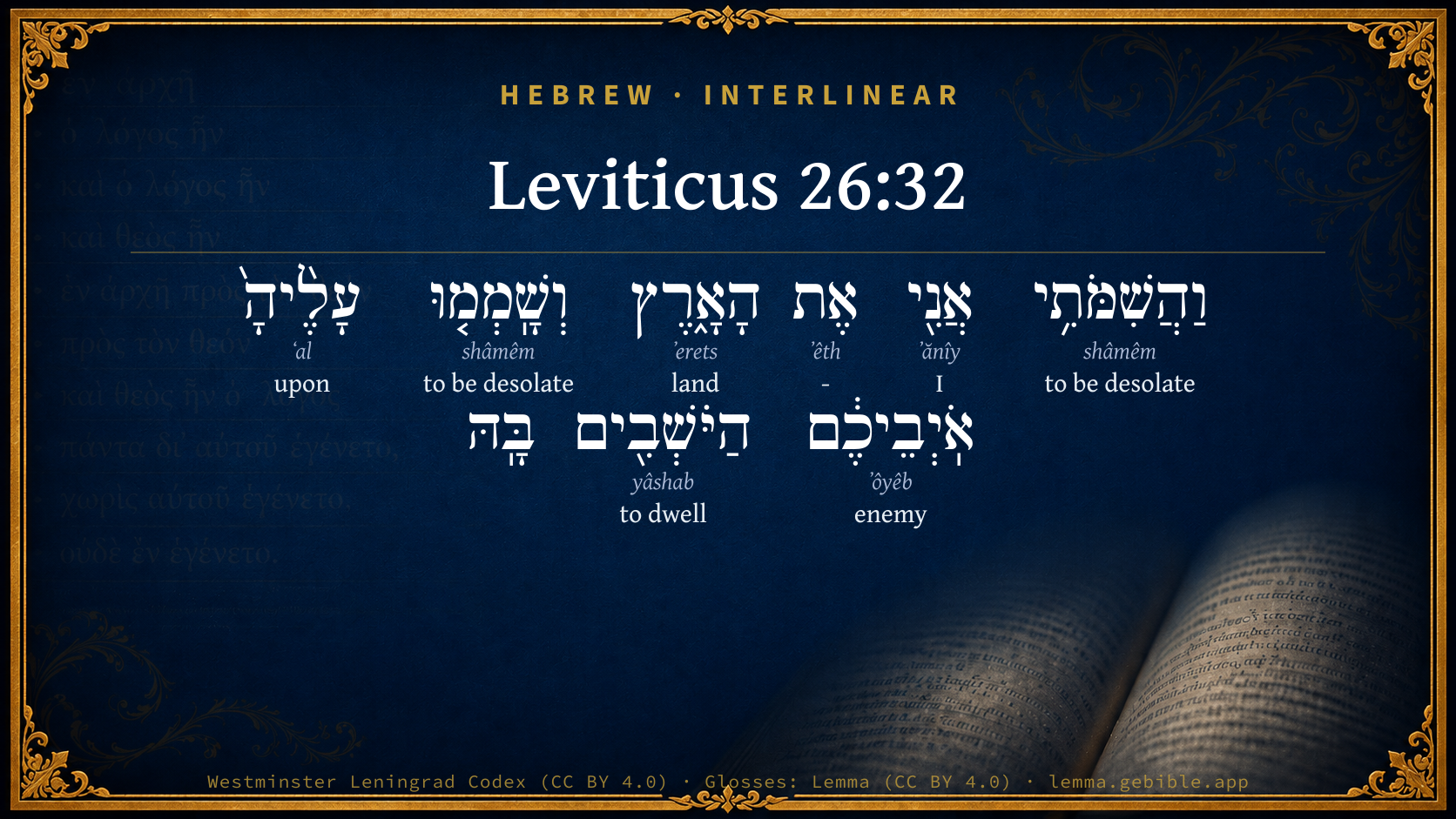
Leviticus 26:32

Hebrew (Westminster Leningrad Codex) Leviticus 26:32 appears in the Hebrew Old Testament. The text above is from the Westminster Leningrad Codex. Each word links to its Strong’s number, a concise gloss, and parsing drawn from the Open Scriptures Hebrew Bible morphology. Click any word for its full Brown-Driver-Briggs (BDB) entry.
Download image
Cite this verse

Leviticus 26:32 (World English Bible). Public Domain. Lemma interlinear Bible study tool, https://lemma.gebible.app/v/leviticus/26/32.

Show BibTeX & RIS
BibTeX
RIS
English Translation
I will bring the land into desolation; and your enemies that dwell therein will be astonished at it.
World English Bible · Public Domain
Download a study sheet

One document with this verse’s original text, its word-by-word gloss line, the meaning frame, cross-references with their text, attributed commentary, and full source and license credits — printable, and it pastes into notes with its structure intact.

This verse Autodidact and up

Study sheet (.html) Plain text (.txt)

A passage Seminary Student

Up to 50 verses in one chapter. A passage sheet keeps up to 6 commentary sources and 12 cross-references per verse, in the order this page ranks them, and says so on the sheet whenever that leaves anything out. Ask for a single verse and you get the Autodidact verse sheet above.

Everything on this page stays free to read, with no account — the sheet is a download of what is already on screen, not access to it.

Want to remove ads? Support Godless Engineer
Compare translations 3

The same verse in 3 English versions, stacked beneath the original-language interlinear above. Click any original word for its lexicon entry.

Each is an independent rendering of the whole verse — the interlinear is not word-aligned to these translations.

Highlighted words mark where these versions differ — a whole-verse word diff, not a word-by-word alignment.

  • World English Bible Public Domain
    I will bring the land into desolation; and your enemies that dwell therein will be astonished at it.
  • King James Version Public Domain
    And I will bring the land into desolation: and your enemies which dwell therein shall be astonished at it.
  • unfoldingWord Literal Text CC BY-SA 4.0
    And I, I will make the land desolate, and your enemies, the dwellers in it, will be appalled at it.

unfoldingWord Literal Text — © unfoldingWord, licensed CC BY-SA 4.0. Word-aligned USFM3 via Door43 (git.door43.org/unfoldingWord/en_ult).

Versions to compare (up to 4)

3 of 4 selected

Show all 18 translations

Every available English version of this verse, each an independent rendering of the whole verse.

  • World English Bible Public Domain
    I will bring the land into desolation; and your enemies that dwell therein will be astonished at it.
  • Berean Standard Bible Public Domain
    And I will lay waste the land, so that your enemies who dwell in it will be appalled.
  • Majority Standard Bible Public Domain
    And I will lay waste the land, so that your enemies who dwell in it will be appalled.
  • King James Version Public Domain
    And I will bring the land into desolation: and your enemies which dwell therein shall be astonished at it.
  • American Standard Version (1901) Public Domain
    And I will bring the land into desolation; and your enemies that dwell therein shall be astonished at it.
  • Revised Version (1885) Public Domain
    And I will bring the land into desolation: and your enemies which dwell therein shall be astonished at it.
  • Geneva Bible (1599) Public Domain
    I will also bring the land vnto a wildernes, and your enemies, which dwell therein, shalbe astonished thereat.
  • Douay-Rheims (1899) Public Domain
    And I will destroy your land, and your enemies shall be astonished at it, when they shall be the inhabitants thereof.
  • Young's Literal Translation Public Domain
    and I have made desolate the land, and your enemies, who are dwelling in it, have been astonished at it.
  • Literal Standard Version CC BY-SA 4.0
    and I have made the land desolate, and your enemies who are dwelling in it have been astonished at it.
  • Unlocked Literal Bible CC BY-SA 4.0
    I will devastate the land. Your enemies who will live there will be shocked at the devastation.
  • unfoldingWord Literal Text CC BY-SA 4.0
    And I, I will make the land desolate, and your enemies, the dwellers in it, will be appalled at it.
  • Darby Bible Public Domain
    And I will bring the land into desolation; that your enemies who dwell there in may be astonished at it.
  • World Messianic Bible Public Domain
    I will bring the land into desolation, and your enemies who dwell in it will be astonished at it.
  • Webster's Bible Public Domain
    And I will bring the land into desolation: and your enemies who dwell in it shall be astonished at it.
  • Free Bible Version CC BY-SA 4.0
    I will devastate your land myself, so that your enemies who come and live in it will be horrified at what has happened.
  • Bible in Basic English Public Domain
    And I will make your land a waste, a wonder to your haters living in it.
  • JPS Tanakh (1917) Public Domain
    And I will bring the land into desolation; and your enemies that dwell therein shall be astonished at it.

Literal Standard Version (2020), Covenant Press — licensed CC BY-SA 4.0. Text via the HelloAO Bible API (eBible.org). Unlocked Literal Bible (unfoldingWord) — licensed CC BY-SA 4.0. Text via the HelloAO Bible API (eBible.org). unfoldingWord Literal Text — © unfoldingWord, licensed CC BY-SA 4.0. Word-aligned USFM3 via Door43 (git.door43.org/unfoldingWord/en_ult). Free Bible Version, Dr. Jonathan Gallagher — licensed CC BY-SA 4.0. Text via the HelloAO Bible API (eBible.org).

Word by word

More ways to search: Search by grammar → Find every occurrence → Compare this word →

Practice this passage: Drill this verse → Learn its vocabulary →

וַהֲשִׁמֹּתִ֥י
shâmêm
H8074
“and · to be desolate”
Conjunction + Verb, Hiphil, Sequential Perfect, 1st Person, Common, Singular
Part of Speech
Conjunction + Verb
Stem
Hiphil
Form
Sequential Perfect
Person
1st Person
Gender
Common
Number
Singular
Full BDB Definition

Origin: a primitive root

TWOT: 2409

to be desolate, be appalled, stun, stupefy - (Qal) - to be desolated, be deflowered, be deserted, be appalled - to be appalled, be awestruck - (Niphal) - to be desolated, be made desolate - to be appalled - (Polel) - to be stunned - appalling, causing horror (participle) - horror-causer, appaller (substantive) - (Hiphil) - to devastate, ravage, make desolated - to appal, show horror - (Hophal) to lay desolate, be desolated - (Hithpolel) - to cause to be desolate - to be appalled, be astounded - to cause oneself desolation, cause oneself ruin
  1. אֲנִ֖י ʼănîy H589 “I” Pronoun, Personal, 1st Person, Common, Singular
  2. אֶת ʼêth H853 “-” Particle, Direct Object
  3. הָאָ֑רֶץ ʼerets H776 “the · land” Particle, Definite Article + Noun, Common, Both, Singular, Absolute
  4. וְשָֽׁמְמ֤וּ shâmêm H8074 “and · to be desolate” Conjunction + Verb, Qal, Sequential Perfect, 3rd Person, Common, Plural
  5. עָלֶ֨יהָ֙ ʻal H5921 “upon · her” Preposition + Suffix, Personal, 3rd Person, Feminine, Singular
  6. אֹֽיְבֵיכֶ֔ם ʼôyêb H341 “enemy · you” Verb, Qal, Participle Active, Masculine, Plural, Construct + Suffix, Personal, 2nd Person, Masculine, Plural
  7. הַיֹּשְׁבִ֖ים yâshab H3427 “the · dwelling” Particle, Definite Article + Verb, Qal, Participle Active, Masculine, Plural, Absolute

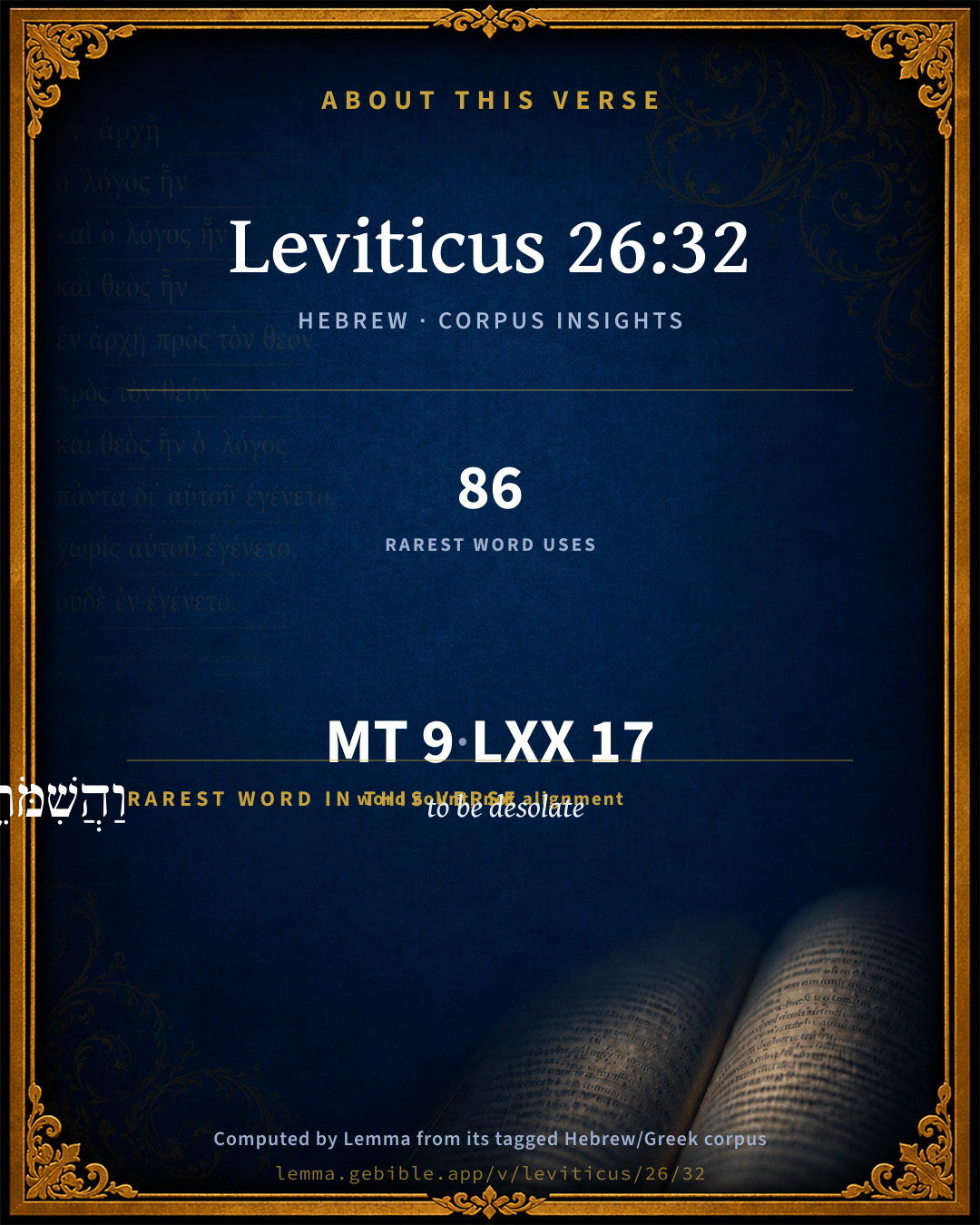
About this verse

These counts appear in no published source. They are computed here, from the morphology-tagged text and Lemma’s own curated glosses. What Lemma adds →

9
words
7
distinct lemmas
Pentateuch
section

Grammatical profile

  • 4 verbs
  • 1 noun
  • 1 pronoun
  • 2 prepositions
  • 1 particle

Verb forms

  • וַהֲשִׁמֹּתִ֥י Hiphil · Sequential Perfect
  • וְשָֽׁמְמ֤וּ Qal · Sequential Perfect
  • אֹֽיְבֵיכֶ֔ם Qal · Participle Active
  • הַיֹּשְׁבִ֖ים Qal · Participle Active

Repetition

A word recurs within this verse — often emphatic in Hebrew:

  • וַהֲשִׁמֹּתִ֥י to be desolate H8074 ×2

Hebrew & Septuagint length

In English translation the verse runs 18 words from the Hebrew and 18 from the Septuagint (LXX English) — the same length.

A rough comparison of the two English renderings, which tokenize alike — not a word-level alignment.

Word counts can differ between the Hebrew and the Greek without any difference in meaning — e.g. the Hebrew direct-object marker אֵת has no separate Greek word, and Greek often adds the article ὁ.

In the original languages it is 9 Hebrew tokens and 17 Greek tokens — but the two are counted differently (Hebrew bundles its prefixes and suffixes into one token; the Greek is in lemma form), so that isn’t a like-for-like length.

Cross-references

26

Topical passages linked to Leviticus 26:32 in the Treasury of Scripture Knowledge — connected by theme and wording, ordered by reader-vote popularity; previews shown in the World English Bible.

  • Jeremiah 9:11 I will make Jerusalem heaps, a dwelling-place of jackals; and I will make the cities of Judah a desolation, without inhabitant.
  • Jeremiah 18:16 to make their land an astonishment, and a perpetual hissing; everyone who passes thereby shall be astonished, and shake his head.
  • Jeremiah 19:8 I will make this city an astonishment, and a hissing; everyone who passes thereby shall be astonished and hiss because of all the plagues of it.
  • Jeremiah 25:11 This whole land shall be a desolation, and an astonishment; and these nations shall serve the king of Babylon seventy years.
  • Deuteronomy 28:37 You shall become an astonishment, a proverb, and a byword, among all the peoples where Yahweh shall lead you away.
  • 1 Kings 9:8 Though this house is so high, yet shall everyone who passes by it be astonished, and shall hiss; and they shall say, Why has Yahweh done thus to this land, and to this house?
  • Jeremiah 25:18 [to wit], Jerusalem, and the cities of Judah, and the kings of it, and the princes of it, to make them a desolation, an astonishment, a hissing, and a curse, as it is this day;
  • Ezekiel 5:15 So it shall be a reproach and a taunt, an instruction and an astonishment, to the nations that are round about you, when I shall execute judgments on you in anger and in wrath, and in wrathful rebukes; (I, Yahweh, have spoken it;)
  • Deuteronomy 29:23–28 [and that] the whole land of it is sulfur, and salt, [and] a burning, [that] it is not sown, nor bears, nor any grass grows therein, like the overthrow of Sodom and Gomorrah, Admah and Zeboiim, which Yahweh overthrew in his anger, and in his wrath:
  • Isaiah 1:7–8 Your country is desolate. Your cities are burned with fire. Strangers devour your land in your presence, And it is desolate, As overthrown by strangers.
  • Isaiah 5:6 I will lay it a wasteland. It won't be pruned nor hoed, But it will grow briers and thorns. I will also command the clouds that they rain no rain on it."
  • Isaiah 5:9 In my ears, Yahweh of Hosts says: "Surely many houses will be desolate, Even great and beautiful, unoccupied.
  • Isaiah 6:11 Then I said, "Lord, how long?" He answered, "Until cities are waste without inhabitant, And houses without man, And the land becomes utterly waste,
  • Isaiah 24:1 Behold, Yahweh makes the earth empty, and makes it waste, and turns it upside down, and scatters abroad the inhabitants of it.
  • Isaiah 32:13–14 On the land of my people shall come up thorns and briers; yes, on all the houses of joy in the joyous city.
  • Isaiah 64:10 Your holy cities are become a wilderness, Zion is become a wilderness, Jerusalem a desolation.
  • Jeremiah 25:38 He has left his covert, as the lion; for their land is become an astonishment because of the fierceness of the oppressing [sword], and because of his fierce anger.
  • Jeremiah 44:2 Thus says Yahweh of Hosts, the God of Israel: You have seen all the evil that I have brought on Jerusalem, and on all the cities of Judah; and, behold, this day they are a desolation, and no man dwells therein,
  • Jeremiah 44:22 so that Yahweh could no longer bear, because of the evil of your doings, and because of the abominations which you have committed; therefore is your land become a desolation, and an astonishment, and a curse, without inhabitant, as it is this day.
  • Lamentations 4:12 The kings of the earth didn't believe, neither all the inhabitants of the world, That the adversary and the enemy would enter into the gates of Jerusalem.
  • Lamentations 5:18 For the mountain of Zion, which is desolate: The foxes walk on it.
  • Ezekiel 33:28–29 I will make the land a desolation and an astonishment; and the pride of her power shall cease; and the mountains of Israel shall be desolate, so that none shall pass through.
  • Daniel 9:2 in the first year of his reign I, Daniel, understood by the books the number of the years about which the word of Yahweh came to Jeremiah the prophet, for the accomplishing of the desolations of Jerusalem, even seventy years.
  • Daniel 9:18 My God, turn your ear, and hear; open your eyes, and see our desolations, and the city which is called by your name: for we do not present our petitions before you for our righteousness, but for your great mercies' sake.
  • Habakkuk 3:17 For though the fig tree doesn't flourish, Nor fruit be in the vines; The labor of the olive fails, The fields yield no food; The flocks are cut off from the fold, And there is no herd in the stalls:
  • Luke 21:20 "But when you see Jerusalem surrounded by armies, then know that its desolation is at hand.

Cross-references courtesy of OpenBible.info (CC BY 4.0).

Hebrew and Greek witnesses Masoretic Hebrew ↔ Greek Septuagint

The same verse in the two great witnesses to the Old Testament, shown verse-for-verse.

These are two independent witnesses, not word-aligned to each other, and the Septuagint is shown in lemma (dictionary) form.

Hebrew Leviticus 26:32 Masoretic · Westminster Leningrad Codex

וַהֲשִׁמֹּתִ֥י אֲנִ֖י אֶת הָאָ֑רֶץ וְשָֽׁמְמ֤וּ עָלֶ֨יהָ֙ אֹֽיְבֵיכֶ֔ם הַיֹּשְׁבִ֖ים בָּֽהּ

I will bring the land into desolation; and your enemies that dwell therein will be astonished at it.

World English Bible · Public Domain

Greek LXX Leviticus 26:32 Septuagint · lemma form

καί ἐκἐρημόω ἐγώ ὁ γῆ σύ καί θαυμάζω ἐπί αὐτός ὁ ἐχθρός σύ ὁ ἐνοἰκέω ἐν αὐτός

And I will lay your land desolate, and your enemies who dwell in it shall wonder at it.

LXX2012 (modern English Septuagint) · Public Domain

Hebrew: Westminster Leningrad Codex (CC BY 4.0). Greek: Septuagint (public domain); English from LXX2012 (modern English Septuagint) (Public Domain). How the Septuagint differs from the Hebrew →

Targum (Aramaic paraphrase)

2

The Targum is the ancient Jewish Aramaic paraphrase of the Hebrew Scriptures — an interpretive translation, not the Hebrew text itself. Onkelos (literal) and Pseudo-Jonathan (expansive) render the Torah, and Jonathan the Prophets. Coverage is partial: where no permissively-licensed English translation exists for a verse, only the Aramaic is shown. This is verse-level text, not a word-by-word alignment to the Hebrew.

  1. Targum Onkelos Torah (Genesis–Deuteronomy)
    וְאֶצְדֵי אֲנָא יָת אַרְעָא וִיצָרְיוּן עֲלַהּ בַּעֲלֵי דְבָבֵיכוֹן דְיָתְבוּן בַּהּ

    (no public-domain English translation for this verse)

    Targum Onkelos — Aramaic: “Onkelos Genesis” (public domain); “Onkelos Exodus” (public domain); “Onkelos Leviticus” (public domain); “Onkelos Numbers” (public domain); “Onkelos Deuteronomy” (public domain). English: “Sefaria Community Translation” (CC0 1.0 (public-domain dedication)); “J.W. Etheridge. The Targums of Onkelos and Jonathan Ben Uzziel on the Pentateuch. London: Longmans, Green, 1862” (public domain). Text via Sefaria.

  2. Targum Pseudo-Jonathan Torah (Genesis–Deuteronomy)
    וְאַצְדֵי לְחוֹד אֲנָא יַת אַרְעָא דְלָא יְהֵי עֲלָהּ נְיַיח רוּחָא וְיִצְדוּן הֵיכְדֵין עֲלָהּ סַנְאֵיכוֹן דְשַׁרְיָין בָּהּ

    And I, even I, will lay your country waste, that the spirit of quietness may not be upon it; so that your enemies who will dwell in it shall be confounded.

    Targum Pseudo-Jonathan — Aramaic: “Targum Jonathan on Genesis” (public domain); “Targum Jonathan on Exodus” (public domain); “Targum Jonathan on Leviticus” (public domain); “Targum Jonathan on Numbers” (public domain); “Targum Jonathan on Deuteronomy” (public domain). English: “The Targum of Jonathan ben Uzziel, trans. J. W. Etheridge, London, 1862” (public domain). Text via Sefaria.

Commentary

Notes on Leviticus 26:32 from classic Christian and Jewish commentators (each source and its license shown beneath its notes). The classic Christian expositions comment on the surrounding passage and are grouped to its opening verse, so a note may address several verses; the Jewish commentaries on the Tanakh (Rashi and others) are per-verse, so they appear only where the commentator wrote on this verse.

Lemma curates 59 commentaries, every one of them public domain or Creative Commons licensed, each selected and text-cleaned for this edition rather than reprinted as found. About our sources →

Trapp's Complete Commentary

John Trapp

Lev 26:32 And I will bring the land into desolation: and your enemies which dwell therein shall be astonished at it.

Ver. 32. Which dwell therein.] After that you shall be driven out of it.

John Trapp, A Commentary or Exposition upon All the Books of the Old and New Testament (1647–1656) — public domain. Text from a community e-Sword module.

Joseph Benson's Commentary

Lev 26:32-33. Your enemies which dwell therein — Having driven you out, and possessed your places; shall be astonished at it — A strong expression, to denote the dreadfulness of their calamity, at which their very enemies should stand amazed. A sword after you — The sword shall follow you into strange lands, and you shall have no rest there.

Joseph Benson's Commentary on the Old and New Testaments (1811–1818) — public domain. Text from a community e-Sword module.

Ellicott's Commentary for English Readers

(32) And I will bring the land into desolation. Better, And I myself will bring, &c. From the ruin of the cities and the sanctuaries the desolation extends to the whole country. Whilst the devastations hitherto were the result of God permitting hostile invasions and conquests, the desolation of the whole country and the dispersion of the Israelites described in the following verses are to be the work of God Himself. He who has promised to bless the land in so marvellous a manner (Lev_26:4-10) as a reward for their obedience, will Himself reduce it to the most astounding desolation as a punishment for their disobedience, so much so, that their very enemies will be amazed at it (Jer_9:11 : Eze_5:15; Eze_33:28-29; Eze_35:10; Eze_36:5).

A Bible Commentary for English Readers, edited by Charles John Ellicott (1878–1897) — public domain. Text from a community e-Sword module.

The Cambridge Bible for Schools and Colleges

gen. ed. J. J. S. Perowne

32. shall be astonished] Cp. Jer_18:16; Jer_19:8.

The Cambridge Bible for Schools and Colleges (gen. ed. J. J. S. Perowne; Cambridge University Press, 1878–1918) — public domain. Text from a community e-Sword module.

John Gill's Exposition

And I will scatter you among the Heathen,.... As with a fan, Jer 15:7; so they were at the time of the Assyrian and Babylonish captivities, some were carried to one place, and some to another, some fled to one place, and some to another, and they are at this day scattered among the several nations of the world:

and will draw out a sword after you; draw it out of its scabbard, and with it pursue after them, when fleeing or going whither they should not; as the remainder of the Jews in Judea sought to go to Egypt, contrary to the will of God, Jer 42:16; see Lev 26:25,

and your land shall be desolate, and your cities waste; for want of men to till the one, and inhabit the other.

John Gill's Exposition of the Whole Bible (1746–1763) — public domain (CC PDM 1.0). Text via the HelloAO Bible API.

Matthew Poole's English Annotations

Having driven you out and possessed your places. See Lam 5:2.

Matthew Poole's English Annotations on the Holy Bible (1683–1685) — public domain. Text from a community e-Sword/MySword module.

Whedon's Commentary on the Bible

Daniel D. Whedon

32. Desolation — “When Elisha came up the defile from Jericho to Bethel, forests clothed the surrounding heights, (2Ki_2:24;) now there is not a tree. Vineyards then covered the terraced sides of glen and hill, from base to summit. They have all disappeared. Cities and fortresses, in the days of Israel’s power, crowned every peak and studded every ridge; shapeless mounds now mark their desolated sites.” — Porter. A fact still more remarkable is, the discovery of cities in Bashan with houses as perfect as if finished only yesterday, and yet without an inhabitant. Porter, from the battlements of the castle of Scalah, “counted thirty towns and villages, many of them almost as perfect as when they were built, and yet for more than five centuries there has not been a single inhabitant in one of them.”

Your enemies… shall be astonished — Not only are the Bedouins, who occasionally encamp in these cities of eastern Palestine, astonished at their utter solitude, but “the stranger that shall come from a far land, shall (do) say when they see the plagues of that land… even all nations shall say, Wherefore hath. the Lord done thus unto this land? What meaneth the heat of this great anger?” Deu_29:22-24.

Daniel D. Whedon (gen. ed.), Commentary on the Old and New Testaments (1874–1909) — public domain. Text from a community e-Sword module.

John Wesley's Explanatory Notes

Who dwell therein - Having driven you out and possessed your places.

John Wesley, Explanatory Notes Upon the Whole Bible (1754–1765) — public domain. Text via the GEBible commentary corpus.

Keil & Delitzsch

C. F. Keil & F. Delitzsch

The land was to become a wilderness, so that even the enemies who dwelt therein would be terrified in consequence (cf. Jer 18:16; Jer 19:8); and the Israelites would be scattered among the heathen, because Jehovah would draw out His sword behind them, i.e., drive them away with a drawn sword, and scatter them to all the winds of heaven (cf. Eze 5:2, Eze 5:12; Eze 12:14).

Keil & Delitzsch — Biblical Commentary on the Old Testament (1861–1891) — public domain (CC PDM 1.0). Text via the HelloAO Bible API. (Old Testament only.)

Rashi

Rabbi Shlomo Yitzchaki (Rashi)

והשמתי אני את הארץ AND I WILL BRING THE LAND INTO DESOLATION [AND YOUR ENEMIES WHO ABIDE IN IT SHALL BE DESOLATE UPON IT] — This was a kindly measure for Israel that the enemies would find no satisfaction in their (the Israelites') land and so it would become desolate of its inhabitants (of the enemies also, and Israel might again easily take possession of it) (Sifra, Bechukotai, Chapter 6 5).

Rashi on the Tanakh — English translations: “The Judaica Press complete Tanach with Rashi, translated by A. J. Rosenberg” (CC BY 4.0); “Pentateuch with Rashi's commentary by M. Rosenbaum and A.M. Silbermann, 1929-1934” (public domain); “The Metsudah Tanach series, Lakewood, N.J” (CC BY 4.0); and “The Book of Joshua, Metsudah Publications, 1997” (CC BY 4.0). Text via Sefaria.

Ibn Ezra

Rabbi Abraham ibn Ezra

Your enemies will be astonished. It will be so desolate that even your enemies living there will be astonished about it, the opposite of what is said (Eichah 2:15); “The joy of all the earth”.

Ibn Ezra on the Tanakh — English translations: “Sefaria Community Translation” (CC0 1.0 (public-domain dedication)); “Yalkut, Sifsei Chachomim Chumash, Metsudah Publications, 2009” (CC BY 4.0); and “Commentary of Ibn Ezra on Isaiah - trans. by M. Friedlander, 1873” (public domain). Text via Sefaria.

Lesson kit

Teaching starters — assembled from the data on this page, not authored interpretation. Every prompt links to the verse data it draws on. Edit before teaching.

Leviticus, in the Pentateuch, opens this verse with 9 words (7 distinct Hebrew lemmas). Its most distinctive word is shâmêm (“to be desolate”). A historical commentator’s framing appears above. Read the whole chapter for the surrounding context.

Discussion questions

  1. The word shâmêm carries the sense “to be desolate.” How does it shape the verse?
  2. How does Jeremiah 9:11, which shares this passage’s theme, read alongside this verse?
  3. What does the repetition of “to be desolate” (2× in this one verse) do in this verse?
  4. These translations render this verse differently; the difference is in the English rendering, not the original. What questions does that raise?
  5. «וַהֲשִׁמֹּתִ֥י» is a Hiphil Sequential Perfect verb. How does that grammatical form shape the action described?
  6. Compare how Trapp's Complete Commentary and Joseph Benson's Commentary read this verse. Where do they agree or differ?

Things to notice

Reading settings

Reading text

Shown beneath each verse's original-language words.

Old Testament
Old Testament edition

Read the OT as the Masoretic Hebrew (MT) or the Greek Septuagint (LXX).

English shown for the Greek Septuagint (in the Hebrew ↔ Greek comparison).

Comparing translations? Open the Compare panel on any verse page to stack up to four side by side.