
Leviticus 20:24

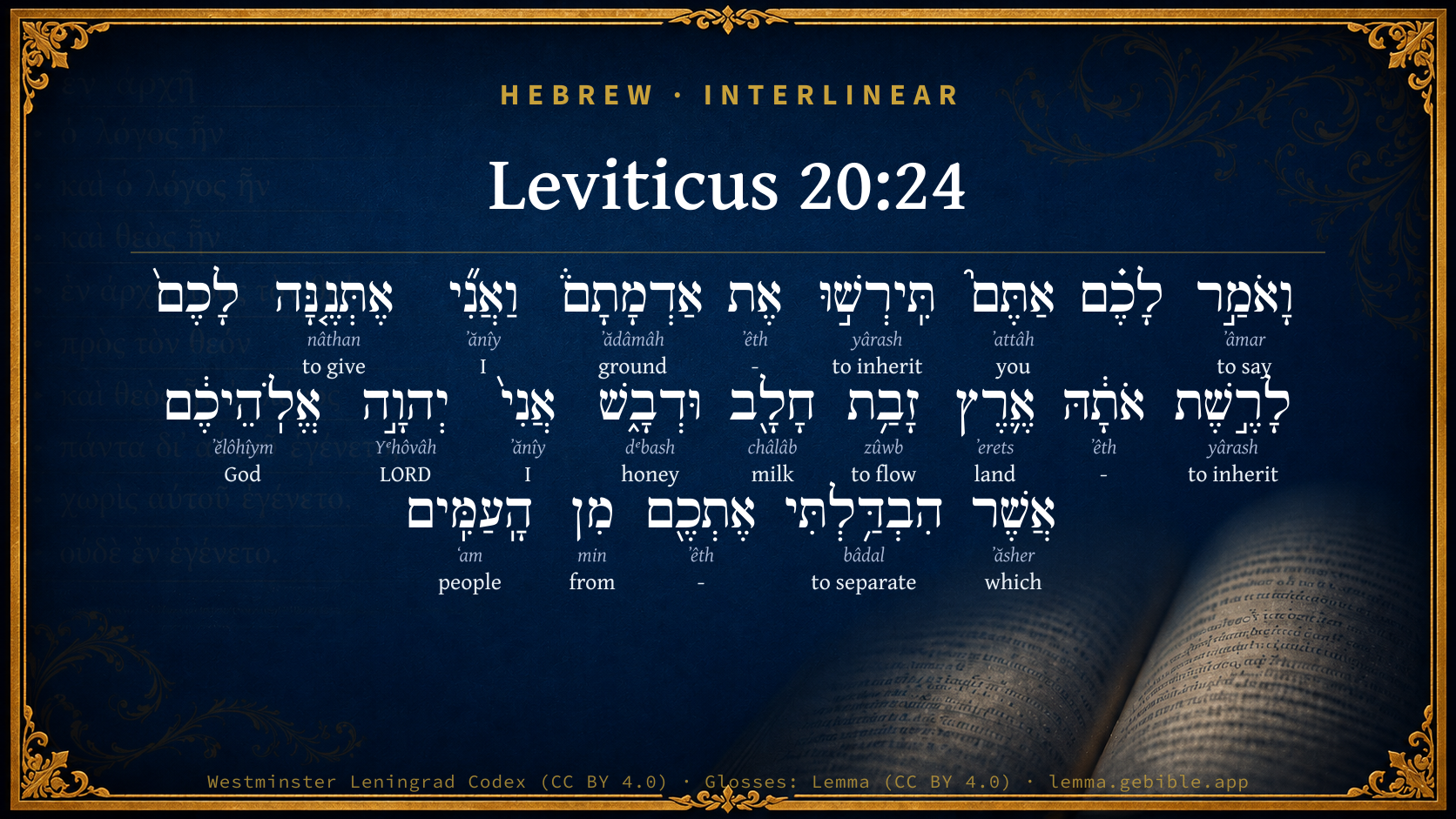
Hebrew (Westminster Leningrad Codex) Leviticus 20:24 appears in the Hebrew Old Testament. The text above is from the Westminster Leningrad Codex. Each word links to its Strong’s number, a concise gloss, and parsing drawn from the Open Scriptures Hebrew Bible morphology. Click any word for its full Brown-Driver-Briggs (BDB) entry.
Download image
Cite this verse

Leviticus 20:24 (World English Bible). Public Domain. Lemma interlinear Bible study tool, https://lemma.gebible.app/v/leviticus/20/24.

Show BibTeX & RIS
BibTeX
RIS
English Translation
But I have said to you, "You shall inherit their land, and I will give it to you to possess it, a land flowing with milk and honey." I am Yahweh your God, who has separated you from the peoples.
World English Bible · Public Domain
Download a study sheet

One document with this verse’s original text, its word-by-word gloss line, the meaning frame, cross-references with their text, attributed commentary, and full source and license credits — printable, and it pastes into notes with its structure intact.

This verse Autodidact and up

Study sheet (.html) Plain text (.txt)

A passage Seminary Student

Up to 50 verses in one chapter. A passage sheet keeps up to 6 commentary sources and 12 cross-references per verse, in the order this page ranks them, and says so on the sheet whenever that leaves anything out. Ask for a single verse and you get the Autodidact verse sheet above.

Everything on this page stays free to read, with no account — the sheet is a download of what is already on screen, not access to it.

Want to remove ads? Support Godless Engineer
Compare translations 3

The same verse in 3 English versions, stacked beneath the original-language interlinear above. Click any original word for its lexicon entry.

Each is an independent rendering of the whole verse — the interlinear is not word-aligned to these translations.

Highlighted words mark where these versions differ — a whole-verse word diff, not a word-by-word alignment.

  • World English Bible Public Domain
    But I have said to you, "You shall inherit their land, and I will give it to you to possess it, a land flowing with milk and honey." I am Yahweh your God, who has separated you from the peoples.
  • King James Version Public Domain
    But I have said unto you, Ye shall inherit their land, and I will give it unto you to possess it, a land that floweth with milk and honey: I am the LORD your God, which have separated you from other people.
  • unfoldingWord Literal Text CC BY-SA 4.0
    And I said to you, ‘You yourselves will inherit their land, and I will give it to you to inherit it: a land flowing milk and honey. I am Yahweh your God, who separates you from the peoples.

unfoldingWord Literal Text — © unfoldingWord, licensed CC BY-SA 4.0. Word-aligned USFM3 via Door43 (git.door43.org/unfoldingWord/en_ult).

Versions to compare (up to 4)

3 of 4 selected

Show all 18 translations

Every available English version of this verse, each an independent rendering of the whole verse.

  • World English Bible Public Domain
    But I have said to you, "You shall inherit their land, and I will give it to you to possess it, a land flowing with milk and honey." I am Yahweh your God, who has separated you from the peoples.
  • Berean Standard Bible Public Domain
    But I have told you that you will inherit their land, since I will give it to you as an inheritance—a land flowing with milk and honey. I am the LORD your God, who has set you apart from the peoples.
  • Majority Standard Bible Public Domain
    But I have told you that you will inherit their land, since I will give it to you as an inheritance—a land flowing with milk and honey. I am the LORD your God, who has set you apart from the peoples.
  • King James Version Public Domain
    But I have said unto you, Ye shall inherit their land, and I will give it unto you to possess it, a land that floweth with milk and honey: I am the LORD your God, which have separated you from other people.
  • American Standard Version (1901) Public Domain
    But I have said unto you, Ye shall inherit their land, and I will give it unto you to possess it, a land flowing with milk and honey: I am Jehovah your God, who hath separated you from the peoples.
  • Revised Version (1885) Public Domain
    But I have said unto you, Ye shall inherit their land, and I will give it unto you to possess it, a land flowing with milk and honey: I am the LORD your God, which have separated you from the peoples.
  • Geneva Bible (1599) Public Domain
    But I haue saide vnto you, ye shall inherite their land, and I will giue it vnto you to possesse it, euen a land that floweth with milke and honie: I am the Lord your God, which haue separated you from other people.
  • Douay-Rheims (1899) Public Domain
    But to you I say: Possess their land which I will give you for an inheritance, a land flowing with milk and honey. I am the Lord your God, who have separated you from other people.
  • Young's Literal Translation Public Domain
    and I say to you, Ye -- ye do possess their ground, and I -- I give it to you to possess it, a land flowing with milk and honey; I `am' Jehovah your God, who hath separated you from the peoples.
  • Literal Standard Version CC BY-SA 4.0
    And I say to you, You possess their ground, and I give it to you to possess it—a land flowing with milk and honey. I [am] your God YHWH, who has separated you from the peoples.
  • Unlocked Literal Bible CC BY-SA 4.0
    I said to you, “You will inherit their land; I will give it to you to possess, a land flowing with milk and honey. I am Yahweh your God, who has separated you from the other peoples.
  • unfoldingWord Literal Text CC BY-SA 4.0
    And I said to you, ‘You yourselves will inherit their land, and I will give it to you to inherit it: a land flowing milk and honey. I am Yahweh your God, who separates you from the peoples.
  • Darby Bible Public Domain
    And I have said unto you, Ye shall possess their land, and I will give it unto you for a possession; a land flowing with milk and honey: I am Jehovah your God, who have separated you from the peoples.
  • World Messianic Bible Public Domain
    But I have said to you, “You shall inherit their land, and I will give it to you to possess it, a land flowing with milk and honey.” I am the LORD your God, who has separated you from the peoples.
  • Webster's Bible Public Domain
    But I have said to you, Ye shall inherit their land, and I will give it to you to possess it, a land that floweth with milk and honey: I am the LORD your God, who have separated you from other people.
  • Free Bible Version CC BY-SA 4.0
    But I have promised you that you will take over their land. I'm going to give it to you to own, a land that flows with milk and honey. I am the Lord your God, who has made you a distinctive people different from all others.
  • Bible in Basic English Public Domain
    But I have said to you, You will take their land and I will give it to you for your heritage, a land flowing with milk and honey: I am the Lord your God who have made you separate from all other peoples.
  • JPS Tanakh (1917) Public Domain
    But I have said unto you: 'Ye shall inherit their land, and I will give it unto you to possess it, a land flowing with milk and honey.' I am the LORD your God, who have set you apart from the peoples.

Literal Standard Version (2020), Covenant Press — licensed CC BY-SA 4.0. Text via the HelloAO Bible API (eBible.org). Unlocked Literal Bible (unfoldingWord) — licensed CC BY-SA 4.0. Text via the HelloAO Bible API (eBible.org). unfoldingWord Literal Text — © unfoldingWord, licensed CC BY-SA 4.0. Word-aligned USFM3 via Door43 (git.door43.org/unfoldingWord/en_ult). Free Bible Version, Dr. Jonathan Gallagher — licensed CC BY-SA 4.0. Text via the HelloAO Bible API (eBible.org).

Word by word

More ways to search: Search by grammar → Find every occurrence → Compare this word →

Practice this passage: Drill this verse → Learn its vocabulary →

זָבַ֥ת
zûwb
H2100
“flowing”
Verb, Qal, Participle Active, Feminine, Singular, Construct
Part of Speech
Verb
Stem
Qal
Form
Participle Active
Gender
Feminine
Number
Singular
State
Construct
Full BDB Definition

Origin: a primitive root

TWOT: 534

to flow, gush, issue, discharge - (Qal) - to flow, gush - to die, pine away (figuratively) - to flow (of issue from woman), have an issue, flux - flowing (participle)
  1. וָאֹמַ֣ר ʼâmar H559 “and · to say” Conjunction + Verb, Qal, Sequential Imperfect, 1st Person, Common, Singular
  2. אַתֶּם֮ ʼattâh H859 “you” Pronoun, Personal, 2nd Person, Masculine, Plural
  3. תִּֽירְשׁ֣וּ yârash H3423 “to inherit” Verb, Qal, Imperfect, 2nd Person, Masculine, Plural
  4. אֶת ʼêth H853 “-” Particle, Direct Object
  5. אַדְמָתָם֒ ʼădâmâh H127 “ground · their” Noun, Common, Feminine, Singular, Construct + Suffix, Personal, 3rd Person, Masculine, Plural
  6. וַאֲנִ֞י ʼănîy H589 “and · I” Conjunction + Pronoun, Personal, 1st Person, Common, Singular
  7. אֶתְּנֶ֤נָּה nâthan H5414 “to give · her” Verb, Qal, Imperfect, 1st Person, Common, Singular + Suffix, Personal, 3rd Person, Feminine, Singular
  8. לָרֶ֣שֶׁת yârash H3423 “to inherit” Preposition + Verb, Qal, Infinitive Construct
  9. אֹתָ֔הּ ʼêth H853 “- · her” Particle, Direct Object + Suffix, Personal, 3rd Person, Feminine, Singular
  10. אֶ֛רֶץ ʼerets H776 “land” Noun, Common, Both, Singular, Absolute
  11. חָלָ֖ב châlâb H2461 “milk” Noun, Common, Masculine, Singular, Absolute
  12. וּדְבָ֑שׁ dᵉbash H1706 “and · honey” Conjunction + Noun, Common, Masculine, Singular, Absolute
  13. אֲנִי֙ ʼănîy H589 “I” Pronoun, Personal, 1st Person, Common, Singular
  14. יְהוָ֣ה Yᵉhôvâh H3068 “LORD” Noun, Proper
  15. אֱלֹֽהֵיכֶ֔ם ʼĕlôhîym H430 “God(s) · your” Noun, Common, Masculine, Plural, Construct + Suffix, Personal, 2nd Person, Masculine, Plural
  16. אֲשֶׁר ʼăsher H834 “which” Particle, Relative
  17. הִבְדַּ֥לְתִּי bâdal H914 “to separate” Verb, Hiphil, Perfect, 1st Person, Common, Singular
  18. אֶתְכֶ֖ם ʼêth H853 “- · you” Particle, Direct Object + Suffix, Personal, 2nd Person, Masculine, Plural
  19. מִן min H4480 “from” Preposition
  20. הָֽעַמִּֽים ʻam H5971 “the · peoples” Particle, Definite Article + Noun, Common, Masculine, Plural, Absolute

About this verse

These counts appear in no published source. They are computed here, from the morphology-tagged text and Lemma’s own curated glosses. What Lemma adds →

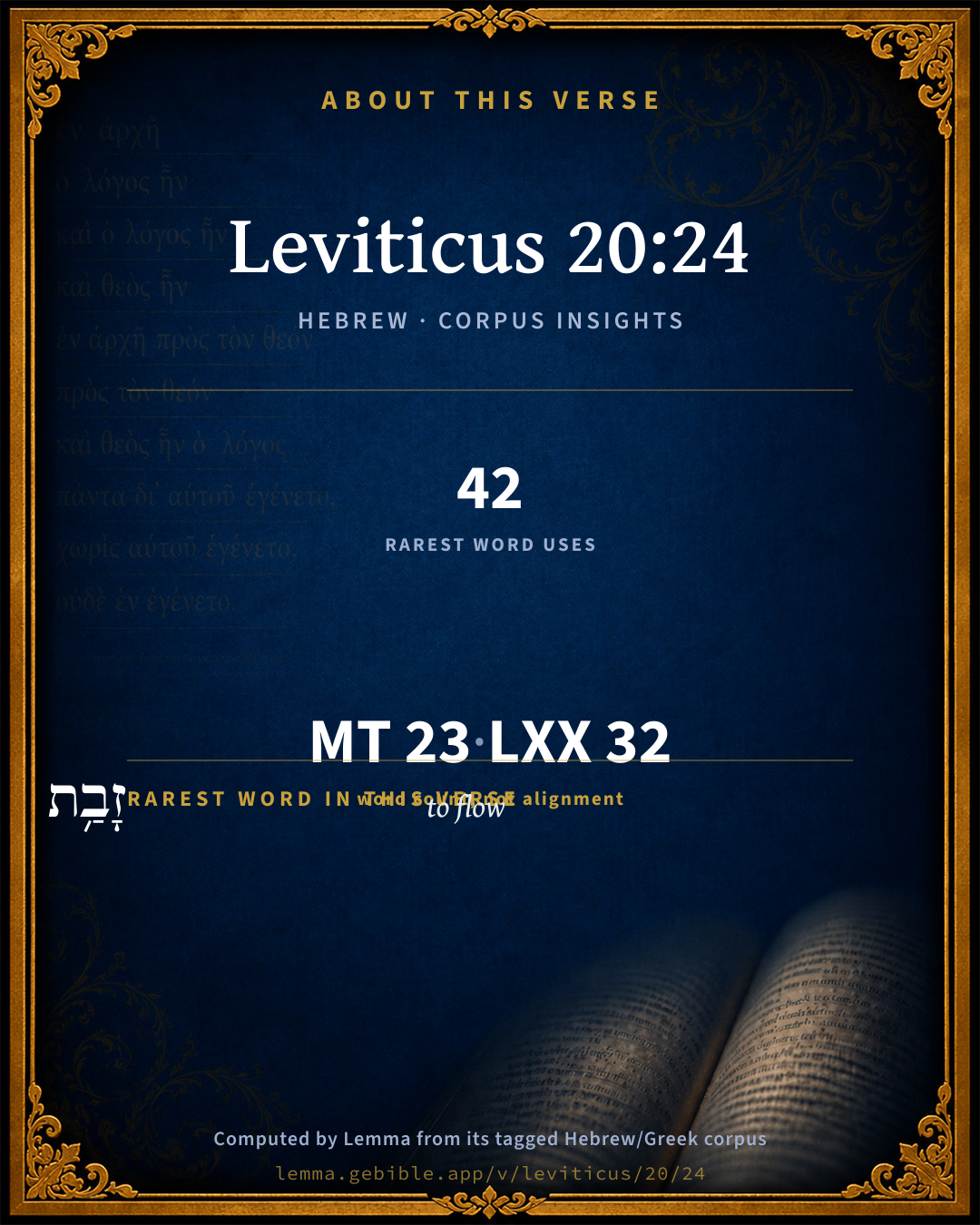
23
words
17
distinct lemmas
Pentateuch
section

Shared distinctive vocabulary

זָבַ֥ת to flow H2100 occurs in 41 verses of the Hebrew Bible. Also found in:

Grammatical profile

  • 6 verbs
  • 7 nouns
  • 3 pronouns
  • 3 prepositions
  • 4 particles

Verb forms

  • וָאֹמַ֣ר Qal · Sequential Imperfect
  • תִּֽירְשׁ֣וּ Qal · Imperfect
  • אֶתְּנֶ֤נָּה Qal · Imperfect
  • לָרֶ֣שֶׁת Qal · Infinitive Construct
  • זָבַ֥ת Qal · Participle Active
  • הִבְדַּ֥לְתִּי Hiphil · Perfect

Repetition

Words recur within this verse — often emphatic in Hebrew:

  • תִּֽירְשׁ֣וּ to inherit H3423 ×2
  • וַאֲנִ֞י I H589 ×2

Hebrew & Septuagint length

In English translation the verse runs 40 words from the Hebrew and 41 from the Septuagint (LXX English) — closely comparable.

A rough comparison of the two English renderings, which tokenize alike — not a word-level alignment.

Word counts can differ between the Hebrew and the Greek without any difference in meaning — e.g. the Hebrew direct-object marker אֵת has no separate Greek word, and Greek often adds the article ὁ.

In the original languages it is 23 Hebrew tokens and 32 Greek tokens — but the two are counted differently (Hebrew bundles its prefixes and suffixes into one token; the Greek is in lemma form), so that isn’t a like-for-like length.

Cross-references

15

Topical passages linked to Leviticus 20:24 in the Treasury of Scripture Knowledge — connected by theme and wording, ordered by reader-vote popularity; previews shown in the World English Bible.

  • Deuteronomy 14:2 For you are a holy people to Yahweh your God, and Yahweh has chosen you to be a people for his own possession, above all peoples who are on the face of the earth.
  • Exodus 3:8 I have come down to deliver them out of the hand of the Egyptians, and to bring them up out of that land to a good and large land, to a land flowing with milk and honey; to the place of the Canaanite, the Hittite, the Amorite, the Perizzite, the Hivite, and the Jebusite.
  • Exodus 3:17 and I have said, I will bring you up out of the affliction of Egypt to the land of the Canaanite, the Hittite, the Amorite, the Perizzite, the Hivite, and the Jebusite, to a land flowing with milk and honey."'
  • Exodus 6:8 I will bring you into the land which I swore to give to Abraham, to Isaac, and to Jacob; and I will give it to you for a heritage: I am Yahweh.'"
  • Deuteronomy 7:6 For you are a holy people to Yahweh your God: Yahweh your God has chosen you to be a people for his own possession, above all peoples who are on the face of the earth.
  • Exodus 33:16 For how would people know that I have found favor in your sight, I and your people? Isn't it in that you go with us, so that we are separated, I and your people, from all the people who are on the surface of the earth?"
  • Leviticus 20:26 You shall be holy to me: for I, Yahweh, am holy, and have set you apart from the peoples, that you should be mine.
  • 1 Kings 8:53 For you did separate them from among all the peoples of the earth, to be your inheritance, as you spoke by Moses your servant, when you brought our fathers out of Egypt, Lord Yahweh.
  • 1 Peter 2:9 But you are a chosen race, a royal priesthood, a holy nation, a people for God's own possession, that you may show forth the excellencies of him who called you out of darkness into his marvelous light:
  • Exodus 13:5 It shall be, when Yahweh shall bring you into the land of the Canaanite, and the Hittite, and the Amorite, and the Hivite, and the Jebusite, which he swore to your fathers to give you, a land flowing with milk and honey, that you shall keep this service in this month.
  • Exodus 19:5–6 Now therefore, if you will indeed obey my voice, and keep my covenant, then you shall be my own possession from among all peoples; for all the earth is mine;
  • Exodus 33:3 to a land flowing with milk and honey: for I will not go up in the midst of you, for you are a stiff-necked people, lest I consume you in the way."
  • Numbers 23:9 For from the top of the rocks I see him, From the hills I see him: behold, it is a people that dwells alone, And shall not be reckoned among the nations.
  • John 15:19 If you were of the world, the world would love its own. But because you are not of the world, since I chose you out of the world, therefore the world hates you.
  • 2 Corinthians 6:17 Therefore, "'Come out from among them, And be separate,' says the Lord, 'Touch no unclean thing. I will receive you.

Cross-references courtesy of OpenBible.info (CC BY 4.0).

Hebrew and Greek witnesses Masoretic Hebrew ↔ Greek Septuagint

The same verse in the two great witnesses to the Old Testament, shown verse-for-verse.

These are two independent witnesses, not word-aligned to each other, and the Septuagint is shown in lemma (dictionary) form.

Hebrew Leviticus 20:24 Masoretic · Westminster Leningrad Codex

וָאֹמַ֣ר לָכֶ֗ם אַתֶּם֮ תִּֽירְשׁ֣וּ אֶת אַדְמָתָם֒ וַאֲנִ֞י אֶתְּנֶ֤נָּה לָכֶם֙ לָרֶ֣שֶׁת אֹתָ֔הּ אֶ֛רֶץ זָבַ֥ת חָלָ֖ב וּדְבָ֑שׁ אֲנִי֙ יְהוָ֣ה אֱלֹֽהֵיכֶ֔ם אֲשֶׁר הִבְדַּ֥לְתִּי אֶתְכֶ֖ם מִן הָֽעַמִּֽים

But I have said to you, "You shall inherit their land, and I will give it to you to possess it, a land flowing with milk and honey." I am Yahweh your God, who has separated you from the peoples.

World English Bible · Public Domain

Greek LXX Leviticus 20:24 Septuagint · lemma form

καί εἶπον σύ σύ κληρονομέω ὁ γῆ αὐτός καί ἐγώ δίδωμι σύ αὐτός ἐν κτῆσις γῆ ῥέω γάλα καί μέλι ἐγώ κύριος ὁ θεός σύ ὅς διαὁρίζω σύ ἀπό πᾶς ὁ ἔθνος

and I said to you, You⌃ shall inherit their land, and I will give it to you for a possession, even a land flowing with milk and honey: I am the Lord your God, who have separated you from all people.

LXX2012 (modern English Septuagint) · Public Domain

Hebrew: Westminster Leningrad Codex (CC BY 4.0). Greek: Septuagint (public domain); English from LXX2012 (modern English Septuagint) (Public Domain). How the Septuagint differs from the Hebrew →

Targum (Aramaic paraphrase)

2

The Targum is the ancient Jewish Aramaic paraphrase of the Hebrew Scriptures — an interpretive translation, not the Hebrew text itself. Onkelos (literal) and Pseudo-Jonathan (expansive) render the Torah, and Jonathan the Prophets. Coverage is partial: where no permissively-licensed English translation exists for a verse, only the Aramaic is shown. This is verse-level text, not a word-by-word alignment to the Hebrew.

  1. Targum Onkelos Torah (Genesis–Deuteronomy)
    וַאֲמָרִית לְכוֹן אַתּוּן תִּירְתוּן יָת אַרְעֲהוֹן וַאֲנָא אֶתְּנִנַהּ לְכוֹן לְמֵירַת יָתַהּ אַרְעָא עַבְדָא חַלָב וּדְבָשׁ אֲנָא יְיָ אֱלָהָכוֹן דִי אַפְרֵשִׁית יָתְכוֹן מִן עַמְמַיָא

    (no public-domain English translation for this verse)

    Targum Onkelos — Aramaic: “Onkelos Genesis” (public domain); “Onkelos Exodus” (public domain); “Onkelos Leviticus” (public domain); “Onkelos Numbers” (public domain); “Onkelos Deuteronomy” (public domain). English: “Sefaria Community Translation” (CC0 1.0 (public-domain dedication)); “J.W. Etheridge. The Targums of Onkelos and Jonathan Ben Uzziel on the Pentateuch. London: Longmans, Green, 1862” (public domain). Text via Sefaria.

  2. Targum Pseudo-Jonathan Torah (Genesis–Deuteronomy)
    וַאֲמָרִית לְכוֹן אַתּוּן תִּזְדַהֲרוּן מִן תּוֹעֵיבְתָּא אִילֵין מִן בִּגְלַל דְתֵירְתוּן יַת אַרְעֲהוֹן וַאֲנָא אִיתְּנִינָהּ לְכוֹן לְמֵירַת יָתָהּ אֲרַע עַבְדָא חֲלַב וּדְבַשׁ אֲנָא הוּא יְיָ אֱלָהָכוֹן דְאַפְרָשִׁית יַתְכוֹן מִן עַמְמַיָא

    But I have told you to beware of these horrors, that you may inherit their land; and I will give it you to possess it, a land producing milk and honey I am the Lord your God who have separated you from the nations.

    Targum Pseudo-Jonathan — Aramaic: “Targum Jonathan on Genesis” (public domain); “Targum Jonathan on Exodus” (public domain); “Targum Jonathan on Leviticus” (public domain); “Targum Jonathan on Numbers” (public domain); “Targum Jonathan on Deuteronomy” (public domain). English: “The Targum of Jonathan ben Uzziel, trans. J. W. Etheridge, London, 1862” (public domain). Text via Sefaria.

Commentary

Notes on Leviticus 20:24 from classic Christian and Jewish commentators (each source and its license shown beneath its notes). The classic Christian expositions comment on the surrounding passage and are grouped to its opening verse, so a note may address several verses; the Jewish commentaries on the Tanakh (Rashi and others) are per-verse, so they appear only where the commentator wrote on this verse.

Lemma curates 59 commentaries, every one of them public domain or Creative Commons licensed, each selected and text-cleaned for this edition rather than reprinted as found. About our sources →

Trapp's Complete Commentary

John Trapp

Lev 20:24 But I have said unto you, Ye shall inherit their land, and I will give it unto you to possess it, a land that floweth with milk and honey: I [am] the LORD your God, which have separated you from [other] people.

Ver. 24. Separated you.] With a wonderful separation; such as was that of light from darkness at the creation.

John Trapp, A Commentary or Exposition upon All the Books of the Old and New Testament (1647–1656) — public domain. Text from a community e-Sword module.

Tyndale Open Study Notes

Tyndale Open Resources

20:24 The expression flowing with milk and honey is common in Exodus—Deuteronomy. It conveys the idea of food being abundant and easy to get. This contrasts with Egypt, where everything depended on the flooding of the Nile and irrigation (Deut 11:9-12).

Tyndale Open Study Notes — © Tyndale Open Resources, licensed CC BY-SA 4.0. Text via the HelloAO Bible API.

Geneva Bible (1599)

Geneva Bible translators

Full of abundance of all things.

Geneva Bible (1599) marginal notes — public domain. Text via Bolls.life.

Jamieson, Fausset & Brown

Robert Jamieson, A. R. Fausset & David Brown

I . . . have separated you from other people--Their selection from the rest of the nations was for the all-important end of preserving the knowledge and worship of the true God amid the universal apostasy; and as the distinction of meats was one great means of completing that separation, the law about making a difference between clean and unclean beasts is here repeated with emphatic solemnity.

Next: Leviticus Chapter 21

Jamieson, Fausset & Brown — Commentary Critical and Explanatory on the Whole Bible (1871) — public domain (CC PDM 1.0). Text via the HelloAO Bible API.

Adam Clarke's Commentary

Verse 24. A land that floweth with milk and honey] See this explained "Ex 3:8".

Adam Clarke's Commentary on the Bible (1810–1826) — public domain. Text from a community e-Sword/MySword module.

Ellicott's Commentary for English Readers

(24) But I have said unto you.—That is, promised to your fathers Abraham, Isaac, and Jacob, and also to you, that he would expel the Canaanites, and give the land to the Israelites as an inheritance.

A Bible Commentary for English Readers, edited by Charles John Ellicott (1878–1897) — public domain. Text from a community e-Sword module.

John Gill's Exposition

But I have said unto you, ye shall inherit the land,.... Promised it unto them, as he had to their fathers, Abraham, Isaac, and Jacob, and also to them; or he had said the above things unto them, that they, observing them, might possess the land of Canaan, and continue therein, which is the sense of the Targum of Jonathan: the Jews say, that the right of inheritance belonged to them, from Shem the son of Noah, whose portion it was, and which they gather from Melchizedek being king of Salem, whom they take to be Shem; and they say, the Canaanites only dwelt in it to make it better, till they should come and inherit it:

and I will give it unto you to possess it; in whose gift it was, and who had a right to dispose of it; and could give them a good title to it, and secure them in the possession of it:

a land that floweth with milk and honey; abounding with all good things, with all the comforts of life, with everything both for necessity and delight; see Exo 3:8,

I am the Lord your God, which have separated you from other people; had chosen them above all people, to be a special and peculiar people to him; had distinguished them by his favours, and had given them particular laws and ordinances, to observe and walk according to them, different from all other nations, which it became them carefully to regard.

John Gill's Exposition of the Whole Bible (1746–1763) — public domain (CC PDM 1.0). Text via the HelloAO Bible API.

Haydock's Catholic Bible Commentary

Honey. Most fertile and delicious. (Menochius)

George Leo Haydock (1774–1849), Haydock's Catholic Family Bible and Commentary, 1859 edition — public domain. Excludes Psalms (Douay-Rheims chapter numbering differs from Protestant) and Deuterocanonical books (Catholic canon only).

Matthew Poole's English Annotations

By my special grace and favour vouchsafed to you above all people, in glorious and miraculous works wrought for you and among you, and in ordinances and other singular privileges and blessings imparted to you, all which calls for your special love and service.

Matthew Poole's English Annotations on the Holy Bible (1683–1685) — public domain. Text from a community e-Sword/MySword module.

Whedon's Commentary on the Bible

Daniel D. Whedon

24. Milk and honey — Both Grecian and Roman poets depict the highest pleasantness and fertility by an abundance of milk and honey. See Homer’s Iliad, 9:141; Ovid, Met., i, iii; See Jos_5:6, note.

Separated you from other people — This separation consisted in circumcision, a knowledge of the true God, a prohibition of idolatry, a unique sacrificial code, and the requirement to obey the moral and the levitical law, which rendered it impossible to mingle socially with the Gentiles without contracting pollution. This separation was subsequently made easier by the secluded position of the Holy Land, which was enclosed on the south and southwest by great wildernesses, on the north by the high mountains of Lebanon, and on the west by a seacoast having few harbours.

Daniel D. Whedon (gen. ed.), Commentary on the Old and New Testaments (1874–1909) — public domain. Text from a community e-Sword module.

The Pulpit Commentary

Vers. 24-26. The Israelites are to avoid all defilement, moral and ceremonial, because they are God"s own possession, separated from other people, and holy unto him.

Three aspects of human life.

The verse suggests three thoughts concerning our human life

I THE EXCELLENCY OF OUR ESTATE. "A land that floweth with milk and honey." God.gave the Israelites an excellent inheritance when he led them into the land. of promise. For beauty, variety of scenery, fertility, etc., it was all that could be desired. Our present estate as citizens of time is one rich and full, a "land flowing," etc. We have:

1. The beauty and grandeur of the world.

2. Human love in its manifold forms, conjugal, parental, filial, fraternal, etc.

3. Sufficiency of all kinds of palatable food.

4. Intellectual gratifications.

5. Spiritual relationships and the sacred, enduring joys which belong to these.

II THE TENURE UNDER WHICH WE HOLD POSSESSION. "I will give it unto you to possess it." We reckon that we "possess" many things. We call them "ours." We endeavour to secure them to ourselves by carefully drawn documents and witnesses. But what, when all has been done that can be done, is the tenure under which we hold everything? It is not the consent of man, but the will of God. God said to Israel concerning the country of the Canaanites, "Ye shall inherit their land, and I will give it unto you to possess it." He thought well to take it away from its former occupants and give it to them. There were, no doubt, the best reasons for this exchange; but Jehovah evidently assumed his perfect right to dispose as seemed well to him of his own. God always has the best grounds on which to deal with us, raising up or laying low; he never acts capriciously; but he often acts without assigning reasons to us, and in such wise that we cannot make any conjecture thereupon that is even probably true. We must recognize the fact that we hold everything at his will, and be perfectly ready to lay it down or to hand it on to another at the bidding of the Supreme. This is true of

(1) our property and position,

(2) our mental powers,

(3) our health, and

(4) our life on earth.

III THE PAINFUL NEED TO SEPARATE OURSELVES FROM OTHERS. "I am the Lord your God, which have separated you flora other people." By their daily habits and social customs (verse 25), the Jews were cut off from intercourse with other people: intermarriages were strictly prohibited; (Deu_7:3, Deu_7:4) they were to maintain a studied separateness from all surrounding nations. The conscientious service of God our Saviour involves some separateness on our part.

1. We have to form ourselves into separate societies, Christian Churches. From these we are bound, in faithfulness, to exclude those who do not profess to love our Lord Jesus Christ. This will produce resentment on their part, and cause them to ascribe to pride that which is due to simple loyalty to the Master.

2. We have to separate ourselves from those persons and things whose association would be injurious to the cause of Christ; from

(1) unholy friendships,

(2) institutions and customs which have evil features or evil tendencies,

(3) the abounding spirit of worldliness and selfishness.

We are bound to make it clear and plain to all that we are "on the Lord"s side," and on the side of all those righteous and holy principles which he commends to us. C.

The Pulpit Commentary (1880–1919), ed. H.D.M. Spence-Jones & Joseph S. Exell — public domain. Text from a community e-Sword module.

unfoldingWord translationNotes

Door43 World Missions Community

a land flowing with milk and honey

The phrase "flowing with milk and honey" means "that is rich and productive with enough food for everyone." AT: "a land that is excellent for cattle and farming" or "a productive land" (See: Idiom)

translationWords

inherit

possess

honey

Yahweh

God

people group

clean

clean

defile

unfoldingWord translationNotes — © Distant Shores Media and the Door43 World Missions Community, licensed CC BY-SA 4.0. Source: git.door43.org/Door43/en_tn.

Lesson kit

Teaching starters — assembled from the data on this page, not authored interpretation. Every prompt links to the verse data it draws on. Edit before teaching.

Leviticus, in the Pentateuch, opens this verse with 23 words (17 distinct Hebrew lemmas). Its most distinctive word is zûwb (“to flow”). A historical commentator’s framing appears above. Read the whole chapter for the surrounding context.

Discussion questions

  1. How does “to flow” (zûwb) shape what this verse is saying?
  2. Exodus 3:8 shares the word «to flow» with this verse. How do the two illuminate each other?
  3. “to inherit” occurs 2× in this one verse. What is the effect of the repetition?
  4. The translations on this page render this verse differently — a whole-verse word diff, not a word-by-word alignment. What might account for the different wordings?
  5. The verb «וָאֹמַ֣ר» is Qal Sequential Imperfect. How does its form color the action?
  6. Reading how Trapp's Complete Commentary and Tyndale Open Study Notes read this verse, where do the two commentators agree and where do they part?

Things to notice

Reading settings

Reading text

Shown beneath each verse's original-language words.

Old Testament
Old Testament edition

Read the OT as the Masoretic Hebrew (MT) or the Greek Septuagint (LXX).

English shown for the Greek Septuagint (in the Hebrew ↔ Greek comparison).

Comparing translations? Open the Compare panel on any verse page to stack up to four side by side.