
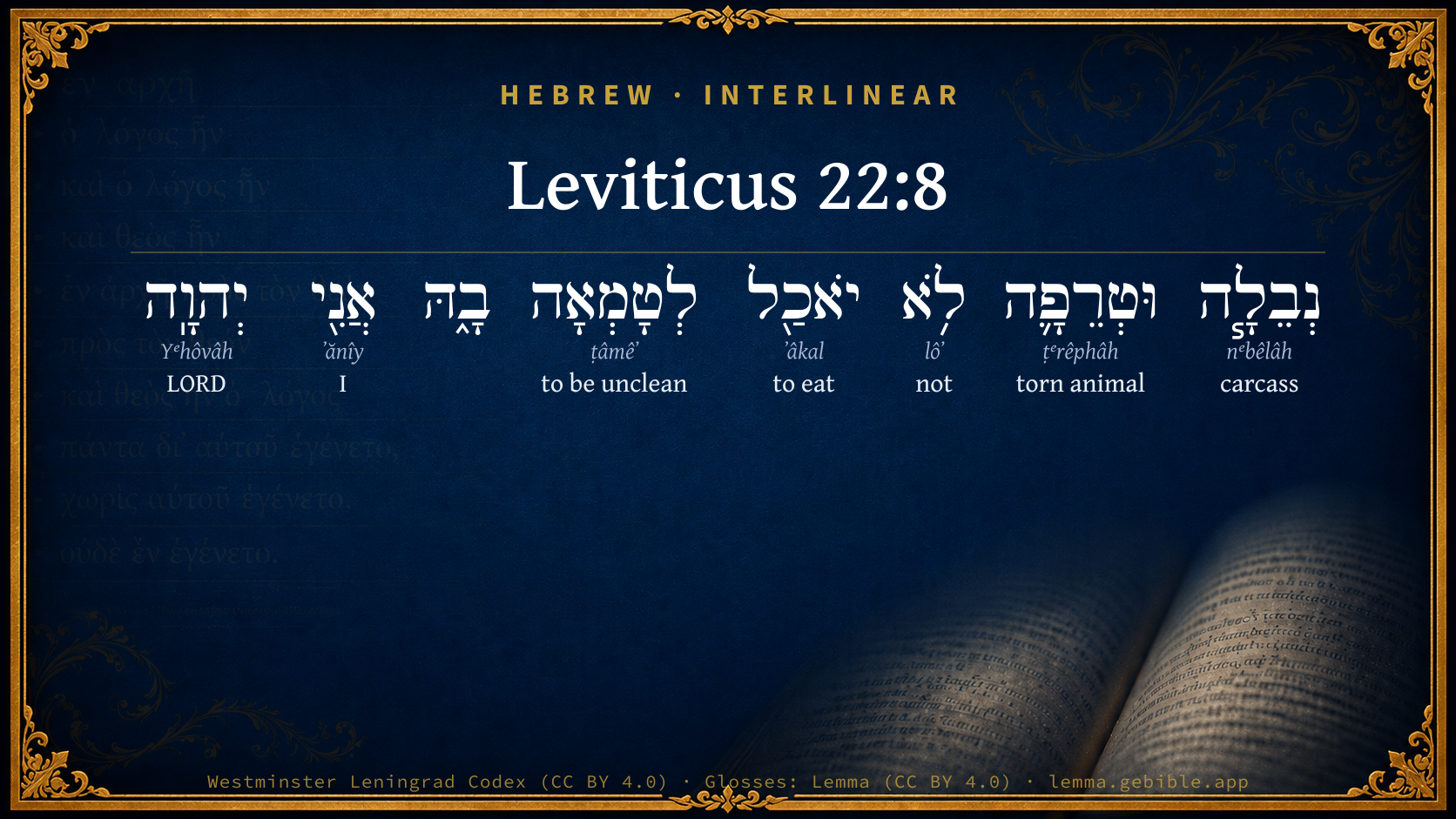
Leviticus 22:8

Hebrew (Westminster Leningrad Codex) Leviticus 22:8 appears in the Hebrew Old Testament. The text above is from the Westminster Leningrad Codex. Each word links to its Strong’s number, a concise gloss, and parsing drawn from the Open Scriptures Hebrew Bible morphology. Click any word for its full Brown-Driver-Briggs (BDB) entry.
Download image
Cite this verse

Leviticus 22:8 (World English Bible). Public Domain. Lemma interlinear Bible study tool, https://lemma.gebible.app/v/leviticus/22/8.

Show BibTeX & RIS
BibTeX
RIS
English Translation
That which dies of itself, or is torn by animals, he shall not eat, defiling himself by it. I am Yahweh.
World English Bible · Public Domain
Download a study sheet

One document with this verse’s original text, its word-by-word gloss line, the meaning frame, cross-references with their text, attributed commentary, and full source and license credits — printable, and it pastes into notes with its structure intact.

This verse Autodidact and up

Study sheet (.html) Plain text (.txt)

A passage Seminary Student

Up to 50 verses in one chapter. A passage sheet keeps up to 6 commentary sources and 12 cross-references per verse, in the order this page ranks them, and says so on the sheet whenever that leaves anything out. Ask for a single verse and you get the Autodidact verse sheet above.

Everything on this page stays free to read, with no account — the sheet is a download of what is already on screen, not access to it.

Want to remove ads? Support Godless Engineer
Compare translations 3

The same verse in 3 English versions, stacked beneath the original-language interlinear above. Click any original word for its lexicon entry.

Each is an independent rendering of the whole verse — the interlinear is not word-aligned to these translations.

Highlighted words mark where these versions differ — a whole-verse word diff, not a word-by-word alignment.

  • World English Bible Public Domain
    That which dies of itself, or is torn by animals, he shall not eat, defiling himself by it. I am Yahweh.
  • King James Version Public Domain
    That which dieth of itself, or is torn with beasts, he shall not eat to defile himself therewith; I am the LORD.
  • unfoldingWord Literal Text CC BY-SA 4.0
    An carcass or a torn he shall not eat, to become unclean by it. I Yahweh.

unfoldingWord Literal Text — © unfoldingWord, licensed CC BY-SA 4.0. Word-aligned USFM3 via Door43 (git.door43.org/unfoldingWord/en_ult).

Versions to compare (up to 4)

3 of 4 selected

Show all 18 translations

Every available English version of this verse, each an independent rendering of the whole verse.

  • World English Bible Public Domain
    That which dies of itself, or is torn by animals, he shall not eat, defiling himself by it. I am Yahweh.
  • Berean Standard Bible Public Domain
    He must not eat anything found dead or torn by wild animals, which would make him unclean. I am the LORD.
  • Majority Standard Bible Public Domain
    He must not eat anything found dead or torn by wild animals, which would make him unclean. I am the LORD.
  • King James Version Public Domain
    That which dieth of itself, or is torn with beasts, he shall not eat to defile himself therewith; I am the LORD.
  • American Standard Version (1901) Public Domain
    That which dieth of itself, or is torn of beasts, he shall not eat, to defile himself therewith: I am Jehovah.
  • Revised Version (1885) Public Domain
    That which dieth of itself, or is torn of beasts, he shall not eat to defile himself therewith: I am the LORD.
  • Geneva Bible (1599) Public Domain
    Of a beast that dyeth, or is rent with beasts, whereby he may be defiled, hee shall not eate: I am the Lord.
  • Douay-Rheims (1899) Public Domain
    That which dieth of itself, and that which was taken by a beast, they shall not eat, nor be defiled therewith, I am the Lord.
  • Young's Literal Translation Public Domain
    a carcase or torn thing he doth not eat, for uncleanness thereby; I `am' Jehovah.
  • Literal Standard Version CC BY-SA 4.0
    he does not eat a carcass or torn thing, to become unclean with it; I [am] YHWH.
  • Unlocked Literal Bible CC BY-SA 4.0
    He must not eat anything found dead or killed by wild animals, by which he would defile himself. I am Yahweh.
  • unfoldingWord Literal Text CC BY-SA 4.0
    An carcass or a torn he shall not eat, to become unclean by it. I Yahweh.
  • Darby Bible Public Domain
    Of a dead carcase and what is torn shall he not eat, to make himself unclean therewith: I am Jehovah.
  • World Messianic Bible Public Domain
    He shall not eat that which dies of itself or is torn by animals, defiling himself by it. I am the LORD.
  • Webster's Bible Public Domain
    That which dieth of itself, or is torn by beasts, he shall not eat to defile himself with it: I am the LORD.
  • Free Bible Version CC BY-SA 4.0
    He must not eat anything that has died, or has been killed by wild animals, because that would make him unclean. I am the Lord.
  • Bible in Basic English Public Domain
    That which comes to a natural death, or is attacked by beasts, he may not take as food, for it will make him unclean: I am the Lord.
  • JPS Tanakh (1917) Public Domain
    That which dieth of itself, or is torn of beasts, he shall not eat to defile himself therewith: I am the LORD.

Literal Standard Version (2020), Covenant Press — licensed CC BY-SA 4.0. Text via the HelloAO Bible API (eBible.org). Unlocked Literal Bible (unfoldingWord) — licensed CC BY-SA 4.0. Text via the HelloAO Bible API (eBible.org). unfoldingWord Literal Text — © unfoldingWord, licensed CC BY-SA 4.0. Word-aligned USFM3 via Door43 (git.door43.org/unfoldingWord/en_ult). Free Bible Version, Dr. Jonathan Gallagher — licensed CC BY-SA 4.0. Text via the HelloAO Bible API (eBible.org).

Word by word

More ways to search: Search by grammar → Find every occurrence → Compare this word →

Practice this passage: Drill this verse → Learn its vocabulary →

About this verse

These counts appear in no published source. They are computed here, from the morphology-tagged text and Lemma’s own curated glosses. What Lemma adds →

8
words
7
distinct lemmas
Pentateuch
section

Notable vocabulary

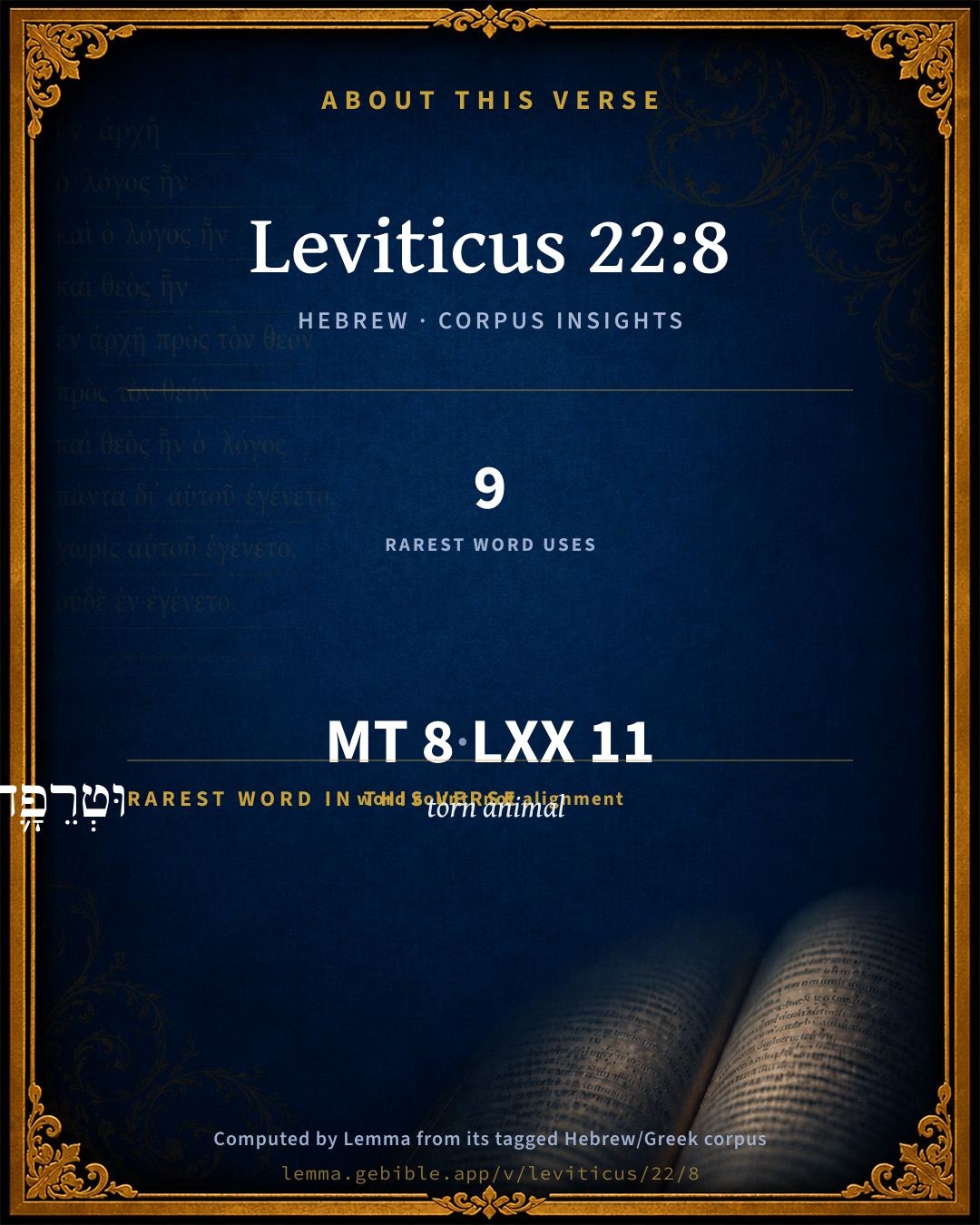
The rarest word here is וּטְרֵפָ֛ה torn animal H2966 — appearing just 9 times in the whole Hebrew Bible.

Shared distinctive vocabulary

וּטְרֵפָ֛ה torn animal H2966 occurs in 9 verses of the Hebrew Bible. Also found in:

Grammatical profile

  • 2 verbs
  • 3 nouns
  • 1 pronoun
  • 1 preposition
  • 1 particle

Verb forms

  • יֹאכַ֖ל Qal · Imperfect
  • לְטָמְאָה Qal · Infinitive Construct

Hebrew & Septuagint length

In English translation the verse runs 21 words from the Hebrew and 26 from the Septuagint (LXX English) — closely comparable.

A rough comparison of the two English renderings, which tokenize alike — not a word-level alignment.

Word counts can differ between the Hebrew and the Greek without any difference in meaning — e.g. the Hebrew direct-object marker אֵת has no separate Greek word, and Greek often adds the article ὁ.

In the original languages it is 8 Hebrew tokens and 11 Greek tokens — but the two are counted differently (Hebrew bundles its prefixes and suffixes into one token; the Greek is in lemma form), so that isn’t a like-for-like length.

Cross-references

6

Topical passages linked to Leviticus 22:8 in the Treasury of Scripture Knowledge — connected by theme and wording, ordered by reader-vote popularity; previews shown in the World English Bible.

  • Leviticus 17:15 "'Every person that eats what dies of itself, or that which is torn by animals, whether he is native-born or a foreigner, he shall wash his clothes, and bathe himself in water, and be unclean until the evening: then he shall be clean.
  • Exodus 22:31 "You shall be holy men to me, therefore you shall not eat any flesh that is torn by animals in the field. You shall cast it to the dogs.
  • Leviticus 7:24 The fat of that which dies of itself, and the fat of that which is torn of animals, may be used for any other service, but you shall in no way eat of it.
  • Deuteronomy 14:21 You shall not eat of anything that dies of itself: you may give it to the foreigner living among you who is within your gates, that he may eat it; or you may sell it to a foreigner: for you are a holy people to Yahweh your God. You shall not boil a kid in its mother's milk.
  • Ezekiel 44:31 The priests shall not eat of anything that dies of itself, or is torn, whether it be bird or animal.
  • Leviticus 11:39–40 "'If any animal, of which you may eat, dies; he who touches its carcass shall be unclean until the evening.

Cross-references courtesy of OpenBible.info (CC BY 4.0).

Hebrew and Greek witnesses Masoretic Hebrew ↔ Greek Septuagint

The same verse in the two great witnesses to the Old Testament, shown verse-for-verse.

These are two independent witnesses, not word-aligned to each other, and the Septuagint is shown in lemma (dictionary) form.

Hebrew Leviticus 22:8 Masoretic · Westminster Leningrad Codex

נְבֵלָ֧ה וּטְרֵפָ֛ה לֹ֥א יֹאכַ֖ל לְטָמְאָה בָ֑הּ אֲנִ֖י יְהוָֽה

That which dies of itself, or is torn by animals, he shall not eat, defiling himself by it. I am Yahweh.

World English Bible · Public Domain

Greek LXX Leviticus 22:8 Septuagint · lemma form

θνησιμαῖος καί θηριάλωτος οὐ ἐσθίω μιαίνω αὐτός ἐν αὐτός ἐγώ κύριος

He shall not eat that which dies of itself, or is taken of beasts, so that he should be polluted by them: I am the Lord.

LXX2012 (modern English Septuagint) · Public Domain

Hebrew: Westminster Leningrad Codex (CC BY 4.0). Greek: Septuagint (public domain); English from LXX2012 (modern English Septuagint) (Public Domain). How the Septuagint differs from the Hebrew →

Targum (Aramaic paraphrase)

2

The Targum is the ancient Jewish Aramaic paraphrase of the Hebrew Scriptures — an interpretive translation, not the Hebrew text itself. Onkelos (literal) and Pseudo-Jonathan (expansive) render the Torah, and Jonathan the Prophets. Coverage is partial: where no permissively-licensed English translation exists for a verse, only the Aramaic is shown. This is verse-level text, not a word-by-word alignment to the Hebrew.

  1. Targum Onkelos Torah (Genesis–Deuteronomy)
    נְבִילָא וּתְבִירָא לָא יֵיכוּל לְאִסְתָּאָבָא בָהּ אֲנָא יְיָ

    (no public-domain English translation for this verse)

    Targum Onkelos — Aramaic: “Onkelos Genesis” (public domain); “Onkelos Exodus” (public domain); “Onkelos Leviticus” (public domain); “Onkelos Numbers” (public domain); “Onkelos Deuteronomy” (public domain). English: “Sefaria Community Translation” (CC0 1.0 (public-domain dedication)); “J.W. Etheridge. The Targums of Onkelos and Jonathan Ben Uzziel on the Pentateuch. London: Longmans, Green, 1862” (public domain). Text via Sefaria.

  2. Targum Pseudo-Jonathan Torah (Genesis–Deuteronomy)
    נְבֵילָא וּקְטוֹלָא לָא יֵיכוּל לְאִסְתָּאֲבָא בָהּ אֲנָא יְיָ

    But of a dead carcase, or (that which hath been) killed (by violence), he may not eat to defile himself therewith. I am the Lord.

    Targum Pseudo-Jonathan — Aramaic: “Targum Jonathan on Genesis” (public domain); “Targum Jonathan on Exodus” (public domain); “Targum Jonathan on Leviticus” (public domain); “Targum Jonathan on Numbers” (public domain); “Targum Jonathan on Deuteronomy” (public domain). English: “The Targum of Jonathan ben Uzziel, trans. J. W. Etheridge, London, 1862” (public domain). Text via Sefaria.

Commentary

Notes on Leviticus 22:8 from classic Christian and Jewish commentators (each source and its license shown beneath its notes). The classic Christian expositions comment on the surrounding passage and are grouped to its opening verse, so a note may address several verses; the Jewish commentaries on the Tanakh (Rashi and others) are per-verse, so they appear only where the commentator wrote on this verse.

Lemma curates 59 commentaries, every one of them public domain or Creative Commons licensed, each selected and text-cleaned for this edition rather than reprinted as found. About our sources →

Trapp's Complete Commentary

John Trapp

Lev 22:8 That which dieth of itself, or is torn [with beasts], he shall not eat to defile himself therewith: I [am] the LORD.

Ver. 8. See on Lev 17:15 Exo 22:31.

John Trapp, A Commentary or Exposition upon All the Books of the Old and New Testament (1647–1656) — public domain. Text from a community e-Sword module.

Jamieson, Fausset & Brown

Robert Jamieson, A. R. Fausset & David Brown

dieth of itself--The feelings of nature revolt against such food. It might have been left to the discretion of the Hebrews, who it may be supposed (like the people of all civilized nations) would have abstained from the use of it without any positive interdict. But an express precept was necessary to show them that whatever died naturally or from disease, was prohibited to them by the operation of that law which forbade them the use of any meat with its blood.

Jamieson, Fausset & Brown — Commentary Critical and Explanatory on the Whole Bible (1871) — public domain (CC PDM 1.0). Text via the HelloAO Bible API.

The Cambridge Bible for Schools and Colleges

gen. ed. J. J. S. Perowne

8. Cp. Lev_17:15.

10–16 describe those to whom, outside the priestly body, permission to eat of the holy things may be extended.

The Cambridge Bible for Schools and Colleges (gen. ed. J. J. S. Perowne; Cambridge University Press, 1878–1918) — public domain. Text from a community e-Sword module.

John Gill's Exposition

That which dieth of itself, or is torn with beasts,.... Whether fowls or beasts, and even clean ones, which, had they been killed in a proper manner, were fit to cut, but dying of themselves, or torn to pieces by other birds or beasts of prey, might not, see Eze 44:31,

he shall not eat, to defile himself therewith; being impure food, at least in a ceremonial sense, and not fit to be eaten; these things were forbid a common Israelite, and much less might a priest eat of them, see Lev 17:15,

I am the Lord; who enjoin this, and expect to be obeyed.

John Gill's Exposition of the Whole Bible (1746–1763) — public domain (CC PDM 1.0). Text via the HelloAO Bible API.

Albert Barnes' Notes on the Bible

The pollution in the priests would be an aggravated one, inasmuch as they would have to forego their sacred functions. Compare Eze 4:14; Eze 44:31. The general prohibition occurs in Lev 11:39; Lev 17:15; Exo 22:31.

Albert Barnes' Notes on the Bible (1834–1885) — public domain. Text from a community e-Sword/MySword module.

Haydock's Catholic Bible Commentary

That. See chap. xvii. 15.

George Leo Haydock (1774–1849), Haydock's Catholic Family Bible and Commentary, 1859 edition — public domain. Excludes Psalms (Douay-Rheims chapter numbering differs from Protestant) and Deuterocanonical books (Catholic canon only).

Whedon's Commentary on the Bible

Daniel D. Whedon

8. Dieth of itself — This is prohibited on ceremonial grounds, because the blood is in the veins, and on sanitary grounds, because the blood corrupts and poisons the flesh.

Daniel D. Whedon (gen. ed.), Commentary on the Old and New Testaments (1874–1909) — public domain. Text from a community e-Sword module.

Rashi

Rabbi Shlomo Yitzchaki (Rashi)

נבלה וטרפה לא יאכל לטמאה בה CARRION, OR THAT WHICH IS TORN HE SHALL NOT EAT TO BECOME UNCLEAN THEREBY — It is with regard to the defilement that Scripture lays down this prohibition: that if he (the priest) eats the carrion of a clean bird — which has no defiling effect through being touched or carried but has a defiling effect only when eaten, as soon as it is in the gullet — he is forbidden to eat holy things (Sifra, Acharei Mot, Chapter 12 6). And it was necessary for Scripture to mention טרפה also, in order to define what נבלה is here intended, viz., one that can have a טרפה amongst the individuals of its class: therefore the נבלה of an unclean bird is excluded, for in its class a טרפה can never occur (cf. Rashi on Leviticus 17:15).

Rashi on the Tanakh — English translations: “The Judaica Press complete Tanach with Rashi, translated by A. J. Rosenberg” (CC BY 4.0); “Pentateuch with Rashi's commentary by M. Rosenbaum and A.M. Silbermann, 1929-1934” (public domain); “The Metsudah Tanach series, Lakewood, N.J” (CC BY 4.0); and “The Book of Joshua, Metsudah Publications, 1997” (CC BY 4.0). Text via Sefaria.

Ramban (Nachmanides)

Rabbi Moshe ben Nachman (Ramban / Nachmanides)

N’VEILAH’ (THAT WHICH DIETH OF ITSELF) ‘U’TREIFAH’ (OR IS TORN OF BEASTS) HE SHALL NOT EAT TO DEFILE HIMSELF THEREWITH. Scripture is stating that [the priest] should be careful not to eat n’veilah or treifah so that he should not become defiled therewith, and then it will be necessary for him to be separated from the holy things, and treifah, since the law applies to all Israelites (See Exodus 22:30 on treifah, and Deuteronomy 14:21 on n’veilah). Ramban’s explanation is that since the main theme of this section is to warn the priests to separate themselves from holy things when they are in a state of impurity, therefore the Torah mentions here the admonition against their eating n’veilah and treifah, since by so doing they will not only have transgressed a law which applies to all Israel, but they will also have to separate themselves from the Sanctuary and its holy things, as they will have been rendered impure. and he will not be able to eat of them until he bathes his flesh in water, and when the sun is down, he shall be clean. And the reason [why He mentioned here the prohibition against eating n’veilah and treifah], is that since He had referred to every sort of impurity which can occur to a person, seeing that He mentioned leprosy and an issue, which includes male and female, and the impurity of the dead, (Verse 5), this refers to the dead.” (Torath Kohanim, Emor 4:4). of semen, and of a swarming thing, therefore He goes back [in the verse before us] to warn [the priests to separate themselves] from the holy things when they are impure because of n’veiloth, and He warned them about this by way of an admonition against eating them. And the reason [why He singled out n’veilah and treifah in warning the priests not to eat them, and He did not mention those creeping things which also render the eater impure], is because a man’s soul finds it loathsome to eat creeping things, but it does not find n’veilah and treifah loathsome. Therefore He mentioned here [the prohibition against eating food which conveys] impurity in the case of [that food] which it is common [to eat]. Now the word treifah mentioned here [which renders the eater impure, must perforce] mean an animal that was torn by a lion or bear which killed it in the field, for when it is still alive [and is then slaughtered ritually] it does not convey impurity [although it may not be eaten. The term treifah which the Torah mentions here as conveying impurity to one who eats it, is applicable, however, even to an animal that was not killed when torn by beasts], for from the moment when it is torn by the lion [or any beast] it is called treifah (“torn”), whether it is alive or after its death. since it was not ritually slaughtered, the Torah still calls it here treifah, for from the moment when it is torn by the beast it is called treifah, whether it is alive or after its death. Thus He mentioned here all sources of impurity, for having stated that animals of the forbidden species [which are not mentioned here, although they do convey impurity to one who eats them], cannot be [made permissible by] ritual slaughtering, be eaten, even if ritually slaughtered, conveys impurity to the one who eats of it [in addition of course to having violated the prohibition against eating it], because there is no law of ritual slaughter regarding it, and it is therefore included under the term n’veilah. An animal of the permitted species, which, when ritually slaughtered, is found to have an organic disease which renders it forbidden for eating, does not convey impurity to the person who eats it, although he has transgressed the law which prohibits the eating of treifah. as I have explained in the section of ‘Vay’hi Bayom Ha’shemini’ (And it came to pass on the eighth day), 11:24. it is [automatically] included under the term of n’veilah [which is mentioned here]. This is by way of the plain meaning of Scripture. The [Rabbinical] explanation likewise interprets [this verse as an admonition] about holy things with reference to impurity, namely that the verse speaks of the carrion of a bird of a permissible species 3:14). If there is, however, an intention to eat it, and it has been rendered susceptible to impurity [by having come into contact with liquid], it is like any other food and may itself contract a first grade impurity, but only if it itself comes into contact with an object that conveys impurity. It is not, however, capable of rendering the eater impure, as human beings cannot become impure through contact with food. The case of the carrion of a bird of a permitted species is a special exception, because in that case the Torah declared that it conveys impurity automatically if eaten [but not if merely touched], although it itself has not received impurity from another object. In short, it is, if eaten, a primary source of impurity which renders the eater impure. [i.e., which died by itself, or has not been slaughtered properly], which has no defiling effect by means of contact or carrying, but [conveys] impurity only when in the [eater’s] gullet, and thus it forbids him to eat [subsequently] of the holy things. And we must then explain [that when Scripture states here] ‘u’treifah’ (or is torn of beasts), of a permitted species of bird, which is n’veilah, why then did Scripture here mention treifah altogether? The answer is: it was necessary for Scripture to state here also u’treifah etc. [it is in order to define the term n’veilah, and to explain that this law of impurity of n’veilah refers only] to those kinds [of birds] that can have a treifah [i.e., to those species which may usually be eaten if slaughtered properly, but which are nonetheless treifah if found to be suffering from certain organic diseases, and consequently forbidden to be eaten], thus excluding the carrion of a bird of one of the forbidden species, for in its class no treifah is ever possible [for such a bird, even if ritually slaughtered, is still n’veilah, since the law of treifah only applies to such birds which, if they were healthy, would be permitted as food by means of ritual slaughter, which does not apply to these forbidden species], as is stated in the language of Rashi [here]. And as far as the impurity of other n’veiloth is concerned, [so that the priest must be careful not to be defiled by them as this will make it necessary for him to be separated from the holy things, although they are not expressly mentioned in Scripture], they have been included in the Torath Kohanim on the basis of the following interpretation: 4:4. “Or whosoever toucheth ‘b’chol’ (any) swarming thing. I would only know the swarming thing. How do I know to include n’veilah? From the expression b’chol (any).”

Ramban (Nachmanides) on the Tanakh — English translation: “Commentary on the Torah by Ramban (Nachmanides). Translated and annotated by Charles B. Chavel. New York, Shilo Pub. House, 1971-1976” (CC BY 4.0). Text via Sefaria.

Lesson kit

Teaching starters — assembled from the data on this page, not authored interpretation. Every prompt links to the verse data it draws on. Edit before teaching.

Leviticus, in the Pentateuch, opens this verse with 8 words (7 distinct Hebrew lemmas). Its most distinctive word is ṭᵉrêphâh (“torn animal”). A historical commentator’s framing appears above. Read the whole chapter for the surrounding context.

Discussion questions

  1. What does “torn animal” (ṭᵉrêphâh) contribute to the verse as a whole?
  2. Genesis 31:39 shares the word «torn animal» with this verse. How do the two illuminate each other?
  3. These translations render this verse differently; the difference is in the English rendering, not the original. What questions does that raise?
  4. The verb «יֹאכַ֖ל» is Qal Imperfect. How does its form color the action?
  5. Reading how Trapp's Complete Commentary and Jamieson, Fausset & Brown read this verse, where do the two commentators agree and where do they part?

Things to notice

Reading settings

Reading text

Shown beneath each verse's original-language words.

Old Testament
Old Testament edition

Read the OT as the Masoretic Hebrew (MT) or the Greek Septuagint (LXX).

English shown for the Greek Septuagint (in the Hebrew ↔ Greek comparison).

Comparing translations? Open the Compare panel on any verse page to stack up to four side by side.