
Judges 17:2

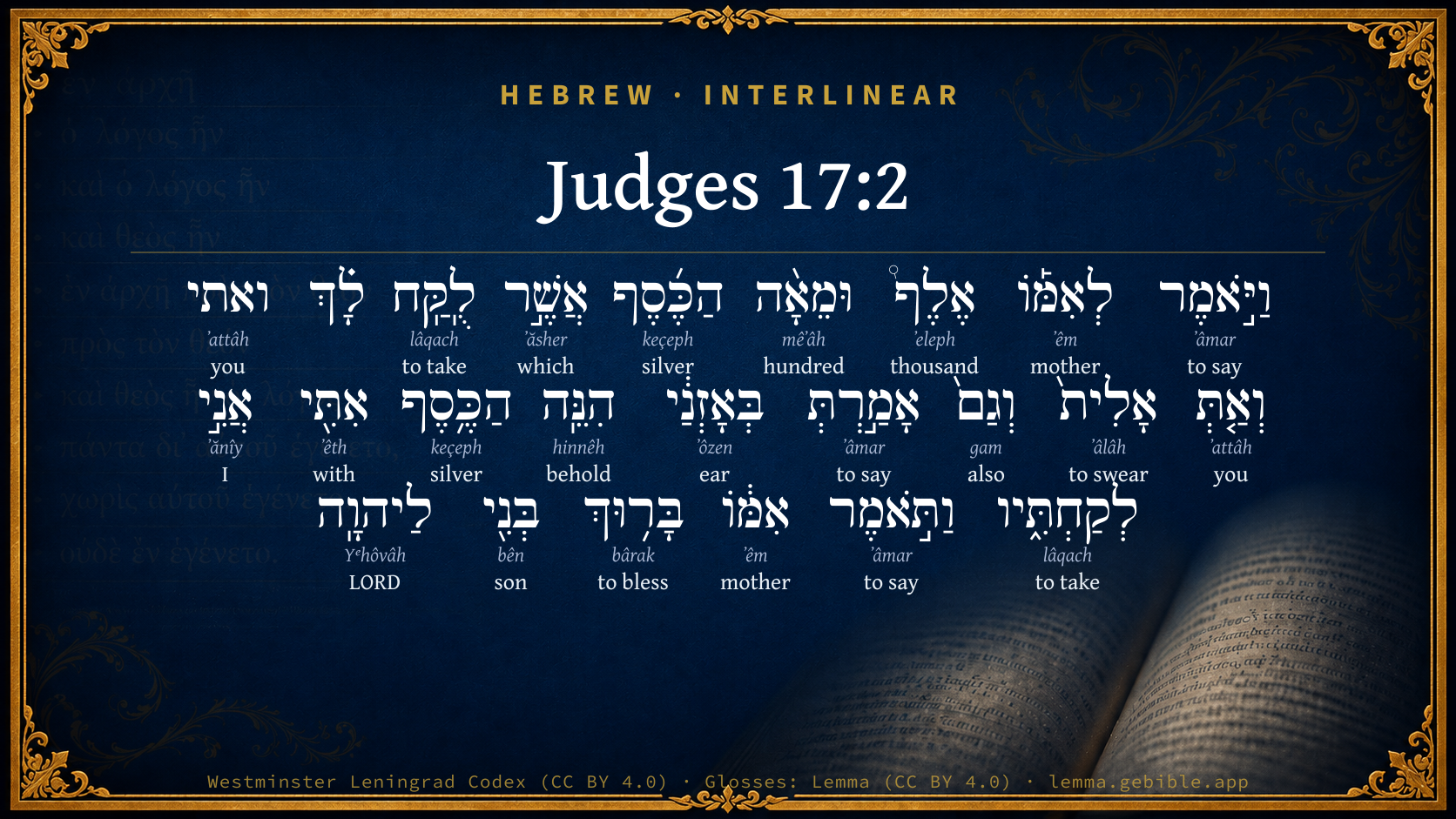
Hebrew (Westminster Leningrad Codex) Judges 17:2 appears in the Hebrew Old Testament. The text above is from the Westminster Leningrad Codex. Each word links to its Strong’s number, a concise gloss, and parsing drawn from the Open Scriptures Hebrew Bible morphology. Click any word for its full Brown-Driver-Briggs (BDB) entry.
Download image
Cite this verse

Judges 17:2 (World English Bible). Public Domain. Lemma interlinear Bible study tool, https://lemma.gebible.app/v/judges/17/2.

Show BibTeX & RIS
BibTeX
RIS
English Translation
He said to his mother, The eleven hundred [pieces] of silver that were taken from you, about which you did utter a curse, and did also speak it in my ears, behold, the silver is with me; I took it. His mother said, Blessed be my son of Yahweh.
World English Bible · Public Domain
Highlights
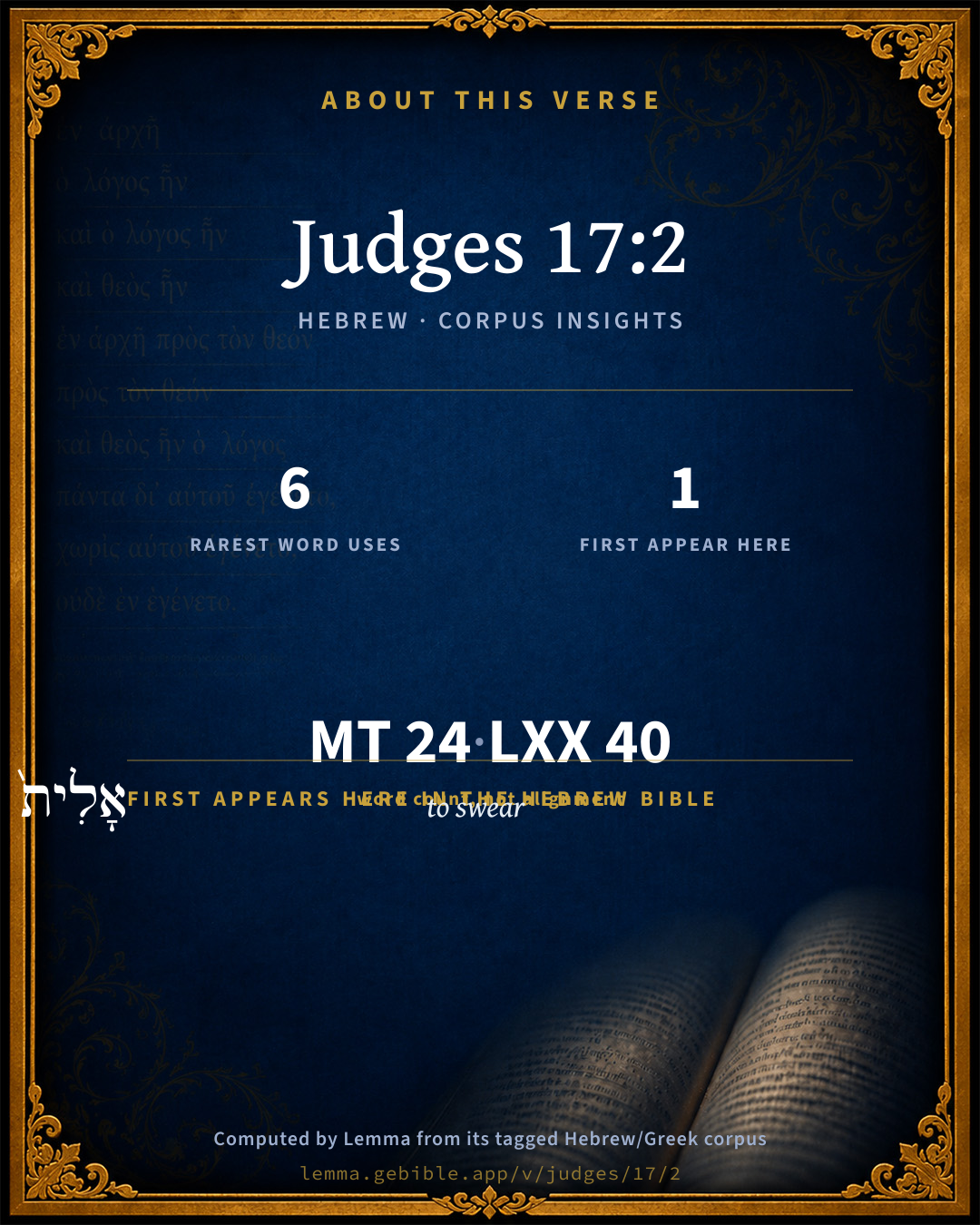
  • 1 first appearance in the Hebrew Bible
Full analysis ↓
Download a study sheet

One document with this verse’s original text, its word-by-word gloss line, the meaning frame, cross-references with their text, attributed commentary, and full source and license credits — printable, and it pastes into notes with its structure intact.

This verse Autodidact and up

Study sheet (.html) Plain text (.txt)

A passage Seminary Student

Up to 50 verses in one chapter. A passage sheet keeps up to 6 commentary sources and 12 cross-references per verse, in the order this page ranks them, and says so on the sheet whenever that leaves anything out. Ask for a single verse and you get the Autodidact verse sheet above.

Everything on this page stays free to read, with no account — the sheet is a download of what is already on screen, not access to it.

Want to remove ads? Support Godless Engineer
Compare translations 3

The same verse in 3 English versions, stacked beneath the original-language interlinear above. Click any original word for its lexicon entry.

Each is an independent rendering of the whole verse — the interlinear is not word-aligned to these translations.

Highlighted words mark where these versions differ — a whole-verse word diff, not a word-by-word alignment.

  • World English Bible Public Domain
    He said to his mother, The eleven hundred [pieces] of silver that were taken from you, about which you did utter a curse, and did also speak it in my ears, behold, the silver is with me; I took it. His mother said, Blessed be my son of Yahweh.
  • King James Version Public Domain
    And he said unto his mother, The eleven hundred shekels of silver that were taken from thee, about which thou cursedst, and spakest of also in mine ears, behold, the silver is with me; I took it. And his mother said, Blessed be thou of the LORD, my son.
  • unfoldingWord Literal Text CC BY-SA 4.0
    And he said to his mother, “The 1,100 silver that was taken from you, and you swore, and also you spoke in my ears, behold, the silver with me. I myself took it.” His mother said, “Blessed my son by Yahweh!”

unfoldingWord Literal Text — © unfoldingWord, licensed CC BY-SA 4.0. Word-aligned USFM3 via Door43 (git.door43.org/unfoldingWord/en_ult).

Versions to compare (up to 4)

3 of 4 selected

Show all 18 translations

Every available English version of this verse, each an independent rendering of the whole verse.

  • World English Bible Public Domain
    He said to his mother, The eleven hundred [pieces] of silver that were taken from you, about which you did utter a curse, and did also speak it in my ears, behold, the silver is with me; I took it. His mother said, Blessed be my son of Yahweh.
  • Berean Standard Bible Public Domain
    said to his mother, “The eleven hundred shekels of silver that were taken from you and about which I heard you utter a curse—I have the silver here with me; I took it.” Then his mother said, “Blessed be my son by the LORD!”
  • Majority Standard Bible Public Domain
    said to his mother, “The eleven hundred shekels of silver that were taken from you and about which I heard you utter a curse—I have the silver here with me; I took it.” Then his mother said, “Blessed be my son by the LORD!”
  • King James Version Public Domain
    And he said unto his mother, The eleven hundred shekels of silver that were taken from thee, about which thou cursedst, and spakest of also in mine ears, behold, the silver is with me; I took it. And his mother said, Blessed be thou of the LORD, my son.
  • American Standard Version (1901) Public Domain
    And he said unto his mother, The eleven hundred `pieces' of silver that were taken from thee, about which thou didst utter a curse, and didst also speak it in mine ears, behold, the silver is with me; I took it. And his mother said, Blessed be my son of Jehovah.
  • Revised Version (1885) Public Domain
    And he said unto his mother, The eleven hundred pieces of silver that were taken from thee, about which thou didst utter a curse, and didst also speak it in mine ears, behold, the silver is with me; I took it. And his mother said, Blessed be my son of the LORD.
  • Geneva Bible (1599) Public Domain
    And he saide vnto his mother, The eleuen hundreth shekels of siluer that were taken from thee, for the which thou cursedst, and spakedst it, euen in mine hearing, beholde, the siluer is with me, I tooke it. Then his mother saide, Blessed be my sonne of the Lord.
  • Douay-Rheims (1899) Public Domain
    Who said to his mother: The eleven hundred pieces of silver, which thou hadst put aside for thyself, and concerning which thou didst swear in my hearing, behold I have, and they are with me. And she said to him: Blessed be my son by the Lord.
  • Young's Literal Translation Public Domain
    and he saith to his mother, `The eleven hundred silverlings which have been taken of thine, and `of which' thou hast sworn, and also spoken in mine ears; lo, the silver `is' with me, I have taken it;' and his mother saith, `Blessed `is' my son of Jehovah.'
  • Literal Standard Version CC BY-SA 4.0
    and he says to his mother, “The eleven hundred pieces of silver which have been taken of yours, and [of which] you have sworn, and also spoken in my ears; behold, the silver [is] with me, I have taken it”; and his mother says, “Blessed [is] my son of YHWH.”
  • Unlocked Literal Bible CC BY-SA 4.0
    He said to his mother, “The 1,100 pieces of silver that were taken from you, about which you spoke a curse, and which I heard—look here! I have the silver with me. I stole it.” His mother said, “May Yahweh bless you, my son!”
  • unfoldingWord Literal Text CC BY-SA 4.0
    And he said to his mother, “The 1,100 silver that was taken from you, and you swore, and also you spoke in my ears, behold, the silver with me. I myself took it.” His mother said, “Blessed my son by Yahweh!”
  • Darby Bible Public Domain
    And he said to his mother, "The eleven hundred pieces of silver which were taken from you, about which you uttered a curse, and also spoke it in my ears, behold, the silver is with me; I took it." And his mother said, "Blessed be my son by the LORD."
  • World Messianic Bible Public Domain
    He said to his mother, “The eleven hundred pieces of silver that were taken from you, about which you uttered a curse, and also spoke it in my ears—behold, the silver is with me. I took it.” His mother said, “May the LORD bless my son!”
  • Webster's Bible Public Domain
    And he said to his mother, The eleven hundred shekels of silver that were taken from thee, about which thou didst curse, and speak of also in my ears, behold, the silver is with me; I took it. And his mother said, Blessed be thou of the LORD, my son.
  • Free Bible Version CC BY-SA 4.0
    told his mother, “Those eleven hundred shekels of silver that were stolen from you and that I heard you curse—I've got the silver. I was the one who took it.” Then his mother said, “My son, the Lord bless you!”
  • Bible in Basic English Public Domain
    And he said to his mother, The eleven hundred shekels of silver which were taken from you, about which you took an oath and said in my hearing, I have given this silver to the Lord from my hand for myself, to make a pictured image and a metal image: see, I have the silver, for I took it: so now I will give it back to you. And his mother said, May the blessing of the Lord be on my son.
  • JPS Tanakh (1917) Public Domain
    And he said unto his mother: 'The eleven hundred pieces of silver that were taken from thee, about which thou didst utter a curse, and didst also speak it in mine ears, behold, the silver is with me; I took it.' And his mother said: 'Blessed be my son of the LORD.'

Literal Standard Version (2020), Covenant Press — licensed CC BY-SA 4.0. Text via the HelloAO Bible API (eBible.org). Unlocked Literal Bible (unfoldingWord) — licensed CC BY-SA 4.0. Text via the HelloAO Bible API (eBible.org). unfoldingWord Literal Text — © unfoldingWord, licensed CC BY-SA 4.0. Word-aligned USFM3 via Door43 (git.door43.org/unfoldingWord/en_ult). Free Bible Version, Dr. Jonathan Gallagher — licensed CC BY-SA 4.0. Text via the HelloAO Bible API (eBible.org).

Word by word

More ways to search: Search by grammar → Find every occurrence → Compare this word →

Practice this passage: Drill this verse → Learn its vocabulary →

אָלִית֙
ʼâlâh
H422
“to swear”
Verb, Qal, Perfect, 2nd Person, Feminine, Singular
Part of Speech
Verb
Stem
Qal
Form
Perfect
Person
2nd Person
Gender
Feminine
Number
Singular
Full BDB Definition

Origin: a primitive root

TWOT: 94

to swear, curse - (Qal) - to swear, take an oath (before God) - to curse - (Hiphil) - to put under oath, adjure - to put under a curse
  1. וַיֹּ֣אמֶר ʼâmar H559 “and · to say” Conjunction + Verb, Qal, Sequential Imperfect, 3rd Person, Masculine, Singular
  2. לְאִמּ֡וֹ ʼêm H517 “to/for · mother · his” Preposition + Noun, Common, Feminine, Singular, Construct + Suffix, Personal, 3rd Person, Masculine, Singular
  3. אֶלֶף֩ ʼeleph H505 “thousand” Adjective, Cardinal number, Both, Singular, Absolute
  4. וּמֵאָ֨ה mêʼâh H3967 “and · hundred” Conjunction + Adjective, Cardinal number, Both, Singular, Absolute
  5. הַכֶּ֜סֶף keçeph H3701 “the · silver” Particle, Definite Article + Noun, Common, Masculine, Singular, Absolute
  6. אֲשֶׁ֣ר ʼăsher H834 “which” Particle, Relative
  7. לֻֽקַּֽח lâqach H3947 “to take” Verb, Pual, Perfect, 3rd Person, Masculine, Singular
  8. ואתי ʼattâh H859 “and · you” Conjunction + Pronoun, Personal, 2nd Person, Feminine, Singular
  9. וְאַ֤תְּ ʼattâh H859 “and · you” Conjunction + Pronoun, Personal, 2nd Person, Feminine, Singular
  10. וְגַם֙ gam H1571 “and · also” Conjunction + Particle, Accusative
  11. אָמַ֣רְתְּ ʼâmar H559 “to say” Verb, Qal, Perfect, 2nd Person, Feminine, Singular
  12. בְּאָזְנַ֔י ʼôzen H241 “in/at · ears · my” Preposition + Noun, Common, Feminine, Dual, Construct + Suffix, Personal, 1st Person, Common, Singular
  13. הִנֵּֽה hinnêh H2009 “behold” Particle, Demonstrative
  14. הַכֶּ֥סֶף keçeph H3701 “the · silver” Particle, Definite Article + Noun, Common, Masculine, Singular, Absolute
  15. אִתִּ֖י ʼêth H854 “with · me” Preposition + Suffix, Personal, 1st Person, Common, Singular
  16. אֲנִ֣י ʼănîy H589 “I” Pronoun, Personal, 1st Person, Common, Singular
  17. לְקַחְתִּ֑יו lâqach H3947 “to take · him” Verb, Qal, Perfect, 1st Person, Common, Singular + Suffix, Personal, 3rd Person, Masculine, Singular
  18. וַתֹּ֣אמֶר ʼâmar H559 “and · to say” Conjunction + Verb, Qal, Sequential Imperfect, 3rd Person, Feminine, Singular
  19. אִמּ֔וֹ ʼêm H517 “mother · his” Noun, Common, Feminine, Singular, Construct + Suffix, Personal, 3rd Person, Masculine, Singular
  20. בָּר֥וּךְ bârak H1288 “blessed” Verb, Qal, Participle Passive, Masculine, Singular, Absolute
  21. בְּנִ֖י bên H1121 “son · my” Noun, Common, Masculine, Singular, Construct + Suffix, Personal, 1st Person, Common, Singular
  22. לַיהוָֽה Yᵉhôvâh H3068 “to/for · LORD” Preposition + Noun, Proper

About this verse

These counts appear in no published source. They are computed here, from the morphology-tagged text and Lemma’s own curated glosses. What Lemma adds →

24
words
17
distinct lemmas
Historical
section

Notable vocabulary

The rarest word here is אָלִית֙ to swear H422 — appearing just 6 times in the whole Hebrew Bible.

First appearance in Scripture

This word makes its first canonical appearance in the Hebrew Bible here:

  • אָלִית֙ to swear H422

Shared distinctive vocabulary

אָלִית֙ to swear H422 occurs in 6 verses of the Hebrew Bible. Also found in:

Grammatical profile

  • 7 verbs
  • 7 nouns
  • 2 adjectives
  • 3 pronouns
  • 2 prepositions
  • 3 particles

Verb forms

  • וַיֹּ֣אמֶר Qal · Sequential Imperfect
  • לֻֽקַּֽח Pual · Perfect
  • אָלִית֙ Qal · Perfect
  • אָמַ֣רְתְּ Qal · Perfect
  • לְקַחְתִּ֑יו Qal · Perfect
  • וַתֹּ֣אמֶר Qal · Sequential Imperfect
  • בָּר֥וּךְ Qal · Participle Passive

Repetition

Words recur within this verse — often emphatic in Hebrew:

  • וַיֹּ֣אמֶר to say H559 ×3
  • לְאִמּ֡וֹ mother H517 ×2
  • הַכֶּ֜סֶף silver H3701 ×2
  • לֻֽקַּֽח to take H3947 ×2
  • ואתי you H859 ×2

Hebrew & Septuagint length

In English translation the verse runs 49 words from the Hebrew and 48 from the Septuagint (LXX English) — closely comparable.

A rough comparison of the two English renderings, which tokenize alike — not a word-level alignment.

Word counts can differ between the Hebrew and the Greek without any difference in meaning — e.g. the Hebrew direct-object marker אֵת has no separate Greek word, and Greek often adds the article ὁ.

In the original languages it is 24 Hebrew tokens and 40 Greek tokens — but the two are counted differently (Hebrew bundles its prefixes and suffixes into one token; the Greek is in lemma form), so that isn’t a like-for-like length.

Cross-references

19

Topical passages linked to Judges 17:2 in the Treasury of Scripture Knowledge — connected by theme and wording, ordered by reader-vote popularity; previews shown in the World English Bible.

  • Nehemiah 13:25 I contended with them, and cursed them, and struck certain of them, and plucked off their hair, and made them swear by God, [saying], You shall not give your daughters to their sons, nor take their daughters for your sons, or for yourselves.
  • Ruth 3:10 He said, Blessed are you by Yahweh, my daughter: you have shown more kindness in the latter end than at the beginning, inasmuch as you didn't follow young men, whether poor or rich.
  • 1 Samuel 23:21 Saul said, Blessed be you of Yahweh; for you have had compassion on me.
  • Matthew 26:74 Then he began to curse and to swear, "I don't know the man!" Immediately the rooster crowed.
  • 2 John 1:11 for he who welcomes him participates in his evil works.
  • Genesis 14:19 He blessed him, and said, "Blessed be Abram of God Most High, possessor of heaven and earth:
  • Genesis 24:30–31 It happened, when he saw the ring, and the bracelets on his sister's hands, and when he heard the words of Rebekah his sister, saying, "This is what the man said to me," that he came to the man. Behold, he was standing by the camels at the spring.
  • Exodus 20:7 "You shall not take the name of Yahweh your God in vain, for Yahweh will not hold him guiltless who takes his name in vain.
  • Deuteronomy 27:16 Cursed be he who sets light by his father or his mother. All the people shall say, Amen.
  • Judges 5:23 Curse you Meroz, said the angel of Yahweh. Curse you bitterly the inhabitants of it, Because they didn't come to the help of Yahweh, To the help of Yahweh against the mighty.
  • 1 Samuel 14:24 The men of Israel were distressed that day; for Saul had adjured the people, saying, Cursed be the man who eats any food until it be evening, and I be avenged on my enemies. So none of the people tasted food.
  • 1 Samuel 14:28 Then answered one of the people, and said, Your father directly charged the people with an oath, saying, Cursed be the man who eats food this day. The people were faint.
  • 1 Samuel 15:13 Samuel came to Saul; and Saul said to him, Blessed are you by Yahweh: I have performed the commandment of Yahweh.
  • 1 Samuel 26:19 Now therefore, please let my lord the king hear the words of his servant. If it be Yahweh that has stirred you up against me, let him accept an offering: but if it be the children of men, cursed be they before Yahweh: for they have driven me out this day that I shouldn't cling to Yahweh's inheritance, saying, Go, serve other gods.
  • Psalms 10:3 For the wicked boasts of his heart's cravings, He blesses the greedy, and condemns Yahweh.
  • Proverbs 28:24 Whoever robs his father or his mother, and says, "It's not wrong." He is a partner with a destroyer.
  • Jeremiah 48:10 Cursed be he who does the work of Yahweh negligently; and cursed be he who keeps back his sword from blood.
  • Romans 9:3 For I could wish that I myself were accursed from Christ for my brothers' sake, my relatives according to the flesh,
  • 1 Corinthians 16:22 If any man doesn't love the Lord Jesus Christ, let him be accursed. Come, Lord!

Cross-references courtesy of OpenBible.info (CC BY 4.0).

Hebrew and Greek witnesses Masoretic Hebrew ↔ Greek Septuagint

The same verse in the two great witnesses to the Old Testament, shown verse-for-verse.

These are two independent witnesses, not word-aligned to each other, and the Septuagint is shown in lemma (dictionary) form.

Hebrew Judges 17:2 Masoretic · Westminster Leningrad Codex

וַיֹּ֣אמֶר לְאִמּ֡וֹ אֶלֶף֩ וּמֵאָ֨ה הַכֶּ֜סֶף אֲשֶׁ֣ר לֻֽקַּֽח לָ֗ךְ ואתי וְאַ֤תְּ אָלִית֙ וְגַם֙ אָמַ֣רְתְּ בְּאָזְנַ֔י הִנֵּֽה הַכֶּ֥סֶף אִתִּ֖י אֲנִ֣י לְקַחְתִּ֑יו וַתֹּ֣אמֶר אִמּ֔וֹ בָּר֥וּךְ בְּנִ֖י לַיהוָֽה

He said to his mother, The eleven hundred [pieces] of silver that were taken from you, about which you did utter a curse, and did also speak it in my ears, behold, the silver is with me; I took it. His mother said, Blessed be my son of Yahweh.

World English Bible · Public Domain

Greek LXX Judges 17:2 Septuagint · lemma form

καί εἶπον ὁ μήτηρ αὐτός ὁ χίλιοι καί ἑκατόν ὅς λαμβάνω ἀργύριον σεαυτοῦ καί ἐγώ ἀράομαι καί προςεἶπον ἐν οὖς ἐγώ ἰδού ὁ ἀργύριον παρά ἐγώ ἐγώ λαμβάνω αὐτός καί εἶπον ὁ μήτηρ αὐτός εὐλογητός ὁ υἱός ἐγώ ὁ κύριος

And he said to his mother, The eleven hundred pieces of silver which you took of yourself, and about which you cursed me, and spoke in my ears, behold, the silver is with me; I took it: and his mother said, Blessed be my son of the Lord.

LXX2012 (modern English Septuagint) · Public Domain

On this verse, Ellicott's Commentary for English Readers discusses the Septuagint’s reading. Read the note in Commentary ↓

Hebrew: Westminster Leningrad Codex (CC BY 4.0). Greek: Septuagint (public domain); English from LXX2012 (modern English Septuagint) (Public Domain). How the Septuagint differs from the Hebrew →

Targum (Aramaic paraphrase)

1

The Targum is the ancient Jewish Aramaic paraphrase of the Hebrew Scriptures — an interpretive translation, not the Hebrew text itself. Onkelos (literal) and Pseudo-Jonathan (expansive) render the Torah, and Jonathan the Prophets. Coverage is partial: where no permissively-licensed English translation exists for a verse, only the Aramaic is shown. This is verse-level text, not a word-by-word alignment to the Hebrew.

  1. Targum Jonathan Prophets (Joshua–Malachi)
    וַאֲמַר לְאִמֵיהּ אֲלַף וּמְאָה סַלְעִין דִכְסַף דְאִתְנְסִיב לִיךְ וְאַתְּ אוֹמִית וְאַף אֲמַרְתְּ קֳדָמַי הָא כַסְפָּא עִמִי אֲנָא נְסִבְתֵּיהּ וַאֲמַרַת אִמֵיהּ בְּרִיךְ בְּרִי קֳדָם יְיָ:

    (no public-domain English translation for this verse)

    Targum Jonathan — Aramaic: “Mikraot Gedolot” (public domain). English: “Sefaria Community Translation” (CC0 1.0 (public-domain dedication)); “London "Chaldee Paraphrase," 1871” (public domain). Text via Sefaria.

Commentary

Notes on Judges 17:2 from classic Christian and Jewish commentators (each source and its license shown beneath its notes). The classic Christian expositions comment on the surrounding passage and are grouped to its opening verse, so a note may address several verses; the Jewish commentaries on the Tanakh (Rashi and others) are per-verse, so they appear only where the commentator wrote on this verse.

Lemma curates 59 commentaries, every one of them public domain or Creative Commons licensed, each selected and text-cleaned for this edition rather than reprinted as found. About our sources →

The Cambridge Bible for Schools and Colleges

gen. ed. J. J. S. Perowne

2. eleven hundred pieces of silver] See on Jdg_16:5.

and didst also speak it] A paraphrase; lit. ‘and didst also say.…’ The text of Jdg_17:2-3 has suffered disturbance; the words of the speech are missing here; the sequence ‘and he restored … I will restore (Jdg_17:3) … And he restored (Jdg_17:4)’ is unintelligible. Of the various corrections proposed the most satisfactory is that of Moore: ‘and thou didst utter a curse and didst also say in mine ears, I verily dedicate the silver unto the Lord from my hand for my son, to make a graven image [and a molten image]; behold, the silver is with me; I took it; now therefore I will restore it unto thee. And his mother said, Blessed be my son of the Lord. Jdg_17:4. So he restored the silver unto his mother, and his mother took two hundred pieces of silver’ etc. That is to say, when the mother of Micah discovered that the money had been stolen, she cursed the thief (never dreaming that her son was guilty), and further consecrated the money forthwith to Jehovah. Under dread of the curse, and fearing the consequences of sacrilege, Micah confessed the theft and restored the money. In the text as rearranged, the words ‘And he restored the eleven hundred pieces of silver to his mother’ in Jdg_17:3 have been struck out as a mistaken anticipation of Jdg_17:4.

The curse was held to possess a living, potent efficacy (cf. Zec_5:3); it called upon the offender to come forward; and whoever heard it was bound to make it known, as we learn from the law in Lev_5:1, cf. Pro_29:24. To augment the curse in the present case the ‘money was solemnly consecrated to Jehovah; it became taboo, and the thief could not make use of it without incurring the Deity’s retaliation. The curse could not be withdrawn, but it might be neutralized by a blessing.

The Cambridge Bible for Schools and Colleges (gen. ed. J. J. S. Perowne; Cambridge University Press, 1878–1918) — public domain. Text from a community e-Sword module.

Trapp's Complete Commentary

John Trapp

Jdg 17:2 And he said unto his mother, The eleven hundred [shekels] of silver that were taken from thee, about which thou cursedst, and spakest of also in mine ears, behold, the silver [is] with me; I took it. And his mother said, Blessed [be thou] of the LORD, my son.

Ver. 2. And he said unto his mother.] His conscience troubled him when he heard his mother curse the thief, which he knew to be himself:

“ Conscia mens ut cuique sun est, &c. ”

The eleven hundred shekels of silver.] Lyra telleth us of some that held Delilah to be Micah’s mother, because she received one thousand one hundred pieces of silver of each lord of the Philistines, to betray Samson into their hands. But this is but a blind guess, and no whit likely; let it therefore pass for a Jewish fable. I like his note better who saith, {a} Old wood is apt to take fire. After all the airing in the desert, Micah’s mother will smell of Egypt. And again, As civilly, so also morally, the birth followeth the belly, as Micah, his mother. Hence most of the kings’ mothers are named.

About which thou cursedst.] Whilst her wealth lasted, she could dedicate a good part of it. But now she hath lost it she falleth a-cursing; as a parrot when beaten falleth to her own hoarse and harsh voice. Wicked men’s mouths are "full of cursing and bitterness." But cursing men are cursed men.

And spakest of also in mine ears.] He started at and was terrified by a mother’s curse. And indeed if there be just cause, God sometimes says Amen to parents’ curses, as were easy to instance. See Gen 9:25 {See Trapp on "Gen 9:25"}

I took it.] Of robbing parents, see Pro 28:24, with the note.

Blessed be thou of the Lord, my son.] "Out of the same mouth proceedeth blessing and cursing." {Jas 3:10} So doth it out of the Pope’s eftsoons, as in the case of Henry IV of France.

{a} Bp. Hall.

John Trapp, A Commentary or Exposition upon All the Books of the Old and New Testament (1647–1656) — public domain. Text from a community e-Sword module.

Joseph Benson's Commentary

Jdg 17:2. About which thou cursedst — That is, didst curse the person who had taken it away. The mother seems to have uttered this curse in the hearing of her son; who, being struck therewith, confessed that he had taken the money; upon which his mother wishes that her curses may be turned into blessings upon him.

Joseph Benson's Commentary on the Old and New Testaments (1811–1818) — public domain. Text from a community e-Sword module.

Adam Clarke's Commentary

Verse 2. About which thou cursedst] Houbigant and others understand this of putting the young man to his oath. It is likely that when the mother of Micah missed the money, she poured imprecations on the thief; and that Micah, who had secreted it, hearing this, was alarmed, and restored the money lest the curses should fall on him.

Adam Clarke's Commentary on the Bible (1810–1826) — public domain. Text from a community e-Sword/MySword module.

Ellicott's Commentary for English Readers

(2) He said unto his mother.—The story is singularly abbreviated, and all details as to how she had acquired the money, &c., are left to conjecture.

The eleven hundred shekels of silver.—The value of eleven hundred skekels would be about £136. It is the same sum which each of the lords of the Philistines promised to give Delilah (Jdg_16:5), and only six hundred shekels less than the entire mass of the earrings given to Gideon—only that those were golden shekels. It is hard to say whence this Ephraimitish lady could have amassed so large a sum.

That were taken from thee.—This is probably the true rendering. The LXX. (Cod. B) have “which thou tookest for thyself,” and (Cod. A) “those taken by thee,” as though she had stolen them.

About which thou cursedst.—Literally, and thou didst adjure. The LXX. (Cod. B) add, “dost adjure me.” The adjuration was clearly that commanded in Lev_5:1 : “And if a soul sin, and hear the voice of swearing, and is a witness, whether he hath seen or known of it; if he do not utter it, then he shall bear his iniquity.” (Comp. Ecclus. iii. 9: “The curse of a mother rooteth out foundations.”)

I took it.—Micah is terrified into confession by his mother’s adjuration. He shows throughout a singular mixture of superstition and ignorance.

Blessed be thou of the Lord, my son.—Because of his penitence and confession.

A Bible Commentary for English Readers, edited by Charles John Ellicott (1878–1897) — public domain. Text from a community e-Sword module.

John Gill's Exposition

And he said unto his mother,.... Who seems to have been a widow, and an ancient woman since Micah had sons, and one of them at age to become a priest:

the eleven hundred shekels of silver that were taken from thee: which were taken away by stealth from her, though it may be rendered "taken to thee" (i); which she had taken to herself out of the rest of her substance, and had separated and devoted it to religious uses; but Jarchi and Kimchi interpret it as we do, and which seems to be the best sense; of the value of this sum; see Gill on Jdg 16:5 and because the like sum is there offered, and was given to Delilah, hence some have thought, as Jarchi relates, that this woman was Delilah; but, as he observes, it is a mistake; for this woman lived long before the times of Samson and Delilah:

about which thou cursedst; which when she perceived was stolen from her, she fell into a passion, and cursed and swore, cursed the thief that took it, whether of her own family or another; or adjured her son, that if he knew anything of it, that he would declare it, suspecting him of the robbery; some think this refers to the oath she had made, that she would devote the silver to a religious use:

and spakest of also in mine ears; of the sum how much it was, and of the use she had designed it for; or rather the curse was delivered in his hearing, and cut him to the heart, and wrought that conviction in him, that he could not retain the money any longer, not being able to bear his mother's curse; though Abarbinel connects this with the following clause, "behold, the silver is with me"; as if the sense was, that she spake in his ears, and charged him with the theft to his face; saying, verily the silver is with thee, thou hast certainly taken it; upon which he confessed it, "I took it"; but the former sense seems best, that not being willing to lie under his mother's curse, he owned that the money was in his hands, and he had taken it from her:

and his mother said, blessed be thou of the Lord, my son; she reversed the curse, and pronounced a blessing on him, or wished one to him, and that without reproving him for his sin, rejoicing to hear of her money again.

(i) "captum est tibi", Montanus, Junius & Tremellius.

John Gill's Exposition of the Whole Bible (1746–1763) — public domain (CC PDM 1.0). Text via the HelloAO Bible API.

Albert Barnes' Notes on the Bible

Thou cursedst - or, “adjuredst me by God.” Compare Mat 26:63; Lev 5:1.

Albert Barnes' Notes on the Bible (1834–1885) — public domain. Text from a community e-Sword/MySword module.

Haydock's Catholic Bible Commentary

Mother. A rich (Calmet) old widow, since she had grandchildren, one of whom was appointed to serve her domestic chapel. (Menochius) --- She had lost a sum of money, and was venting imprecations against the thief, when her son came and informed her that he had it safe, upon which she changed her curses into blessings. --- Swear, may have another meaning, as if she had made a vow of this money. (Calmet; Menochius) --- Lord. Hebrew Yehova, the title of God, which she gives to idols, (Menochius) or perhaps she preposterously adored both the true and false gods at the same time. (Calmet) --- Many Protestants assert that her intention was good, in what she did. (Monceius; Grotius, &c.) --- So willing are they to excuse all from idolatry but Catholics! (Haydock) --- Almost all interpreters condemn Michas and his mother of superstition, and of acting contrary to the express orders of God, in appointing a priest who was not of the family of Aaron, &c. (Calmet) --- Their graven image was an idol. But this is no proof against the sacred images of Catholics. (Worthington)

George Leo Haydock (1774–1849), Haydock's Catholic Family Bible and Commentary, 1859 edition — public domain. Excludes Psalms (Douay-Rheims chapter numbering differs from Protestant) and Deuterocanonical books (Catholic canon only).

Matthew Poole's English Annotations

About which thou cursedst, i.e. didst curse the person who had taken them away, and that in my hearing, as it follows. I took it; the fear of thy curse makes me acknowledge mine offence, and beg thy pardon.

Blessed be thou of the Lord; I willingly consent to and beg from God the removal of the curse, and a blessing instead of it. Be thou free from my curse, because thou hast so honestly restored it.

Matthew Poole's English Annotations on the Holy Bible (1683–1685) — public domain. Text from a community e-Sword/MySword module.

Whedon's Commentary on the Bible

Daniel D. Whedon

2. About which thou cursedst — Having missed the money, she uttered imprecations against the thief.

Also in my ears — She so uttered and kept repeating her curses that among others Micah also heard her.

I took it — The son had been the thief, but his mother’s curses seem to have awed him, and led him to make restitution. This act of robbery, and the thief being allowed to go unpunished, show the lawlessness of the time.

Blessed — Instead of reproof and penalty for his theft he receives a blessing. This blessing sprang from sudden joy at receiving again her lost silver.

Daniel D. Whedon (gen. ed.), Commentary on the Old and New Testaments (1874–1909) — public domain. Text from a community e-Sword module.

The Pulpit Commentary

The eleven hundred. See Jud_1:16:5, note. Thou cursedst. The Cethib and the Alexandrian Codex of the Septuagint read, Thou cursedst, i.e. adjuredst me, which is a better reading. There is a direct and verbal reference to the law contained in Lev_5:1. The word thou cursedst here and the voice of swearing in Leviticus are the same root. It was in consequence of this adjuration that Micah confessed his guilt. Compare Mat_26:63, when our Lord, on the adjuration of the high priest, broke his silence and confessed that he was Christ, the Son of God. In Achan"s confession (Jos_7:19, Jos_7:20) there is no distinct reference to Lev_5:1, though this may have been the ground of it.

The Pulpit Commentary (1880–1919), ed. H.D.M. Spence-Jones & Joseph S. Exell — public domain. Text from a community e-Sword module.

John Wesley's Explanatory Notes

Cursedst - That is, didst curse the person who had taken them away. I took it - The fear of thy curse makes me acknowledge mine offense, and beg thy pardon. Blessed - I willingly consent to, and beg from God the removal of the curse, and a blessing instead of it. Be thou free from my curse, because thou hast so honestly restored it.

John Wesley, Explanatory Notes Upon the Whole Bible (1754–1765) — public domain. Text via the GEBible commentary corpus.

Rashi

Rabbi Shlomo Yitzchaki (Rashi)

Stolen from you [lit. "to you"]. Stolen from you. Similarly, "For women were withheld 'to' us,"—'from' us.

When you cursed. You cursed whoever stole it, and even uttered the curse in my ear.

Look, the silver. I confess to you, concerning it, that it is in my possession, as I stole it.

Rashi on the Tanakh — English translations: “The Judaica Press complete Tanach with Rashi, translated by A. J. Rosenberg” (CC BY 4.0); “Pentateuch with Rashi's commentary by M. Rosenbaum and A.M. Silbermann, 1929-1934” (public domain); “The Metsudah Tanach series, Lakewood, N.J” (CC BY 4.0); and “The Book of Joshua, Metsudah Publications, 1997” (CC BY 4.0). Text via Sefaria.

Lesson kit

Teaching starters — assembled from the data on this page, not authored interpretation. Every prompt links to the verse data it draws on. Edit before teaching.

Judges, in the Historical, opens this verse with 24 words (17 distinct Hebrew lemmas). Its most distinctive word is ʼâlâh (“to swear”). A historical commentator’s framing appears above. Read the whole chapter for the surrounding context.

Discussion questions

  1. How does “to swear” (ʼâlâh) shape what this verse is saying?
  2. The word “to swear” first appears here in Scripture. What is being introduced at this debut?
  3. 1 Samuel 14:24 shares the word «to swear» with this verse. How do the two illuminate each other?
  4. “to say” occurs 3× in this one verse. What is the effect of the repetition?
  5. These translations render this verse differently; the difference is in the English rendering, not the original. What questions does that raise?
  6. The verb «וַיֹּ֣אמֶר» is Qal Sequential Imperfect. How does its form color the action?
  7. Reading how The Cambridge Bible for Schools and Colleges and Trapp's Complete Commentary read this verse, where do the two commentators agree and where do they part?

Things to notice

Reading settings

Reading text

Shown beneath each verse's original-language words.

Old Testament
Old Testament edition

Read the OT as the Masoretic Hebrew (MT) or the Greek Septuagint (LXX).

English shown for the Greek Septuagint (in the Hebrew ↔ Greek comparison).

Comparing translations? Open the Compare panel on any verse page to stack up to four side by side.