Isaiah 43:12

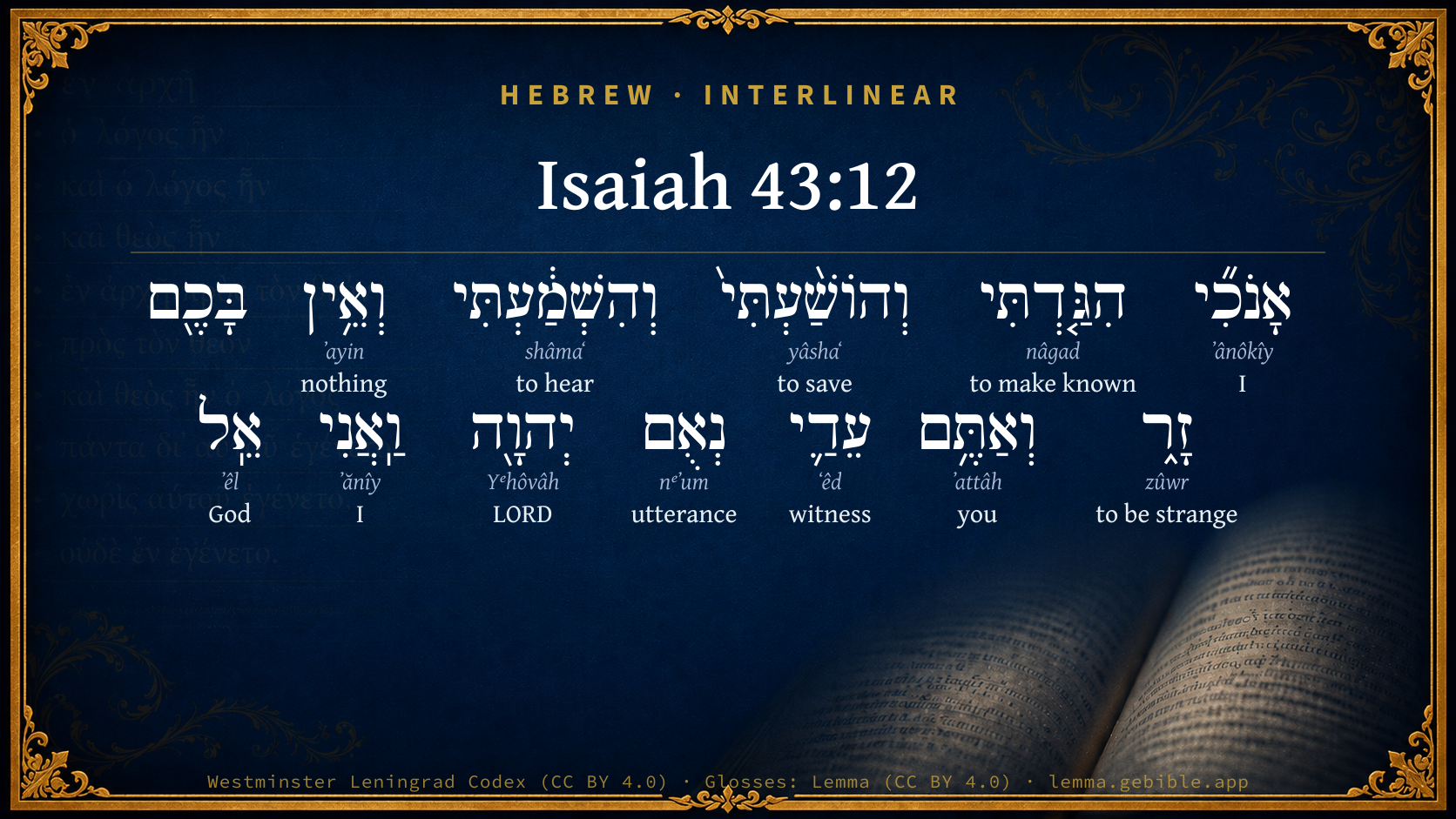
Hebrew (Westminster Leningrad Codex) Isaiah 43:12 appears in the Hebrew Old Testament. The text above is from the Westminster Leningrad Codex. Each word links to its Strong’s number, a concise gloss, and parsing drawn from the Open Scriptures Hebrew Bible morphology. Click any word for its full Brown-Driver-Briggs (BDB) entry.
Download image
Cite this verse

Isaiah 43:12 (World English Bible). Public Domain. Lemma interlinear Bible study tool, https://lemma.gebible.app/v/isaiah/43/12.

Show BibTeX & RIS
BibTeX
RIS
English Translation
I have declared, and I have saved, and I have shown; and there was no strange [god] among you: therefore you are my witnesses, says Yahweh, and I am God.
World English Bible · Public Domain
Download a study sheet

One document with this verse’s original text, its word-by-word gloss line, the meaning frame, cross-references with their text, attributed commentary, and full source and license credits — printable, and it pastes into notes with its structure intact.

This verse Autodidact and up

Study sheet (.html) Plain text (.txt)

A passage Seminary Student

Up to 50 verses in one chapter. A passage sheet keeps up to 6 commentary sources and 12 cross-references per verse, in the order this page ranks them, and says so on the sheet whenever that leaves anything out. Ask for a single verse and you get the Autodidact verse sheet above.

Everything on this page stays free to read, with no account — the sheet is a download of what is already on screen, not access to it.

Want to remove ads? Support Godless Engineer
Compare translations 3

The same verse in 3 English versions, stacked beneath the original-language interlinear above. Click any original word for its lexicon entry.

Each is an independent rendering of the whole verse — the interlinear is not word-aligned to these translations.

Highlighted words mark where these versions differ — a whole-verse word diff, not a word-by-word alignment.

  • World English Bible Public Domain
    I have declared, and I have saved, and I have shown; and there was no strange [god] among you: therefore you are my witnesses, says Yahweh, and I am God.
  • King James Version Public Domain
    I have declared, and have saved, and I have shewed, when there was no strange god among you: therefore ye are my witnesses, saith the LORD, that I am God.
  • unfoldingWord Literal Text CC BY-SA 4.0
    I, I declared, and I saved, and I made hear, and there was no strange among you. And you my witnesses”—the declaration of Yahweh— “that I God.

unfoldingWord Literal Text — © unfoldingWord, licensed CC BY-SA 4.0. Word-aligned USFM3 via Door43 (git.door43.org/unfoldingWord/en_ult).

Versions to compare (up to 4)

3 of 4 selected

Show all 18 translations

Every available English version of this verse, each an independent rendering of the whole verse.

  • World English Bible Public Domain
    I have declared, and I have saved, and I have shown; and there was no strange [god] among you: therefore you are my witnesses, says Yahweh, and I am God.
  • Berean Standard Bible Public Domain
    I alone decreed and saved and proclaimed—I, and not some foreign god among you. So you are My witnesses,” declares the LORD, “that I am God.
  • Majority Standard Bible Public Domain
    I alone decreed and saved and proclaimed—I, and not some foreign god among you. So you are My witnesses,” declares the LORD, “that I am God.
  • King James Version Public Domain
    I have declared, and have saved, and I have shewed, when there was no strange god among you: therefore ye are my witnesses, saith the LORD, that I am God.
  • American Standard Version (1901) Public Domain
    I have declared, and I have saved, and I have showed; and there was no strange `god' among you: therefore ye are my witnesses, saith Jehovah, and I am God.
  • Revised Version (1885) Public Domain
    I have declared, and I have saved, and I have shewed, and there was no strange god among you: therefore ye are my witnesses, saith the LORD, and I am God.
  • Geneva Bible (1599) Public Domain
    I haue declared, and I haue saued, and I haue shewed, when there was no strange god among you: therefore you are my witnesses, sayeth the Lord, that I am God.
  • Douay-Rheims (1899) Public Domain
    I have declared, and have saved. I have made it heard, and there was no strange one among you. You are my witnesses, saith the Lord, and I am God.
  • Young's Literal Translation Public Domain
    I -- I declared, and saved, and proclaimed, And there is no stranger with you, And ye `are' My witnesses, an affirmation of Jehovah, And I `am' God.
  • Literal Standard Version CC BY-SA 4.0
    I declared, and saved, and proclaimed, || And there is no stranger with you, || And you [are] My witnesses, a declaration of YHWH, || And I [am] God.
  • Unlocked Literal Bible CC BY-SA 4.0
    I have declared, saved, and proclaimed, and there is no other god among you. You are my witnesses,” declares Yahweh, “I am God.
  • unfoldingWord Literal Text CC BY-SA 4.0
    I, I declared, and I saved, and I made hear, and there was no strange among you. And you my witnesses”—the declaration of Yahweh— “that I God.
  • Darby Bible Public Domain
    It is I that have declared, and have saved, and have shewed, when there was no strange [god] among you; and ye are my witnesses, saith Jehovah, that I [am] ùGod.
  • World Messianic Bible Public Domain
    I have declared, I have saved, and I have shown, and there was no strange god among you. Therefore you are my witnesses”, says the LORD, “and I am God.
  • Webster's Bible Public Domain
    I have declared, and have saved, and I have shown, when there was no strange god among you: therefore ye are my witnesses, saith the LORD, that I am God.
  • Free Bible Version CC BY-SA 4.0
    I predicted what was going to happen, then I saved you, then I announced it—there was no foreign god among you that did this. You are my witnesses that I am God, declares the Lord.
  • Bible in Basic English Public Domain
    I gave the word, and made it clear, and there was no strange god among you: for this reason you are my witnesses, says the Lord.
  • JPS Tanakh (1917) Public Domain
    I have declared, and I have saved, and I have announced, and there was no strange god among you; therefore ye are My witnesses, saith the LORD, and I am God.

Literal Standard Version (2020), Covenant Press — licensed CC BY-SA 4.0. Text via the HelloAO Bible API (eBible.org). Unlocked Literal Bible (unfoldingWord) — licensed CC BY-SA 4.0. Text via the HelloAO Bible API (eBible.org). unfoldingWord Literal Text — © unfoldingWord, licensed CC BY-SA 4.0. Word-aligned USFM3 via Door43 (git.door43.org/unfoldingWord/en_ult). Free Bible Version, Dr. Jonathan Gallagher — licensed CC BY-SA 4.0. Text via the HelloAO Bible API (eBible.org).

Word by word

More ways to search: Search by grammar → Find every occurrence → Compare this word →

Practice this passage: Drill this verse → Learn its vocabulary →

עֵדַ֛י
ʻêd
H5707
“witnesses · my”
Noun, Common, Masculine, Plural, Construct + Suffix, Personal, 1st Person, Common, Singular
Part of Speech
Noun
Type
Common
Gender
Masculine
Number
Plural
State
Construct
Full BDB Definition

Origin: contracted from H5749

TWOT: 1576b

witness - witness, testimony, evidence (of things) - witness (of people)
  1. אָנֹכִ֞י ʼânôkîy H595 “I” Pronoun, Personal, 1st Person, Common, Singular
  2. הִגַּ֤דְתִּי nâgad H5046 “to make known” Verb, Hiphil, Perfect, 1st Person, Common, Singular
  3. וְהוֹשַׁ֨עְתִּי֙ yâshaʻ H3467 “and · to save” Conjunction + Verb, Hiphil, Perfect, 1st Person, Common, Singular
  4. וְהִשְׁמַ֔עְתִּי shâmaʻ H8085 “and · to hear” Conjunction + Verb, Hiphil, Perfect, 1st Person, Common, Singular
  5. וְאֵ֥ין ʼayin H369 “and · nothing” Conjunction + Particle, Negative
  6. זָ֑ר zûwr H2114 “strange” Adjective, Adjective, Masculine, Singular, Absolute
  7. וְאַתֶּ֥ם ʼattâh H859 “and · you” Conjunction + Pronoun, Personal, 2nd Person, Masculine, Plural
  8. נְאֻם nᵉʼum H5002 “utterance of” Noun, Common, Masculine, Singular, Construct
  9. יְהוָ֖ה Yᵉhôvâh H3068 “LORD” Noun, Proper
  10. וַֽאֲנִי ʼănîy H589 “and · I” Conjunction + Pronoun, Personal, 1st Person, Common, Singular
  11. אֵֽל ʼêl H410 “God” Noun, Common, Masculine, Singular, Absolute

About this verse

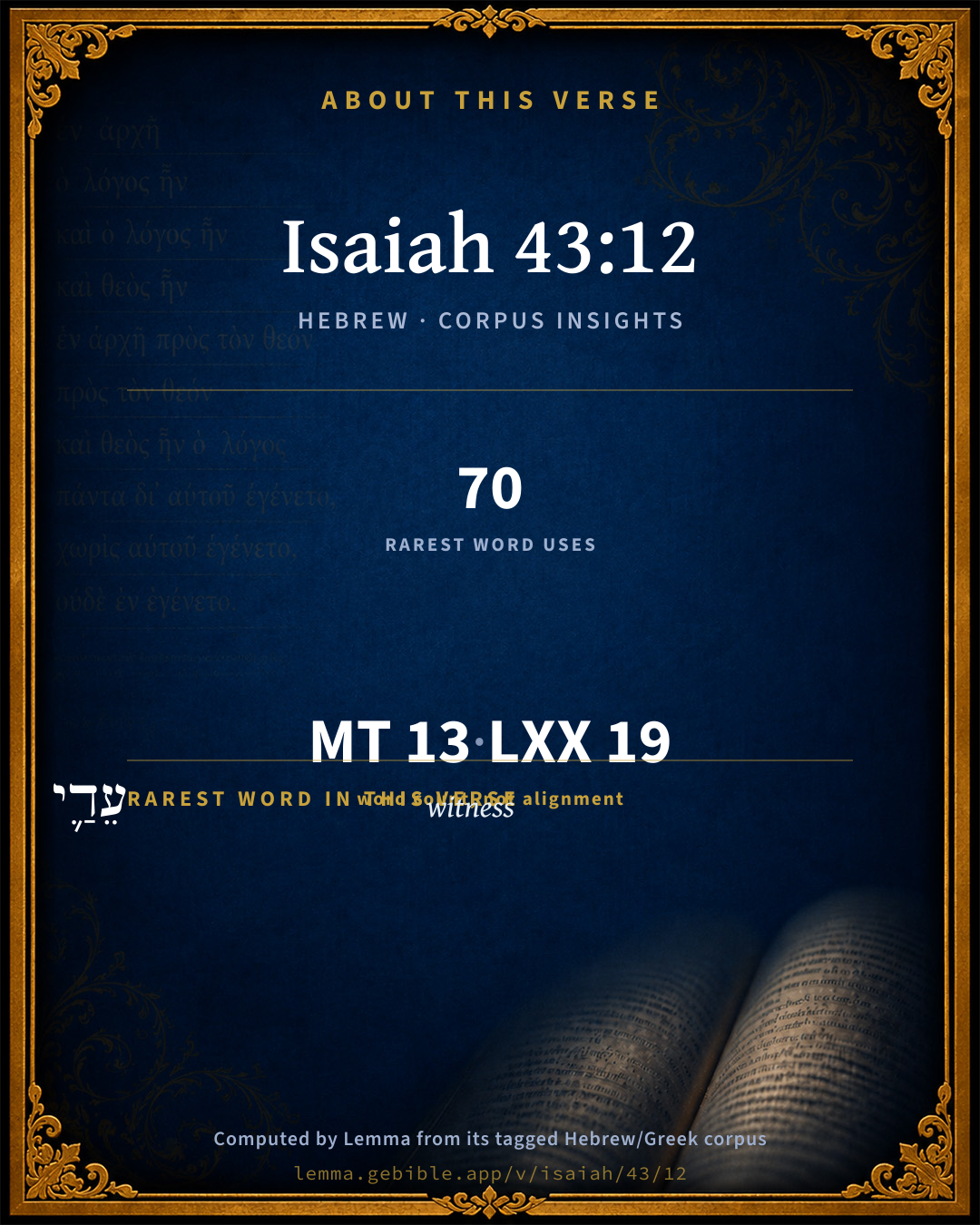
These counts appear in no published source. They are computed here, from the morphology-tagged text and Lemma’s own curated glosses. What Lemma adds →

13
words
12
distinct lemmas
Prophets
section

Grammatical profile

  • 3 verbs
  • 4 nouns
  • 1 adjective
  • 3 pronouns
  • 1 preposition
  • 1 particle

Verb forms

  • הִגַּ֤דְתִּי Hiphil · Perfect
  • וְהוֹשַׁ֨עְתִּי֙ Hiphil · Perfect
  • וְהִשְׁמַ֔עְתִּי Hiphil · Perfect

Hebrew & Septuagint length

In English translation the verse runs 30 words from the Hebrew and 27 from the Septuagint (LXX English) — closely comparable.

A rough comparison of the two English renderings, which tokenize alike — not a word-level alignment.

Word counts can differ between the Hebrew and the Greek without any difference in meaning — e.g. the Hebrew direct-object marker אֵת has no separate Greek word, and Greek often adds the article ὁ.

In the original languages it is 13 Hebrew tokens and 19 Greek tokens — but the two are counted differently (Hebrew bundles its prefixes and suffixes into one token; the Greek is in lemma form), so that isn’t a like-for-like length.

Cross-references

9

Topical passages linked to Isaiah 43:12 in the Treasury of Scripture Knowledge — connected by theme and wording, ordered by reader-vote popularity; previews shown in the World English Bible.

  • Deuteronomy 32:12 Yahweh alone did lead him, There was no foreign god with him.
  • Psalms 81:9–10 There shall be no strange god in you, Neither shall you worship any foreign god.
  • Isaiah 44:8 Don't fear, neither be afraid: haven't I declared to you of old, and shown it? You are my witnesses. Is there a God besides me? Indeed, there is not. I don't know any Rock.
  • Isaiah 43:10 You are my witnesses, says Yahweh, and my servant whom I have chosen; that you may know and believe me, and understand that I am he: before me there was no God formed, neither shall there be after me.
  • Isaiah 37:7 Behold, I will put a spirit in him, and he shall hear news, and shall return to his own land; and I will cause him to fall by the sword in his own land.
  • Isaiah 37:20 Now therefore, Yahweh our God, save us from his hand, that all the kingdoms of the earth may know that you are Yahweh, even you only.
  • Isaiah 46:9–10 Remember the former things of old: for I am God, and there is none else; [I am] God, and there is none like me;
  • Isaiah 48:4–7 Because I knew that you are obstinate, and your neck is an iron sinew, and your brow brass;
  • Isaiah 37:35–36 For I will defend this city to save it, for my own sake, and for my servant David's sake.

Cross-references courtesy of OpenBible.info (CC BY 4.0).

Hebrew and Greek witnesses Masoretic Hebrew ↔ Greek Septuagint

The same verse in the two great witnesses to the Old Testament, shown verse-for-verse.

These are two independent witnesses, not word-aligned to each other, and the Septuagint is shown in lemma (dictionary) form.

Hebrew Isaiah 43:12 Masoretic · Westminster Leningrad Codex

אָנֹכִ֞י הִגַּ֤דְתִּי וְהוֹשַׁ֨עְתִּי֙ וְהִשְׁמַ֔עְתִּי וְאֵ֥ין בָּכֶ֖ם זָ֑ר וְאַתֶּ֥ם עֵדַ֛י נְאֻם יְהוָ֖ה וַֽאֲנִי אֵֽל

I have declared, and I have saved, and I have shown; and there was no strange [god] among you: therefore you are my witnesses, says Yahweh, and I am God.

World English Bible · Public Domain

Greek LXX Isaiah 43:12 Septuagint · lemma form

ἀναἀγγέλλω καί σώζω ὀνειδίζω καί οὐ εἰμί ἐν σύ ἀλλότριος σύ ἐγώ μάρτυς καΐἐγώ μάρτυς λέγω κύριος ὁ θεός

I have declared, and have saved; I have reproached, and there was no strange god among you: you⌃ are my witnesses, and I am the Lord God,

LXX2012 (modern English Septuagint) · Public Domain

Hebrew: Westminster Leningrad Codex (CC BY 4.0). Greek: Septuagint (public domain); English from LXX2012 (modern English Septuagint) (Public Domain). How the Septuagint differs from the Hebrew →

Targum (Aramaic paraphrase)

1

The Targum is the ancient Jewish Aramaic paraphrase of the Hebrew Scriptures — an interpretive translation, not the Hebrew text itself. Onkelos (literal) and Pseudo-Jonathan (expansive) render the Torah, and Jonathan the Prophets. Coverage is partial: where no permissively-licensed English translation exists for a verse, only the Aramaic is shown. This is verse-level text, not a word-by-word alignment to the Hebrew.

  1. Targum Jonathan Prophets (Joshua–Malachi)
    אֲנָא חֲוֵיתִי לְאַבְרָהָם אֲבוּכוֹן מָה דַעֲתִיד לְמֵיתָא אֲנָא פְּרָקִית יַתְכוֹן מִמִצְרָיִם כְּמָא דְקַיְמִית לֵיהּ בֵּין בִּתְרַיָא וַאֲנָא אַשְׁמְעֵית יַתְכוֹן אוּלְפַן אוֹרַיְתִי מִסִינַי וְעַד אַתּוּן קַיָמִין וְלֵית בְּכוֹן נוּכְרִי וְאַתּוּן סָהֲדִין קֳדָמַי אֲמַר יְיָ וַאֲנָא אֱלָהָא:

    I, I have declared unto Abraham your father what would come to pass; I, I redeemed you out of Egypt, as I swore to him between the pieces; and I, I have made you to hear the doctrine of my law from Sinai, and ye are still alive, when there was no strange god among you; yea, ye are my witnesses, saith the Lord, that I am God.

    Targum Jonathan — Aramaic: “Mikraot Gedolot” (public domain). English: “Sefaria Community Translation” (CC0 1.0 (public-domain dedication)); “London "Chaldee Paraphrase," 1871” (public domain). Text via Sefaria.

Commentary

Notes on Isaiah 43:12 from classic Christian and Jewish commentators (each source and its license shown beneath its notes). The classic Christian expositions comment on the surrounding passage and are grouped to its opening verse, so a note may address several verses; the Jewish commentaries on the Tanakh (Rashi and others) are per-verse, so they appear only where the commentator wrote on this verse.

Lemma curates 59 commentaries, every one of them public domain or Creative Commons licensed, each selected and text-cleaned for this edition rather than reprinted as found. About our sources →

Trapp's Complete Commentary

John Trapp

Isa 43:12 I have declared, and have saved, and I have shewed, when [there was] no strange [god] among you: therefore ye [are] my witnesses, saith the LORD, that I [am] God.

Ver. 12. I have showed, when there was no strange God among you.] See Deu 32:12. {See Trapp on "Exo 34:14"}

Therefore ye are my witnesses.] See on Isa 43:10.

John Trapp, A Commentary or Exposition upon All the Books of the Old and New Testament (1647–1656) — public domain. Text from a community e-Sword module.

The Preacher's Complete Homiletical Commentary

Joseph S. Exell (gen. ed.)

GOD’S WITNESSES

Isa_43:12. Ye are my witnesses, saith the Lord, that I am God.

Catch a view of the picture with which these words are connected, and then let us look at the sentiment in relation to ourselves. God is supposed to be observing the conduct of man in relation to Himself. He sees that almost everywhere He is virtually excluded from His own world, His place usurped by idols. He seems to say, “Shall this state of things be allowed to continue? Am I never to have my due? I will bring this matter to a test. I will assemble the whole world, and will call upon the nations who worship idols to produce their evidence of the deity of these things they worship, and I will call upon my own people to stand forth and give their testimony for Me. I have given you proofs of the reality of my existence; ye are therefore my witnesses. I will confront all idolaters with you, and you shall testify that I am God (Isa_43:8-13).

I. THE CHURCH, whose internal blessedness is in God, and whose experienced blessedness is from Him, is under obligation to stand forth to the world as giving a perpetual testimony for God. (H. E. I. 3903–3907.)

1. She is able to do this. Having been from the beginning the repository of the sacred documents, she can testify

(1) that He gave prophecies which have been fulfilled in her history (Isa_43:12); and

(2) that He has wrought miracles on her behalf (Isa_43:12).

2. She does this—

(1) By the very fact of the assembly of her members for worship, she testifies to the world her confidence that “He is, and that He is the rewarder of them that diligently seek Him.”

(2) By her ordinances—preaching and the sacraments—she bears perpetual testimony with respect to the nature of religion, the condition of man, the claims of God, the principles on which God and man are to be harmonised and reconciled to each other.

II. THE INDIVIDUAL CHRISTIAN may be viewed in the same light.

1. The Christian may sometimes be called to give testimony for God in word, to a friend, or to an enemy (1Pe_3:15).

2. Special calls may be made upon him to be a witness to God’s faithfulness to His promises, and to the fact that He is the hearer and answerer of prayer (Psa_18:6; Psa_34:6; Psa_66:16).

3. Whether he will or no, by his habitual conduct he bears a testimony to the world as to his real belief concerning God. It ought deeply to impress our conscience that thus we are constantly giving either faithful or unfaithful testimony concerning Him.

III. In view of these facts, let us recognise and remember—

1. The honour God has put upon us in thus committing His character into our hands.

2. That thus we are brought into a wonderful resemblance to our Lord Himself. He is termed “the true and faithful Witness.” While He lived on earth He gave such a representation of the character of God that He could say, “He that hath seen Me, hath seen the Father;” and it should be our ambition, by a close imitation of Him, also to show forth the glory of God, “full of grace and truth.”

3. The obstacles, temptations, and dangers by which we are surrounded, that we may be on our guard against them.

4. The guilt of that professing Christian who by his inconsistencies gives a false witness for God, so that men looking at it can see nothing at all of the Divine character. How often have men of the world been hardened by regarding the false testimony which inconsistent Christians give (H. E. I. 1163, 1164, 4177).

5. The sinfulness of those divisions by which the power of the Church’s testimony on behalf of God is broken (H. E. I. 1225, 2450).

6. The greatness of the reward of faithful witnesses for God (Mat_10:32).

IV. Consider the character, the duty, and the doom of those who render this testimony of the Church necessary.

1. Your character is—opposers of God, deniers of God; refusing His claims and His rights, expelling Him from the very earth He has made.

2. Your duty is immediately to receive the testimony of the Church, and be led by it to an earnest inquiry into the claims of God upon you, and to a penitent, believing acceptance of the salvation He offers you.

3. If you will not do this, your doom will be that God will triumph over you; He will glorify Himself, His power, and His justice in your eternal destruction from His presence (2Th_1:7-10; Psa_2:10-12).—Thomas Binney.

Before a great assembly—all the nations of the earth—the question to be decided is, which out of a host of rival gods is the living and true God? The mode of test is a crucial one, viz., which out of these gods has foretold the future? Plain prophecies are asked for—distinct predictions which could not be ascribed to human sagacity. The gods of the heathen fail; and Jehovah summons His people Israel to attest that the fortunes of their nation had been foretold and had fallen out as predicted (Gen_15:12-16; Gen_15:18-21).

Christian believers may be regarded as taking the place of ancient Israel; and in the widest sense they may be appealed to as God’s witnesses in the great controversy going on between God and the world. Let us note—

I. Some of the questions upon which Christians are called to give evidence in favour of their God.

1. One of the first is this: Is there distinct interposition of God on behalf of man, in answer to believing prayer? The world is ready—too ready—to ridicule the idea. “Providence is a blind Fate, impartial alike in its severities and its bounties.” Now, albeit there is the same event to the righteous and to the wicked, the former are ready to testify that in the same events there are distinct differences in God’s dealings.

But the precise question is, whether or no God answers believing prayer. How many witnesses might be called to answer, Yes!

2. What are the ultimate results of affliction? The Christian holds that the woes of unbelievers are very different from the chastening sorrows of believers. He believes that he gains by his losses; he is ready to prove it from his own experience.

3. Is the believer’s life a joyful one? What happy people other people must be, if Christians are melancholy! With all their trials they can rejoice in the Lord, and again and again rejoice.

4. The moral tendencies of evangelical Christianity are sometimes called in question. It is thought that the doctrine of free grace tends to make men think lightly of sin. “If God forgives sin so easily, men will sin more and more.” But the world abounds with proofs to the contrary! Men hate sin most at the foot of the cross; they love holiness most when they feel that God has blotted out their sins like a cloud.

5. The Christian religion is sometimes said to be antiquated: “it has had its day.” Now is the time for true believers to vindicate the manliness and force of their faith. They are “God’s witnesses;” can Christianity no longer nourish heroes? Let us teach the world that we retain the old power among us.

6. It is our daily business to witness for God as to whether or no faith in the blood of Jesus Christ really can give calm and peace to the mind. Our hallowed peace must be the proof of that.

7. We shall be called one day to prove whether Christ can help a man to die well or not. A continuous faithful witness will make that last testimony indubitable.

II. Some suggestions as to the mode of witnessing. You must witness, if you be a Christian. You are subpœna: You will suffer for it if you do not.

1. As a witness, you are required to speak the truth, the whole truth, and nothing but the truth. Speak the truth, but let your life be true, as well as your words.

2. Direct evidence is always the best. Second-hand Christianity is one of the worst things in the world.

3. A witness must take care not to damage his own case. Some Christian professors give very telling testimony the other way; but we are God’s witnesses! Let our testimony be clear for Him.

4. Every witness must expect to be cross-examined. “He that is first in his own cause,” says Solomon, “seemeth just; but his neighbour cometh and searcheth him.” Therefore, watch!

III. There is another witness beside you. “Ye are my witnesses, and my Servant whom I have chosen” (Php_2:7-8). Witnesses for God are not solitary (Dan_3:25; Rev_1:5). “I am the Truth,” said Christ; in Him was no sin (Joh_14:30); His witness-bearing was perfect; He witnessed to Divine justice; read Christ’s witness to God’s love (1Jn_4:10); He could say—“He that hath seen Me hath seen the Father.”

CONCLUSION.—

1. Christians, make your lives clear! Be as the pellucid brook—not as the muddy creek. You need not tell men that you love them: make them feel it.

2. Our witness to those to whom this subject does not apply is, Except ye seek God in Christ, ye must perish; but if ye seek Him, He will be found of you.—C. H. Spurgeon: Metropolitan Tabernacle Pulpit, vol. xi. pp. 445–456.

(A Sermon to Young Men.)

“Ye,” men of Judah, people of Israel, “are my witnesses”—witnesses that I am, and of what I am. All the nations round about you have corrupted themselves and gone astray, and worship and serve the creature more than the Creator. “Ye are my witnesses.”

But God has other witnesses:—

1. Nature (Rom_1:20; Act_14:17).

2. Man’s own soul. Its capacities, its attributes, its aspirations, can neither be explained nor satisfied without God.

The world’s greatest want is God. Man is made for God, and without God he cannot be a true and perfect man—his nature will be at once defiled and incomplete, and his experience more that of the animal than of the angel. Sooner far will you succeed in covering the earth with fruitfulness and beauty without light, than make human nature and society bright, pure, and blessed without God. We call on you, then, for your own souls’ sake, for your country’s sake, and for the world’s sake, to become witnesses for God.—In those who would be witnesses for God, three things are necessary:—

I. KNOWLEDGE OF GOD. Unless you know Him—not absolutely and perfectly,—that no finite mind, not even Gabriel’s, can do; but as it hath pleased Him to make Himself known in His works and in His Word—you cannot bear witness of Him. If you would know Him truly, you must study the book in which He is revealed; study it as you would a history, a philosophy, or a science which you wish thoroughly to understand (H. E. I. 576–580).

II. STRONG FAITH IN GOD AND IN HIS CHRIST. Without such faith, Moses, the apostles, and the martyrs could not have witnessed for God as they did. Nor can you. The morals, practices, and spirit of our age render a deep and abiding faith essential to a stable and successful witnessing for God. Such a faith you cannot have by merely wishing for it. It is born of light and nursed in light. To be of the highest, truest, and strongest order, it must be born of the intellect and the heart. The surest means of begetting it is to have in your own souls the experience of the power of the Gospel to meet all the necessities of your moral nature. To this evidence of experience you should add a comprehensive knowledge of the varied and external evidences of your faith. Thus you will be able to give a reason for the faith that is in you (H. E. I. 1138–1149).

III. A WHOLE-HEARTED DECISION FOR GOD. “Be a whole man in everything,” said Joseph John Gurney to his son,—“a whole man in the playground, and a whole man in the schoolroom.” We must be whole men in witnessing for God. Vacillation and half-heartedness will make our testimony of none effect. There will be no need of roughness or ruggedness of character in order to all this. Jesus was very gentle. The most prominent Bible examples suggest to us, not the storms and tempest, but the quiet stream, ever deepening and growing, which flows on for ever. Moses, Joseph, the three true-hearted Israelites in Babylon—what they were in the fulness of their purpose to serve the Lord, and in the calm fearlessness with which they fulfilled their purpose, we must be. It is not required of us that, being firm as rocks, we should be as unfeeling. It is only required that we be as the well-rooted oak, which feels the stormy blast and tempest, but sends its roots the deeper, and grows the stronger, from the force which threatens its destruction.

Now, with these three things—knowledge of God, strong faith in God, and a whole-hearted decision for God—do you ask what you have to do as witness-bearers? You might almost as well ask what the sun has to do. What but to shine? The influence of the man in whom these three forces dwell will be felt, even if he put forth as little direct effort to make it felt as does the violet when it perfumes the air. And yet the Christian has this great superiority over the sun, which sends forth his light through millions of miles of space, and over the flowers which fill plains and valleys with their fragrance—that he knows what he is and does, and means it all. He may, and does, consciously aim at a character of greater brightness and sweeter fragrance, and at making himself a more efficient instrument of the divine beneficence to mankind (H. E. I. 1089–1095).

With such aims and endeavours, “How shall he bear witness for God?” He will connect himself with a Christian church; he will take part in the common labours of the church; in the business of life he will be honest and honourable; he will strive, through Divine grace, to embody in his life the spirit and morals of the Sermon on the Mount. The man who is all this, and in his heart aims at all this, will be prepared to bear witness for God in every form and way that Providence may determine. He will not need to write “Christian” on his forehead; men will take knowledge of him that he has been with Jesus.

Among such witnesses for God, we want greatly to enrol you.—John Kennedy, D.D.: Christian World Pulpit, vol. i. pp. 424–427.

The Preacher's Complete Homiletical Commentary (gen. ed. Joseph S. Exell; Funk & Wagnalls, c. 1892) — public domain (pre-1929). A full-Bible homiletical/sermon-outline anthology covering 65 of 66 books (2 John is absent from the source module). Text from a community e-Sword module.

Jamieson, Fausset & Brown

Robert Jamieson, A. R. Fausset & David Brown

declared--predicted the future (Isa 41:22-23).

saved--the nation, in past times of danger.

showed--namely, that I was God.

when . . . no strange god, &c.--to whom the predictions uttered by Me could be assigned. "Strange" means foreign, introduced from abroad.

Jamieson, Fausset & Brown — Commentary Critical and Explanatory on the Whole Bible (1871) — public domain (CC PDM 1.0). Text via the HelloAO Bible API.

Adam Clarke's Commentary

Verse 12. I have declared, and have saved] My prophets have always predicted your deliverances before they took place; and I have fulfilled their words to the uttermost.

Adam Clarke's Commentary on the Bible (1810–1826) — public domain. Text from a community e-Sword/MySword module.

Ellicott's Commentary for English Readers

(12) When there was no strange god among you.—Better, and there was . . . It was no heathen oracle or soothsayer that had foretold the restoration. Israel as a people, through its whole future history, was to be a living witness of the oneness and eternity of its God, and the eternity implies (Isa_43:13) omnipotence.

A Bible Commentary for English Readers, edited by Charles John Ellicott (1878–1897) — public domain. Text from a community e-Sword module.

The Cambridge Bible for Schools and Colleges

gen. ed. J. J. S. Perowne

12. have declared … saved … shewed] The arrangement of the verbs is peculiar. Some would remove the second, others the third, as dittography. But if there be any error in the text it is more likely the omission of a fourth word, which would be parallel to “saved,” as “shewed” is to “declared” (so Duhm).

when there was no strange god] Rather as R.V. and there was no strange (i.e. foreign) god. There cannot be an allusion to an early period of the history, before idolatry had crept in; because the deliverance is conceived as having just taken place. It is true that many “strange gods” had been acknowledged in Israel; but none of them was really there, as a living active presence in their midst. The meaning is, “It was I who did this, and no god who was a stranger among you.” strange god is strictly “stranger,” as in Deu_32:16; Jer_2:25; Jer_3:13.

therefore ye are … that I am God] Render: and ye are my witnesses, and I am God.

The Cambridge Bible for Schools and Colleges (gen. ed. J. J. S. Perowne; Cambridge University Press, 1878–1918) — public domain. Text from a community e-Sword module.

John Gill's Exposition

Yea, before the day was I am he,.... Before there was a day, before the first day of the creation; that is, before time was, or from all eternity, I am he that resolved upon and contrived this method of saving men; "and ever since that day was" (k), as it may be rendered, I am he that have spoken of it by all the prophets, from the beginning of the world, and now it is accomplished:

and there is none can deliver out of my hand: either such whom the Lord determines to punish, or such whom he resolves to save; none can snatch them out of his hands, there they are safe:

I will work, and who shall let it? as when he wrought the work of creation, there was no opposition to it, or hinderance of him; and in providence all things are done as be pleases; so all his purposes and decrees, which are his works within him, are exactly accomplished according to his pleasure, and none can resist his will. The work of redemption is finished just according to the draught of it in his eternal mind; and when he works upon the heart of a sinner at conversion, whatever obstructions and difficulties are in the way, these are removed, and the work is begun, and carried on, and performed, until the day of Christ. The work of the Lord in his churches, and the setting up of his kingdom in the world, in a more visible and glorious manner, shall be done, and none will be able to hinder it:

who can turn it back? either his work, or his hand in working; his purposes cannot be disannulled; his power cannot be controlled; his work cannot be made void, or of no effect; he always succeeds, for he has no superior that can obstruct him.

(k) "ex quo dies fuit", Gataker; "ex quo dies esse coepit", Vatablus; "inde a tempore diei", Piscator. "Hu", may be considered here as one of the names of God, who from eternity to eternity is, "he", the same yesterday, today, and for ever.

John Gill's Exposition of the Whole Bible (1746–1763) — public domain (CC PDM 1.0). Text via the HelloAO Bible API.

Albert Barnes' Notes on the Bible

I have declared - I have announced or predicted future events; I have warned of danger; I have marked out the path of safety. He had thus shown that he was the true God (see the note at Isa 41:22-23).

And have saved - I have delivered the nation in former times of danger, and have thus shown that I would protect them.

And have showed - Hebrew, ‘Caused to hear.’ I have made known future events, and have thus showed that I was God.

When there was no strange god among you - Before the time when there was any idol in the nation, and when, therefore, it could not be pretended that deliverance was to be traced to anyone but to Yahweh. The word ‘god’ here is not in the original, but is properly supplied. The word זר zâr is evidently used instead of זר אל 'êl zâr, as in Psa 44:20; Psa 81:9. It denotes a god that is worshipped by foreigners. The sense is, that their former deliverance could in no sense be traced to any such foreign god.

Therefore, ye are my witnesses - You who have so often been defended; you who have the predictions respecting future events, can be appealed to as evidence that I am the only true God, able to deliver. The doctrine taught in this passage is, that God may appeal to his dealings with his people as a demonstration that he is the true God, and that he is faithful and able to deliver - an appeal which may be made to his church at large in view of its trials, persecutions, and deliverances; and to every one who is his true friend and worshipper.

Albert Barnes' Notes on the Bible (1834–1885) — public domain. Text from a community e-Sword/MySword module.

Haydock's Catholic Bible Commentary

One idol, to announce what would happen.

George Leo Haydock (1774–1849), Haydock's Catholic Family Bible and Commentary, 1859 edition — public domain. Excludes Psalms (Douay-Rheims chapter numbering differs from Protestant) and Deuterocanonical books (Catholic canon only).

Matthew Poole's English Annotations

I have declared, and have saved; I first foretold your deliverance, and then effected it.

I have showed; I foretold it. This branch he repeated, because this is the principal argument used here, and Isa 41, to determine this controversy between God and idols.

When there was no strange god among you; and this I did when you did not worship any idols, and therefore it could not be pretended that you had this knowledge from them.

Matthew Poole's English Annotations on the Holy Bible (1683–1685) — public domain. Text from a community e-Sword/MySword module.

The Pulpit Commentary

I have declared, etc. Translate, I announced, and delivered, add proclaimed (the deliverance), when there was no strange god among you; i.e. I did what the idol-gods cannot do announced deliverance, and effected it, and further proclaimed (or published) it, at the time when you Israelites had no idolatry among you. The allusion is to the deliverance of Jerusalem from Sennacherib, which God announced by the mouth of Isaiah, (Isa_37:33-35) effected by the hand of his angel, (Isa_37:36) and then caused to be published by Isaiah, who wrote the two accounts of the deliverance both that in his own prophecy, and that in the Second Book of Kings. (2Ki_19:20-35) At that time there was no (open) idolatry in Judah, since Hezekiah had destroyed the idols. (2Ki_18:4) Therefore ye are my witnesses... that I am God; literally, and ye are my witnesses, and I am God. Ye can bear witness of the truth of what I have asserted in the previous portion of the verse, and your witness to this effect proves me to be God.

The Pulpit Commentary (1880–1919), ed. H.D.M. Spence-Jones & Joseph S. Exell — public domain. Text from a community e-Sword module.

John Wesley's Explanatory Notes

I - I first foretold your deliverance, and then effected it. When - And this I did when you did not worship any idols.

John Wesley, Explanatory Notes Upon the Whole Bible (1754–1765) — public domain. Text via the GEBible commentary corpus.

J. A. Alexander on Isaiah

Joseph Addison Alexander

“I have told and have saved and have declared (or let you hear beforehand), and there is not among you (any) stranger; and ye are my witnesses, saith Jehovah, and I (am) God.” Having laid claim successively to divine prescience and power, He here combines the two, and represents Himself both as the foreteller and the giver of salvation. The emphatic insertion of the pronoun I at the beginning of the verse can only be expressed in English by a circumlocution, it is I that have told etc.

Joseph Addison Alexander, The Prophecies of Isaiah (1846–1847; New York: Scribner, 1870–1878) — public domain. Text from a community e-Sword module.

unfoldingWord translationNotes

Door43 World Missions Community

General Information:

Yahweh continues speaking to the people of Israel.

no one can rescue anyone from my hand

Here the word "hand" represents Yahweh's power. AT: "no one can rescue anyone from my power" (See: Metonymy)

who can turn it back?

Yahweh uses this question to say that no one can turn back his hand. It can be translated as a statement. Turning back his hand represents stopping him from doing something. See how you translated a similar phrase in Isaiah 14:27. AT: "no one can turn it back." or "no one can stop me." (See: Rhetorical Question and Metaphor)

translationWords

declare

save

preach

false god

testimony

God

hand

unfoldingWord translationNotes — © Distant Shores Media and the Door43 World Missions Community, licensed CC BY-SA 4.0. Source: git.door43.org/Door43/en_tn.

Rashi

Rabbi Shlomo Yitzchaki (Rashi)

I told of the exiles to Abraham.

and I saved to fulfill the word at the time [designated for its] end.

and I made heard to you the first events.

and there was no stranger among you In those days, when I did all these, there did not appear among all of you, among the heathens (the children of the nations [mss., K’li Paz]) a strange God, to show his greatness and his Godliness. ([Other manuscripts read:] And I made My Torah heard to you, and none among you estranged himself from accepting.)

and you are My witnesses that I opened seven heavens for you, and you saw no image.

Rashi on the Tanakh — English translations: “The Judaica Press complete Tanach with Rashi, translated by A. J. Rosenberg” (CC BY 4.0); “Pentateuch with Rashi's commentary by M. Rosenbaum and A.M. Silbermann, 1929-1934” (public domain); “The Metsudah Tanach series, Lakewood, N.J” (CC BY 4.0); and “The Book of Joshua, Metsudah Publications, 1997” (CC BY 4.0). Text via Sefaria.

Ibn Ezra

Rabbi Abraham ibn Ezra

I have declared in Egypt, to save you.

And I have caused to hear. I have caused you to hear my voice on Sinai.

There was no stranger among you. The Israelites alone were there.

And you are my witnesses. You were informed of it by your fathers.

And I am God continually; comp. I am the Lord, I change not (Mal. 3:6)

Ibn Ezra on the Tanakh — English translations: “Sefaria Community Translation” (CC0 1.0 (public-domain dedication)); “Yalkut, Sifsei Chachomim Chumash, Metsudah Publications, 2009” (CC BY 4.0); and “Commentary of Ibn Ezra on Isaiah - trans. by M. Friedlander, 1873” (public domain). Text via Sefaria.

Lesson kit

Teaching starters — assembled from the data on this page, not authored interpretation. Every prompt links to the verse data it draws on. Edit before teaching.

Isaiah, in the Prophets, opens this verse with 13 words (12 distinct Hebrew lemmas). Its most distinctive word is ʻêd (“witness”). A historical commentator’s framing appears above. Read the whole chapter for the surrounding context.

Discussion questions

  1. How does “witness” (ʻêd) shape what this verse is saying?
  2. How does Deuteronomy 32:12, which shares this passage’s theme, read alongside this verse?
  3. These translations render this verse differently; the difference is in the English rendering, not the original. What questions does that raise?
  4. «הִגַּ֤דְתִּי» is a Hiphil Perfect verb. How does that grammatical form shape the action described?
  5. Compare how Trapp's Complete Commentary and The Preacher's Complete Homiletical Commentary read this verse. Where do they agree or differ?

Things to notice

Reading settings

Reading text

Shown beneath each verse's original-language words.

Old Testament
Old Testament edition

Read the OT as the Masoretic Hebrew (MT) or the Greek Septuagint (LXX).

English shown for the Greek Septuagint (in the Hebrew ↔ Greek comparison).

Comparing translations? Open the Compare panel on any verse page to stack up to four side by side.