
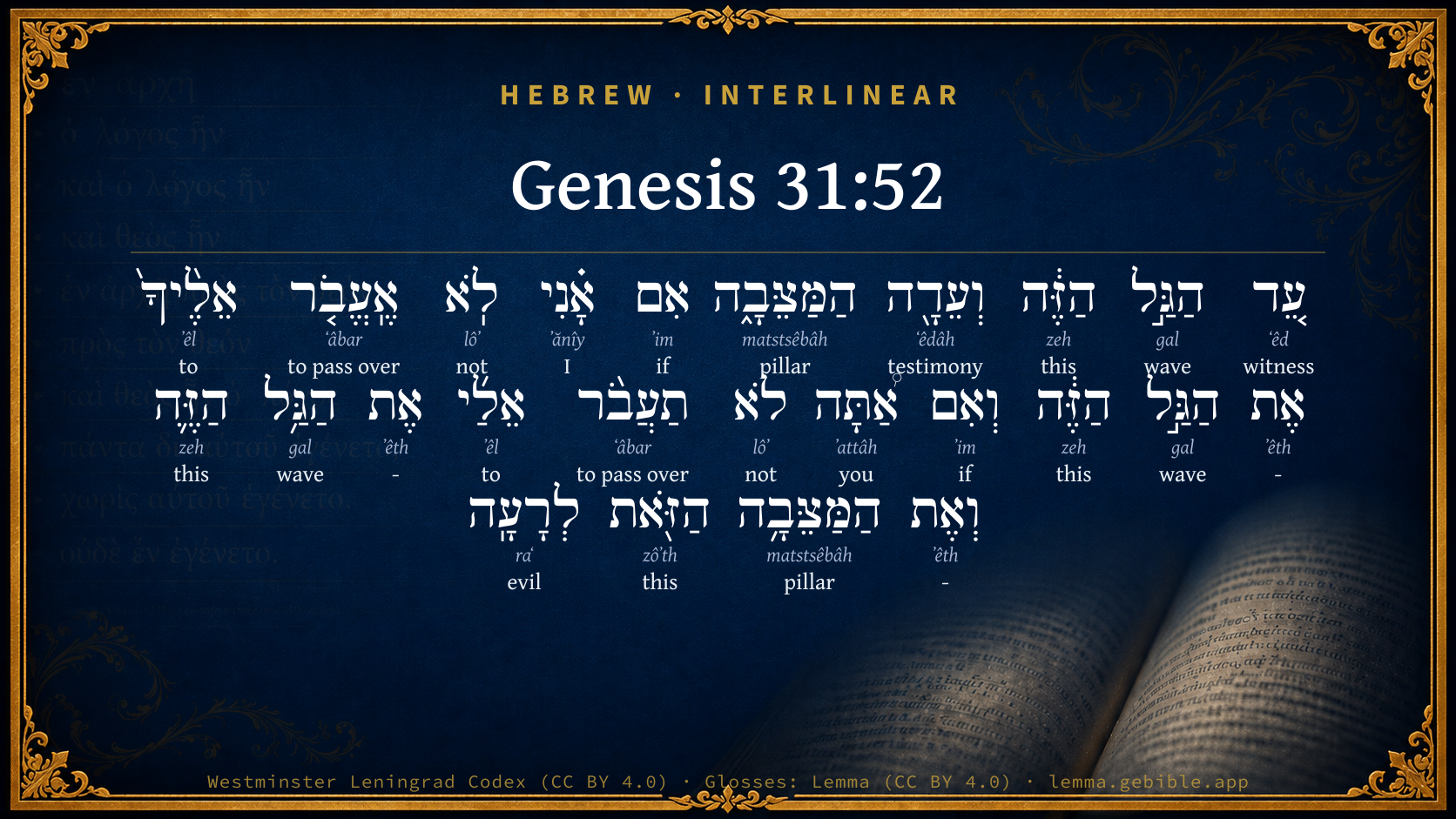
Genesis 31:52

Hebrew (Westminster Leningrad Codex) Genesis 31:52 appears in the Hebrew Old Testament. The text above is from the Westminster Leningrad Codex. Each word links to its Strong’s number, a concise gloss, and parsing drawn from the Open Scriptures Hebrew Bible morphology. Click any word for its full Brown-Driver-Briggs (BDB) entry.
Download image
Cite this verse

Genesis 31:52 (World English Bible). Public Domain. Lemma interlinear Bible study tool, https://lemma.gebible.app/v/genesis/31/52.

Show BibTeX & RIS
BibTeX
RIS
English Translation
May this heap be a witness, and the pillar be a witness, that I will not pass over this heap to you, and that you will not pass over this heap and this pillar to me, for harm.
World English Bible · Public Domain
Download a study sheet

One document with this verse’s original text, its word-by-word gloss line, the meaning frame, cross-references with their text, attributed commentary, and full source and license credits — printable, and it pastes into notes with its structure intact.

This verse Autodidact and up

Study sheet (.html) Plain text (.txt)

A passage Seminary Student

Up to 50 verses in one chapter. A passage sheet keeps up to 6 commentary sources and 12 cross-references per verse, in the order this page ranks them, and says so on the sheet whenever that leaves anything out. Ask for a single verse and you get the Autodidact verse sheet above.

Everything on this page stays free to read, with no account — the sheet is a download of what is already on screen, not access to it.

Want to remove ads? Support Godless Engineer
Compare translations 3

The same verse in 3 English versions, stacked beneath the original-language interlinear above. Click any original word for its lexicon entry.

Each is an independent rendering of the whole verse — the interlinear is not word-aligned to these translations.

Highlighted words mark where these versions differ — a whole-verse word diff, not a word-by-word alignment.

  • World English Bible Public Domain
    May this heap be a witness, and the pillar be a witness, that I will not pass over this heap to you, and that you will not pass over this heap and this pillar to me, for harm.
  • King James Version Public Domain
    This heap be witness, and this pillar be witness, that I will not pass over this heap to thee, and that thou shalt not pass over this heap and this pillar unto me, for harm.
  • unfoldingWord Literal Text CC BY-SA 4.0
    This heap a witness and the pillar a witness that I will not pass by this heap to you, and that you will not pass by this heap and this pillar to me, to do harm.

unfoldingWord Literal Text — © unfoldingWord, licensed CC BY-SA 4.0. Word-aligned USFM3 via Door43 (git.door43.org/unfoldingWord/en_ult).

Versions to compare (up to 4)

3 of 4 selected

Show all 18 translations

Every available English version of this verse, each an independent rendering of the whole verse.

  • World English Bible Public Domain
    May this heap be a witness, and the pillar be a witness, that I will not pass over this heap to you, and that you will not pass over this heap and this pillar to me, for harm.
  • Berean Standard Bible Public Domain
    This mound is a witness, and this pillar is a witness, that I will not go past this mound to harm you, and you will not go past this mound and pillar to harm me.
  • Majority Standard Bible Public Domain
    This mound is a witness, and this pillar is a witness, that I will not go past this mound to harm you, and you will not go past this mound and pillar to harm me.
  • King James Version Public Domain
    This heap be witness, and this pillar be witness, that I will not pass over this heap to thee, and that thou shalt not pass over this heap and this pillar unto me, for harm.
  • American Standard Version (1901) Public Domain
    This heap be witness, and the pillar be witness, that I will not pass over this heap to thee, and that thou shalt not pass over this heap and this pillar unto me, for harm.
  • Revised Version (1885) Public Domain
    This heap be witness, and the pillar be witness, that I will not pass over this heap to thee, and that thou shalt not pass over this heap and this pillar unto me, for harm.
  • Geneva Bible (1599) Public Domain
    This heape shall be witnesse, and the pillar shall be witnesse, that I will not come ouer this heape to thee, and that thou shalt not passe ouer this heape and this pillar vnto me for euill.
  • Douay-Rheims (1899) Public Domain
    Shall be a witness: this heap, I say, and the stone, be they for a testimony, if either I shall pass beyond it going towards thee, or thou shalt pass beyond it, thinking harm to me.
  • Young's Literal Translation Public Domain
    this heap `is' witness, and the standing pillar `is' witness, that I do not pass over this heap unto thee, and that thou dost not pass over this heap and this standing pillar unto me -- for evil;
  • Literal Standard Version CC BY-SA 4.0
    this heap [is] witness, and the standing pillar [is] witness, that I do not pass over this heap to you, and that you do not pass over this heap and this standing pillar to me—for evil;
  • Unlocked Literal Bible CC BY-SA 4.0
    This pile is a witness, and the pillar is a witness, that I will not pass beyond this pile to you, and that you will not pass beyond this pile and this pillar to me, to do harm.
  • unfoldingWord Literal Text CC BY-SA 4.0
    This heap a witness and the pillar a witness that I will not pass by this heap to you, and that you will not pass by this heap and this pillar to me, to do harm.
  • Darby Bible Public Domain
    [let] this heap be witness, and the pillar a witness, that neither I pass this heap [to go] to thee, nor thou pass this heap and this pillar [to come] to me, for harm.
  • World Messianic Bible Public Domain
    May this heap be a witness, and the pillar be a witness, that I will not pass over this heap to you, and that you will not pass over this heap and this pillar to me, for harm.
  • Webster's Bible Public Domain
    This heap be witness, and this pillar be witness, that I will not pass over this heap to thee, and that thou shalt not pass over this heap and this pillar to me, for harm.
  • Free Bible Version CC BY-SA 4.0
    They also act as a witness to our solemn promises to each other: I will not come past them to attack you; and you will not come past them to attack me.
  • Bible in Basic English Public Domain
    They will be witness that I will not go over these stones to you, and you will not go over these stones or this pillar to me, for any evil purpose.
  • JPS Tanakh (1917) Public Domain
    This heap be witness, and the pillar be witness, that I will not pass over this heap to thee, and that thou shalt not pass over this heap and this pillar unto me, for harm.

Literal Standard Version (2020), Covenant Press — licensed CC BY-SA 4.0. Text via the HelloAO Bible API (eBible.org). Unlocked Literal Bible (unfoldingWord) — licensed CC BY-SA 4.0. Text via the HelloAO Bible API (eBible.org). unfoldingWord Literal Text — © unfoldingWord, licensed CC BY-SA 4.0. Word-aligned USFM3 via Door43 (git.door43.org/unfoldingWord/en_ult). Free Bible Version, Dr. Jonathan Gallagher — licensed CC BY-SA 4.0. Text via the HelloAO Bible API (eBible.org).

Word by word

More ways to search: Search by grammar → Find every occurrence → Compare this word →

Practice this passage: Drill this verse → Learn its vocabulary →

וְעֵדָ֖ה
ʻêdâh
H5713
“and · testimony”
Conjunction + Noun, Common, Feminine, Singular, Absolute
Part of Speech
Conjunction + Noun
Type
Common
Gender
Feminine
Number
Singular
State
Absolute
Full BDB Definition

Origin: from H5707 in its technical sense

TWOT: 1576c , 1576e

testimony, witness - always plural and always of laws as divine testimonies
  1. עֵ֚ד ʻêd H5707 “witness” Noun, Common, Masculine, Singular, Absolute
  2. הַגַּ֣ל gal H1530 “the · wave” Particle, Definite Article + Noun, Common, Masculine, Singular, Absolute
  3. הַזֶּ֔ה zeh H2088 “the · this” Particle, Definite Article + Pronoun, Demonstrative, Masculine, Singular
  4. הַמַּצֵּבָ֑ה matstsêbâh H4676 “the · pillar” Particle, Definite Article + Noun, Common, Feminine, Singular, Absolute
  5. אִם ʼim H518 “if” Conjunction
  6. אָ֗נִי ʼănîy H589 “I” Pronoun, Personal, 1st Person, Common, Singular
  7. לֹֽא lôʼ H3808 “not” Particle, Negative
  8. אֶֽעֱבֹ֤ר ʻâbar H5674 “to pass over” Verb, Qal, Imperfect, 1st Person, Common, Singular
  9. אֵלֶ֨יךָ֙ ʼêl H413 “to · you” Preposition + Suffix, Personal, 2nd Person, Masculine, Singular
  10. אֶת ʼêth H853 “-” Particle, Direct Object
  11. הַגַּ֣ל gal H1530 “the · wave” Particle, Definite Article + Noun, Common, Masculine, Singular, Absolute
  12. הַזֶּ֔ה zeh H2088 “the · this” Particle, Definite Article + Pronoun, Demonstrative, Masculine, Singular
  13. וְאִם ʼim H518 “and · if” Conjunction + Conjunction
  14. אַ֠תָּה ʼattâh H859 “you” Pronoun, Personal, 2nd Person, Masculine, Singular
  15. לֹא lôʼ H3808 “not” Particle, Negative
  16. תַעֲבֹ֨ר ʻâbar H5674 “to pass over” Verb, Qal, Imperfect, 2nd Person, Masculine, Singular
  17. אֵלַ֜י ʼêl H413 “to · me” Preposition + Suffix, Personal, 1st Person, Common, Singular
  18. אֶת ʼêth H853 “-” Particle, Direct Object
  19. הַגַּ֥ל gal H1530 “the · wave” Particle, Definite Article + Noun, Common, Masculine, Singular, Absolute
  20. הַזֶּ֛ה zeh H2088 “the · this” Particle, Definite Article + Pronoun, Demonstrative, Masculine, Singular
  21. וְאֶת ʼêth H853 “and · -” Conjunction + Particle, Direct Object
  22. הַמַּצֵּבָ֥ה matstsêbâh H4676 “the · pillar” Particle, Definite Article + Noun, Common, Feminine, Singular, Absolute
  23. הַזֹּ֖את zôʼth H2063 “the · this” Particle, Definite Article + Pronoun, Demonstrative, Feminine, Singular
  24. לְרָעָֽה raʻ H7451 “to/for · evil” Preposition + Noun, Common, Feminine, Singular, Absolute

About this verse

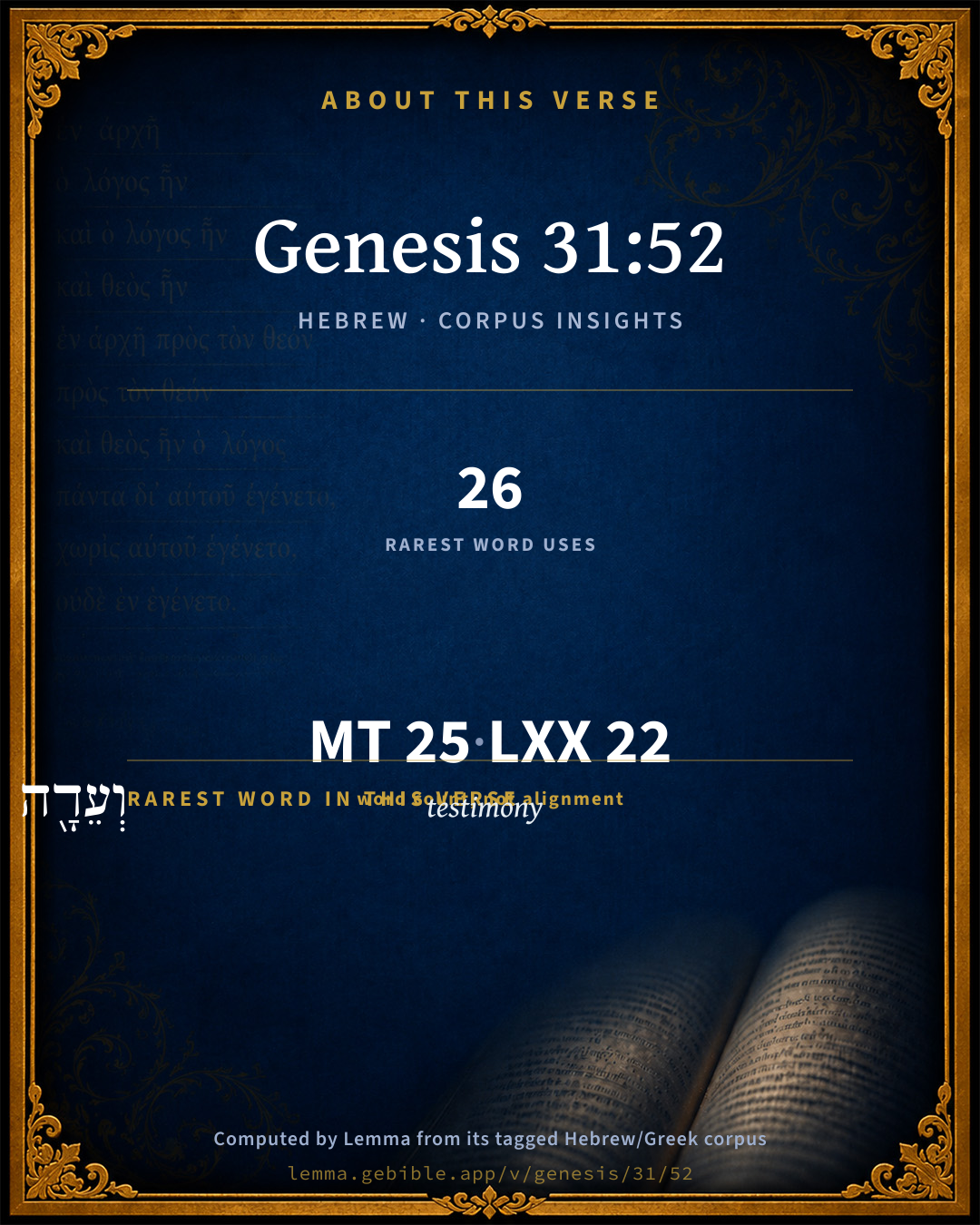
These counts appear in no published source. They are computed here, from the morphology-tagged text and Lemma’s own curated glosses. What Lemma adds →

25
words
14
distinct lemmas
Pentateuch
section

Shared distinctive vocabulary

וְעֵדָ֖ה testimony H5713 occurs in 25 verses of the Hebrew Bible. Also found in:

Grammatical profile

  • 2 verbs
  • 8 nouns
  • 6 pronouns
  • 2 prepositions
  • 2 conjunctions
  • 5 particles

Verb forms

  • אֶֽעֱבֹ֤ר Qal · Imperfect
  • תַעֲבֹ֨ר Qal · Imperfect

Repetition

Words recur within this verse — often emphatic in Hebrew:

  • הַגַּ֣ל wave H1530 ×3
  • הַמַּצֵּבָ֑ה pillar H4676 ×2
  • אֶֽעֱבֹ֤ר to pass over H5674 ×2
  • הַזֶּ֔ה this H2088 ×3
  • אִם if H518 ×2
  • לֹֽא not H3808 ×2
  • אֵלֶ֨יךָ֙ to H413 ×2

Hebrew & Septuagint length

In English translation the verse runs 38 words from the Hebrew and 24 from the Septuagint (LXX English) — the Septuagint runs noticeably shorter here. See the side-by-side →

A rough comparison of the two English renderings, which tokenize alike — not a word-level alignment.

Word counts can differ between the Hebrew and the Greek without any difference in meaning — e.g. the Hebrew direct-object marker אֵת has no separate Greek word, and Greek often adds the article ὁ.

In the original languages it is 25 Hebrew tokens and 22 Greek tokens — but the two are counted differently (Hebrew bundles its prefixes and suffixes into one token; the Greek is in lemma form), so that isn’t a like-for-like length.

Cross-references

2

Topical passages linked to Genesis 31:52 in the Treasury of Scripture Knowledge — connected by theme and wording, ordered by reader-vote popularity; previews shown in the World English Bible.

  • Genesis 31:48 Laban said, "This heap is witness between me and you this day." Therefore it was named Galeed
  • Genesis 31:44–45 Now come, let us make a covenant, you and I; and let it be for a witness between me and you."

Cross-references courtesy of OpenBible.info (CC BY 4.0).

Hebrew and Greek witnesses Masoretic Hebrew ↔ Greek Septuagint

The same verse in the two great witnesses to the Old Testament, shown verse-for-verse.

Here the Septuagint runs noticeably shorter than the Hebrew — LXX2012 (modern English Septuagint) 24 words vs World English Bible 38. A rough length comparison of the two English translations, not a word-level alignment — read both below.

These are two independent witnesses, not word-aligned to each other, and the Septuagint is shown in lemma (dictionary) form.

Hebrew Genesis 31:52 Masoretic · Westminster Leningrad Codex

עֵ֚ד הַגַּ֣ל הַזֶּ֔ה וְעֵדָ֖ה הַמַּצֵּבָ֑ה אִם אָ֗נִי לֹֽא אֶֽעֱבֹ֤ר אֵלֶ֨יךָ֙ אֶת הַגַּ֣ל הַזֶּ֔ה וְאִם אַ֠תָּה לֹא תַעֲבֹ֨ר אֵלַ֜י אֶת הַגַּ֥ל הַזֶּ֛ה וְאֶת הַמַּצֵּבָ֥ה הַזֹּ֖את לְרָעָֽה

May this heap be a witness, and the pillar be a witness, that I will not pass over this heap to you, and that you will not pass over this heap and this pillar to me, for harm.

World English Bible · Public Domain

Greek LXX Genesis 31:52 Septuagint · lemma form

ἐάν τε γάρ ἐγώ μή διαβαίνω πρός σύ μηδέ σύ διαβαίνω πρός ἐγώ ὁ βουνός οὗτος καί ὁ στήλη οὗτος ἐπί κακία

For if I should not cross over to you, neither should you cross over to me, for mischief beyond this heap and this pillar.

LXX2012 (modern English Septuagint) · Public Domain

Hebrew: Westminster Leningrad Codex (CC BY 4.0). Greek: Septuagint (public domain); English from LXX2012 (modern English Septuagint) (Public Domain). How the Septuagint differs from the Hebrew →

Targum (Aramaic paraphrase)

2

The Targum is the ancient Jewish Aramaic paraphrase of the Hebrew Scriptures — an interpretive translation, not the Hebrew text itself. Onkelos (literal) and Pseudo-Jonathan (expansive) render the Torah, and Jonathan the Prophets. Coverage is partial: where no permissively-licensed English translation exists for a verse, only the Aramaic is shown. This is verse-level text, not a word-by-word alignment to the Hebrew.

  1. Targum Onkelos Torah (Genesis–Deuteronomy)
    סָהִיד דְּגוֹרָא הָדֵין וְסָהֲדָא קָמָא אִם אֲנָא לָא אֶעְבַּר לְוָתָךְ יָת דְּגוֹרָא הָדֵין וְאִם אַתְּ לָא תֵעִבַּר לְוָתִי יָת דְּגוֹרָא הָדֵין וְיָת קַמְתָא הָדָא לְבִישׁוּ

    (no public-domain English translation for this verse)

    Targum Onkelos — Aramaic: “Onkelos Genesis” (public domain); “Onkelos Exodus” (public domain); “Onkelos Leviticus” (public domain); “Onkelos Numbers” (public domain); “Onkelos Deuteronomy” (public domain). English: “Sefaria Community Translation” (CC0 1.0 (public-domain dedication)); “J.W. Etheridge. The Targums of Onkelos and Jonathan Ben Uzziel on the Pentateuch. London: Longmans, Green, 1862” (public domain). Text via Sefaria.

  2. Targum Pseudo-Jonathan Torah (Genesis–Deuteronomy)
    סְהִיד אוֹגַר הָדֵין וּסְהִידָא קָמָא אִין אֲנָא לָא אֲעִיבַר לְוָתָךְ יַת אוֹגַר הָדֵין וְאִין אַנְתְּ לָא תְעִיבַר לְוָתִי יַת אוֹגַר הָדֵין וְיַת קָמָא הָדָא לְאַבְאָשָׁא

    This mound is a witness, and this pillar is a witness, that I may not pass beyond this mound to thee, and that thou mayest not pass beyond this mound and this pillar to do harm.

    Targum Pseudo-Jonathan — Aramaic: “Targum Jonathan on Genesis” (public domain); “Targum Jonathan on Exodus” (public domain); “Targum Jonathan on Leviticus” (public domain); “Targum Jonathan on Numbers” (public domain); “Targum Jonathan on Deuteronomy” (public domain). English: “The Targum of Jonathan ben Uzziel, trans. J. W. Etheridge, London, 1862” (public domain). Text via Sefaria.

Commentary

Notes on Genesis 31:52 from classic Christian and Jewish commentators (each source and its license shown beneath its notes). The classic Christian expositions comment on the surrounding passage and are grouped to its opening verse, so a note may address several verses; the Jewish commentaries on the Tanakh (Rashi and others) are per-verse, so they appear only where the commentator wrote on this verse.

Lemma curates 59 commentaries, every one of them public domain or Creative Commons licensed, each selected and text-cleaned for this edition rather than reprinted as found. About our sources →

Trapp's Complete Commentary

John Trapp

Gen 31:52 This heap [be] witness, and [this] pillar [be] witness, that I will not pass over this heap to thee, and that thou shalt not pass over this heap and this pillar unto me, for harm.

Ver. 52. {See Trapp on "Gen 31:44"}

John Trapp, A Commentary or Exposition upon All the Books of the Old and New Testament (1647–1656) — public domain. Text from a community e-Sword module.

Jamieson, Fausset & Brown

Robert Jamieson, A. R. Fausset & David Brown

This heap be witness--Objects of nature were frequently thus spoken of. But over and above, there was a solemn appeal to God; and it is observable that there was a marked difference in the religious sentiments of the two. Laban spake of the God of Abraham and Nahor, their common ancestors; but Jacob, knowing that idolatry had crept in among that branch of the family, swore by the "fear of his father Isaac." They who have one God should have one heart: they who are agreed in religion should endeavor to agree in everything else.

Next: Genesis Chapter 32

Jamieson, Fausset & Brown — Commentary Critical and Explanatory on the Whole Bible (1871) — public domain (CC PDM 1.0). Text via the HelloAO Bible API.

John Gill's Exposition

And early in the morning Laban rose up,.... In order to prepare for, and set forward on his journey home:

and kissed his sons and his daughters; Jacob and his sons, who were his grandsons, and his daughters Rachel and Leah, with Dinah his granddaughter, as was the custom of relations and friends in those countries and times, at parting:

and blessed them; wished all happiness to them:

and Laban departed, and returned unto his place; to the city of Haran, where he dwelt; and after this we hear no more of him, nor of any transaction of his in life, or when and where he died, only his name is once mentioned by Jacob, Gen 32:4.

Next: Genesis Chapter 32

John Gill's Exposition of the Whole Bible (1746–1763) — public domain (CC PDM 1.0). Text via the HelloAO Bible API.

Rashi

Rabbi Shlomo Yitzchaki (Rashi)

אם אני THAT I WILL NOT — Here the word אם is used in the sense of אשר “that”, as (Genesis 24:33) “until that (אם) I have spoken my words”.

לרעה FOR EVIL — For evil you may not pass, but for trading purposes (as e. g., with a caravan) you may pass (Genesis Rabbah 74:16).

Rashi on the Tanakh — English translations: “The Judaica Press complete Tanach with Rashi, translated by A. J. Rosenberg” (CC BY 4.0); “Pentateuch with Rashi's commentary by M. Rosenbaum and A.M. Silbermann, 1929-1934” (public domain); “The Metsudah Tanach series, Lakewood, N.J” (CC BY 4.0); and “The Book of Joshua, Metsudah Publications, 1997” (CC BY 4.0). Text via Sefaria.

Radak

Rabbi David Kimhi (Radak)

עד...אם אני, the expression אם אני and אם אתה in this verse must be understood as if the Torah had written שאני and שאתה, “that I,“ “that you.” We find the word אם used in that sense in Genesis 24,19 עד אם כלו לשתות, “until they have finished drinking,” as we pointed out there.

אני, the word is spelled with the vowel kametz although it does not signify a comma or other interruption of the subject matter under discussion. It is to be understood as in Psalms 89,28 in אף אני-בכור אתנהו, “I will even consider him as a firstborn.” The long vowel kametz lends emphasis to the word. So it does in our verse, and so it does in Genesis 27,34 ברכני גן אני אבי, “bless me also father!” Esau pleaded: “I too need a blessing.”

ואת המצבה הזאת, which you have erected as a witness and sign of the covenant between you and me. Yaakov had erected the monument, whereas both had he and Lavan had combined to set up the pile of stones described as גל. This is why he mentioned the מצבה when saying to Yaakov ואם אתה, we must wonder altogether that Lavan was now prepared to make his peace with Yaakov, having obtained nothing in return for his pursuit. The fact is that although he had boasted that he possessed the power to harm Yaakov, he had realised that Yaakov’s G’d not only had assisted him in the past, but had given him, Lavan personally, notice not even to harass Yaakov. This is why now he begged for a peace agreement, as had Avimelech when be asked for such an agreement from Yitzchok after first having expelled him from Gerar. Avimelech had also acknowledged in front of his general that they had convinced themselves that G’d was on the side of Yitzchok (26,28)

Radak on the Tanakh — English translations: “Sefaria Community Translation” (CC0 1.0 (public-domain dedication)); “Eliyahu Munk, HaChut Hameshulash” (CC BY 4.0); “Rabbi Mike Feuer, Jerusalem Anthology” (CC BY 4.0); and “R. David Kimhi on the first book of Psalms, Translated by R.G. Finch, London, 1919” (public domain). Text via Sefaria.

Lesson kit

Teaching starters — assembled from the data on this page, not authored interpretation. Every prompt links to the verse data it draws on. Edit before teaching.

Genesis, in the Pentateuch, opens this verse with 25 words (14 distinct Hebrew lemmas). Its most distinctive word is ʻêdâh (“testimony”). The Greek Septuagint runs shorter here. A historical commentator’s framing appears above. Read the whole chapter for the surrounding context.

Discussion questions

  1. What does “testimony” (ʻêdâh) contribute to the verse as a whole?
  2. How does Genesis 21:30, which shares the word «testimony», read alongside this verse?
  3. What does the repetition of “wave” (3× in this one verse) do in this verse?
  4. The Septuagint runs shorter here than the Hebrew. What might account for the difference?
  5. The translations on this page render this verse differently — a whole-verse word diff, not a word-by-word alignment. What might account for the different wordings?
  6. «אֶֽעֱבֹ֤ר» is a Qal Imperfect verb. How does that grammatical form shape the action described?
  7. Compare how Trapp's Complete Commentary and Jamieson, Fausset & Brown read this verse. Where do they agree or differ?

Things to notice

Reading settings

Reading text

Shown beneath each verse's original-language words.

Old Testament
Old Testament edition

Read the OT as the Masoretic Hebrew (MT) or the Greek Septuagint (LXX).

English shown for the Greek Septuagint (in the Hebrew ↔ Greek comparison).

Comparing translations? Open the Compare panel on any verse page to stack up to four side by side.