
Genesis 24:45

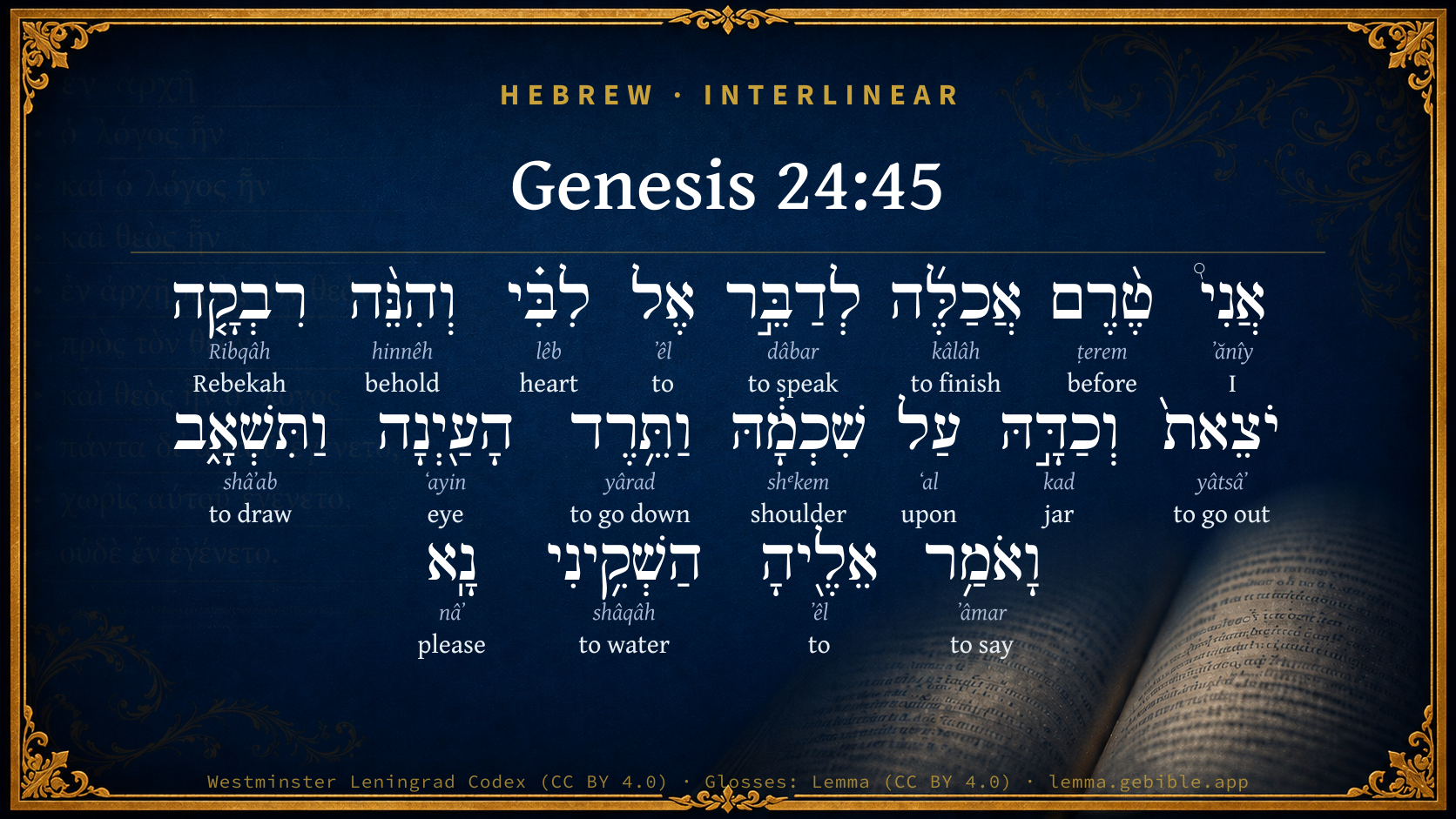
Hebrew (Westminster Leningrad Codex) Genesis 24:45 appears in the Hebrew Old Testament. The text above is from the Westminster Leningrad Codex. Each word links to its Strong’s number, a concise gloss, and parsing drawn from the Open Scriptures Hebrew Bible morphology. Click any word for its full Brown-Driver-Briggs (BDB) entry.
Download image
Cite this verse

Genesis 24:45 (World English Bible). Public Domain. Lemma interlinear Bible study tool, https://lemma.gebible.app/v/genesis/24/45.

Show BibTeX & RIS
BibTeX
RIS
English Translation
Before I had done speaking in my heart, behold, Rebekah came forth with her pitcher on her shoulder. She went down to the spring, and drew. I said to her, 'Please let me drink.'
World English Bible · Public Domain
Download a study sheet

One document with this verse’s original text, its word-by-word gloss line, the meaning frame, cross-references with their text, attributed commentary, and full source and license credits — printable, and it pastes into notes with its structure intact.

This verse Autodidact and up

Study sheet (.html) Plain text (.txt)

A passage Seminary Student

Up to 50 verses in one chapter. A passage sheet keeps up to 6 commentary sources and 12 cross-references per verse, in the order this page ranks them, and says so on the sheet whenever that leaves anything out. Ask for a single verse and you get the Autodidact verse sheet above.

Everything on this page stays free to read, with no account — the sheet is a download of what is already on screen, not access to it.

Want to remove ads? Support Godless Engineer
Compare translations 3

The same verse in 3 English versions, stacked beneath the original-language interlinear above. Click any original word for its lexicon entry.

Each is an independent rendering of the whole verse — the interlinear is not word-aligned to these translations.

Highlighted words mark where these versions differ — a whole-verse word diff, not a word-by-word alignment.

  • World English Bible Public Domain
    Before I had done speaking in my heart, behold, Rebekah came forth with her pitcher on her shoulder. She went down to the spring, and drew. I said to her, 'Please let me drink.'
  • King James Version Public Domain
    And before I had done speaking in mine heart, behold, Rebekah came forth with her pitcher on her shoulder; and she went down unto the well, and drew water: and I said unto her, Let me drink, I pray thee.
  • unfoldingWord Literal Text CC BY-SA 4.0
    Before I had finished speaking in my heart, then behold, Rebekah was coming out and her jar on her shoulder. And she went down to the spring and drew water, and I said to her, ‘Please give me a drink.’

unfoldingWord Literal Text — © unfoldingWord, licensed CC BY-SA 4.0. Word-aligned USFM3 via Door43 (git.door43.org/unfoldingWord/en_ult).

Versions to compare (up to 4)

3 of 4 selected

Show all 18 translations

Every available English version of this verse, each an independent rendering of the whole verse.

  • World English Bible Public Domain
    Before I had done speaking in my heart, behold, Rebekah came forth with her pitcher on her shoulder. She went down to the spring, and drew. I said to her, 'Please let me drink.'
  • Berean Standard Bible Public Domain
    And before I had finished praying in my heart, there was Rebekah coming out with her jar on her shoulder, and she went down to the spring and drew water. So I said to her, ‘Please give me a drink.’
  • Majority Standard Bible Public Domain
    And before I had finished praying in my heart, there was Rebekah coming out with her jar on her shoulder, and she went down to the spring and drew water. So I said to her, ‘Please give me a drink.’
  • King James Version Public Domain
    And before I had done speaking in mine heart, behold, Rebekah came forth with her pitcher on her shoulder; and she went down unto the well, and drew water: and I said unto her, Let me drink, I pray thee.
  • American Standard Version (1901) Public Domain
    And before I had done speaking in my heart, behold, Rebekah came forth with her pitcher on her shoulder. And she went down unto the fountain, and drew. And I said unto her, Let me drink, I pray thee.
  • Revised Version (1885) Public Domain
    And before I had done speaking in mine heart, behold, Rebekah came forth with her pitcher on her shoulder; and she went down unto the fountain, and drew: and I said unto her, Let me drink, I pray thee.
  • Geneva Bible (1599) Public Domain
    And before I had made an end of speaking in mine heart, beholde, Rebekah came foorth, and her pitcher on her shoulder, and she went downe vnto the well, and drewe water. Then I said vnto her, Giue me drinke, I pray thee.
  • Douay-Rheims (1899) Public Domain
    And whilst I pondered these things secretly with myself, Rebecca appeared coming with a pitcher, which she carried on her shoulder: and she went down to the well and drew water. And I said to her: Give me a little to drink.
  • Young's Literal Translation Public Domain
    `Before I finish speaking unto my heart, then lo, Rebekah is coming out, and her pitcher on her shoulder, and she goeth down to the fountain, and draweth; and I say unto her, Let me drink, I pray thee,
  • Literal Standard Version CC BY-SA 4.0
    Before I finish speaking to my heart, then behold, Rebekah is coming out, and her pitcher [is] on her shoulder, and she goes down to the fountain and draws; and I say to her, Please let me drink,
  • Unlocked Literal Bible CC BY-SA 4.0
    Even before I had finished speaking in my heart, behold, Rebekah came out with her pitcher on her shoulder and she went down to the spring and drew water. So I said to her, 'Please give me a drink.'
  • unfoldingWord Literal Text CC BY-SA 4.0
    Before I had finished speaking in my heart, then behold, Rebekah was coming out and her jar on her shoulder. And she went down to the spring and drew water, and I said to her, ‘Please give me a drink.’
  • Darby Bible Public Domain
    Before I ended speaking in my heart, behold, Rebecca came forth with her pitcher on her shoulder, and went down to the well, and drew [water]; and I said to her, Give me, I pray thee, to drink.
  • World Messianic Bible Public Domain
    Before I had finished speaking in my heart, behold, Rebekah came out with her pitcher on her shoulder. She went down to the spring, and drew. I said to her, ‘Please let me drink.’
  • Webster's Bible Public Domain
    And before I had done speaking in my heart, behold, Rebekah came forth with her pitcher on her shoulder; and she went down to the well, and drew water: and I said to her, Let me drink, I pray thee.
  • Free Bible Version CC BY-SA 4.0
    “I hadn't even finished praying silently when I saw Rebekah coming to get water, carrying her water jar on her shoulder. She went down to the spring to get water, and I said to her, ‘Please give me a drink.’
  • Bible in Basic English Public Domain
    And even while I was saying this to myself, Rebekah came out with her vessel on her arm; and she went down to the spring to get water; and I said to her, Give me a drink.
  • JPS Tanakh (1917) Public Domain
    And before I had done speaking to my heart, behold, Rebekah came forth with her pitcher on her shoulder; and she went down unto the fountain, and drew. And I said unto her: Let me drink, I pray thee.

Literal Standard Version (2020), Covenant Press — licensed CC BY-SA 4.0. Text via the HelloAO Bible API (eBible.org). Unlocked Literal Bible (unfoldingWord) — licensed CC BY-SA 4.0. Text via the HelloAO Bible API (eBible.org). unfoldingWord Literal Text — © unfoldingWord, licensed CC BY-SA 4.0. Word-aligned USFM3 via Door43 (git.door43.org/unfoldingWord/en_ult). Free Bible Version, Dr. Jonathan Gallagher — licensed CC BY-SA 4.0. Text via the HelloAO Bible API (eBible.org).

Word by word

More ways to search: Search by grammar → Find every occurrence → Compare this word →

Practice this passage: Drill this verse → Learn its vocabulary →

וְכַדָּ֣הּ
kad
H3537
“and · jar · her”
Conjunction + Noun, Common, Feminine, Singular, Construct + Suffix, Personal, 3rd Person, Feminine, Singular
Part of Speech
Conjunction + Noun
Type
Common
Gender
Feminine
Number
Singular
State
Construct
Full BDB Definition

Origin: from an unused root meaning to deepen

TWOT: 953a

jar, large jar (portable)
  1. אֲנִי֩ ʼănîy H589 “I” Pronoun, Personal, 1st Person, Common, Singular
  2. טֶ֨רֶם ṭerem H2962 “before” Adverb
  3. אֲכַלֶּ֜ה kâlâh H3615 “to finish” Verb, Piel, Imperfect, 1st Person, Common, Singular
  4. לְדַבֵּ֣ר dâbar H1696 “to speak” Preposition + Verb, Piel, Infinitive Construct
  5. אֶל ʼêl H413 “to” Preposition
  6. לִבִּ֗י lêb H3820 “heart · my” Noun, Common, Masculine, Singular, Construct + Suffix, Personal, 1st Person, Common, Singular
  7. וְהִנֵּ֨ה hinnêh H2009 “and · behold” Conjunction + Particle, Demonstrative
  8. רִבְקָ֤ה Ribqâh H7259 “Rebekah” Noun, Proper
  9. יֹצֵאת֙ yâtsâʼ H3318 “going out” Verb, Qal, Participle Active, Feminine, Singular, Absolute
  10. עַל ʻal H5921 “upon” Preposition
  11. שִׁכְמָ֔הּ shᵉkem H7926 “shoulder · her” Noun, Common, Masculine, Singular, Construct + Suffix, Personal, 3rd Person, Feminine, Singular
  12. וַתֵּ֥רֶד yârad H3381 “and · to go down” Conjunction + Verb, Qal, Sequential Imperfect, 3rd Person, Feminine, Singular
  13. הָעַ֖יְנָה ʻayin H5869 “the · eye · toward” Particle, Definite Article + Noun, Common, Both, Singular, Absolute + Suffix, Demonstrative
  14. וַתִּשְׁאָ֑ב shâʼab H7579 “and · to draw” Conjunction + Verb, Qal, Sequential Imperfect, 3rd Person, Feminine, Singular
  15. וָאֹמַ֥ר ʼâmar H559 “and · to say” Conjunction + Verb, Qal, Sequential Imperfect, 1st Person, Common, Singular
  16. אֵלֶ֖יהָ ʼêl H413 “to · her” Preposition + Suffix, Personal, 3rd Person, Feminine, Singular
  17. הַשְׁקִ֥ינִי shâqâh H8248 “water · me” Verb, Hiphil, Imperative, 2nd Person, Feminine, Singular + Suffix, Personal, 1st Person, Common, Singular
  18. נָֽא nâʼ H4994 “please” Particle, Exhortation

About this verse

These counts appear in no published source. They are computed here, from the morphology-tagged text and Lemma’s own curated glosses. What Lemma adds →

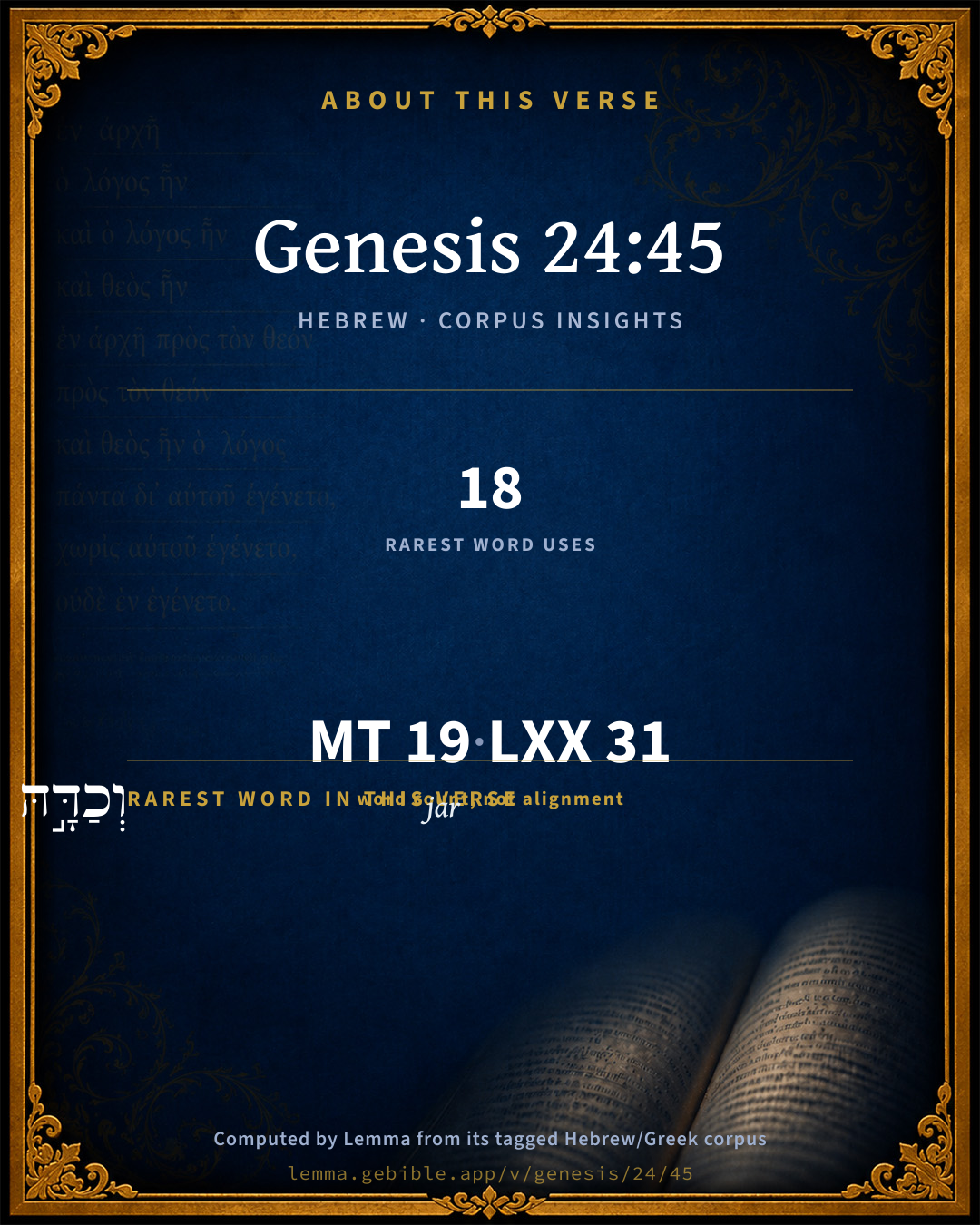
19
words
18
distinct lemmas
Pentateuch
section

Notable vocabulary

The rarest word here is וְכַדָּ֣הּ jar H3537 — appearing just 18 times in the whole Hebrew Bible.

Shared distinctive vocabulary

וְכַדָּ֣הּ jar H3537 occurs in 17 verses of the Hebrew Bible. Also found in:

Grammatical profile

  • 7 verbs
  • 5 nouns
  • 1 pronoun
  • 3 prepositions
  • 1 adverb
  • 2 particles

Verb forms

  • אֲכַלֶּ֜ה Piel · Imperfect
  • לְדַבֵּ֣ר Piel · Infinitive Construct
  • יֹצֵאת֙ Qal · Participle Active
  • וַתֵּ֥רֶד Qal · Sequential Imperfect
  • וַתִּשְׁאָ֑ב Qal · Sequential Imperfect
  • וָאֹמַ֥ר Qal · Sequential Imperfect
  • הַשְׁקִ֥ינִי Hiphil · Imperative

Repetition

A word recurs within this verse — often emphatic in Hebrew:

  • אֶל to H413 ×2

Hebrew & Septuagint length

In English translation the verse runs 34 words from the Hebrew and 42 from the Septuagint (LXX English) — closely comparable.

A rough comparison of the two English renderings, which tokenize alike — not a word-level alignment.

Word counts can differ between the Hebrew and the Greek without any difference in meaning — e.g. the Hebrew direct-object marker אֵת has no separate Greek word, and Greek often adds the article ὁ.

In the original languages it is 19 Hebrew tokens and 31 Greek tokens — but the two are counted differently (Hebrew bundles its prefixes and suffixes into one token; the Greek is in lemma form), so that isn’t a like-for-like length.

Cross-references

13

Topical passages linked to Genesis 24:45 in the Treasury of Scripture Knowledge — connected by theme and wording, ordered by reader-vote popularity; previews shown in the World English Bible.

  • Genesis 24:15–20 It happened, before he had done speaking, that behold, Rebekah came out, who was born to Bethuel the son of Milcah, the wife of Nahor, Abraham's brother, with her pitcher on her shoulder.
  • Isaiah 65:24 It shall happen that, before they call, I will answer; and while they are yet speaking, I will hear.
  • Daniel 9:23 At the beginning of your petitions the commandment went forth, and I am come to tell you; for you are greatly beloved: therefore consider the matter, and understand the vision.
  • Matthew 7:7 "Ask, and it will be given you. Seek, and you will find. Knock, and it will be opened for you.
  • Acts 10:30 Cornelius said, "Four days ago, I was fasting until this hour, and at the ninth hour, I prayed in my house, and behold, a man stood before me in bright clothing,
  • Acts 12:12–17 Thinking about that, he came to the house of Mary, the mother of John whose surname was Mark, where many were gathered together and were praying.
  • 1 Samuel 1:13–15 Now Hannah, she spoke in her heart; only her lips moved, but her voice was not heard: therefore Eli thought she had been drunken.
  • 2 Samuel 7:27 For you, Yahweh of Hosts, the God of Israel, have revealed to your servant, saying, I will build you a house: therefore has your servant found in his heart to pray this prayer to you.
  • Nehemiah 2:4 Then the king said to me, For what do you make request? So I prayed to the God of heaven.
  • Isaiah 58:9 Then shall you call, and Yahweh will answer; you shall cry, and he will say, Here I am. If you take away from the midst of you the yoke, the putting forth of the finger, and speaking wickedly;
  • Daniel 9:19 Lord, hear; Lord, forgive; Lord, listen and do; don't defer, for your own sake, my God, because your city and your people are called by your name.
  • Acts 4:24–33 When they heard it, they lifted up their voice to God with one accord, and said, "O Lord, you are God, who made the heaven, the earth, the sea, and all that is in them;
  • Romans 8:26 In the same way, the Spirit also helps our weaknesses, for we don't know how to pray as we ought. But the Spirit himself makes intercession for us with groanings which can't be uttered.

Cross-references courtesy of OpenBible.info (CC BY 4.0).

Hebrew and Greek witnesses Masoretic Hebrew ↔ Greek Septuagint

The same verse in the two great witnesses to the Old Testament, shown verse-for-verse.

These are two independent witnesses, not word-aligned to each other, and the Septuagint is shown in lemma (dictionary) form.

Hebrew Genesis 24:45 Masoretic · Westminster Leningrad Codex

אֲנִי֩ טֶ֨רֶם אֲכַלֶּ֜ה לְדַבֵּ֣ר אֶל לִבִּ֗י וְהִנֵּ֨ה רִבְקָ֤ה יֹצֵאת֙ וְכַדָּ֣הּ עַל שִׁכְמָ֔הּ וַתֵּ֥רֶד הָעַ֖יְנָה וַתִּשְׁאָ֑ב וָאֹמַ֥ר אֵלֶ֖יהָ הַשְׁקִ֥ינִי נָֽא

Before I had done speaking in my heart, behold, Rebekah came forth with her pitcher on her shoulder. She went down to the spring, and drew. I said to her, 'Please let me drink.'

World English Bible · Public Domain

Greek LXX Genesis 24:45 Septuagint · lemma form

καί γίγνομαι πρό ὁ συντελέω ἐγώ λαλέω ἐν ὁ διάνοια εὐθύς ρεβεκκα ἐκπορεύομαι ἔχω ὁ ὑδρία ἐπί ὁ ὦμος καί καταβαίνω ἐπί ὁ πηγή καί ὑδρεύω εἶπον δέ αὐτός ποτίζω ἐγώ

And it came to pass before I had done speaking in my mind, straightway Rebecca came forth, having her pitcher on her shoulders; and she went down to the well, and drew water; and I said to her, Give me to drink.

LXX2012 (modern English Septuagint) · Public Domain

Hebrew: Westminster Leningrad Codex (CC BY 4.0). Greek: Septuagint (public domain); English from LXX2012 (modern English Septuagint) (Public Domain). How the Septuagint differs from the Hebrew →

Targum (Aramaic paraphrase)

2

The Targum is the ancient Jewish Aramaic paraphrase of the Hebrew Scriptures — an interpretive translation, not the Hebrew text itself. Onkelos (literal) and Pseudo-Jonathan (expansive) render the Torah, and Jonathan the Prophets. Coverage is partial: where no permissively-licensed English translation exists for a verse, only the Aramaic is shown. This is verse-level text, not a word-by-word alignment to the Hebrew.

  1. Targum Onkelos Torah (Genesis–Deuteronomy)
    אֲנָא עַד לָא שֵׁיצִיתִי לְמַלָּלָא בְלִבִּי וְהָא רִבְקָה נְפָקַת וְקוּלְתַהּ עַל כַּתְפַּהּ וּנְחָתַת לְעֵינָא וּמְלָת וַאֲמָרִית לַהּ אַשְׁקִינִי כְעָן

    (no public-domain English translation for this verse)

    Targum Onkelos — Aramaic: “Onkelos Genesis” (public domain); “Onkelos Exodus” (public domain); “Onkelos Leviticus” (public domain); “Onkelos Numbers” (public domain); “Onkelos Deuteronomy” (public domain). English: “Sefaria Community Translation” (CC0 1.0 (public-domain dedication)); “J.W. Etheridge. The Targums of Onkelos and Jonathan Ben Uzziel on the Pentateuch. London: Longmans, Green, 1862” (public domain). Text via Sefaria.

  2. Targum Pseudo-Jonathan Torah (Genesis–Deuteronomy)
    אֲנָא עַד לָא פַּסְקִית לְמַלָלָא עִם הִרְהוּרֵי לִבִּי וְהָא רִבְקָה נַפְקַת וּלְגִינְתָהּ עַל כַּתְפָהּ וּנְחָתַת לְעַיְינָא וּמְלַת וַאֲמָרִית לָהּ אַשְׁקִינִי כְדוּן

    I had not yet finished speaking in the thoughts of my heart, when, behold, Rivekah came forth with the pitcher upon (her) shoulder, and went down to the fountain, and filled. And I said, Let me now drink.

    Targum Pseudo-Jonathan — Aramaic: “Targum Jonathan on Genesis” (public domain); “Targum Jonathan on Exodus” (public domain); “Targum Jonathan on Leviticus” (public domain); “Targum Jonathan on Numbers” (public domain); “Targum Jonathan on Deuteronomy” (public domain). English: “The Targum of Jonathan ben Uzziel, trans. J. W. Etheridge, London, 1862” (public domain). Text via Sefaria.

Commentary

Notes on Genesis 24:45 from classic Christian and Jewish commentators (each source and its license shown beneath its notes). The classic Christian expositions comment on the surrounding passage and are grouped to its opening verse, so a note may address several verses; the Jewish commentaries on the Tanakh (Rashi and others) are per-verse, so they appear only where the commentator wrote on this verse.

Lemma curates 59 commentaries, every one of them public domain or Creative Commons licensed, each selected and text-cleaned for this edition rather than reprinted as found. About our sources →

Trapp's Complete Commentary

John Trapp

Gen 24:45 And before I had done speaking in mine heart, behold, Rebekah came forth with her pitcher on her shoulder; and she went down unto the well, and drew [water]: and I said unto her, Let me drink, I pray thee.

Ver. 45. With her pitcher on her shoulder.] Though a sufficient man’s daughter, and a match for a prince’s son. {See Trapp on "Gen 23:6"}

John Trapp, A Commentary or Exposition upon All the Books of the Old and New Testament (1647–1656) — public domain. Text from a community e-Sword module.

Joseph Benson's Commentary

Gen 24:45. Before I had done speaking in my heart — Which perhaps he mentions, lest it should be suspected that Rebekah had overheard his prayer, and designedly complied with it; no, saith he, I spake it in my heart, so that none heard it but God, to whom thoughts are words, and from whom the answer came.

Joseph Benson's Commentary on the Old and New Testaments (1811–1818) — public domain. Text from a community e-Sword module.

Geneva Bible (1599)

Geneva Bible translators

Signifying that this prayer was not spoken by the mouth, but only meditated in his heart.

Geneva Bible (1599) marginal notes — public domain. Text via Bolls.life.

Adam Clarke's Commentary

Verse 45. Before I had done speaking in mine heart] So we find that the whole of this prayer, so circumstantially related Ge 24:12-14, and again Ge 24:42-44, was mental, and heard only by that God to whom it was directed. It would have been improper to have used public prayer on the occasion, as his servants could have felt no particular interest in the accomplishment of his petitions, because they were not concerned in them, having none of the responsibility of this mission.

Adam Clarke's Commentary on the Bible (1810–1826) — public domain. Text from a community e-Sword/MySword module.

Ellicott's Commentary for English Readers

(45) Speaking in mine heart—The Heb. idiom is far more exact and true: namely, before I had done speaking to my heart.

A Bible Commentary for English Readers, edited by Charles John Ellicott (1878–1897) — public domain. Text from a community e-Sword module.

John Gill's Exposition

Then Laban and Bethuel answered,.... The order of the words in the original is, "then answered Laban and Bethuel"; the word for "answered" is in the singular number, from whence it may be concluded, that Laban gave the answer in the name of Bethuel, he consenting to it, who might be an old man, and left the management of his family affairs to his son, who, Aben Ezra thinks, excelled his father in wisdom and honour; but Jarchi represents him as a wicked and impudent man, who took upon him to speak before his father: but some have thought that this Bethuel was not old Bethuel, the father of Rebekah, but young Bethuel his son, the younger brother of Laban and Rebekah, their father Bethuel being dead, as Josephus says, before observed; and this seems to be countenanced by Gen 24:59, where they are represented as blessing Rebekah, and calling her their sister:

and said, the thing proceedeth from the Lord: that Rebekah should be given to Isaac, as the Targum of Jonathan adds: this matter appears to be according to his will and pleasure, he seems to have appointed it in his decree, and to be bringing it about by his providence; for these men, though they were in part idolaters yet had some good notions of the true God, and of his government of the world, and of his ordering all things in it according to the counsel of his will:

we cannot speak unto thee good or bad; cannot deny the request; the thing was so plain that they had not anything to object to it.

John Gill's Exposition of the Whole Bible (1746–1763) — public domain (CC PDM 1.0). Text via the HelloAO Bible API.

John Wesley's Explanatory Notes

Before I had done speaking in my heart - Which perhaps he mentions, lest it should be suspected that Rebekah had overheard his prayer, and designedly humoured it; no, saith he, I spake it in my heart, so that none heard it but God, to whom thoughts are words, and from him the answer came.

John Wesley, Explanatory Notes Upon the Whole Bible (1754–1765) — public domain. Text via the GEBible commentary corpus.

unfoldingWord translationNotes

Door43 World Missions Community

General Information:

Abraham's servant continues speaking to Rebekah's family.

speaking in my heart

To pray silently in one's mind is spoken of as if he were speaking in his heart. The word "heart" refers to his thoughts and his mind. AT: "praying" or "praying quietly" (See: Metaphor and Metonymy)

behold, Rebekah came

"suddenly Rebekah came" or "I was surprised because I saw Rebekah coming"

pitcher

This is a medium-size jar made of clay used for holding and pouring liquids. See how you translated this in Genesis 24:14.

she went down to the spring

The phrase "went down" is used because the spring was somewhere lower than where the servant was standing.

spring

opening in the ground from which fresh water comes

watered the camels

"gave water to the camels"

translationWords

heart

Rebekah

fountain

unfoldingWord translationNotes — © Distant Shores Media and the Door43 World Missions Community, licensed CC BY-SA 4.0. Source: git.door43.org/Door43/en_tn.

Rashi

Rabbi Shlomo Yitzchaki (Rashi)

טרם אכלה means I WAS NOT YET FINISHING. Similarly in the case of every word that expresses an action contemporaneous with another Scripture sometimes uses the past tense — so that it might have written here טרם כִּלִיתִי — and sometimes it uses the future tense. Examples are: (Job I. 5) “For Job was saying (אמר)” — here it is past tense and (ib.) “Thus was Job doing (יעשה)” — here it is future tense. But the meaning of both of them is contemporaneous action: “for Job was saying (whilst he sacrificed) “Perhaps my sons have sinned etc." “and he was doing this" (whenever his sons feasted).

Rashi on the Tanakh — English translations: “The Judaica Press complete Tanach with Rashi, translated by A. J. Rosenberg” (CC BY 4.0); “Pentateuch with Rashi's commentary by M. Rosenbaum and A.M. Silbermann, 1929-1934” (public domain); “The Metsudah Tanach series, Lakewood, N.J” (CC BY 4.0); and “The Book of Joshua, Metsudah Publications, 1997” (CC BY 4.0). Text via Sefaria.

Ramban (Nachmanides)

Rabbi Moshe ben Nachman (Ramban / Nachmanides)

BEHOLD, REBEKAH CAME FORTH WITH HER PITCHER ON HER SHOULDER. This indicates that while he was in her house he heard her name, or perhaps she told him her name at the beginning even though it is not mentioned in Scripture.

Ramban (Nachmanides) on the Tanakh — English translation: “Commentary on the Torah by Ramban (Nachmanides). Translated and annotated by Charles B. Chavel. New York, Shilo Pub. House, 1971-1976” (CC BY 4.0). Text via Sefaria.

Lesson kit

Teaching starters — assembled from the data on this page, not authored interpretation. Every prompt links to the verse data it draws on. Edit before teaching.

Genesis, in the Pentateuch, opens this verse with 19 words (18 distinct Hebrew lemmas). Its most distinctive word is kad (“jar”). A historical commentator’s framing appears above. Read the whole chapter for the surrounding context.

Discussion questions

  1. The word kad carries the sense “jar.” How does it shape the verse?
  2. How does Genesis 24:14, which shares the word «jar», read alongside this verse?
  3. What does the repetition of “to” (2× in this one verse) do in this verse?
  4. These translations render this verse differently. What is at stake in choosing one wording over another?
  5. «אֲכַלֶּ֜ה» is a Piel Imperfect verb. How does that grammatical form shape the action described?
  6. Compare how Trapp's Complete Commentary and Joseph Benson's Commentary read this verse. Where do they agree or differ?

Things to notice

Reading settings

Reading text

Shown beneath each verse's original-language words.

Old Testament
Old Testament edition

Read the OT as the Masoretic Hebrew (MT) or the Greek Septuagint (LXX).

English shown for the Greek Septuagint (in the Hebrew ↔ Greek comparison).

Comparing translations? Open the Compare panel on any verse page to stack up to four side by side.