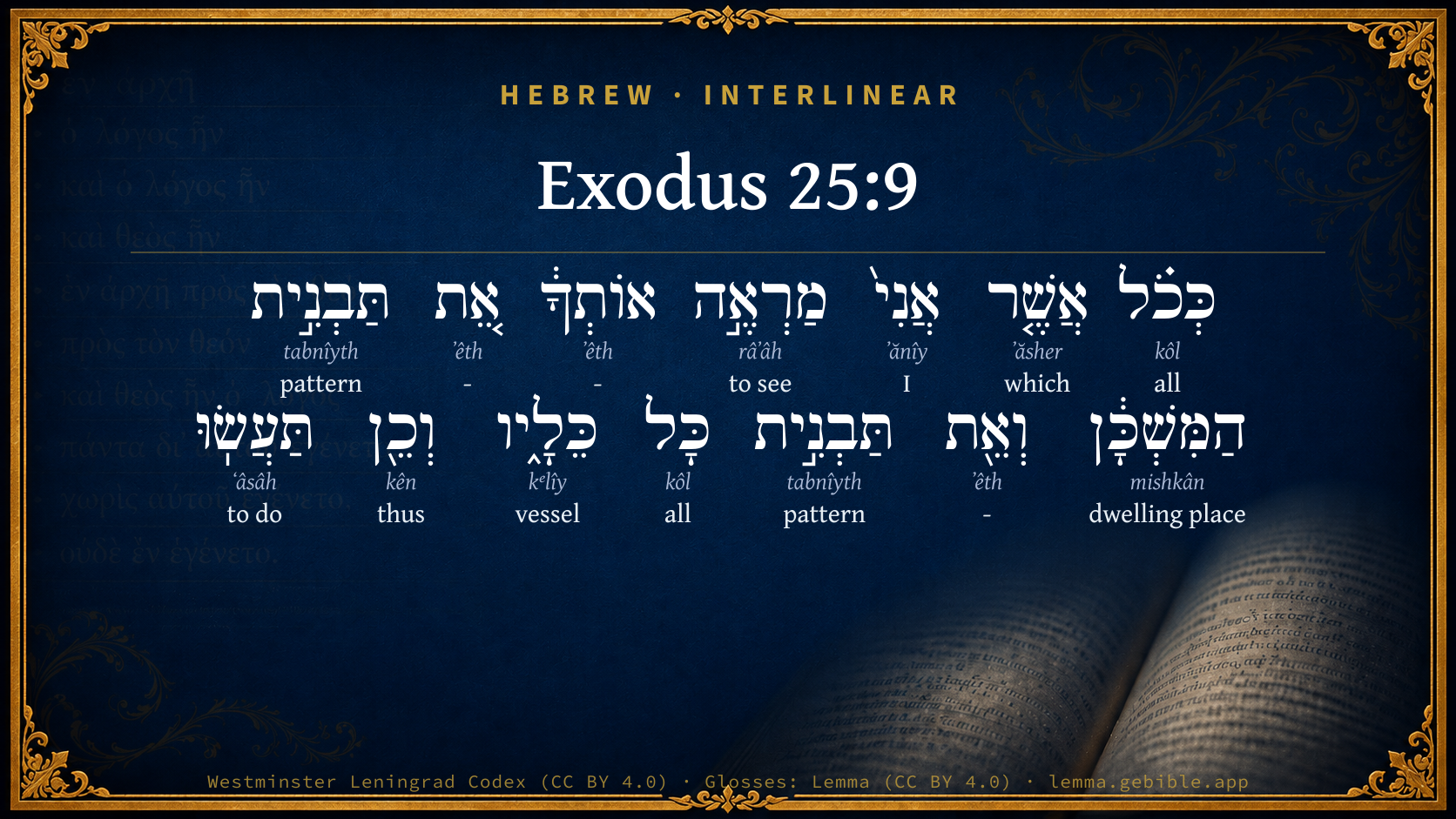
Exodus 25:9

Hebrew (Westminster Leningrad Codex) Exodus 25:9 appears in the Hebrew Old Testament. The text above is from the Westminster Leningrad Codex. Each word links to its Strong’s number, a concise gloss, and parsing drawn from the Open Scriptures Hebrew Bible morphology. Click any word for its full Brown-Driver-Briggs (BDB) entry.
Download image
Cite this verse

Exodus 25:9 (World English Bible). Public Domain. Lemma interlinear Bible study tool, https://lemma.gebible.app/v/exodus/25/9.

Show BibTeX & RIS
BibTeX
RIS
English Translation
According to all that I show you, the pattern of the tent, and the pattern of all of its furniture, even so you shall make it.
World English Bible · Public Domain
Highlights
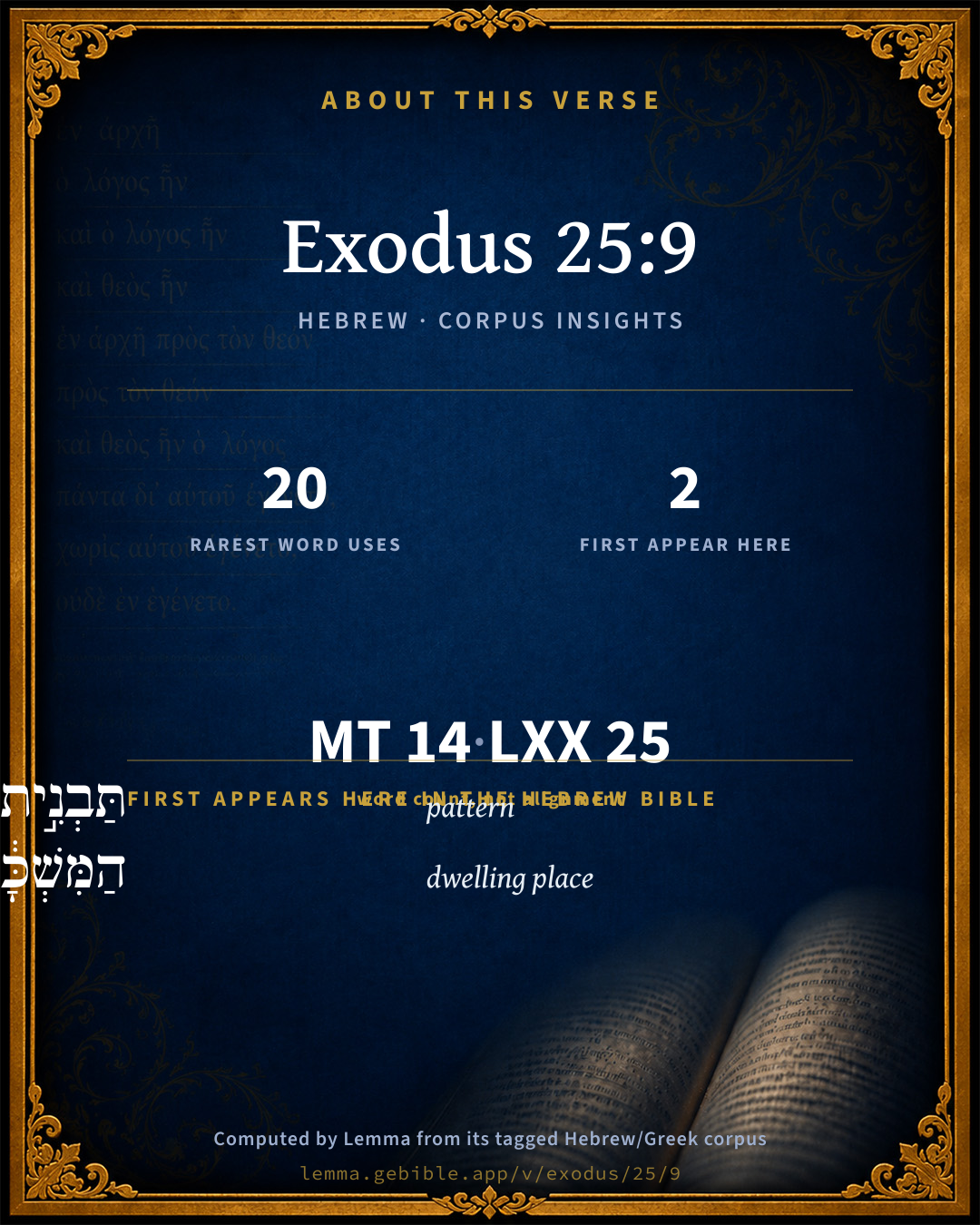
  • 2 first appearances in the Hebrew Bible
Full analysis ↓
Download a study sheet

One document with this verse’s original text, its word-by-word gloss line, the meaning frame, cross-references with their text, attributed commentary, and full source and license credits — printable, and it pastes into notes with its structure intact.

This verse Autodidact and up

Study sheet (.html) Plain text (.txt)

A passage Seminary Student

Up to 50 verses in one chapter. A passage sheet keeps up to 6 commentary sources and 12 cross-references per verse, in the order this page ranks them, and says so on the sheet whenever that leaves anything out. Ask for a single verse and you get the Autodidact verse sheet above.

Everything on this page stays free to read, with no account — the sheet is a download of what is already on screen, not access to it.

Want to remove ads? Support Godless Engineer
Compare translations 3

The same verse in 3 English versions, stacked beneath the original-language interlinear above. Click any original word for its lexicon entry.

Each is an independent rendering of the whole verse — the interlinear is not word-aligned to these translations.

Highlighted words mark where these versions differ — a whole-verse word diff, not a word-by-word alignment.

  • World English Bible Public Domain
    According to all that I show you, the pattern of the tent, and the pattern of all of its furniture, even so you shall make it.
  • King James Version Public Domain
    According to all that I show thee, after the pattern of the tabernacle, and the pattern of all the instruments thereof, even so shall ye make it.
  • unfoldingWord Literal Text CC BY-SA 4.0
    according to all that I am about to show you—the pattern of the Dwelling and the pattern of all of its utensils—and thus you shall make it.

unfoldingWord Literal Text — © unfoldingWord, licensed CC BY-SA 4.0. Word-aligned USFM3 via Door43 (git.door43.org/unfoldingWord/en_ult).

Versions to compare (up to 4)

3 of 4 selected

Show all 18 translations

Every available English version of this verse, each an independent rendering of the whole verse.

  • World English Bible Public Domain
    According to all that I show you, the pattern of the tent, and the pattern of all of its furniture, even so you shall make it.
  • Berean Standard Bible Public Domain
    You must make the tabernacle and design all its furnishings according to the pattern I show you.
  • Majority Standard Bible Public Domain
    You must make the tabernacle and design all its furnishings according to the pattern I show you.
  • King James Version Public Domain
    According to all that I show thee, after the pattern of the tabernacle, and the pattern of all the instruments thereof, even so shall ye make it.
  • American Standard Version (1901) Public Domain
    According to all that I show thee, the pattern of the tabernacle, and the pattern of all the furniture thereof, even so shall ye make it.
  • Revised Version (1885) Public Domain
    According to all that I shew thee, the pattern of the tabernacle, and the pattern of all the furniture thereof, even so shall ye make it.
  • Geneva Bible (1599) Public Domain
    According to all that I shewe thee, euen so shall ye make the forme of the Tabernacle, and the facion of all the instruments thereof.
  • Douay-Rheims (1899) Public Domain
    According to all the likeness of the tabernacle which I will shew thee, and of all the vessels for the service thereof: and thus you shall make it:
  • Young's Literal Translation Public Domain
    according to all that which I am shewing thee, the pattern of the tabernacle, and the pattern of all its vessels, even so ye do make `it'.
  • Literal Standard Version CC BY-SA 4.0
    according to all that which I am showing you, the pattern of the Dwelling Place, and the pattern of all its vessels, even so you make [it].
  • Unlocked Literal Bible CC BY-SA 4.0
    You must make it exactly as I will show you in the plans for the tabernacle and for all its equipment.
  • unfoldingWord Literal Text CC BY-SA 4.0
    according to all that I am about to show you—the pattern of the Dwelling and the pattern of all of its utensils—and thus you shall make it.
  • Darby Bible Public Domain
    According to all that I shall shew thee, the pattern of the tabernacle, and the pattern of all the utensils thereof, even so shall ye make [it].
  • World Messianic Bible Public Domain
    According to all that I show you, the pattern of the tabernacle, and the pattern of all of its furniture, even so you shall make it.
  • Webster's Bible Public Domain
    According to all that I show thee after the pattern of the tabernacle, and the pattern of all its instruments, even so shall ye make it.
  • Free Bible Version CC BY-SA 4.0
    You must make the Tabernacle and all its furnishings according to the design I'm going to show you.
  • Bible in Basic English Public Domain
    Make the House and everything in it from the designs which I will give you.
  • JPS Tanakh (1917) Public Domain
    According to all that I show thee, the pattern of the tabernacle, and the pattern of all the furniture thereof, even so shall ye make it.

Literal Standard Version (2020), Covenant Press — licensed CC BY-SA 4.0. Text via the HelloAO Bible API (eBible.org). Unlocked Literal Bible (unfoldingWord) — licensed CC BY-SA 4.0. Text via the HelloAO Bible API (eBible.org). unfoldingWord Literal Text — © unfoldingWord, licensed CC BY-SA 4.0. Word-aligned USFM3 via Door43 (git.door43.org/unfoldingWord/en_ult). Free Bible Version, Dr. Jonathan Gallagher — licensed CC BY-SA 4.0. Text via the HelloAO Bible API (eBible.org).

Word by word

More ways to search: Search by grammar → Find every occurrence → Compare this word →

Practice this passage: Drill this verse → Learn its vocabulary →

תַּבְנִ֣ית
tabnîyth
H8403
“pattern of”
Noun, Common, Feminine, Singular, Construct
Part of Speech
Noun
Type
Common
Gender
Feminine
Number
Singular
State
Construct
Full BDB Definition

Origin: from H1129

TWOT: 255d

pattern, plan, form, construction, figure - construction, structure - meaning dubious - pattern - figure, image (of idols)
  1. כְּכֹ֗ל kôl H3605 “like/as · all” Preposition + Noun, Common, Masculine, Singular, Absolute
  2. אֲשֶׁ֤ר ʼăsher H834 “which” Particle, Relative
  3. אֲנִי֙ ʼănîy H589 “I” Pronoun, Personal, 1st Person, Common, Singular
  4. מַרְאֶ֣ה râʼâh H7200 “seeing” Verb, Hiphil, Participle Active, Masculine, Singular, Absolute
  5. אוֹתְךָ֔ ʼêth H853 “- · you” Particle, Direct Object + Suffix, Personal, 2nd Person, Masculine, Singular
  6. אֵ֚ת ʼêth H853 “-” Particle, Direct Object
  7. הַמִּשְׁכָּ֔ן mishkân H4908 “the · dwelling place” Particle, Definite Article + Noun, Common, Masculine, Singular, Absolute
  8. וְאֵ֖ת ʼêth H853 “and · -” Conjunction + Particle, Direct Object
  9. תַּבְנִ֣ית tabnîyth H8403 “pattern of” Noun, Common, Feminine, Singular, Construct
  10. כָּל kôl H3605 “all of” Noun, Common, Masculine, Singular, Construct
  11. כֵּלָ֑יו kᵉlîy H3627 “vessels · his” Noun, Common, Masculine, Plural, Construct + Suffix, Personal, 3rd Person, Masculine, Singular
  12. וְכֵ֖ן kên H3651 “and · thus” Conjunction + Particle, Demonstrative
  13. תַּעֲשֽׂוּ ʻâsâh H6213 “to do” Verb, Qal, Imperfect, 2nd Person, Masculine, Plural

About this verse

These counts appear in no published source. They are computed here, from the morphology-tagged text and Lemma’s own curated glosses. What Lemma adds →

14
words
10
distinct lemmas
Pentateuch
section

Notable vocabulary

The rarest word here is תַּבְנִ֣ית pattern H8403 — appearing just 20 times in the whole Hebrew Bible.

First appearance in Scripture

These words make their first canonical appearance in the Hebrew Bible here:

  • תַּבְנִ֣ית pattern H8403
  • הַמִּשְׁכָּ֔ן dwelling place H4908

Shared distinctive vocabulary

תַּבְנִ֣ית pattern H8403 occurs in 17 verses of the Hebrew Bible. Also found in:

Grammatical profile

  • 2 verbs
  • 6 nouns
  • 1 pronoun
  • 5 particles

Verb forms

  • מַרְאֶ֣ה Hiphil · Participle Active
  • תַּעֲשֽׂוּ Qal · Imperfect

Repetition

Words recur within this verse — often emphatic in Hebrew:

  • כְּכֹ֗ל all H3605 ×2
  • תַּבְנִ֣ית pattern H8403 ×2

Hebrew & Septuagint length

In English translation the verse runs 26 words from the Hebrew and 35 from the Septuagint (LXX English) — closely comparable.

A rough comparison of the two English renderings, which tokenize alike — not a word-level alignment.

Word counts can differ between the Hebrew and the Greek without any difference in meaning — e.g. the Hebrew direct-object marker אֵת has no separate Greek word, and Greek often adds the article ὁ.

In the original languages it is 14 Hebrew tokens and 25 Greek tokens — but the two are counted differently (Hebrew bundles its prefixes and suffixes into one token; the Greek is in lemma form), so that isn’t a like-for-like length.

Cross-references

5

Topical passages linked to Exodus 25:9 in the Treasury of Scripture Knowledge — connected by theme and wording, ordered by reader-vote popularity; previews shown in the World English Bible.

  • Exodus 25:40 See that you make them after their pattern, which has been shown to you on the mountain.
  • Hebrews 8:5 who serve a copy and shadow of the heavenly things, even as Moses was warned by God when he was about to make the tabernacle, for he said, "See, you shall make everything according to the pattern that was shown to you on the mountain."
  • Acts 7:44 "Our fathers had the tent of the testimony in the wilderness, even as he who spoke to Moses commanded him to make it according to the pattern that he had seen;
  • Hebrews 9:9 which is a symbol of the present age, where gifts and sacrifices are offered that are incapable, concerning the conscience, of making the worshipper perfect;
  • 1 Chronicles 28:11–19 Then David gave to Solomon his son the pattern of the porch [of the temple], and of the houses of it, and of the treasuries of it, and of the upper rooms of it, and of the inner chambers of it, and of the place of the mercy seat;

Cross-references courtesy of OpenBible.info (CC BY 4.0).

Hebrew and Greek witnesses Masoretic Hebrew ↔ Greek Septuagint

The same verse in the two great witnesses to the Old Testament, shown verse-for-verse.

These are two independent witnesses, not word-aligned to each other, and the Septuagint is shown in lemma (dictionary) form.

Hebrew Exodus 25:9 Masoretic · Westminster Leningrad Codex

כְּכֹ֗ל אֲשֶׁ֤ר אֲנִי֙ מַרְאֶ֣ה אוֹתְךָ֔ אֵ֚ת תַּבְנִ֣ית הַמִּשְׁכָּ֔ן וְאֵ֖ת תַּבְנִ֣ית כָּל כֵּלָ֑יו וְכֵ֖ן תַּעֲשֽׂוּ

According to all that I show you, the pattern of the tent, and the pattern of all of its furniture, even so you shall make it.

World English Bible · Public Domain

Greek LXX Exodus 25:9 Septuagint · lemma form

καί ποιέω ἐγώ κατά πᾶς ὅσος ἐγώ σύ δεικνύω ἐν ὁ ὄρος ὁ παράδειγμα ὁ σκηνή καί ὁ παράδειγμα πᾶς ὁ σκεῦος αὐτός οὕτως ποιέω

And you shall make for me according to all things which I show you in the mountain; even the pattern of the tabernacle, and the pattern of all its furniture: so shall you make it.

LXX2012 (modern English Septuagint) · Public Domain

On this verse, The Cambridge Bible for Schools and Colleges discusses the Septuagint’s reading. Read the note in Commentary ↓

Hebrew: Westminster Leningrad Codex (CC BY 4.0). Greek: Septuagint (public domain); English from LXX2012 (modern English Septuagint) (Public Domain). How the Septuagint differs from the Hebrew →

Targum (Aramaic paraphrase)

2

The Targum is the ancient Jewish Aramaic paraphrase of the Hebrew Scriptures — an interpretive translation, not the Hebrew text itself. Onkelos (literal) and Pseudo-Jonathan (expansive) render the Torah, and Jonathan the Prophets. Coverage is partial: where no permissively-licensed English translation exists for a verse, only the Aramaic is shown. This is verse-level text, not a word-by-word alignment to the Hebrew.

  1. Targum Onkelos Torah (Genesis–Deuteronomy)
    כְּכֹל דִי אֲנָא מַחֲזֵי יָתָךְ יָת דְמוּת מַשְׁכְּנָא וְיָת דְמוּת כָּל מָנוֹהִי וְכֵן תַּעְבְּדוּן:

    (no public-domain English translation for this verse)

    Targum Onkelos — Aramaic: “Onkelos Genesis” (public domain); “Onkelos Exodus” (public domain); “Onkelos Leviticus” (public domain); “Onkelos Numbers” (public domain); “Onkelos Deuteronomy” (public domain). English: “Sefaria Community Translation” (CC0 1.0 (public-domain dedication)); “J.W. Etheridge. The Targums of Onkelos and Jonathan Ben Uzziel on the Pentateuch. London: Longmans, Green, 1862” (public domain). Text via Sefaria.

  2. Targum Pseudo-Jonathan Torah (Genesis–Deuteronomy)
    כְּכָל מַה דַּאֲנָא מַחֲמֵי יָתָךְ יַת צוּרַת מַשְׁכְּנָא וְיַת צוּרַת כָּל מָנוֹי וְהֵיכְדֵין תַּעַבְדוּן

    According to all that I show thee, the likeness of the tabernacle and the likeness of all its vessels, so shalt thou make.

    Targum Pseudo-Jonathan — Aramaic: “Targum Jonathan on Genesis” (public domain); “Targum Jonathan on Exodus” (public domain); “Targum Jonathan on Leviticus” (public domain); “Targum Jonathan on Numbers” (public domain); “Targum Jonathan on Deuteronomy” (public domain). English: “The Targum of Jonathan ben Uzziel, trans. J. W. Etheridge, London, 1862” (public domain). Text via Sefaria.

Commentary

Notes on Exodus 25:9 from classic Christian and Jewish commentators (each source and its license shown beneath its notes). The classic Christian expositions comment on the surrounding passage and are grouped to its opening verse, so a note may address several verses; the Jewish commentaries on the Tanakh (Rashi and others) are per-verse, so they appear only where the commentator wrote on this verse.

Lemma curates 59 commentaries, every one of them public domain or Creative Commons licensed, each selected and text-cleaned for this edition rather than reprinted as found. About our sources →

Trapp's Complete Commentary

John Trapp

Exo 25:9 According to all that I shew thee, [after] the pattern of the tabernacle, and the pattern of all the instruments thereof, even so shall ye make [it].

Ver. 9. According to all that I show thee.] Nothing was left to man’s invention. Here then is no footing for the Popish pomp.

John Trapp, A Commentary or Exposition upon All the Books of the Old and New Testament (1647–1656) — public domain. Text from a community e-Sword module.

Joseph Benson's Commentary

Exo 25:9. According to all that I show thee — God showed him an exact plan of it in little, which he must conform to in all points. And God did not only show him the model, but gave him also particular directions how to frame the tabernacle, according to that model, in all the parts of it. When Moses was to describe the creation of the world, though it be such a stately and curious fabric, yet he gave a very short and general account of it; but when he comes to describe the tabernacle, he doth it with the greatest niceness and accuracy imaginable; for God’s church and instituted religion are more precious to him than all the rest of the world. And all the Scriptures were written, not to describe to us the works of nature, (a general view of which is sufficient to lead us to a knowledge of the Creator,) but to acquaint us with the methods of grace, and those things which are purely matters of revelation.

Joseph Benson's Commentary on the Old and New Testaments (1811–1818) — public domain. Text from a community e-Sword module.

Tyndale Open Study Notes

Tyndale Open Resources

25:9 exactly according to the pattern: We do not determine for ourselves how we want to come into the presence of a holy God. If we come into his presence at all, it will be on his terms and in accord with his desires and character.

Tyndale Open Study Notes — © Tyndale Open Resources, licensed CC BY-SA 4.0. Text via the HelloAO Bible API.

Jamieson, Fausset & Brown

Robert Jamieson, A. R. Fausset & David Brown

According to all that I show thee, after the pattern of the tabernacle--The proposed erection could be, in the circumstances of the Israelites, not of a fixed and stable but of a temporary and movable description, capable of being carried about with them in their various sojournings. It was made after "the pattern" shown to Moses, by which is now generally understood, not that it was an unheard-of novelty, or an entirely original structure, for it is ascertained to have borne resemblance in form and arrangements to the style of an Egyptian temple, but that it was so altered, modified, and purified from all idolatrous associations, as to be appropriated to right objects, and suggestive of ideas connected with the true God and His worship.

Jamieson, Fausset & Brown — Commentary Critical and Explanatory on the Whole Bible (1871) — public domain (CC PDM 1.0). Text via the HelloAO Bible API.

Adam Clarke's Commentary

Verse 9. After the pattern of the tabernacle] It has been supposed that there had been a tabernacle before that erected by Moses, though it probably did not now exist; but the tabernacle which Moses is ordered to make was to be formed exactly on the model of this ancient one, the pattern of which God showed him in the mount, Ex 25:40. The word משכן mishcan signifies literally the dwelling or habitation; and this was so called because it was the dwelling place of God; and the only place on the earth in which he made himself manifest. See Clarke on Ex 25:40, and on Ex 33:7-10.

Adam Clarke's Commentary on the Bible (1810–1826) — public domain. Text from a community e-Sword/MySword module.

Ellicott's Commentary for English Readers

(9) The pattern.—It has been maintained that God shewed to Moses (1) a material structure, furnished with material objects, as the model which he was to follow in making the Tabernacle and its appurtenances; (2) a pictorial representation of the whole; (3) a series of visions in which the forms were represented to the eye of the mind. The entire analogy of the Divine dealings is in favour of the last-mentioned view.

A Bible Commentary for English Readers, edited by Charles John Ellicott (1878–1897) — public domain. Text from a community e-Sword module.

The Cambridge Bible for Schools and Colleges

gen. ed. J. J. S. Perowne

9. The sanctuary is to be constructed in accordance with a model shewn to Moses in the mount (v. 40, Exo_26:30, Exo_27:8; Num_8:4). Gudea, king of Lagash (c. 3000 b.c.), was shewn in a dream, by the goddess Nina, the complete model of a temple which he was to erect in her honour: gold, precious stones, cedar, and other materials for the purpose were collected by him from the most distant countries (Rogers, Hist. of Bab. and Ass. i. 369 f.; Maspero, i. 610 f.).

the tabernacle] the Dwelling, Heb. mishkân, cognate with the verb rendered ‘dwell’ in v. 8. In AV. the word ‘tabernacle’ (derived from the tabernaculum of the Vulg., and therefore meaning properly simply a ‘tent’), through a confusion originating with the LXX. (who in the Pent. rendered both words by σκηνή), was used indiscriminately for ’ôhel (‘tent’) and mishkân (‘dwelling’): in RV. the distinction has been preserved by rendering ’ôhel ‘tent,’ and mishkân ‘tabernacle.’ This is undoubtedly a great improvement: the retention of ‘tabernacle’ for mishkân has, however, the disadvantage of obliterating the connexion between mishkân, ‘dwelling,’ and the cognate verb shâkan, to ‘dwell.’ Dwelling would have been the better rend. for mishkân throughout.

As regards mishkân, it is to be observed that it is used in P in both in narrower and a wider sense. In its narrower, and stricter sense, it is used of the tapestry curtains with their supporting frames, which constituted the ‘Dwelling’ par excellence (see Exo_26:1; Exo_26:6; Exo_26:15; and cf. Exo_40:2; Exo_40:6, Num_3:25); but in its wider sense it is extended so as to be a general term for the entire fabric of the sanctuary, including the ‘tent’ and other coverings (Exo_26:7; Exo_26:14) over the ‘Dwelling’ (so here, Num_16:9; Num_17:13, and elsewhere). Mishkân, in one or other of these technical senses, occurs about 100 times in P; and is used similarly a few times to Chr. (as 1Ch_6:32; 1Ch_16:39): otherwise the word is rare, and mostly poetical. The commonest expression (about 130 times) for the sanctuary as a whole is, however, the ‘Tent of Meeting’ (see on Exo_27:21).

furniture] The wide term explained on Exo_22:7, and including here all articles, vessels, utensils, &c., belonging to the sanctuary.

10–22 (cf. Exo_37:1-9). The Ark, the most sacred and important of the articles contained in the sanctuary. The ark, as described by P, is an oblong chest of acacia wood, overlaid within and without with gold, about 3 ft. 9 in. long, 2 ft. 3 in. wide, and 2 ft. 3 in. deep; each of sides is finished with a rim, or moulding, of solid gold; and for its transport it is provided with two poles of acacia wood, overlaid with gold, which pass through four rings, attached to its four feet. Distinct from the ark, but resting upon it, is the ‘mercy-seat,’ or ‘propitiatory,’ a slab of solid gold, of the same length and breadth as the ark (its thickness is not stated): and near the ends of this, soldered securely into it, and facing each other, with their wings spread out over the mercy-seat, stand two small emblematic figures, the cherubim, made of beaten gold. Inside the ark are the two tables upon which the Decalogue is inscribed. From between the cherubim above the mercy-seat Jehovah ‘meets’ Moses, and speaks with him (Exo_25:22, Exo_30:6, Num_7:89).

The Cambridge Bible for Schools and Colleges (gen. ed. J. J. S. Perowne; Cambridge University Press, 1878–1918) — public domain. Text from a community e-Sword module.

John Gill's Exposition

According to all that I show thee,.... That is, the sanctuary was to be made in all respects exactly according to the view of it that Moses now had upon the mount from God, and which he was to communicate to the workmen for their instruction and direction:

after the pattern of the tabernacle, and of the pattern of all the instruments thereof, even so shall ye make it: and by the "pattern" is not meant an idea of it, impressed on the mind of Moses, or a picture of it which was shown him, but a little edifice representing it in all its parts, a perfect model of it: and so Maimonides (i) says, "Tabnith", the word here used, signifies the structure and disposition of anything, i.e. the form of it in a four square, in roundness, in a triangle, or in any of the like figures, see Heb 8:5 and so David had, by the Spirit, a pattern of the temple, and which he gave to his son Solomon, to build according to it, Ch1 28:11.

(i) Moreh Nevochim, par. 1. c. 3.

John Gill's Exposition of the Whole Bible (1746–1763) — public domain (CC PDM 1.0). Text via the HelloAO Bible API.

Whedon's Commentary on the Bible

Daniel D. Whedon

9. The pattern of the tabernacle — This is most positively represented throughout this entire narrative (comp. Exo_25:40; Exo_26:30; Act_7:44; Heb_8:5) as given to Moses by divine revelation. The notion that it was a fiction of the priests, invented nearly a thousand years after the time of Moses, puts such a withering stamp of falsehood upon this straightforward narrative that it must fail to commend itself to any serious student of history. But when we study out the details, and picture the whole pattern before our eyes — when, further, we consider the striking symbolism of the various objects, and their adaptation to body forth the profoundest truths touching the relations of God and man — we are convinced that the pattern originated not with man, but with God himself. How God showed Moses this model of the tabernacle we are not told. It may have been imaged before him in clear outline, like the sight of the burning bush; or, in a dream of the night it may have been definitely pictured before the soul. We have no need, however, with the rabbins, to suppose that he saw heaven opened, and a material tabernacle there, in form and substance like what he was commanded to make.

Daniel D. Whedon (gen. ed.), Commentary on the Old and New Testaments (1874–1909) — public domain. Text from a community e-Sword module.

The Pulpit Commentary

The patterns. Many of the old Jewish commentators supposed, that Moses was shown by God a real material structure, which actually existed in the heavens, far grander than its earthly copy, after which he was to have the tabernacle fashioned. Some recent Christian writers, without going these lengths, suggest that "an actual picture or model of the earthly tabernacle and its furniture was shown to him" (Keil). But the words of the text, as well as those of Act_7:44, and Heb_8:5, are sufficiently justified, if we take a view less material than either of thesei.e. , if we suppose Moses to have had impressed on his mind, in vision, the exact appearance of the tabernacle and its adjuncts, in such sort that he could both fully understand, and also, when necessary, supplement, the verbal descriptions subsequently given to him. It is unnecessary to inquire how the impression was produced. God who in vision communicated to Ezekiel the entire plan of that magnificent temple which he describes in ch. 40-42., could certainly have made known to Moses, in the same way, the far simpler structure of the primitive Tabernacle.

The Pulpit Commentary (1880–1919), ed. H.D.M. Spence-Jones & Joseph S. Exell — public domain. Text from a community e-Sword module.

John Wesley's Explanatory Notes

According to all that I shew thee - God shewed him an exact plan of it in little, which he must conform to in all points. And God did not only shew him the model, but gave him also particular directions how to frame the tabernacle, according to that model, in all the parts of it. When Moses was to describe the creation of the world, tho' it be such a stately and curious fabrick, yet he gave a very short and general account of it; but when he comes to describe the tabernacle, he doth it with the greatest niceness and accuracy imaginable: for God's church and instituted religion is more precious to him than all the rest of the world. And the scriptures were written not to describe to us the works of nature, (a general view of which is sufficient to lead us to the knowledge of the Creator,) but to acquaint us with the methods of grace, and those things which are purely matters of Revelation.

John Wesley, Explanatory Notes Upon the Whole Bible (1754–1765) — public domain. Text via the GEBible commentary corpus.

Scofield Reference Notes

C. I. Scofield

tabernacle pattern

The tabernacle, speaking comprehensively, is explained in the N.T. as typical in three ways:

(1) of the Church as a habitation of God through the Spirit Exo 25:8; Eph 2:19-22

(2) of the believer 2Co 6:16

(3) as a figure of things in the heavens Heb 9:23; Heb 9:24. In detail, all speaks of Christ:

(1) The ark, in its materials, acacia-wood (See Scofield "Exo 26:15") and gold, is a type of the humanity and deity of Christ.

(2) In its contents, a type of Christ, as:

(a) having God’s law in His heart Exo 25:16. (b) the wilderness food (or portion) of His people Exo 16:33 (c) Himself the resurrection, of which Aaron;s rod is the symbol Num 17:10.

(3) In its use the ark, especially the mercy-seat, was a type of God’s throne. That it was, to the sinning Israelite, a throne of grace and not of judgment was due to the mercy-seat formed of gold and sprinkled with the blood of atonement, which vindicated the law, and divine holiness guarded by the cherubim Gen 3:24

(See Scofield "Eze 1:5") See PROPITIATION, See Scofield "Rom 3:25"

The Scofield Reference Bible (1917 edition), notes by C. I. Scofield — public domain. Text from a community e-Sword module.

Rashi

Rabbi Shlomo Yitzchaki (Rashi)

ככל אשר אני מראה אותך ACCORDING TO ALL THAT I AM SHOWING THEE here, את תבנית המשכן THE PATTERN OF THE DWELLING. — This verse must be connected with the verse that precedes it, thus: And let them make for Me a sanctuary … according to all that I am showing thee (the words ושכנתי בתוכם being a parenthesis).

וכן תעשו AND SO SHALL YE MAKE IT also in future generations (cf. Sanhedrin 16b); if one of the vessels is lost, or when you make for Me the vessels for the “House of Eternity” (another name for the Temple in Jerusalem), — as e. g., the tables, candlesticks, lavers and stands which Solomon had made — you shall make them after the pattern of these (the vessels of the Tabernacle), If, however, the verse were not to be connected with the preceding one but formed a new statement, Scripture ought not to have written: וכן תעשו “and so shall ye make them” but כן תעשו “so shall ye make them” and then it would be speaking of the making of the tent of meeting and its vessels and not of the vessels of the Temple, and the translation would be: according to all that I am showing you the pattern of the Tabernacle and the pattern of all its vessels, even so shall you make them.

Rashi on the Tanakh — English translations: “The Judaica Press complete Tanach with Rashi, translated by A. J. Rosenberg” (CC BY 4.0); “Pentateuch with Rashi's commentary by M. Rosenbaum and A.M. Silbermann, 1929-1934” (public domain); “The Metsudah Tanach series, Lakewood, N.J” (CC BY 4.0); and “The Book of Joshua, Metsudah Publications, 1997” (CC BY 4.0). Text via Sefaria.

Ramban (Nachmanides)

Rabbi Moshe ben Nachman (Ramban / Nachmanides)

AND SO SHALL YE MAKE IT — [also] “in future generations. If one of the vessels is lost, or when you make the vessels of the Sanctuary of Jerusalem, — “the Eternal House.” See in Seder Yithro Note 598. such as the tables,. the candelabrums, Verse 7: And he made the ten candelabrums. the lavers, Verse 6: And he made ten lavers. and the bases which Solomon made — after the pattern of these you shall make them. If, however, this [part of the verse] were not connected with the preceding part [which reads: According to all that I show thee, the pattern of the Tabernacle, and the pattern of all the vessels], Scripture should not have written: ‘and’ so shall ye make it, but: “so shall ye make it,” and then it would be speaking of the making of the Tent of Meeting, the expression is not set apart from the preceding part of the verse but is connected with it, thus: “and” so shall you make the pattern of all the furniture of the Sanctuary. and its vessels.” Thus is Rashi’s language. But I do not know if this is true, that Solomon was bound to make the vessels of the Sanctuary of Jerusalem — “the Eternal House.” See in Seder Yithro Note 598. after the pattern of these vessels [of the Tabernacle]. The altar of brass which Solomon made was twenty cubits long and twenty wide! And Rabbi Abraham ibn Ezra wrote: “And so shall ye make — the vessels, thus refers only to the pattern of all the furniture (mentioned right above), but does not refer to the pattern of the Tabernacle since the term “making” was already stated with reference to it, namely, and let them ‘make’ Me a Sanctuary. for at the beginning He said, And let them make Me a Sanctuary.” In line with the plain meaning of Scripture there is no need for all this. Rather, the duplication [and so shall ye make it] has the purpose of expressing emphasis and eagerness. Thus He said: “And let them make Me a Sanctuary” — a house and vessels — as a Royal Sanctuary and seat of Majesty, that I may dwell in the midst of them in the house and on the Throne of Glory which they will make for Me there. According to all that I show thee the pattern of this Tabernacle of which I have said that I will dwell in the midst of them, and the pattern of all the vessels thereof. He repeated, and so shall ye all make it with eagerness and diligence. This is similar to the repetition found in the verse, and the children of Israel did according to all that the Eternal commanded Moses, so did they. Here, because the verse speaks of a command, it says, and so ‘shall’ ye make it, [whereas in the other verse the repeat states so ‘did’ they, because it speaks of a deed accomplished].

Ramban (Nachmanides) on the Tanakh — English translation: “Commentary on the Torah by Ramban (Nachmanides). Translated and annotated by Charles B. Chavel. New York, Shilo Pub. House, 1971-1976” (CC BY 4.0). Text via Sefaria.

Lesson kit

Teaching starters — assembled from the data on this page, not authored interpretation. Every prompt links to the verse data it draws on. Edit before teaching.

Exodus, in the Pentateuch, opens this verse with 14 words (10 distinct Hebrew lemmas). Its most distinctive word is tabnîyth (“pattern”). A historical commentator’s framing appears above. Read the whole chapter for the surrounding context.

Discussion questions

  1. What does “pattern” (tabnîyth) contribute to the verse as a whole?
  2. 2 words here appear for the first time in Scripture. What is being introduced at this debut?
  3. Exodus 25:40 shares the word «pattern» with this verse. How do the two illuminate each other?
  4. “all” occurs 2× in this one verse. What is the effect of the repetition?
  5. These translations render this verse differently; the difference is in the English rendering, not the original. What questions does that raise?
  6. The verb «מַרְאֶ֣ה» is Hiphil Participle Active. How does its form color the action?
  7. Reading how Trapp's Complete Commentary and Joseph Benson's Commentary read this verse, where do the two commentators agree and where do they part?

Things to notice

Reading settings

Reading text

Shown beneath each verse's original-language words.

Old Testament
Old Testament edition

Read the OT as the Masoretic Hebrew (MT) or the Greek Septuagint (LXX).

English shown for the Greek Septuagint (in the Hebrew ↔ Greek comparison).

Comparing translations? Open the Compare panel on any verse page to stack up to four side by side.