
2 Kings 1:10

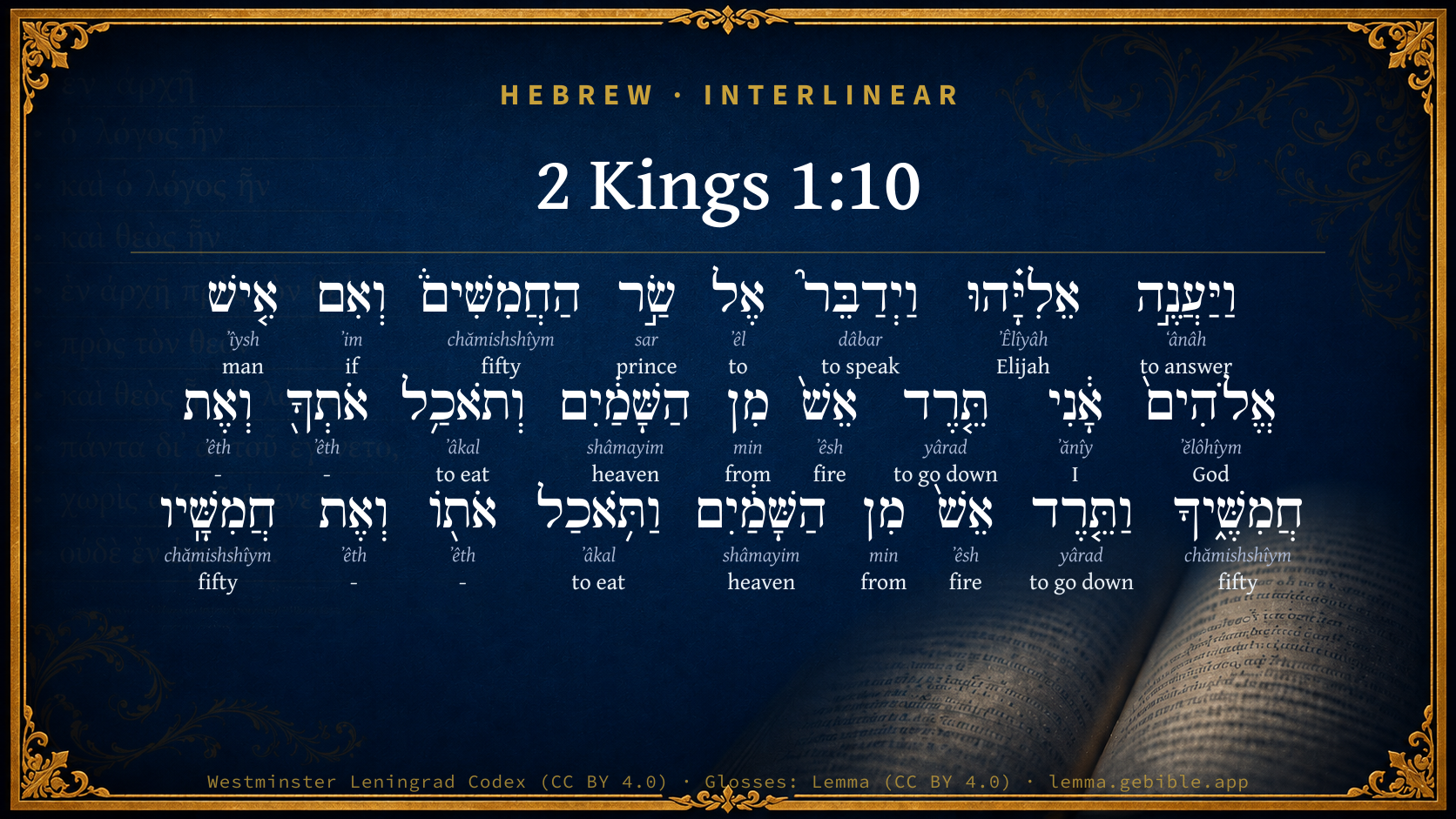
Hebrew (Westminster Leningrad Codex) 2 Kings 1:10 appears in the Hebrew Old Testament. The text above is from the Westminster Leningrad Codex. Each word links to its Strong’s number, a concise gloss, and parsing drawn from the Open Scriptures Hebrew Bible morphology. Click any word for its full Brown-Driver-Briggs (BDB) entry.
Download image
Cite this verse

2 Kings 1:10 (World English Bible). Public Domain. Lemma interlinear Bible study tool, https://lemma.gebible.app/v/2-kings/1/10.

Show BibTeX & RIS
BibTeX
RIS
English Translation
Elijah answered to the captain of fifty, If I be a man of God, let fire come down from the sky, and consume you and your fifty. Fire came down from the sky, and consumed him and his fifty.
World English Bible · Public Domain
Download a study sheet

One document with this verse’s original text, its word-by-word gloss line, the meaning frame, cross-references with their text, attributed commentary, and full source and license credits — printable, and it pastes into notes with its structure intact.

This verse Autodidact and up

Study sheet (.html) Plain text (.txt)

A passage Seminary Student

Up to 50 verses in one chapter. A passage sheet keeps up to 6 commentary sources and 12 cross-references per verse, in the order this page ranks them, and says so on the sheet whenever that leaves anything out. Ask for a single verse and you get the Autodidact verse sheet above.

Everything on this page stays free to read, with no account — the sheet is a download of what is already on screen, not access to it.

Want to remove ads? Support Godless Engineer
Compare translations 3

The same verse in 3 English versions, stacked beneath the original-language interlinear above. Click any original word for its lexicon entry.

Each is an independent rendering of the whole verse — the interlinear is not word-aligned to these translations.

Highlighted words mark where these versions differ — a whole-verse word diff, not a word-by-word alignment.

  • World English Bible Public Domain
    Elijah answered to the captain of fifty, If I be a man of God, let fire come down from the sky, and consume you and your fifty. Fire came down from the sky, and consumed him and his fifty.
  • King James Version Public Domain
    And Elijah answered and said to the captain of fifty, If I be a man of God, then let fire come down from heaven, and consume thee and thy fifty. And there came down fire from heaven, and consumed him and his fifty.
  • unfoldingWord Literal Text CC BY-SA 4.0
    And Elijah answered and said to the captain of the fifty, “And if I a man of God, let fire come down from the heavens, and let it consume you and your fifty.” And fire came down from the heavens, and it consumed him and his fifty.

unfoldingWord Literal Text — © unfoldingWord, licensed CC BY-SA 4.0. Word-aligned USFM3 via Door43 (git.door43.org/unfoldingWord/en_ult).

Versions to compare (up to 4)

3 of 4 selected

Show all 18 translations

Every available English version of this verse, each an independent rendering of the whole verse.

  • World English Bible Public Domain
    Elijah answered to the captain of fifty, If I be a man of God, let fire come down from the sky, and consume you and your fifty. Fire came down from the sky, and consumed him and his fifty.
  • Berean Standard Bible Public Domain
    Elijah answered the captain, “If I am a man of God, may fire come down from heaven and consume you and your fifty men.” And fire came down from heaven and consumed the captain and his fifty men.
  • Majority Standard Bible Public Domain
    Elijah answered the captain, “If I am a man of God, may fire come down from heaven and consume you and your fifty men.” And fire came down from heaven and consumed the captain and his fifty men.
  • King James Version Public Domain
    And Elijah answered and said to the captain of fifty, If I be a man of God, then let fire come down from heaven, and consume thee and thy fifty. And there came down fire from heaven, and consumed him and his fifty.
  • American Standard Version (1901) Public Domain
    And Elijah answered and said to the captain of fifty, If I be a man of God, let fire come down from heaven, and consume thee and thy fifty. And there came down fire from heaven, and consumed him and his fifty.
  • Revised Version (1885) Public Domain
    And Elijah answered and said to the captain of fifty, If I be a man of God, let fire come down from heaven, and consume thee and thy fifty. And there came down fire from heaven, and consumed him and his fifty.
  • Geneva Bible (1599) Public Domain
    But Eliiah answered, and saide to the captaine ouer the fiftie, If that I be a man of God, let fire come downe from the heauen, and deuoure thee and thy fiftie. So fire came downe from the heauen and deuoured him and his fiftie.
  • Douay-Rheims (1899) Public Domain
    And Elias answering, said to the captain of fifty: If I be a man of God, let fire come down from heaven, and consume thee, and thy fifty. And there came down fire from heaven, and consumed him, and the fifty that were with him.
  • Young's Literal Translation Public Domain
    And Elijah answereth and speaketh unto the head of the fifty, `And if I `am' a man of God, fire doth come down from the heavens, and consume thee and thy fifty;' and fire cometh down from the heavens, and consumeth him and his fifty.
  • Literal Standard Version CC BY-SA 4.0
    And Elijah answers and speaks to the head of the fifty, “And if I [am] a man of God, fire comes down from the heavens and consumes you and your fifty”; and fire comes down from the heavens and consumes him and his fifty.
  • Unlocked Literal Bible CC BY-SA 4.0
    Elijah answered and said to the captain, “If I am a man of God, let fire come down from heaven and consume you and your fifty men.” Then fire came down from heaven and consumed him and his fifty men.
  • unfoldingWord Literal Text CC BY-SA 4.0
    And Elijah answered and said to the captain of the fifty, “And if I a man of God, let fire come down from the heavens, and let it consume you and your fifty.” And fire came down from the heavens, and it consumed him and his fifty.
  • Darby Bible Public Domain
    And Elijah answered and said to the captain of fifty, And if I be a man of God, let fire come down from the heavens and consume thee and thy fifty. And there came down fire from the heavens, and consumed him and his fifty.
  • World Messianic Bible Public Domain
    Elijah answered to the captain of fifty, “If I am a man of God, then let fire come down from the sky and consume you and your fifty!” Then fire came down from the sky, and consumed him and his fifty.
  • Webster's Bible Public Domain
    And Elijah answered and said to the captain of fifty, If I am a man of God, then let fire come down from heaven, and consume thee and thy fifty. And there came down fire from heaven, and consumed him and his fifty.
  • Free Bible Version CC BY-SA 4.0
    Elijah replied to the captain, “If I am a man of God, then let fire fall from heaven and burn up you and your fifty men.” Fire fell from heaven and burned up the captain and his men.
  • Bible in Basic English Public Domain
    And Elijah in answer said to the captain of fifty, If I am a man of God, may fire come down from heaven on you and on your fifty men, and put an end to you. Then fire came down from heaven and put an end to him and his fifty men.
  • JPS Tanakh (1917) Public Domain
    And Elijah answered and said to the captain of fifty: 'If I be a man of God, let fire come down from heaven, and consume thee and thy fifty.' And there came down fire from heaven, and consumed him and his fifty.

Literal Standard Version (2020), Covenant Press — licensed CC BY-SA 4.0. Text via the HelloAO Bible API (eBible.org). Unlocked Literal Bible (unfoldingWord) — licensed CC BY-SA 4.0. Text via the HelloAO Bible API (eBible.org). unfoldingWord Literal Text — © unfoldingWord, licensed CC BY-SA 4.0. Word-aligned USFM3 via Door43 (git.door43.org/unfoldingWord/en_ult). Free Bible Version, Dr. Jonathan Gallagher — licensed CC BY-SA 4.0. Text via the HelloAO Bible API (eBible.org).

Word by word

More ways to search: Search by grammar → Find every occurrence → Compare this word →

Practice this passage: Drill this verse → Learn its vocabulary →

אֵלִיָּ֗הוּ
ʼÊlîyâh
H452
“Elijah”
Noun, Proper
Part of Speech
Noun
Type
Proper
Full BDB Definition

Origin: from H410 and H3050

TWOT: None

Elijah or Eliah = "my God is Jehovah" or " Yah(u) is God" - the great prophet of the reign of Ahab - Benjamite son of Jeroham - a son of Elam with foreign wife during exile - a son of Harim, and priest, with foreign wife during exile
  1. וַיַּעֲנֶ֣ה ʻânâh H6030 “and · to answer” Conjunction + Verb, Qal, Sequential Imperfect, 3rd Person, Masculine, Singular
  2. וַיְדַבֵּר֮ dâbar H1696 “and · to speak” Conjunction + Verb, Piel, Sequential Imperfect, 3rd Person, Masculine, Singular
  3. אֶל ʼêl H413 “to” Preposition
  4. שַׂ֣ר sar H8269 “prince of” Noun, Common, Masculine, Singular, Construct
  5. הַחֲמִשִּׁים֒ chămishshîym H2572 “the · fifty” Particle, Definite Article + Adjective, Cardinal number, Both, Plural, Absolute
  6. וְאִם ʼim H518 “and · if” Conjunction + Conjunction
  7. אִ֤ישׁ ʼîysh H376 “man of” Noun, Common, Masculine, Singular, Construct
  8. אֱלֹהִים֙ ʼĕlôhîym H430 “God(s)” Noun, Common, Masculine, Plural, Absolute
  9. אָ֔נִי ʼănîy H589 “I” Pronoun, Personal, 1st Person, Common, Singular
  10. תֵּ֤רֶד yârad H3381 “to go down” Verb, Qal, Jussive, 3rd Person, Feminine, Singular
  11. אֵשׁ֙ ʼêsh H784 “fire” Noun, Common, Both, Singular, Absolute
  12. מִן min H4480 “from” Preposition
  13. הַשָּׁמַ֔יִם shâmayim H8064 “the · heaven(s)” Particle, Definite Article + Noun, Common, Masculine, Plural, Absolute
  14. וְתֹאכַ֥ל ʼâkal H398 “and · to eat” Conjunction + Verb, Qal, Imperfect, 3rd Person, Feminine, Singular
  15. אֹתְךָ֖ ʼêth H853 “- · you” Particle, Direct Object + Suffix, Personal, 2nd Person, Masculine, Singular
  16. וְאֶת ʼêth H853 “and · -” Conjunction + Particle, Direct Object
  17. חֲמִשֶּׁ֑יךָ chămishshîym H2572 “fifty · your” Adjective, Cardinal number, Both, Plural, Construct + Suffix, Personal, 2nd Person, Masculine, Singular
  18. וַתֵּ֤רֶד yârad H3381 “and · to go down” Conjunction + Verb, Qal, Sequential Imperfect, 3rd Person, Feminine, Singular
  19. אֵשׁ֙ ʼêsh H784 “fire” Noun, Common, Both, Singular, Absolute
  20. מִן min H4480 “from” Preposition
  21. הַשָּׁמַ֔יִם shâmayim H8064 “the · heaven(s)” Particle, Definite Article + Noun, Common, Masculine, Plural, Absolute
  22. וַתֹּ֥אכַל ʼâkal H398 “and · to eat” Conjunction + Verb, Qal, Sequential Imperfect, 3rd Person, Feminine, Singular
  23. אֹת֖וֹ ʼêth H853 “- · him” Particle, Direct Object + Suffix, Personal, 3rd Person, Masculine, Singular
  24. וְאֶת ʼêth H853 “and · -” Conjunction + Particle, Direct Object
  25. חֲמִשָּֽׁיו chămishshîym H2572 “fifty · his” Adjective, Cardinal number, Both, Plural, Construct + Suffix, Personal, 3rd Person, Masculine, Singular

About this verse

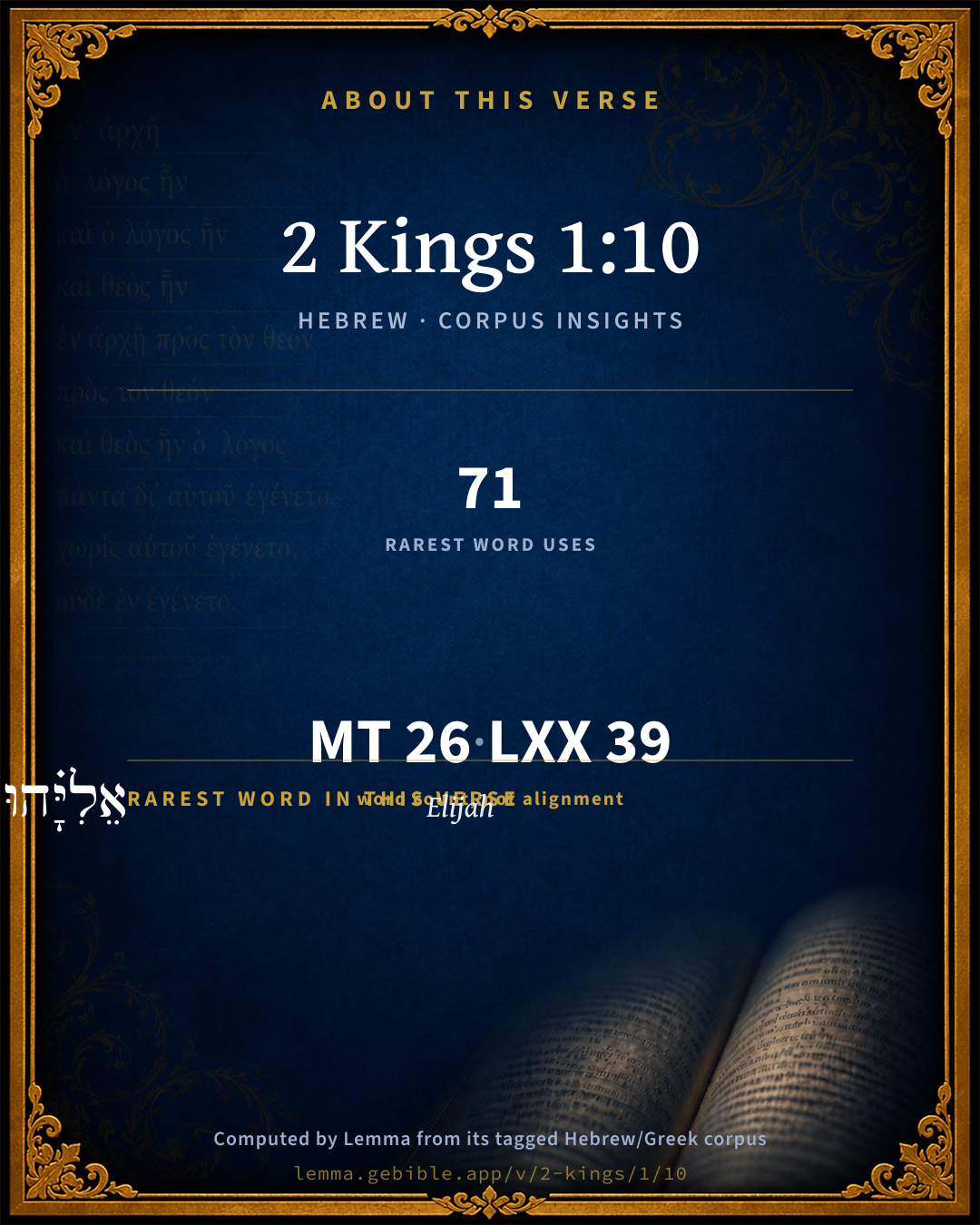
These counts appear in no published source. They are computed here, from the morphology-tagged text and Lemma’s own curated glosses. What Lemma adds →

26
words
16
distinct lemmas
Historical
section

Grammatical profile

  • 6 verbs
  • 8 nouns
  • 3 adjectives
  • 1 pronoun
  • 3 prepositions
  • 1 conjunction
  • 4 particles

Verb forms

  • וַיַּעֲנֶ֣ה Qal · Sequential Imperfect
  • וַיְדַבֵּר֮ Piel · Sequential Imperfect
  • תֵּ֤רֶד Qal · Jussive
  • וְתֹאכַ֥ל Qal · Imperfect
  • וַתֵּ֤רֶד Qal · Sequential Imperfect
  • וַתֹּ֥אכַל Qal · Sequential Imperfect

Repetition

Words recur within this verse — often emphatic in Hebrew:

  • הַחֲמִשִּׁים֒ fifty H2572 ×3
  • תֵּ֤רֶד to go down H3381 ×2
  • אֵשׁ֙ fire H784 ×2
  • הַשָּׁמַ֔יִם heaven H8064 ×2
  • וְתֹאכַ֥ל to eat H398 ×2
  • מִן from H4480 ×2

Hebrew & Septuagint length

In English translation the verse runs 39 words from the Hebrew and 44 from the Septuagint (LXX English) — closely comparable.

A rough comparison of the two English renderings, which tokenize alike — not a word-level alignment.

Word counts can differ between the Hebrew and the Greek without any difference in meaning — e.g. the Hebrew direct-object marker אֵת has no separate Greek word, and Greek often adds the article ὁ.

In the original languages it is 26 Hebrew tokens and 39 Greek tokens — but the two are counted differently (Hebrew bundles its prefixes and suffixes into one token; the Greek is in lemma form), so that isn’t a like-for-like length.

Cross-references

20

Topical passages linked to 2 Kings 1:10 in the Treasury of Scripture Knowledge — connected by theme and wording, ordered by reader-vote popularity; previews shown in the World English Bible.

  • Luke 9:54 When his disciples, James and John, saw this, they said, "Lord, do you want us to command fire to come down from the sky, and destroy them, just as Elijah did?"
  • Daniel 3:25 He answered, Look, I see four men loose, walking in the midst of the fire, and they have no hurt; and the aspect of the fourth is like a son of the gods.
  • 1 Kings 18:36–38 It happened at the time of the offering of the [evening] offering, that Elijah the prophet came near, and said, Yahweh, the God of Abraham, of Isaac, and of Israel, let it be known this day that you are God in Israel, and that I am your servant, and that I have done all these things at your word.
  • Daniel 3:22 Therefore because the king's commandment was urgent, and the furnace exceeding hot, the flame of the fire killed those men who took up Shadrach, Meshach, and Abednego.
  • Psalms 106:18 A fire was kindled in their company. The flame burned up the wicked.
  • Hebrews 12:29 for our God is a consuming fire.
  • Numbers 16:28–30 Moses said, Hereby you shall know that Yahweh has sent me to do all these works; for [I have] not [done them] of my own mind.
  • Job 1:16 While he was still speaking, there also came another, and said, "The fire of God has fallen from the sky, and has burned up the sheep and the servants, and consumed them, and I alone have escaped to tell you."
  • Revelation 11:5 If anyone desires to harm them, fire proceeds out of their mouth and devours their enemies. If anyone desires to harm them, he must be killed in this way.
  • Numbers 16:35 Fire came forth from Yahweh, and devoured the two hundred fifty men who offered the incense.
  • 1 Kings 22:28 Micaiah said, If you return at all in peace, Yahweh has not spoken by me. He said, Hear, you peoples, all of you.
  • 2 Kings 2:23–24 He went up from there to Bethel; and as he was going up by the way, there came forth young lads out of the city, and mocked him, and said to him, Go up, you baldy; go up, you baldhead.
  • 2 Chronicles 36:16 but they mocked the messengers of God, and despised his words, and scoffed at his prophets, until the wrath of Yahweh arose against his people, until there was no remedy.
  • Psalms 105:15 "Don't touch my anointed ones! Do my prophets no harm!"
  • Daniel 6:24 The king commanded, and they brought those men who had accused Daniel, and they cast them into the den of lions, them, their children, and their wives; and the lions had the mastery of them, and broke all their bones in pieces, before they came to the bottom of the den.
  • Matthew 21:41 They told him, "He will miserably destroy those miserable men, and will lease out the vineyard to other farmers, who will give him the fruit in its season."
  • Matthew 23:34–37 Therefore, behold, I send to you prophets, wise men, and scribes. Some of them you will kill and crucify; and some of them you will scourge in your synagogues, and persecute from city to city;
  • Acts 5:3–10 But Peter said, "Ananias, why has Satan filled your heart to lie to the Holy Spirit, and to keep back part of the price of the land?
  • Acts 12:19 When Herod had sought for him, and didn't find him, he examined the guards, and commanded that they should be put to death. He went down from Judea to Caesarea, and stayed there.
  • Numbers 11:1 The people were as murmurers, [speaking] evil in the ears of Yahweh: and when Yahweh heard it, his anger was kindled; and the fire of Yahweh burnt among them, and devoured in the uttermost part of the camp.

Cross-references courtesy of OpenBible.info (CC BY 4.0).

Hebrew and Greek witnesses Masoretic Hebrew ↔ Greek Septuagint

The same verse in the two great witnesses to the Old Testament, shown verse-for-verse.

These are two independent witnesses, not word-aligned to each other, and the Septuagint is shown in lemma (dictionary) form.

Hebrew 2 Kings 1:10 Masoretic · Westminster Leningrad Codex

וַיַּעֲנֶ֣ה אֵלִיָּ֗הוּ וַיְדַבֵּר֮ אֶל שַׂ֣ר הַחֲמִשִּׁים֒ וְאִם אִ֤ישׁ אֱלֹהִים֙ אָ֔נִי תֵּ֤רֶד אֵשׁ֙ מִן הַשָּׁמַ֔יִם וְתֹאכַ֥ל אֹתְךָ֖ וְאֶת חֲמִשֶּׁ֑יךָ וַתֵּ֤רֶד אֵשׁ֙ מִן הַשָּׁמַ֔יִם וַתֹּ֥אכַל אֹת֖וֹ וְאֶת חֲמִשָּֽׁיו

Elijah answered to the captain of fifty, If I be a man of God, let fire come down from the sky, and consume you and your fifty. Fire came down from the sky, and consumed him and his fifty.

World English Bible · Public Domain

Greek LXX 2 Kings 1:10 Septuagint · lemma form

καί ἀποκρίνω ηλιου καί εἶπον πρός ὁ πεντηκόνταρχος καί εἰ ἄνθρωπος ὁ θεός ἐγώ καταβαίνω πῦρ ἐκ ὁ οὐρανός καί καταἐσθίω σύ καί ὁ πεντήκοντα σύ καί καταβαίνω πῦρ ἐκ ὁ οὐρανός καί καταἐσθίω αὐτός καί ὁ πεντήκοντα αὐτός

And Eliu answered and said to the captain of fifty, And if I am a man of God, fire shall come down out of heaven, and devour you and your fifty. And fire came down out of heaven, and devoured him and his fifty.

LXX2012 (modern English Septuagint) · Public Domain

On this verse, Ellicott's Commentary for English Readers discusses the Septuagint’s reading. Read the note in Commentary ↓

Hebrew: Westminster Leningrad Codex (CC BY 4.0). Greek: Septuagint (public domain); English from LXX2012 (modern English Septuagint) (Public Domain). How the Septuagint differs from the Hebrew →

Targum (Aramaic paraphrase)

1

The Targum is the ancient Jewish Aramaic paraphrase of the Hebrew Scriptures — an interpretive translation, not the Hebrew text itself. Onkelos (literal) and Pseudo-Jonathan (expansive) render the Torah, and Jonathan the Prophets. Coverage is partial: where no permissively-licensed English translation exists for a verse, only the Aramaic is shown. This is verse-level text, not a word-by-word alignment to the Hebrew.

  1. Targum Jonathan Prophets (Joshua–Malachi)
    וַאֲתֵיב אֵלִיָה וּמַלֵיל עִם רַב חַמְשִׁין אִם נְבִיָא דַייָ אֲנָא תֵּיחוֹת אֶשְׁתָּא מִן שְׁמַיָא וְתֵיכוּל יָתָךְ וְיַת חַמְשִׁין דְעִמָךְ וּנְחָתַת אֶשְׁתָּא מִן שְׁמַיָא וַאֲכָלַת יָתֵיהּ וְיַת חַמְשִׁין דְעִמֵיהּ:

    (no public-domain English translation for this verse)

    Targum Jonathan — Aramaic: “Mikraot Gedolot” (public domain). English: “Sefaria Community Translation” (CC0 1.0 (public-domain dedication)); “London "Chaldee Paraphrase," 1871” (public domain). Text via Sefaria.

Commentary

Notes on 2 Kings 1:10 from classic Christian and Jewish commentators (each source and its license shown beneath its notes). The classic Christian expositions comment on the surrounding passage and are grouped to its opening verse, so a note may address several verses; the Jewish commentaries on the Tanakh (Rashi and others) are per-verse, so they appear only where the commentator wrote on this verse.

Lemma curates 59 commentaries, every one of them public domain or Creative Commons licensed, each selected and text-cleaned for this edition rather than reprinted as found. About our sources →

Trapp's Complete Commentary

John Trapp

2Ki 1:10 And Elijah answered and said to the captain of fifty, If I [be] a man of God, then let fire come down from heaven, and consume thee and thy fifty. And there came down fire from heaven, and consumed him and his fifty.

Ver. 10. Then let fire come down from heaven.] This he spake by a motion of God’s Spirit, in zeal of a just punishment to be inflicted on so proud and profane a person. Sed O quam hoc non est omnium! See Luk 9:54.

And there came down fire from heaven.] Mr Fox in his "Martyrology" telleth us that as Robert Balding and James Clark were going to carry William Seaman, martyr, - in Queen Mary’s days, - to their master, Sir John Tyrrell, in the night, there fell, it is credibly reported, a light between them out of the element, and parted them. This Balding, albeit he was then in his best age, after that time never enjoyed a good day, but pined away even to death. {a}

{a} Act. and Mon., 1846.

John Trapp, A Commentary or Exposition upon All the Books of the Old and New Testament (1647–1656) — public domain. Text from a community e-Sword module.

Joseph Benson's Commentary

2Ki 1:10. Elijah said, If I be a man of God, then let fire come down, &c. — This prayer or denunciation of Elijah did not proceed from malice and hatred to his enemies, nor from a desire to secure himself, which he could easily have done some other way; nor to revenge himself, for it was not his own cause he acted in; but from a pure zeal to vindicate God’s name and honour, which were so horribly abused; to prove his mission, and to reveal the wrath of God from heaven against the ungodliness and unrighteousness of men. And therefore Christ does not condemn this act of Elijah, but only reproves his disciples for their perverse inclination to imitate it from another spirit and principle, and in a more unseasonable time. There came down fire, and consumed him and his fifty — It is plain, from the address of this captain to Elijah, that he knew him to be a prophet, for he calls him a man of God; and therefore, he must have known that it was unlawful for him to be in any ways aiding, in obedience to an idolatrous king, in ill-treating a man of this sort: for it was no less than insulting and setting at naught the God of Israel, whose prophet he was. The captain, without doubt, knew that Ahaziah was angry with the prophet, and that he sent for him with no other end but to take an unjust revenge of him for having denounced his death. He, therefore, that would rather obey a tyrant than the laws of nature and revelation, which forbid us to be instruments of injustice, well deserved punishment. He who rather chose to secure his life than put it in any danger by refusing to be the executioner of unjust commands, justly deserved to lose it; and what we have said of the captain is likewise to be thought of the men. But, it may be objected, that both the captain and the soldiers were idolaters, and had forsaken the worship of the God of Israel: if this were the case, which perhaps it was, they deserved death for their idolatry, as well as for attempting to put the unjust orders of the king into execution. And we ought to conclude that Elijah’s calling for fire from heaven upon them, was not merely from the impulse of his own mind; but that a divine prophetic influence prompted him to it, God knowing that they deserved, and that it was fit to inflict this punishment upon them. For the actions of the true prophets, in such cases as these, must not be looked upon as merely springing from themselves, but as the effect of divine influences and impulses, which they could not do otherwise than obey.

Joseph Benson's Commentary on the Old and New Testaments (1811–1818) — public domain. Text from a community e-Sword module.

Geneva Bible (1599)

Geneva Bible translators

He declareth what power God’s word hath in the mouth of his servants, when they threaten God’s judgments against the wicked.

Geneva Bible (1599) marginal notes — public domain. Text via Bolls.life.

Jamieson, Fausset & Brown

Robert Jamieson, A. R. Fausset & David Brown

let fire come down--rather, "fire shall come down." Not to avenge a personal insult of Elijah, but an insult upon God in the person of His prophet; and the punishment was inflicted, not by the prophet, but by the direct hand of God.

Jamieson, Fausset & Brown — Commentary Critical and Explanatory on the Whole Bible (1871) — public domain (CC PDM 1.0). Text via the HelloAO Bible API.

Adam Clarke's Commentary

Verse 10. And there came down fire] Some have blamed the prophet for destroying these men, by bringing down fire from heaven upon them. But they do not consider that it was no more possible for Elijah to bring down fire from heaven, than for them to do it. God alone could send the fire; and as he is just and good, he would not have destroyed these men had there not been a sufficient cause to justify the act. It was not to please Elijah, or to gratify any vindictive humour in him, that God thus acted; but to show his own power and justice. No entreaty of Elijah could have induced God to have performed an act that was wrong in itself. Elijah, personally, had no concern in the business. God led him simply to announce on these occasions what he himself had determined to do. If I be a man of God, i.e., as surely as I am a man of God, fire SHALL come down from heaven, and SHALL consume thee and thy fifty. This is the literal meaning of the original; and by it we see that Elijah's words were only declarative, and not imprecatory.

Adam Clarke's Commentary on the Bible (1810–1826) — public domain. Text from a community e-Sword/MySword module.

Ellicott's Commentary for English Readers

(10) And Elijah answered and said.—So Syriac and LXX. Heb., and spake.

If.—Heb., And if a man of the god I (truly be). This “and” closely connects the prophet’s reply with the captain’s demand. All the versions except the LXX. omit it, with some Hebrew MSS.

Then.—Omit.

Let fire come down from heaven.—A phrase found only here and in 2Ch_7:1. Ewald considers this a mark of the later origin of this tradition about Elijah. The words “come down” are at any rate appropriate, as repeating the captain’s bidding to the prophet.

Consume.—Eat, or devour. (Comp. 1Ki_18:38.) Here, as there, Jehovah is represented as vindicating His own cause by the means most adequate to the necessities of the time, viz., a manifest miracle.

A Bible Commentary for English Readers, edited by Charles John Ellicott (1878–1897) — public domain. Text from a community e-Sword module.

The Cambridge Bible for Schools and Colleges

gen. ed. J. J. S. Perowne

10. If I be a man of God] The spirit of the Law differs from that of the Gospel, and our Lord forbad (Luk_9:55) his disciples the wish to imitate Elijah. But in the light which he had, Elijah felt that the majesty of Jehovah was outraged, when the name ‘man of God’, which should have signified reverence, was used as a term of scorn. And in the spirit of the Law he calls on God to make manifest that His servants and His message may not lightly be despised. And God in His discipline of the world granted the prophet’s prayer. Bp Hall says ‘There are few tracks of Elijah that are ordinary and fit for common feet. His actions are more for wonder than for precedent. Not in his own defence would the prophet have been the death of so many, if God had not, by a peculiar instinct, made him an instrument of this just vengeance’.

The Cambridge Bible for Schools and Colleges (gen. ed. J. J. S. Perowne; Cambridge University Press, 1878–1918) — public domain. Text from a community e-Sword module.

John Gill's Exposition

And Elijah answered and said to the captain of fifty, if I be a man of God,.... As I am, and thou shalt know it by the following token, though thou callest me so jeeringly:

then let fire come down from heaven, and consume thee and thy fifty; this he said not in a passion, and from a private spirit of revenge, but for the vindication of the honour and glory of God, and under the impulse of his spirit, who was abused through the insult on him as his prophet:

and there came down fire from heaven, and consumed him and his fifty; a flash of lightning, which destroyed them at once; the Lord hearkening to the voice of his prophet, in vindication of him in his office, and of his own glory.

John Gill's Exposition of the Whole Bible (1746–1763) — public domain (CC PDM 1.0). Text via the HelloAO Bible API.

Albert Barnes' Notes on the Bible

The charge of cruelty made against Elijah makes it needful to consider the question: What was Elijah’s motive? And the answer is: Sharply to make a signal example, to vindicate God’s honor in a striking way. Ahaziah had, as it were, challenged Yahweh to a trial of strength by sending a band of fifty to arrest one man. Elijah was not Jesus Christ, able to reconcile mercy with truth, the vindication of God’s honor with the utmost tenderness for erring men, and awe them merely by His presence (compare Joh 18:6). In Elijah the spirit of the Law was embodied in its full severity. His zeal was fierce; he was not shocked by blood; he had no softness and no relenting. He did not permanently profit by the warning at Horeb (1Ki 19:12 note). He continued the uncompromising avenger of sin, the wielder of the terrors of the Lord, such exactly as he had shown himself at Carmel. He is, consequently, no pattern for Christian men Luk 9:55; but his character is the perfection of the purely legal type. No true Christian after Pentecost would have done what Elijah did. But what he did, when he did it, was not sinful. It was but executing strict, stern justice. Elijah asked that fire should fall - God made it fall; and, by so doing, both vindicated His own honor, and justified the prayer of His prophet.

Albert Barnes' Notes on the Bible (1834–1885) — public domain. Text from a community e-Sword/MySword module.

Haydock's Catholic Bible Commentary

Let fire, &c. Elias was inspired to call down fire from heaven upon these captains, who came to apprehend him; not out of a desire to gratify any private passion, but to punish the insult offered to religion, to confirm his mission, and to shew how vain are the efforts of men against God and his servants, whom he has a mind to protect. (Challoner) --- The Roman laws authorized a person, in authority, to punish those who refuse to obey. (Ulpin 1 D.) Si quis jus dicenti non obtemperaverit, omnibus concessum est suam jurisdictionem defendere pœnali judicio. Elias acted as God’s envoy, and the insult reverted upon him. (St. Thomas Aquinas, [Summa Theologiae] 2. 2. q. 108, a. 2.) --- The Manichees have blamed the conduct of the prophet: but the miracle justifies him, as God would never countenance the private revenge of any one; and the Holy Ghost places this transaction on a level with that when Elias shut up the heavens, Ecclesiasticus xlviii. 3. St. Peter was moved with the like zeal, Acts v. 5. The sons of Zebedee gave way to some private indignation, when they wished our Saviour to call down fire from heaven upon a city of Samaria, Luke ix. 54. But he reprimanded them for it; as the citizens might not be so well acquainted with him, as these soldiers must have been with Elias: and he came to display the spirit of mildness, (Calmet) to attract all to his holy religion; while Elias had manifested the severity of the divine judgments, conformably to the law of terror, under which he lived. (Haydock) --- In zeal of justice, Elias procured fire to burn these wicked men, as he had done for the holocaust. (St. Augustine) (Worthington)

George Leo Haydock (1774–1849), Haydock's Catholic Family Bible and Commentary, 1859 edition — public domain. Excludes Psalms (Douay-Rheims chapter numbering differs from Protestant) and Deuterocanonical books (Catholic canon only).

Matthew Poole's English Annotations

Elijah’s desire did not proceed from a carnal and malicious passion; but from a pure zeal to vindicate God’s name and honour, which was so horribly abused; and from the motion of God’s Spirit, as is evident from God’s miraculous answer to his desire. And therefore Christ doth not condemn this fact of Elias, but only reproves his disciples for their perverse imitation of it from another spirit and principle, and in a more unseasonable time, Luk 9:54,55.

Matthew Poole's English Annotations on the Holy Bible (1683–1685) — public domain. Text from a community e-Sword/MySword module.

Whedon's Commentary on the Bible

Daniel D. Whedon

10. Let fire come down from heaven, and consume thee and thy fifty — This was a miracle of Divine judgment, and in perfect keeping with the spirit of the old dispensation, as many examples may be cited to show. Exo_19:13, Exodus 1932; Exo_10:27; Num_14:37; Num_16:21; Num_16:32; Num_16:35; Num_16:49; Num_25:4; Num_25:9. In this respect the new dispensation widely differs from the old. “For the Son of man is not come to destroy men’s lives, but to save them.” Luk_9:51-56, where see notes. But it must not be understood that when our Lord rebuked the two disciples, and showed them the difference between the Law and the Gospel as to the spirit of each, he thereby blamed this act of Elijah. “He blamed the two disciples who dishonoured Elijah, by endeavouring to pervert his act into a precedent for a proposal which was altogether dissimilar to that act of Elijah, in all the circumstances of the case. Elijah was God’s minister for executing his Divine judgment. The two disciples were but the servants of their own anger. There was a fire in their breasts which God had never kindled; far was it from the Saviour of the world to second their earthly fire with his heavenly.” — Wordsworth.

Daniel D. Whedon (gen. ed.), Commentary on the Old and New Testaments (1874–1909) — public domain. Text from a community e-Sword module.

The Pulpit Commentary

And Elijah answered... let fire come down. The LXX render, katabhsetai pur will come down;" and so some moderns, who are anxious to clear the prophet of the charges of cruelty and bloodthirstiness which have been brought against him. But there is no need of altering the translation, Elijah undoubtedly "commanded fire to come down from heaven", (Luk_9:54) or, in other words, prayed to God that it might come down, and in answer to his prayer the fire fell. The narrative may be set aside as an embellishment of later times, having no historical foundation, by those who (like Ewald) deny that miracles are possible; but, if it be accepted, it must be accepted as it stands, and Elijah must be regarded, not as having merely prophesied a result, but as having been instrumental in producing it. We must judge Elijah, not by the ideas of our own day, but by those of the age wherein he lived. He was raised up to vindicate God"s honor, to check and punish idolatry, to keep alive a faithful remnant in Israel, when all the powers of the earth were leagued together to destroy and smother true religion. He was an embodiment of the Law of absolute, strict, severe justice. The fair face of mercy was not revealed to him. Already, at Carmel, he had executed the Divine vengeance on idolaters after an exemplary fashion. (1Ki_18:40) Now, Ahaziah, the son of the wicked Jezebel, had challenged Jehovah to a trial of strength by first ignoring him, and then sending a troop of soldiers to arrest his prophet. Was Elijah to succumb without an effort, or was he to vindicate the majesty and honor of Jehovah? He had no power of himself to do either good or harm. He could but pray to Jehovah, and Jehovah, in his wisdom and perfect goodness, would either grant or refuse his prayer. If he granted it, the punishment inflicted would not be Elijah"s work, but his. To tax Elijah with cruelty is to involve God in the charge. God regarded it as a fitting time for making a signal example, and, so regarding it, he inspired a spirit of indignation in the breast of his prophet, who thereupon made the prayer which he saw fit to answer. The judgment was in accordance with the general tone and tenor of the Law, which assigns "tribulation and anguish to every soul of man that doeth evil", (Rom_2:9) and visits with death every act of rebellion against God. There came down fire. Josephus says that the "fire" was a flash of lightning (prhsthr), and so the commentators generally.

The Pulpit Commentary (1880–1919), ed. H.D.M. Spence-Jones & Joseph S. Exell — public domain. Text from a community e-Sword module.

John Wesley's Explanatory Notes

Let fire, &c. - Elijah did this, not to secure himself, he could have done that some other way: nor to revenge himself, for it was not his own cause that he acted in: but to prove his mission, and to reveal the wrath of God from heaven against the ungodliness and unrighteousness of men.

John Wesley, Explanatory Notes Upon the Whole Bible (1754–1765) — public domain. Text via the GEBible commentary corpus.

Lesson kit

Teaching starters — assembled from the data on this page, not authored interpretation. Every prompt links to the verse data it draws on. Edit before teaching.

2 Kings, in the Historical, opens this verse with 26 words (16 distinct Hebrew lemmas). Its most distinctive word is ʼÊlîyâh (“Elijah”). A historical commentator’s framing appears above. Read the whole chapter for the surrounding context.

Discussion questions

  1. The word ʼÊlîyâh carries the sense “Elijah.” How does it shape the verse?
  2. Luke 9:54 shares this passage’s theme. How do the two illuminate each other?
  3. “fifty” occurs 3× in this one verse. What is the effect of the repetition?
  4. These translations render this verse differently. What is at stake in choosing one wording over another?
  5. The verb «וַיַּעֲנֶ֣ה» is Qal Sequential Imperfect. How does its form color the action?
  6. Reading how Trapp's Complete Commentary and Joseph Benson's Commentary read this verse, where do the two commentators agree and where do they part?

Things to notice

Reading settings

Reading text

Shown beneath each verse's original-language words.

Old Testament
Old Testament edition

Read the OT as the Masoretic Hebrew (MT) or the Greek Septuagint (LXX).

English shown for the Greek Septuagint (in the Hebrew ↔ Greek comparison).

Comparing translations? Open the Compare panel on any verse page to stack up to four side by side.