Exodus 6:5

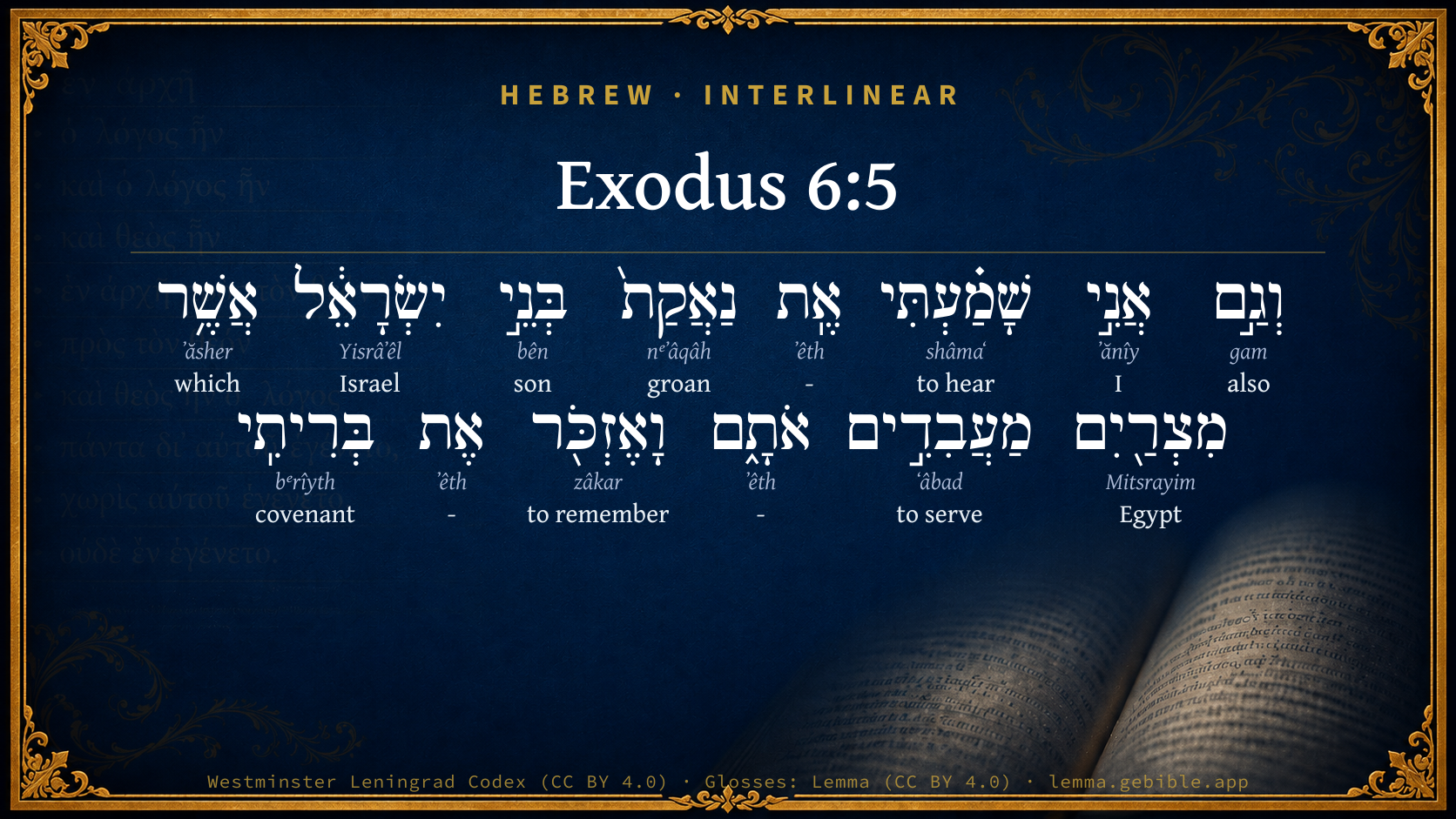
Hebrew (Westminster Leningrad Codex) Exodus 6:5 appears in the Hebrew Old Testament. The text above is from the Westminster Leningrad Codex. Each word links to its Strong’s number, a concise gloss, and parsing drawn from the Open Scriptures Hebrew Bible morphology. Click any word for its full Brown-Driver-Briggs (BDB) entry.
Download image
Cite this verse

Exodus 6:5 (World English Bible). Public Domain. Lemma interlinear Bible study tool, https://lemma.gebible.app/v/exodus/6/5.

Show BibTeX & RIS
BibTeX
RIS
English Translation
Moreover I have heard the groaning of the children of Israel, whom the Egyptians keep in bondage, and I have remembered my covenant.
World English Bible · Public Domain
Download a study sheet

One document with this verse’s original text, its word-by-word gloss line, the meaning frame, cross-references with their text, attributed commentary, and full source and license credits — printable, and it pastes into notes with its structure intact.

This verse Autodidact and up

Study sheet (.html) Plain text (.txt)

A passage Seminary Student

Up to 50 verses in one chapter. A passage sheet keeps up to 6 commentary sources and 12 cross-references per verse, in the order this page ranks them, and says so on the sheet whenever that leaves anything out. Ask for a single verse and you get the Autodidact verse sheet above.

Everything on this page stays free to read, with no account — the sheet is a download of what is already on screen, not access to it.

Want to remove ads? Support Godless Engineer
Compare translations 3

The same verse in 3 English versions, stacked beneath the original-language interlinear above. Click any original word for its lexicon entry.

Each is an independent rendering of the whole verse — the interlinear is not word-aligned to these translations.

Highlighted words mark where these versions differ — a whole-verse word diff, not a word-by-word alignment.

  • World English Bible Public Domain
    Moreover I have heard the groaning of the children of Israel, whom the Egyptians keep in bondage, and I have remembered my covenant.
  • King James Version Public Domain
    And I have also heard the groaning of the children of Israel, whom the Egyptians keep in bondage; and I have remembered my covenant.
  • unfoldingWord Literal Text CC BY-SA 4.0
    And moreover, I have heard the groaning of the sons of Israel, whom the Egyptians are enslaving, and I have remembered my covenant.

unfoldingWord Literal Text — © unfoldingWord, licensed CC BY-SA 4.0. Word-aligned USFM3 via Door43 (git.door43.org/unfoldingWord/en_ult).

Versions to compare (up to 4)

3 of 4 selected

Show all 18 translations

Every available English version of this verse, each an independent rendering of the whole verse.

  • World English Bible Public Domain
    Moreover I have heard the groaning of the children of Israel, whom the Egyptians keep in bondage, and I have remembered my covenant.
  • Berean Standard Bible Public Domain
    Furthermore, I have heard the groaning of the Israelites, whom the Egyptians are enslaving, and I have remembered My covenant.
  • Majority Standard Bible Public Domain
    Furthermore, I have heard the groaning of the Israelites, whom the Egyptians are enslaving, and I have remembered My covenant.
  • King James Version Public Domain
    And I have also heard the groaning of the children of Israel, whom the Egyptians keep in bondage; and I have remembered my covenant.
  • American Standard Version (1901) Public Domain
    And moreover I have heard the groaning of the children of Israel, whom the Egyptians keep in bondage; and I have remembered my covenant.
  • Revised Version (1885) Public Domain
    And moreover I have heard the groaning of the children of Israel, whom the Egyptians keep in bondage; and I have remembered my covenant.
  • Geneva Bible (1599) Public Domain
    So I haue also hearde the groning of the children of Israel, whom the Egyptians keepe in bondage, and haue remembred my couenant.
  • Douay-Rheims (1899) Public Domain
    I have heard the groaning of the children of Israel, wherewith the Egyptians have oppressed them: and I have remembered my covenant.
  • Young's Literal Translation Public Domain
    and also I have heard the groaning of the sons of Israel, whom the Egyptians are causing to serve, and I remember My covenant.
  • Literal Standard Version CC BY-SA 4.0
    and I have also heard the groaning of the sons of Israel, whom the Egyptians are causing to serve, and I remember My covenant.
  • Unlocked Literal Bible CC BY-SA 4.0
    Moreover, I have heard the groaning of the Israelites whom the Egyptians have enslaved, and I have called to mind my covenant.
  • unfoldingWord Literal Text CC BY-SA 4.0
    And moreover, I have heard the groaning of the sons of Israel, whom the Egyptians are enslaving, and I have remembered my covenant.
  • Darby Bible Public Domain
    And I have heard also the groaning of the children of Israel, whom the Egyptians have forced to serve, and I have remembered my covenant.
  • World Messianic Bible Public Domain
    Moreover I have heard the groaning of the children of Israel, whom the Egyptians keep in bondage, and I have remembered my covenant.
  • Webster's Bible Public Domain
    And I have also heard the groaning of the children of Israel, whom the Egyptians keep in bondage: and I have remembered my covenant.
  • Free Bible Version CC BY-SA 4.0
    In addition I've heard the groans of the Israelites that the Egyptians are treating as slaves, and I haven't forgotten the agreement I promised them.
  • Bible in Basic English Public Domain
    And truly my ears are open to the cry of the children of Israel whom the Egyptians keep under their yoke; and I have kept in mind my agreement.
  • JPS Tanakh (1917) Public Domain
    And moreover I have heard the groaning of the children of Israel, whom the Egyptians keep in bondage; and I have remembered My covenant.

Literal Standard Version (2020), Covenant Press — licensed CC BY-SA 4.0. Text via the HelloAO Bible API (eBible.org). Unlocked Literal Bible (unfoldingWord) — licensed CC BY-SA 4.0. Text via the HelloAO Bible API (eBible.org). unfoldingWord Literal Text — © unfoldingWord, licensed CC BY-SA 4.0. Word-aligned USFM3 via Door43 (git.door43.org/unfoldingWord/en_ult). Free Bible Version, Dr. Jonathan Gallagher — licensed CC BY-SA 4.0. Text via the HelloAO Bible API (eBible.org).

Word by word

More ways to search: Search by grammar → Find every occurrence → Compare this word →

Practice this passage: Drill this verse → Learn its vocabulary →

נַאֲקַת֙
nᵉʼâqâh
H5009
“groan of”
Noun, Common, Feminine, Singular, Construct
Part of Speech
Noun
Type
Common
Gender
Feminine
Number
Singular
State
Construct
Full BDB Definition

Origin: from H5008 ;

TWOT: 1275a

groan, groaning
  1. וְגַ֣ם gam H1571 “and · also” Conjunction + Particle, Accusative
  2. אֲנִ֣י ʼănîy H589 “I” Pronoun, Personal, 1st Person, Common, Singular
  3. שָׁמַ֗עְתִּי shâmaʻ H8085 “to hear” Verb, Qal, Perfect, 1st Person, Common, Singular
  4. אֶֽת ʼêth H853 “-” Particle, Direct Object
  5. בְּנֵ֣י bên H1121 “sons of” Noun, Common, Masculine, Plural, Construct
  6. יִשְׂרָאֵ֔ל Yisrâʼêl H3478 “Israel” Noun, Proper
  7. אֲשֶׁ֥ר ʼăsher H834 “which” Particle, Relative
  8. מִצְרַ֖יִם Mitsrayim H4714 “Egypt” Noun, Proper
  9. מַעֲבִדִ֣ים ʻâbad H5647 “serving” Verb, Hiphil, Participle Active, Masculine, Plural, Absolute
  10. אֹתָ֑ם ʼêth H853 “- · them” Particle, Direct Object + Suffix, Personal, 3rd Person, Masculine, Plural
  11. וָאֶזְכֹּ֖ר zâkar H2142 “and · to remember” Conjunction + Verb, Qal, Sequential Imperfect, 1st Person, Common, Singular
  12. אֶת ʼêth H853 “-” Particle, Direct Object
  13. בְּרִיתִֽי bᵉrîyth H1285 “covenant · my” Noun, Common, Feminine, Singular, Construct + Suffix, Personal, 1st Person, Common, Singular

About this verse

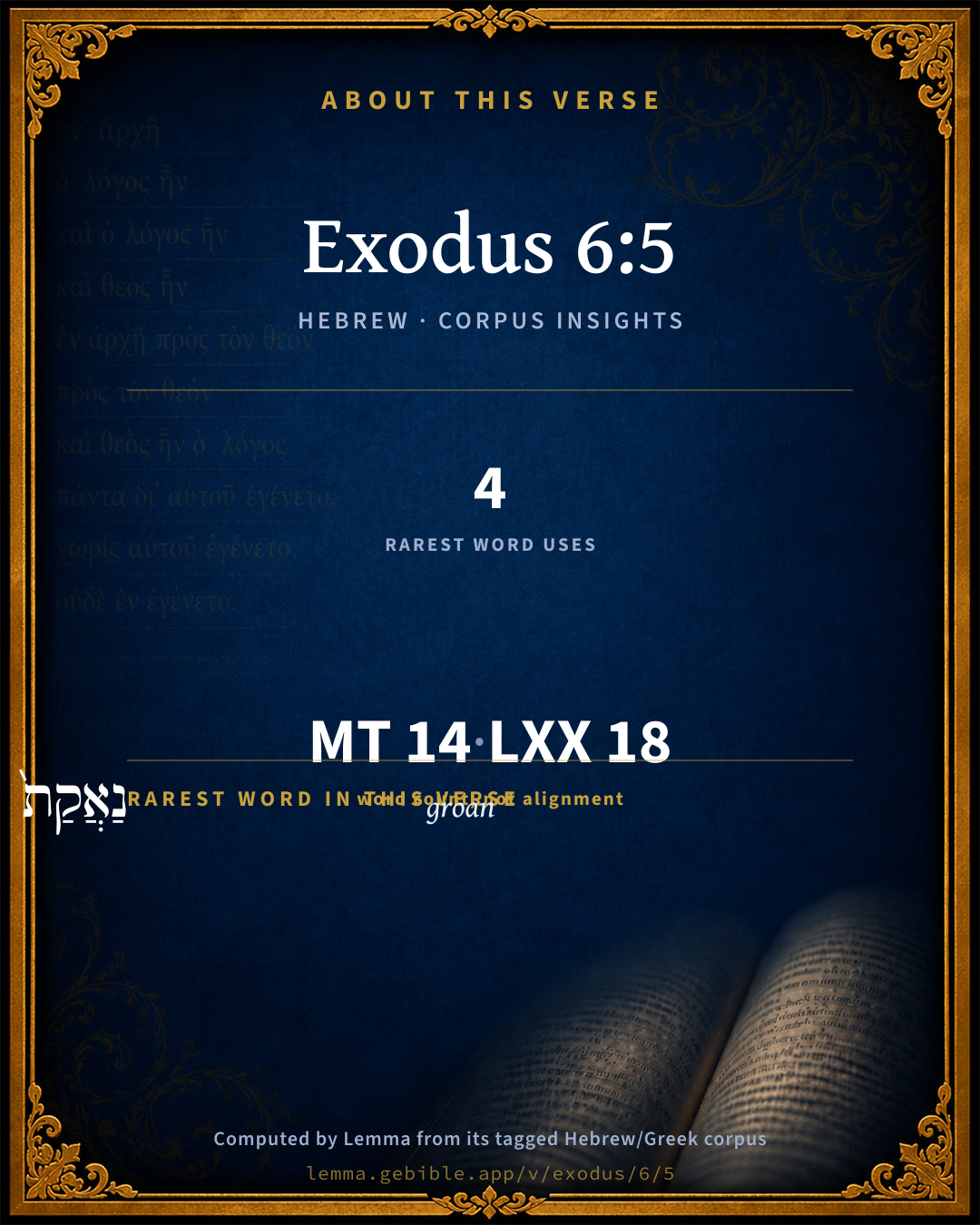
These counts appear in no published source. They are computed here, from the morphology-tagged text and Lemma’s own curated glosses. What Lemma adds →

14
words
12
distinct lemmas
Pentateuch
section

Notable vocabulary

The rarest word here is נַאֲקַת֙ groan H5009 — appearing just 4 times in the whole Hebrew Bible.

Shared distinctive vocabulary

נַאֲקַת֙ groan H5009 occurs in 4 verses of the Hebrew Bible. Also found in:

Grammatical profile

  • 3 verbs
  • 5 nouns
  • 1 pronoun
  • 5 particles

Verb forms

  • שָׁמַ֗עְתִּי Qal · Perfect
  • מַעֲבִדִ֣ים Hiphil · Participle Active
  • וָאֶזְכֹּ֖ר Qal · Sequential Imperfect

Hebrew & Septuagint length

In English translation the verse runs 23 words from the Hebrew and 26 from the Septuagint (LXX English) — closely comparable.

A rough comparison of the two English renderings, which tokenize alike — not a word-level alignment.

Word counts can differ between the Hebrew and the Greek without any difference in meaning — e.g. the Hebrew direct-object marker אֵת has no separate Greek word, and Greek often adds the article ὁ.

In the original languages it is 14 Hebrew tokens and 18 Greek tokens — but the two are counted differently (Hebrew bundles its prefixes and suffixes into one token; the Greek is in lemma form), so that isn’t a like-for-like length.

Cross-references

9

Topical passages linked to Exodus 6:5 in the Treasury of Scripture Knowledge — connected by theme and wording, ordered by reader-vote popularity; previews shown in the World English Bible.

  • Exodus 2:24 God heard their groaning, and God remembered his covenant with Abraham, with Isaac, and with Jacob.
  • Psalms 106:44–45 Nevertheless he regarded their distress, When he heard their cry.
  • Isaiah 63:9 In all their affliction he was afflicted, and the angel of his presence saved them: in his love and in his pity he redeemed them; and he bore them, and carried them all the days of old.
  • Genesis 8:1 God remembered Noah, all the animals, and all the cattle that were with him in the ark; and God made a wind to pass over the earth. The waters subsided.
  • Genesis 9:15 and I will remember my covenant, which is between me and you and every living creature of all flesh, and the waters will no more become a flood to destroy all flesh.
  • Exodus 3:7 Yahweh said, "I have surely seen the affliction of my people who are in Egypt, and have heard their cry because of their taskmasters, for I know their sorrows.
  • Psalms 105:8 He has remembered his covenant forever, The word which he commanded to a thousand generations,
  • Luke 1:54 He has given help to Israel, his servant, that he might remember mercy,
  • Luke 1:72 To show mercy towards our fathers, To remember his holy covenant,

Cross-references courtesy of OpenBible.info (CC BY 4.0).

Hebrew and Greek witnesses Masoretic Hebrew ↔ Greek Septuagint

The same verse in the two great witnesses to the Old Testament, shown verse-for-verse.

These are two independent witnesses, not word-aligned to each other, and the Septuagint is shown in lemma (dictionary) form.

Hebrew Exodus 6:5 Masoretic · Westminster Leningrad Codex

וְגַ֣ם אֲנִ֣י שָׁמַ֗עְתִּי אֶֽת נַאֲקַת֙ בְּנֵ֣י יִשְׂרָאֵ֔ל אֲשֶׁ֥ר מִצְרַ֖יִם מַעֲבִדִ֣ים אֹתָ֑ם וָאֶזְכֹּ֖ר אֶת בְּרִיתִֽי

Moreover I have heard the groaning of the children of Israel, whom the Egyptians keep in bondage, and I have remembered my covenant.

World English Bible · Public Domain

Greek LXX Exodus 6:5 Septuagint · lemma form

καί ἐγώ εἰςἀκούω ὁ στεναγμός ὁ υἱός ἰσραήλ ὅς ὁ αἰγύπτιος καταδουλόω αὐτός καί μιμνήσκω ὁ διαθήκη σύ

And I listened to the groaning of the children of Israel (the affliction with which the Egyptians enslave them) and I remembered the covenant with you.

LXX2012 (modern English Septuagint) · Public Domain

Hebrew: Westminster Leningrad Codex (CC BY 4.0). Greek: Septuagint (public domain); English from LXX2012 (modern English Septuagint) (Public Domain). How the Septuagint differs from the Hebrew →

Targum (Aramaic paraphrase)

2

The Targum is the ancient Jewish Aramaic paraphrase of the Hebrew Scriptures — an interpretive translation, not the Hebrew text itself. Onkelos (literal) and Pseudo-Jonathan (expansive) render the Torah, and Jonathan the Prophets. Coverage is partial: where no permissively-licensed English translation exists for a verse, only the Aramaic is shown. This is verse-level text, not a word-by-word alignment to the Hebrew.

  1. Targum Onkelos Torah (Genesis–Deuteronomy)
    וְאַף קֳדָמַי שְׁמִיעַ יָת קְבֵילַת בְּנֵי יִשְׂרָאֵל דִי מִצְרָאֵי מַפְלְחִין בְּהוֹן וְדָכִירְנָא יָת קְיָמִי:

    (no public-domain English translation for this verse)

    Targum Onkelos — Aramaic: “Onkelos Genesis” (public domain); “Onkelos Exodus” (public domain); “Onkelos Leviticus” (public domain); “Onkelos Numbers” (public domain); “Onkelos Deuteronomy” (public domain). English: “Sefaria Community Translation” (CC0 1.0 (public-domain dedication)); “J.W. Etheridge. The Targums of Onkelos and Jonathan Ben Uzziel on the Pentateuch. London: Longmans, Green, 1862” (public domain). Text via Sefaria.

  2. Targum Pseudo-Jonathan Torah (Genesis–Deuteronomy)
    וּלְחוֹד עָל קֳדָמַי יַת אֲנֵיק בְּנֵי יִשְרָאֵל דְמִצְרָאֵי מְשַׁעֲבְּדוּן יַתְהוֹן וּדְכִירְנָא יַת קְיָימִי

    And now cometh before Me the groaning of the sons of Israel, because the Mizraee do enslave them; and I remember My covenant.

    Targum Pseudo-Jonathan — Aramaic: “Targum Jonathan on Genesis” (public domain); “Targum Jonathan on Exodus” (public domain); “Targum Jonathan on Leviticus” (public domain); “Targum Jonathan on Numbers” (public domain); “Targum Jonathan on Deuteronomy” (public domain). English: “The Targum of Jonathan ben Uzziel, trans. J. W. Etheridge, London, 1862” (public domain). Text via Sefaria.

Commentary

Notes on Exodus 6:5 from classic Christian and Jewish commentators (each source and its license shown beneath its notes). The classic Christian expositions comment on the surrounding passage and are grouped to its opening verse, so a note may address several verses; the Jewish commentaries on the Tanakh (Rashi and others) are per-verse, so they appear only where the commentator wrote on this verse.

Lemma curates 59 commentaries, every one of them public domain or Creative Commons licensed, each selected and text-cleaned for this edition rather than reprinted as found. About our sources →

Trapp's Complete Commentary

John Trapp

Exo 6:5 And I have also heard the groaning of the children of Israel, whom the Egyptians keep in bondage; and I have remembered my covenant.

Ver. 5. I have also heard the groaning.] He heareth "the young ravens that cry" {Psa 147:9} unto him but by implication only, and with a hoarse voice unfit to move pity (whence also they have their name in the Hebrew - ערב). How much more his own covenanters!

John Trapp, A Commentary or Exposition upon All the Books of the Old and New Testament (1647–1656) — public domain. Text from a community e-Sword module.

Joseph Benson's Commentary

Exo 6:5-6. I have heard the groaning of the children of Israel — He means their groaning on occasion of the late hardships put upon them. God takes notice of the increase of his people’s calamities, and observes how their enemies grow upon them. I will bring you out: I will rid you: I will redeem you: I will bring you into the land of Canaan; and I will give it you — Let man take the shame of his unbelief, which needs such repetitions, and let God have the glory of his condescending grace, which gives us such repeated assurances. With a stretched-out arm — With almighty power: a metaphor taken from a man that stretches out his arm, to put forth all his strength.

Joseph Benson's Commentary on the Old and New Testaments (1811–1818) — public domain. Text from a community e-Sword module.

The Cambridge Bible for Schools and Colleges

gen. ed. J. J. S. Perowne

5. and I also. The pronoun is emphatic,—I, the same who gave the promise of v. 4.

the groaning] see Exo_2:24 (P).

keep in bondage] Heb. make to serve, as Exo_1:13 (P).

remembered my covenant] as Exo_2:24 (P): see also Gen_9:15-16 (P); Lev_26:42; Lev_26:45 (H); Eze_16:60.

5–8. And now He has heard the groanings of the patriarchs’ descendants in their bondage (v. 5); and bids Moses tell them that He is Yahweh, and as such will deliver them from Egypt (v. 6), will make them His people (v. 7), and bring them into the land promised to their fathers (v. 8).

The Cambridge Bible for Schools and Colleges (gen. ed. J. J. S. Perowne; Cambridge University Press, 1878–1918) — public domain. Text from a community e-Sword module.

John Gill's Exposition

Wherefore say unto the children of Israel, I am the Lord,.... Eternal in his being, immutable in his counsels, faithful to his covenant, and able to fulfil it:

and I will bring you out from under the burdens of the Egyptians; which lay heavy on them, and made them sigh and groan:

and I will rid you out of their bondage; in which they were kept, and by which their lives were made bitter:

and I will redeem you with a stretched out arm; with an arm stretched out from heaven to earth, as Aben Ezra expresses it; even by the exertion of his almighty power, openly and manifestly displayed in the lighting down of his arm upon the enemies of his people, and in delivering them out of their hands:

and with great judgments; upon the Egyptians, by many and sore plagues and punishments inflicted on them.

John Gill's Exposition of the Whole Bible (1746–1763) — public domain (CC PDM 1.0). Text via the HelloAO Bible API.

The Pulpit Commentary

I have also heard the groaning. Compare Exo_2:24 and Exo_3:9. The repetition is in consequence of Moses" expostulation, (Exo_5:22, Exo_5:23) and is to assure the Israelites that God has not forgotten them, but will sustain them under their afflictions, and will shortly deliver them.

The Pulpit Commentary (1880–1919), ed. H.D.M. Spence-Jones & Joseph S. Exell — public domain. Text from a community e-Sword module.

John Wesley's Explanatory Notes

I have heard the groaning of the children of Israel - He means their groaning on occasion of the late hardships put upon them. God takes notice of the increase of his people's calamities, and observes how their enemies grow upon them.

John Wesley, Explanatory Notes Upon the Whole Bible (1754–1765) — public domain. Text via the GEBible commentary corpus.

Rashi

Rabbi Shlomo Yitzchaki (Rashi)

וגם אני — Since I established and set up My covenant it is incumbent upon Me to fulfil it; therefore, שמעתי את נאקת בני ישראל I HAVE HEARD THE GROANING OF THE CHILDREN OF ISRAEL who groan (complain) אשר מצרים מעבדים אתם THAT THE EGYPTIANS ARE ENSLAVING THEM, ואזכר AND I REMEMBER that covenant which I have already made with them; because at the covenant “between the pieces” I said to him, (Genesis 15:14) “And also against that nation whom they shall serve will I pronounce judgment.”

Rashi on the Tanakh — English translations: “The Judaica Press complete Tanach with Rashi, translated by A. J. Rosenberg” (CC BY 4.0); “Pentateuch with Rashi's commentary by M. Rosenbaum and A.M. Silbermann, 1929-1934” (public domain); “The Metsudah Tanach series, Lakewood, N.J” (CC BY 4.0); and “The Book of Joshua, Metsudah Publications, 1997” (CC BY 4.0). Text via Sefaria.

Ibn Ezra

Rabbi Abraham ibn Ezra

I have also heard. Furthermore, I sent you because the B’nei Yisrael have repented and cried out to Me.

Ibn Ezra on the Tanakh — English translations: “Sefaria Community Translation” (CC0 1.0 (public-domain dedication)); “Yalkut, Sifsei Chachomim Chumash, Metsudah Publications, 2009” (CC BY 4.0); and “Commentary of Ibn Ezra on Isaiah - trans. by M. Friedlander, 1873” (public domain). Text via Sefaria.

Lesson kit

Teaching starters — assembled from the data on this page, not authored interpretation. Every prompt links to the verse data it draws on. Edit before teaching.

Exodus, in the Pentateuch, opens this verse with 14 words (12 distinct Hebrew lemmas). Its most distinctive word is nᵉʼâqâh (“groan”). A historical commentator’s framing appears above. Read the whole chapter for the surrounding context.

Discussion questions

  1. What does “groan” (nᵉʼâqâh) contribute to the verse as a whole?
  2. How does Exodus 2:24, which shares the word «groan», read alongside this verse?
  3. The translations on this page render this verse differently — a whole-verse word diff, not a word-by-word alignment. What might account for the different wordings?
  4. «שָׁמַ֗עְתִּי» is a Qal Perfect verb. How does that grammatical form shape the action described?
  5. Compare how Trapp's Complete Commentary and Joseph Benson's Commentary read this verse. Where do they agree or differ?

Things to notice

Reading settings

Reading text

Shown beneath each verse's original-language words.

Old Testament
Old Testament edition

Read the OT as the Masoretic Hebrew (MT) or the Greek Septuagint (LXX).

English shown for the Greek Septuagint (in the Hebrew ↔ Greek comparison).

Comparing translations? Open the Compare panel on any verse page to stack up to four side by side.