
Genesis 18:17

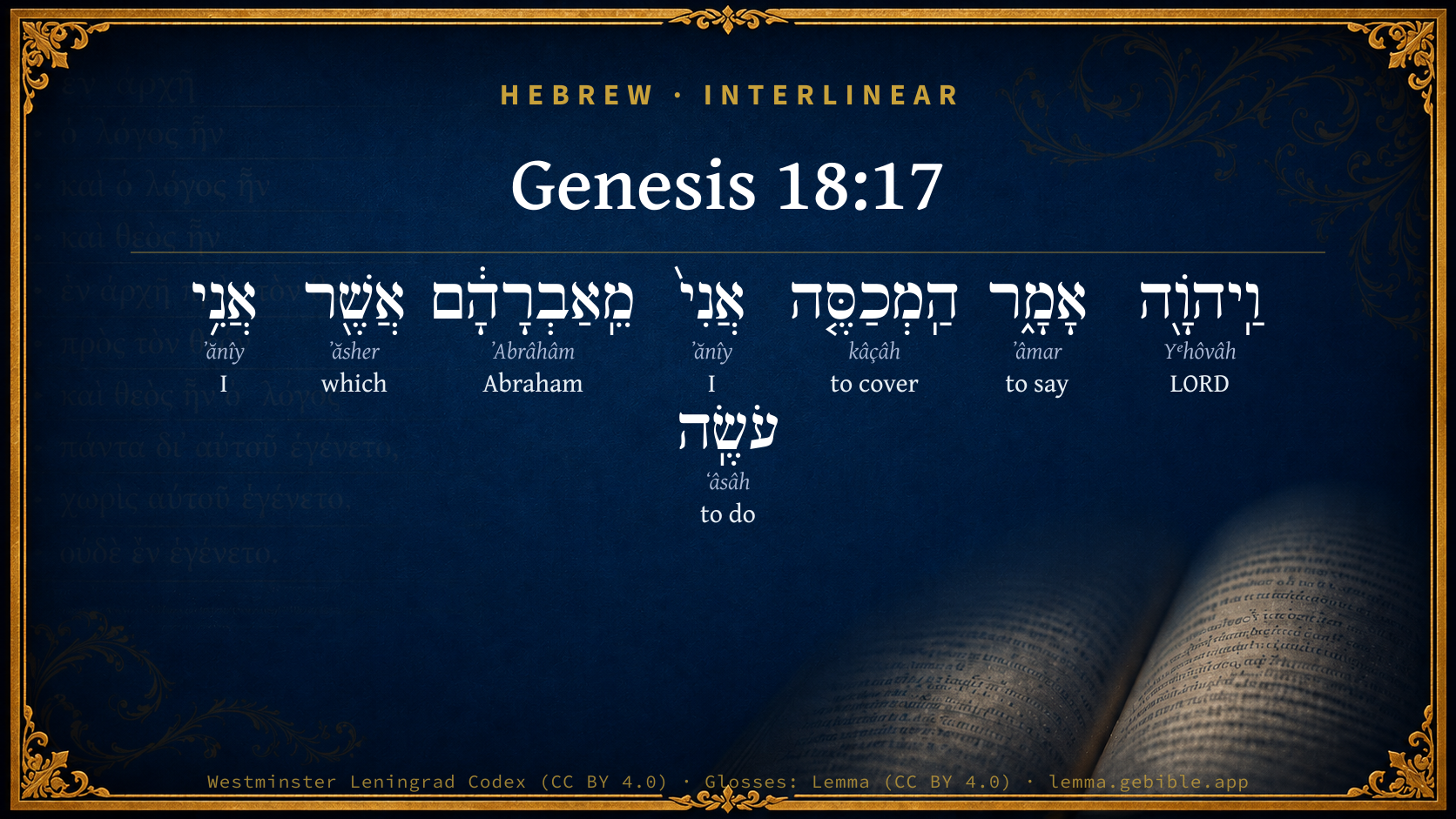
Hebrew (Westminster Leningrad Codex) Genesis 18:17 appears in the Hebrew Old Testament. The text above is from the Westminster Leningrad Codex. Each word links to its Strong’s number, a concise gloss, and parsing drawn from the Open Scriptures Hebrew Bible morphology. Click any word for its full Brown-Driver-Briggs (BDB) entry.
Download image
Cite this verse

Genesis 18:17 (World English Bible). Public Domain. Lemma interlinear Bible study tool, https://lemma.gebible.app/v/genesis/18/17.

Show BibTeX & RIS
BibTeX
RIS
English Translation
Yahweh said, "Will I hide from Abraham what I do,
World English Bible · Public Domain
Download a study sheet

One document with this verse’s original text, its word-by-word gloss line, the meaning frame, cross-references with their text, attributed commentary, and full source and license credits — printable, and it pastes into notes with its structure intact.

This verse Autodidact and up

Study sheet (.html) Plain text (.txt)

A passage Seminary Student

Up to 50 verses in one chapter. A passage sheet keeps up to 6 commentary sources and 12 cross-references per verse, in the order this page ranks them, and says so on the sheet whenever that leaves anything out. Ask for a single verse and you get the Autodidact verse sheet above.

Everything on this page stays free to read, with no account — the sheet is a download of what is already on screen, not access to it.

Want to remove ads? Support Godless Engineer
Compare translations 3

The same verse in 3 English versions, stacked beneath the original-language interlinear above. Click any original word for its lexicon entry.

Each is an independent rendering of the whole verse — the interlinear is not word-aligned to these translations.

Highlighted words mark where these versions differ — a whole-verse word diff, not a word-by-word alignment.

  • World English Bible Public Domain
    Yahweh said, "Will I hide from Abraham what I do,
  • King James Version Public Domain
    And the LORD said, Shall I hide from Abraham that thing which I do;
  • unfoldingWord Literal Text CC BY-SA 4.0
    And Yahweh said, “Should I hide from Abraham what I am doing?

unfoldingWord Literal Text — © unfoldingWord, licensed CC BY-SA 4.0. Word-aligned USFM3 via Door43 (git.door43.org/unfoldingWord/en_ult).

Versions to compare (up to 4)

3 of 4 selected

Show all 18 translations

Every available English version of this verse, each an independent rendering of the whole verse.

  • World English Bible Public Domain
    Yahweh said, "Will I hide from Abraham what I do,
  • Berean Standard Bible Public Domain
    And the LORD said, “Shall I hide from Abraham what I am about to do?
  • Majority Standard Bible Public Domain
    And the LORD said, “Shall I hide from Abraham what I am about to do?
  • King James Version Public Domain
    And the LORD said, Shall I hide from Abraham that thing which I do;
  • American Standard Version (1901) Public Domain
    And Jehovah said, Shall I hide from Abraham that which I do;
  • Revised Version (1885) Public Domain
    And the LORD said, Shall I hide from Abraham that which I do;
  • Geneva Bible (1599) Public Domain
    And the Lord said, Shall I hide from Abraham that thing which I doe,
  • Douay-Rheims (1899) Public Domain
    And when the men rose up from thence, they turned their eyes towards Sodom: and Abraham walked with them, bringing them on the way.
  • Young's Literal Translation Public Domain
    and Jehovah said, `Am I concealing from Abraham that which I am doing,
  • Literal Standard Version CC BY-SA 4.0
    and YHWH said, “Am I concealing from Abraham that which I am doing,
  • Unlocked Literal Bible CC BY-SA 4.0
    But Yahweh said, “Should I hide from Abraham what I am about to do,
  • unfoldingWord Literal Text CC BY-SA 4.0
    And Yahweh said, “Should I hide from Abraham what I am doing?
  • Darby Bible Public Domain
    And Jehovah said, Shall I hide from Abraham what I am doing?
  • World Messianic Bible Public Domain
    The LORD said, “Will I hide from Abraham what I do,
  • Webster's Bible Public Domain
    And the LORD said, Shall I hide from Abraham that thing which I do;
  • Free Bible Version CC BY-SA 4.0
    Then the Lord said, “Should I keep from Abraham what I'm going to do?
  • Bible in Basic English Public Domain
    And the Lord said, Am I to keep back from Abraham the knowledge of what I do;
  • JPS Tanakh (1917) Public Domain
    And the LORD said: 'Shall I hide from Abraham that which I am doing;

Literal Standard Version (2020), Covenant Press — licensed CC BY-SA 4.0. Text via the HelloAO Bible API (eBible.org). Unlocked Literal Bible (unfoldingWord) — licensed CC BY-SA 4.0. Text via the HelloAO Bible API (eBible.org). unfoldingWord Literal Text — © unfoldingWord, licensed CC BY-SA 4.0. Word-aligned USFM3 via Door43 (git.door43.org/unfoldingWord/en_ult). Free Bible Version, Dr. Jonathan Gallagher — licensed CC BY-SA 4.0. Text via the HelloAO Bible API (eBible.org).

Word by word

More ways to search: Search by grammar → Find every occurrence → Compare this word →

Practice this passage: Drill this verse → Learn its vocabulary →

הַֽמְכַסֶּ֤ה
kâçâh
H3680
“covering”
Particle, Interrogative + Verb, Piel, Participle Active, Masculine, Singular, Absolute
Part of Speech
Particle + Verb
Stem
Piel
Form
Participle Active
Gender
Masculine
Number
Singular
State
Absolute
Full BDB Definition

Origin: a primitive root

TWOT: 1008

to cover, conceal, hide - (Qal) conceal, covered (participle) - (Niphal) to be covered - (Piel) - to cover, clothe - to cover, conceal - to cover (for protection) - to cover over, spread over - to cover, overwhelm - (Pual) - to be covered - to be clothed - (Hithpael) to cover oneself, clothe oneself
  1. וַֽיהֹוָ֖ה Yᵉhôvâh H3068 “and · LORD” Conjunction + Noun, Proper
  2. אָמָ֑ר ʼâmar H559 “to say” Verb, Qal, Perfect, 3rd Person, Masculine, Singular
  3. אֲנִי֙ ʼănîy H589 “I” Pronoun, Personal, 1st Person, Common, Singular
  4. מֵֽאַבְרָהָ֔ם ʼAbrâhâm H85 “from · Abraham” Preposition + Noun, Proper
  5. אֲשֶׁ֖ר ʼăsher H834 “which” Particle, Relative
  6. אֲנִ֥י ʼănîy H589 “I” Pronoun, Personal, 1st Person, Common, Singular
  7. עֹשֶֽׂה ʻâsâh H6213 “doing” Verb, Qal, Participle Active, Masculine, Singular, Absolute

About this verse

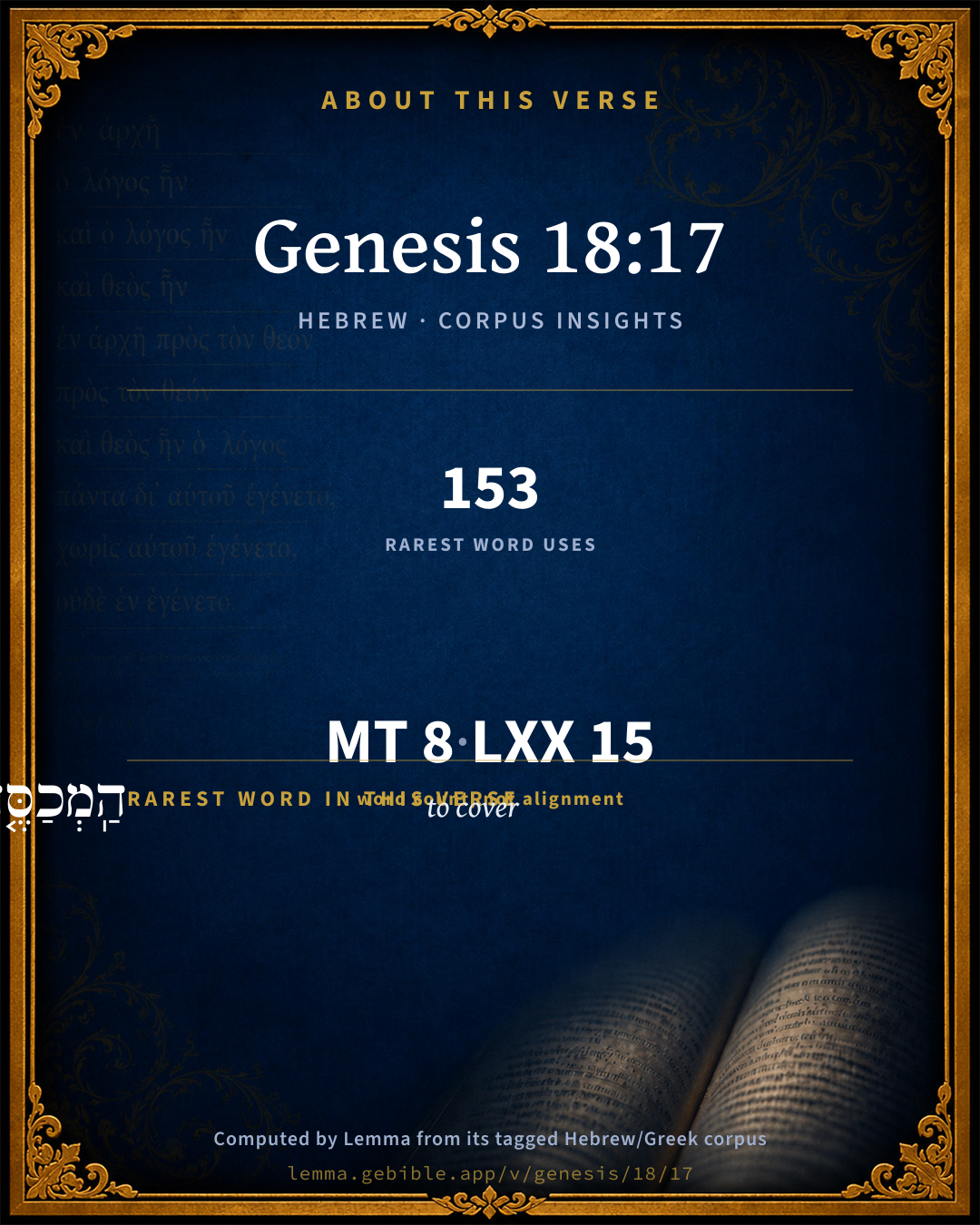
These counts appear in no published source. They are computed here, from the morphology-tagged text and Lemma’s own curated glosses. What Lemma adds →

8
words
7
distinct lemmas
Pentateuch
section

Grammatical profile

  • 3 verbs
  • 2 nouns
  • 2 pronouns
  • 1 particle

Verb forms

  • אָמָ֑ר Qal · Perfect
  • הַֽמְכַסֶּ֤ה Piel · Participle Active
  • עֹשֶֽׂה Qal · Participle Active

Repetition

A word recurs within this verse — often emphatic in Hebrew:

  • אֲנִי֙ I H589 ×2

Hebrew & Septuagint length

In English translation the verse runs 10 words from the Hebrew and 17 from the Septuagint (LXX English) — the Septuagint runs noticeably longer here. See the side-by-side →

A rough comparison of the two English renderings, which tokenize alike — not a word-level alignment.

Word counts can differ between the Hebrew and the Greek without any difference in meaning — e.g. the Hebrew direct-object marker אֵת has no separate Greek word, and Greek often adds the article ὁ.

In the original languages it is 8 Hebrew tokens and 15 Greek tokens — but the two are counted differently (Hebrew bundles its prefixes and suffixes into one token; the Greek is in lemma form), so that isn’t a like-for-like length.

Cross-references

7

Topical passages linked to Genesis 18:17 in the Treasury of Scripture Knowledge — connected by theme and wording, ordered by reader-vote popularity; previews shown in the World English Bible.

  • Psalms 25:14 The friendship of Yahweh is with those who fear him. He will show them his covenant.
  • Amos 3:7 Surely the Lord Yahweh will do nothing, Unless he reveals his secret to his servants the prophets.
  • John 15:15 No longer do I call you servants, for the servant doesn't know what his lord does. But I have called you friends, for everything that I heard from my Father, I have made known to you.
  • Genesis 19:24 Then Yahweh rained on Sodom and on Gomorrah sulfur and fire from Yahweh out of the sky.
  • James 2:23 and the Scripture was fulfilled which says, "Abraham believed God, and it was accounted to him as righteousness;" and he was called the friend of God.
  • 2 Kings 4:27 When she came to the man of God to the hill, she caught hold of his feet. Gehazi came near to thrust her away; but the man of God said, Let her alone: for her soul is vexed within her; and Yahweh has hid it from me, and has not told me.
  • 2 Chronicles 20:7 Did not you, our God, drive out the inhabitants of this land before your people Israel, and give it to the seed of Abraham your friend forever?

Cross-references courtesy of OpenBible.info (CC BY 4.0).

Hebrew and Greek witnesses Masoretic Hebrew ↔ Greek Septuagint

The same verse in the two great witnesses to the Old Testament, shown verse-for-verse.

Here the Septuagint runs noticeably longer than the Hebrew — LXX2012 (modern English Septuagint) 17 words vs World English Bible 10. A rough length comparison of the two English translations, not a word-level alignment — read both below.

These are two independent witnesses, not word-aligned to each other, and the Septuagint is shown in lemma (dictionary) form.

Hebrew Genesis 18:17 Masoretic · Westminster Leningrad Codex

וַֽיהֹוָ֖ה אָמָ֑ר הַֽמְכַסֶּ֤ה אֲנִי֙ מֵֽאַבְרָהָ֔ם אֲשֶׁ֖ר אֲנִ֥י עֹשֶֽׂה

Yahweh said, "Will I hide from Abraham what I do,

World English Bible · Public Domain

Greek LXX Genesis 18:17 Septuagint · lemma form

ὁ δέ κύριος εἶπον μή κρύπτω ἐγώ ἀπό αβρααμ ὁ παῖς ἐγώ ὅς ἐγώ ποιέω

And the Lord said, Shall I hide from Abraam my servant what things I intend to do?

LXX2012 (modern English Septuagint) · Public Domain

On this verse, Whedon's Commentary on the Bible discusses the Septuagint’s reading. Read the note in Commentary ↓

Hebrew: Westminster Leningrad Codex (CC BY 4.0). Greek: Septuagint (public domain); English from LXX2012 (modern English Septuagint) (Public Domain). How the Septuagint differs from the Hebrew →

Targum (Aramaic paraphrase)

2

The Targum is the ancient Jewish Aramaic paraphrase of the Hebrew Scriptures — an interpretive translation, not the Hebrew text itself. Onkelos (literal) and Pseudo-Jonathan (expansive) render the Torah, and Jonathan the Prophets. Coverage is partial: where no permissively-licensed English translation exists for a verse, only the Aramaic is shown. This is verse-level text, not a word-by-word alignment to the Hebrew.

  1. Targum Onkelos Torah (Genesis–Deuteronomy)
    וַיְיָ אֲמָר הַמְכַסֵּי אֲנָא מֵאַבְרָהָם דִּי אֲנָא עָבֵד

    (no public-domain English translation for this verse)

    Targum Onkelos — Aramaic: “Onkelos Genesis” (public domain); “Onkelos Exodus” (public domain); “Onkelos Leviticus” (public domain); “Onkelos Numbers” (public domain); “Onkelos Deuteronomy” (public domain). English: “Sefaria Community Translation” (CC0 1.0 (public-domain dedication)); “J.W. Etheridge. The Targums of Onkelos and Jonathan Ben Uzziel on the Pentateuch. London: Longmans, Green, 1862” (public domain). Text via Sefaria.

  2. Targum Pseudo-Jonathan Torah (Genesis–Deuteronomy)
    וַיְיָ אָמַר בְּמֵימְרֵיהּ לֵית אַוְושַׁר לִי לִמְכַסְיָא מִן אַבְרָהָם מַה דַאֲנָא עָבֵיד וּמִן דִינָא הוּא דְלָא נַעֲבֵּיד עַד דְנוֹדַע יָתֵיהּ

    And the Lord said, with His Word, I cannot hide from Abraham that which I am about to do; and it is right that before I do it, I should make it known to him. For

    Targum Pseudo-Jonathan — Aramaic: “Targum Jonathan on Genesis” (public domain); “Targum Jonathan on Exodus” (public domain); “Targum Jonathan on Leviticus” (public domain); “Targum Jonathan on Numbers” (public domain); “Targum Jonathan on Deuteronomy” (public domain). English: “The Targum of Jonathan ben Uzziel, trans. J. W. Etheridge, London, 1862” (public domain). Text via Sefaria.

Commentary

Notes on Genesis 18:17 from classic Christian and Jewish commentators (each source and its license shown beneath its notes). The classic Christian expositions comment on the surrounding passage and are grouped to its opening verse, so a note may address several verses; the Jewish commentaries on the Tanakh (Rashi and others) are per-verse, so they appear only where the commentator wrote on this verse.

Lemma curates 59 commentaries, every one of them public domain or Creative Commons licensed, each selected and text-cleaned for this edition rather than reprinted as found. About our sources →

Trapp's Complete Commentary

John Trapp

Gen 18:17 And the LORD said, Shall I hide from Abraham that thing which I do;

Ver. 17. Shall I hide from Abraham?] My bosom friend. He shall be both of God’s court, and his council. His "secret is with them that fear him". {Psa 25:14} The kings of Israel had some one courtier, called the king’s friend by a specialty, to whom they imparted arcana imperii , state secrets. Such an office had Abraham about God, who calls him "Abraham my friend." See what our Saviour saith to all his, Joh 15:15. "This honour have all his saints."

John Trapp, A Commentary or Exposition upon All the Books of the Old and New Testament (1647–1656) — public domain. Text from a community e-Sword module.

Joseph Benson's Commentary

Gen 18:17. Shall I hide from Abraham that thing which I do — Thus doth God in his counsels express himself after the manner of men, with deliberation. “The secret of the Lord is with them that fear him.” Those that by faith live a life of communion with God, cannot but know more of his mind than other people. They have a better insight into what is present, and a better foresight of what is to come.

Joseph Benson's Commentary on the Old and New Testaments (1811–1818) — public domain. Text from a community e-Sword module.

Tyndale Open Study Notes

Tyndale Open Resources

18:17-19 Abraham was responsible for teaching his descendants righteousness and justice so that they might enjoy God’s blessings. It was important for Abraham to know how God’s righteousness was at work in judgment.

Tyndale Open Study Notes — © Tyndale Open Resources, licensed CC BY-SA 4.0. Text via the HelloAO Bible API.

Geneva Bible (1599)

Geneva Bible translators

Jehovah the Hebrew word which we call Lord, showeth that this Angel was Christ: for this word is only applied to God.

Geneva Bible (1599) marginal notes — public domain. Text via Bolls.life.

Jamieson, Fausset & Brown

Robert Jamieson, A. R. Fausset & David Brown

the Lord said, Shall I hide--The chief stranger, no other than the Lord, disclosed to Abraham the awful doom about to be inflicted on Sodom and the cities of the plain for their enormous wickedness.

Jamieson, Fausset & Brown — Commentary Critical and Explanatory on the Whole Bible (1871) — public domain (CC PDM 1.0). Text via the HelloAO Bible API.

Adam Clarke's Commentary

Verse 17. Shall I hide from Abraham] That is, I will not hide. A common mode of speech in Scripture - a question asked when an affirmative is designed. Do men gather grapes of thorns? Men do not gather grapes of thorns, &c.

Adam Clarke's Commentary on the Bible (1810–1826) — public domain. Text from a community e-Sword/MySword module.

John Calvin's Commentaries

17. Shall I hide from Abraham? Seeing that God here takes counsel, as if concerning a doubtful matter, he does it for the sake of men; for he had already determined what he would do. But he designed, in this manner, to render Abraham more intent upon the consideration of the causes of Sodom’s destruction. He adduces two reasons why He wished to manifest his design to Abraham, before he carried it into execution. The former is, that he had already granted him a singularly honorable privilege; the second, that it would be useful and fruitful in the instruction of posterity. Therefore, in this expression, the scope and use of revelation is briefly noted.

John Calvin's Commentaries (1540-1563) — public domain. Text from the Calvin Translation Society English edition (1840s-50s) via the Christian Classics Ethereal Library (ccel.org). Calvin's coverage is partial (roughly two-thirds of the Bible); uncommented books and verses are honest gaps, never fabricated. The 19th-century editor's footnotes and remarks are omitted so the notes are faithfully Calvin's own voice.

The Cambridge Bible for Schools and Colleges

gen. ed. J. J. S. Perowne

17. And the Lord said] i.e. within Himself: cf. Gen_20:11, “I thought,” lit. “I said.”

Shall I hide from Abraham] With the thought of this verse, cf. Amo_3:6-7, “shall evil befall a city, and the Lord hath not done it? Surely the Lord God will do nothing, but he revealeth his secret unto his servants the prophets.” Here Jehovah purposes to reveal His intention to Abraham on account of his position as one who was in covenant relation, and the recipient of the promise (Gen_18:18).’

The Cambridge Bible for Schools and Colleges (gen. ed. J. J. S. Perowne; Cambridge University Press, 1878–1918) — public domain. Text from a community e-Sword module.

John Gill's Exposition

And the Lord said,.... Either unto Abraham himself, so leading on to what he was about to make known to him; and without supposing this it will be difficult to account for Abraham's intercession for Sodom upon this: or to the two angels with him; not as consulting them whether he should or no do what he next suggests, but to give to them Abraham's just character, and the reasons of his using him in such a friendly manner: or it may be, to the other divine Persons, the Father and Spirit, one with the Son of God, and always present with him:

shall I hide from Abraham the thing which I do? which he was about to do, namely, the destruction of Sodom and Gomorrah: the Jewish writers (a) observe, that these cities were given in the grant of the whole land to Abraham, and therefore it was right to acquaint him with it first: but other and better reasons are given in the next words; Abraham was a friend of the Lord, and he had showed himself friendly to him, not only now, but heretofore, and therefore will treat him as his friend, by imparting his secrets to him.

(a) Targ. Jerus. & Jarchi in loc.

John Gill's Exposition of the Whole Bible (1746–1763) — public domain (CC PDM 1.0). Text via the HelloAO Bible API.

Matthew Poole's English Annotations

q.d. I will not, cannot hide it; it is against the laws of friendship to conceal my secrets from him. The interrogation here is in effect a negation, as elsewhere. Compare 2Sa 7:5, with 1Ch 17:4; and Mat 7:16, with Luk 6:43. See also Amo 3:7.

Matthew Poole's English Annotations on the Holy Bible (1683–1685) — public domain. Text from a community e-Sword/MySword module.

Whedon's Commentary on the Bible

Daniel D. Whedon

17. Shall I hide… which I do — Here, again, Jehovah speaks in his own name and person, and the style of the narrative gives a lifelike reality to every circumstance. How like a bosom friend he speaks! The Septuagint reads: “By no means will I hide from Abraham, my child, what I do.” From such companionship Abraham was truly called “the friend of God.”

2Ch_20:7; Isa_41:8; Jas_2:23.

Daniel D. Whedon (gen. ed.), Commentary on the Old and New Testaments (1874–1909) — public domain. Text from a community e-Sword module.

The Pulpit Commentary

And the Lord said (to himself), Shall I hide from Abraham the LXX interpolate, tou paidov mou; but, as Philo observes, tou filou mou would have been a more appropriate designation for the patriarch (cf. 2Ch_20:7; Isa_41:8; Jam_2:23) that thing which I do. Ie. propose to do, the present being used for the future, where, as m the utterances of God, whose will is equivalent to his deed, the action is regarded by the Speaker as being already as good as finished (vide Ewald, "Hebrews Synt.," Gesenius,

Ver. 17.

Sodom"s doom revealed.

I THE REASON OF THE REVELATION.

1. Abraham"s new position. Having been lately taken into covenant with God, allied by the holy tie of a celestial friendship to Jehovah, the patriarch seemed in the Lord"s eyes to occupy a footing of intimacy before him that demanded the disclosure of Sodom"s impending doom. That footing the patriarch no doubt owed to Divine grace sovereign, unmerited, free; but still, having been accorded to him, it is, by a further act of grace, represented, as laying God himself under certain" obligations towards his servant. So the secret of the Lord is with them that fear him, and he will show them his covenant". (Psa_25:14)

2. Abraham"s new prospects. About to become the head of a great nation, it was natural to suppose that Abraham would be profoundly interested in all that concerned mankind. As the head of the Old Testament Church too, which had just been constituted, (Ge 17) there existed a special reason for his being properly instructed as to the impending judgment of Sodom. Upon him would devolve the interpretation to the men of his day of the significance of that event. Rightly viewed, this is one of the proper functions of the Church on earth to explain God"s judgments to the unbelieving world. Hence "the Lord God doeth nothing but he revealeth his secret unto Ms servants the prophets". (Amo_3:7)

3. Abraham"s new responsibilities. These were the cultivation of personal and family religion, which devolved upon him with a new force and a heavier degree of obligation than they did before in consequence of his new standing as a Church member. God having graciously assigned this position within the Church in order that he might command his children and his household after him, by means of religious instruction as well as through the influence of personal example, to fear God, it was needful that he should be informed as to the ground, at least, of the coming judgment on the cities of the plain.

II THE REASON OF THE RETRIBUTION. This was the wickedness of Sodom, which was

1. Exceedingly heinous as to its character. Minutely detailed in the ensuing chapter, it is here only indirectly mentioned as something grievous in the sight of God. All sin is inherently offensive in the eyes of the Almighty; but some forms of wickedness are more presumptuously daring or more intrinsically loathsome than others, and of such sort were the sins of. (Gen_19:1)

2. Exceedingly abundant as to its measure. It was "multiplied" iniquity of which the Sodomites were guilty; and this not simply in the sense in which the sins of all may be characterized as beyond computation, (Psa_19:12 Psa_40:12) but in the sense that their hearts were set in them to do evil, (Ecc_8:11) so that they worked all manner of uncleanness with greediness. (Eph_4:19)

1. Exceedingly clear as to its commission. Though God speaks of making investigation into the sins of Sodom, this was really unnecessary. The moral degeneracy of the inhabitants of the Jordan valley was one of the "all things" that are ever "naked and manifest" unto his eye. So nothing can hide sin from God (2Ch_16:9; Pro_15:3; Amo_9:8)

2. Exceedingly patent as to its ill desert. This was the reason why God employed the language of Ver. 21. He meant that though the guilt of Sodom was great, he would not let loose his vengeance until it should be seen to be perfectly just. Nothing would be done in haste, but all with judicial calmness.

Lessons:

1. The impotence of anything but true religion to purify the heart or refine a people.

2. God is specially observant of the wickedness of great cities.

3. When great cities sink to a certain depth in their wickedness they are doomed to perish.

4. When God"s judgments overtake a nation they are ever characterized by justice.

The Pulpit Commentary (1880–1919), ed. H.D.M. Spence-Jones & Joseph S. Exell — public domain. Text from a community e-Sword module.

John Wesley's Explanatory Notes

Shall I hide from Abraham that thing which I do - Thus doth God in his councils express himself after the manner of men, with deliberation. The secret of the Lord is with them that fear him. Those that by faith live a life of communion with God, cannot but know more of his mind than other people. They have a better insight into what is present, and a better foresight of what is to come.

John Wesley, Explanatory Notes Upon the Whole Bible (1754–1765) — public domain. Text via the GEBible commentary corpus.

Rashi

Rabbi Shlomo Yitzchaki (Rashi)

המכסה אני SHALL I HIDE? This is a question.

אשר אני עושה WHAT I AM DOING in Sodom. It is not proper for Me to do this thing without his knowledge. I gave him this land and these five cities therefore are his — as it is said, (10:19) “And the territory of the Canaanites was from Sidon … as thou goest towards Sodom and Gommorah etc.” I called him Abraham, the father of a multitude of nations; should I destroy the children without informing the father who loves me? (Genesis Rabbah 49:2)

Rashi on the Tanakh — English translations: “The Judaica Press complete Tanach with Rashi, translated by A. J. Rosenberg” (CC BY 4.0); “Pentateuch with Rashi's commentary by M. Rosenbaum and A.M. Silbermann, 1929-1934” (public domain); “The Metsudah Tanach series, Lakewood, N.J” (CC BY 4.0); and “The Book of Joshua, Metsudah Publications, 1997” (CC BY 4.0). Text via Sefaria.

Ramban (Nachmanides)

Rabbi Moshe ben Nachman (Ramban / Nachmanides)

AND THE ETERNAL SAID. I.e., to the host of heaven standing by Him, or to the angel messengers.It is possible that the word amar (He said) refers to thought, meaning that He thought He should not keep it hidden from Abraham on account of these reasons. Similarly: I ‘said,’ in the noontide of my days I shall go; And he ‘said’ to slay David. Likewise all expressions of speaking within the heart refer to thought., further, 27:41. See Ramban there.

Ramban (Nachmanides) on the Tanakh — English translation: “Commentary on the Torah by Ramban (Nachmanides). Translated and annotated by Charles B. Chavel. New York, Shilo Pub. House, 1971-1976” (CC BY 4.0). Text via Sefaria.

Radak

Rabbi David Kimhi (Radak)

וה' אמר, the Lord, Who had appeared to Him initially to inform him of the sins of the Sodomites (13,13) informed Avraham now, after the departure of the angels, about His plans in detail. The Torah adds, in its narrative, what had prompted G’d to take this unusual step of informing Avraham of His plans, seeing that his own safety was not involved. G’d felt duty-bound to apprise Avraham of His intentions.

Radak on the Tanakh — English translations: “Sefaria Community Translation” (CC0 1.0 (public-domain dedication)); “Eliyahu Munk, HaChut Hameshulash” (CC BY 4.0); “Rabbi Mike Feuer, Jerusalem Anthology” (CC BY 4.0); and “R. David Kimhi on the first book of Psalms, Translated by R.G. Finch, London, 1919” (public domain). Text via Sefaria.

Lesson kit

Teaching starters — assembled from the data on this page, not authored interpretation. Every prompt links to the verse data it draws on. Edit before teaching.

Genesis, in the Pentateuch, opens this verse with 8 words (7 distinct Hebrew lemmas). Its most distinctive word is kâçâh (“to cover”). The Greek Septuagint runs longer here. A historical commentator’s framing appears above. Read the whole chapter for the surrounding context.

Discussion questions

  1. What does “to cover” (kâçâh) contribute to the verse as a whole?
  2. How does Psalms 25:14, which shares this passage’s theme, read alongside this verse?
  3. What does the repetition of “I” (2× in this one verse) do in this verse?
  4. The Septuagint runs longer here than the Hebrew. What might account for the difference?
  5. These translations render this verse differently. What is at stake in choosing one wording over another?
  6. «אָמָ֑ר» is a Qal Perfect verb. How does that grammatical form shape the action described?
  7. Compare how Trapp's Complete Commentary and Joseph Benson's Commentary read this verse. Where do they agree or differ?

Things to notice

Reading settings

Reading text

Shown beneath each verse's original-language words.

Old Testament
Old Testament edition

Read the OT as the Masoretic Hebrew (MT) or the Greek Septuagint (LXX).

English shown for the Greek Septuagint (in the Hebrew ↔ Greek comparison).

Comparing translations? Open the Compare panel on any verse page to stack up to four side by side.