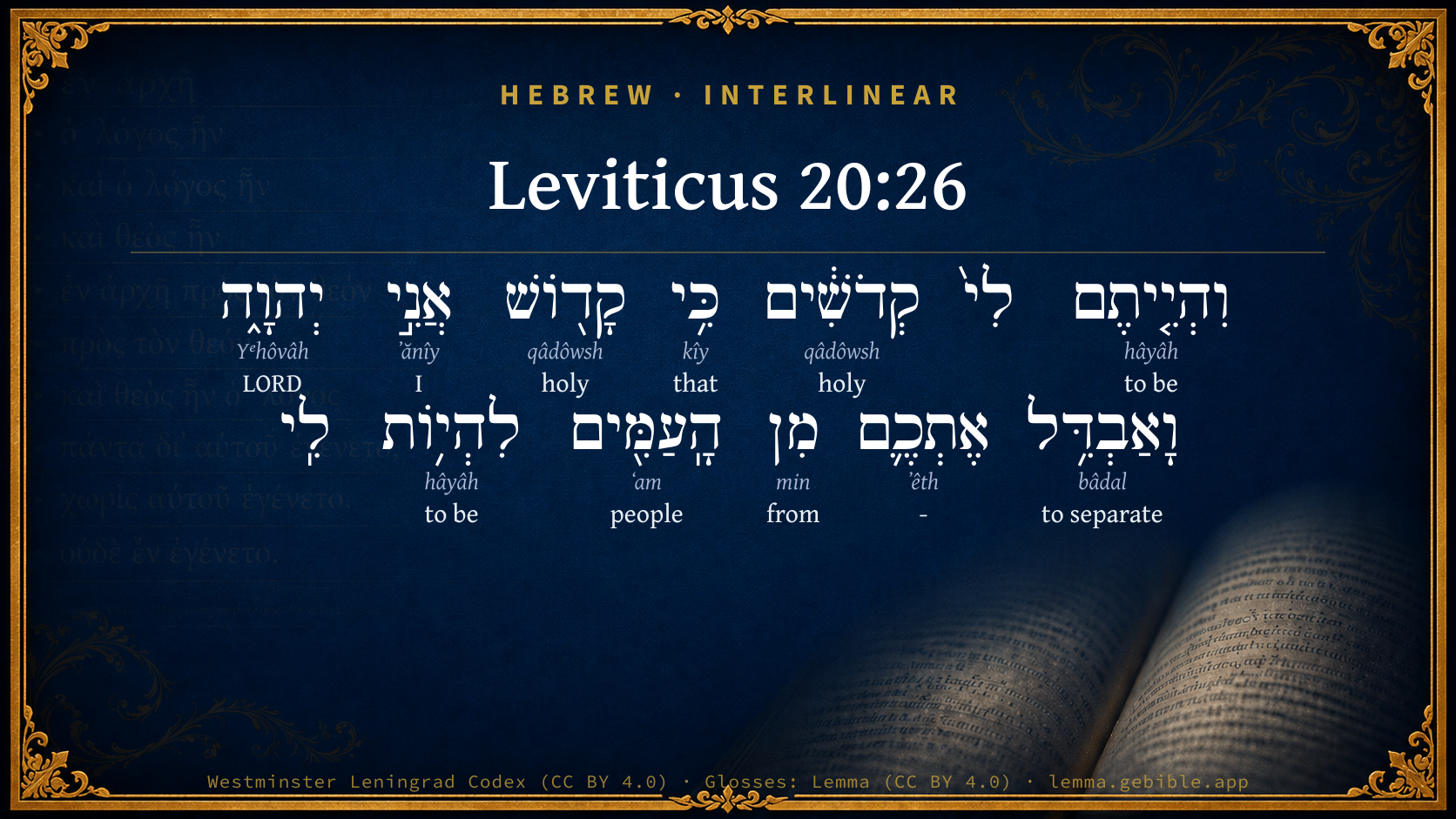
Leviticus 20:26

Hebrew (Westminster Leningrad Codex) Leviticus 20:26 appears in the Hebrew Old Testament. The text above is from the Westminster Leningrad Codex. Each word links to its Strong’s number, a concise gloss, and parsing drawn from the Open Scriptures Hebrew Bible morphology. Click any word for its full Brown-Driver-Briggs (BDB) entry.
Download image
Cite this verse

Leviticus 20:26 (World English Bible). Public Domain. Lemma interlinear Bible study tool, https://lemma.gebible.app/v/leviticus/20/26.

Show BibTeX & RIS
BibTeX
RIS
English Translation
You shall be holy to me: for I, Yahweh, am holy, and have set you apart from the peoples, that you should be mine.
World English Bible · Public Domain
Download a study sheet

One document with this verse’s original text, its word-by-word gloss line, the meaning frame, cross-references with their text, attributed commentary, and full source and license credits — printable, and it pastes into notes with its structure intact.

This verse Autodidact and up

Study sheet (.html) Plain text (.txt)

A passage Seminary Student

Up to 50 verses in one chapter. A passage sheet keeps up to 6 commentary sources and 12 cross-references per verse, in the order this page ranks them, and says so on the sheet whenever that leaves anything out. Ask for a single verse and you get the Autodidact verse sheet above.

Everything on this page stays free to read, with no account — the sheet is a download of what is already on screen, not access to it.

Want to remove ads? Support Godless Engineer
Compare translations 3

The same verse in 3 English versions, stacked beneath the original-language interlinear above. Click any original word for its lexicon entry.

Each is an independent rendering of the whole verse — the interlinear is not word-aligned to these translations.

Highlighted words mark where these versions differ — a whole-verse word diff, not a word-by-word alignment.

  • World English Bible Public Domain
    You shall be holy to me: for I, Yahweh, am holy, and have set you apart from the peoples, that you should be mine.
  • King James Version Public Domain
    And ye shall be holy unto me: for I the LORD am holy, and have severed you from other people, that ye should be mine.
  • unfoldingWord Literal Text CC BY-SA 4.0
    And you shall be holy for me, because I Yahweh am holy, and I separate you from the peoples to be for me.

unfoldingWord Literal Text — © unfoldingWord, licensed CC BY-SA 4.0. Word-aligned USFM3 via Door43 (git.door43.org/unfoldingWord/en_ult).

Versions to compare (up to 4)

3 of 4 selected

Show all 18 translations

Every available English version of this verse, each an independent rendering of the whole verse.

  • World English Bible Public Domain
    You shall be holy to me: for I, Yahweh, am holy, and have set you apart from the peoples, that you should be mine.
  • Berean Standard Bible Public Domain
    You are to be holy to Me because I, the LORD, am holy, and I have set you apart from the nations to be My own.
  • Majority Standard Bible Public Domain
    You are to be holy to Me because I, the LORD, am holy, and I have set you apart from the nations to be My own.
  • King James Version Public Domain
    And ye shall be holy unto me: for I the LORD am holy, and have severed you from other people, that ye should be mine.
  • American Standard Version (1901) Public Domain
    And ye shall be holy unto me: for I, Jehovah, am holy, and have set you apart from the peoples, that ye should be mine.
  • Revised Version (1885) Public Domain
    And ye shall be holy unto me: for I the LORD am holy, and have separated you from the peoples, that ye should be mine.
  • Geneva Bible (1599) Public Domain
    Therefore shall ye be holie vnto me: for I the Lord am holy, and I haue separated you from other people, that ye shoulde be mine.
  • Douay-Rheims (1899) Public Domain
    You shall be holy unto me, because I the Lord am holy, and I have separated you from other people, that you should be mine.
  • Young's Literal Translation Public Domain
    and ye have been holy to Me; for holy `am' I, Jehovah; and I separate you from the peoples to become Mine.
  • Literal Standard Version CC BY-SA 4.0
    And you have been holy to Me, for I, YHWH, [am] holy; and I separate you from the peoples to become Mine.
  • Unlocked Literal Bible CC BY-SA 4.0
    You must be holy, for I, Yahweh, am holy, and I have separated you from the other peoples, for you belong to me.
  • unfoldingWord Literal Text CC BY-SA 4.0
    And you shall be holy for me, because I Yahweh am holy, and I separate you from the peoples to be for me.
  • Darby Bible Public Domain
    And ye shall be holy unto me; for I Jehovah am holy, and have separated you from the peoples to be mine.
  • World Messianic Bible Public Domain
    You shall be holy to me, for I, the LORD, am holy, and have set you apart from the peoples, that you should be mine.
  • Webster's Bible Public Domain
    And ye shall be holy to me: for I the LORD am holy, and have severed you from other people, that ye should be mine.
  • Free Bible Version CC BY-SA 4.0
    You shall be holy to me because I am holy. I am the Lord, and I have made you a distinctive people different from all other nations. You belong to me.
  • Bible in Basic English Public Domain
    And you are to be holy to me; for I the Lord am holy and have made you separate from the nations, so that you may be my people.
  • JPS Tanakh (1917) Public Domain
    And ye shall be holy unto Me; for I the LORD am holy, and have set you apart from the peoples, that ye should be Mine.

Literal Standard Version (2020), Covenant Press — licensed CC BY-SA 4.0. Text via the HelloAO Bible API (eBible.org). Unlocked Literal Bible (unfoldingWord) — licensed CC BY-SA 4.0. Text via the HelloAO Bible API (eBible.org). unfoldingWord Literal Text — © unfoldingWord, licensed CC BY-SA 4.0. Word-aligned USFM3 via Door43 (git.door43.org/unfoldingWord/en_ult). Free Bible Version, Dr. Jonathan Gallagher — licensed CC BY-SA 4.0. Text via the HelloAO Bible API (eBible.org).

Word by word

More ways to search: Search by grammar → Find every occurrence → Compare this word →

Practice this passage: Drill this verse → Learn its vocabulary →

וָאַבְדִּ֥ל
bâdal
H914
“and · to separate”
Conjunction + Verb, Hiphil, Sequential Imperfect, 1st Person, Common, Singular
Part of Speech
Conjunction + Verb
Stem
Hiphil
Form
Sequential Imperfect
Person
1st Person
Gender
Common
Number
Singular
Full BDB Definition

Origin: a primitive root

TWOT: 203

to divide, separate - (Hiphil) - to divide, separate, sever - to separate, set apart - to make a distinction, difference - to divide into parts - (Niphal) - to separate oneself from (reflexive of 1a2) - to withdraw from - to separate oneself unto - to be separated - to be excluded - to be set apart
  1. וִהְיִ֤יתֶם hâyâh H1961 “and · to be” Conjunction + Verb, Qal, Sequential Perfect, 2nd Person, Masculine, Plural
  2. קְדֹשִׁ֔ים qâdôwsh H6918 “holy” Adjective, Adjective, Masculine, Plural, Absolute
  3. כִּ֥י kîy H3588 “that” Conjunction
  4. קָד֖וֹשׁ qâdôwsh H6918 “holy” Adjective, Adjective, Masculine, Singular, Absolute
  5. אֲנִ֣י ʼănîy H589 “I” Pronoun, Personal, 1st Person, Common, Singular
  6. יְהוָ֑ה Yᵉhôvâh H3068 “LORD” Noun, Proper
  7. אֶתְכֶ֛ם ʼêth H853 “- · you” Particle, Direct Object + Suffix, Personal, 2nd Person, Masculine, Plural
  8. מִן min H4480 “from” Preposition
  9. הָֽעַמִּ֖ים ʻam H5971 “the · peoples” Particle, Definite Article + Noun, Common, Masculine, Plural, Absolute
  10. לִהְי֥וֹת hâyâh H1961 “to be” Preposition + Verb, Qal, Infinitive Construct

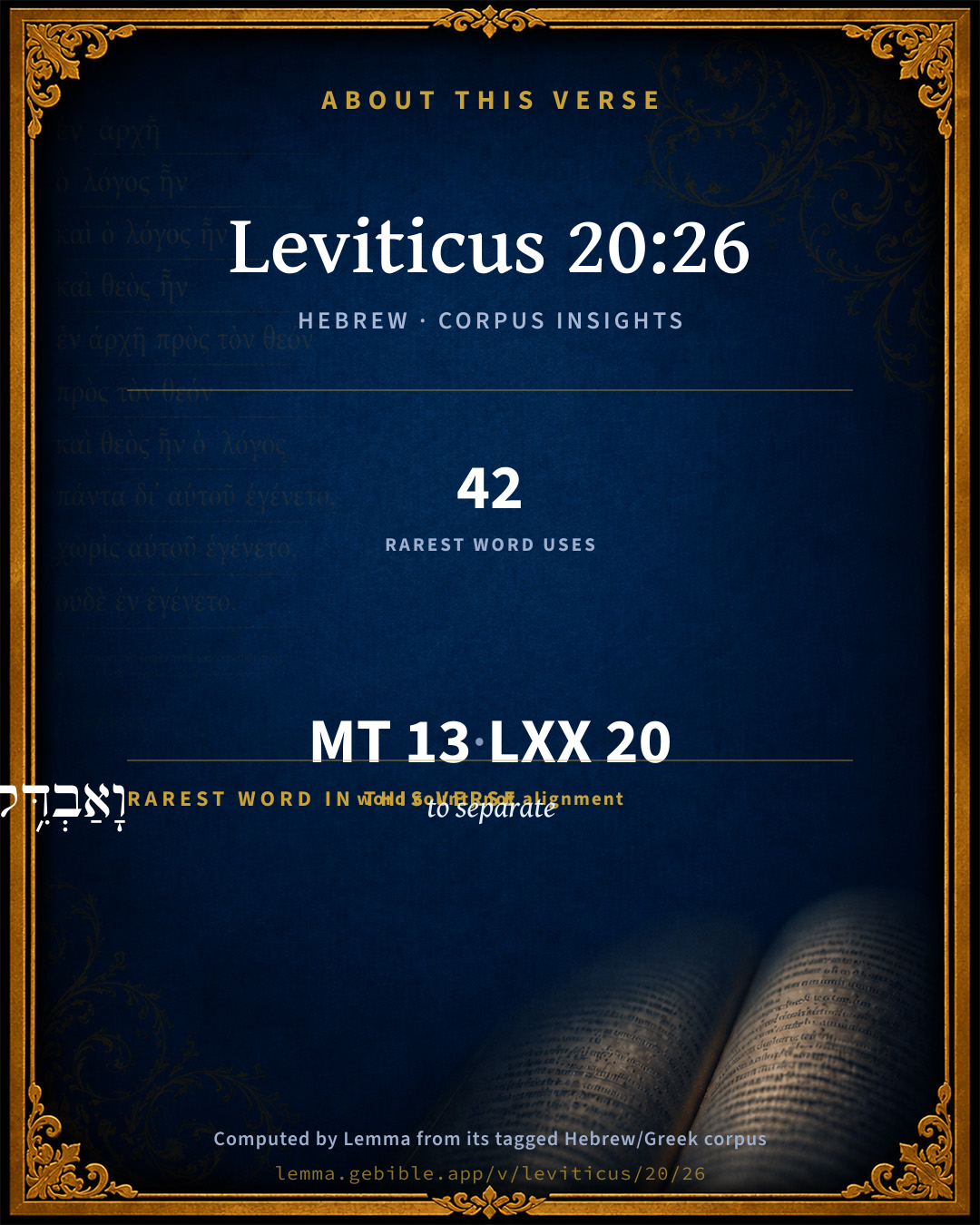
About this verse

These counts appear in no published source. They are computed here, from the morphology-tagged text and Lemma’s own curated glosses. What Lemma adds →

13
words
9
distinct lemmas
Pentateuch
section

Shared distinctive vocabulary

וָאַבְדִּ֥ל to separate H914 occurs in 40 verses of the Hebrew Bible. Also found in:

Grammatical profile

  • 3 verbs
  • 2 nouns
  • 2 adjectives
  • 1 pronoun
  • 3 prepositions
  • 1 conjunction
  • 1 particle

Verb forms

  • וִהְיִ֤יתֶם Qal · Sequential Perfect
  • וָאַבְדִּ֥ל Hiphil · Sequential Imperfect
  • לִהְי֥וֹת Qal · Infinitive Construct

Repetition

Words recur within this verse — often emphatic in Hebrew:

  • וִהְיִ֤יתֶם to be H1961 ×2
  • קְדֹשִׁ֔ים holy H6918 ×2

Hebrew & Septuagint length

In English translation the verse runs 24 words from the Hebrew and 24 from the Septuagint (LXX English) — the same length.

A rough comparison of the two English renderings, which tokenize alike — not a word-level alignment.

Word counts can differ between the Hebrew and the Greek without any difference in meaning — e.g. the Hebrew direct-object marker אֵת has no separate Greek word, and Greek often adds the article ὁ.

In the original languages it is 13 Hebrew tokens and 20 Greek tokens — but the two are counted differently (Hebrew bundles its prefixes and suffixes into one token; the Greek is in lemma form), so that isn’t a like-for-like length.

Cross-references

14

Topical passages linked to Leviticus 20:26 in the Treasury of Scripture Knowledge — connected by theme and wording, ordered by reader-vote popularity; previews shown in the World English Bible.

  • 1 Peter 1:15–16 but just as he who called you is holy, you yourselves also be holy in all of your behavior;
  • Leviticus 20:7 "'Sanctify yourselves therefore, and be holy; for I am Yahweh your God.
  • Leviticus 20:24 But I have said to you, "You shall inherit their land, and I will give it to you to possess it, a land flowing with milk and honey." I am Yahweh your God, who has separated you from the peoples.
  • Leviticus 19:2 "Speak to all the congregation of the children of Israel, and tell them, 'You shall be holy; for I Yahweh your God am holy.
  • Deuteronomy 7:6 For you are a holy people to Yahweh your God: Yahweh your God has chosen you to be a people for his own possession, above all peoples who are on the face of the earth.
  • Titus 2:14 who gave himself for us, that he might redeem us from all iniquity, and purify for himself a people for his own possession, zealous for good works.
  • Deuteronomy 26:18–19 and Yahweh has declared you this day to be a people for his own possession, as he has promised you, and that you should keep all his commandments;
  • Deuteronomy 14:2 For you are a holy people to Yahweh your God, and Yahweh has chosen you to be a people for his own possession, above all peoples who are on the face of the earth.
  • Isaiah 6:3 One called to another, and said, "Holy, holy, holy, is Yahweh of Hosts! The whole earth is full of his glory!"
  • Revelation 4:8 The four living creatures, each one of them having six wings, are full of eyes around about and within. They have no rest day and night, saying, "Holy, holy, holy, holy, holy, holy, holy, holy, holy is the Lord God, the Almighty, who was and who is and who is to come!"
  • Psalms 99:5 Exalt Yahweh our God. Worship at his footstool. He is Holy!
  • Psalms 99:9 Exalt Yahweh, our God. Worship at his holy hill, For Yahweh, our God, is holy!
  • Revelation 3:7 "To the angel of the assembly in Philadelphia write: "He who is holy, he who is true, he who has the key of David, he who opens and no one can shut, and who shuts and no one opens, says these things:
  • Isaiah 30:11 get out of the way, turn aside out of the path, cause the Holy One of Israel to cease from before us."

Cross-references courtesy of OpenBible.info (CC BY 4.0).

Hebrew and Greek witnesses Masoretic Hebrew ↔ Greek Septuagint

The same verse in the two great witnesses to the Old Testament, shown verse-for-verse.

These are two independent witnesses, not word-aligned to each other, and the Septuagint is shown in lemma (dictionary) form.

Hebrew Leviticus 20:26 Masoretic · Westminster Leningrad Codex

וִהְיִ֤יתֶם לִי֙ קְדֹשִׁ֔ים כִּ֥י קָד֖וֹשׁ אֲנִ֣י יְהוָ֑ה וָאַבְדִּ֥ל אֶתְכֶ֛ם מִן הָֽעַמִּ֖ים לִהְי֥וֹת לִֽי

You shall be holy to me: for I, Yahweh, am holy, and have set you apart from the peoples, that you should be mine.

World English Bible · Public Domain

Greek LXX Leviticus 20:26 Septuagint · lemma form

καί εἰμί ἐγώ ἅγιος ὅτι ἐγώ ἅγιος κύριος ὁ θεός σύ ὁ ἀποὁρίζω σύ ἀπό πᾶς ὁ ἔθνος εἰμί ἐγώ

And you⌃ shall be holy to me; because I the Lord your God am holy, who separated you from all nations, to be mine.

LXX2012 (modern English Septuagint) · Public Domain

Hebrew: Westminster Leningrad Codex (CC BY 4.0). Greek: Septuagint (public domain); English from LXX2012 (modern English Septuagint) (Public Domain). How the Septuagint differs from the Hebrew →

Targum (Aramaic paraphrase)

2

The Targum is the ancient Jewish Aramaic paraphrase of the Hebrew Scriptures — an interpretive translation, not the Hebrew text itself. Onkelos (literal) and Pseudo-Jonathan (expansive) render the Torah, and Jonathan the Prophets. Coverage is partial: where no permissively-licensed English translation exists for a verse, only the Aramaic is shown. This is verse-level text, not a word-by-word alignment to the Hebrew.

  1. Targum Onkelos Torah (Genesis–Deuteronomy)
    וּתְהוֹן קֳדָמַי קַדִישִׁין אֲרֵי קַדִישׁ אֲנָא יְיָ וְאַפְרֵשִׁית יָתְכוֹן מִן עַמְמַיָא לְמֶהֱוֵי פָלְחִין קֳדָמַי

    (no public-domain English translation for this verse)

    Targum Onkelos — Aramaic: “Onkelos Genesis” (public domain); “Onkelos Exodus” (public domain); “Onkelos Leviticus” (public domain); “Onkelos Numbers” (public domain); “Onkelos Deuteronomy” (public domain). English: “Sefaria Community Translation” (CC0 1.0 (public-domain dedication)); “J.W. Etheridge. The Targums of Onkelos and Jonathan Ben Uzziel on the Pentateuch. London: Longmans, Green, 1862” (public domain). Text via Sefaria.

  2. Targum Pseudo-Jonathan Torah (Genesis–Deuteronomy)
    וְתֶהֱווֹן קֳדָמַי קַדִישִׁין אֲרוּם קַדִישׁ אֲנָא יְיָ דִבְחָרִית בְּכוֹן וְאַפְרָשִׁית יַתְכוֹן מִן עַמְמַיָא מְטוֹל לְמֶהֱוֵי פַּלְחִין קֳדָמַי

    And you shall be holy before me; for holy am I, the Lord, who have chosen you, and separated you from the nations to be wor­shippers before Me.

    Targum Pseudo-Jonathan — Aramaic: “Targum Jonathan on Genesis” (public domain); “Targum Jonathan on Exodus” (public domain); “Targum Jonathan on Leviticus” (public domain); “Targum Jonathan on Numbers” (public domain); “Targum Jonathan on Deuteronomy” (public domain). English: “The Targum of Jonathan ben Uzziel, trans. J. W. Etheridge, London, 1862” (public domain). Text via Sefaria.

Commentary

Notes on Leviticus 20:26 from classic Christian and Jewish commentators (each source and its license shown beneath its notes). The classic Christian expositions comment on the surrounding passage and are grouped to its opening verse, so a note may address several verses; the Jewish commentaries on the Tanakh (Rashi and others) are per-verse, so they appear only where the commentator wrote on this verse.

Lemma curates 59 commentaries, every one of them public domain or Creative Commons licensed, each selected and text-cleaned for this edition rather than reprinted as found. About our sources →

Trapp's Complete Commentary

John Trapp

Lev 20:26 And ye shall be holy unto me: for I the LORD [am] holy, and have severed you from [other] people, that ye should be mine.

Ver. 26. See Lev 19:2; Lev 20:7.

John Trapp, A Commentary or Exposition upon All the Books of the Old and New Testament (1647–1656) — public domain. Text from a community e-Sword module.

The Biblical Illustrator

Joseph S. Exell

Lev_20:26

Ye shall be holy unto Me: for I the Lord am holy.

Holiness enforced

I. Let us endeavour to explain the meaning, and the force of that reason for which holiness is so universally enjoined. Ye shall be holy: for I the Lord your God am holy. And so Gods holiness is made the motive for ours. And why? The Lord our God is holy; therefore should we labour to become so likewise, in order that we may become like Him in the most lovely and glorious of His attributes. We should labour to become like Him in the most lovely and glorious of His attributes in order that by so doing we may become well-pleasing in His sight; and, by becoming well-pleasing in His sight, to attain to that eternal happiness which God hath prepared for all those who, because they are like Him, He will condescend to love.

II. Having seen why the holiness of God is proposed to us as the motive to become holy, let us proceed to examine into the nature of that holiness which we are commanded to imitate, that we may have a model of that which we are to pursue.

1. First of all, then, we are taught that God is a Spirit. As the heavens, therefore, are higher than the earth, so also must we place our conceptions of what constitutes the essential holiness of the High and Lofty One that inhabiteth eternity, above the pollution of every earthly passion. Therefore in knowing, in the first place, what is the model of that holiness of God which you are to pursue, you must first of all remember that no earthly pleasure, no carnal imagination must have a place within the sanctuary of the heart. The utter banishment of all these lusts, then, both from our minds (lest they be defiled), and from our actions (lest they become unholy), must be the first of our labours, must be our perpetual care.

2. But God is not holy in Himself alone, He is holy also in His acts towards every creature in His power. And herein we have another point on which we are to labour after the similitude to Gods holiness; we must throw aside every regard towards the persons of men, which courts the lofty, which rejects and despises the lowly man; we must account the welfare of all an object of our care; we must consider none too mean to be helped by our hand--none too high to mete out to them things which are expedient and their due. We must think of all, we must feel for all, we must be just to all; and so to show forth the similitude of Gods holiness to all.

3. Thus holy in Himself, and holy in His acts, God is holy, in the third place, in the manner in which He regards both sin and the sinner. The face of the Lord is against them that do evil; and the wicked, though he be exalted, shall not stand in His sight, for He is of purer eyes than to behold iniquity. To turn, then, away our eyes, lest we look upon vanity, and to separate ourselves from all commerce with ungodly men--to give no encouragement to transgression, nor to the transgressor--to have no fellowship with the unfruitful works of darkness, but rather to reprove them, both in word and deed--these are the duties to which in imitation of Gods holiness this third particular would more particularly direct us.

III. But who is sufficient for these things? Imperfectly as we have delineated the holiness of the Lord, few as are the features which we have had time to detail, yet who can consider his own failings in life without confessing how feebly he has attained to the conformity of the Almightys holiness? When the text is taken in itself, as the measure of the duty required of all, and when we compare it with our weak and wavering performances, there is nothing left for man but destruction and despair. But the same God, who hates every unholy person and thing, has made a way to escape, that we may be able to bear it. Christ has fulfilled the law of holiness for man; and He who knew no sin, has been made sin for us, that we might be made the righteousness of God in Him. This is at once the apparently great mystery, and this the consolation of our religion. (C. Benson.)

Ye shall be holy

There are three ways in which we may take these words. First, as simply the statement of a fact; the Lord, speaking in prophecy, says you shall be holy; you cannot help being holy, for you belong to God. He has chosen you. Thus every saved one becomes dedicated; and whatever is dedicated is holy; and, therefore, you being dedicated, you must be holy. Another interpretation might be (still prophetically), You shall be holy. The Lord God Omnipotent shall see to that. But then the promise bears upon that word your. Your God. If He is really your God, the God you have chosen, the God you have loved, the God you have served, the Cod really in your heart, your God, then He will take care and make you holy. But though both these interpretations of the verse are admissible, and true, and comforting, I think it is evident that they are not the meaning which is chiefly intended. Shall is not meant to be a future tense, but the imperative mood, It is very frequent in the Bible; a strong imperative, a positive law to be holy. Ye shall be holy, and for this reason above all others, because the Lord your God is holy. The creature must be like his Creator; the child must be like his Father; the scholar must be like his Master; the sinner must be like his Saviour. Ye shall be holy. It is your first duty to be holy. The reasons why we should be holy are very many. We are made capable of holiness. That is a great fact. Our former convictions and feelings point us to holiness. We have to do with holy things. Everything that we see, and everything we touch is holy. God has provided a way by which we may be holy. Holiness, even in this world, is the highest happiness, and we are made fit for and trained for a holy world beyond--a holy eternity. But besides and above all this our best and highest reason for anything is always what we find in God Himself. Ye shall be holy: for I the Lord your God am holy. It was Gods primary principle at mans creation. Let Us make man in Our image, after Our likeness. Therefore God made man holy. And when man lost his holiness, God, being very jealous about it, immediately proceeded to provide a way by which we could recover it. But what is holiness? The Greek word for holiness is compounded of two words which mean without earth, free from earthliness. Or we may take holiness to be that which has God for its Author, and God for its end; or that which matches with God, and is fitted for His service and His glory. Or sanctified purity. Or, as we have seen, that which resembles God, and is dedicated to His service and His glory. A reflection of Himself, or one or other of His attributes. A reflection of His holiness. Now the great and all-important question is, How is holiness to be attained? How do we, who are so very far off from holiness, become holy? In its great outline, I should say the answer is this: First, you must be, and realise that you are, a member of Christ; a Christian. Made so by your baptism, and your membership ratified and confirmed by the solemn words and vows which you yourself have made, and the many inward feelings in your own heart, and the many communications which you have had with God from time to time. Being, then, a member of Christ, and Christ your Head, the Holy Spirit, which was poured upon you at baptism, must hold His true place in your heart. The great work lies all within the Trinity. The Father gives you to the Son, the Son gives you to the Holy Ghost, the Holy Ghost gives you back to the Son changed and sanctified. Sanctified, but still a poor sinner. And the Son cleanses you with His blood, and clothes you with His own righteousness, and gives you back to the Father, through Him and in Him holy, holy enough for heaven, holy enough to stand in Gods holy presence. (Jas. Vaughan, M. A.)

Holiness; -

I. The holiness of saints depends upon no outward condition, requires no special gift of nature or of providence, of understanding or wisdom, nay, i may say, of grace. It need not be shown in any one form; it does not require the largeness of any one grace; still less does it consist in austere sadness, or stern constraint, or rigid severity as to ourselves or others, except as to our sins. The blessed company of the redeemed saints have and have not found one road to heaven. One road they found, in that they were saved through one Redeemer, looking on to Him and believing in Him before He came or looking to Him when He had come. But all else in their outward lot was different. They were redeemed to God out of every kindred, and tongue, and people and nation.

II. Holiness was made for all. It is the end for which we were made, for which we were redeemed, for which God the Holy Ghost is sent down and shed abroad in the hearts that will receive Him. God did not will to create us as perfect. He willed that we, through His grace, should become perfect. But what He willed that we Should be, that, if our will fail not, we must become. His almighty will vouchsafes to depend on ours. What God commands; what God wills; what God so willed that He made us for this alone, that we should be holy, and being holy, should share His holiness and bliss--that must be within our reach if we will.

III. The mistake of mistakes is to think that holiness consists in great or extraordinary things, beyond the reach of ordinary men. It has been well said, Holiness does not consist in doing uncommon things, but in doing common things uncommonly well. Few can ever do great things, and the few who can do them can each do but few. But every one can study the will of God, and can give great diligence to know it and to do what he knows. Your daily round of duty is your daily path to come nearer unto God. (E. B. Pusey, D. D.)

Godly distinctiveness

I. A unique code of moral and sacred laws. Ye shall keep all My statutes and all My judgments, and do them (Lev_20:22). No other people had a standard of morals, or a directory of religious regulations comparable to these.

II. A studious avoidance of the customs of ungodliness. Ye shall not walk in the manners of the nations, &c. (Lev_20:23). Conformity to the world was prohibited. However sanctioned, or desirable, or seemingly harmless, the customs of the ungodly were to be shunned.

III. A cautious selection of social enjoyments and indulgences. Ye shall put difference between clean and unclean, &c. (Lev_20:25). Palate not to be gratified, tables not to be spread with promiscuous viands. Gods wish and word were to rule them in every enjoyment, and self-restraint was to mark them in every gratification.

IV. A heritage of special privileges as Gods people. Ye shall inherit their land, a land that floweth with milk and honey, &c. (Lev_20:24). Sinners lose earthly felicities, as the penalty of their impiety: therefore I abhorred them (Lev_20:23). The godly possess rich heritage of good as the mark of Gods favour: I will give it unto you to possess (Lev_20:24).

V. A seal of divine sanctity resting upon them: They show themselves to be--

1. Divinely separated (Lev_20:24), from other people. Their history and career attest Gods dealing with them as with no other people.

2. Divinely sanctified. Ye shall be holy unto Me: for I the Lord am holy, and have severed you from other people (Lev_20:26). For the very beauty of the Lord rests upon the character and conduct of those He redeems. Note:

(1) God claims His people: they are not their own; may not follow their own desires and delights; He is their law, they must surrender to Him. That ye should be Mine (Lev_20:26). It is a blessed fact co belong to God: but it carries its obligations.

(2) Privileges are conditioned upon fidelity (Lev_20:22). The inheritance would be forfeited if obedience were withheld. All Gods covenant promises to us wait upon our loyalty to Him. Ye are My friends if ye do, &c. (W. H. Jellie.)

A holy God requires a holy people

The various laws which the Jews received from God through the medium of Moses were all meant to promote social, personal, political, national morality; to keep the people distinct from infecting elements around them, separated and hedged off from the possibility of contagion; so that whatever defiled them might be seen not to come from others, but to rise from the depths of their own fallen and depraved hearts. Therefore I have separated you from all people, that ye might be unto Me, He says, a peculiar people; and the great end that He contemplated constantly was their holiness--that they might be a holy people. The word holy, in fact, means properly, separated--set apart to some purpose or object or end. But in order to make their holiness still more likely He presented ever before them a grand model. Be ye holy, is His constant phrase, for I the Lord am holy. Ye shall be holy unto Me: for I the Lord am holy. It is well known that a people become, to a great extent, what their god or their gods are. The gods of the heathen were most of them monsters of lust. Jupiter was depraved; Mercury was a thief; others of their gods were infected with the greatest crimes; as if their villainy upon earth gave them a title to a niche in the Pantheon of heathenism. You must expect, from such gods in the theology of a people, bad lives in the history of that people. If the model be so bad, how low must the imitator and the worshipper be! But before the Jews there was placed the magnificent ideal of all that was holy, pure, just, perfect. The nearer they approached God, the nobler they became; the farther they receded from Him, the more degenerate they became. They had the standard infinitely remote, but infinitely perfect, ceaseless approximation to which was their nations strength, its glory, and its happiness. Thus the Jews were selected that they might be holy. They had a model constantly before them they were to imitate, that they might be holy. And they were chosen for this grand destiny not because of their own virtues--for, strange enough, their very mercies the corruption of their hearts turned into their own merits, and the more God favoured them, with a perverse ingenuity the most remarkable, when we know it was so often rebuked, the more credit they took to themselves; and He tells them that He chose them, not because they were greater or more excellent than any other nation, but because, in His own sovereignty, He set His love upon them. Thus they were hedged round with ceremonial laws; they had presented before them a perfect, infinitely perfect, Model; they were selected by distinguishing grace in order to reach and strive after this great destiny; they had ringing in their ears every day the law, Thou shalt love, which is translated into practical language, Thou shalt be holy, in order that they might obtain the end for which they were chosen and blessed and favoured--to be a separated people and a holy people to the Lord. Now, what the Jews were meant to be nationally we Christians are meant to be personally. We, too, are selected and favoured for this purpose; and we shall find all the economy of the New Testament constantly contemplates the holiness of Gods people as the great end and object and aim of our Christian privileges and blessings and mercies upon earth.

I. But, first of all, let us define what holiness is. The word means simply separation. So the Latin word sacer, from which comes our word sacred, is employed to denote profane as well as sacred--means wicked as well as holy. Hence the expression Auri sacra fames, literally translated, The sacred thirst of gold, but strictly and properly, The accursed thirst of gold. The meaning, therefore, of a holy person is one severed or separated to something; and when applied to that which is pure and just and true it means separated to God. And we can only form an idea of what holiness is by seeing it defined by God, as embodied in His character and explained at length in His Word. Holiness in a Christian is just separation, sanctification, severance from the excessive love of things lawful, from the forbidden love of things sinful, to the growing love of what God has commanded in His holy Word, and of the grand image that God has depicted in every page of His revelation.

II. Now having seen what this holiness is, let me state, in the next place, how Christians in the new testament are constantly associated with it.

1. They are elected to it. He has chosen us in Christ from the foundation of the world, that we should be holy.

2. Now, this holiness, in the next place, is true and lasting beauty; it is real and original beauty. The Kings daughter has all her beauty within, that needs a spiritual eye to discriminate and discern. The mass of mankind can only see glare, pretension, gaudiness, but the true Christian sees a city where the world sees none, for Christ, when He came to His own, His own recieved Him not; there was no beauty in Him that the world should desire Him.

3. And this holiness, too, of character is the highest possible honour. It is the livery of Heaven; it is the very robes of the King of glory; it is the dress which He prepares for His own; it is the Apocalyptic garments white and clean, which are the righteousness of saints; it is the raiment white and clean which no moth can gnaw, which no rust can decay, which no thief can break through and steal.

4. Arid, in the next place, this holiness is fitness for heaven. A man without an ear cannot enjoy music. In the same manner, a person without a sanctified heart, without holiness, is not fit for heaven.

5. In the next place, it is the distinguishing mark of the true Church of the Lord Jesus Christ. It is this that makes a Christian; and without this he cannot see God or put forth any valid claim to be a Christian at all.

6. In the next place, the Holy Spirit is the Author of this holiness.

III. Thus we have seen what this holiness is and who is the Author of it; let me notice now that all the institutions of the gospel are meant to promote it. Preaching is meant to promote it; sacraments are meant to promote it; the reading of the Bible is meant to promote it; the teaching of teachers is meant to promote it; all our schools and institutions, our preaching and hearing, our praying and communicating, are all helps that, by the blessing of the Spirit of God, bring us nearer to Him who is the Fountain of all holiness, of all light, and of all life.

IV. And in the next place, all the chastisements of Gods providence are meant to promote this. (J. Gumming, D. D.)

Holiness

Holiness! There is sweet music in the very name. It tells of sin subdued, of boisterous passions lulled, of fiery lusts becalmed, of miry paths made clean. It sets before us a pure walk, where peace and joy go hand in hand, and scatter heaven-born fragrance round. Holiness! To cause this lovely plant to thrive, its roots to deepen, and its branches to bear fruit, is one grand purport of the scheme of grace. The Lords own voice proclaims, Ye shall be holy: for I am holy. Holiness falls short when it falls short of God. But perhaps you say such glorious lustre is too bright for sight. The heavenly sunshine dims the dazzled eye. But still draw near. Gods Holiness, in human form, has visited and trod our earth. Jesus takes flesh and tabernacles here. His walk in our soiled paths is clean as on celestial pavement. Mark every act. Hear every word. They have one feature, holiness. Mark next the soil in which this flower has roots, the seed from which it springs. Mans pride must here lie low. It never thrives in Natures field. Neither can hand of Nature plant it. When sin came in each gracious fibre died. The curse fell blightingly on earth, bat most so on the human heart. The thorns and briars of the outward world are dismal emblems of the wilderness within. Gods likeness was effaced at once, and hideous enmity established its one rule. How, then, can holiness revive? Until the waste becomes a garden the plant cannot be set; until Heaven gives the seed it can nowhere be found. God must prepare the soil. God must infuse the seed. The work is wholly Gods. Next mark the renovating means. The wondrous engine is the gospel truth. The Spirit wins by charming notes. He opens ears to hear new melody. He gives the eye to see new scenes. He reveals Christ, the beauty of all beauty. He shows the cleansing blood, the sympathising heart, the perfect refuge, the all-sufficient aid. These sights wave a transforming wand. A new affection subjugates the man. Jesus and purer hopes now occupy the mind. Darkness is passed. The true light shines. The grace of faith springs up. This is the chain which binds the soul to Christ and makes the Saviour and the sinner one. A channel is now formed by which Christs fulness plenteously flows down. The barren branch becomes a portion of the fruitful stem. Christs vital juices permeate the whole. The limbs receive close union with the head, and one life reigns throughout the total frame. (Dean Law.)

Example of holiness

Christ is the Pattern, the Sample, the exemplary Cause of our sanctification. Holiness in us is the copy or transcript of the holiness that is in the Lord Jesus. As the wax hath line for line from the seal, the child limb for limb, feature for feature, from the father, so is holiness in us from Christ. (M. Henry.)

Influence of holiness

There is an energy of moral suasion in a good mans life passing the highest efforts of the orators genius. The seen but silent beauty of holiness speaks more eloquently of God and duty than the tongues of men and angels. Let parents remember this. The best inheritance a parent can bequeath to a child is a virtuous example, a legacy of hallowed remembrances and associations. The beauty of holiness beaming through the life of a loved relative or friend is more effectual to strengthen such as do stand in Virtues ways and raise up those who are bowed down than precept, command, entreaty, or warning. Christianity itself, I believe, owes by far the greater part of its moral power, not to the precepts or parables of Christ, but to His own character. The beauty of that holiness which is enshrined in the four brief biographies of the Man of Nazareth has done more, and will do more, to regenerate the world and bring on everlasting righteousness than all the other agencies put together. It has done more to spread His religion in the world than all that has ever been preached or written on the evidences of Christianity. (T. Chalmers, D. D.)

Sanctification, what it is

The saintly and learned Archbishop Ussher was frequently urged by a friend to write his thoughts on sanctification, which at length he engaged to do; but a considerable time elapsing, the performance of his promise was importunately claimed. The Archbishop replied, I have not written, and yet I cannot charge myself with a breach of promise, for I began to write; but when I came to treat of the new creature which God formeth by His own Spirit in every regenerate soul I found so little of it wrought in myself that I could speak of it only as parrots, or by rote, but without the knowledge of what I might have expressed, and therefore I durst not presume to proceed any further upon it. Upon this his friend stood amazed to hear such a confession from so grave, holy, and eminent a person. The Archbishop then added: I must tell you we do not well understand what sanctification and the new creature are. It is no less than for a man to be brought to an entire resignation of his own will to the will of God, and to live in the offering up of his soul continually in the flames of love, as a whole burnt-offering to Christ; and oh l how many who profess Christianity are unacquainted experimentally with this work upon their souls!

Holiness defined

At one of the ragged schools in Ireland a clergyman asked the question, What is holiness? A poor Irish convert in tattered rags jumped up and said, Please, your Reverence, its being clean inside.

True holiness

True holiness is a plain and an even thing, without falsehood, guile, perverseness of spirit, deceitfulness of heart, or starting aside. It hath one end, one rule, one way, one heart; whereas hypocrites are, in the Scripture, called double-minded men, because they pretend to God and follow the world; and crooked men, like the swelling of a wall whose parts are not perpendicular nor level to their foundation. Now rectitude, sincerity, and singleness of heart are ever, both in the eyes of God and man, beautiful things. (H. G. Salter.)

The ideal Holy One

And have you never cried in your hearts with longing, almost with impatience, Surely, surely there is an ideal Holy One somewhere, or else how could have arisen in my mind the conception, however faint, of an ideal holiness? But where? oh, where? Not in the world around, strewn with unholiness. Not in myself, unholy, too, without and within, and calling myself sometimes the very worst of all the bad company I meet, because that company is the only company from which I cannot escape. Oh! is there a Holy One whom I may contemplate with utter delight? and if so, where is He? Oh I that I might behold, if but for a moment, His perfect beauty, even though, as in the fable of Semele of old, the lightning of his glances were death. (Charles Kingsley.)

The Mount of Holiness

In elocution there is what rhetoricians term a second voice. It comes after an orator has been speaking sufficiently long for his lungs to become thoroughly warmed. The diversified ligaments and muscles and membranes which compose or influence his vocal organs then take on a more perfectly adjusted action, and the voice grows flexible and full and rich, able to express thoughts that breathe and words that burn. There is a vision known to opticians as second sight. In their later years many people come into possession of this. They can lay aside their spectacles, worn perhaps for a quarter of a century, and with the naked eye read the finest print. I have seen octogenarians whose eyesight was apparently as good as in the palmiest days of their youth. There is a mental perception enjoyed by multitudes of thinkers which seems to them like a second intellectuality. It is broader, clearer, and more satisfying than was the first. It is reached after a night-time of doubt and darkness, during which ones theories seem like chaos and ones beliefs like desperate guesses. It comes after a transition period, when, like Noahs ark, the mind can find no Ararat on which to anchor. Then breaks in a new light; the shadows flee, the heterogeneous mass of speculations begin to crystallise; a form appears, and he who had well-nigh become Diogenes the Cynic begins to develop into Socrates the Philosopher. So there is a second religious experience, deeper than the first. It lies beyond the surf of unbelief and partial consecration, and is reached by launching out into the deep of an unreserved dedication to God. Many have attained unto it and enjoy the rest of faith. Others are hungering after this more perfect righteousness, and will not hunger long in vain. Multitudes more are wishing for but making no determined efforts to secure it. They are like travellers ascending the valley of Chamounix, who catch glimpses of Mont Blanc, and though longing to stand on its glittering summit, have no expectation of ever doing so. I recall a memorable Sunday afternoon when, from an hotel window in Geneva, seventy miles distant, I caught my first view of that celebrated landmark. The setting sun was transmuting, as no other alchemist ever could, its whole immense top into one gorgeous mass of burnished gold, and the desire to visit it came upon me like a spell. But the city of Geneva, with its bright stores and historic church and marvellous watch factories, its bridges across the crystal river, and its romantic lake, lay at my feet, and I fingered; and when at last I sought the shining mount, like most tourists I was satisfied to reach its base and gaze upon it from below. So it is with thousands of Christians. Before their raptured vision rises, in their best moments, the Mount of Holiness. They sigh for its lofty experiences, but still view it from afar, or journey no farther than its foot-hills. Would they but climb its rising footways and scale its magnificent peaks, a second and deeper experience would be theirs. (Sunday School Record.)

.

The Biblical Illustrator, edited by Joseph S. Exell (c. 1880s–1900s) — public domain. Text from a community e-Sword module.

Ellicott's Commentary for English Readers

(26) And ye shall be holy unto me.—Rather, And ye shall be my holy ones, in harmony with the remark in the last clause of this verse, where God says that He had separated them for the purpose that “ye should be mine” The phrase only occurs here, and is different from the one which has been used in Lev_11:44-45; Lev_20:17.

And have severed you from other people.—Better, and have separated you from other people, as the Authorised Version renders this phrase in Lev_20:24. That is, God has separated them from the rest of the nations to be His holy people, and to be an example to them. The spiritual guides during the second Temple have explained this separation of Israel as not implying the rejection of the other nations, but simply as the first installment. They maintained that it implies that all other nations are gradually to follow, and that the Divine choice is to go on from people to people, till “many nations shall be joined to the Lord . . . and shall be my people” (Zec_2:11), where the same phrase, “shall be mine,” is used as in the passage before us. The Divine plan of the redemption of mankind they set forth in the text before us as follows :—“If the Scripture had said, I have separated all the nations from you, there would be no future for the Gentiles; but since it is said, I have separated you from the nations, it is as one who first of all separates the best from the less good, and then goes on continually to separate the better ones. But he who separates the bad from the good, by this very process rejects the bad, and does not return to them.” The Mosaic doctrine of the separation of Israel, therefore, so far from tending to produce and harbour in the Jews contracted views of God’s mercy, and a contempt for all other nations, has taught them to look upon themselves as simply having gone first to the mountain of the Lord, and that all other nations are to follow, and to become with them children of God.

A Bible Commentary for English Readers, edited by Charles John Ellicott (1878–1897) — public domain. Text from a community e-Sword module.

John Gill's Exposition

And ye shall be holy unto me,.... Separated from all unclean persons and things, and devoted to his service, and obedient to all his commands, and so live holy lives and conversations, according to his will, and to his honour and glory:

for I the Lord am holy; and therefore they, his people, should be like him, and imitate him, and observe those things which are agreeable to his holy nature and will, and yield a cheerful obedience to his holy precepts:

and have severed you from other people, that ye should be mine; which is a very forcible argument, a strong motive, and which laid them under great obligation to obedience and holiness.

John Gill's Exposition of the Whole Bible (1746–1763) — public domain (CC PDM 1.0). Text via the HelloAO Bible API.

Haydock's Catholic Bible Commentary

Mine. This is the reason of these different prescriptions, that they may know the dignity to which they have been raised, and may avoid the manners of the profane. (Calmet)

George Leo Haydock (1774–1849), Haydock's Catholic Family Bible and Commentary, 1859 edition — public domain. Excludes Psalms (Douay-Rheims chapter numbering differs from Protestant) and Deuterocanonical books (Catholic canon only).

The Pulpit Commentary

The command, Ye shall be holy unto me: for I the Lord am holy, is binding upon Christians far more strongly than on the Israelites. For

I CHRISTIANS HAVE A POWER GIVEN THEM WHEREBY THEY CAN BE HOLY WHICH THE ISRAELITES HAD NOT. St. Paul, having declared that the final purpose of God"s election and our adoption in Christ is "that we should be holy and without blame before him in love", (Eph_1:4) goes on to say that to those who believed, on hearing the gospel of their salvation preached, there was given the earnest of the Holy Spirit, with which they were sealed unto the day of redemption. (Eph_1:13, Eph_1:14) The Spirit of holiness is given to every baptized Christian soul, in a way in which he was not imparted to the Israelites, the dispensation of types and shadows having given place to that of spiritual realities, and the promised Comforter having been sent, not only to be with us, but to be in us. (Joh_14:16, 17 16:7-15)

II CHRISTIANS HAVE IN CHRIST AN EXAMPLE OF DIVINE HOLINESS WHICH THE ISRAELITES HAD NOT. They are therefore able to realize more fully than the Israelites the manner in which they are to "be holy, for the Lord your God is holy. They see before them the example of One who is God, and who emptied himself of his glory and power, and was made man, and lived a life of perfect holiness on earth. On this model they can, by the help of that Spirit vouchsafed to each Christian, form their own lives. It is an ideal never to be attained, but yet to have an ideal is an inexpressible help.

III CHRISTIANS, BY THEIR UNION WITH CHRIST AS THEIR HEAD, RECEIVE FROM HIM OF HIS HOLINESS. God has given Christ "to be the Head over all things to the Church, which is his body", (Eph_1:22, Eph_1:23) and has gathered "together in one all things in Christ", (Eph_1:10) that we "may grow up into him in all things, which is the Head, even Christ: from whom the whole body... maketh increase... unto the edifying of itself in love". (Eph_4:15, Eph_4:16) "Christ is the Head of the Church, as the husband is head of the wife", (Eph_5:23) and "we are members of his body, of his flesh, and of his bones". (Eph_5:30) The Word is "full of grace and truth... and of his fullness have all we received, and grace for grace". (Joh_1:14-16) From the mystical union between Christ and his Church there flow down graces upon those who are the members of his Church.

IV CHRISTIANS CAN BY FAITH APPROPRIATE TO THEMSELVES OF THE HOLINESS OF CHRIST. By faith the holiness, whereby satisfaction was made by Christ for the sinfulness of all mankind, may be so realized by the believing Christian as to be regarded as though it were his own in respect to his own sins.

The Pulpit Commentary (1880–1919), ed. H.D.M. Spence-Jones & Joseph S. Exell — public domain. Text from a community e-Sword module.

unfoldingWord translationNotes

Door43 World Missions Community

I have separated you

"I have distinguished you" or "I have set you apart"

translationWords

holy

people group

unfoldingWord translationNotes — © Distant Shores Media and the Door43 World Missions Community, licensed CC BY-SA 4.0. Source: git.door43.org/Door43/en_tn.

Rashi

Rabbi Shlomo Yitzchaki (Rashi)

ואבדל אתכם מן העמים להיות לי ‎ AND I HAVE SEPARATED YOU FROM THE PEOPLES THAT YOU SHOULD BE MINE — If you hold yourselves apart from them then you will be Mine, but if not, you belong to (become subject to) Nebuchadnezzar and others like him. Rabbi Eleazer ben Azariah said, “Whence do we know that one should not say, "My soul loathes swine’s flesh”, or, “I have no desire to wear clothes which are a mixture of wool and linen”, but one should say, "I would, indeed, like them, but what can I do since my Father in heaven has imposed these decrees upon me”? Because Scripture states: “I have separated you from the peoples to be for Me", whichyour separation from them (from their doings) should be for My sake — that one should keep aloof from sin and take upon himself the yoke of the kingdom of Heaven (Sifra, Kedoshim, Chapter 12 23).

Rashi on the Tanakh — English translations: “The Judaica Press complete Tanach with Rashi, translated by A. J. Rosenberg” (CC BY 4.0); “Pentateuch with Rashi's commentary by M. Rosenbaum and A.M. Silbermann, 1929-1934” (public domain); “The Metsudah Tanach series, Lakewood, N.J” (CC BY 4.0); and “The Book of Joshua, Metsudah Publications, 1997” (CC BY 4.0). Text via Sefaria.

Lesson kit

Teaching starters — assembled from the data on this page, not authored interpretation. Every prompt links to the verse data it draws on. Edit before teaching.

Leviticus, in the Pentateuch, opens this verse with 13 words (9 distinct Hebrew lemmas). Its most distinctive word is bâdal (“to separate”). A historical commentator’s framing appears above. Read the whole chapter for the surrounding context.

Discussion questions

  1. The word bâdal carries the sense “to separate.” How does it shape the verse?
  2. Genesis 1:4 shares the word «to separate» with this verse. How do the two illuminate each other?
  3. “to be” occurs 2× in this one verse. What is the effect of the repetition?
  4. The translations on this page render this verse differently — a whole-verse word diff, not a word-by-word alignment. What might account for the different wordings?
  5. The verb «וִהְיִ֤יתֶם» is Qal Sequential Perfect. How does its form color the action?
  6. Reading how Trapp's Complete Commentary and The Biblical Illustrator read this verse, where do the two commentators agree and where do they part?

Things to notice

Reading settings

Reading text

Shown beneath each verse's original-language words.

Old Testament
Old Testament edition

Read the OT as the Masoretic Hebrew (MT) or the Greek Septuagint (LXX).

English shown for the Greek Septuagint (in the Hebrew ↔ Greek comparison).

Comparing translations? Open the Compare panel on any verse page to stack up to four side by side.