
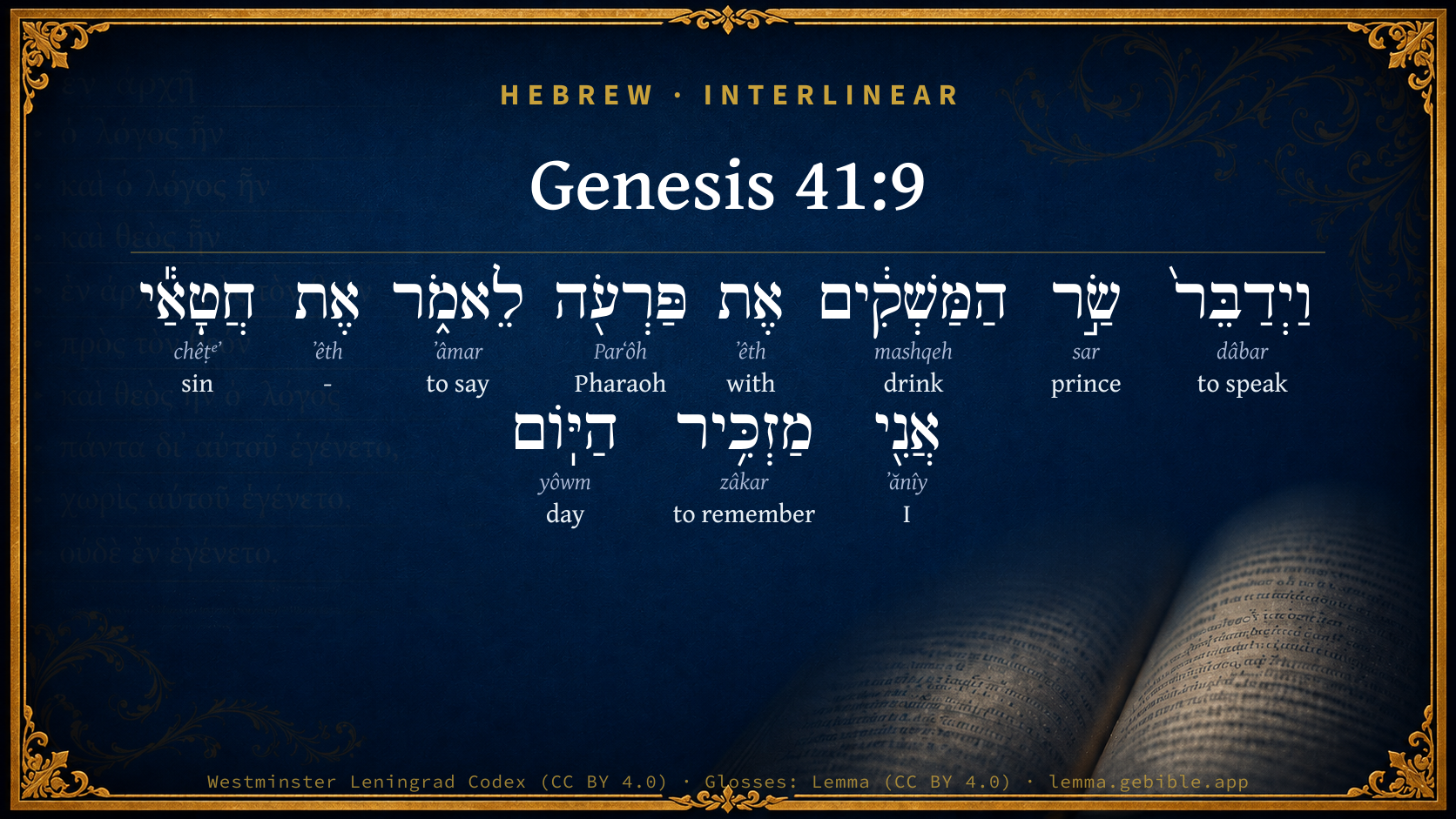
Genesis 41:9

Hebrew (Westminster Leningrad Codex) Genesis 41:9 appears in the Hebrew Old Testament. The text above is from the Westminster Leningrad Codex. Each word links to its Strong’s number, a concise gloss, and parsing drawn from the Open Scriptures Hebrew Bible morphology. Click any word for its full Brown-Driver-Briggs (BDB) entry.
Download image
Cite this verse

Genesis 41:9 (World English Bible). Public Domain. Lemma interlinear Bible study tool, https://lemma.gebible.app/v/genesis/41/9.

Show BibTeX & RIS
BibTeX
RIS
English Translation
Then the chief cupbearer spoke to Pharaoh, saying, "I remember my faults today.
World English Bible · Public Domain
Highlights
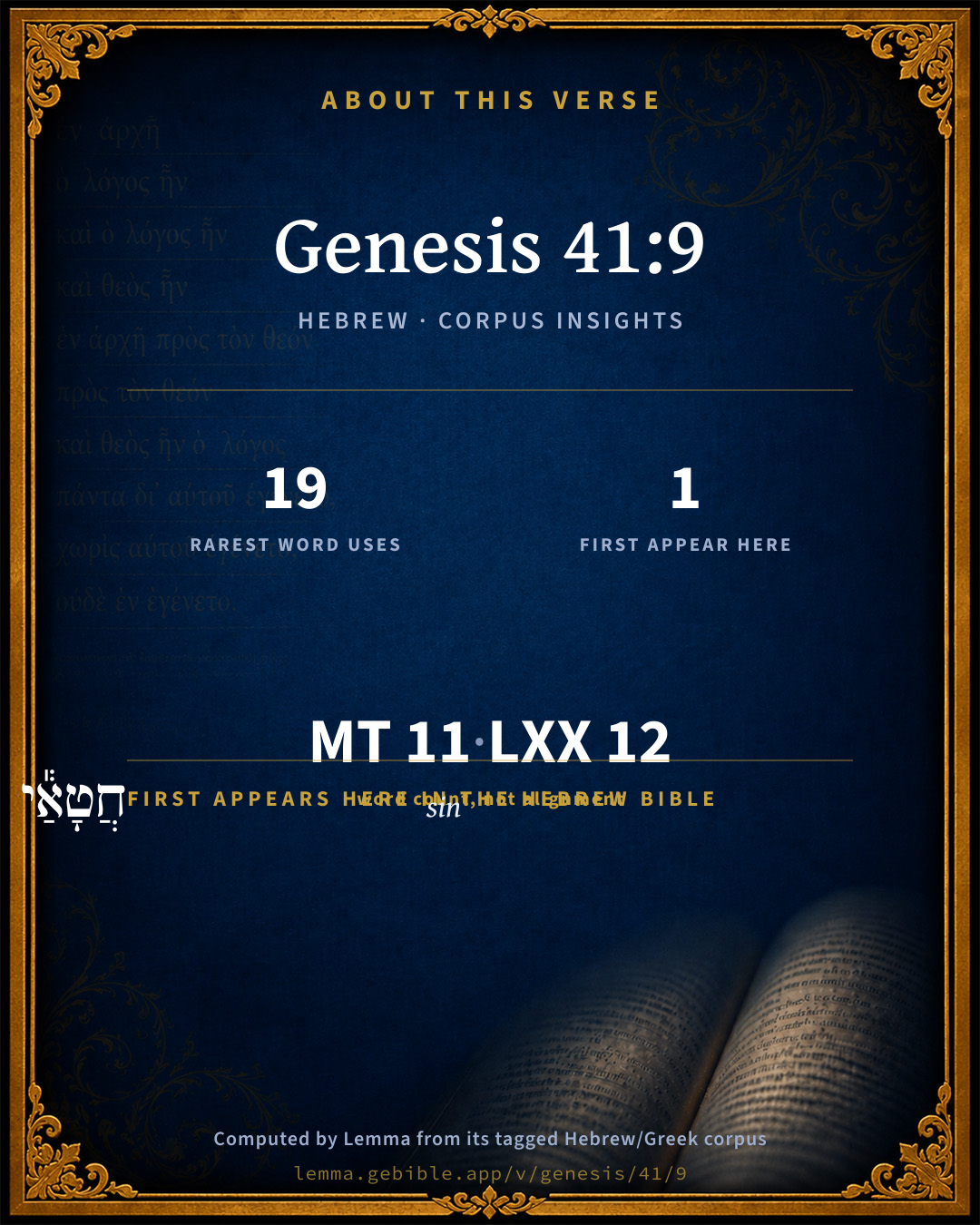
  • 1 first appearance in the Hebrew Bible
Full analysis ↓
Download a study sheet

One document with this verse’s original text, its word-by-word gloss line, the meaning frame, cross-references with their text, attributed commentary, and full source and license credits — printable, and it pastes into notes with its structure intact.

This verse Autodidact and up

Study sheet (.html) Plain text (.txt)

A passage Seminary Student

Up to 50 verses in one chapter. A passage sheet keeps up to 6 commentary sources and 12 cross-references per verse, in the order this page ranks them, and says so on the sheet whenever that leaves anything out. Ask for a single verse and you get the Autodidact verse sheet above.

Everything on this page stays free to read, with no account — the sheet is a download of what is already on screen, not access to it.

Want to remove ads? Support Godless Engineer
Compare translations 3

The same verse in 3 English versions, stacked beneath the original-language interlinear above. Click any original word for its lexicon entry.

Each is an independent rendering of the whole verse — the interlinear is not word-aligned to these translations.

Highlighted words mark where these versions differ — a whole-verse word diff, not a word-by-word alignment.

  • World English Bible Public Domain
    Then the chief cupbearer spoke to Pharaoh, saying, "I remember my faults today.
  • King James Version Public Domain
    Then spake the chief butler unto Pharaoh, saying, I do remember my faults this day:
  • unfoldingWord Literal Text CC BY-SA 4.0
    Then the chief of the cupbearers spoke with Pharaoh, saying, “Today I remember my offenses.

unfoldingWord Literal Text — © unfoldingWord, licensed CC BY-SA 4.0. Word-aligned USFM3 via Door43 (git.door43.org/unfoldingWord/en_ult).

Versions to compare (up to 4)

3 of 4 selected

Show all 18 translations

Every available English version of this verse, each an independent rendering of the whole verse.

  • World English Bible Public Domain
    Then the chief cupbearer spoke to Pharaoh, saying, "I remember my faults today.
  • Berean Standard Bible Public Domain
    Then the chief cupbearer said to Pharaoh, “Today I recall my failures.
  • Majority Standard Bible Public Domain
    Then the chief cupbearer said to Pharaoh, “Today I recall my failures.
  • King James Version Public Domain
    Then spake the chief butler unto Pharaoh, saying, I do remember my faults this day:
  • American Standard Version (1901) Public Domain
    Then spake the chief butler unto Pharaoh, saying, I do remember my faults this day:
  • Revised Version (1885) Public Domain
    Then spake the chief butler unto Pharaoh, saying, I do remember my faults this day:
  • Geneva Bible (1599) Public Domain
    Then spake the chiefe butler vnto Pharaoh, saying, I call to minde my faultes this day.
  • Douay-Rheims (1899) Public Domain
    And devoured all the beauty of the former. Pharao awaked after his rest:
  • Young's Literal Translation Public Domain
    And the chief of the butlers speaketh with Pharaoh, saying, `My sin I mention this day:
  • Literal Standard Version CC BY-SA 4.0
    And the chief of the butlers speaks with Pharaoh, saying, “I mention my sin this day:
  • Unlocked Literal Bible CC BY-SA 4.0
    Then the chief cupbearer said to Pharaoh, “Today I am thinking about my offenses.
  • unfoldingWord Literal Text CC BY-SA 4.0
    Then the chief of the cupbearers spoke with Pharaoh, saying, “Today I remember my offenses.
  • Darby Bible Public Domain
    Then spoke the chief of the cup-bearers to Pharaoh, saying, I remember mine offences this day.
  • World Messianic Bible Public Domain
    Then the chief cup bearer spoke to Pharaoh, saying, “I remember my faults today.
  • Webster's Bible Public Domain
    Then spoke the chief butler to Pharaoh, saying, I do remember my faults this day:
  • Free Bible Version CC BY-SA 4.0
    But then the chief cupbearer spoke up. “Today I've just remembered a bad mistake I've made,” he explained.
  • Bible in Basic English Public Domain
    Then the chief wine-servant said to Pharaoh, The memory of my sin comes back to me now;
  • JPS Tanakh (1917) Public Domain
    Then spoke the chief butler unto Pharaoh, saying: 'I make mention of my faults this day:

Literal Standard Version (2020), Covenant Press — licensed CC BY-SA 4.0. Text via the HelloAO Bible API (eBible.org). Unlocked Literal Bible (unfoldingWord) — licensed CC BY-SA 4.0. Text via the HelloAO Bible API (eBible.org). unfoldingWord Literal Text — © unfoldingWord, licensed CC BY-SA 4.0. Word-aligned USFM3 via Door43 (git.door43.org/unfoldingWord/en_ult). Free Bible Version, Dr. Jonathan Gallagher — licensed CC BY-SA 4.0. Text via the HelloAO Bible API (eBible.org).

Word by word

More ways to search: Search by grammar → Find every occurrence → Compare this word →

Practice this passage: Drill this verse → Learn its vocabulary →

הַמַּשְׁקִ֔ים
mashqeh
H4945
“the · drinks”
Particle, Definite Article + Noun, Common, Masculine, Plural, Absolute
Part of Speech
Particle + Noun
Type
Common
Gender
Masculine
Number
Plural
State
Absolute
Full BDB Definition

Origin: from H8248

TWOT: 2452c

irrigation, drink - irrigation - drink, drinking vessels - butlership (office of butler) - butler, cup-bearer
  1. וַיְדַבֵּר֙ dâbar H1696 “and · to speak” Conjunction + Verb, Piel, Sequential Imperfect, 3rd Person, Masculine, Singular
  2. שַׂ֣ר sar H8269 “prince of” Noun, Common, Masculine, Singular, Construct
  3. אֶת ʼêth H854 “with” Preposition
  4. פַּרְעֹ֖ה Parʻôh H6547 “Pharaoh” Noun, Proper
  5. לֵאמֹ֑ר ʼâmar H559 “to say” Preposition + Verb, Qal, Infinitive Construct
  6. אֶת ʼêth H853 “-” Particle, Direct Object
  7. חֲטָאַ֕י chêṭᵉʼ H2399 “sins · my” Noun, Common, Masculine, Plural, Construct + Suffix, Personal, 1st Person, Common, Singular
  8. אֲנִ֖י ʼănîy H589 “I” Pronoun, Personal, 1st Person, Common, Singular
  9. מַזְכִּ֥יר zâkar H2142 “remembering” Verb, Hiphil, Participle Active, Masculine, Singular, Absolute
  10. הַיּֽוֹם yôwm H3117 “the · day” Particle, Definite Article + Noun, Common, Masculine, Singular, Absolute

About this verse

These counts appear in no published source. They are computed here, from the morphology-tagged text and Lemma’s own curated glosses. What Lemma adds →

11
words
11
distinct lemmas
Pentateuch
section

Notable vocabulary

The rarest word here is הַמַּשְׁקִ֔ים drink H4945 — appearing just 19 times in the whole Hebrew Bible.

First appearance in Scripture

This word makes its first canonical appearance in the Hebrew Bible here:

  • חֲטָאַ֕י sin H2399

Shared distinctive vocabulary

הַמַּשְׁקִ֔ים drink H4945 occurs in 18 verses of the Hebrew Bible. Also found in:

Grammatical profile

  • 3 verbs
  • 5 nouns
  • 1 pronoun
  • 1 preposition
  • 1 particle

Verb forms

  • וַיְדַבֵּר֙ Piel · Sequential Imperfect
  • לֵאמֹ֑ר Qal · Infinitive Construct
  • מַזְכִּ֥יר Hiphil · Participle Active

Hebrew & Septuagint length

In English translation the verse runs 13 words from the Hebrew and 14 from the Septuagint (LXX English) — closely comparable.

A rough comparison of the two English renderings, which tokenize alike — not a word-level alignment.

Word counts can differ between the Hebrew and the Greek without any difference in meaning — e.g. the Hebrew direct-object marker אֵת has no separate Greek word, and Greek often adds the article ὁ.

In the original languages it is 11 Hebrew tokens and 12 Greek tokens — but the two are counted differently (Hebrew bundles its prefixes and suffixes into one token; the Greek is in lemma form), so that isn’t a like-for-like length.

Cross-references

3

Topical passages linked to Genesis 41:9 in the Treasury of Scripture Knowledge — connected by theme and wording, ordered by reader-vote popularity; previews shown in the World English Bible.

  • Genesis 40:14 But remember me when it will be well with you, and show kindness, please, to me, and make mention of me to Pharaoh, and bring me out of this house.
  • Genesis 40:23 Yet the chief cupbearer didn't remember Joseph, but forgot him.
  • Genesis 40:1–3 It happened after these things, that the butler of the king of Egypt and his baker offended their lord, the king of Egypt.

Cross-references courtesy of OpenBible.info (CC BY 4.0).

Hebrew and Greek witnesses Masoretic Hebrew ↔ Greek Septuagint

The same verse in the two great witnesses to the Old Testament, shown verse-for-verse.

These are two independent witnesses, not word-aligned to each other, and the Septuagint is shown in lemma (dictionary) form.

Hebrew Genesis 41:9 Masoretic · Westminster Leningrad Codex

וַיְדַבֵּר֙ שַׂ֣ר הַמַּשְׁקִ֔ים אֶת פַּרְעֹ֖ה לֵאמֹ֑ר אֶת חֲטָאַ֕י אֲנִ֖י מַזְכִּ֥יר הַיּֽוֹם

Then the chief cupbearer spoke to Pharaoh, saying, "I remember my faults today.

World English Bible · Public Domain

Greek LXX Genesis 41:9 Septuagint · lemma form

καί λαλέω ὁ ἀρχιοινοχόος πρός φαραώ λέγω ὁ ἁμαρτία ἐγώ ἀναμιμνήσκω σήμερον

And the chief cupbearer spoke to Pharao, saying, I this day remember my fault:

LXX2012 (modern English Septuagint) · Public Domain

On this verse, The Cambridge Bible for Schools and Colleges discusses the Septuagint’s reading. Read the note in Commentary ↓

Hebrew: Westminster Leningrad Codex (CC BY 4.0). Greek: Septuagint (public domain); English from LXX2012 (modern English Septuagint) (Public Domain). How the Septuagint differs from the Hebrew →

Targum (Aramaic paraphrase)

2

The Targum is the ancient Jewish Aramaic paraphrase of the Hebrew Scriptures — an interpretive translation, not the Hebrew text itself. Onkelos (literal) and Pseudo-Jonathan (expansive) render the Torah, and Jonathan the Prophets. Coverage is partial: where no permissively-licensed English translation exists for a verse, only the Aramaic is shown. This is verse-level text, not a word-by-word alignment to the Hebrew.

  1. Targum Onkelos Torah (Genesis–Deuteronomy)
    וּמַלִּיל רַב שָׁקֵי (עִם פַּרְעֹה) לְפַרְעֹה לְמֵימָר יָת סָרְחָנִי אֲנָא מַדְכַּר יוֹמָא דֵּין

    (no public-domain English translation for this verse)

    Targum Onkelos — Aramaic: “Onkelos Genesis” (public domain); “Onkelos Exodus” (public domain); “Onkelos Leviticus” (public domain); “Onkelos Numbers” (public domain); “Onkelos Deuteronomy” (public domain). English: “Sefaria Community Translation” (CC0 1.0 (public-domain dedication)); “J.W. Etheridge. The Targums of Onkelos and Jonathan Ben Uzziel on the Pentateuch. London: Longmans, Green, 1862” (public domain). Text via Sefaria.

  2. Targum Pseudo-Jonathan Torah (Genesis–Deuteronomy)
    וּמַלֵיל רַב מְזוֹגַיָא קֳדָם פַּרְעה לְמֵימַר יַת סוֹרְחָנִי אֲנָא מַדְכַּר יוֹמָא דֵין

    And the chief of the cup-bearers spake before Pharoh, saying, My faults do I remember this day.

    Targum Pseudo-Jonathan — Aramaic: “Targum Jonathan on Genesis” (public domain); “Targum Jonathan on Exodus” (public domain); “Targum Jonathan on Leviticus” (public domain); “Targum Jonathan on Numbers” (public domain); “Targum Jonathan on Deuteronomy” (public domain). English: “The Targum of Jonathan ben Uzziel, trans. J. W. Etheridge, London, 1862” (public domain). Text via Sefaria.

Commentary

Notes on Genesis 41:9 from classic Christian and Jewish commentators (each source and its license shown beneath its notes). The classic Christian expositions comment on the surrounding passage and are grouped to its opening verse, so a note may address several verses; the Jewish commentaries on the Tanakh (Rashi and others) are per-verse, so they appear only where the commentator wrote on this verse.

Lemma curates 59 commentaries, every one of them public domain or Creative Commons licensed, each selected and text-cleaned for this edition rather than reprinted as found. About our sources →

Matthew Henry's Commentary

Here is, 1. The recommending of Joseph to Pharaoh for an interpreter. The chief butler did it more in compliment to Pharaoh, to oblige him, than in gratitude to Joseph, or in compassion for his case. He makes a fair confession (Gen 41:9): "I remember my faults this day, in forgetting Joseph." Note, It is best to remember our duty, and to do it in its time; but, if we have neglected that, it is next best to remember our faults, and repent of them, and do our duty at last; better late than never. Some think he means his faults against Pharaoh, for which he was imprisoned; and then he would insinuate that, though Pharaoh had forgiven him, he had not forgiven himself. The story he had to tell was, in short, That there was an obscure young man in the king's prison, who had very properly interpreted his dream, and the chief baker's (the event corresponding in each with the interpretation), and that he would recommend him to the king his master for an interpreter. Note, God's time for the enlargement of his people will appear at last to be the fittest time. If the chief butler had at first used his interest for Joseph's enlargement, and had obtained it, it is probable that upon his release he would have gone back to the land of the Hebrews again, which he spoke of so feelingly (Gen 40:15), and then he would neither have been so blessed himself, nor such a blessing to his family, as afterwards he proved. But staying two years longer, and coming out now upon this occasion, at last, to interpret the king's dreams, way was made for his very great preferment. Those that patiently wait for God shall be paid for their waiting, not only principal but interest, Lam 3:26. 2. The introducing of Joseph to Pharaoh. The king's business requires haste. Joseph is sent for out of the dungeon with all speed; Pharaoh's order discharged him both from his imprisonment and from his servitude, and made him a candidate for some of the highest trusts at court. The king can scarcely allow him time, but that decency required it, to shave himself, and to change his raiment, Gen 41:14. It is done with all possible expedition, and Joseph is brought in, perhaps almost as much surprised as Peter was, Act 12:9. So suddenly is his captivity brought back that he is as one that dreams, Psa 126:1. Pharaoh immediately, without enquiring who or whence he was, tells him his business, that he expected he should interpret his dream, Gen 41:15. To which, Joseph makes him a very modest decent reply, (Gen 41:16), in which, (1.) He gives honour to God. "It is not in me, God must give it." Note, Great gifts appear most graceful and illustrious when those that have them use them humbly, and take not the praise of them to themselves, but give it to God. To such God gives more grace. (2.) He shows respect to Pharaoh, and hearty good-will to him and his government, in supposing that the interpretation would be an answer of peace. Note, Those that consult God's oracles may expect an answer of peace. If Joseph be made the interpreter, hope the best.

Matthew Henry's Commentary on the Whole Bible (1708–1710) — public domain (CC PDM 1.0). Text via the HelloAO Bible API.

Trapp's Complete Commentary

John Trapp

Gen 41:9 Then spake the chief butler unto Pharaoh, saying, I do remember my faults this day:

Ver. 9. I do remember my faults this day.] Oratio vere aulica, saith Pareus, - a right courtier’s speech. He so relates the history of his imprisonment, that he takes all the blame thereof to himself; gives Pharaoh the full commendation of his justice and clemency. As for Joseph, he mentions him to the king, lest, if any else should have done it before him, he should have been disgraced for his silence; but somewhat slenderly, and more for self-respects, than of any good affection to the innocent prisoner; whom he calls a young man, a bondman, and Hebrew; in whose behalf he neither adviseth, nor entreateth that he may be sent for. So very little is it that Joseph oweth to this patron! And such, for most part, are court commendations. There you have αναβολην και μεταβολην; as one said of old, delays and changes good store: every man seeking and serving his own aims and ends; but little minding the good of others, further than subservient to their own.

John Trapp, A Commentary or Exposition upon All the Books of the Old and New Testament (1647–1656) — public domain. Text from a community e-Sword module.

The Biblical Illustrator

Joseph S. Exell

Gen_41:9-13

I do remember my faults this day

Pharaohs butler; or, The power of memory, association, and conscience

I.

THE POWER OF MEMORY. I do remember. Memory, a faculty of mind, wonderful, varies in its strength and exercise, accompanied by pains as well as pleasures. The effect depends upon the state of the soul, and on the character of the things remembered, whether good or evil, painful or pleasant (see Job_21:6; Psa_63:6; Psa_77:3; Psa_137:1; Eze_16:61, Eph_2:11; Luk_16:25; Rev_14:13.) Beware. Do some evil deed, commit some wrong against your neighbour or your God; and, try as you will, you cannot quite forget. Memory may slumber for a while, but will some day awake.

II. THE POWER OF ASSOCIATION. This day. Why then? For two years all had seemingly been forgotten. Now chord of association touched: Pharaohs dreams. This power is often appealed to in Scripture. Type, symbol, parable, all recognize, and receive much of their value from association. In the special case before us, behold the hand of God. The great designs of Providence are ripe for execution. Hence the butler is roused to action. It needs but a touch of association, and the long-forgotten promise is recalled. Josephs release immediately follows.

III. THE POWER OF CONSCIENCE. My faults. Mark the power conscience:

1. In exciting a sense of personal blameworthiness.

(1) Infidelity.

(2) Ingratitude.

2. In exciting a feeling of painful remorse.

(1)Shame.

(2)Regret.

(3)Atonement. (Homilist.)

Faults remembered

I. WE ARE ALL CHARGEABLE WITH FAULTS (Ecc_7:20; Rom_3:12; Psa_19:12; Psa_143:2; Jam_3:2; 1Jn_1:8; Rom_3:23). Yet did not the chief butler remember Joseph, but forgot him. It was forgetfulness most inexcusable; it was ingratitude most unkind I But what are our faults? We have offended, not the king of Egypt, but the King of kings, the King of heaven, the Greatest and Best of all beings. We have forgotten, not the son of Jacob, but the Son of God, the Lord of life and glory.

II. WE ARE LIABLE TO FORGET OUR FAULTS.

1. The evidence of this. Men have convictions of sin, but they stifle them.

2. The causes of this.

(1) Ignorance of the true nature and malignity of sin.

(2) Partiality to self, strengthened by the deceitfulness of the heart.

(3) The hurry of business.

(4) Elevation in worldly circumstances.

III. Various circumstances are adapted to REMIND US OF OUR FAULTS.

1. Providential occurrences. Some of these regard ourselves, the affliction of our persons, or our immediate connections. Other providential occurrences regard the condition of those about us: they strike our observation. We witness sometimes She difficulties in which others are involved; we think of what occasioned such difficulties, and are reminded of similar causes in ourselves, which might have produced similar effects.

2. The ministry of Gods Word.

IV. When we are reminded of our faults we should be ready to confess 1Jn_1:8-9). What, then, have we to confess to God? What are the faults which this day we remember? We must go to Him with all our faults, with all our follies, and with all the iniquity of our sin.

V. Confession of faults should always be attended with REAL AMENDMENT. (T. Kidd.)

Pharaohs butler

There are some truths in this verse which I wish you to understand and remember. I shall name and illustrate five of these.

I. THE POWER OF INGRATITUDE. Josephs request to the butler, and the butlers reply. How easily he might have kept his promise I Have you been ungrateful to any one--parents, teachers, Jesus? If so, repent at once.

II. THE POWER OF MEMORY. As the bridge spans the river, so the butlers memory went back over two years. He saw Joseph in prison and his broken promise. How kind God has been in giving us such a wonderful faculty! Use it well in connection with pure objects, good books, and godly persons. You will then have always excellent and instructive companions.

III. THE POWER OF A SINGLE EVENT. What caused the butler to remember Joseph? The kings dream. How suggestive often are little things! A book, a portrait, a stone, a shoe.

IV. THE POWER OF CONSCIENCE. The butler began to think about his faults.

V. THE POWER OF INTERCESSION. The butler interceded with the king for Joseph. This led to Josephs freedom and exaltation. Do not forget this. Act upon it. The good which you may secure for others in this way. (Homiletic Review.)

Have you forgotten Him?

No single power or faculty of man escaped damage at the Fall: while the affections were polluted, the will was made perverse, the judgment was shifted from its proper balance, and the memory lost much of its power and more of its integrity. Our memories, like ourselves, have done the things which they ought not to have done, and have left undone the things which they ought to have done, and there is no health in them. Among other things, it is not always easy to recollect our faults We have special and particular reasons for not wishing to be too often reminded of them. If, however, the grace of God has entered into a man he will pray that he may remember his faults, and he will ask grace that if he should forget any excellences which he once supposed he had, he may not forget his defects, his sins, his infirmities, and his transgressions, but may have them constantly before him, that he may be humbled by them and led to seek pardon for them and help to overcome them.

I. We shall first call your attention to the BUTLERS FAULTS, for his faults are ours, only ours are on a larger scale: I do remember my faults this day. His particular fault was that he had forgotten Joseph; that, having promised to remember him when it should be well with him, he had altogether overlooked the circumstances which occurred in the prison, and had been enjoying himself, and leaving his friend to pine in obscurity.

1. Here, then, is the first fault--the butler had forgotten a friend. That is never a thing to be said in a mans praise. We ought to write the deeds of friendship as much as possible in marble; and that man is unworthy of esteem who can readily forget favours received. As I never shall forget when, at the foot of the Cross, I saw the interpretation of all my inward griefs; when I looked up and saw the flowing of my Saviours precious blood, and had the great riddle all unriddled. My brethren, what a discovery was that when we learned the secret that we were to be saved not by what we were or were to be, but saved by what Christ had done for us I Happy day I we see Jesus as the cluster crushed until the hearts blood flows, and can by faith go in unto the King, with Jesus Christs own precious blood and offer that, just as the butler stood before Pharaoh with the wine-cup in his hand, I bear a cup filled not with my blood, but His blood: not the blood from me as a cluster of the vine of earth, but the blood of Jesus as a cluster of heavens own vintage, pouring out its precious floods to make glad the heart of God and man.

2. Here lies our fault: that we have forgotten all this--not forgotten the fact, but forgotten to love Him who gave us that soul-comforting, heart-cheering interpretation.

3. We have not, however, quite done with the case of the butler and Joseph. The request which Joseph made of the butler was a very natural one. He said, Think of me when it is well with thee. He asked no hard, difficult, exacting favour, but simply, Think of me, and speak to Pharaoh. What the Saviour asks of us, His servants, is most natural and most simple, and quite as much for our good as it is for His glory. Among other things, He has said to all of you who love Him, This do in remembrance of Me.

4. I have stated the butlers case, but I shall want to pause a minute or two over this head just to go into the reason of his fault. Why was it that he did not recollect Joseph? There is always a reason for everything, if we do but try to find out. He must have been swayed by one of the three reasons.

(1) Perhaps the butler was naturally ungrateful. We do not know, but that may have been the case: he may have been a person who could receive unbounded favours without a due sense of obligation. I trust that is not our case in the fullest and most unmitigated sense, but I am afraid we must all plead guilty in a measure.

(2) Perhaps, however, worldly care choked the memory. The chief butler had a great deal to do: he had many under-servants, and, having to wait in a palace, much care was required. He who serves a despot like the king of Egypt must be very particular in his service. It is very possible that the butler was so busy with his work and his gains, and looking after his fellow-servants and all that, that he forgot poor Joseph. Is it not very possible that this may be the case with us? We forget the Lord Jesus to whom we are bound by such ties, because our business is so large, our family so numerous, our cares so pressing, our bills and bonds so urgent, and even because perhaps our gains are so large.

(3) I am half ashamed to have to say one thing more. I am afraid that the butler forgot Joseph out of pride; because he had grown such a great man, and Joseph was in prison. I do not suppose that this operates with many of you, but I have known it with some professed believers. When they were little in Israel, when they first professed to have found peace, oh how they acknowledged Jesus! But they got on in the world and prospered, and then they could not worship among those poor people who were good enough for them once--they now drive to a more fashionable place of worship, where the Lord Jesus is seldom heard of. They feel themselves bound to get into a higher class of society, as they call it, and the poor despised cause of Jesus is beneath them, forgetting, as they foolishly do, that the day will come when Christs cause shall be uppermost; when the world shall go down and the faithful followers of the Lord Jesus shall be peers and princes even in this world, and reign with Him; He being King of kings and Lord of lords, and they sitting upon His throne and sharing in His royal dignity. I hope none of you have forgotten Christ because of that.

II. The second point is this--WHAT CIRCUMSTANCES BROUGHT THE FAULT TO THE BUTLERS MIND? The same circumstances which surround us this morning

1. First, he met with a person in the same condition as that in which he once was. King Pharaoh had dreamed a dream, and wished for an interpretation. Joseph could interpret; and the butler remembered his fault. Brothers and sisters in Christ, there are those in the world who are in the same state of mind as you were once in. They once loved sin and hated God, and were strangers and aliens from the commonwealth of Israel; but in some of them there has been the mysterious working of the Holy Spirit, and they have dreamed a dream. They are awakened, although not yet enlightened. Salvation is a riddle to them at present, and they want the interpretation. Do you not remember how the gospel was blessed to you? Do you not desire to send it to others? If you cannot preach yourself, will you not help me in my life-work of training others to preach Jesus?

2. The next thing that recalled the butlers thought was this: he saw that many means had been used to interpret Pharaohs dream, but they had all failed. We read that Pharaoh sent for his wise men, but they could not interpret his dream. You are in a like case. Do not you feel a want, if you cannot go and preach yourselves, to help others to do so?

3. Then, again, if the butler could have known it, he had other motives for remembering Joseph. It was through Joseph that the whole land of Egypt was blessed. Joseph comes out of prison, and interprets the dream which God had given to the head of the state, and that interpretation preserved all Egypt, yea, and all other nations during seven years of dearth. Only Joseph could do it. Oh, brethren, you know that it is only Jesus who is the balm of Gilead, for the wounds of this poor dying world. You know that there is nothing which can bless our land, and all other lands, like the Cross of Jesus Christ.

4. Once more, surely the butler would have remembered Joseph had he known to what an exaltation Joseph would be brought. Think of the splendour which yet wilt surround our Lord Jesus I He shall come, beloved, He shall come in the chariots of salvation. The day draweth nigh when all things shall be put under Him. Kings shall yield their crowns to His superior sway, and whole sheaves of sceptres, plucked from tyrants hands, shall be gathered beneath His arm. You by testifying of Him are promoting the extension of His kingdom, and doing the best that in you lies to gather together the scattered who are to be the jewels of His crown.

III. In the last place, I have some few things to say by way of COMMENDATION OF THE BUTLERS REMEMBRANCE. It is a pity he forgot Joseph, but it is a great blessing that he did not always forget him. It is a sad thing that you and I should have done so little; it is a mercy that there is time left for us to do more.

1. I like the butlers remembrance, first of all, because it was very humbling to him.

2. I commend his remembrance for another thing, namely, that it was so personal. I do remember my faults this day. What capital memories we have for treasuring up other peoples faults, for once let us keep to ourselves. Let the confession begin with the minister. I do remember my faults this day.

3. The best part of it, perhaps, was the practical nature of the confession. The moment he remembered his fault, he redressed it as far as he could, Now, dear friends, if you recollect your fault to the Lord Jesus, may you have grace not to fall into it again! If you have not spoken for Him, speak to-day. If you have not given to His cause, give now I If you have not devoted yourselves as you ought to have done to the promotion of His kingdom, do it now. (C. H. Spurgeon.)

Confession of sin difficult

Many years ago, a minister put up for the night with a man who was supposed to possess but little of what people call common sense. Just as he was about to retire for rest, the man said: Tell me, sir, what three words in the English language it is the most difficult to pronounce? I dont know that I can, was the reply. Well, said the man, Ill give you till to-morrow morning to answer me. The minister thought no more of the question till it was proposed to him again in the morning, when he carelessly said he had not thought of it. Then, said the man, I will tell you. They are--I am wrong.

The Biblical Illustrator, edited by Joseph S. Exell (c. 1880s–1900s) — public domain. Text from a community e-Sword module.

Joseph Benson's Commentary

Gen 41:9. I remember my faults this day — In forgetting Joseph; or rather, he means his faults against Pharaoh, for which he was imprisoned; and thus he would insinuate, that, though Pharaoh had forgiven him, he had not forgiven himself. God’s time for the enlargement of his people will appear, at last, to be the fittest time. If the chief butler had at first used his interest for Joseph’s enlargement, and had obtained it, it is probable he would have gone back to the land of the Hebrews, and then he had neither been so blessed himself, nor such a blessing to his family. But staying two years longer, and coming out upon this occasion to interpret the king’s dreams, a way was made for his preferment.

Joseph Benson's Commentary on the Old and New Testaments (1811–1818) — public domain. Text from a community e-Sword module.

Whedon's Commentary on the Bible

Daniel D. Whedon

JOSEPH INTERPRETS PHARAOH’S DREAMS, Gen_41:9-36.

9. My faults — The sins which caused his imprisonment. The recital of the king’s dreams, and the inability of all the wise men to interpret them, cause the butler to remember his offences, his imprisonment, his dream, and all connected with it.

Daniel D. Whedon (gen. ed.), Commentary on the Old and New Testaments (1874–1909) — public domain. Text from a community e-Sword module.

The Preacher's Complete Homiletical Commentary

Joseph S. Exell (gen. ed.)

CRITICAL NOTES.—

Gen_41:14. He shaved himself and changed his raiment.] “The fact of Joseph having shaved himself is in striking accord with the Egyptian custom, which was to let the beard and hair grow in mourning only—otherwise most scrupulously shaving; whereas the Hebrews cultivated the hair and beard and shaved in token of mourning (see 2Sa_10:4-5; Isa_15:2; Jer_16:6; Jer_41:5; Amo_8:10), He changed his raiment, from the ordinary habit of the prison to that of ordinary life or even of festal rejoicing. The fact of his having it in his power to do so shews that he was not treated as ordinary prisoners are.” (See Gen_39:22-23.)—(Alford.)—

Gen_41:16. God shall give Pharaoh an answer of peace.] Heb. “God will answer as to the peace (or welfare) of Pharaoh.” The meaning is, that God will give an answer such as shall prove to be for the welfare of Pharaoh.—

MAIN HOMILETICS OF THE PARAGRAPH.—Gen_41:9-16

JOSEPH SUMMONED INTO PHARAOH’S PRESENCE

Consider—

I. His long waiting for notice and deliverance. For two long and weary years was Joseph lingering in that prison. He had to endure that trial of hope deferred that maketh the heart sick. The purest and wisest man in the land was shut up in a prison for two of the best years of his life. This seems to us a sad waste of power. But the religious mind will see in it the wisdom of God.

1. In regard to the education of character. The delays of Providence (as they seem to us) are part of our spiritual education. All this time, Joseph was learning God’s lessons. We require the teaching, not only of precepts, but also of events and trials. Joseph had faults of character to correct, much to unlearn; notoriously the spirit of censoriousness and pride. And two years were not too short a time to get the lessons of life’s true wisdom by heart. The wisdom of God in this painful chapter of Joseph’s history is also seen—

2. In its adaptation to the circumstances of the individual. During these two years of Joseph’s hard trial, events were not ripe for his deliverance. Divine Providence is not obliged to use forcing processes to precipitate events. Had Joseph been released before, he might have returned to his father’s house, or re-entered the service of Potiphar; and then in the natural course of things, how could Israel and Egypt have been preserved! The wisdom of God is yet further seen—

3. In its elevation above all human infirmities. God is not in haste to bring His work to its appointed end. Providence works by, what appear to us to be, slow methods. Short-sighted man must seize upon every tempting opportunity, but infinite wisdom knows no such infirmity. God allows those slowly to ripen whom He destines for a great work. Illustrated by the history of John the Baptist, who spent a life-time in the wilderness to prepare him for a brief ministry of a few months; and also by God’s own Son, who did not begin to preach the Gospel of the kingdom till He was thirty years old.

II. The manifest hand of God in it. Without doubt we have here the agency of man, and results which may be traced to the natural course of events. The chief butler suddenly remembers how Joseph interpreted his dream, and also that of his fellow-prisoner; and how remarkably the interpretation had been fulfilled. He mentions this extraordinary person to Pharaoh, who naturally sends for Joseph as the very man he wanted in his great perplexity. But we cannot here fail to see the manifest hand of God at work. It was God who sent this dream to Pharaoh, and it must follow that the interpreter of it must be divinely instructed. It was wisely ordered that Joseph should be under no obligation to Pharaoh for his deliverance. It is for his own sake that Pharaoh sends for Joseph. The chief butler was suffered to forget his friend, the prophet of his deliverance, and was forced to remember him only by circumstances. To neither of them was Joseph indebted. Thus it was God’s design that the chosen family should be under obligations to none. Their calling was to impart blessings to mankind, and not to receive.

III. His piety throughout the interview.

1. His simplicity of character. He makes no long speech. He does not use the opportunity to glorify himself, or to plead for liberty and reward. His manner was dignified and respectful, yet marked by great openness and simplicity of character. Joseph is the same in the palace or in the prison.

2. His humility. He indulged in no spirit of boasting, though this compliment from the king would have tempted weaker men to be vain and proud. (Gen_41:15.) Joseph never forgot his character as a witness for God.

3. His calmness. He was conscious of God’s presence and of his own integrity, so he could afford to be calm before the rulers of this world.

4. His kindly consideration for others. Pharaoh might have reason for the worst fears when he heard of the interpretation of the baker’s dream. Though a king he was not exempt from the common evils of human nature; nor from death—the chief calamity. But Joseph hastens to remove all fear of an unfavourable interpretation from his mind, by assuring him that the future had in it nothing but what would make for the peace of Pharaoh. Thus Joseph combined faithfulness to God’s cause with kindness and consideration for man.

SUGGESTIVE COMMENTS ON THE VERSES

Gen_41:9. He ought, indeed, to have remembered his fault against Joseph and against God, whose goodness he concealed when he ought to have published it. But this fault seems to have made little or no impression on his mind. His former faults he acknowledged in deference to the king.—(Bush.)

A right courtier’s speech! He so relates the history of his imprisonment that he takes all the blame thereof to himself; gives Pharaoh the full commendation of his justice and clemency. (Trapp.)

There is a morbid feeling which delights in railing against human nature; but there is a wiser lesson to be gained from this story than merely speaking of the butler’s ungratefulness. Consider, first, the suspense in which he was respecting his trial, and then the onerous duties that he had to perform. Then remember, too, that what Joseph did for him after all was not so much, it was merely the interpretation of his dream. The lesson that we draw from this is: In this world we do too little and we expect too much. We bless a poor man by giving to him, and we expect that we have made him our debtor for life. You fancy that the world has forgotten you. Reason with yourselves. For this world from which you expect so much, what have you done? And if you find that you have done little and received much, what marvel is it that you receive no more? The only marvel is that we have received so much.—(Robertson.)

The memory of the chief butler. Forgetfulness of the small—a sharp remembrance in the service of the great.—(Lange).

Gen_41:10-13. He now recites the circumstances in which he became acquainted with Joseph, and his wonderful success in interpreting dreams. It is not so much to do Joseph a favour that he commends him as it is to raise himself in Pharaoh’s esteem.—(Jacobus.)

And he interpreted to us our dreams. And well you requited him! But better late than never, though a ready dispatch doubleth the benefit. Howbeit God had an overruling hand in it, for Joseph’s greatest good. He turneth the world’s ingratitude to the salvation of His servants.—(Trapp.)

Joseph as opposed to the Egyptian interpreters of dreams, Moses as opposed to the Egyptian sorcerers, Christ as opposed to the Scribes and Pharisees, Paul as opposed to heresies, etc., or, in other words, the contrast between Divine wisdom and the wisdom of this world—a contrast that pervades all history.—(Lange.)

Gen_41:14. The word of the Lord had sufficiently tried Joseph. The mystery of Providence concerning him was now to be cleared up.

It is said of Mephibosheth, 2Sa_19:24, that he had not washed his clothes, nor washed his feet, nor trimmed his beard, from the time that David left Jerusalem, because of Absolom, till he returned again in peace to his father’s house. By like signs Joseph expressed his humiliation under those afflictions which Divine Providence had laid upon him. But now, when called before the king, he laid aside his mourning apparel, that he might appear with decency and due respect in the royal presence. Doubtless when he exchanged his prison garments for such as are worn in king’s palaces, his heart rejoiced less in the change of his circumstances, than in the favour of God, who had “put off his sackcloth, and girded him with gladness, to the end that his glory might sing praise to the Lord.”—(Bush.)

Gen_41:15. Pharaoh desires to learn from Joseph. The highest in station must be ready to learn from the lowest. Wisdom is not to be despised because it has a humble dwelling in some obscure child of man.

A Christian is not to judge the gifts according to the person, but the persons according to the gifts.—(Cramer.)

Joseph had now an opportunity, which he did not suffer to pass unimproved, of shewing forth the superiority of his own God to the gods of Egypt, and of pouring contempt upon the boasted wisdom of the magicians.—(Bush.)

Gen_41:16. No man is fit to declare the counsels of God who is not deeply sensible of his own unfitness without receiving light and help from above.—(Bush.)

Observe the graceful way in which Joseph refers all to God. He says, “It is not in me: God shall give Pharaoh an answer of peace.” Observe also his calmness; this was produced by the consciousness of God’s presence. He was not there to consider what men would think of him; he felt that the gift was from God. It is only this feeling that can effectually crush the flutterings of vanity. “What hast thou,” says the Apostle, “that thou didst not receive?”—(Robertson.)

The Preacher's Complete Homiletical Commentary (gen. ed. Joseph S. Exell; Funk & Wagnalls, c. 1892) — public domain (pre-1929). A full-Bible homiletical/sermon-outline anthology covering 65 of 66 books (2 John is absent from the source module). Text from a community e-Sword module.

Tyndale Open Study Notes

Tyndale Open Resources

41:9-13 The chief cup-bearer finally remembered Joseph and testified that his interpretations were true.

Tyndale Open Study Notes — © Tyndale Open Resources, licensed CC BY-SA 4.0. Text via the HelloAO Bible API.

Geneva Bible (1599)

Geneva Bible translators

He confesseth his fault against the king before he speak of Joseph.

Geneva Bible (1599) marginal notes — public domain. Text via Bolls.life.

Jamieson, Fausset & Brown

Robert Jamieson, A. R. Fausset & David Brown

then spake the chief butler unto Pharaoh, saying, I do remember my faults--This public acknowledgment of the merits of the young Hebrew would, tardy though it was, have reflected credit on the butler had it not been obviously made to ingratiate himself with his royal master. It is right to confess our faults against God, and against our fellow men when that confession is made in the spirit of godly sorrow and penitence. But this man was not much impressed with a sense of the fault he had committed against Joseph; he never thought of God, to whose goodness he was indebted for the prophetic announcement of his release, and in acknowledging his former fault against the king, he was practising the courtly art of pleasing his master.

Jamieson, Fausset & Brown — Commentary Critical and Explanatory on the Whole Bible (1871) — public domain (CC PDM 1.0). Text via the HelloAO Bible API.

Adam Clarke's Commentary

Verse 9. I do remember my faults] It is not possible he could have forgotten the circumstance to which he here alludes; it was too intimately connected with all that was dear to him, to permit him ever to forget it. But it was not convenient for him to remember this before; and probably he would not have remembered it now, had he not seen, that giving this information in such a case was likely to serve his own interest. We are justified in thinking evil of this man because of his scandalous neglect of a person who foretold the rescue of his life from imminent destruction, and who, being unjustly confined, prayed to have his case fairly represented to the king that justice might be done him; but this courtier, though then in the same circumstances himself, found it convenient to forget the poor, friendless Hebrew slave!

Adam Clarke's Commentary on the Bible (1810–1826) — public domain. Text from a community e-Sword/MySword module.

John Calvin's Commentaries

9. Then spake the chief butler. Although the Lord took pity on Egypt, yet he did it not for the sake of the king, or of the country, but that Joseph might, at length, be brought out of prison; and further, that, in the time of famine, food might be supplied to the Church: for although the produce was stored with no design beyond that of providing for the kingdom of Egypt; yet God chiefly cared for his Church, which he esteemed more highly than ten worlds. Therefore the butler, who had resolved to be silent respecting Joseph, is constrained to speak for the liberation of the holy man. In saying, I do remember my faults this day, he is understood by some as confessing the fault of ingratitude, because he had not kept the promise he had given. But the meaning is different; for he could not speak concerning his imprisonment, without interposing a preface of this kind, through fear, lest suspicion should enter into the mind of the king, that his servant thought himself injured; or, should take offense, as if the butler had not been sensible of the benefit conferred upon him. We know how sensitive are the minds of kings; and the courtier had found this out by long experience: therefore he begins by acknowledging that he had been justly cast into prison. Whence it follows that he was indebted to the clemency of the king for restoration to his former state.

John Calvin's Commentaries (1540-1563) — public domain. Text from the Calvin Translation Society English edition (1840s-50s) via the Christian Classics Ethereal Library (ccel.org). Calvin's coverage is partial (roughly two-thirds of the Bible); uncommented books and verses are honest gaps, never fabricated. The 19th-century editor's footnotes and remarks are omitted so the notes are faithfully Calvin's own voice.

The Cambridge Bible for Schools and Colleges

gen. ed. J. J. S. Perowne

9. I do remember] R.V. marg., will make mention of, gives the right meaning of the Heb. LXX ἀναμιμνήσκω, Lat. confiteor.

my faults] Lit. “my sins” (cf. Gen_40:1). He is not referring to his forgetfulness (Gen_40:23), but to his offences against Pharaoh.

The Cambridge Bible for Schools and Colleges (gen. ed. J. J. S. Perowne; Cambridge University Press, 1878–1918) — public domain. Text from a community e-Sword module.

John Gill's Exposition

Then spake the chief butler unto Pharaoh,.... When the magicians and wise men could not interpret his dreams, he was in distress of mind on that account:

saying, I do remember my faults this day; which some interpret of his forgetfulness of Joseph and his afflictions, and of his ingratitude to him, and breach of promise in not making mention of him to Pharaoh before this time; but they seem rather to be faults he had committed against Pharaoh, and were the reason of his being wroth with him, as in Gen 41:10; and these were either real faults, which the king had pardoned, or however such as he had been charged with, and cleared from; and which he now in a courtly manner takes to himself, and owns them, that the king's goodness and clemency to him might appear, and lest he should seem to charge the king with injustice in casting him into prison; which circumstance he could not avoid relating in the story he was about to tell.

John Gill's Exposition of the Whole Bible (1746–1763) — public domain (CC PDM 1.0). Text via the HelloAO Bible API.

Haydock's Catholic Bible Commentary

My sin against your majesty, and my ingratitude towards Joseph. (Calmet)

George Leo Haydock (1774–1849), Haydock's Catholic Family Bible and Commentary, 1859 edition — public domain. Excludes Psalms (Douay-Rheims chapter numbering differs from Protestant) and Deuterocanonical books (Catholic canon only).

Matthew Poole's English Annotations

Not against Joseph by ingratitude, but against the king; by which expression he both acknowledgeth the king’s justice in imprisoning him, and his clemency in pardoning him.

Matthew Poole's English Annotations on the Holy Bible (1683–1685) — public domain. Text from a community e-Sword/MySword module.

The Pulpit Commentary

Vers. 9-13. Then spake the chief butler unto Pharaoh, saying, I do remember my faults this day: literally, my faults (sc. am) remembering today; but whether he understood by his faults his ingratitude to Joseph or his offense against Pharaoh commentators are not agreed, though the latter seems the more probablePharaoh was wroth with his servants, literally, broke out against them (vide Gen_40:2) and put me in ward in the captain of the guard"s house, literally, put me in custody of the house of the captain of the slaughterers (cf. Gen_40:3) both me and the chief baker: and we dreamed a dream in one night, I and he; we dreamed each man according to the interpretation of his dream. (vide Gen_40:5) And there was there with us a young man, a Hebrew, servant to the captain of the guard (vide; Gen_37:36) and we told him (so. our dreams), and he interpreted to us our dreams (vide; Gen_40:12, Gen_40:13, Gen_40:18, Gen_40:19) to each man according to his dream he did interpret. And it came to pass, as he interpreted to us, so it was; me he (not Pharaoh, but Joseph) restored unto mine office, and him he hanged. (vide Gen_40:21, Gen_40:22)

The Pulpit Commentary (1880–1919), ed. H.D.M. Spence-Jones & Joseph S. Exell — public domain. Text from a community e-Sword module.

John Wesley's Explanatory Notes

I remember my faults this day - in forgetting Joseph. Some think he means his faults against Pharaoh, for which he was imprisoned, and then he would insinuate, that through Pharaoh had forgiven him, he had not forgiven himself. God's time for the enlargement of his people will appear, at last, to be the fittest time. If the chief butler had at first used his interest for Joseph's enlargement, and had obtained, it is probable, he would have gone back to the land of the Hebrews, and then he had neither been so blessed himself, nor such a blessing to his family. But staying two years longer, and coming out upon this occasion to interpret the king's dreams, way was made for his preferment. The king can scarce allow him time, but that decency required it, to shave himself, and to change his raiment, chap. xli, 14. It is done with all possible expedition, and Joseph is brought in perhaps almost as much surprised as Peter was, Acts xii, 9, so suddenly is his captivity brought back, that he is as one that dreams, Psalm lxxvi, 1. Pharaoh immediately, without enquiring who or whence he was tells him his business, that he expected he should interpret his dream.

John Wesley, Explanatory Notes Upon the Whole Bible (1754–1765) — public domain. Text via the GEBible commentary corpus.

Keil & Delitzsch

C. F. Keil & F. Delitzsch

In this dilemma the head cup-bearer thought of Joseph; and calling to mind his offence against the king (Gen 40:1), and his ingratitude to Joseph (Gen 40:23), he related to the king how Joseph had explained their dreams to him and the chief baker in the prison, and how entirely the interpretation had come true.

Keil & Delitzsch — Biblical Commentary on the Old Testament (1861–1891) — public domain (CC PDM 1.0). Text via the HelloAO Bible API. (Old Testament only.)

Kretzmann's Popular Commentary

Paul E. Kretzmann

The Chief Butler Remembers Joseph

v. 9. Then spake the chief butler unto Pharaoh, saying, I do remember my faults this day, his offense against the king and its subsequent punishment were still strong in his memory. He did not belong to the class of the wise men of the kingdom, but, as a high officer, had the privilege of speaking to Pharaoh.

v. 10. Pharaoh was wroth with his servants, and put me in ward in the captain of the, guard’s house, both me and the chief baker, Gen 40:2-3.

v. 11. And we dreamed a dream in one night, I and he; we dreamed each man according to the interpretation of his dream. There were significant incidents in either dream which were brought out in the interpretation and emphasized by the events that followed.

v. 12. And there was there with us a young man, an Hebrew, servant to the captain of the guard, for it was Potiphar who had made the arrangement that Joseph was to be the attendant of the butler and the baker. And we told him, and he interpreted to us our dreams; to each man according to his dream he did interpret.

v. 13. And it came to pass, as he interpreted to us, so it was; me he, that is, Joseph, in his interpretation,restored unto mine office, and him he hanged. He indicates his belief that Joseph’s interpretation had shaped events. Thus the chief butler’s gratitude, although late, came at a time when it was of most value to Joseph.

Paul E. Kretzmann, Popular Commentary of the Bible (1921–1924) — public domain. Text from a community e-Sword module.

unfoldingWord translationNotes

Door43 World Missions Community

chief cupbearer

The most important person who brings drinks to the king. See how you translated this in Genesis 40:2.

Today I am thinking about my offenses

The word "Today" is used for emphasis. His "offenses" are that he should have told Pharaoh something much earlier but he did not. AT: "I just realized that I forgot to tell you something"

Pharaoh was angry

The cupbearer is referring to Pharaoh in third person. This is a common way for someone with less power to speak to someone with greater power. AT: "You, Pharaoh, were angry" (See: First, Second, or Third Person)

with his servants

Here "his" refers to Pharaoh. Here "servants" refers to the cupbearer and the chief baker. AT: "with us, your servants" (See: First, Second, or Third Person)

put me in custody in the house of the captain of the guard, the chief baker and me

"put the chief baker and me in the prison where the captain of the guard was in charge." Here "house" refers to the prison.

the captain of the guard

The soldier in charge of the royal guards. See how you translated this in Genesis 40:2-3.

the chief baker

The most important person who made food for the king. See how you translated this in Genesis 40:2-3.

We dreamed a dream the same night, he and I

"One night we both had dreams"

We dreamed

Here "We" refers to the chief cupbearer and the chief baker. (See: Exclusive and Inclusive "We")

We dreamed each man according to the interpretation of his dream

"Our dreams had different meanings"

translationWords

Pharaoh

anger

servant

house

dream

unfoldingWord translationNotes — © Distant Shores Media and the Door43 World Missions Community, licensed CC BY-SA 4.0. Source: git.door43.org/Door43/en_tn.

Radak

Rabbi David Kimhi (Radak)

את חטאי, even though it is not good manners for a person to mention the sins he had committed against his sovereign in his presence after the time had passed for forgiveness, in this instance the cup bearer excuses his mentioning these sins as he does so in the king’s interest.

Radak on the Tanakh — English translations: “Sefaria Community Translation” (CC0 1.0 (public-domain dedication)); “Eliyahu Munk, HaChut Hameshulash” (CC BY 4.0); “Rabbi Mike Feuer, Jerusalem Anthology” (CC BY 4.0); and “R. David Kimhi on the first book of Psalms, Translated by R.G. Finch, London, 1919” (public domain). Text via Sefaria.

Lesson kit

Teaching starters — assembled from the data on this page, not authored interpretation. Every prompt links to the verse data it draws on. Edit before teaching.

Genesis, in the Pentateuch, opens this verse with 11 words (11 distinct Hebrew lemmas). Its most distinctive word is mashqeh (“drink”). A historical commentator’s framing appears above. Read the whole chapter for the surrounding context.

Discussion questions

  1. What does “drink” (mashqeh) contribute to the verse as a whole?
  2. The word “sin” first appears here in Scripture. What is being introduced at this debut?
  3. Genesis 13:10 shares the word «drink» with this verse. How do the two illuminate each other?
  4. The translations on this page render this verse differently — a whole-verse word diff, not a word-by-word alignment. What might account for the different wordings?
  5. The verb «וַיְדַבֵּר֙» is Piel Sequential Imperfect. How does its form color the action?
  6. Reading how Matthew Henry's Commentary and Trapp's Complete Commentary read this verse, where do the two commentators agree and where do they part?

Things to notice

Reading settings

Reading text

Shown beneath each verse's original-language words.

Old Testament
Old Testament edition

Read the OT as the Masoretic Hebrew (MT) or the Greek Septuagint (LXX).

English shown for the Greek Septuagint (in the Hebrew ↔ Greek comparison).

Comparing translations? Open the Compare panel on any verse page to stack up to four side by side.