
Exodus 10:2

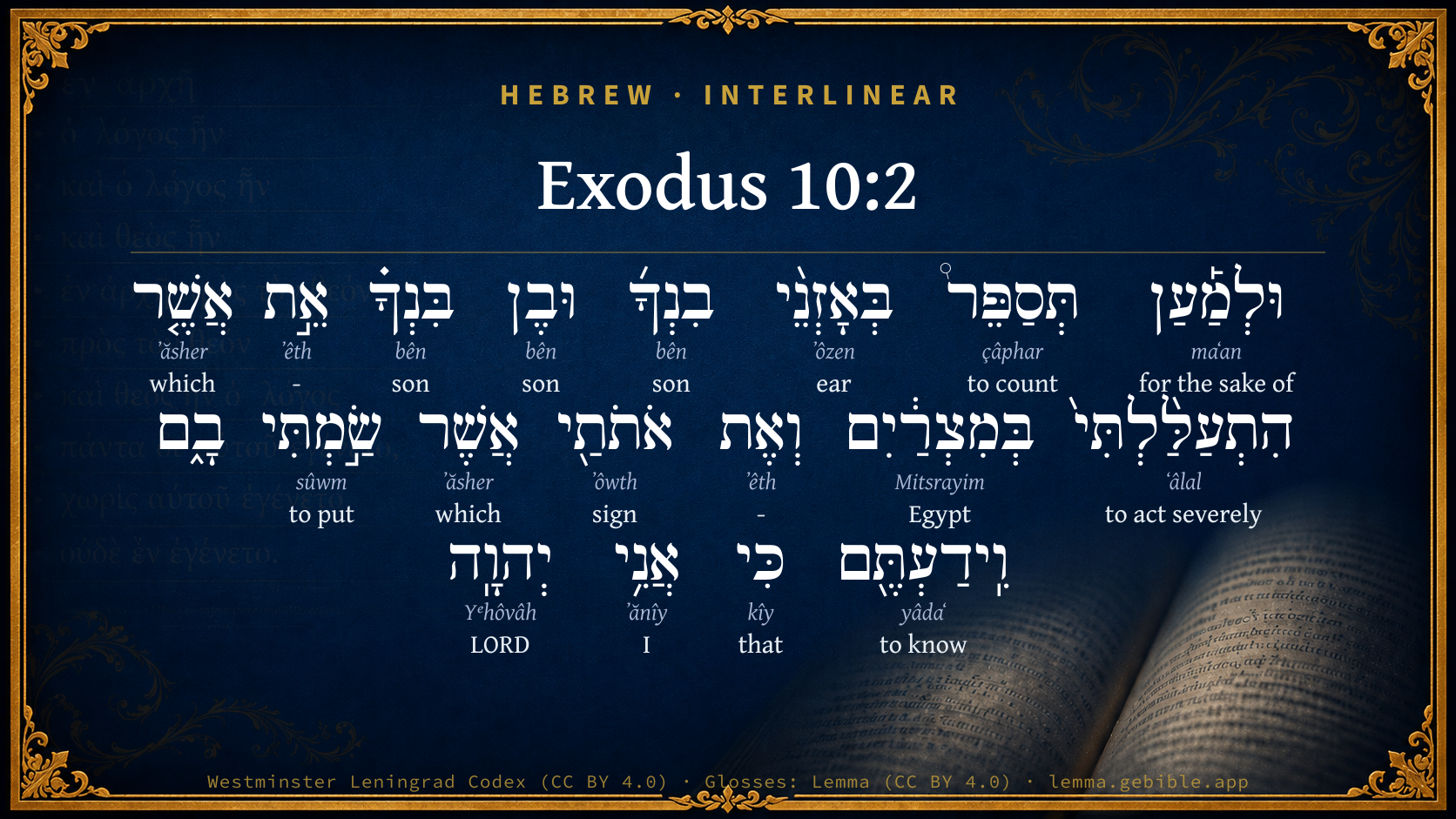
Hebrew (Westminster Leningrad Codex) Exodus 10:2 appears in the Hebrew Old Testament. The text above is from the Westminster Leningrad Codex. Each word links to its Strong’s number, a concise gloss, and parsing drawn from the Open Scriptures Hebrew Bible morphology. Click any word for its full Brown-Driver-Briggs (BDB) entry.
Download image
Cite this verse

Exodus 10:2 (World English Bible). Public Domain. Lemma interlinear Bible study tool, https://lemma.gebible.app/v/exodus/10/2.

Show BibTeX & RIS
BibTeX
RIS
English Translation
and that you may tell in the hearing of your son, and of your son's son, what things I have done to Egypt, and my signs which I have done among them; that you may know that I am Yahweh."
World English Bible · Public Domain
Highlights
  • 1 first appearance in the Hebrew Bible
Full analysis ↓
Download a study sheet

One document with this verse’s original text, its word-by-word gloss line, the meaning frame, cross-references with their text, attributed commentary, and full source and license credits — printable, and it pastes into notes with its structure intact.

This verse Autodidact and up

Study sheet (.html) Plain text (.txt)

A passage Seminary Student

Up to 50 verses in one chapter. A passage sheet keeps up to 6 commentary sources and 12 cross-references per verse, in the order this page ranks them, and says so on the sheet whenever that leaves anything out. Ask for a single verse and you get the Autodidact verse sheet above.

Everything on this page stays free to read, with no account — the sheet is a download of what is already on screen, not access to it.

Want to remove ads? Support Godless Engineer
Compare translations 3

The same verse in 3 English versions, stacked beneath the original-language interlinear above. Click any original word for its lexicon entry.

Each is an independent rendering of the whole verse — the interlinear is not word-aligned to these translations.

Highlighted words mark where these versions differ — a whole-verse word diff, not a word-by-word alignment.

  • World English Bible Public Domain
    and that you may tell in the hearing of your son, and of your son's son, what things I have done to Egypt, and my signs which I have done among them; that you may know that I am Yahweh."
  • King James Version Public Domain
    And that thou mayest tell in the ears of thy son, and of thy son's son, what things I have wrought in Egypt, and my signs which I have done among them; that ye may know how that I am the LORD.
  • unfoldingWord Literal Text CC BY-SA 4.0
    and so that you may proclaim in the ears of your son and the son of your son that I toyed with Egypt, and my signs which I performed among them—and you will know that I am Yahweh.”

unfoldingWord Literal Text — © unfoldingWord, licensed CC BY-SA 4.0. Word-aligned USFM3 via Door43 (git.door43.org/unfoldingWord/en_ult).

Versions to compare (up to 4)

3 of 4 selected

Show all 18 translations

Every available English version of this verse, each an independent rendering of the whole verse.

  • World English Bible Public Domain
    and that you may tell in the hearing of your son, and of your son's son, what things I have done to Egypt, and my signs which I have done among them; that you may know that I am Yahweh."
  • Berean Standard Bible Public Domain
    and that you may tell your children and grandchildren how severely I dealt with the Egyptians when I performed miraculous signs among them, so that all of you may know that I am the LORD.”
  • Majority Standard Bible Public Domain
    and that you may tell your children and grandchildren how severely I dealt with the Egyptians when I performed miraculous signs among them, so that all of you may know that I am the LORD.”
  • King James Version Public Domain
    And that thou mayest tell in the ears of thy son, and of thy son's son, what things I have wrought in Egypt, and my signs which I have done among them; that ye may know how that I am the LORD.
  • American Standard Version (1901) Public Domain
    and that thou mayest tell in the ears of thy son, and of thy son's son, what things I have wrought upon Egypt, and my signs which I have done among them; that ye may know that I am Jehovah.
  • Revised Version (1885) Public Domain
    and that thou mayest tell in the ears of thy son, and of thy son’s son, what things I have wrought upon Egypt, and my signs which I have done among them; that ye may know that I am the LORD.
  • Geneva Bible (1599) Public Domain
    And that thou maist declare in the eares of thy sonne, and of thy sonnes sonne, what things I haue done in Egypt, and my miracles, which I haue done among them: that ye may knowe that I am the Lord.
  • Douay-Rheims (1899) Public Domain
    And thou mayest tell in the ears of thy sons, and of they grandsons, how often I have plagued the Egyptians, and wrought my signs amongst them: and you may know that I am the Lord:
  • Young's Literal Translation Public Domain
    and so that thou recountest in the ears of thy son, and of thy son's son, that which I have done in Egypt, and My signs which I have set among them, and ye have known that I `am' Jehovah.'
  • Literal Standard Version CC BY-SA 4.0
    and so that you recount in the ears of your son, and of your son’s son, that which I have done in Egypt, and My signs which I have set among them, and you have known that I [am] YHWH.”
  • Unlocked Literal Bible CC BY-SA 4.0
    I have also done this so that you may tell your children and grandchildren the things I have done, how I have harshly treated Egypt, and how I have given various signs of my power among them. In this way you will know that I am Yahweh.”
  • unfoldingWord Literal Text CC BY-SA 4.0
    and so that you may proclaim in the ears of your son and the son of your son that I toyed with Egypt, and my signs which I performed among them—and you will know that I am Yahweh.”
  • Darby Bible Public Domain
    and that thou mightest tell in the ears of thy son and thy son's son what I have wrought in Egypt, and my signs which I have done among them; and ye shall know that I am Jehovah.
  • World Messianic Bible Public Domain
    and that you may tell in the hearing of your son, and of your son’s son, what things I have done to Egypt, and my signs which I have done among them; that you may know that I am the LORD.”
  • Webster's Bible Public Domain
    And that thou mayest tell in the ears of thy son, and of thy son's son, what things I have wrought in Egypt, and my signs which I have done among them; that ye may know how that I am the LORD.
  • Free Bible Version CC BY-SA 4.0
    This is so you can tell your children and grandchildren how I made the Egyptians look foolish by doing these miracles among them, and so that you may know that I am the Lord.”
  • Bible in Basic English Public Domain
    And so that you may be able to give to your son and to your son's son the story of my wonders in Egypt, and the signs which I have done among them; so that you may see that I am the Lord.
  • JPS Tanakh (1917) Public Domain
    and that thou mayest tell in the ears of thy son, and of thy son's son, what I have wrought upon Egypt, and My signs which I have done among them; that ye may know that I am the LORD.'

Literal Standard Version (2020), Covenant Press — licensed CC BY-SA 4.0. Text via the HelloAO Bible API (eBible.org). Unlocked Literal Bible (unfoldingWord) — licensed CC BY-SA 4.0. Text via the HelloAO Bible API (eBible.org). unfoldingWord Literal Text — © unfoldingWord, licensed CC BY-SA 4.0. Word-aligned USFM3 via Door43 (git.door43.org/unfoldingWord/en_ult). Free Bible Version, Dr. Jonathan Gallagher — licensed CC BY-SA 4.0. Text via the HelloAO Bible API (eBible.org).

Word by word

More ways to search: Search by grammar → Find every occurrence → Compare this word →

Practice this passage: Drill this verse → Learn its vocabulary →

הִתְעַלַּ֨לְתִּי֙
ʻâlal
H5953
“to act severely”
Verb, Hithpael, Perfect, 1st Person, Common, Singular
Part of Speech
Verb
Stem
Hithpael
Form
Perfect
Person
1st Person
Gender
Common
Number
Singular
Full BDB Definition

Origin: a primitive root

TWOT: 1627 , 1627b , 1628

to act severely, deal with severely, make a fool of someone - (Poel) to act severely - (Poal) to be severely dealt with - (Hithpael) to busy oneself, divert oneself, deal wantonly, deal - (Hithpoel) to practise practices, thrust forth (in wickedness) - (Poel) to glean - (Poel) to act or play the child - (Poel) to insert, thrust, thrust in, thrust upon ruthlessly, abuse (by thrusting through)
  1. וּלְמַ֡עַן maʻan H4616 “and · for the sake of” Conjunction + Preposition
  2. תְּסַפֵּר֩ çâphar H5608 “to count” Verb, Piel, Imperfect, 2nd Person, Masculine, Singular
  3. בְּאָזְנֵ֨י ʼôzen H241 “in/at · ears of” Preposition + Noun, Common, Feminine, Dual, Construct
  4. בִנְךָ֜ bên H1121 “son · your” Noun, Common, Masculine, Singular, Construct + Suffix, Personal, 2nd Person, Masculine, Singular
  5. וּבֶן bên H1121 “and · son of” Conjunction + Noun, Common, Masculine, Singular, Construct
  6. בִּנְךָ֗ bên H1121 “son · your” Noun, Common, Masculine, Singular, Construct + Suffix, Personal, 2nd Person, Masculine, Singular
  7. אֵ֣ת ʼêth H853 “-” Particle, Direct Object
  8. אֲשֶׁ֤ר ʼăsher H834 “which” Particle, Relative
  9. בְּמִצְרַ֔יִם Mitsrayim H4714 “in/at · Egypt” Preposition + Noun, Proper
  10. וְאֶת ʼêth H853 “and · -” Conjunction + Particle, Direct Object
  11. אֹתֹתַ֖י ʼôwth H226 “signs · my” Noun, Common, Both, Plural, Construct + Suffix, Personal, 1st Person, Common, Singular
  12. אֲשֶׁר ʼăsher H834 “which” Particle, Relative
  13. שַׂ֣מְתִּי sûwm H7760 “to put” Verb, Qal, Perfect, 1st Person, Common, Singular
  14. וִֽידַעְתֶּ֖ם yâdaʻ H3045 “and · to know” Conjunction + Verb, Qal, Sequential Perfect, 2nd Person, Masculine, Plural
  15. כִּי kîy H3588 “that” Conjunction
  16. אֲנִ֥י ʼănîy H589 “I” Pronoun, Personal, 1st Person, Common, Singular
  17. יְהוָֽה Yᵉhôvâh H3068 “LORD” Noun, Proper

About this verse

These counts appear in no published source. They are computed here, from the morphology-tagged text and Lemma’s own curated glosses. What Lemma adds →

19
words
14
distinct lemmas
Pentateuch
section

Notable vocabulary

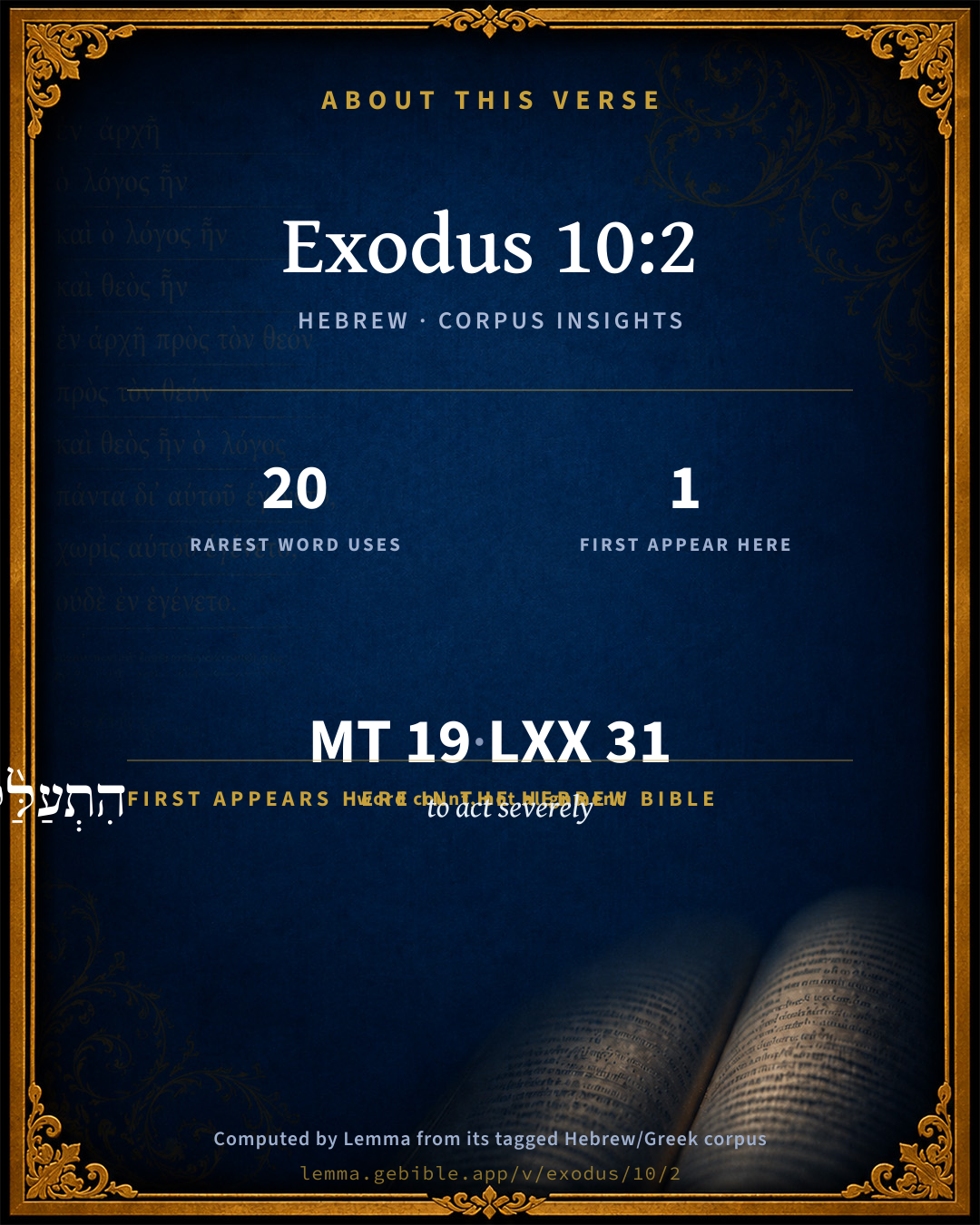
The rarest word here is הִתְעַלַּ֨לְתִּי֙ to act severely H5953 — appearing just 20 times in the whole Hebrew Bible.

First appearance in Scripture

This word makes its first canonical appearance in the Hebrew Bible here:

  • הִתְעַלַּ֨לְתִּי֙ to act severely H5953

Shared distinctive vocabulary

הִתְעַלַּ֨לְתִּי֙ to act severely H5953 occurs in 18 verses of the Hebrew Bible. Also found in:

Grammatical profile

  • 4 verbs
  • 7 nouns
  • 1 pronoun
  • 2 prepositions
  • 1 conjunction
  • 4 particles

Verb forms

  • תְּסַפֵּר֩ Piel · Imperfect
  • הִתְעַלַּ֨לְתִּי֙ Hithpael · Perfect
  • שַׂ֣מְתִּי Qal · Perfect
  • וִֽידַעְתֶּ֖ם Qal · Sequential Perfect

Repetition

Words recur within this verse — often emphatic in Hebrew:

  • בִנְךָ֜ son H1121 ×3
  • אֲשֶׁ֤ר which H834 ×2

Hebrew & Septuagint length

In English translation the verse runs 40 words from the Hebrew and 41 from the Septuagint (LXX English) — closely comparable.

A rough comparison of the two English renderings, which tokenize alike — not a word-level alignment.

Word counts can differ between the Hebrew and the Greek without any difference in meaning — e.g. the Hebrew direct-object marker אֵת has no separate Greek word, and Greek often adds the article ὁ.

In the original languages it is 19 Hebrew tokens and 31 Greek tokens — but the two are counted differently (Hebrew bundles its prefixes and suffixes into one token; the Greek is in lemma form), so that isn’t a like-for-like length.

Cross-references

14

Topical passages linked to Exodus 10:2 in the Treasury of Scripture Knowledge — connected by theme and wording, ordered by reader-vote popularity; previews shown in the World English Bible.

  • Joel 1:3 Tell your children about it, And have your children tell their children, And their children, another generation.
  • Deuteronomy 4:9 Only take heed to yourself, and keep your soul diligently, lest you forget the things which your eyes saw, and lest they depart from your heart all the days of your life; but make them known to your children and your children's children;
  • Exodus 13:14 It shall be, when your son asks you in time to come, saying, 'What is this?' that you shall tell him, 'By strength of hand Yahweh brought us out from Egypt, from the house of bondage;
  • Deuteronomy 6:20–22 When your son asks you in time to come, saying, What mean the testimonies, and the statutes, and the ordinances, which Yahweh our God has commanded you?
  • Exodus 7:17 Thus says Yahweh, "In this you shall know that I am Yahweh. Behold, I will strike with the rod that is in my hand on the waters which are in the river, and they shall be turned to blood.
  • Psalms 44:1 We have heard with our ears, God; Our fathers have told us, What work you did in their days, In the days of old.
  • Psalms 78:5–6 For he established a testimony in Jacob, And appointed a law in Israel, Which he commanded our fathers, That they should make them known to their children;
  • Ephesians 6:4 You fathers, don't provoke your children to wrath, but nurture them in the discipline and instruction of the Lord.
  • Exodus 12:26–27 It will happen, when your children ask you, 'What do you mean by this service?'
  • Exodus 13:8–9 You shall tell your son in that day, saying, 'It is because of that which Yahweh did for me when I came forth out of Egypt.'
  • Psalms 58:11 So that men shall say, "Most assuredly there is a reward for the righteous. Most assuredly there is a God who judges the earth."
  • Psalms 71:18 Yes, even when I am old and gray-haired, God, don't forsake me, Until I have declared your strength to the next generation, Your might to everyone who is to come.
  • Ezekiel 20:26 and I polluted them in their own gifts, in that they caused to pass through [the fire] all that opens the womb, that I might make them desolate, to the end that they might know that I am Yahweh.
  • Ezekiel 20:28 For when I had brought them into the land, which I swore to give to them, then they saw every high hill, and every thick tree, and they offered there their sacrifices, and there they presented the provocation of their offering; there also they made their sweet savor, and they poured out there their drink-offerings.

Cross-references courtesy of OpenBible.info (CC BY 4.0).

Hebrew and Greek witnesses Masoretic Hebrew ↔ Greek Septuagint

The same verse in the two great witnesses to the Old Testament, shown verse-for-verse.

These are two independent witnesses, not word-aligned to each other, and the Septuagint is shown in lemma (dictionary) form.

Hebrew Exodus 10:2 Masoretic · Westminster Leningrad Codex

וּלְמַ֡עַן תְּסַפֵּר֩ בְּאָזְנֵ֨י בִנְךָ֜ וּבֶן בִּנְךָ֗ אֵ֣ת אֲשֶׁ֤ר הִתְעַלַּ֨לְתִּי֙ בְּמִצְרַ֔יִם וְאֶת אֹתֹתַ֖י אֲשֶׁר שַׂ֣מְתִּי בָ֑ם וִֽידַעְתֶּ֖ם כִּי אֲנִ֥י יְהוָֽה

and that you may tell in the hearing of your son, and of your son's son, what things I have done to Egypt, and my signs which I have done among them; that you may know that I am Yahweh."

World English Bible · Public Domain

Greek LXX Exodus 10:2 Septuagint · lemma form

ὅπως διαἡγέομαι εἰς ὁ οὖς ὁ τέκνον σύ καί ὁ τέκνον ὁ τέκνον σύ ὅσος ἐνπαίζω ὁ αἰγύπτιος καί ὁ σημεῖον ἐγώ ὅς ποιέω ἐν αὐτός καί γιγνώσκω ὅτι ἐγώ κύριος

that you⌃ may relate in the ears of your children, and to your children's children, in how many things I have mocked the Egyptians, and my wonders which I wrought among them; and you⌃ shall know that I am the Lord.

LXX2012 (modern English Septuagint) · Public Domain

On this verse, The Cambridge Bible for Schools and Colleges discusses the Septuagint’s reading. Read the note in Commentary ↓

Hebrew: Westminster Leningrad Codex (CC BY 4.0). Greek: Septuagint (public domain); English from LXX2012 (modern English Septuagint) (Public Domain). How the Septuagint differs from the Hebrew →

Targum (Aramaic paraphrase)

2

The Targum is the ancient Jewish Aramaic paraphrase of the Hebrew Scriptures — an interpretive translation, not the Hebrew text itself. Onkelos (literal) and Pseudo-Jonathan (expansive) render the Torah, and Jonathan the Prophets. Coverage is partial: where no permissively-licensed English translation exists for a verse, only the Aramaic is shown. This is verse-level text, not a word-by-word alignment to the Hebrew.

  1. Targum Onkelos Torah (Genesis–Deuteronomy)
    וּבְדִיל דְתִשְׁתָּעֵי קֳדָם בְּרָךְ וּבַר בְּרָךְ יָת נִסִין דִי עֲבָדִית בְּמִצְרַיִם וְיָת אַתְוָתַי דִי שַׁוֵיתִי בְהוֹן וְתִדְעוּן אֲרֵי אֲנָא יְיָ:

    (no public-domain English translation for this verse)

    Targum Onkelos — Aramaic: “Onkelos Genesis” (public domain); “Onkelos Exodus” (public domain); “Onkelos Leviticus” (public domain); “Onkelos Numbers” (public domain); “Onkelos Deuteronomy” (public domain). English: “Sefaria Community Translation” (CC0 1.0 (public-domain dedication)); “J.W. Etheridge. The Targums of Onkelos and Jonathan Ben Uzziel on the Pentateuch. London: Longmans, Green, 1862” (public domain). Text via Sefaria.

  2. Targum Pseudo-Jonathan Torah (Genesis–Deuteronomy)
    וּמִן בִּגְלַל דְתַתְנֵי בְּמִשְׁמְעֵי בְּרָךְ וּבַר בְּרָךְ יַת נִיסִין דַעֲבָדִית בְּמִצְרַיִם וְיַת אַתְוָותַי דְשַׁוֵּיתִי בְּהוֹן וְתִנְדְּעוּן אֲרוּם אֲנָא הוּא יְיָ

    and that in the hearing of thy sons and of thy children's children may be told the wonders I have done in Mizraim, and the signs that I set among them, that ye may know that I am the Lord.

    Targum Pseudo-Jonathan — Aramaic: “Targum Jonathan on Genesis” (public domain); “Targum Jonathan on Exodus” (public domain); “Targum Jonathan on Leviticus” (public domain); “Targum Jonathan on Numbers” (public domain); “Targum Jonathan on Deuteronomy” (public domain). English: “The Targum of Jonathan ben Uzziel, trans. J. W. Etheridge, London, 1862” (public domain). Text via Sefaria.

Commentary

Notes on Exodus 10:2 from classic Christian and Jewish commentators (each source and its license shown beneath its notes). The classic Christian expositions comment on the surrounding passage and are grouped to its opening verse, so a note may address several verses; the Jewish commentaries on the Tanakh (Rashi and others) are per-verse, so they appear only where the commentator wrote on this verse.

Lemma curates 59 commentaries, every one of them public domain or Creative Commons licensed, each selected and text-cleaned for this edition rather than reprinted as found. About our sources →

Trapp's Complete Commentary

John Trapp

Exo 10:2 And that thou mayest tell in the ears of thy son, and of thy son’s son, what things I have wrought in Egypt, and my signs which I have done among them; that ye may know how that I [am] the LORD.

Ver. 2. And that thou mayest tell.] The memory of God’s magnalia, his great works, must be transmitted to posterity -

“ Ut nati natorum et qui nascentur ab illis, ”

that later ages may hear and fear this great God. See 1Sa 4:8.

John Trapp, A Commentary or Exposition upon All the Books of the Old and New Testament (1647–1656) — public domain. Text from a community e-Sword module.

The Preacher's Complete Homiletical Commentary

Joseph S. Exell (gen. ed.)

CRITICAL NOTES.—

Exo_10:2. What things I have wrought] A special word is here used, and it is used in a special conjugation, and both circumstances unite to give life and beauty to the expression in the original. The verb עלל is “not applied to working off, forming or doing a thing at once, but to constant, repeated turning and moving about in work or action.”—Fürst. How beautifully this suits the infliction of plague after plague on Egypt, any one can see at a glance. And then the form of the word התעללתי puts it in the reflexive conjugation, one of the uses of which is to show that the action is done to or for oneself;—thus keeping up the avowal of Jehovah that in his visitations on the Egypt he sought to glorify himself in the eyes of men. It is difficult, many times, to translate all that is in the original without resorting to paraphrase; as, here, we are tempted to render: “What I wrought out for myself by a series of acts.” We shall be glad if, by these notes, we can kindle in some minds the determination to spare no pains requisite to be able to repair to the fountain-head.

MAIN HOMILETICS OF THE PARAGRAPH.—Exo_10:2

THE SIGNS OF GOD TO THE GENERATIONS OF THE FUTURE

God respects the general good of the race in multiplying retributive evils upon individuals. Hence the plagues sent upon Pharaoh and his nation were calculated to instruct the generations of the future, as well as to punish Pharaoh. Children must be instructed in the ways of God, and neglect of this tuition is sinful and contrary to the Divine command. What are the signs of God made known by the plagues of Egypt for the moral instruction of future generations?

I. That God is supreme over the kingdom of nature. The plagues that came upon Egypt would give to future generations abundant demonstration of this fact, that the rivers, the dust of the ground, the atmosphere, the thunder, lightning and the hail are all at the immediate control of God. Man may have a certain power over nature, but it is limited, and subject to the Divine. Science places the natural universe under the command of man. This is the Divine ordination. But man’s power over nature is derived; God’s is underived and independent. Hence,

1. He can inflict pain on the wicked.

2. He can protect the good from harm.

3. He can send famine or plenty.

II. That God is supreme over the cunning and power of the Devil. The magicians of Egypt were agents of the Devil. They were inspired by him in their opposition to Moses and Aaron. They were aided by his cunning. Their defeat was his defeat also. Satan cannot work a miracle. He may perform a marvel. He is subject to the control of God. This is evident in the history of the plagues. If he could have resisted the power of heaven, it would have been to his interest to have done so, and he would have done so. He may deceive men. He cannot protect them from the wrath of God. Hence:

1. God can deliver men from the power of the Devil.

2. God can destroy the works of the Devil.

3. God can frustrate the designs of the Devil. Teach this blessed truth and glorions fact to the youthful; that the good agencies of the universe are more potent than the bad. This will lead youthhood to confide in God.

III. That goodness is happiness, and that conflict with God is the misery of man. This is clearly taught by the plagues of Egypt. In them we see the history of a man in conflict with God; and what a record of pain and woe! When men contend with God they are sure to be plagued. Life is happy in proportion as it is good, and as it is in harmony with the Supreme Being of the universe. When men commit sin they must expect to be plagued. This must be taught to the youthful, that purity of life and true enjoyment are inseparably connected. To be happy we must be at peace with heaven. The Divine supremacy over nature, the Divine power over Satan, the greatness of God, the safety of the good, and the misery of sin, are God’s signs, manifested in the history of Pharaoh to the generations of the future. LESSONS:

1. That in the lives of individuals we have signs of God.

2. That all the signs of God in human life are to be carefully noted and taught to the young.

3. That all the signs of life are evidence of the Divine supremacy.

THE MINISTRY OF SIN

God makes Pharaoh “to stand” for the benefit of Israel, and in them for the benefit of humanity. It was for Pharaoh in the first instance to resist Divine light and grace, and oppress Israel,—it was then for God to economize the tyrant and his wrath. The conduct of the Egyptian king served—

I. To reveal God. “That ye may know how that I am the Lord.” The cloud of evil in its very nature is calculated to eclipse the Divine glory, and hide the Divine One from the eves of mankind, but as the sun overmasters the clouds of the sky, and makes them to enchance his splendour, so God causes the cloud of evil to become the back ground on which His glorious shape and infinite perfections are the more clearly and forcibly displayed. Pharaoh’s perverseness revealed all the more fully.

1. The Divine love. The more the Children of Israel were wronged the more God’s grace and kindness were demonstrated to them.

2. Divine righteousness. Each successive miracle exhibited more impressively the righteousness of God’s administration.

3. The Divine power. Each judgment, rising in severity, declared the more unmistakenably the absolute sovereignty and awful power of God. And so throughout the whole world, and throughout all life, sin which would hide God, reveals Him, sin which would dethrone God only shows the strength and splendour of His awful throne. Evil was not necessary for the revelation of the Divine Being, but since evil has invaded the universe, such is the perfection of God’s wisdom and might, that devils become the heralds of His glory, and the dissonant voice of evil swells into fuller power the pœan of His praise. And the perverse conduct of the Egyptian king serves—

II. To further the interests of Israel. Their highest interest was furthered by their attaining a fuller knowledge of God, and their permanent interest was secured by these wonders impressing themselves on the popular mind. “And that thou mayest tell in the ears of thy son, and of thy son’s son, what things I have wrought in Egypt.” Sin was not necessary to the development of mankind, but since it has forced its way into the universe, God overrules it to high and happy issues. From the sin of Egypt came the higher education of Israel, and through them the higher education of mankind at large, and from sectional evil God still educes general good. God reigns, and confounds evil, making that serve which was designed only to blast and destroy. Bad man are apostles, missionaries, martyrs, redeemers of society; but, alas! apostles whom Christ will deny, missionaries without Heaven’s smile, martyrs without the palm, redeemers to whom pertains the cross without the crown. Unconsciously, unwillingly, they glorify God, and serve society. Let not the Church fear, let the sinners be afraid. He “that sitteth in the heavens shall laugh: the Lord shall have them in derision. Then shall he speak unto them in his wrath and vex them in his sore displeasure. Yet have I set my king upon my holy hill of Zion.” (Psa_2:4-7.)—W. L. Watkinson.

TRANSMITTING THE KNOWLEDGE OF THE TRUE GOD

The world had then nearly lost the knowledge of the True God. The ordinary operations of his hands did not reveal him to men’s callous hearts. Idols usurped his throne. He therefore manifested himself by “signs.” The silence of uniformity was broken. He wrought wonders.

I. Jehovah made himself known to the Israelites in Egypt as the only true God by signs. He separated Himself form the idols of Egypt by overthrowing their power and bringing them into contempt. His wondrous acts revealed His supremacy. Miracles manifest the presence of the True God. Acts reveal character. The Bible, which contains the fullest revelations of God, is a record of His acts. The plagues did not however fully reveal the character of God. Judgment is His strange work. God adapts Himself in His revelations to the spiritual condition of men. The Israelites were in a state of of spiritual infancy. God revealed to them his power and faithfulness. He asserted His supremacy over all false deities, His power over nature and ability to protect his chosen people, and His truth in “remembering His covenant” with their forefathers. He revealed himself more fully in after years. Christ is the fullest revelation of the true God.

II. That this knowledge is to be transmitted from generation to generation. God would have Himself known. He delights to reveal Himself to men. He acts in one age for all time. Divine knowledge must not be hidden. Men have to transmit it. Posterity should be cared for. The knowledge of useful inventions, scientific discoveries, social achievements is gladly transmitted, how much more this which is far more valuable! The young should be instructed in this knowledge above everything else. This is a public duty. Society should make provision for the transmission of the knowledge of the true God. Especially is this a parental duty. Tell it “in the ears of thy son and of thy son’s son.” Relationship, peculiar affection, and the tender solicitude which every parent feels for the welfare of his children should lead him to instruct them in Divine knowledge. To shew them His acts is to reveal Him. To give to them a clear conception of the true God is to bestow upon them the greatest of all blessings. Parents can impart no higher good. It is eternal. It is greater than wealth, or rank, or any other temporal advantage. Parental influence the most potent in telling of God’s acts. No lips teach like the lips of loving authority. Some parents neglect this solemn duty. Ever ready to speak about worldly enterprises, the acts of great men, their own, but they are silent about God’s. Such neglect is ruinous to their children, and dishonouring to God.

III. In the transmission of the knowledge of the true God is the hope of the world. Wherever the knowledge of the true God prevails, righteousness and peace are found. Idolatry has ever been the bane of mankind. A false conception of God debases. Worship becomes a degradation. Men’s ideas of God affect not only their religious views but their moral principles and social customs. In knowing the true God is true life. “This is life eternal, to know Thee, the only true God, and Jesus Christ whom thou has sent.” Just as men acknowledge and serve the God that revealed himself by Moses in Egypt, and afterwards more fully by Jesus Christ are they elevated, saved, and blessed. In the spread of this knowledge is every uplifting influence. Superstition, violence and error will disappear. The Heavenly Jerusalem will be built on earth. God being known will be loved and obeyed. “Men rising from the ruin of the fall” will be “one with God, and God be all in all.” For the sake of future ages God’s mighty acts should be told in “the ears of thy son and of thy son’s son.” In the instruction of the young is the truest hope of the advancement of mankind. The future of the world depends upon how much knowledge of the true God is possessed.

SUGGESTIVE COMMENTS ON THE VERSES

Exo_10:2. The acknowledgment of God in His Church is the main end of His wonderful plagues.

By signs:—

1. Showing the woe of sin.

2. The folly of human malice.

3. The justice of God.

4. The safety of the Church.

The Divine supremacy:—

1. Rejected by the proud.

2. Received by the good.

3. Revealed by the works of God.

4. To be acknowledged by all.

The signs:—

1. Their nature.

2. Their locality.

3. Their design.

The Preacher's Complete Homiletical Commentary (gen. ed. Joseph S. Exell; Funk & Wagnalls, c. 1892) — public domain (pre-1929). A full-Bible homiletical/sermon-outline anthology covering 65 of 66 books (2 John is absent from the source module). Text from a community e-Sword module.

Tyndale Open Study Notes

Tyndale Open Resources

10:2 The plagues were sent so that Israel will know that I am the Lord (similarly, with respect to Egypt, see 9:14-16).

Tyndale Open Study Notes — © Tyndale Open Resources, licensed CC BY-SA 4.0. Text via the HelloAO Bible API.

Geneva Bible (1599)

Geneva Bible translators

The miracles should be so great, that they should be spoken of for ever: where also we see the duty of parents toward their children.

Geneva Bible (1599) marginal notes — public domain. Text via Bolls.life.

Jamieson, Fausset & Brown

Robert Jamieson, A. R. Fausset & David Brown

And that thou mayest tell . . . of thy son, and of thy son's son, &c.--There was a further and higher reason for the infliction of those awful judgments, namely, that the knowledge of them there, and the permanent record of them still, might furnish a salutary and impressive lesson to the Church down to the latest ages. Worldly historians might have described them as extraordinary occurrences that marked this era of Moses in ancient Egypt. But we are taught to trace them to their cause: the judgments of divine wrath on a grossly idolatrous king and nation.

Jamieson, Fausset & Brown — Commentary Critical and Explanatory on the Whole Bible (1871) — public domain (CC PDM 1.0). Text via the HelloAO Bible API.

Adam Clarke's Commentary

Verse 2. That thou mayest tell in the ears of thy son] That the miracles wrought at this time might be a record for the instruction of the latest posterity, that Jehovah alone, the God of the Hebrews, was the sole Maker, Governor, and Supporter of the heavens and the earth. Thus we find God so did his marvellous works, that they might be had in everlasting remembrance. It was not to crush the poor worm, Pharaoh, that he wrought such mighty wonders, but to convince his enemies, to the end of the world, that no cunning or power can prevail against him; and to show his followers that whosoever trusted in him should never be confounded.

Adam Clarke's Commentary on the Bible (1810–1826) — public domain. Text from a community e-Sword/MySword module.

Ellicott's Commentary for English Readers

(2) That thou mayest tell.—Those who experience God’s mercies are bound to hand on the memory of what He has done for them to future generations. Natural gratitude would prompt such action. But, lest the duty should be neglected, the Israelites had it at this time constantly enjoined upon them (Exo_12:26-27; Exo_13:14-15; Deu_32:7; Jos_4:6, &c):

A Bible Commentary for English Readers, edited by Charles John Ellicott (1878–1897) — public domain. Text from a community e-Sword module.

The Cambridge Bible for Schools and Colleges

gen. ed. J. J. S. Perowne

2. thou] i.e. Moses, addressed however as the representative of Israel. Cf. the plural ye at the end of the verse.

in the ears of thy son, &c.] The story is to be passed on to the children. The interest in the instruction of future generations, as Deu_4:9; Deu_6:7; comp. also ch. Exo_12:26 f., with the note, and Jdg_6:13, Psa_44:1; Psa_78:5-6.

how I have mocked the Egyptians] so RVm. rightly: cf. 1Sa_6:6 RVm. (also with reference to the Egyptians), Exo_31:4 RVm. AV. itself has the rend. mock in Num_22:29, Jer_38:19. The word used cannot mean ‘wrought’: in Arabic the corresponding word means to divert or occupy oneself; the Heb. word is applied in a bad sense, to ‘divert oneself at another’s expense,’ i.e. to make a toy of, or, by a slight paraphrase, to mock. As used here, ‘it is an anthropomorphism which is not consonant with the higher Christian conception of God’ (McNeile).

done] better, set, as the same verb, also of ‘signs’ ‘set’ in Egypt, is actually rendered, Jer_32:20 AV., RV., Psa_78:43 RV., cv. 27 RV. (cf. Isa_66:19).

and that (G.-K.§ 112p) ye may know, &c.] cf. on Exo_8:10.

2, 3a. Before the last plague comes, the Israelites are to make request of the Egyptians, as directed in Exo_3:21-22; cf. Exo_12:35-36.

2. every man] in Exo_3:22 only the women are to make the request.

and jewels of gold] LXX. Sam. add and raiment (as Exo_3:22, Exo_12:35). It must be supplied, or understood, from Exo_12:36, to be included.

3a. gave. &c.] according to the promise of Exo_3:21 a; cf. Exo_12:36.

3b. Cf. Num_12:3 ‘Now the man Moses was very meek,’ &c.; also, for ‘the man Moses,’ Gen_19:9, Jdg_17:5, 1Sa_1:21, 1Ki_11:28, Est_9:4.

was very great, &c.] on account viz. of the wonders wrought by him. The words suggest a reason why the Egyptians acceded the more readily to the Israelites’ request.

The Cambridge Bible for Schools and Colleges (gen. ed. J. J. S. Perowne; Cambridge University Press, 1878–1918) — public domain. Text from a community e-Sword module.

John Gill's Exposition

And that thou mayest tell in the ears of thy son, and of thy son's son,.... Not of his sons and grandsons only; for Moses here, as Aben Ezra observes, was in the stead of Israel; and the sense is, that it should be told to their posterity in all succeeding ages:

what things I have wrought in Egypt; the plagues that he inflicted on the Egyptians:

and my signs which I have done amongst them; meaning the same things which were signs:

that ye may know how that I am the Lord; that their God is the true Jehovah, and the one only living and true God; the Lord God omnipotent, omniscient, omnipresent, infinite, and eternal.

John Gill's Exposition of the Whole Bible (1746–1763) — public domain (CC PDM 1.0). Text via the HelloAO Bible API.

Whedon's Commentary on the Bible

Daniel D. Whedon

2. And that thou mayest tell in the ears of thy son — See instances of this in Psalms 78, 106.

Daniel D. Whedon (gen. ed.), Commentary on the Old and New Testaments (1874–1909) — public domain. Text from a community e-Sword module.

The Pulpit Commentary

That thou mayest tell in the ears of thy son, and of thy son"s son. The Psalms show how after generations dwelt in thought upon the memory of the great deeds done in Egypt and the deliverance wrought there. (See especially Ps 78 Ps 105 and Ps 106; but compare also Psa_68:6, 7 77:14-20 81:5, 6 114:1-3 135:8, 9 136:10-15)

The tales of a grandfather.

Jehovah tells Moses, as the representative of Israel, that these glorious Divine actions in Egypt are to be matters of careful instruction in after ages. Each parent is to speak of them to his children, and each grandparent to his grandchildren. And is there not something particularly suggestive in this expression, "thy son"s son"? It brings before us the aged Israelite, his own part in the toil and strife of the world accomplished, his strength exhausted, the scene of his occupations left to a younger generation, and he himself quietly waiting for the close. How is he to occupy his time? Not in utter idleness, for that is good for no man, however long and hard he may have worked. Some part of his thoughts, it may be hoped, goes out in anticipations of the full and unmixed eternity now so near; but some part also will go backward into time, not without pensive and painful interest. He looks from the eminence he has attained, and two generations are behind him, his children and his children"s children. His own children are busy. The world is with them constantly, and its demands are very pressing. They hardly see their offspring from Monday morning till Saturday night. It is only too easy for a man to get so absorbed in seeking the good of strangers, as to have no time for his own household. The following extract from the biography of Wilberforce bears in a very instructive way on this point. "It is said that his children seldom got a quiet minute with him during the sitting of Parliament. So long as they were infants he had not time to seek amusement from them. Even whilst they were of this age, it made a deep impression on his mind when, one of them beginning to cry as he took him up, the nurse said naturally, by way of explanation, "He always is afraid of strangers. And if this danger of distance between him and his children came to a man like Wilberforce, we may be sure that it comes to thousands who are less sensitive and conscientious than he was. What a field of usefulness, then, is here indicated for a grandfather! In his retirement, and out of his long experience, he may speak of principles the soundness of which he has amply established, and errors which he has had painfully to correct; he may point to a rich harvest gathered from good seed he has been able to sow. Thus the grandfather finds opportunities for useful instruction which the father, alas! may not even seek. Of such it may be truly said, "They shall bring forth fruit in old age". (Psa_92:14) Notice here two points:

I IT IS WELL FOR THE YOUNGER TO LOOK FORWARD WITH CONCERN TO THE OCCUPATIONS OF A POSSIBLE OLD AGE. The very fact that life is uncertain dictates the prudence of a consideration like this. Life may be shorter than we expect it to be, but it may also be longer. We must not reckon on old age, but that is no reason why we should not prepare for it. Boys and girls can hardly be expected to look so far ahead; but those who have come to manhood and womanhood and some exercise of reflective power, may well ask the question, "How shall I occupy old age if it comes?" And surely it is much to remember that if each stage in life is occupied as it ought to be, then this very fidelity and carefulness will help to provide congenial occupation for the last stage of all. Who would wish to spend the closing years of life in such stupor and lethargy as come over only too many, when there are sources of interest and usefulness such as Jehovah indicates to Moses here? Old age might be a brighter and more profitable scene than it usually is. Who can tell, indeed, whether much of the physical prostration, pain, and sensitive decay, which belong to the aged and tend to shut them out from the world, might not be spared, if there were but a wiser life in earlier years, a life spent in obedience to the laws which God has given for life Many of the most important of these laws we either misunderstand or ignore altogether. Old age is a season into which we should not drift, but advance with a calm consideration of what we may be able to do in it, for the glory of God and the good of men. If we live to be old, what are our reminiscences to be? You who are on the climbing side of life, ask yourselves what sort of life you are making, what chapters of autobiography you may hereafter be able to write. Can anything be sadder than some autobiographies and reminiscences? There are such books, sad with expressed sadness, where the vanity of life is confessed and bewailed on every page. But there are other books, far sadder even than the former sort, just because of the very satisfaction with life which they contain. The men who have written them seem to look back in much the same spirit as once they looked forward. They looked forward with all the eagerness and enjoying power of youth, and they look back without having discovered how selfish, frivolous and unworthy their lives have been. At eighty they are as well pleased with their notion that man has come into this world to enjoy himself as they were at eighteen. Whether we shall live into old age is not for us to settle, nor what our state of body and circumstances may be if we do so live. But one thing at all events we may seek to avoid, namely, a state of mind in old age such as that in which Wesley tells us he found a certain old man at Okehampton. "Our landlord here informed us that he was upwards of ninety, yet had not lost either his sight, hearing, or teeth. Nor had he found that for which he was born. Indeed he did not seem to have any more thought about it than a child of six years old.

II OBSERVE, CONCERNING WHAT THINGS IN PARTICULAR GOD WOULD HAVE THE OLD SPEAK TO THE YOUNG. Not so much concerning what they have done, but concerning what God has done for them. Every old man, however foolish, blundering and wasted his own career may have been, has this resort that he can look back on the dealings of God. It may be that he has to think of a late repentance on his own part; it may be that he has to think a great deal more of God"s mercy to him after years of utter negligence, than God"s help to him through years of struggling obedience. Even so, he can magnify God most abundantly and instructively. Magnifying God is the thing which all Christians should aim at when they look back on the time covered by their own individual life, or over that long, large tract through which authentic history extends. "Tell what things I have wrought in Egypt, and my signs which I have done among them." There will never be lack of voices to celebrate the achievements of men. But what a grand occupation for the aged Christian to turn the thoughts of children to the achievements of God, such works as the overthrow of Pharaoh and the guiding into Canaan, and, above all, the work which he does in the hearts of those who believe in his Son. To look on the works of men, on all their selfishness and rivalry, to see how the success of the few involves the failure of the many all this is very humiliating. But how glorious to speak of the works of God, to point him out in Creation, in Providence, in Redemption; and then to call on the young, all their life through, to be fellow-labourers together with him what an occupation is here suggested for old age! The "grey-headed and very aged men" (Job_15:10) may thus do much for us. When Boaz became the nourisher of Naomi"s grey hairs, Naomi took the child of Boaz and Ruth, laid it in her bosom, and became nurse unto it. And surely her nursing would include instruction, the telling of her own personal experiences to the growing Obed, full as these experiences were of things fitted to guide the youth to a good and noble manhood. A friend who called on C. M. Young, the celebrated actor, a few months before his death, reported that he gave a miserable account of himself, and wound up by saying, "Seventy-nine is telling its tale." True! Seventy-nine must tell a tale of exhausted physical energy, but the tale need not therefore be altogether doleful. Serious it must be, and not without touches of shame; but it will be the fault of the teller if it does not contain much to guide, inspire, and invigorate the young. Y. (Job_32:9; Psa_37:25; 1Ki_12:6-8)

The Pulpit Commentary (1880–1919), ed. H.D.M. Spence-Jones & Joseph S. Exell — public domain. Text from a community e-Sword module.

Rashi

Rabbi Shlomo Yitzchaki (Rashi)

התעללתי means I HAVE MOCKED, as in, (Numbers 22:29) “Because thou hast mocked (התעללת) me”; (I Samuel 6:6) “Indeed, when he mocked (התעולל) them”, which, also, is said in reference to Egypt. It is not an expression denoting doing and action, for were this so it should have written עוללתי, similar to (Lamentations 1:22) “And do (עולל) unto them as thou hast done (עוללת) unto me”, and to (Lamentations 1:12) “which he has done (עולל) unto me”.

Rashi on the Tanakh — English translations: “The Judaica Press complete Tanach with Rashi, translated by A. J. Rosenberg” (CC BY 4.0); “Pentateuch with Rashi's commentary by M. Rosenbaum and A.M. Silbermann, 1929-1934” (public domain); “The Metsudah Tanach series, Lakewood, N.J” (CC BY 4.0); and “The Book of Joshua, Metsudah Publications, 1997” (CC BY 4.0). Text via Sefaria.

Ramban (Nachmanides)

Rabbi Moshe ben Nachman (Ramban / Nachmanides)

HITH’ALALTI.’ “I have mocked him, for it is I Who hardened his heart and exacted punishments of him.” This is similar in intent to the verse: He that sits in heaven smiles, the Eternal mocks them., 2:4.The Holy One, blessed be He, now informed Moses of the plague of locusts, [although this is not stated here in Scripture], and that he should tell it to Pharaoh, for what sense was there that he be commanded, Go in unto Pharaoh, and not say something to him, the plague being mentioned only in the words of Moses to Pharaoh, as Scripture spoke succinctly of this. So also was the case above with the plague of hail, where Scripture told of the words of the Holy One, blessed be He, to Moses, Stand before Pharaoh, and say unto him, etc., but did not at all mention that Moses said so to Pharaoh, as I have explained., Verse 18. The reason for it is that Scripture does not want to elaborate on it in two places, [i.e., when G-d said it to Moses, and when Moses relayed it to Pharaoh], and so it shortens the narrative sometimes at one point and other times at another.In Eileh Shemoth Rabbah, I have seen it stated: “And that thou mayest tell in the ears of thy son. The Holy One, blessed be He, informed Moses what plague He is about to bring upon them, and Moses wrote it down with a hint: And that thou mayest tell in the ears of thy son, and of thy son’s son, which is an allusion to the plague of locusts, just as it is said [of the locusts in the days of the prophet Joel], Tell ye your children of it, and let your children tell their children, etc.”, etc., which is a reference to the locusts.

Ramban (Nachmanides) on the Tanakh — English translation: “Commentary on the Torah by Ramban (Nachmanides). Translated and annotated by Charles B. Chavel. New York, Shilo Pub. House, 1971-1976” (CC BY 4.0). Text via Sefaria.

Ibn Ezra

Rabbi Abraham ibn Ezra

And so that you (singular) may relate. Hashem is addressing Moshe as the representative of all Yisrael. This can be seen from the fact that at the end of the verse the plural is used. I made a mockery. The Torah is speaking in human idiom, as if Hashem were a human being toying with another for revenge.

Ibn Ezra on the Tanakh — English translations: “Sefaria Community Translation” (CC0 1.0 (public-domain dedication)); “Yalkut, Sifsei Chachomim Chumash, Metsudah Publications, 2009” (CC BY 4.0); and “Commentary of Ibn Ezra on Isaiah - trans. by M. Friedlander, 1873” (public domain). Text via Sefaria.

Lesson kit

Teaching starters — assembled from the data on this page, not authored interpretation. Every prompt links to the verse data it draws on. Edit before teaching.

Exodus, in the Pentateuch, opens this verse with 19 words (14 distinct Hebrew lemmas). Its most distinctive word is ʻâlal (“to act severely”). A historical commentator’s framing appears above. Read the whole chapter for the surrounding context.

Discussion questions

  1. What does “to act severely” (ʻâlal) contribute to the verse as a whole?
  2. This is the first place “to act severely” appears in Scripture (first appears here). What does its debut here establish?
  3. How does Leviticus 19:10, which shares the word «to act severely», read alongside this verse?
  4. What does the repetition of “son” (3× in this one verse) do in this verse?
  5. These translations render this verse differently. What is at stake in choosing one wording over another?
  6. «תְּסַפֵּר֩» is a Piel Imperfect verb. How does that grammatical form shape the action described?
  7. Compare how Trapp's Complete Commentary and The Preacher's Complete Homiletical Commentary read this verse. Where do they agree or differ?

Things to notice

Reading settings

Reading text

Shown beneath each verse's original-language words.

Old Testament
Old Testament edition

Read the OT as the Masoretic Hebrew (MT) or the Greek Septuagint (LXX).

English shown for the Greek Septuagint (in the Hebrew ↔ Greek comparison).

Comparing translations? Open the Compare panel on any verse page to stack up to four side by side.