Leviticus 19:2

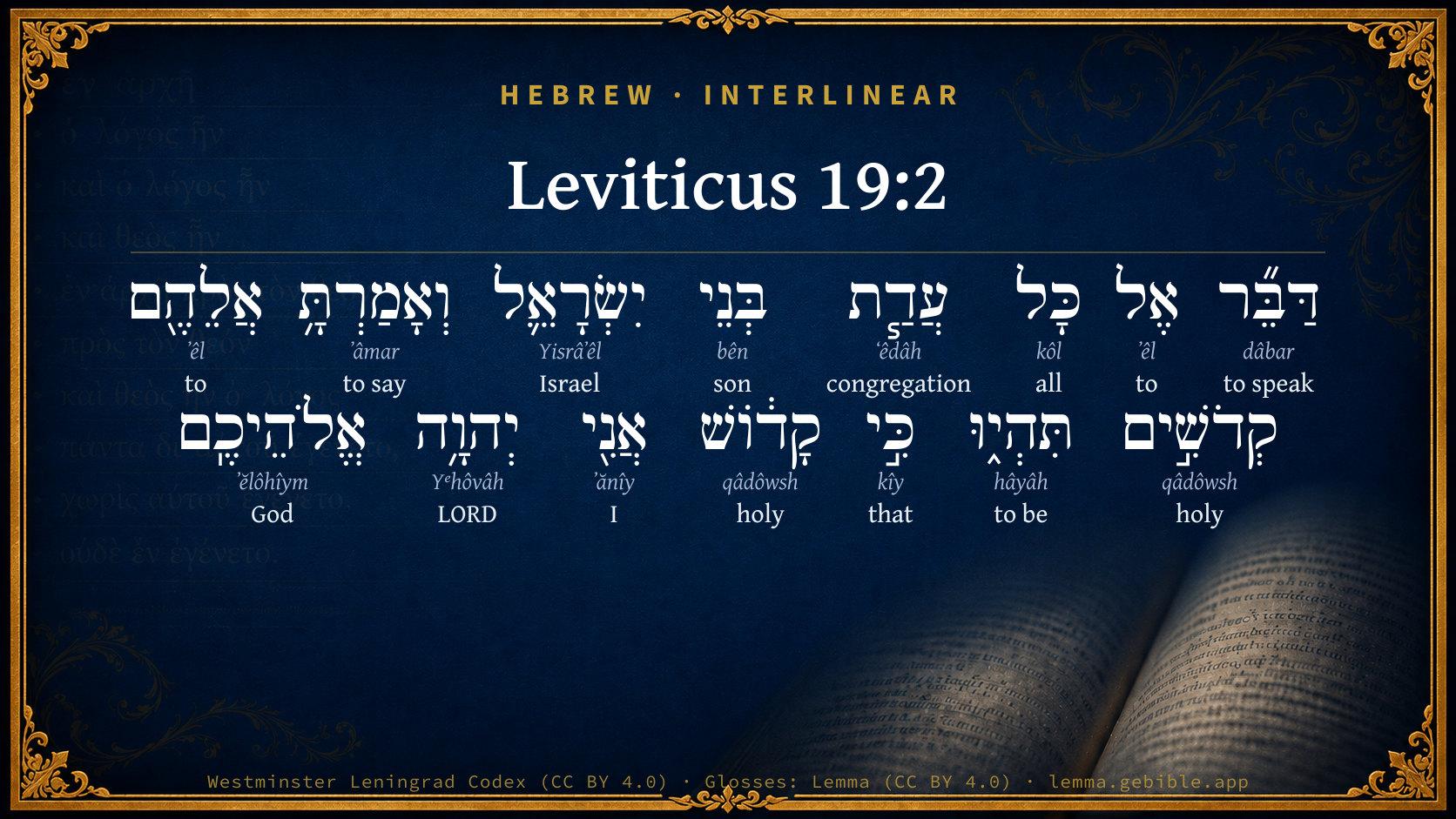
Hebrew (Westminster Leningrad Codex) Leviticus 19:2 appears in the Hebrew Old Testament. The text above is from the Westminster Leningrad Codex. Each word links to its Strong’s number, a concise gloss, and parsing drawn from the Open Scriptures Hebrew Bible morphology. Click any word for its full Brown-Driver-Briggs (BDB) entry.
Download image
Cite this verse

Leviticus 19:2 (World English Bible). Public Domain. Lemma interlinear Bible study tool, https://lemma.gebible.app/v/leviticus/19/2.

Show BibTeX & RIS
BibTeX
RIS
English Translation
"Speak to all the congregation of the children of Israel, and tell them, 'You shall be holy; for I Yahweh your God am holy.
World English Bible · Public Domain
Download a study sheet

One document with this verse’s original text, its word-by-word gloss line, the meaning frame, cross-references with their text, attributed commentary, and full source and license credits — printable, and it pastes into notes with its structure intact.

This verse Autodidact and up

Study sheet (.html) Plain text (.txt)

A passage Seminary Student

Up to 50 verses in one chapter. A passage sheet keeps up to 6 commentary sources and 12 cross-references per verse, in the order this page ranks them, and says so on the sheet whenever that leaves anything out. Ask for a single verse and you get the Autodidact verse sheet above.

Everything on this page stays free to read, with no account — the sheet is a download of what is already on screen, not access to it.

Want to remove ads? Support Godless Engineer
Compare translations 3

The same verse in 3 English versions, stacked beneath the original-language interlinear above. Click any original word for its lexicon entry.

Each is an independent rendering of the whole verse — the interlinear is not word-aligned to these translations.

Highlighted words mark where these versions differ — a whole-verse word diff, not a word-by-word alignment.

  • World English Bible Public Domain
    "Speak to all the congregation of the children of Israel, and tell them, 'You shall be holy; for I Yahweh your God am holy.
  • King James Version Public Domain
    Speak unto all the congregation of the children of Israel, and say unto them, Ye shall be holy: for I the LORD your God am holy.
  • unfoldingWord Literal Text CC BY-SA 4.0
    “Speak to all the congregation of the sons of Israel, and you shall say to them, ‘You shall be holy, for I, Yahweh your God, holy.

unfoldingWord Literal Text — © unfoldingWord, licensed CC BY-SA 4.0. Word-aligned USFM3 via Door43 (git.door43.org/unfoldingWord/en_ult).

Versions to compare (up to 4)

3 of 4 selected

Show all 18 translations

Every available English version of this verse, each an independent rendering of the whole verse.

  • World English Bible Public Domain
    "Speak to all the congregation of the children of Israel, and tell them, 'You shall be holy; for I Yahweh your God am holy.
  • Berean Standard Bible Public Domain
    “Speak to the whole congregation of Israel and tell them: Be holy because I, the LORD your God, am holy.
  • Majority Standard Bible Public Domain
    “Speak to the whole congregation of Israel and tell them: Be holy because I, the LORD your God, am holy.
  • King James Version Public Domain
    Speak unto all the congregation of the children of Israel, and say unto them, Ye shall be holy: for I the LORD your God am holy.
  • American Standard Version (1901) Public Domain
    Speak unto all the congregation of the children of Israel, and say unto them, Ye shall be holy; for I Jehovah your God am holy.
  • Revised Version (1885) Public Domain
    Speak unto all the congregation of the children of Israel, and say unto them, Ye shall be holy: for I the LORD your God am holy.
  • Geneva Bible (1599) Public Domain
    Speake vnto all the Congregation of the children of Israel, and say vnto them, Ye shalbe holy, for I the Lord your God am holy.
  • Douay-Rheims (1899) Public Domain
    Speak to all the congregation of the children of Israel, and thou shalt say to them: Be ye holy, because I the Lord your God am holy.
  • Young's Literal Translation Public Domain
    `Speak unto all the company of the sons of Israel, and thou hast said unto them, Ye are holy, for holy `am' I, Jehovah, your God.
  • Literal Standard Version CC BY-SA 4.0
    “Speak to all the congregation of the sons of Israel, and you have said to them: You are holy, because I, your God YHWH, [am] holy.
  • Unlocked Literal Bible CC BY-SA 4.0
    “Speak to all the assembly of the people of Israel and say to them, 'You must be holy, for I Yahweh your God am holy.
  • unfoldingWord Literal Text CC BY-SA 4.0
    “Speak to all the congregation of the sons of Israel, and you shall say to them, ‘You shall be holy, for I, Yahweh your God, holy.
  • Darby Bible Public Domain
    Speak unto all the assembly of the children of Israel, and say unto them, Holy shall ye be, for I Jehovah your God am holy.
  • World Messianic Bible Public Domain
    “Speak to all the congregation of the children of Israel, and tell them, ‘You shall be holy; for I, the LORD your God, am holy.
  • Webster's Bible Public Domain
    Speak to all the congregation of the children of Israel, and say to them, Ye shall be holy: for I the LORD your God am holy.
  • Free Bible Version CC BY-SA 4.0
    “Tell all the Israelites: You must be holy because I am holy; I am the Lord your God.
  • Bible in Basic English Public Domain
    Say to all the people of Israel, You are to be holy, for I, the Lord your God, am holy.
  • JPS Tanakh (1917) Public Domain
    Speak unto all the congregation of the children of Israel, and say unto them: Ye shall be holy; for I the LORD your God am holy.

Literal Standard Version (2020), Covenant Press — licensed CC BY-SA 4.0. Text via the HelloAO Bible API (eBible.org). Unlocked Literal Bible (unfoldingWord) — licensed CC BY-SA 4.0. Text via the HelloAO Bible API (eBible.org). unfoldingWord Literal Text — © unfoldingWord, licensed CC BY-SA 4.0. Word-aligned USFM3 via Door43 (git.door43.org/unfoldingWord/en_ult). Free Bible Version, Dr. Jonathan Gallagher — licensed CC BY-SA 4.0. Text via the HelloAO Bible API (eBible.org).

Word by word

More ways to search: Search by grammar → Find every occurrence → Compare this word →

Practice this passage: Drill this verse → Learn its vocabulary →

קְדֹשִׁ֣ים
qâdôwsh
H6918
“holy”
Adjective, Adjective, Masculine, Plural, Absolute
Part of Speech
Adjective
Type
Adjective
Gender
Masculine
Number
Plural
State
Absolute
Full BDB Definition

Origin: from H6942

TWOT: 1990b

sacred, holy, Holy One, saint, set apart
  1. דַּבֵּ֞ר dâbar H1696 “speak” Verb, Piel, Imperative, 2nd Person, Masculine, Singular
  2. אֶל ʼêl H413 “to” Preposition
  3. כָּל kôl H3605 “all of” Noun, Common, Masculine, Singular, Construct
  4. עֲדַ֧ת ʻêdâh H5712 “congregation of” Noun, Common, Feminine, Singular, Construct
  5. בְּנֵי bên H1121 “sons of” Noun, Common, Masculine, Plural, Construct
  6. יִשְׂרָאֵ֛ל Yisrâʼêl H3478 “Israel” Noun, Proper
  7. וְאָמַרְתָּ֥ ʼâmar H559 “and · to say” Conjunction + Verb, Qal, Sequential Perfect, 2nd Person, Masculine, Singular
  8. אֲלֵהֶ֖ם ʼêl H413 “to · them” Preposition + Suffix, Personal, 3rd Person, Masculine, Plural
  9. תִּהְי֑וּ hâyâh H1961 “to be” Verb, Qal, Imperfect, 2nd Person, Masculine, Plural
  10. כִּ֣י kîy H3588 “that” Conjunction
  11. קָד֔וֹשׁ qâdôwsh H6918 “holy” Adjective, Adjective, Masculine, Singular, Absolute
  12. אֲנִ֖י ʼănîy H589 “I” Pronoun, Personal, 1st Person, Common, Singular
  13. יְהוָ֥ה Yᵉhôvâh H3068 “LORD” Noun, Proper
  14. אֱלֹהֵיכֶֽם ʼĕlôhîym H430 “God(s) · your” Noun, Common, Masculine, Plural, Construct + Suffix, Personal, 2nd Person, Masculine, Plural

About this verse

These counts appear in no published source. They are computed here, from the morphology-tagged text and Lemma’s own curated glosses. What Lemma adds →

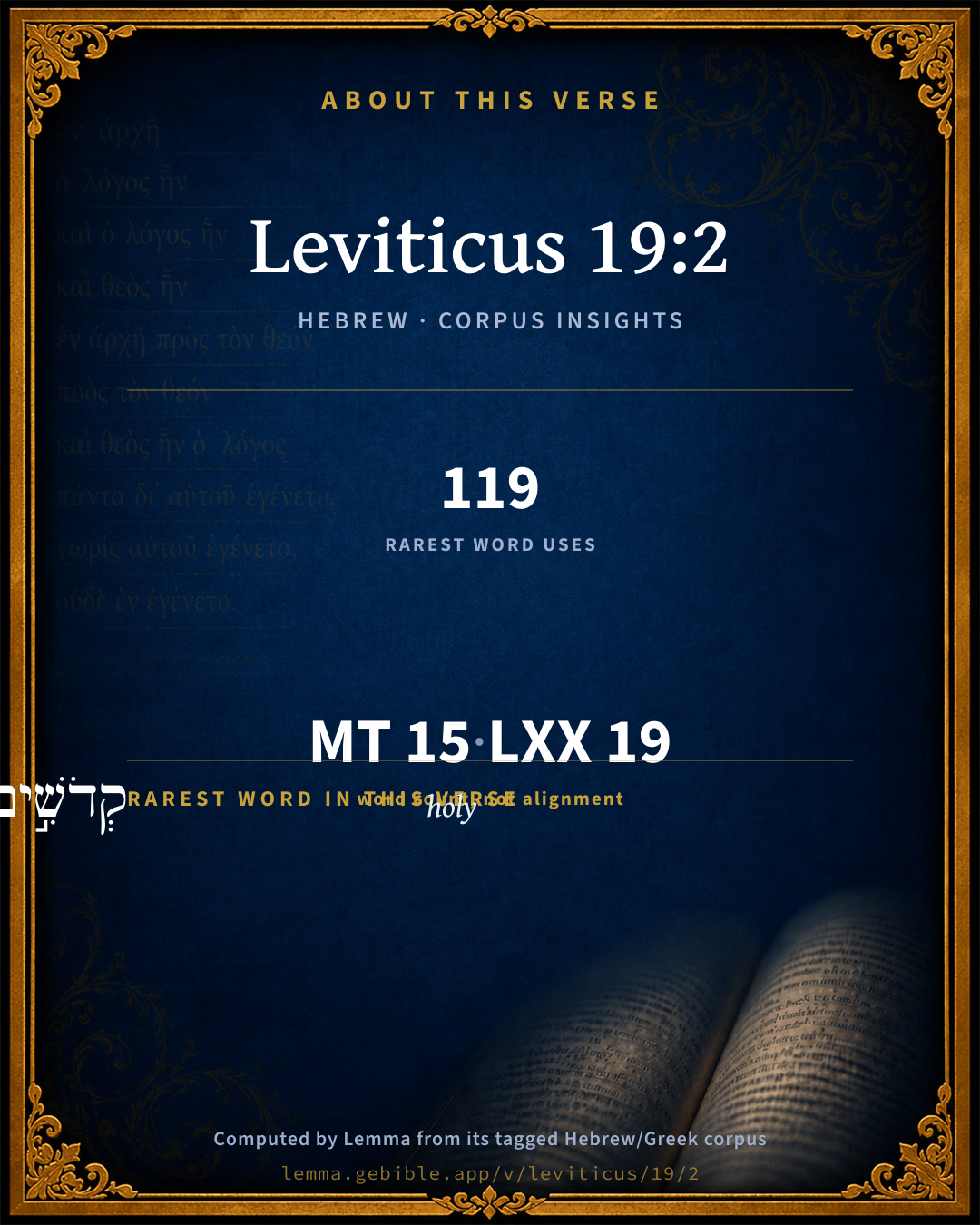
15
words
13
distinct lemmas
Pentateuch
section

Grammatical profile

  • 3 verbs
  • 6 nouns
  • 2 adjectives
  • 1 pronoun
  • 2 prepositions
  • 1 conjunction

Verb forms

  • דַּבֵּ֞ר Piel · Imperative
  • וְאָמַרְתָּ֥ Qal · Sequential Perfect
  • תִּהְי֑וּ Qal · Imperfect

Repetition

Words recur within this verse — often emphatic in Hebrew:

  • קְדֹשִׁ֣ים holy H6918 ×2
  • אֶל to H413 ×2

Hebrew & Septuagint length

In English translation the verse runs 24 words from the Hebrew and 27 from the Septuagint (LXX English) — closely comparable.

A rough comparison of the two English renderings, which tokenize alike — not a word-level alignment.

Word counts can differ between the Hebrew and the Greek without any difference in meaning — e.g. the Hebrew direct-object marker אֵת has no separate Greek word, and Greek often adds the article ὁ.

In the original languages it is 15 Hebrew tokens and 19 Greek tokens — but the two are counted differently (Hebrew bundles its prefixes and suffixes into one token; the Greek is in lemma form), so that isn’t a like-for-like length.

Cross-references

11

Topical passages linked to Leviticus 19:2 in the Treasury of Scripture Knowledge — connected by theme and wording, ordered by reader-vote popularity; previews shown in the World English Bible.

  • Leviticus 11:44–45 For I am Yahweh your God. Sanctify yourselves therefore, and be holy; for I am holy: neither shall you defile yourselves with any kind of creeping thing that moves on the earth.
  • Leviticus 20:7 "'Sanctify yourselves therefore, and be holy; for I am Yahweh your God.
  • 1 Peter 1:15–16 but just as he who called you is holy, you yourselves also be holy in all of your behavior;
  • 2 Corinthians 6:14–16 Don't be unequally yoked with unbelievers, for what fellowship have righteousness and iniquity? Or what communion has light with darkness?
  • Matthew 5:48 Therefore you shall be perfect, just as your Father in heaven is perfect.
  • Leviticus 20:26 You shall be holy to me: for I, Yahweh, am holy, and have set you apart from the peoples, that you should be mine.
  • 2 Corinthians 7:1 Having therefore these promises, beloved, let us cleanse ourselves from all defilement of flesh and spirit, perfecting holiness in the fear of God.
  • Exodus 19:6 and you shall be to me a kingdom of priests, and a holy nation.' These are the words which you shall speak to the children of Israel."
  • Leviticus 21:8 You shall sanctify him therefore; for he offers the bread of your God: he shall be holy to you: for I Yahweh, who sanctify you, am holy.
  • Isaiah 6:3–4 One called to another, and said, "Holy, holy, holy, is Yahweh of Hosts! The whole earth is full of his glory!"
  • Amos 3:3 Do two walk together, Unless they have agreed?

Cross-references courtesy of OpenBible.info (CC BY 4.0).

Hebrew and Greek witnesses Masoretic Hebrew ↔ Greek Septuagint

The same verse in the two great witnesses to the Old Testament, shown verse-for-verse.

These are two independent witnesses, not word-aligned to each other, and the Septuagint is shown in lemma (dictionary) form.

Hebrew Leviticus 19:2 Masoretic · Westminster Leningrad Codex

דַּבֵּ֞ר אֶל כָּל עֲדַ֧ת בְּנֵי יִשְׂרָאֵ֛ל וְאָמַרְתָּ֥ אֲלֵהֶ֖ם קְדֹשִׁ֣ים תִּהְי֑וּ כִּ֣י קָד֔וֹשׁ אֲנִ֖י יְהוָ֥ה אֱלֹהֵיכֶֽם

"Speak to all the congregation of the children of Israel, and tell them, 'You shall be holy; for I Yahweh your God am holy.

World English Bible · Public Domain

Greek LXX Leviticus 19:2 Septuagint · lemma form

λαλέω ὁ συναγωγή ὁ υἱός ἰσραήλ καί εἶπον πρός αὐτός ἅγιος εἰμί ὅτι ἐγώ ἅγιος κύριος ὁ θεός σύ

Speak to the congregation of the children of Israel, and you shall say to them, You⌃ shall be holy; for I the Lord your God am holy.

LXX2012 (modern English Septuagint) · Public Domain

Hebrew: Westminster Leningrad Codex (CC BY 4.0). Greek: Septuagint (public domain); English from LXX2012 (modern English Septuagint) (Public Domain). How the Septuagint differs from the Hebrew →

Targum (Aramaic paraphrase)

2

The Targum is the ancient Jewish Aramaic paraphrase of the Hebrew Scriptures — an interpretive translation, not the Hebrew text itself. Onkelos (literal) and Pseudo-Jonathan (expansive) render the Torah, and Jonathan the Prophets. Coverage is partial: where no permissively-licensed English translation exists for a verse, only the Aramaic is shown. This is verse-level text, not a word-by-word alignment to the Hebrew.

  1. Targum Onkelos Torah (Genesis–Deuteronomy)
    מַלֵל עִם כָּל כְּנִשְׁתָּא דִבְנֵי יִשְׂרָאֵל וְתֵימַר לְהוֹן קַדִישִׁין תְּהוֹן אֲרֵי קַדִישׁ אֲנָא יְיָ אֱלָהָכוֹן

    (no public-domain English translation for this verse)

    Targum Onkelos — Aramaic: “Onkelos Genesis” (public domain); “Onkelos Exodus” (public domain); “Onkelos Leviticus” (public domain); “Onkelos Numbers” (public domain); “Onkelos Deuteronomy” (public domain). English: “Sefaria Community Translation” (CC0 1.0 (public-domain dedication)); “J.W. Etheridge. The Targums of Onkelos and Jonathan Ben Uzziel on the Pentateuch. London: Longmans, Green, 1862” (public domain). Text via Sefaria.

  2. Targum Pseudo-Jonathan Torah (Genesis–Deuteronomy)
    מַלֵיל עִם כָּל כְּנִישְׁתָּא דִבְנֵי יִשְרָאֵל וְתֵימַר לְהוֹן קַדִישִׁין תְּהוֹן אֲרוּם קַדִישׁ אֲנָא יְיָ אֳלָהָכוֹן

    Speak with the whole congregation of the sons of Israel, and say to them: Ye, shall be holy, for I the Lord your God am Holy.

    Targum Pseudo-Jonathan — Aramaic: “Targum Jonathan on Genesis” (public domain); “Targum Jonathan on Exodus” (public domain); “Targum Jonathan on Leviticus” (public domain); “Targum Jonathan on Numbers” (public domain); “Targum Jonathan on Deuteronomy” (public domain). English: “The Targum of Jonathan ben Uzziel, trans. J. W. Etheridge, London, 1862” (public domain). Text via Sefaria.

Commentary

Notes on Leviticus 19:2 from classic Christian and Jewish commentators (each source and its license shown beneath its notes). The classic Christian expositions comment on the surrounding passage and are grouped to its opening verse, so a note may address several verses; the Jewish commentaries on the Tanakh (Rashi and others) are per-verse, so they appear only where the commentator wrote on this verse.

Lemma curates 59 commentaries, every one of them public domain or Creative Commons licensed, each selected and text-cleaned for this edition rather than reprinted as found. About our sources →

Trapp's Complete Commentary

John Trapp

Lev 19:2 Speak unto all the congregation of the children of Israel, and say unto them, Ye shall be holy: for I the LORD your God [am] holy.

Ver. 2. Ye shall be holy.] Ritually and really. {See Trapp on "Lev 11:44"} {See Trapp on "Mat 5:48"} {See Trapp on "1Pe 1:16"} {See Trapp on "1Jn 3:3"}

John Trapp, A Commentary or Exposition upon All the Books of the Old and New Testament (1647–1656) — public domain. Text from a community e-Sword module.

The Biblical Illustrator

Joseph S. Exell

Lev_19:2

Ye shall be holy.

The object of Gods laws

The position of this come mand at the head of the long list of precepts which follows is most significant and instructive. It sets before us the object of the whole ceremonial and moral law, and, we may add, the supreme object of the gospel also, namely, to produce a certain type of moral and spiritual character, a holy manhood; it, moreover, precisely interprets this term, so universally misunderstood and misapplied among all nations, as essentially consisting in a spiritual likeness to God: Ye shall be holy: for I the Lord your God am holy. These words evidently at once define holiness and declare the supreme motive to the attainment and maintenance of a holy character. This, then, is brought before us as the central thought in which all the diverse precepts and prohibitions which follow find their unity; and, accordingly, we find this keynote of the whole law echoing, as it were, all through this chapter, in the constant refrain, repeated herein no less than fourteen--twice seven--times; I am the Lord! I am the Lord your God! (S. H. Kellogg, D. D.)

A fountain of purity

One summer day, a few years ago, strolling for rest and pleasure near the mouth of the Columbia river, where there is a large rise and fall of the tide, I came, at low tide, upon a splendid spring of pure, fresh water, clear as crystal, gushing up from between the rocks that two hours before had formed a part of the rivers bed. Twice a day the soiled tide rises above that beautiful fountain and covers it over; but there it is, down deep under the salt tide, and when the tide has spent its force and gone back again to the oceans depths, it sends out its pure waters fresh and clear as before. So if the human heart be really a fountain of love to Christ it will send out its streams of fresh, sweet waters, even into the midst of the salt tides of politics or business. And the man who carries such a fountain into the days worry and struggle will come again at night, when the worlds tide has spent its force, with clean hands, sweet spirit, and conscience void of offence toward God and man. (S. S. Chronicle.)

Holiness silences the profane

Holiness has a mighty influence upon others. It stops the mouths of the ungodly, who are ready to reproach religion and throw the dirt of professors sins on the face of profession itself. They say frogs will cease croaking when a light is brought near them; the light of a holy conversation hangs, as it were, a padlock on profane lips. (W. Gurnall.)

The Biblical Illustrator, edited by Joseph S. Exell (c. 1880s–1900s) — public domain. Text from a community e-Sword module.

Joseph Benson's Commentary

Lev 19:2. Ye shall be holy — Separated from all the forementioned defilements, and entirely consecrated to God, and obedient to all his laws. I am holy — Both in my essence, and in all my laws, which are holy, and just, and good.

Joseph Benson's Commentary on the Old and New Testaments (1811–1818) — public domain. Text from a community e-Sword module.

Keil & Delitzsch

C. F. Keil & F. Delitzsch

The commandment in Lev 19:2, "to be holy as God is holy," expresses on the one hand the principle upon which all the different commandments that follow were based, and on the other hand the goal which the Israelites were to keep before them as the nation of Jehovah.

Lev 19:3

The first thing required is reverence towards parents and the observance of the Lord's Sabbaths-the two leading pillars of the moral government, and of social well-being. To fear father and mother answers to the honour commanded in the decalogue to be paid to parents; and in the observance of the Sabbaths the labour connected with a social calling is sanctified to the Lord God.

Lev 19:4

Lev 19:4 embraces the first two commandments of the decalogue: viz., not to turn to idols to worship them (Deu 31:18, Deu 31:20), nor to make molten gods (see at Exo 34:17). The gods beside Jehovah are called elilim, i.e., nothings, from their true nature.

Lev 19:5-8

True fidelity to Jehovah was to be shown, so far as sacrifice, the leading form of divine worship, was concerned, in the fact, that the holiness of the sacrificial flesh was strictly preserved in the sacrificial meals, and none of the flesh of the peace-offerings eaten on the third day. To this end the command in Lev 7:15-18 is emphatically repeated, and transgressors are threatened with extermination. On the singular ישּׂא in Lev 19:8, see at Gen 27:29, and for the expression "shall be cut off," Gen 17:14.

Keil & Delitzsch — Biblical Commentary on the Old Testament (1861–1891) — public domain (CC PDM 1.0). Text via the HelloAO Bible API. (Old Testament only.)

Tyndale Open Study Notes

Tyndale Open Resources

19:2 be holy: See study note on 11:44-45.

Tyndale Open Study Notes — © Tyndale Open Resources, licensed CC BY-SA 4.0. Text via the HelloAO Bible API.

Geneva Bible (1599)

Geneva Bible translators

That is, void of all pollution, idolatry, and superstition both of soul and body.

Geneva Bible (1599) marginal notes — public domain. Text via Bolls.life.

Ellicott's Commentary for English Readers

(2) Speak unto all the congregation of the children of Israel.—The importance which the Lawgiver Himself attaches to this epitome of the whole Law, as this section is called, may be seen from the fact that God commands Moses to address these precepts “to all the congregation of the children of Israel—a phrase which occurs nowhere else in Leviticus in this formula, and which is only to be found once more in the whole Pentateuch (Exo_12:3), at the institution of the Passover, the great national festival which commemorates the redemption of the Israelites from Egypt.

I the Lord your God.—Around this solemn declaration, which is repeated no less than sixteen times, both in its full and shorter form (see Lev_19:1), cluster the different precepts of this section. It is this solemn formula which links together the various injunctions in the chapter before us. As the Lord who is their God is Himself holy, they who are His people must also be holy, or as the saying which obtained during the second Temple expresses it, “the surroundings of the king must bear the moral impress of the sovereign;” or, in other words, your nearness to God not only demands. that your conduct should not be in contradiction to His holy nature, but that your life should bear the impress and reflect the image of God. (See Lev_11:44; Mat_5:48; 1Pe_1:15.)

A Bible Commentary for English Readers, edited by Charles John Ellicott (1878–1897) — public domain. Text from a community e-Sword module.

John Gill's Exposition

Speak unto all the congregation of the children of Israel,.... They could not be all spoke to together, but tribe after tribe, or family after family; or rather the heads of the tribes, and at most the heads of families were convened, and the following instructions were given, to be communicated to their respective tribes and families. Jarchi says this section was spoken in the congregation, because the greater part of the body of the law, or the more substantial parts of it, depend upon it; and indeed all the ten commandments are included in it, with various other laws, both judicial and ceremonial. Aben Ezra remarks, that all the congregation are spoken to, to include the proselytes, because they had been warned of incests, as the Israelites, in the preceding chapter; see Gill on Lev 18:26,

and say unto them, ye shall be holy: a separate people from all others, abstaining from all the impurity and idolatry they are cautioned against in the foregoing chapter, and observing the holy precepts expressed in this:

for I the Lord your God am holy; in his nature, essence, originally, independently, immutably, and perfectly; and the more holy they were, the more like they would be to him; See Gill on Lev 11:44 and See Gill on Lev 11:45; where the same words are used, after the laws given about creatures clean and unclean to be eaten, as here, after those about impure copulations and incests.

John Gill's Exposition of the Whole Bible (1746–1763) — public domain (CC PDM 1.0). Text via the HelloAO Bible API.

Albert Barnes' Notes on the Bible

Ye shall be holy ... - These words express the keynote to the whole book of Leviticus, being addressed to the whole nation. There does not appear to be any systematic arrangement in the laws which follow. They were intended as guards to the sanctity of the elect people, enforcing common duties by immediate appeal to the highest authority. Compare Lev 18:24-30 note.

Albert Barnes' Notes on the Bible (1834–1885) — public domain. Text from a community e-Sword/MySword module.

Matthew Poole's English Annotations

Ye shall be holy, separated from all the forementioned defilements, and entirely consecrated to God, and obedient to all his laws and statutes.

I the Lord your God am holy, both in my essence, and in all my laws, which are holy and just and good, and in all my actions; whereas the gods of the heathens are unholy both in their laws and institutions, whereby they allow and require filthy and abominable actions; and in their practices, some of them having given wicked examples to their worshippers.

Matthew Poole's English Annotations on the Holy Bible (1683–1685) — public domain. Text from a community e-Sword/MySword module.

Whedon's Commentary on the Bible

Daniel D. Whedon

2. Ye shall be holy — Inward and outward holiness is the aim of all the laws of God. He seeks to cleanse the heart, the fountain of action, and the very seat of character. See Introduction, (8.)

For… I am holy — This implies that man is bound to realize his loftiest ideal of purity, and that the revelation of God’s holiness is that ideal. The grounds of obligation for Israel were: 1.) the nature of God, holiness; 2.) his act of creation, Isa_43:1; Isaiah 3.) his act of deliverance from Egypt, Exo_20:2.

Changing the third to the redemption from sin, procured by Jesus Christ, we have the New Testament grounds of obligation for all men. See Lev_11:44, notes.

Daniel D. Whedon (gen. ed.), Commentary on the Old and New Testaments (1874–1909) — public domain. Text from a community e-Sword module.

The Pulpit Commentary

Ye shall be holy: for I the Lord your God am holy. The religious motive is put forward here, as in the previous chapter, as the foundation of all morality. It is God"s will that we should be holy, and by being holy we. are like God, who is to be our model so far as is possible to the creature. So in the new dispensation, "Be ye therefore perfect, even as your Father which is in heaven is perfect". (Mat_5:48) "As he which hath called you is holy, so be ye holy in all manner of conversation". (1Pe_1:15)

The Pulpit Commentary (1880–1919), ed. H.D.M. Spence-Jones & Joseph S. Exell — public domain. Text from a community e-Sword module.

John Wesley's Explanatory Notes

Be ye holy - Separated from all the forementioned defilements, and entirely consecrated to God and obedient to all his laws. I am holy - Both in my essence, and in all my laws, which are holy and just and good.

John Wesley, Explanatory Notes Upon the Whole Bible (1754–1765) — public domain. Text via the GEBible commentary corpus.

Rashi

Rabbi Shlomo Yitzchaki (Rashi)

דבר אל כל עדת בני ישראל SPEAK UNTO ALL THE CONGREGATION OF THE CHILDREN OF ISRAEL — This (the addition of the words כל עדת) teaches us that this section was proclaimed in full assembly because most of the fundamental teachings of the Torah are dependent on it (contained in it) (Sifra, Kedoshim, Section 1 1; Vayikra Rabbah 24:5).

קדשים תהיו YE SHALL BE HOLY — This means, keep aloof from the forbidden sexual relations just mentioned and from sinful thoughts. [It is evident that this is the meaning of קדשים תהיו because] wherever you find in the Torah a command to fence yourself in against such relations you also find mention of “holiness". Examples are: (Leviticus 21:7) “[They shall not take] a wife that is a harlot, or a profane etc.", and in the next verse "for I, the Lord, who sanctifieth you, [am holy]"; (Leviticus 21:15) “Neither shall he profane his seed (by the forbidden unions mentioned in the preceding verses) for I the Lord do sanctify him"; (Leviticus 21:6) "They shall be holy… followed by (v. 7) "[they shall not take] a wife that is a harlot or a profane" (cf. Vayikra Rabbah 24:4-6).

Rashi on the Tanakh — English translations: “The Judaica Press complete Tanach with Rashi, translated by A. J. Rosenberg” (CC BY 4.0); “Pentateuch with Rashi's commentary by M. Rosenbaum and A.M. Silbermann, 1929-1934” (public domain); “The Metsudah Tanach series, Lakewood, N.J” (CC BY 4.0); and “The Book of Joshua, Metsudah Publications, 1997” (CC BY 4.0). Text via Sefaria.

Ramban (Nachmanides)

Rabbi Moshe ben Nachman (Ramban / Nachmanides)

SPEAK UNTO ALL THE CONGREGATION OF THE CHILDREN OF ISRAEL. Our Rabbis have already said. Quoted also in Rashi. that this section was addressed to the full assembly [of all Israel] because most of the fundamental principles of the Torah are dependent on it, this being the reason for the expression, speak unto all the congregation of the children of Israel. This section, however, was mentioned here in [the book of] Torath Kohanim because it contains laws concerning the thanks-offering, and also because it states the punishments He commanded us to execute on those who do the abominable deeds mentioned [in the preceding sections], as well as [those for] the forbidden sexual relationships. These subjects have been included in this book [of Torath Kohanim] for the reason that we have written at the beginning of this book.

YE SHALL BE HOLY. “Abstain from the forbidden sexual relationships [mentioned in the preceding section] and from [other] sin, because wherever you find [in the Torah] a warning to guard against immorality, you find the mention of ‘holiness.’” This is Rashi’s language. But in the Torath Kohanim I have seen it mentioned without any qualification [i.e., without any particular reference to immorality, as Rashi expressed it], saying:. “Be self-restraining.” Similarly, the Rabbis taught there: 12:4. “And ye shall sanctify yourselves, and be ye holy, for I am Holy. Just as I am Holy, so be you holy. Just as I am Pure, so be you pure.” And in my opinion, this abstinence does not refer only to restraint from acts of immorality, as the Rabbi [Rashi] wrote, but it is rather the self-control mentioned throughout the Talmud, which confers upon those who practice it the name of P’rushim (Pharisees), [literally: “those who are separated” from self-indulgence, as will be explained, or those who practice self-restraint]. The meaning thereof is as follows: The Torah has admonished us against immorality and forbidden foods, but permitted sexual intercourse between man and his wife, and the eating of [certain] meat and wine. If so, a man of desire could consider this to be a permission to be passionately addicted to sexual intercourse with his wife or many wives, and be among winebibbers, among gluttonous eaters of flesh, and speak freely all profanities, since this prohibition has not been [expressly] mentioned in the Torah, and thus he will become a sordid person within the permissible realm of the Torah! Therefore, after having listed the matters which He prohibited altogether, Scripture followed them up by a general command that we practice moderation even in matters which are permitted, [such as in the following]: One should minimize sexual intercourse, similar to that which the Rabbis have said, “So that the disciples of the Sages should not be found together with their wives as often as the hens,” and he should not engage in it except as required in fulfillment of the commandment thereof. He should also sanctify himself [to self-restraint] by using wine in small amounts, just as Scripture calls a Nazirite “holy” [for abstaining from wine and strong drink], and he should remember the evils which the Torah mentioned as following from [drinking wine] in the cases of Noah and Lot., 19:33. Similarly, he should keep himself away from impurity [in his ordinary daily activity], even though we have not been admonished against it in the Torah, similar to that which the Rabbis have said: “For the P’rushim (Pharisees), the clothes of the unlearned are considered as if trodden upon by a zav” [or zavah — a man or woman having suffered a flux], and just as the Nazirite is called “holy” because of guarding himself from the impurity of the dead. Likewise he should guard his mouth and tongue from being defiled by excessive food and by lewd talk, similar to what Scripture states, and every mouth speaketh wantonness, and he should purify himself in this respect until he reaches the degree known as [complete] “self-restraint,” as the Rabbis said concerning Rabbi Chiya, that never in his life did he engage in unnecessary talk. It is with reference to these and similar matters that this general commandment [Ye shall be holy] is concerned, after He had enumerated all individual deeds which are strictly forbidden, so that cleanliness of hands and body, are also included in this precept, just like the Rabbis have said: “And ye shall sanctify yourselves. This refers to the washing of hands before meals. And be ye holy. This refers to the washing of hands after meals [before the reciting of grace]. For I am holy — this alludes to the spiced oil” [with which they used to rub their hands after a meal]. For although these [washings and perfuming of the hands] are commandments of Rabbinic origin, yet Scripture’s main intention is to warn us of such matters, that we should be [physically] clean and [ritually] pure, and separated from the common people who soil themselves with luxuries and unseemly things. And such is the way of the Torah, that after it lists certain specific prohibitions, it includes them all in a general precept. Thus after warning with detailed laws regarding all business dealings between people, such as not to steal or rob or to wrong one another, and other similar prohibitions, He said in general, And thou shalt do that which is right and good, thus including under a positive commandment the duty of doing that which is right and of agreeing to a compromise [when not to do so would be inequitable]; as well as all requirements to act “beyond” the line of justice [i.e., to be generous in not insisting upon one’s rights as defined by the strict letter of the law, but to agree to act “beyond” that line of the strict law] for the sake of pleasing one’s fellowman, as I will explain when I reach there [that verse], with the will of the Holy One, blessed be He. Similarly in the case of the Sabbath, He prohibited doing certain classes of work by means of a negative commandment, and painstaking labors [not categorized as “work,” such as transferring heavy loads in one’s yard from one place to another, etc.] He included under a general positive commandment, as it is said, but on the seventh day thou shalt rest., 23:12. I will yet explain this with the help of G-d.

FOR I THE ETERNAL YOUR G-D AM HOLY. This means to say that we will merit to cleave unto Him by being holy. This expression [I the Eternal your G-d] is similar to that of the first commandment in the Ten Commandments [which begins, I am the Eternal thy G-d]. He commanded here, Ye shall fear every man his mother, and his father, for there [in the Ten Commandments] He commanded that we honor them, and here it is about fearing them. And he states here, and ye shall keep My Sabbaths, for there [in the Ten Commandments] He commanded concerning remembering it, Verse 8 (Vol. II, pp. 306-311). and here about keeping it. We have already explained the meaning of both terms., Verse 8 (Vol. II, pp. 306-311).

Ramban (Nachmanides) on the Tanakh — English translation: “Commentary on the Torah by Ramban (Nachmanides). Translated and annotated by Charles B. Chavel. New York, Shilo Pub. House, 1971-1976” (CC BY 4.0). Text via Sefaria.

Lesson kit

Teaching starters — assembled from the data on this page, not authored interpretation. Every prompt links to the verse data it draws on. Edit before teaching.

Leviticus, in the Pentateuch, opens this verse with 15 words (13 distinct Hebrew lemmas). Its most distinctive word is qâdôwsh (“holy”). A historical commentator’s framing appears above. Read the whole chapter for the surrounding context.

Discussion questions

  1. The word qâdôwsh carries the sense “holy.” How does it shape the verse?
  2. Leviticus 11:44–45 shares this passage’s theme. How do the two illuminate each other?
  3. “holy” occurs 2× in this one verse. What is the effect of the repetition?
  4. The translations on this page render this verse differently — a whole-verse word diff, not a word-by-word alignment. What might account for the different wordings?
  5. The verb «דַּבֵּ֞ר» is Piel Imperative. How does its form color the action?
  6. Reading how Trapp's Complete Commentary and The Biblical Illustrator read this verse, where do the two commentators agree and where do they part?

Things to notice

Reading settings

Reading text

Shown beneath each verse's original-language words.

Old Testament
Old Testament edition

Read the OT as the Masoretic Hebrew (MT) or the Greek Septuagint (LXX).

English shown for the Greek Septuagint (in the Hebrew ↔ Greek comparison).

Comparing translations? Open the Compare panel on any verse page to stack up to four side by side.