
Exodus 6:12

Hebrew (Westminster Leningrad Codex) Exodus 6:12 appears in the Hebrew Old Testament. The text above is from the Westminster Leningrad Codex. Each word links to its Strong’s number, a concise gloss, and parsing drawn from the Open Scriptures Hebrew Bible morphology. Click any word for its full Brown-Driver-Briggs (BDB) entry.
Download image
Cite this verse

Exodus 6:12 (World English Bible). Public Domain. Lemma interlinear Bible study tool, https://lemma.gebible.app/v/exodus/6/12.

Show BibTeX & RIS
BibTeX
RIS
English Translation
Moses spoke before Yahweh, saying, "Behold, the children of Israel haven't listened to me. How then shall Pharaoh listen to me, who am of uncircumcised lips?"
World English Bible · Public Domain
Download a study sheet

One document with this verse’s original text, its word-by-word gloss line, the meaning frame, cross-references with their text, attributed commentary, and full source and license credits — printable, and it pastes into notes with its structure intact.

This verse Autodidact and up

Study sheet (.html) Plain text (.txt)

A passage Seminary Student

Up to 50 verses in one chapter. A passage sheet keeps up to 6 commentary sources and 12 cross-references per verse, in the order this page ranks them, and says so on the sheet whenever that leaves anything out. Ask for a single verse and you get the Autodidact verse sheet above.

Everything on this page stays free to read, with no account — the sheet is a download of what is already on screen, not access to it.

Want to remove ads? Support Godless Engineer
Compare translations 3

The same verse in 3 English versions, stacked beneath the original-language interlinear above. Click any original word for its lexicon entry.

Each is an independent rendering of the whole verse — the interlinear is not word-aligned to these translations.

Highlighted words mark where these versions differ — a whole-verse word diff, not a word-by-word alignment.

  • World English Bible Public Domain
    Moses spoke before Yahweh, saying, "Behold, the children of Israel haven't listened to me. How then shall Pharaoh listen to me, who am of uncircumcised lips?"
  • King James Version Public Domain
    And Moses spake before the LORD, saying, Behold, the children of Israel have not hearkened unto me; how then shall Pharaoh hear me, who am of uncircumcised lips?
  • unfoldingWord Literal Text CC BY-SA 4.0
    And Moses spoke before the face of Yahweh, saying, “Behold, the sons of Israel have not listened to me, so how will Pharaoh listen to me? And I have uncircumcised lips.”

unfoldingWord Literal Text — © unfoldingWord, licensed CC BY-SA 4.0. Word-aligned USFM3 via Door43 (git.door43.org/unfoldingWord/en_ult).

Versions to compare (up to 4)

3 of 4 selected

Show all 18 translations

Every available English version of this verse, each an independent rendering of the whole verse.

  • World English Bible Public Domain
    Moses spoke before Yahweh, saying, "Behold, the children of Israel haven't listened to me. How then shall Pharaoh listen to me, who am of uncircumcised lips?"
  • Berean Standard Bible Public Domain
    But in the LORD’s presence Moses replied, “If the Israelites will not listen to me, then why would Pharaoh listen to me, since I am unskilled in speech?”
  • Majority Standard Bible Public Domain
    But in the LORD’s presence Moses replied, “If the Israelites will not listen to me, then why would Pharaoh listen to me, since I am unskilled in speech?”
  • King James Version Public Domain
    And Moses spake before the LORD, saying, Behold, the children of Israel have not hearkened unto me; how then shall Pharaoh hear me, who am of uncircumcised lips?
  • American Standard Version (1901) Public Domain
    And Moses spake before Jehovah, saying, Behold, the children of Israel have not hearkened unto me; how then shall Pharaoh hear me, who am of uncircumcised lips?
  • Revised Version (1885) Public Domain
    And Moses spake before the LORD, saying, Behold, the children of Israel have not hearkened unto me; how then shall Pharaoh hear me, who am of uncircumcised lips?
  • Geneva Bible (1599) Public Domain
    But Moses spake before the Lord, saying, Beholde, the children of Israel hearken not vnto me, howe then shall Pharaoh heare mee, which am of vncircumcised lippes?
  • Douay-Rheims (1899) Public Domain
    Moses answered before the Lord Behold the children of Israel do no hearken to me; and how will Pharao hear me, especially as I am of uncircumcised lips?
  • Young's Literal Translation Public Domain
    and Moses speaketh before Jehovah, saying, `Lo, the sons of Israel have not hearkened unto me, and how doth Pharaoh hear me, and I of uncircumcised lips?'
  • Literal Standard Version CC BY-SA 4.0
    and Moses speaks before YHWH, saying, “Behold, the sons of Israel have not listened to me, and how does Pharaoh hear me, and I of uncircumcised lips?”
  • Unlocked Literal Bible CC BY-SA 4.0
    Moses said to Yahweh, “If the Israelites have not listened to me, why will Pharaoh listen to me, since I am not good at speaking?”
  • unfoldingWord Literal Text CC BY-SA 4.0
    And Moses spoke before the face of Yahweh, saying, “Behold, the sons of Israel have not listened to me, so how will Pharaoh listen to me? And I have uncircumcised lips.”
  • Darby Bible Public Domain
    And Moses spoke before Jehovah, saying, Lo, the children of Israel do not hearken to me: how then should Pharaoh hearken to me, to me of uncircumcised lips?
  • World Messianic Bible Public Domain
    Moses spoke before the LORD, saying, “Behold, the children of Israel haven’t listened to me. How then shall Pharaoh listen to me, when I have uncircumcised lips?”
  • Webster's Bible Public Domain
    And Moses spoke before the LORD, saying, Behold, the children of Israel have not hearkened to me; how then shall Pharaoh hear me, who am of uncircumcised lips?
  • Free Bible Version CC BY-SA 4.0
    But Moses replied, “Even my own people don't listen to me. Why would Pharaoh listen to me, especially since I'm such a poor speaker?”
  • Bible in Basic English Public Domain
    And Moses, answering the Lord, said, See, the children of Israel will not give ear to me; how then will Pharaoh give ear to me, whose lips are unclean?
  • JPS Tanakh (1917) Public Domain
    And Moses spoke before the LORD, saying: 'Behold, the children of Israel have not hearkened unto me; how then shall Pharaoh hear me, who am of uncircumcised lips?'

Literal Standard Version (2020), Covenant Press — licensed CC BY-SA 4.0. Text via the HelloAO Bible API (eBible.org). Unlocked Literal Bible (unfoldingWord) — licensed CC BY-SA 4.0. Text via the HelloAO Bible API (eBible.org). unfoldingWord Literal Text — © unfoldingWord, licensed CC BY-SA 4.0. Word-aligned USFM3 via Door43 (git.door43.org/unfoldingWord/en_ult). Free Bible Version, Dr. Jonathan Gallagher — licensed CC BY-SA 4.0. Text via the HelloAO Bible API (eBible.org).

Word by word

More ways to search: Search by grammar → Find every occurrence → Compare this word →

Practice this passage: Drill this verse → Learn its vocabulary →

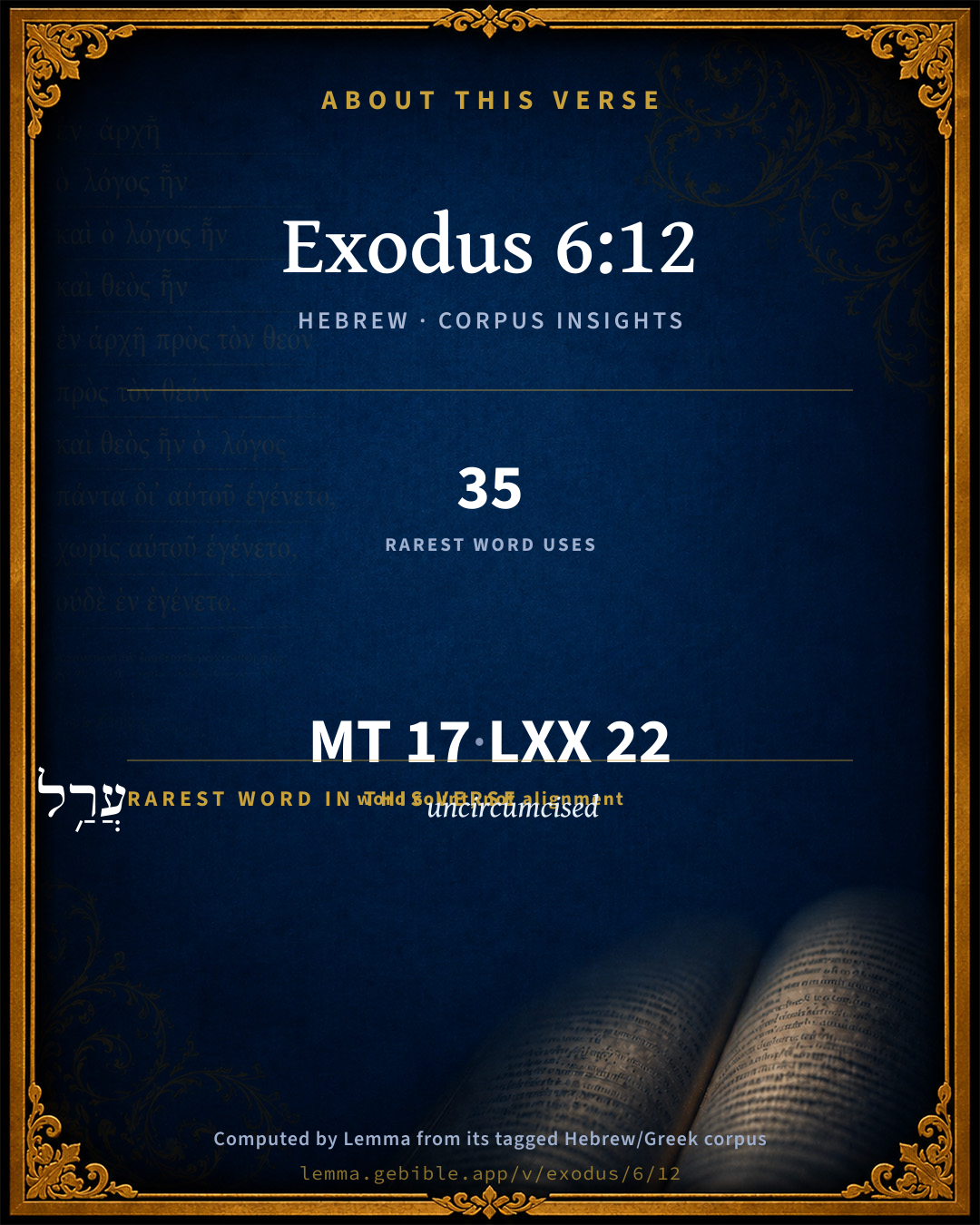
עֲרַ֥ל
ʻârêl
H6189
“uncircumcised of”
Adjective, Adjective, Masculine, Singular, Construct
Part of Speech
Adjective
Type
Adjective
Gender
Masculine
Number
Singular
State
Construct
Full BDB Definition

Origin: from H6188

TWOT: 1695b

uncircumcised, having foreskin
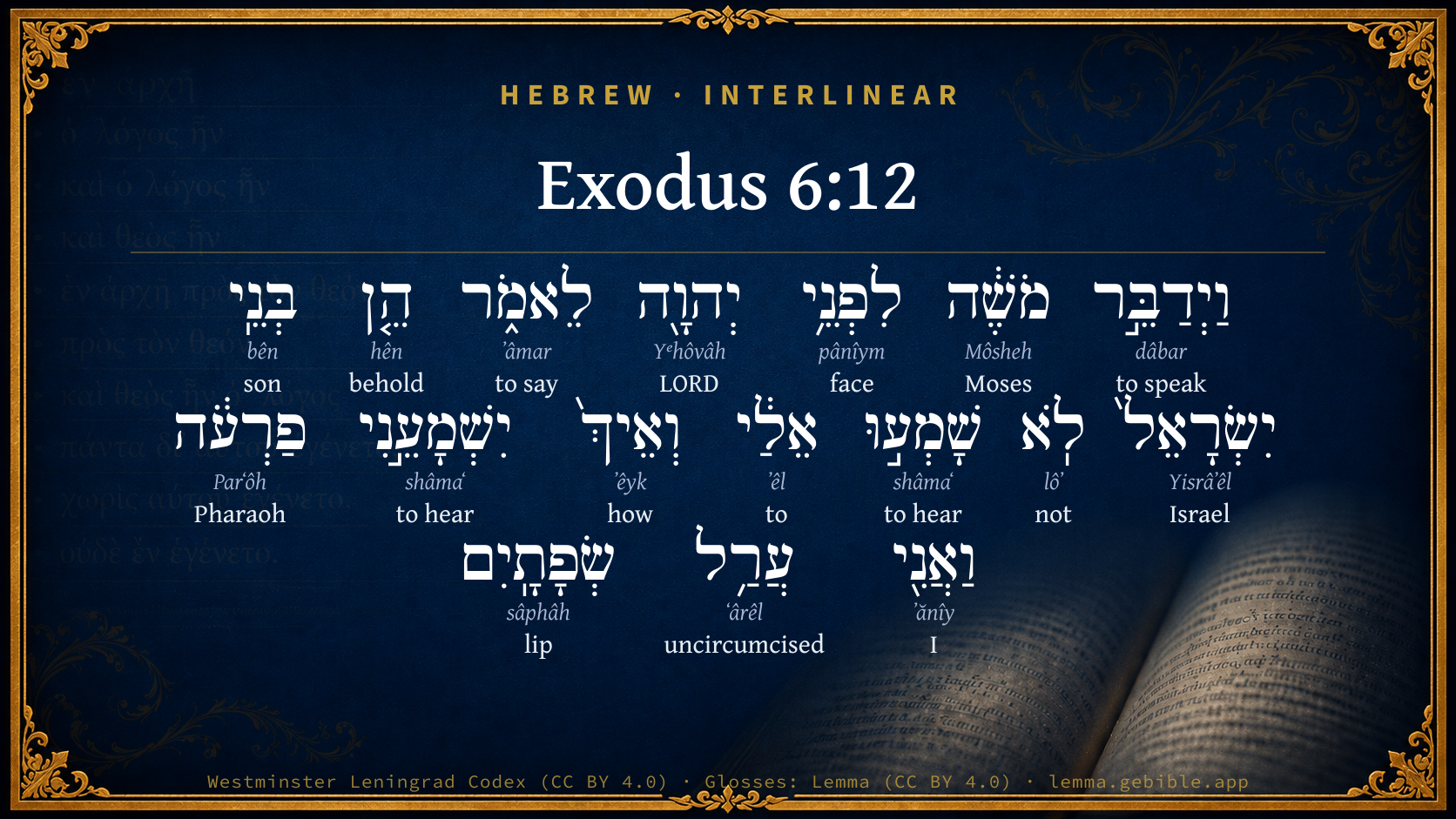
  1. וַיְדַבֵּ֣ר dâbar H1696 “and · to speak” Conjunction + Verb, Piel, Sequential Imperfect, 3rd Person, Masculine, Singular
  2. מֹשֶׁ֔ה Môsheh H4872 “Moses” Noun, Proper
  3. לִפְנֵ֥י pânîym H6440 “to/for · face(s) of” Preposition + Noun, Common, Both, Plural, Construct
  4. יְהוָ֖ה Yᵉhôvâh H3068 “LORD” Noun, Proper
  5. לֵאמֹ֑ר ʼâmar H559 “to say” Preposition + Verb, Qal, Infinitive Construct
  6. הֵ֤ן hên H2005 “behold” Particle, Demonstrative
  7. בְּנֵֽי bên H1121 “sons of” Noun, Common, Masculine, Plural, Construct
  8. יִשְׂרָאֵל֙ Yisrâʼêl H3478 “Israel” Noun, Proper
  9. לֹֽא lôʼ H3808 “not” Particle, Negative
  10. שָׁמְע֣וּ shâmaʻ H8085 “to hear” Verb, Qal, Perfect, 3rd Person, Common, Plural
  11. אֵלַ֔י ʼêl H413 “to · me” Preposition + Suffix, Personal, 1st Person, Common, Singular
  12. וְאֵיךְ֙ ʼêyk H349 “and · how” Conjunction + Particle, Interrogative
  13. יִשְׁמָעֵ֣נִי shâmaʻ H8085 “to hear · me” Verb, Qal, Imperfect, 3rd Person, Masculine, Singular + Suffix, Personal, 1st Person, Common, Singular
  14. פַרְעֹ֔ה Parʻôh H6547 “Pharaoh” Noun, Proper
  15. וַאֲנִ֖י ʼănîy H589 “and · I” Conjunction + Pronoun, Personal, 1st Person, Common, Singular
  16. שְׂפָתָֽיִם sâphâh H8193 “lips” Noun, Common, Feminine, Dual, Absolute

About this verse

These counts appear in no published source. They are computed here, from the morphology-tagged text and Lemma’s own curated glosses. What Lemma adds →

17
words
16
distinct lemmas
Pentateuch
section

Shared distinctive vocabulary

עֲרַ֥ל uncircumcised H6189 occurs in 32 verses of the Hebrew Bible. Also found in:

Grammatical profile

  • 4 verbs
  • 7 nouns
  • 1 adjective
  • 1 pronoun
  • 1 preposition
  • 3 particles

Verb forms

  • וַיְדַבֵּ֣ר Piel · Sequential Imperfect
  • לֵאמֹ֑ר Qal · Infinitive Construct
  • שָׁמְע֣וּ Qal · Perfect
  • יִשְׁמָעֵ֣נִי Qal · Imperfect

Repetition

A word recurs within this verse — often emphatic in Hebrew:

  • שָׁמְע֣וּ to hear H8085 ×2

Hebrew & Septuagint length

In English translation the verse runs 26 words from the Hebrew and 28 from the Septuagint (LXX English) — closely comparable.

A rough comparison of the two English renderings, which tokenize alike — not a word-level alignment.

Word counts can differ between the Hebrew and the Greek without any difference in meaning — e.g. the Hebrew direct-object marker אֵת has no separate Greek word, and Greek often adds the article ὁ.

In the original languages it is 17 Hebrew tokens and 22 Greek tokens — but the two are counted differently (Hebrew bundles its prefixes and suffixes into one token; the Greek is in lemma form), so that isn’t a like-for-like length.

Cross-references

13

Topical passages linked to Exodus 6:12 in the Treasury of Scripture Knowledge — connected by theme and wording, ordered by reader-vote popularity; previews shown in the World English Bible.

  • Exodus 4:10 Moses said to Yahweh, "Oh, Lord, I am not eloquent, neither before now, nor since you have spoken to your servant; for I am slow of speech, and of a slow tongue."
  • Exodus 6:30 Moses said before Yahweh, "Behold, I am of uncircumcised lips, and how shall Pharaoh listen to me?"
  • Jeremiah 1:6 Then said I, Ah, Lord Yahweh! behold, I don't know how to speak; for I am a child.
  • Jeremiah 6:10 To whom shall I speak and testify, that they may hear? behold, their ear is uncircumcised, and they can't listen: behold, the word of Yahweh is become to them a reproach; they have no delight in it.
  • Exodus 6:9 Moses spoke so to the children of Israel, but they didn't listen to Moses for anguish of spirit, and for cruel bondage.
  • Leviticus 26:41 I also walked contrary to them, and brought them into the land of their enemies: if then their uncircumcised heart is humbled, and they then accept the punishment of their iniquity;
  • Acts 7:51 "You stiff-necked and uncircumcised in heart and ears, you always resist the Holy Spirit! As your fathers did, so you do.
  • Exodus 3:13 Moses said to God, "Behold, when I come to the children of Israel, and tell them, 'The God of your fathers has sent me to you;' and they ask me, 'What is his name?' What should I tell them?"
  • Exodus 4:29–31 Moses and Aaron went and gathered together all the elders of the children of Israel.
  • Exodus 5:19–21 The officers of the children of Israel saw that they were in trouble, when it was said, "You shall not diminish anything from your daily quota of bricks!"
  • Deuteronomy 30:6 Yahweh your God will circumcise your heart, and the heart of your seed, to love Yahweh your God with all your heart, and with all your soul, that you may live.
  • Isaiah 6:5 Then I said, "Woe is me! For I am undone, because I am a man of unclean lips, and I dwell in the midst of a people of unclean lips: for my eyes have seen the King, Yahweh of Hosts!"
  • Jeremiah 9:26 Egypt, and Judah, and Edom, and the children of Ammon, and Moab, and all that have the corners [of their hair] cut off, who dwell in the wilderness; for all the nations are uncircumcised, and all the house of Israel are uncircumcised in heart.

Cross-references courtesy of OpenBible.info (CC BY 4.0).

Hebrew and Greek witnesses Masoretic Hebrew ↔ Greek Septuagint

The same verse in the two great witnesses to the Old Testament, shown verse-for-verse.

These are two independent witnesses, not word-aligned to each other, and the Septuagint is shown in lemma (dictionary) form.

Hebrew Exodus 6:12 Masoretic · Westminster Leningrad Codex

וַיְדַבֵּ֣ר מֹשֶׁ֔ה לִפְנֵ֥י יְהוָ֖ה לֵאמֹ֑ר הֵ֤ן בְּנֵֽי יִשְׂרָאֵל֙ לֹֽא שָׁמְע֣וּ אֵלַ֔י וְאֵיךְ֙ יִשְׁמָעֵ֣נִי פַרְעֹ֔ה וַאֲנִ֖י עֲרַ֥ל שְׂפָתָֽיִם

Moses spoke before Yahweh, saying, "Behold, the children of Israel haven't listened to me. How then shall Pharaoh listen to me, who am of uncircumcised lips?"

World English Bible · Public Domain

Greek LXX Exodus 6:12 Septuagint · lemma form

λαλέω δέ μωυσῆς ἔναντι κύριος λέγω ἰδού ὁ υἱός ἰσραήλ οὐ εἰςἀκούω ἐγώ καί πῶς εἰςἀκούω ἐγώ φαραώ ἐγώ δέ ἄλογος εἰμί

And Moses spoke before the Lord, saying, Behold, the children of Israel listened not to me, and how shall Pharao listen to me? and I am not eloquent.

LXX2012 (modern English Septuagint) · Public Domain

Hebrew: Westminster Leningrad Codex (CC BY 4.0). Greek: Septuagint (public domain); English from LXX2012 (modern English Septuagint) (Public Domain). How the Septuagint differs from the Hebrew →

Targum (Aramaic paraphrase)

2

The Targum is the ancient Jewish Aramaic paraphrase of the Hebrew Scriptures — an interpretive translation, not the Hebrew text itself. Onkelos (literal) and Pseudo-Jonathan (expansive) render the Torah, and Jonathan the Prophets. Coverage is partial: where no permissively-licensed English translation exists for a verse, only the Aramaic is shown. This is verse-level text, not a word-by-word alignment to the Hebrew.

  1. Targum Onkelos Torah (Genesis–Deuteronomy)
    וּמַלִיל משֶׁה קֳדָם יְיָ לְמֵימָר הָא בְנֵי יִשְׂרָאֵל לָא קַבִּילוּ מִנִי וְאֵכְדֵין יְקַבֵּל מִנִי פַרְעֹה וַאֲנָא יַקִיר מַמְלָל:

    (no public-domain English translation for this verse)

    Targum Onkelos — Aramaic: “Onkelos Genesis” (public domain); “Onkelos Exodus” (public domain); “Onkelos Leviticus” (public domain); “Onkelos Numbers” (public domain); “Onkelos Deuteronomy” (public domain). English: “Sefaria Community Translation” (CC0 1.0 (public-domain dedication)); “J.W. Etheridge. The Targums of Onkelos and Jonathan Ben Uzziel on the Pentateuch. London: Longmans, Green, 1862” (public domain). Text via Sefaria.

  2. Targum Pseudo-Jonathan Torah (Genesis–Deuteronomy)
    וּמַלֵיל משֶׁה קֳדָם יְיָ לְמֵימָר הָא בְּנֵי יִשְרָאֵל לָא קַבִּילוּ מִינִי וְהֵיכְדֵין יְקַבֵּיל מִינִי פַּרְעה וַאֲנָא קְשֵׁי מַמְלֵיל

    And Mosheh said before the Lord, Behold, the sons of Israel do not hearken to me; how then will Pharoh hearken to me, and I a man difficult of speech?

    Targum Pseudo-Jonathan — Aramaic: “Targum Jonathan on Genesis” (public domain); “Targum Jonathan on Exodus” (public domain); “Targum Jonathan on Leviticus” (public domain); “Targum Jonathan on Numbers” (public domain); “Targum Jonathan on Deuteronomy” (public domain). English: “The Targum of Jonathan ben Uzziel, trans. J. W. Etheridge, London, 1862” (public domain). Text via Sefaria.

Commentary

Notes on Exodus 6:12 from classic Christian and Jewish commentators (each source and its license shown beneath its notes). The classic Christian expositions comment on the surrounding passage and are grouped to its opening verse, so a note may address several verses; the Jewish commentaries on the Tanakh (Rashi and others) are per-verse, so they appear only where the commentator wrote on this verse.

Lemma curates 59 commentaries, every one of them public domain or Creative Commons licensed, each selected and text-cleaned for this edition rather than reprinted as found. About our sources →

Joseph Benson's Commentary

Exo 6:12-13. Behold, the children of Israel have not hearkened to me — They gave no heed to what I have said; how then shall Pharaoh hear me? — If the anguish of their spirit makes them deaf to that which would compose and comfort them, much more will his pride and insolence make him deaf to that which will but exasperate him. Who am of uncircumcised lips — He was conscious to himself that he had not the gift of utterance. The Lord gave them a charge to the children of Israel and to Pharaoh — God’s authority is sufficient to answer all objections, and binds us to obedience without murmuring or disputing.

Joseph Benson's Commentary on the Old and New Testaments (1811–1818) — public domain. Text from a community e-Sword module.

Geneva Bible (1599)

Geneva Bible translators

Or barbarous and rude in speech: and by this word (uncircumcised) is signified the whole corruption of man’s nature.

Geneva Bible (1599) marginal notes — public domain. Text via Bolls.life.

Jamieson, Fausset & Brown

Robert Jamieson, A. R. Fausset & David Brown

how then shall . . . who am of uncircumcised lips?--A metaphorical expression among the Hebrews, who, taught to look on the circumcision of any part as denoting perfection, signified its deficiency or unsuitableness by uncircumcision. The words here express how painfully Moses felt his want of utterance or persuasive oratory. He seems to have fallen into the same deep despondency as his brethren, and to be shrinking with nervous timidity from a difficult, if not desperate, cause. If he had succeeded so ill with the people, whose dearest interests were all involved, what better hope could he entertain of his making more impression on the heart of a king elated with pride and strong in the possession of absolute power? How strikingly was the indulgent forbearance of God displayed towards His people amid all their backwardness to hail His announcement of approaching deliverance! No perverse complaints or careless indifference on their part retarded the development of His gracious purposes. On the contrary, here, as generally, the course of His providence is slow in the infliction of judgments, while it moves more quickly, as it were, when misery is to be relieved or benefits conferred.

Jamieson, Fausset & Brown — Commentary Critical and Explanatory on the Whole Bible (1871) — public domain (CC PDM 1.0). Text via the HelloAO Bible API.

Adam Clarke's Commentary

Verse 12. Uncircumcised lips?] The word ערל aral, which we translate uncircumcised, seems to signify any thing exuberant or superfluous. Had not Moses been remarkable for his excellent beauty, I should have thought the passage might be rendered protuberant lips; but as this sense cannot be admitted for the above reason, the word must refer to some natural impediment in his speech; and probably means a want of distinct and ready utterance, either occasioned by some defect in the organs of speech, or impaired knowledge of the Egyptian language after an absence of forty years. See Clarke on Ex 4:10.

Adam Clarke's Commentary on the Bible (1810–1826) — public domain. Text from a community e-Sword/MySword module.

Ellicott's Commentary for English Readers

(12) How then shall Pharaoh hear me?—This time the objection comes from Moses. His double rejection, by Pharaoh (Exo_5:1-4) and by Israel (Exo_6:9), had thrown him back into utter despondency. All that diffidence and distrust of himself which he had shown in his earlier communications with Jehovah (Exo_3:11; Exo_4:1; Exo_4:10; Exo_4:13) revived, and he despaired of success in his mission. Was it of any use his making a second appeal to the foreign monarch when he had failed with his own countrymen?

Uncircumcised lips.—Rosenmüller argues from this expression that Moses was “tongue-tied;” but it is not clear that more is meant here than in Exo_4:10, where Moses says that Hebrews 13 “slow of speech and of a slow tongue.” He had some difficulty of utterance; but whether or not it was a physical impediment remains uncertain. “Uncircumcised” is used, according to the Hebrew idiom, for any imperfection which interferes with efficiency. An “uncircumcised ear,” is explained in Jeremiah 6 to be an ear that “cannot hearken;” and an “uncircumcised heart: (Lev. xxvi 41) is a heart that fails to understand.

A Bible Commentary for English Readers, edited by Charles John Ellicott (1878–1897) — public domain. Text from a community e-Sword module.

The Cambridge Bible for Schools and Colleges

gen. ed. J. J. S. Perowne

12. In Exo_4:10 (J) Moses urges his inability to persuade the people; here he urges that the Pharaoh is not likely to listen to him.

of uncircumcised lips] i.e. lips closed in, which open and speak with difficulty. Cf. the same expression of the heart, when it is (in a figurative sense) closed in, and so impervious to good impressions (Lev_26:41, Jer_9:26, Eze_44:7; Eze_44:9), and of the ear, when it is, metaphorically, in a similar condition, and hears imperfectly (Jer_6:10). In substance, the meaning is the same as that of J’s ‘slow’ (lit. ‘heavy’) of mouth and tongue (Exo_4:10 b).

The answer to v. 12 does not follow till Exo_7:1, where the way is prepared for it by the repetition in substance of vv. 10–12 in vv. 28–30.

The Cambridge Bible for Schools and Colleges (gen. ed. J. J. S. Perowne; Cambridge University Press, 1878–1918) — public domain. Text from a community e-Sword module.

John Gill's Exposition

And the Lord spake unto Moses and unto Aaron,.... No notice is taken of the objection of Moses, having been sufficiently answered before, and Aaron is joined with him in the following charge:

and gave them a charge unto the children of Israel, and unto Pharaoh king of Egypt; that is, to go to the children of Israel and comfort them, and direct them what they should do, and how they should behave under their present circumstances; assuring them of deliverance, and to go to Pharaoh, and to make a fresh demand upon him to let Israel go; and in this work they had a solemn charge from God to continue, and not to desist from it, until they had finished it:

to bring the children of Israel out of the land of Egypt; which they were to be the instruments of: and that it might be known clearly from whom they descended, who had such a charge given them, and such honour put upon them, the following genealogy is recorded.

John Gill's Exposition of the Whole Bible (1746–1763) — public domain (CC PDM 1.0). Text via the HelloAO Bible API.

Albert Barnes' Notes on the Bible

Uncircumcised lips - An uncircumcised ear is one that does not hear clearly; an uncircumcised heart one slow to receive and understand warnings; uncircumcised lips, such as cannot speak fluently. The recurrence of the hesitation of Moses is natural; great as was the former trial this was far more severe; yet his words always imply fear of failure, not of personal danger (see Exo 3:11).

Albert Barnes' Notes on the Bible (1834–1885) — public domain. Text from a community e-Sword/MySword module.

Haydock's Catholic Bible Commentary

Uncircumcised lips. So he calls the defect he had in his words, or utterance. (Challoner) --- The Hebrews call the heart, &c., uncircumcised, when it has any natural or moral defect, Acts vii. 15. (Tirinus) --- "I do not speak the language in its purity." Sym.[Symmachus?], "I express my sentiments with difficulty," chap. iv. 10. (Onkelos.)

George Leo Haydock (1774–1849), Haydock's Catholic Family Bible and Commentary, 1859 edition — public domain. Excludes Psalms (Douay-Rheims chapter numbering differs from Protestant) and Deuterocanonical books (Catholic canon only).

Matthew Poole's English Annotations

i.e. Of polluted lips. Uncircumcision being a great defect and blemish, whereby men were rendered profane, contemptible, and unfit for many services and privileges, may note any defect, whether moral, and of the spirit, or natural, and of the body. So here it notes Moses’s inability to clothe God’s commands in such words as might prevail with Pharaoh. But this was a great weakness of faith, as if God could not effect his purpose, because the instrument was unfit.

Matthew Poole's English Annotations on the Holy Bible (1683–1685) — public domain. Text from a community e-Sword/MySword module.

The Pulpit Commentary

Uncircumcised lips, i.e. "lips inefficient for the purpose for which lips are given;" as "uncircumcised ears" are ears that cannot hearken, (Jer_6:10) and an "uncircumcised heart" a heart that cannot understand. (Jer_9:26) The meaning is the same as in Exo_4:10, where Moses says that he is "slow of speech and of a slow tongue." Nothing can be determined from the expression as to the exact cause of the imperfection of which complaint is made.

The Pulpit Commentary (1880–1919), ed. H.D.M. Spence-Jones & Joseph S. Exell — public domain. Text from a community e-Sword module.

John Wesley's Explanatory Notes

Behold, the children of Israel have not hearkened to me; they gave no heed to what I have said, how then shall Pharaoh hear me? - If the anguish of their spirit makes them deaf to that which would compose and comfort them, much more will his pride and insolence, make him deaf to that which will but exasperate him. Who am of uncircumcised lips - He was conscious to himself that he had not the gift of utterance.

John Wesley, Explanatory Notes Upon the Whole Bible (1754–1765) — public domain. Text via the GEBible commentary corpus.

Rashi

Rabbi Shlomo Yitzchaki (Rashi)

ואיך ישמעני פרעה HOW THAN SHALL PHARAOH HEAR ME? — This is one of the ten inferences from minor to major which are found in the Bible (Genesis Rabbah 92:7).

ערל שפתים OF UNCIRCUMCISED LIPS — It really means obstructed as regards the lips. So, too, in respect to all forms derived from ערל I say that they signify obstructed. E. g. (Jeremiah 6:10) “their ear is עֲרֵלָה — stopped up so that it will not hear; (Jeremiah 9:25) “עַרְלִי in heart” — their hearts are closed so that they will not understand; (Habakkuk 2:16) “Drink thou, also וְהֵעָרֵל” — and become thou closed up (in thy senses) through intoxication caused by the cup of curse mentioned in that passage; the foreskin (ערלה) of the flesh is so called because the membrum is closed up and covered by it; (Leviticus 19:23) וערלתם ערלתו signifies, make for it (the tree) a closure (אוטם) and cover by means of an inhibition that will prove a barrier against eating it; (Leviticus 19:23 “Three years shall it be to you as ערלים” — it shall be closed up and covered and barred so that it many not be eaten.

Rashi on the Tanakh — English translations: “The Judaica Press complete Tanach with Rashi, translated by A. J. Rosenberg” (CC BY 4.0); “Pentateuch with Rashi's commentary by M. Rosenbaum and A.M. Silbermann, 1929-1934” (public domain); “The Metsudah Tanach series, Lakewood, N.J” (CC BY 4.0); and “The Book of Joshua, Metsudah Publications, 1997” (CC BY 4.0). Text via Sefaria.

Ramban (Nachmanides)

Rabbi Moshe ben Nachman (Ramban / Nachmanides)

BEHOLD, THE CHILDREN OF ISRAEL HAVE NOT HEARKENED UNTO ME because You have done nothing [for Israel] so that my words should be acceptable to them. AND HOW THEN SHALL PHARAOH HEAR ME? AND besides, I AM OF UNCIRCUMCISED LIPS, and I am not fit to speak before a great king.It is possible to explain that Moses thought that due to his deficiency — for he was of uncircumcised lips — the children of Israel would not hearken to him, for he could not frame [words] to speak kindly to them, words of good cheer and comfort, and all the more how could he speak to Pharaoh?Now the reason that Moses again broached this argument [of his speech-impediment, when he had already mentioned it above in Chapter 4, Verse 10], is that G-d did not originally command him that he was to speak before Pharaoh. He merely said, And thou shalt come, thou and the elders of Israel, unto the king of Egypt, and ye shall say unto him. In that case it was possible that the elders should speak [before Pharaoh] and Moses would remain silent. Then Moses said that he was ashamed even to speak to the people, saying, I am not a man of words., 4:10. Whereupon the Holy One, blessed be He, answered him, And he [Aaron] shall be thy spokesman unto the people., Verse 16. And so indeed Moses and Aaron did when they first came to the people, as it is said, And Aaron spoke all the words which the Eternal had spoken unto Moses, and did the signs in the sight of the people., Verse 30. But now Moses himself was commanded, Wherefore say unto the children of Israel: I am the Eternal, and he did speak to them as He commanded him, but they did not hearken to him. Now when He again commanded Moses to speak to Pharaoh, Moses said, “How can I speak to him, I who am of uncircumcised lips.” Then the Holy One, blessed be He, associated Aaron with him, and gave both of them a charge unto the children of Israel, that they should say to them whatever He will command them, and unto Pharaoh to bring them forth out of his land. Now Rashi commented: “[And He gave them a charge unto the children of Israel, and unto Pharaoh, king of Egypt]. That is to say, He gave them a command with regard to the children of Israel and His mission on which He had sent them to Pharaoh.” But there is no need for this.

Ramban (Nachmanides) on the Tanakh — English translation: “Commentary on the Torah by Ramban (Nachmanides). Translated and annotated by Charles B. Chavel. New York, Shilo Pub. House, 1971-1976” (CC BY 4.0). Text via Sefaria.

Lesson kit

Teaching starters — assembled from the data on this page, not authored interpretation. Every prompt links to the verse data it draws on. Edit before teaching.

Exodus, in the Pentateuch, opens this verse with 17 words (16 distinct Hebrew lemmas). Its most distinctive word is ʻârêl (“uncircumcised”). A historical commentator’s framing appears above. Read the whole chapter for the surrounding context.

Discussion questions

  1. The word ʻârêl carries the sense “uncircumcised.” How does it shape the verse?
  2. How does Genesis 17:14, which shares the word «uncircumcised», read alongside this verse?
  3. What does the repetition of “to hear” (2× in this one verse) do in this verse?
  4. The translations on this page render this verse differently — a whole-verse word diff, not a word-by-word alignment. What might account for the different wordings?
  5. «וַיְדַבֵּ֣ר» is a Piel Sequential Imperfect verb. How does that grammatical form shape the action described?
  6. Compare how Joseph Benson's Commentary and Geneva Bible (1599) read this verse. Where do they agree or differ?

Things to notice

Reading settings

Reading text

Shown beneath each verse's original-language words.

Old Testament
Old Testament edition

Read the OT as the Masoretic Hebrew (MT) or the Greek Septuagint (LXX).

English shown for the Greek Septuagint (in the Hebrew ↔ Greek comparison).

Comparing translations? Open the Compare panel on any verse page to stack up to four side by side.