Ecclesiastes 2:18

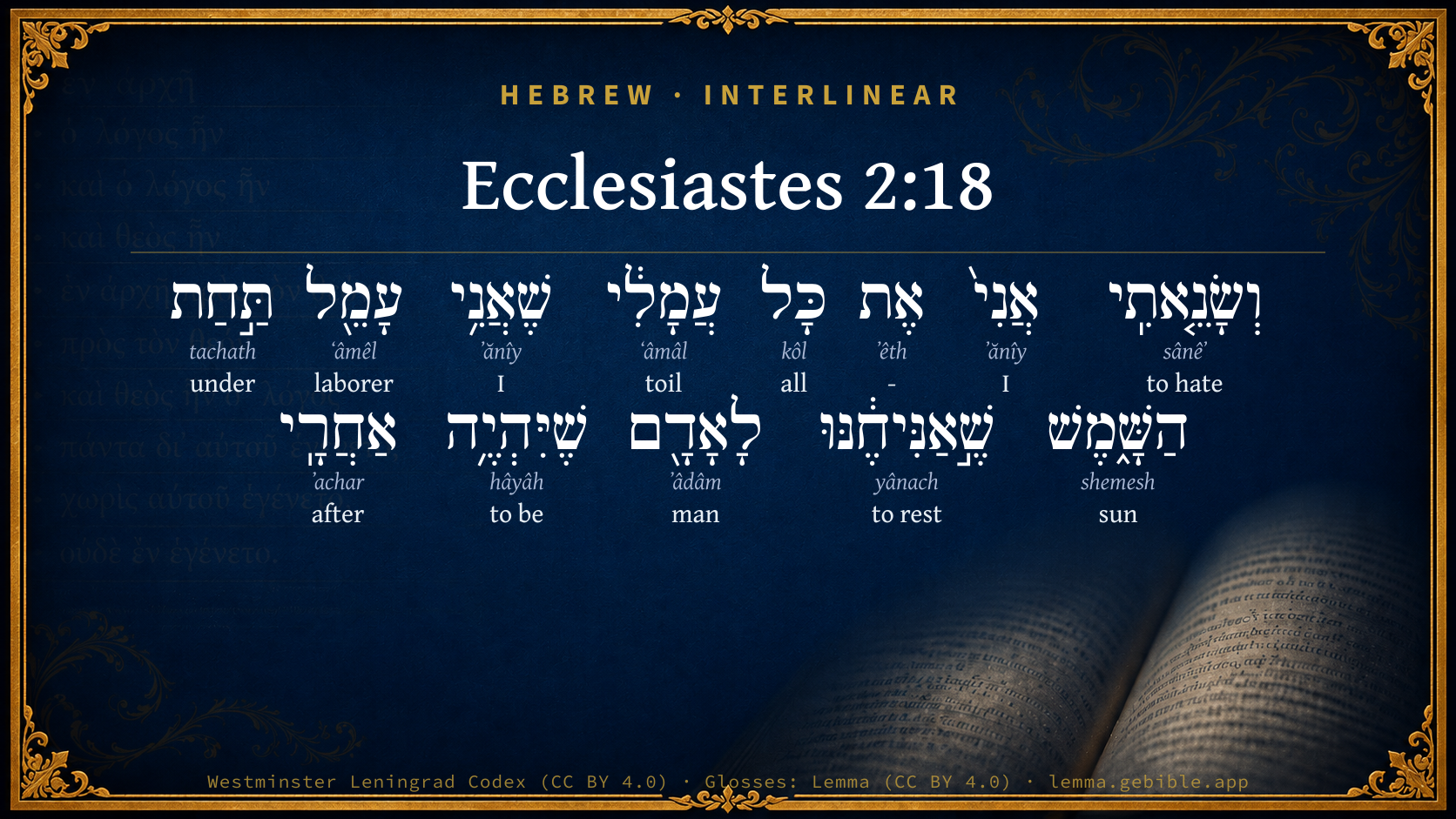
Hebrew (Westminster Leningrad Codex) Ecclesiastes 2:18 appears in the Hebrew Old Testament. The text above is from the Westminster Leningrad Codex. Each word links to its Strong’s number, a concise gloss, and parsing drawn from the Open Scriptures Hebrew Bible morphology. Click any word for its full Brown-Driver-Briggs (BDB) entry.
Download image
Cite this verse

Ecclesiastes 2:18 (World English Bible). Public Domain. Lemma interlinear Bible study tool, https://lemma.gebible.app/v/ecclesiastes/2/18.

Show BibTeX & RIS
BibTeX
RIS
English Translation
I hated all my labor in which I labored under the sun, seeing that I must leave it to the man who comes after me.
World English Bible · Public Domain
Download a study sheet

One document with this verse’s original text, its word-by-word gloss line, the meaning frame, cross-references with their text, attributed commentary, and full source and license credits — printable, and it pastes into notes with its structure intact.

This verse Autodidact and up

Study sheet (.html) Plain text (.txt)

A passage Seminary Student

Up to 50 verses in one chapter. A passage sheet keeps up to 6 commentary sources and 12 cross-references per verse, in the order this page ranks them, and says so on the sheet whenever that leaves anything out. Ask for a single verse and you get the Autodidact verse sheet above.

Everything on this page stays free to read, with no account — the sheet is a download of what is already on screen, not access to it.

Want to remove ads? Support Godless Engineer
Compare translations 3

The same verse in 3 English versions, stacked beneath the original-language interlinear above. Click any original word for its lexicon entry.

Each is an independent rendering of the whole verse — the interlinear is not word-aligned to these translations.

Highlighted words mark where these versions differ — a whole-verse word diff, not a word-by-word alignment.

  • World English Bible Public Domain
    I hated all my labor in which I labored under the sun, seeing that I must leave it to the man who comes after me.
  • King James Version Public Domain
    Yea, I hated all my labour which I had taken under the sun: because I should leave it unto the man that shall be after me.
  • unfoldingWord Literal Text CC BY-SA 4.0
    And I hated, I, all my toil that I had toiled under the sun, that I will leave it to the person who will be after me.

unfoldingWord Literal Text — © unfoldingWord, licensed CC BY-SA 4.0. Word-aligned USFM3 via Door43 (git.door43.org/unfoldingWord/en_ult).

Versions to compare (up to 4)

3 of 4 selected

Show all 18 translations

Every available English version of this verse, each an independent rendering of the whole verse.

  • World English Bible Public Domain
    I hated all my labor in which I labored under the sun, seeing that I must leave it to the man who comes after me.
  • Berean Standard Bible Public Domain
    I hated all for which I had toiled under the sun, because I must leave it to the man who comes after me.
  • Majority Standard Bible Public Domain
    I hated all for which I had toiled under the sun, because I must leave it to the man who comes after me.
  • King James Version Public Domain
    Yea, I hated all my labour which I had taken under the sun: because I should leave it unto the man that shall be after me.
  • American Standard Version (1901) Public Domain
    And I hated all my labor wherein I labored under the sun, seeing that I must leave it unto the man that shall be after me.
  • Revised Version (1885) Public Domain
    And I hated all my labour wherein I laboured under the sun: seeing that I must leave it unto the man that shall be after me.
  • Geneva Bible (1599) Public Domain
    I hated also all my labour, wherein I had trauailed vnder the sunne, which I shall leaue to the man that shalbe after me.
  • Douay-Rheims (1899) Public Domain
    Again I hated all my application wherewith I had earnestly laboured under the sun, being like to have an heir after me,
  • Young's Literal Translation Public Domain
    And I have hated all my labour that I labour at under the sun, because I leave it to a man who is after me.
  • Literal Standard Version CC BY-SA 4.0
    And I have hated all my labor that I labor at under the sun, because I leave it to a man who is after me.
  • Unlocked Literal Bible CC BY-SA 4.0
    I hated all my accomplishments for which I had worked under the sun because I must leave them behind to the man who comes after me.
  • unfoldingWord Literal Text CC BY-SA 4.0
    And I hated, I, all my toil that I had toiled under the sun, that I will leave it to the person who will be after me.
  • Darby Bible Public Domain
    And I hated all my labour wherewith I had been toiling under the sun, because I should leave it unto the man that shall be after me.
  • World Messianic Bible Public Domain
    I hated all my labor in which I labored under the sun, because I must leave it to the man who comes after me.
  • Webster's Bible Public Domain
    Yes, I hated all my labor which I had taken under the sun: because I should leave it to the man that shall be after me.
  • Free Bible Version CC BY-SA 4.0
    I even ended up hating what I had achieved here on earth because I have to hand it over to whoever comes after me.
  • Bible in Basic English Public Domain
    Hate had I for all my work which I had done, because the man who comes after me will have its fruits.
  • JPS Tanakh (1917) Public Domain
    And I hated all my labour wherein I laboured under the sun, seeing that I must leave it unto the man that shall be after me.

Literal Standard Version (2020), Covenant Press — licensed CC BY-SA 4.0. Text via the HelloAO Bible API (eBible.org). Unlocked Literal Bible (unfoldingWord) — licensed CC BY-SA 4.0. Text via the HelloAO Bible API (eBible.org). unfoldingWord Literal Text — © unfoldingWord, licensed CC BY-SA 4.0. Word-aligned USFM3 via Door43 (git.door43.org/unfoldingWord/en_ult). Free Bible Version, Dr. Jonathan Gallagher — licensed CC BY-SA 4.0. Text via the HelloAO Bible API (eBible.org).

Word by word

More ways to search: Search by grammar → Find every occurrence → Compare this word →

Practice this passage: Drill this verse → Learn its vocabulary →

עָמֵ֖ל
ʻâmêl
H6001
“laborer”
Adjective, Adjective, Masculine, Singular, Absolute
Part of Speech
Adjective
Type
Adjective
Gender
Masculine
Number
Singular
State
Absolute
Full BDB Definition

Origin: from H5998

TWOT: 1639b , 1639c

labourer, sufferer, wretched one (noun masculine) - labourer, workman - sufferer - toiling (adjectival verb)
  1. וְשָׂנֵ֤אתִֽי sânêʼ H8130 “and · to hate” Conjunction + Verb, Qal, Perfect, 1st Person, Common, Singular
  2. אֲנִי֙ ʼănîy H589 “I” Pronoun, Personal, 1st Person, Common, Singular
  3. אֶת ʼêth H853 “-” Particle, Direct Object
  4. כָּל kôl H3605 “all of” Noun, Common, Masculine, Singular, Construct
  5. עֲמָלִ֔י ʻâmâl H5999 “toil · my” Noun, Common, Both, Singular, Construct + Suffix, Personal, 1st Person, Common, Singular
  6. שֶׁאֲנִ֥י ʼănîy H589 “who/which · I” Particle, Relative + Pronoun, Personal, 1st Person, Common, Singular
  7. תַּ֣חַת tachath H8478 “under” Preposition
  8. הַשָּׁ֑מֶשׁ shemesh H8121 “the · sun” Particle, Definite Article + Noun, Common, Both, Singular, Absolute
  9. שֶׁ֣אַנִּיחֶ֔נּוּ yânach H3240 “who/which · to rest · him” Particle, Relative + Verb, Hiphil, Imperfect, 1st Person, Common, Singular + Suffix, Personal, 3rd Person, Masculine, Singular
  10. לָאָדָ֖ם ʼâdâm H120 “to/for the · man” Preposition, Determined + Noun, Common, Masculine, Singular, Absolute
  11. שֶׁיִּהְיֶ֥ה hâyâh H1961 “who/which · to be” Particle, Relative + Verb, Qal, Imperfect, 3rd Person, Masculine, Singular
  12. אַחֲרָֽי ʼachar H310 “after · me” Preposition + Suffix, Personal, 1st Person, Common, Singular

About this verse

These counts appear in no published source. They are computed here, from the morphology-tagged text and Lemma’s own curated glosses. What Lemma adds →

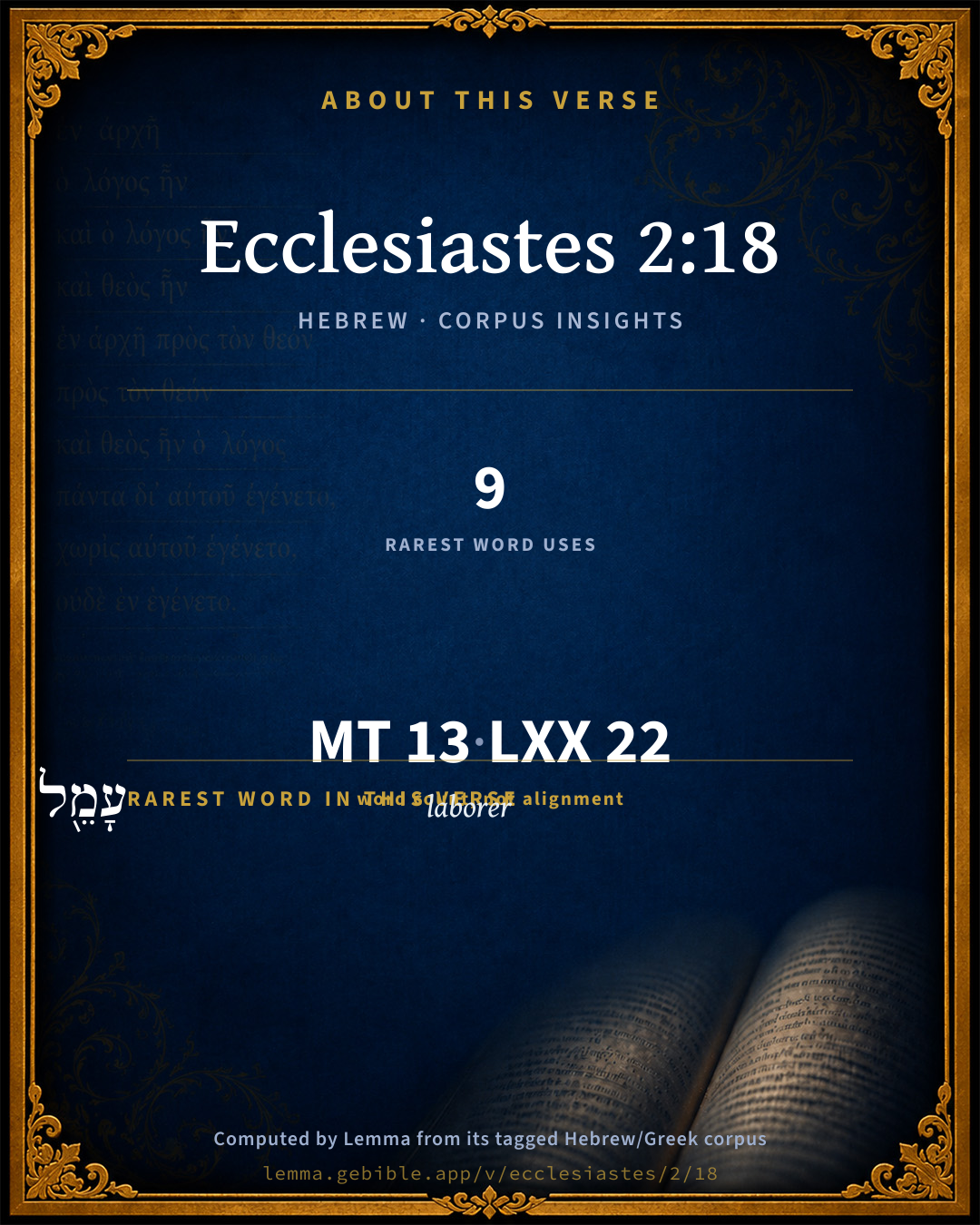
13
words
12
distinct lemmas
Wisdom
section

Notable vocabulary

The rarest word here is עָמֵ֖ל laborer H6001 — appearing just 9 times in the whole Hebrew Bible.

Shared distinctive vocabulary

עָמֵ֖ל laborer H6001 occurs in 9 verses of the Hebrew Bible. Also found in:

Grammatical profile

  • 3 verbs
  • 4 nouns
  • 1 adjective
  • 2 pronouns
  • 2 prepositions
  • 1 particle

Verb forms

  • וְשָׂנֵ֤אתִֽי Qal · Perfect
  • שֶׁ֣אַנִּיחֶ֔נּוּ Hiphil · Imperfect
  • שֶׁיִּהְיֶ֥ה Qal · Imperfect

Repetition

A word recurs within this verse — often emphatic in Hebrew:

  • אֲנִי֙ I H589 ×2

Hebrew & Septuagint length

In English translation the verse runs 25 words from the Hebrew and 27 from the Septuagint (LXX English) — closely comparable.

A rough comparison of the two English renderings, which tokenize alike — not a word-level alignment.

Word counts can differ between the Hebrew and the Greek without any difference in meaning — e.g. the Hebrew direct-object marker אֵת has no separate Greek word, and Greek often adds the article ὁ.

In the original languages it is 13 Hebrew tokens and 22 Greek tokens — but the two are counted differently (Hebrew bundles its prefixes and suffixes into one token; the Greek is in lemma form), so that isn’t a like-for-like length.

Cross-references

16

Topical passages linked to Ecclesiastes 2:18 in the Treasury of Scripture Knowledge — connected by theme and wording, ordered by reader-vote popularity; previews shown in the World English Bible.

  • Psalms 39:6 "Surely every man walks like a shadow. Surely they busy themselves in vain. He heaps up, and doesn't know who shall gather.
  • Psalms 49:10 For he sees that wise men die; Likewise the fool and the senseless perish, And leave their wealth to others.
  • Luke 16:27–28 "He said, 'I ask you therefore, father, that you would send him to my father's house;
  • 1 Kings 11:11–13 Therefore Yahweh said to Solomon, Because this is done of you, and you have not kept my covenant and my statutes, which I have commanded you, I will surely tear the kingdom from you, and will give it to your servant.
  • Psalms 17:14 From men by your hand, Yahweh, From men of the world, whose portion is in this life. You fill the belly of your cherished ones. Your sons have plenty, And they store up wealth for their children.
  • Ecclesiastes 1:3 What does man gain from all his labor in which he labors under the sun?
  • Ecclesiastes 1:13 I applied my heart to seek and to search out by wisdom concerning all that is done under the sky. It is a heavy burden that God has given to the sons of men to be afflicted with.
  • Ecclesiastes 2:4–9 I made myself great works. I built myself houses. I planted myself vineyards.
  • Ecclesiastes 2:26 For to the man who pleases him, God gives wisdom, knowledge, and joy; but to the sinner he gives travail, to gather and to heap up, that he may give to him who pleases God. This also is vanity and a chasing after wind.
  • Ecclesiastes 4:3 Yes, better than them both is him who has not yet been, who has not seen the evil work that is done under the sun.
  • Ecclesiastes 5:13–14 There is a grievous evil which I have seen under the sun: wealth kept by its owner to his harm.
  • Ecclesiastes 5:18 Behold, that which I have seen to be good and proper is for one to eat and to drink, and to enjoy good in all his labor, in which he labors under the sun, all the days of his life which God has given him; for this is his portion.
  • Ecclesiastes 9:9 Live joyfully with the wife whom you love all the days of your life of vanity, which he has given you under the sun, all your days of vanity: for that is your portion in life, and in your labor in which you labor under the sun.
  • Luke 12:20 "But God said to him, 'You foolish one, tonight your soul is required of you. The things which you have prepared--whose will they be?'
  • Acts 20:29–30 For I know that after my departure, vicious wolves will enter in among you, not sparing the flock.
  • 1 Corinthians 3:10 According to the grace of God which was given to me, as a wise master builder I laid a foundation, and another builds on it. But let each man be careful how he builds on it.

Cross-references courtesy of OpenBible.info (CC BY 4.0).

Hebrew and Greek witnesses Masoretic Hebrew ↔ Greek Septuagint

The same verse in the two great witnesses to the Old Testament, shown verse-for-verse.

These are two independent witnesses, not word-aligned to each other, and the Septuagint is shown in lemma (dictionary) form.

Hebrew Ecclesiastes 2:18 Masoretic · Westminster Leningrad Codex

וְשָׂנֵ֤אתִֽי אֲנִי֙ אֶת כָּל עֲמָלִ֔י שֶׁאֲנִ֥י עָמֵ֖ל תַּ֣חַת הַשָּׁ֑מֶשׁ שֶׁ֣אַנִּיחֶ֔נּוּ לָאָדָ֖ם שֶׁיִּהְיֶ֥ה אַחֲרָֽי

I hated all my labor in which I labored under the sun, seeing that I must leave it to the man who comes after me.

World English Bible · Public Domain

Greek LXX Ecclesiastes 2:18 Septuagint · lemma form

καί μισέω ἐγώ σύν πᾶς μόχθος ἐγώ ὅς ἐγώ μοχθέω ὑπό ὁ ἥλιος ὅτι ἀποἵημι αὐτός ὁ ἄνθρωπος ὁ γίγνομαι μετά ἐγώ

And I hated the whole of my labor which I took under the sun; because I must leave it to the man who will come after me.

LXX2012 (modern English Septuagint) · Public Domain

Hebrew: Westminster Leningrad Codex (CC BY 4.0). Greek: Septuagint (public domain); English from LXX2012 (modern English Septuagint) (Public Domain). How the Septuagint differs from the Hebrew →

Commentary

Notes on Ecclesiastes 2:18 from classic Christian and Jewish commentators (each source and its license shown beneath its notes). The classic Christian expositions comment on the surrounding passage and are grouped to its opening verse, so a note may address several verses; the Jewish commentaries on the Tanakh (Rashi and others) are per-verse, so they appear only where the commentator wrote on this verse.

Lemma curates 59 commentaries, every one of them public domain or Creative Commons licensed, each selected and text-cleaned for this edition rather than reprinted as found. About our sources →

Trapp's Complete Commentary

John Trapp

Ecc 2:18 Yea, I hated all my labour which I had taken under the sun: because I should leave it unto the man that shall be after me.

Ver. 18. Yea, I hated all my labour,] i.e., I was sorry to think that I had been so eager and earnest in getting a great estate, which now I must leave, and to whom I know not; sure I am to those that never took any pains for it. And herein we see the corruption of our nature discover itself, in that we are so wedded to the things of this world - especially if gotten by our own art and industry - that we think much to be divorced from them by death, and to leave them to others, when ourselves can enjoy them no longer. Henry Beaufort, that rich and wretched cardinal, bishop of Winchester, and chancellor of England, in the reign of Henry VI, when he perceived that he must die, and that there was no remedy, murmured at death, that his riches could not reprieve him till a further time. For he asked, ‘Why should I die, being so rich? If the whole realm would save my life, I am able either by policy to get it, or by riches to buy it. Fie, quoth he, will not death be hired? will money do nothing?’ {a}

Latimer, in a sermon before King Edward VI, tells a story of a rich man, that when he lay upon his sick bed, there came one to him and told him that certainly, by all reason they can judge by, he was like to be a man for another world, a dead man. As soon as ever he hears but these words, saith Latimer; What! must I die? said he. Send for a physician; wounds, sides, heart, must I die? wounds, sides, heart, must I die? and thus he goes on, and there could be nothing got from him, but Wounds, sides, heart, must I die? Must I die and go from these? Here was all, here is the end of a man that made his portion to be in this world. If this man’s heart had been ripped up after he was dead, there might have been found written in it, ‘The god of this present world.’

Mr Jeremy Burroughs relates in print {b} of another rich man, that had sometime lived near unto him, who, when he heard his sickness was deadly, sent for his bags of money, and hugged them in his arms, saying, Oh! must I leave you? Oh! must I leave you? And of another, who, when he lay upon his sick bed, called for his bags, and laid a bag of gold to his heart, and then bade them take it away, It will not do, it will not do.

Mr Rogers in his "Treatise of Love," tells of one that, being near death, clapped a twenty shillings piece of gold into his own mouth, saying, Some wiser than some, I will take this with me howsoever.

{a} Acts and Mon., fol. 925.

{b} Serm. on Psa 17:14, April 3, 1643, before the Lord Mayor.

John Trapp, A Commentary or Exposition upon All the Books of the Old and New Testament (1647–1656) — public domain. Text from a community e-Sword module.

The Biblical Illustrator

Joseph S. Exell

Ecc_2:18-19

Yea, I hated all my labour which I had taken under the sun: because I should leave it unto the man that shall be after me.

The dirge of the dead hand

Solomons life was complete from the naturalistic standpoint. He sought pleasure with a zest we should condemn as licence nowadays, but which the spirit of those times was accustomed to count lawful, at least for kings. And more than that, he gave himself to great and imposing enterprises, diligently seeking the welfare of his people as well as his own personal and family aggrandizement. And yet work upon an unspiritual plane of ideas could not altogether satisfy him. He had an unhappy forecast of pending changes, for Rehoboam was not an ideal youth. He already seems to be hearing the cry, The king is dead: long live the king! And how sick at heart he feels as all the signs seem to show that the new king will be an iconoclast, a reactionary, a fool, or at least a man who does not think in the same groove as his predecessor! But this heartsick pessimism, like the same temper everywhere, was misjudging. That which was ignoble in his work perished, and deserved to perish. His heart-ache, as he thought of how much in the schemes he had tried to carry out would be altered by his successors, was relevant only to the lower ranges of his work. But the royal preacher was thinking not so much of his work as of himself. He wanted to invest his own dead hand with perpetual power; but that is not permitted to the best of the children of men in this lament we can find traces of self-idolatry, and self-idolatry is allied with contempt of our fellows and disbelief of the living God.

I. This temper represents the mood of one who is doing much of his work under the unwholesome stimulus of pride and ambition. Why should even Solomon flatter himself that all his works were so perfect that they were beyond the need of modification and readjustment? There were wise men before him, and wise men were destined to come after him, and he had contemporaries who, if not equalling him in the range of his knowledge, had at least kept themselves from plunging into the same abysses of folly and self-indulgence; and yet the great king was under the impression that he was probably the last of the sages, and that the distinguished race would vanish at his own funeral. We know now how groundless his assumption was; for in every age the world has had in it men whose gifts, acquisitions, and practical sagacity have far outmatched those of this much-bepraised king, who was sybarite as well as sage, and who, through untempered success, over-deep draughts of intoxicating flattery, and polygamistic animalism, was spoiled into an ignoble old age. The man who looks upon life from Solomons standpoint has obviously set his heart upon achieving what will be an enduring monument of his own reputation, and, like the Pyramids, which defend nothing, shelter nothing, protect nothing, teach nothing, will immortalize, in an indestructible edifice of colossal barrenness, the faded empire of a royal mummy. The vain man wants to do something that will be sacred from the hands of the would-be reformer, or it will be no true tribute to his infallibility. Why should posterity, out of mere respect for us, refrain from trying to improve upon our work? Men are sent into the world in ever fresh tides of young hope and vitality to help the common good of the race, and not to be our minions and satellites. Others may succeed in cultivating finer blooms to put into our gardens, trees of nobler stature to adorn our parks, herbs of more medicinal virtue to plant in our fields: in substituting rarer and more translucent stones for the crude add unwrought material with which we reared temples and palaces.

II. This utterance implied an ungracious disdain of the men who were shortly to step into power. Of all men in the world Solomon ought not to have been hard upon the fools. He had not uniformly set the wisest example in his own person, and the luxurious harems he had acclimatized upon Jewish soil were not likely to be schools of the sublimest philosophy and breeding-places of the most stalwart virtue. And in a lukewarm and unspiritual state of society an evil prophecy of this sort always tends to fulfil itself. Not to trust those who are around us, and who expect to take up our work, is just the way to corrupt and demoralize them. The effect is the same as that produced by the suspicious head of a household who keeps every cheap trifle under lock and key. The mistrust of posterity is, perhaps, a meaner and a more wicked thing than the mistrust of our contemporaries, for posterity cannot speak for itself and lift up its voice in protest against this unjust and wholesale condemnation. We do our utmost to imperil our own work, when we assume that no one will be fit to carry it on after the sceptre has fallen from our lifeless grasp.

III. This temper of soul implies a gloomy view of the future of the human race. The wise man lacked faith in humanity and its unknown possibilities, lacked that faith which it was the specific intention of the promise made to his forefathers to produce. To his own complacent estimate it seemed that the race had touched the high-water mark of intelligence and character in himself, and that now the inevitable decline must begin. How lure, riot in faith to Samuel, and Elijah, and Elisha, who nurtured schools for the future prophets, and who, in spite of the stern work they had to do, turned an undespairing outlook upon the future. Jesus and His apostles expected unbroken files of sowers and reapers to co-operate with each other and to carry on the victorious work of the kingdom to the end of time. The Church could not fail, although the gates of hell might send forth red-hot torrents of rage and opposition; and the lineage of godly and discerning workers would never be cut off root and branch, like the house of Eli. If we think, and speak, and act as though future workers would spring up and worthily carry on our modest beginnings, unborn and ungrown generations will respond to our confidence, and we shall not lack men to stand before the Lord in our room for ever. The man is both an atheist and a hater of his kind who asserts that the world is moving backward into the abyss of barbarism and folly.

IV. This temper indicates a deep and ominous lack of religious faith. He who speaks in any such strain has for the time being lost faith in the providential sovereignty of God. There is a touch of Manichaeism in this heartsick pessimism. It sees a mere Puck installed over the universe and clothed with infinite attributes, satisfying his soul with mischief, and encouraging the fools who make havoc with the achievements of the wise. All such vapourings show that there is a heathen or an infidel half in our personalities, sadly needing to be exorcised so that we may become sane, and useful, and happy men. Faith in God is one with the gift of prophecy; and if this royal preacher had always stirred up the gift which was in him, he would have felt how all that was best in his work would be preserved through apparent decline and reaction, till at last one wiser and greater than Solomon had appeared, to gather up into His plans all the true and unselfish work of the past, and to fulfil the fair and holy dreams of the worlds ardent youth.

V. This unhappy, corrosive temper may eat into our hearts, not so much because we repudiate the doctrine of Gods providential sovereignty, but because we are not living and working in high harmony with His counsels. In catering so lavishly for his own lusts and luxuries, this king was doing his own will and work, rather than Gods, and it may have been the appointed penalty of his ornate selfishness that fools should make havoc of his accomplished dreams just as soon as he had passed away. He speaks of parks, pleasure gardens, fountains, artificial lakes, palace orchestras, fortune making, personal enrichment, material aggression. It is true there was a point at which he became patriotic, and sought his peoples prosperity; but that seems to have been his second thought rather than his first. And this policy of self-aggrandize-ment was identified with foreign marriages and heathen coalitions, which had such a demoralizing effect upon his own successors and the nation at large, and which prepared the way for the schisms and tragic apostasies of the coming times. If we cherish no higher views of life, we cannot fairly count upon the good offices of Divine Providence in protecting our enterprise from the pranks of fools. What right has that man to look for the enduring blessing of God who chooses his tasks in selfishness and pride? Let our work be holy, unselfish, spiritual, and God will accept it as a sacrifice for Himself, and preserve it in the unknown future from violation; for the sons of light, seen by the seer of Patmos, who compass the divine altar in heaven, hover in their strong ministries about every altar upon earth where lies the accepted oblation of unselfish toil. (Thomas G. Selby.)

The Biblical Illustrator, edited by Joseph S. Exell (c. 1880s–1900s) — public domain. Text from a community e-Sword module.

Jamieson, Fausset & Brown

Robert Jamieson, A. R. Fausset & David Brown

One hope alone was left to the disappointed worldling, the perpetuation of his name and riches, laboriously gathered, through his successor. For selfishness is mostly at the root of worldly parents' alleged providence for their children. But now the remembrance of how he himself, the piously reared child of David, had disregarded his father's dying charge (Ch1 28:9), suggested the sad misgivings as to what Rehoboam, his son by an idolatrous Ammonitess, Naamah, should prove to be; a foreboding too fully realized (1Ki. 12:1-18; Kg1 14:21-31).

Jamieson, Fausset & Brown — Commentary Critical and Explanatory on the Whole Bible (1871) — public domain (CC PDM 1.0). Text via the HelloAO Bible API.

Adam Clarke's Commentary

Verse 18. I hated all my labour] Because,

1. It has not answered the end for which it was instituted.

2. I can enjoy the fruits of it but a short time.

3. I must leave it to others, and know not whether a wise man, a knave, or a fool will possess it.

Adam Clarke's Commentary on the Bible (1810–1826) — public domain. Text from a community e-Sword/MySword module.

Ellicott's Commentary for English Readers

(18) Eccles. 9:19. There seems to be no special reference to Rehoboam, but only the assertion of the general principle that the wisest of men must leave all that his labour has gained to be enjoyed by another who may be destitute of wisdom. The thought is not so much that it is a hardship for the wise man to leave what he has gained, as that it is that he should have no advantage over the fool who enjoys the same without any merit.

A Bible Commentary for English Readers, edited by Charles John Ellicott (1878–1897) — public domain. Text from a community e-Sword module.

The Cambridge Bible for Schools and Colleges

gen. ed. J. J. S. Perowne

18. because I should leave it unto the man that shall be after me] The history of the great ones of the earth presents not a few parallel utterances. Mazarin walks through the galleries of his palace and says to himself, “Il faut quitter tout cela.” Frederick William IV. of Prussia turns to his friend Bunsen as they stand on the terrace at Potsdam, and says, as they look out on the garden, “Das auch, das soll ich lassen,” (“This too I must leave behind me”.) The thought recurs again and again (chs. Ecc_4:8, Ecc_5:14, Ecc_6:2).

The Cambridge Bible for Schools and Colleges (gen. ed. J. J. S. Perowne; Cambridge University Press, 1878–1918) — public domain. Text from a community e-Sword module.

John Gill's Exposition

Yea, I hated all my labour which I had taken under the sun,.... The great works he made, the houses he built; the vineyards, gardens, and orchards he planted, &c. what he got by his labour, his riches and wealth; and what he also got, not by the labour of his hands, but of his mind. Some understand this of the books he wrote; which were a weariness to his body, and fatigue to his mind; and which he might fear some persons would make an ill use of: Aben Ezra interprets it of his labour in this book. All which he had no great regard unto, since it was to be left to another;

because I should leave it unto the man that shall be after me; because he could not enjoy the fruits of his labour himself, at least but a very short time: but must be obliged to leave all to another, his possessions, estates, riches, and treasure; which a man cannot carry with him when he dies, but must leave all behind him, to his heirs and successors (x). The Targum is,

"because I shall leave it to Rehoboam my son, who shall come after me; and Jeroboam his servant shall come and take ten tribes out of his hands, and possess half the kingdom.''

(x) "Rape, congere, aufer, posside, relinquendum est." Martial. Epigr. l. 8. Ep. 43.

John Gill's Exposition of the Whole Bible (1746–1763) — public domain (CC PDM 1.0). Text via the HelloAO Bible API.

Haydock's Catholic Bible Commentary

CHAPTER II.

George Leo Haydock (1774–1849), Haydock's Catholic Family Bible and Commentary, 1859 edition — public domain. Excludes Psalms (Douay-Rheims chapter numbering differs from Protestant) and Deuterocanonical books (Catholic canon only).

Matthew Poole's English Annotations

I hated all my labour which I had taken under the sun; all these riches and buildings, and other fruits of my labour, were the matter of my repentance, and aggravations of my misery, because I must, and that everlastingly, part with them, and leave them all behind me.

Matthew Poole's English Annotations on the Holy Bible (1683–1685) — public domain. Text from a community e-Sword/MySword module.

Whedon's Commentary on the Bible

Daniel D. Whedon

18. Hated all my labour — He not only gets no satisfaction from his works, but he must leave all to a stranger, a thought which makes all look odious to him.

The man that shall be after me — Solomon speaks as if he knew well his son Rehoboam, who was perhaps impatient to get upon the throne, where he made such disastrous work.

Daniel D. Whedon (gen. ed.), Commentary on the Old and New Testaments (1874–1909) — public domain. Text from a community e-Sword module.

The Pulpit Commentary

Such had been his general view of men"s actions; he now brings the thought home to his own case, which makes his distress more poignant. Yea (and), I hated all my labor which I had taken under the sun. He is disgusted to reflect upon all the trouble he has taken in life, when he thinks of what will become of the productions of his genius and the treasures which he has amassed. Because I should leave it (my labor, i.e. its results) unto the man that shall be after me. It is impossible that Solomon could thus have spoken of Rehoboam; and to suppose that he wrote thus after Jeroboam"s attempt, (1Ki_2:26, etc.) and in contemplation of a possible usurper, is not warranted by any historical statement, the absolute security of the succession being all along expected, and the growing discontent being perfectly unknown to, or contemptuously disregarded by, the king. The sentiment is general, and recurs more than once; e.g. Ecc_4:8 Ecc_5:14 Ecc_6:2. Thus Horace, "Epist.," 2:2. 175

Sic quia perpetuus nulli datur usus, et heres Heredem alterius velut unda supervenit undam, Quid vici prosunt aut horrea?

Vers. 18-23.

Concern for posterity.

It is distinctive of man that he is a being that looks before and after; he cannot be satisfied to regard only the present; he investigates the former days, and the ancestry from which he has derived life and circumstances; he speculates as to the days to come, and "all the wonder yet to be." It appeared to the "Preacher" of Jerusalem that too great solicitude regarding our posterity is an element in the vanity" which is characteristic of this life.

I IT IS NATURAL THAT MEN SHOULD ANTICIPATE THEIR POSTERITY WITH INTEREST AND SOLICITUDE. Family life is so natural to man that there is nothing strange in the anxiety which most men feel with regard to their children, and even their children"s children. Men do not like the prospect of their posterity sinking in the social scale. Prosperous men find a pleasure and satisfaction in "founding a family," in perpetuating their name, preserving their estates and possessions to their descendants, and in the prospect of being remembered with gratitude and pride by generations yet unborn. In the case of kings and nobles such sentiments and anticipations are especially powerful.

II IT IS A MATTER OF FACT THAT IN MANY INSTANCES MEN"S ANTICIPATIONS REGARDING POSTERITY ARE DISAPPOINTED. The wide and accurate observations of the author of Ecclesiastes convinced him that such is the case.

1. The rich man"s descendants scatter the wealth which he has accumulated by means of labor and self-denial. It need not be proved, for the fact is patent to all, that it is the same in this respect in our own days as it was in the Hebrew state. In fact, we have an English proverb, "One generation makes money; the second keeps it; the third spends it.

2. The wise man"s descendant proves to be a fool. Notwithstanding what has been maintained to be a law of "hereditary genius," the fact is unquestionable that there are many instances in which the learned, the accomplished, the intellectually great, are succeeded by those bearing their name, but by no means inheriting their ability. And the contrast is one painful to witness, and humiliating to those to whose disadvantage it is drawn.

3. The descendants of the great in many instances fall into obscurity and contempt. History affords us many examples of such descent; tells of the posterity of the noble, titled, and powerful working with their hands for daily bread, etc.

III THE PROSPECT OF AN UNFORTUNATE POSTERITY OFTEN DISTRESSES AND TROUBLES MEN, ESPECIALLY THE GREAT. The "wise man" knew what it was to brood over such a prospect as opened up to his foreseeing mind. He came to hate his labor, and to cause his heart to despair; all his days were sorrow, and his travail grief; his heart took not rest in the night; and life seemed only vanity to him. Why should I toil, and take heed, and care, and deny myself? is the question which many a man puts to himself in the sessions of silent thought. My children or my children"s children may squander my fiches, alienate my estates, sully my reputation; my work may be undone, and my fond hopes may be mocked. What is human life but hollowness, vanity, wind?

IV THE TRUE CONSOLATION BENEATH THE PRESSURE OF SUCH FOREBODINGS. It is vain to attempt to comfort ourselves by denying facts or by cherishing unfounded and unreasonable hopes. What we have to do is to place all our confidence in a wise and gracious God, and to leave the future to his providential care; and at the same time to do our own duty, not concerning ourselves overmuch as to the conduct of others, of those who shall come after us. It is for us to "rest in the Lord," who has not promised to order and overrule all things for our glory or happiness, but who will surely order and overrule them for the advancement of his kingdom and the honor of his Name. T.

Vers. 18-24.

The complaint of the successful.

The man who labors and who fails to acquire may be pitied, and if he finds his life to have a large measure of vanity he may be excused for complaining; but here is

I THE COMPLAINT OF THE SUCCESSFUL. The speaker (of the text) is made (or makes himself) miserable because he has gained much by the expenditure of time and strength, and he has to leave it behind him when he dies; he has to leave it to one who has not labored" (ver. 21), and possibly to a man who is not as wise as himself, bat is a fool" (ver. 19), and he may scatter or misuse it. And the thought of the insecurity of life, together with the certainty of leaving all behind to the man who comes after, whoever or whatever he may be, makes day and night wretched (ver. 23).

II WHEREIN IT IS SOUND. It is quite right that a man should ask himself what will become of his acquisition. To be satisfied with present pleasure is ignoble; to be careless of what is coming after us moi le deluge is shamefully selfish. It becomes every man to consider what the long results of his labor will be, whether satisfactory or unfruitful.

III WHEREIN IT IS UNSOUND.

1. There is nothing painful in the thought of parting with our treasure. We inherited much from those who went before us, and we may be well content to hand down all we have to those who come after us. We spent no labor on that which we inherited: why should we be aggrieved because our heirs will have spent none on what they take from us?

2. If we did not hoard our treasures, but distributed them while we lived, putting them into the hands of the wise; or if (again) we chose our heirs according to their spiritual rather than their fleshly affinities, we should be spared the misery of accumulating the substance which a fool will scatter. But let us look at a stilt better aspect of the subject.

IV THE LEGACY AND THE HOPE OF THE WISE.

1. His best legacy. We may and we should so spend our time and our strength that what we leave behind us is not wealth that can be dissipated or stolen, but worth that cannot fail to bless Divine truth lodged in many minds, good principles planted in many hearts, a pure and noble character built up in many souls. This is what no fool can divert or destroy; this is that which will live on, and multiply and bless, when we are far from all mortal scenes. Immeasurably better is the legacy of holy influence than that of "uncertain riches;" the former must be a lasting blessing, the latter may be an incalculable curse.

2. His best and purest hope. What if the dying man feels that his grasp on earthly gain is about to be finally relaxed? is he not about to open his hand in a heavenly sphere, where the Divine Father will enrich him with a heavenly heritage, which will make all material treasures seem poor indeed? C.

Vers. 18-23.

Riches, though obtained by much toil, are vanity.

The thought of death, which sweeps away the wise man as well as the fool, and of the eternal oblivion which swallows up the memory of them both, was very depressing; but a new cause for deeper dejection of spirit is round in the reflection that the man who has toiled in the accumulation of wealth must leave it all to another, of whom he knows nothing, and who wilt perhaps dissipate it in a very brief time.

I The first mortifying thought is HE BUT GATHERS FOR A SUCCESSOR. (Ver. 18.) He himself, when the moment of death comes, must leave his possessions and depart into the world of shadows as naked as he was when he entered upon life. The fact that such a reflection should be bitter proves how deeply the soul is corroded by covetous and selfish aggrandizement. The heart is absorbed in the things of the present, and the anticipation of heavenly and spiritual joys grows faint and dies away. To be torn from the wealth and possessions acquired upon earth is regarded as losing everything; to be forced to leave them to another, even to a son, is almost as bad as being plundered of them by a thief. This feeling of bitter regret at having to give up all they possess at the call of death, has often been experienced by those who have found their chief occupation and happiness in life in the acquisition of earthly treasures. "Mazarin walks through the galleries of his palace and says to himself, "Il taut quitter tout cela." Frederick William IV of Prussia turns to his friend Bunsen, as they stand on the terrace at Potsdam, and says as they look out on the garden, "Das auch, das soil ich lassen" ("This too! must leave behind me")" (Plumptre).

II The second mortifying thought is THAT IT IS QUITE UNCERTAIN WHAT CHARACTER THE SUCCESSOR WILL BE OF, AND WHAT USE HE WILL MAKE OF HIS INHERITANCE. (Ver. 19.) He may be a wise man, or he may be a fool; he may make a prudent use of his inheritance, or he may in a very short time scatter it to the winds. The very change in his circumstances, the novelty of his new situation, may turn his head and lead him into courses of folly which otherwise he might have avoided. Some have thought that the character of the youthful Rehoboam was already so far developed as to suggest this mortifying reflection to Solomon. But this is quite conjectural. The early career of the headstrong, arrogant sovereign whose folly broke up the kingdom of Israel is an illustration of the truth of this general statement, and may have been in the thoughts of the writer, if he were not Solomon but some later sage. The special reference to this one historical example of an inheritance dissipated by an unworthy son need not be pressed. For, unfortunately, in every generation there are only too many instances of a like kind. So frequent are they, indeed, as to suggest very humiliating reflections to every one who has spent his life in acquiring riches or collecting treasures of art. As he sees fortunes squandered and collections of rarities broken up, the thought must recur to his mind whose are to be the things which he has treasured up so carefully (Psa_39:6; Luk_12:20)

III The third mortifying thought is THAT THE CHARACTER OF THE SUCCESSOR MAY NOT BE A MATTER OF DOUBT; he may be a man of a positively foolish and vicious disposition (ver. 21). The case presents itself of a man who has labored in wisdom and knowledge and equity having to leave to another who is devoid of these virtues, who has never sought to acquire them, all that his prudence and diligence have enabled him to acquire. There is thus a climax in the thoughts of the writer. First of all, there is some matter for irritation, especially to a selfish mind, in the idea of giving up to another what one has spent years of laborious toil m gathering together. Then there is the torturing doubt as to the possible character of the new owner, and the use he will make of what is left to him. But worst of all is the conviction that he is both foolish and vicious. This is enough to poison all present enjoyment, and to paralyze all further effort. Why should a man spend laborious days and sleepless nights, if this is to be the end of it all? What has he left to show for all his exertions? What but weariness and exhaustion, and the bitter reflection that all has been in vain? Yet a little time after he has been forced by death to part with his possessions, and they will be made to minister to the frivolity and vice of one who has never labored for them, and ultimately will be scattered like chaff before the wind. Thus a final discovery of the vanity of all earthly employments is made. The acquisition of wisdom and knowledge, the gratification of the pleasures of sense, the cultivation and indulgence of artistic tastes, had all been tried as possible avenues to lasting happiness, and tried in vain. To these must now be added the accumulation by prudent and lawful means, of great wealth. This, too, was discovered to be vanity. It could only be accomplished by years of toil, and brought with it fresh cares; and in the end all that had been gained must be given up to another. Mortifying though the experiments had turned out to be, they had at least been of negative value. Though they had not revealed where happiness was to be found, they had revealed where it was not to be found. The last disappointment, the discovery of the vanity of riches, taught the great truth which might become a clue to lead to the much-desired happiness, that "a man"s life consisteth not in the abundance of the things which he possesseth". J.W. (Luk_12:15)

The Pulpit Commentary (1880–1919), ed. H.D.M. Spence-Jones & Joseph S. Exell — public domain. Text from a community e-Sword module.

John Wesley's Explanatory Notes

All my labour - All these riches and buildings, and other fruits of my labour, were aggravations of my misery. Because - Because I must, and that everlastingly, leave them all behind me.

John Wesley, Explanatory Notes Upon the Whole Bible (1754–1765) — public domain. Text via the GEBible commentary corpus.

Keil & Delitzsch

C. F. Keil & F. Delitzsch

"And I hated all my labour with which I laboured under the sun, that I should leave it to the man who shall be after me;" i.e., not: who shall come into existence after me, but: who shall occupy my place after me. The fiction discovers itself here in the expression: "The king," who would not thus express himself indefinitely and unsympathetically regarding his son and successor on the throne, is stripped of his historical individuality. The first and third שׁ are relat. pron. (quem, after the schema egymologicum עמל עמל, Ecc 2:11, Ecc 9:9, and qui), the second is relat. conj. (eo) quod. The suffix of שׁאן refers to the labour in the sense of that which is obtained by wearisome labour, accomplished or collected with labour; cf. כּח, product, fruit, Gen 4:12; עבודה, effect, Isa 32:17.

How this man will be circumstanced who will have at his disposal that for which he has not laboured, is uncertain.

Keil & Delitzsch — Biblical Commentary on the Old Testament (1861–1891) — public domain (CC PDM 1.0). Text via the HelloAO Bible API. (Old Testament only.)

Lesson kit

Teaching starters — assembled from the data on this page, not authored interpretation. Every prompt links to the verse data it draws on. Edit before teaching.

Ecclesiastes, in the Wisdom, opens this verse with 13 words (12 distinct Hebrew lemmas). Its most distinctive word is ʻâmêl (“laborer”). A historical commentator’s framing appears above. Read the whole chapter for the surrounding context.

Discussion questions

  1. How does “laborer” (ʻâmêl) shape what this verse is saying?
  2. How does Judges 5:26, which shares the word «laborer», read alongside this verse?
  3. What does the repetition of “I” (2× in this one verse) do in this verse?
  4. These translations render this verse differently; the difference is in the English rendering, not the original. What questions does that raise?
  5. «וְשָׂנֵ֤אתִֽי» is a Qal Perfect verb. How does that grammatical form shape the action described?
  6. Compare how Trapp's Complete Commentary and The Biblical Illustrator read this verse. Where do they agree or differ?

Things to notice

Reading settings

Reading text

Shown beneath each verse's original-language words.

Old Testament
Old Testament edition

Read the OT as the Masoretic Hebrew (MT) or the Greek Septuagint (LXX).

English shown for the Greek Septuagint (in the Hebrew ↔ Greek comparison).

Comparing translations? Open the Compare panel on any verse page to stack up to four side by side.