Deuteronomy 32:52

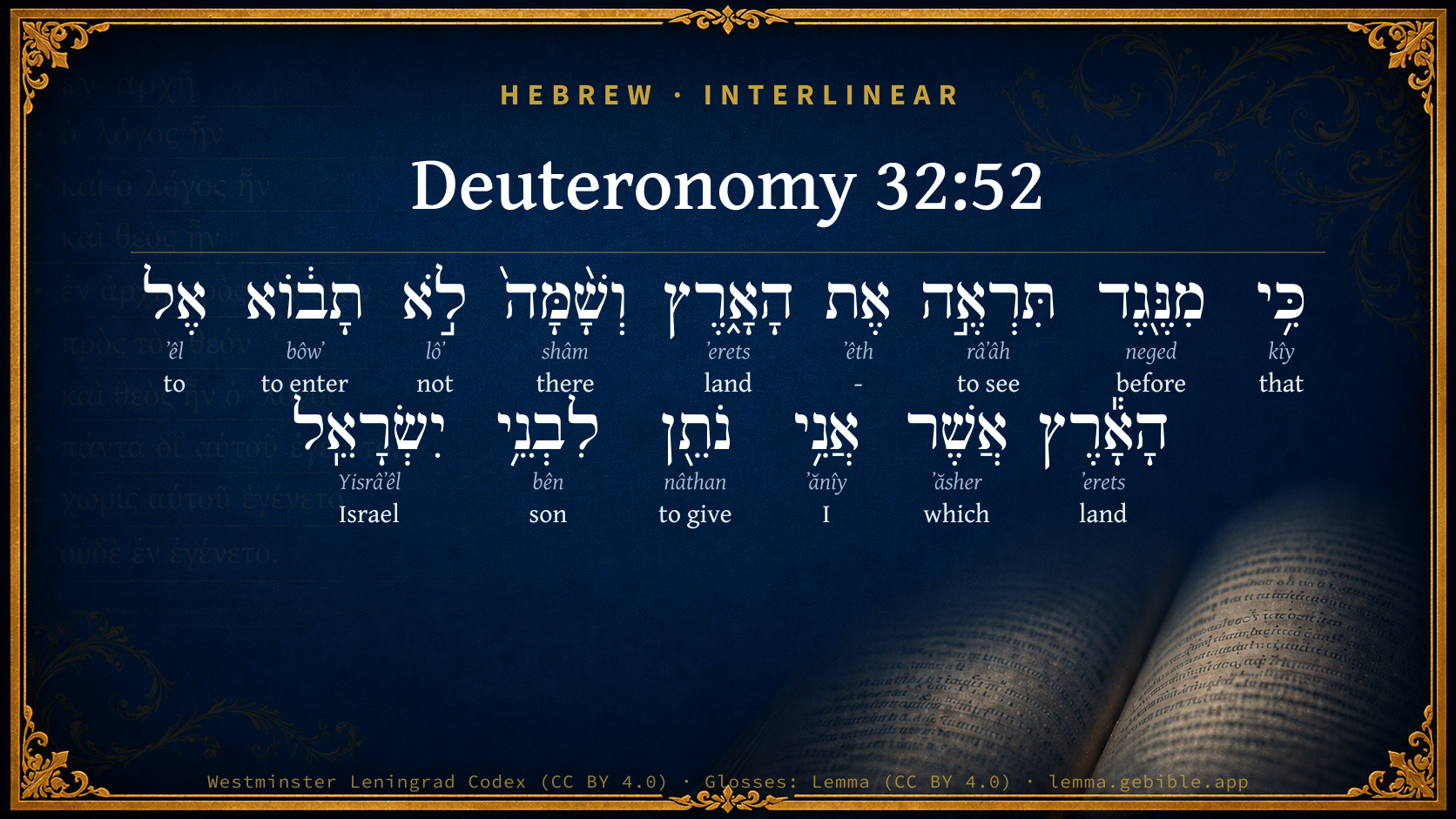
Hebrew (Westminster Leningrad Codex) Deuteronomy 32:52 appears in the Hebrew Old Testament. The text above is from the Westminster Leningrad Codex. Each word links to its Strong’s number, a concise gloss, and parsing drawn from the Open Scriptures Hebrew Bible morphology. Click any word for its full Brown-Driver-Briggs (BDB) entry.
Download image
Cite this verse

Deuteronomy 32:52 (World English Bible). Public Domain. Lemma interlinear Bible study tool, https://lemma.gebible.app/v/deuteronomy/32/52.

Show BibTeX & RIS
BibTeX
RIS
English Translation
For you shall see the land before you; but you shall not go there into the land which I give the children of Israel.
World English Bible · Public Domain
Download a study sheet

One document with this verse’s original text, its word-by-word gloss line, the meaning frame, cross-references with their text, attributed commentary, and full source and license credits — printable, and it pastes into notes with its structure intact.

This verse Autodidact and up

Study sheet (.html) Plain text (.txt)

A passage Seminary Student

Up to 50 verses in one chapter. A passage sheet keeps up to 6 commentary sources and 12 cross-references per verse, in the order this page ranks them, and says so on the sheet whenever that leaves anything out. Ask for a single verse and you get the Autodidact verse sheet above.

Everything on this page stays free to read, with no account — the sheet is a download of what is already on screen, not access to it.

Want to remove ads? Support Godless Engineer
Compare translations 3

The same verse in 3 English versions, stacked beneath the original-language interlinear above. Click any original word for its lexicon entry.

Each is an independent rendering of the whole verse — the interlinear is not word-aligned to these translations.

Highlighted words mark where these versions differ — a whole-verse word diff, not a word-by-word alignment.

  • World English Bible Public Domain
    For you shall see the land before you; but you shall not go there into the land which I give the children of Israel.
  • King James Version Public Domain
    Yet thou shalt see the land before thee; but thou shalt not go thither unto the land which I give the children of Israel.
  • unfoldingWord Literal Text CC BY-SA 4.0
    For you will see the land from the front, but you will not go there, into the land that I am giving to the sons of Israel.”

unfoldingWord Literal Text — © unfoldingWord, licensed CC BY-SA 4.0. Word-aligned USFM3 via Door43 (git.door43.org/unfoldingWord/en_ult).

Versions to compare (up to 4)

3 of 4 selected

Show all 18 translations

Every available English version of this verse, each an independent rendering of the whole verse.

  • World English Bible Public Domain
    For you shall see the land before you; but you shall not go there into the land which I give the children of Israel.
  • Berean Standard Bible Public Domain
    Although you shall see from a distance the land that I am giving the Israelites, you shall not enter it.”
  • Majority Standard Bible Public Domain
    Although you shall see from a distance the land that I am giving the Israelites, you shall not enter it.”
  • King James Version Public Domain
    Yet thou shalt see the land before thee; but thou shalt not go thither unto the land which I give the children of Israel.
  • American Standard Version (1901) Public Domain
    For thou shalt see the land before thee; but thou shalt not go thither into the land which I give the children of Israel.
  • Revised Version (1885) Public Domain
    For thou shalt see the land before thee; but thou shalt not go thither into the land which I give the children of Israel.
  • Geneva Bible (1599) Public Domain
    Thou shalt therefore see the lande before thee, but shalt not go thither, I meane, into the land which I giue the children of Israel.
  • Douay-Rheims (1899) Public Domain
    Thou shalt see the land before thee, which I will give to the children of Israel, but thou shalt not enter into it.
  • Young's Literal Translation Public Domain
    but over-against thou seest the land, and thither thou dost not go in, unto the land which I am giving to the sons of Israel.'
  • Literal Standard Version CC BY-SA 4.0
    Indeed, you see the land before [you], but you do not go in there to the land which I am giving to the sons of Israel.”
  • Unlocked Literal Bible CC BY-SA 4.0
    For you will see the land before you, but you will not go there, into the land that I am giving to the people of Israel.”
  • unfoldingWord Literal Text CC BY-SA 4.0
    For you will see the land from the front, but you will not go there, into the land that I am giving to the sons of Israel.”
  • Darby Bible Public Domain
    For thou shalt see the land before [thee]; but thou shalt not go thither unto the land which I give the children of Israel.
  • World Messianic Bible Public Domain
    For you shall see the land from a distance; but you shall not go there into the land which I give the children of Israel.”
  • Webster's Bible Public Domain
    Yet thou shalt see the land before thee, but thou shalt not go thither to the land which I give the children of Israel.
  • Free Bible Version CC BY-SA 4.0
    Though you will see the country that I am giving the Israelites from a distance, you won't enter it.”
  • Bible in Basic English Public Domain
    So you will see the land before you, but you will not go into the land which I am giving to the children of Israel.
  • JPS Tanakh (1917) Public Domain
    For thou shalt see the land afar off; but thou shalt not go thither into the land which I give the children of Israel.'

Literal Standard Version (2020), Covenant Press — licensed CC BY-SA 4.0. Text via the HelloAO Bible API (eBible.org). Unlocked Literal Bible (unfoldingWord) — licensed CC BY-SA 4.0. Text via the HelloAO Bible API (eBible.org). unfoldingWord Literal Text — © unfoldingWord, licensed CC BY-SA 4.0. Word-aligned USFM3 via Door43 (git.door43.org/unfoldingWord/en_ult). Free Bible Version, Dr. Jonathan Gallagher — licensed CC BY-SA 4.0. Text via the HelloAO Bible API (eBible.org).

Word by word

More ways to search: Search by grammar → Find every occurrence → Compare this word →

Practice this passage: Drill this verse → Learn its vocabulary →

מִנֶּ֖גֶד
neged
H5048
“from · before”
Preposition + Preposition
Part of Speech
Preposition + Preposition
Full BDB Definition

Origin: from H5046

TWOT: 1289a

what is conspicuous, what is in front of (substantive) - in front of, straight forward, before, in sight of (adverb) - in front of oneself, straightforward (adverb) - before your face, in your view or purpose (adverb) - what is in front of, corresponding to (with preposition) - in front of, before (with preposition) - in the sight or presence of (with preposition) - parallel to (with preposition) - over, for (with preposition) - in front, opposite (with preposition) - at a distance (with preposition) - from the front of, away from (preposition) - from before the eyes of, opposite to, at a distance from (preposition) - from before, in front of (preposition) - as far as the front of (preposition)
  1. כִּ֥י kîy H3588 “that” Conjunction
  2. תִּרְאֶ֣ה râʼâh H7200 “to see” Verb, Qal, Imperfect, 2nd Person, Masculine, Singular
  3. אֶת ʼêth H853 “-” Particle, Direct Object
  4. הָאָ֑רֶץ ʼerets H776 “the · land” Particle, Definite Article + Noun, Common, Both, Singular, Absolute
  5. וְשָׁ֨מָּה֙ shâm H8033 “and · there · toward” Conjunction + Adverb + Suffix, Demonstrative
  6. לֹ֣א lôʼ H3808 “not” Particle, Negative
  7. תָב֔וֹא bôwʼ H935 “to enter” Verb, Qal, Imperfect, 2nd Person, Masculine, Singular
  8. אֶל ʼêl H413 “to” Preposition
  9. הָאָ֕רֶץ ʼerets H776 “the · land” Particle, Definite Article + Noun, Common, Both, Singular, Absolute
  10. אֲשֶׁר ʼăsher H834 “which” Particle, Relative
  11. אֲנִ֥י ʼănîy H589 “I” Pronoun, Personal, 1st Person, Common, Singular
  12. נֹתֵ֖ן nâthan H5414 “giving” Verb, Qal, Participle Active, Masculine, Singular, Absolute
  13. לִבְנֵ֥י bên H1121 “to/for · sons of” Preposition + Noun, Common, Masculine, Plural, Construct
  14. יִשְׂרָאֵֽל Yisrâʼêl H3478 “Israel” Noun, Proper

About this verse

These counts appear in no published source. They are computed here, from the morphology-tagged text and Lemma’s own curated glosses. What Lemma adds →

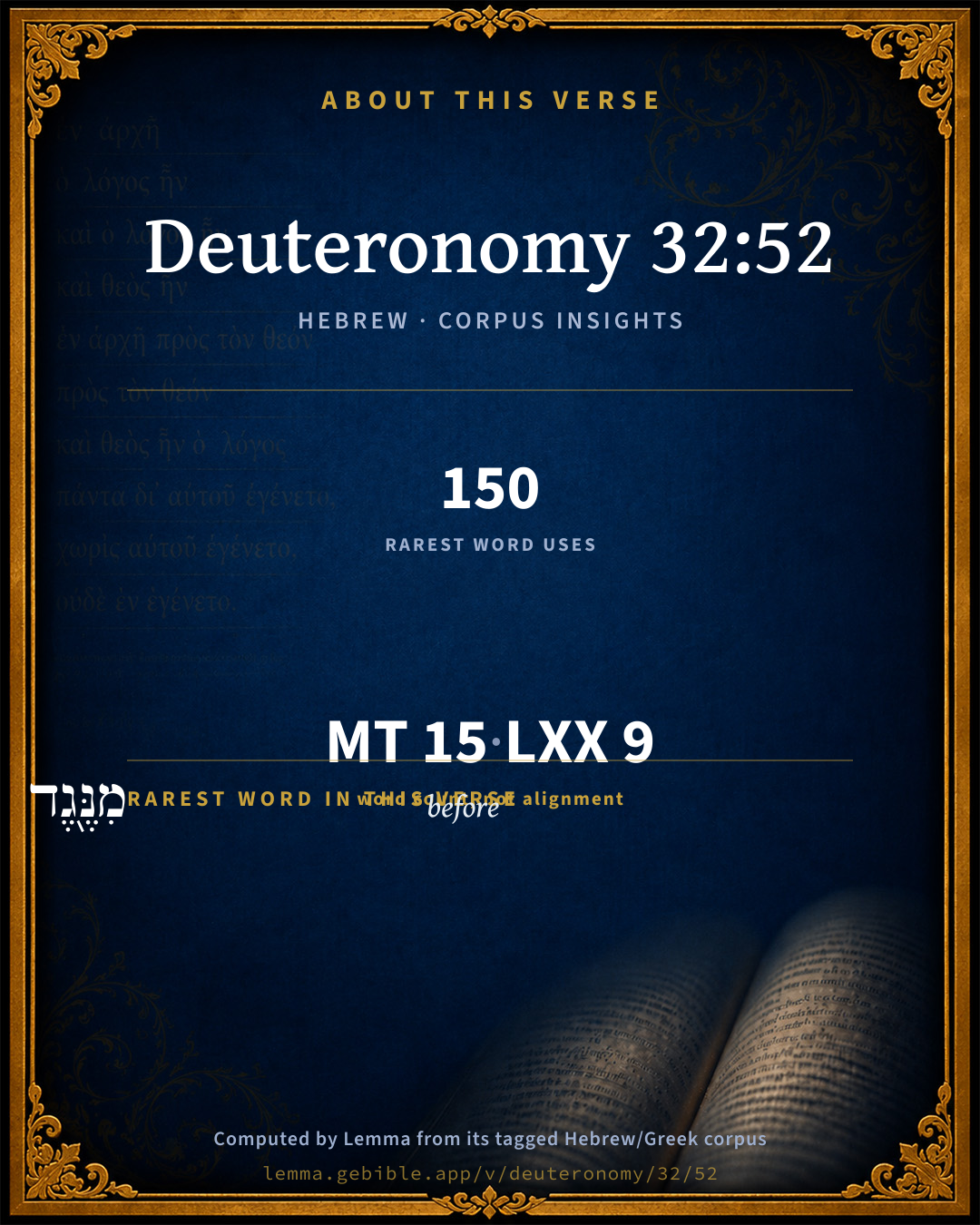
15
words
14
distinct lemmas
Pentateuch
section

Grammatical profile

  • 3 verbs
  • 4 nouns
  • 1 pronoun
  • 2 prepositions
  • 1 conjunction
  • 1 adverb
  • 3 particles

Verb forms

  • תִּרְאֶ֣ה Qal · Imperfect
  • תָב֔וֹא Qal · Imperfect
  • נֹתֵ֖ן Qal · Participle Active

Repetition

A word recurs within this verse — often emphatic in Hebrew:

  • הָאָ֑רֶץ land H776 ×2

Hebrew & Septuagint length

In English translation the verse runs 24 words from the Hebrew and 14 from the Septuagint (LXX English) — the Septuagint runs noticeably shorter here. See the side-by-side →

A rough comparison of the two English renderings, which tokenize alike — not a word-level alignment.

Word counts can differ between the Hebrew and the Greek without any difference in meaning — e.g. the Hebrew direct-object marker אֵת has no separate Greek word, and Greek often adds the article ὁ.

In the original languages it is 15 Hebrew tokens and 9 Greek tokens — but the two are counted differently (Hebrew bundles its prefixes and suffixes into one token; the Greek is in lemma form), so that isn’t a like-for-like length.

Cross-references

7

Topical passages linked to Deuteronomy 32:52 in the Treasury of Scripture Knowledge — connected by theme and wording, ordered by reader-vote popularity; previews shown in the World English Bible.

  • Deuteronomy 34:1–4 Moses went up from the plains of Moab to Mount Nebo, to the top of Pisgah, that is over against Jericho. Yahweh shown him all the land of Gilead, to Dan,
  • Numbers 27:12 Yahweh said to Moses, Go up into this mountain of Abarim, and see the land which I have given to the children of Israel.
  • Deuteronomy 1:37 Also Yahweh was angry with me for your sakes, saying, You also shall not go in there:
  • Deuteronomy 3:27 Go up to the top of Pisgah, and lift up your eyes westward, and northward, and southward, and eastward, and see with your eyes: for you shall not go over this Jordan.
  • Deuteronomy 32:49 Go up into this mountain of Abarim, to Mount Nebo, which is in the land of Moab, that is over against Jericho; and see the land of Canaan, which I give to the children of Israel for a possession;
  • Hebrews 11:13 These all died in faith, not having received the promises, but having seen them and embraced them from afar, and having confessed that they were strangers and pilgrims on the earth.
  • Hebrews 11:39 These all, having had testimony given to them through their faith, didn't receive the promise,

Cross-references courtesy of OpenBible.info (CC BY 4.0).

Hebrew and Greek witnesses Masoretic Hebrew ↔ Greek Septuagint

The same verse in the two great witnesses to the Old Testament, shown verse-for-verse.

Here the Septuagint runs noticeably shorter than the Hebrew — LXX2012 (modern English Septuagint) 14 words vs World English Bible 24. A rough length comparison of the two English translations, not a word-level alignment — read both below.

These are two independent witnesses, not word-aligned to each other, and the Septuagint is shown in lemma (dictionary) form.

Hebrew Deuteronomy 32:52 Masoretic · Westminster Leningrad Codex

כִּ֥י מִנֶּ֖גֶד תִּרְאֶ֣ה אֶת הָאָ֑רֶץ וְשָׁ֨מָּה֙ לֹ֣א תָב֔וֹא אֶל הָאָ֕רֶץ אֲשֶׁר אֲנִ֥י נֹתֵ֖ן לִבְנֵ֥י יִשְׂרָאֵֽל

For you shall see the land before you; but you shall not go there into the land which I give the children of Israel.

World English Bible · Public Domain

Greek LXX Deuteronomy 32:52 Septuagint · lemma form

ὅτι ἀπέναντι ὁράω ὁ γῆ καί ἐκεῖ οὐ εἰςἔρχομαι

You shall see the land before you, but you shall not enter into it.

LXX2012 (modern English Septuagint) · Public Domain

Hebrew: Westminster Leningrad Codex (CC BY 4.0). Greek: Septuagint (public domain); English from LXX2012 (modern English Septuagint) (Public Domain). How the Septuagint differs from the Hebrew →

Targum (Aramaic paraphrase)

2

The Targum is the ancient Jewish Aramaic paraphrase of the Hebrew Scriptures — an interpretive translation, not the Hebrew text itself. Onkelos (literal) and Pseudo-Jonathan (expansive) render the Torah, and Jonathan the Prophets. Coverage is partial: where no permissively-licensed English translation exists for a verse, only the Aramaic is shown. This is verse-level text, not a word-by-word alignment to the Hebrew.

  1. Targum Onkelos Torah (Genesis–Deuteronomy)
    אֲרֵי מִקֳבֵל תֶּחֱזֵי יָת אַרְעָא וּלְתַמָן לָא תֵעוּל לְאַרְעָא דִי אֲנָא יָהֵב לִבְנֵי יִשְׂרָאֵל

    (no public-domain English translation for this verse)

    Targum Onkelos — Aramaic: “Onkelos Genesis” (public domain); “Onkelos Exodus” (public domain); “Onkelos Leviticus” (public domain); “Onkelos Numbers” (public domain); “Onkelos Deuteronomy” (public domain). English: “Sefaria Community Translation” (CC0 1.0 (public-domain dedication)); “J.W. Etheridge. The Targums of Onkelos and Jonathan Ben Uzziel on the Pentateuch. London: Longmans, Green, 1862” (public domain). Text via Sefaria.

  2. Targum Pseudo-Jonathan Torah (Genesis–Deuteronomy)
    אֲרוּם מִקָבֵיל תֶּחֱמֵי יַת אַרְעָא וְתַמָן לָא תֵיעוּל לְאַרְעָא דַאֲנָא יָהִיב לִבְנֵי יִשְרָאֵל

    therefore thou mayest look over against it, but shalt not enter into the land that I give unto the children of Israel.

    Targum Pseudo-Jonathan — Aramaic: “Targum Jonathan on Genesis” (public domain); “Targum Jonathan on Exodus” (public domain); “Targum Jonathan on Leviticus” (public domain); “Targum Jonathan on Numbers” (public domain); “Targum Jonathan on Deuteronomy” (public domain). English: “The Targum of Jonathan ben Uzziel, trans. J. W. Etheridge, London, 1862” (public domain). Text via Sefaria.

Commentary

Notes on Deuteronomy 32:52 from classic Christian and Jewish commentators (each source and its license shown beneath its notes). The classic Christian expositions comment on the surrounding passage and are grouped to its opening verse, so a note may address several verses; the Jewish commentaries on the Tanakh (Rashi and others) are per-verse, so they appear only where the commentator wrote on this verse.

Lemma curates 59 commentaries, every one of them public domain or Creative Commons licensed, each selected and text-cleaned for this edition rather than reprinted as found. About our sources →

Jamieson, Fausset & Brown

Robert Jamieson, A. R. Fausset & David Brown

thou shalt see the land, but thou shalt not go thither-- (Num 27:12). Notwithstanding so severe a disappointment, not a murmur of complaint escapes his lips. He is not only resigned but acquiescing; and in the near prospect of his death, he pours forth the feelings of his devout heart in sublime strains and eloquent blessings.

Next: Deuteronomy Chapter 33

Jamieson, Fausset & Brown — Commentary Critical and Explanatory on the Whole Bible (1871) — public domain (CC PDM 1.0). Text via the HelloAO Bible API.

Adam Clarke's Commentary

Verse 52. Thou shalt see the land before thee] See Nu 27:12, c. How glorious to depart out of this life with God in his heart and heaven in his eye! his work, his great, unparalleled usefulness, ending only with his life. The serious reader will surely join in the following pious ejaculation of the late Rev. Charles Wesley, one of the best Christian poets of the last century: -

"O that without a lingering groan

I may the welcome word receive

My body with my charge lay down,

And cease at once to work and live!"

IT would require a dissertation expressly formed for the purpose to point out the general merit and extraordinary beauties of this very sublime ode. To enter into such particulars can scarcely comport with the nature of the present work. Drs. Lowth, Kennicott, and Durell, have done much in this way; and to their respective works the critical reader is referred. A very considerable extract from what they have written on this chapter may be found in Dr. Dodd's notes. In writing this ode the design of Moses was,

1. To set forth the Majesty of God; to give that generation and all successive ones a proper view of the glorious perfections of the object of their worship. He therefore shows that from his holiness and purity he must be displeased with sin; from his justice and righteousness he must punish it; and from the goodness and infinite benevolence of his nature he is ever disposed to help the weak, instruct the ignorant, and show mercy to the wretched, sinful sons and daughters of men.

2. To show the duty and interest of his people. To have such a Being for their friend is to have all possible happiness, both spiritual and temporal, secured; to have him for their enemy is to be exposed to inevitable destruction and ruin.

3. To warn them against irreligion and apostasy; to show the possibility of departing from God, and the miseries that would overwhelm them and their posterity should they be found walking in opposition to the laws of their Creator.

4. To give a proper and impressive view of the providence of God, by referring to the history of his gracious dealings with them and their ancestors; the minute attention he paid to all their wants, the wonderful manner in which he led, fed, clothed, protected, and saved them, in all their travels and in all perils.

5. To leave on record an everlasting testimony against them, should they ever cast off his fear and pollute his worship, which should serve at once as a warning to the world, and a vindication of his justice, when the judgments he had threatened were found to be poured out upon them; for he who loved them so long and so intensely could not become their enemy but in consequence of the greatest and most unprincipled provocations.

6. To show the shocking and unprecedented ingratitude which induced a people so highly favoured, and so wondrously protected and loved, to sin against their God; and how reasonable and just it was, for the vindication of his holiness, that God should pour out upon them such judgments as he had never inflicted on any other people, and so mark their disobedience and ingratitude with fresh marks of his displeasure, that the punishment should bear some proportion to the guilt, and that their preservation as a distinct people might afford a feeling proof both of the providence and justice of God.

7. To show the glory of the latter days in the re-election of the long reprobated Jewish nation, and the final diffusion of his grace and goodness over the earth by means of the Gospel of Christ.

And all this is done with such strength and elegance of diction, with such appropriate, energetic, and impressive figures and metaphors, and in such a powerful torrent of that soul-penetrating, pure poetic spirit that comes glowing from the bosom of God, that the reader is alternately elated or depressed, filled with compunction or confidence, with despair or hope, according to the quick transitions of the inimitable writer to the different topics which form the subject of this incomparable and wondrously varied ode. May that Spirit by which it was dictated give it its fullest, most durable, and most effectual impression upon the mind of every reader!

Adam Clarke's Commentary on the Bible (1810–1826) — public domain. Text from a community e-Sword/MySword module.

The Cambridge Bible for Schools and Colleges

gen. ed. J. J. S. Perowne

52. This v. is in addition to Num_27:12-14.

before thee] The Heb. is stronger, lit. from in front of = over against (Deu_28:66). Scot. ‘forenenst.’

The Cambridge Bible for Schools and Colleges (gen. ed. J. J. S. Perowne; Cambridge University Press, 1878–1918) — public domain. Text from a community e-Sword module.

Haydock's Catholic Bible Commentary

Into it. By repeating this reproach and judgment God excited in his servant the most lively sentiments of repentance for his fault, Numbers xx. (Haydock) --- Aaron had been deprived of the sight of this delightful country. If they had been labouring for its acquisition alone, the reflection must have been very cutting. But they had a better country in view, though they had greatly desired to enter into that land which was to be ennobled and purified by the birth and blood of the Son of God. (Haydock) --- Having received the order from God in the evening, after Moses had taught his canticle to the people, he immediately set his house in order, and on the following morning he gave his last blessing to the tribes of Israel, and was attended by the chief to the foot of the mountain. (Salien)

George Leo Haydock (1774–1849), Haydock's Catholic Family Bible and Commentary, 1859 edition — public domain. Excludes Psalms (Douay-Rheims chapter numbering differs from Protestant) and Deuterocanonical books (Catholic canon only).

The Pulpit Commentary

Yet thou shalt See the land. (cf. Heb_11:13)

The Pulpit Commentary (1880–1919), ed. H.D.M. Spence-Jones & Joseph S. Exell — public domain. Text from a community e-Sword module.

John Wesley's Explanatory Notes

Yet thou shalt see the land - And see it as the earnest of that better country, which is only seen with the eye of faith. What is death to him who has a believing prospect and a steadfast hope of eternal life?

John Wesley, Explanatory Notes Upon the Whole Bible (1754–1765) — public domain. Text via the GEBible commentary corpus.

Rashi

Rabbi Shlomo Yitzchaki (Rashi)

כי מנגד means, BECAUSE FROM THE DISTANCE.

תראה וגו׳ YOU SHALL SEE [THE LAND] etc. — If you do not see it now, you will not see it at any time during your lifetime,

ושמה לא תבוא SINCE YOU SHALL NOT COME THERE — for I know that it is dear unto you, therefore I tell you (v. 49) “Ascend and see it!”.

Rashi on the Tanakh — English translations: “The Judaica Press complete Tanach with Rashi, translated by A. J. Rosenberg” (CC BY 4.0); “Pentateuch with Rashi's commentary by M. Rosenbaum and A.M. Silbermann, 1929-1934” (public domain); “The Metsudah Tanach series, Lakewood, N.J” (CC BY 4.0); and “The Book of Joshua, Metsudah Publications, 1997” (CC BY 4.0). Text via Sefaria.

Lesson kit

Teaching starters — assembled from the data on this page, not authored interpretation. Every prompt links to the verse data it draws on. Edit before teaching.

Deuteronomy, in the Pentateuch, opens this verse with 15 words (14 distinct Hebrew lemmas). Its most distinctive word is neged (“before”). The Greek Septuagint runs shorter here. A historical commentator’s framing appears above. Read the whole chapter for the surrounding context.

Discussion questions

  1. How does “before” (neged) shape what this verse is saying?
  2. How does Deuteronomy 34:1–4, which shares this passage’s theme, read alongside this verse?
  3. What does the repetition of “land” (2× in this one verse) do in this verse?
  4. The Septuagint runs shorter here than the Hebrew. What might account for the difference?
  5. These translations render this verse differently; the difference is in the English rendering, not the original. What questions does that raise?
  6. «תִּרְאֶ֣ה» is a Qal Imperfect verb. How does that grammatical form shape the action described?
  7. Compare how Jamieson, Fausset & Brown and Adam Clarke's Commentary read this verse. Where do they agree or differ?

Things to notice

Reading settings

Reading text

Shown beneath each verse's original-language words.

Old Testament
Old Testament edition

Read the OT as the Masoretic Hebrew (MT) or the Greek Septuagint (LXX).

English shown for the Greek Septuagint (in the Hebrew ↔ Greek comparison).

Comparing translations? Open the Compare panel on any verse page to stack up to four side by side.