Job 7:11

Hebrew (Westminster Leningrad Codex) Job 7:11 appears in the Hebrew Old Testament. The text above is from the Westminster Leningrad Codex. Each word links to its Strong’s number, a concise gloss, and parsing drawn from the Open Scriptures Hebrew Bible morphology. Click any word for its full Brown-Driver-Briggs (BDB) entry.
Download image
Cite this verse

Job 7:11 (World English Bible). Public Domain. Lemma interlinear Bible study tool, https://lemma.gebible.app/v/job/7/11.

Show BibTeX & RIS
BibTeX
RIS
English Translation
"Therefore I will not keep silent. I will speak in the anguish of my spirit. I will complain in the bitterness of my soul.
World English Bible · Public Domain
Download a study sheet

One document with this verse’s original text, its word-by-word gloss line, the meaning frame, cross-references with their text, attributed commentary, and full source and license credits — printable, and it pastes into notes with its structure intact.

This verse Autodidact and up

Study sheet (.html) Plain text (.txt)

A passage Seminary Student

Up to 50 verses in one chapter. A passage sheet keeps up to 6 commentary sources and 12 cross-references per verse, in the order this page ranks them, and says so on the sheet whenever that leaves anything out. Ask for a single verse and you get the Autodidact verse sheet above.

Everything on this page stays free to read, with no account — the sheet is a download of what is already on screen, not access to it.

Want to remove ads? Support Godless Engineer
Compare translations 3

The same verse in 3 English versions, stacked beneath the original-language interlinear above. Click any original word for its lexicon entry.

Each is an independent rendering of the whole verse — the interlinear is not word-aligned to these translations.

Highlighted words mark where these versions differ — a whole-verse word diff, not a word-by-word alignment.

  • World English Bible Public Domain
    "Therefore I will not keep silent. I will speak in the anguish of my spirit. I will complain in the bitterness of my soul.
  • King James Version Public Domain
    Therefore I will not refrain my mouth; I will speak in the anguish of my spirit; I will complain in the bitterness of my soul.
  • unfoldingWord Literal Text CC BY-SA 4.0
    Therefore I will not restrain my mouth; I will speak in the distress of my spirit; I will complain in the bitterness of my soul.

unfoldingWord Literal Text — © unfoldingWord, licensed CC BY-SA 4.0. Word-aligned USFM3 via Door43 (git.door43.org/unfoldingWord/en_ult).

Versions to compare (up to 4)

3 of 4 selected

Show all 18 translations

Every available English version of this verse, each an independent rendering of the whole verse.

  • World English Bible Public Domain
    "Therefore I will not keep silent. I will speak in the anguish of my spirit. I will complain in the bitterness of my soul.
  • Berean Standard Bible Public Domain
    Therefore I will not restrain my mouth; I will speak in the anguish of my spirit; I will complain in the bitterness of my soul.
  • Majority Standard Bible Public Domain
    Therefore I will not restrain my mouth; I will speak in the anguish of my spirit; I will complain in the bitterness of my soul.
  • King James Version Public Domain
    Therefore I will not refrain my mouth; I will speak in the anguish of my spirit; I will complain in the bitterness of my soul.
  • American Standard Version (1901) Public Domain
    Therefore I will not refrain my mouth; I will speak in the anguish of my spirit; I will complain in the bitterness of my soul.
  • Revised Version (1885) Public Domain
    Therefore I will not refrain my mouth; I will speak in the anguish of my spirit; I will complain in the bitterness of my soul.
  • Geneva Bible (1599) Public Domain
    Therefore I will not spare my mouth, but will speake in the trouble of my spirite, and muse in the bitternesse of my minde.
  • Douay-Rheims (1899) Public Domain
    Wherefore I will not spare my month, I will speak in the affliction of my spirit: I will talk with the bitterness of my soul.
  • Young's Literal Translation Public Domain
    Also I -- I withhold not my mouth -- I speak in the distress of my spirit, I talk in the bitterness of my soul.
  • Literal Standard Version CC BY-SA 4.0
    Also I do not withhold my mouth—I speak in the distress of my spirit, I talk in the bitterness of my soul.
  • Unlocked Literal Bible CC BY-SA 4.0
    Therefore I will not restrain my mouth; I will speak in the anguish of my spirit; I will complain in the bitterness of my soul.
  • unfoldingWord Literal Text CC BY-SA 4.0
    Therefore I will not restrain my mouth; I will speak in the distress of my spirit; I will complain in the bitterness of my soul.
  • Darby Bible Public Domain
    Therefore I will not restrain my mouth: I will speak in the anguish of my spirit; I will complain in the bitterness of my soul.
  • World Messianic Bible Public Domain
    “Therefore I will not keep silent. I will speak in the anguish of my spirit. I will complain in the bitterness of my soul.
  • Webster's Bible Public Domain
    Therefore I will not restrain my mouth; I will speak in the anguish of my spirit; I will complain in the bitterness of my soul.
  • Free Bible Version CC BY-SA 4.0
    So, no, I won't hold my tongue—I will speak in the agony of my spirit; I will complain in the bitterness of my soul.
  • Bible in Basic English Public Domain
    So I will not keep my mouth shut; I will let the words come from it in the pain of my spirit, my soul will make a bitter outcry.
  • JPS Tanakh (1917) Public Domain
    Therefore I will not refrain my mouth; I will speak in the anguish of my spirit; I will complain in the bitterness of my soul.

Literal Standard Version (2020), Covenant Press — licensed CC BY-SA 4.0. Text via the HelloAO Bible API (eBible.org). Unlocked Literal Bible (unfoldingWord) — licensed CC BY-SA 4.0. Text via the HelloAO Bible API (eBible.org). unfoldingWord Literal Text — © unfoldingWord, licensed CC BY-SA 4.0. Word-aligned USFM3 via Door43 (git.door43.org/unfoldingWord/en_ult). Free Bible Version, Dr. Jonathan Gallagher — licensed CC BY-SA 4.0. Text via the HelloAO Bible API (eBible.org).

Word by word

More ways to search: Search by grammar → Find every occurrence → Compare this word →

Practice this passage: Drill this verse → Learn its vocabulary →

אָ֝שִׂ֗יחָה
sîyach
H7878
“to meditate”
Verb, Qal, Imperfect, 1st Person, Common, Singular
Part of Speech
Verb
Stem
Qal
Form
Imperfect
Person
1st Person
Gender
Common
Number
Singular
Full BDB Definition

Origin: a primitive root

TWOT: 2255

to put forth, mediate, muse, commune, speak, complain, ponder, sing - (Qal) - to complain - to muse, meditate upon, study, ponder - to talk, sing, speak - (Polel) to meditate, consider, put forth thoughts
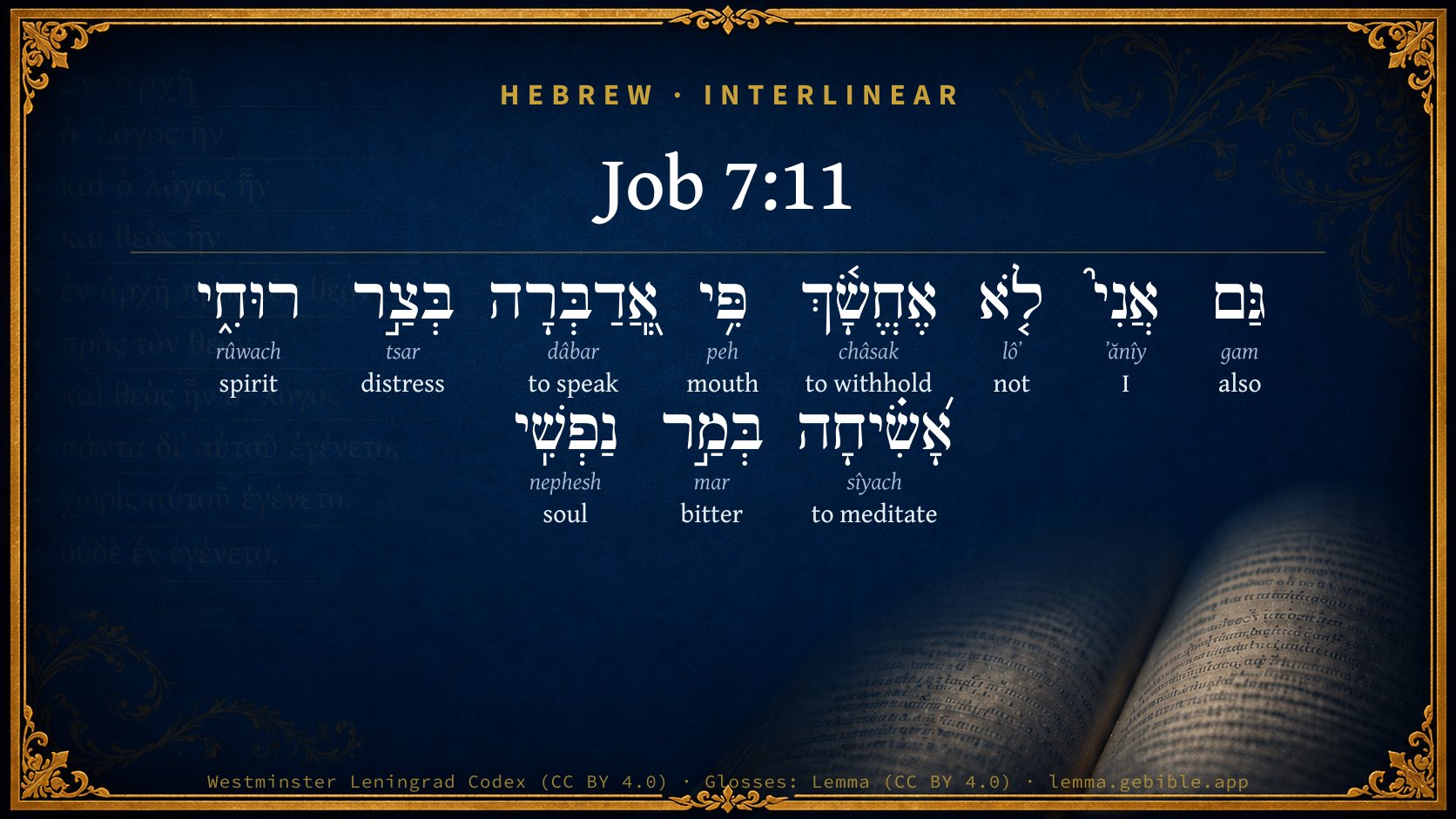
  1. גַּם gam H1571 “also” Particle, Accusative
  2. אֲנִי֮ ʼănîy H589 “I” Pronoun, Personal, 1st Person, Common, Singular
  3. לֹ֤א lôʼ H3808 “not” Particle, Negative
  4. אֶחֱשָׂ֫ךְ châsak H2820 “to withhold” Verb, Qal, Imperfect, 1st Person, Common, Singular
  5. פִּ֥י peh H6310 “mouth · my” Noun, Common, Masculine, Singular, Construct + Suffix, Personal, 1st Person, Common, Singular
  6. אֲֽ֭דַבְּרָה dâbar H1696 “to speak” Verb, Piel, Imperfect, 1st Person, Common, Singular
  7. בְּצַ֣ר tsar H6862 “in/at · distress of” Preposition + Adjective, Adjective, Masculine, Singular, Construct
  8. רוּחִ֑י rûwach H7307 “spirit · my” Noun, Common, Both, Singular, Construct + Suffix, Personal, 1st Person, Common, Singular
  9. בְּמַ֣ר mar H4751 “in/at · bitter of” Preposition + Adjective, Adjective, Masculine, Singular, Construct
  10. נַפְשִֽׁי nephesh H5315 “soul · my” Noun, Common, Both, Singular, Construct + Suffix, Personal, 1st Person, Common, Singular

About this verse

These counts appear in no published source. They are computed here, from the morphology-tagged text and Lemma’s own curated glosses. What Lemma adds →

11
words
11
distinct lemmas
Wisdom
section

Notable vocabulary

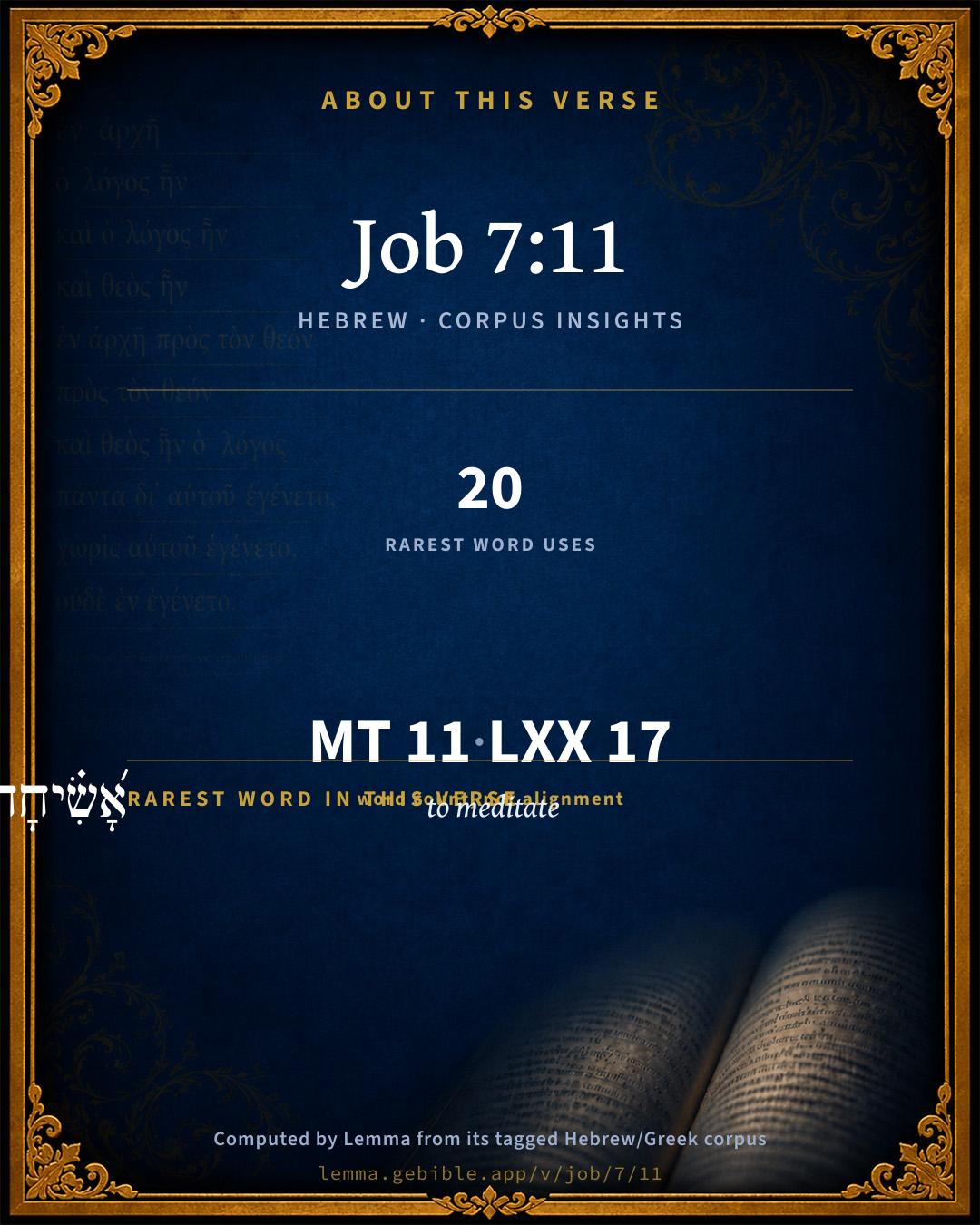
The rarest word here is אָ֝שִׂ֗יחָה to meditate H7878 — appearing just 20 times in the whole Hebrew Bible.

Shared distinctive vocabulary

אָ֝שִׂ֗יחָה to meditate H7878 occurs in 20 verses of the Hebrew Bible. Also found in:

Grammatical profile

  • 3 verbs
  • 3 nouns
  • 2 adjectives
  • 1 pronoun
  • 2 particles

Verb forms

  • אֶחֱשָׂ֫ךְ Qal · Imperfect
  • אֲֽ֭דַבְּרָה Piel · Imperfect
  • אָ֝שִׂ֗יחָה Qal · Imperfect

Hebrew & Septuagint length

In English translation the verse runs 24 words from the Hebrew and 24 from the Septuagint (LXX English) — the same length.

A rough comparison of the two English renderings, which tokenize alike — not a word-level alignment.

Word counts can differ between the Hebrew and the Greek without any difference in meaning — e.g. the Hebrew direct-object marker אֵת has no separate Greek word, and Greek often adds the article ὁ.

In the original languages it is 11 Hebrew tokens and 17 Greek tokens — but the two are counted differently (Hebrew bundles its prefixes and suffixes into one token; the Greek is in lemma form), so that isn’t a like-for-like length.

Cross-references

17

Topical passages linked to Job 7:11 in the Treasury of Scripture Knowledge — connected by theme and wording, ordered by reader-vote popularity; previews shown in the World English Bible.

  • 1 Samuel 1:10 She was in bitterness of soul, and prayed to Yahweh, and wept sore.
  • Psalms 40:9 I have proclaimed glad news of righteousness in the great assembly. Behold, I will not seal my lips, Yahweh, you know.
  • Job 10:1 "My soul is weary of my life; I will give free course to my complaint. I will speak in the bitterness of my soul.
  • Job 6:26 Do you intend to reprove words, Seeing that the speeches of one who is desperate are as wind?
  • Job 21:25 Another dies in bitterness of soul, And never tastes of good.
  • Isaiah 38:15 What shall I say? he has both spoken to me, and himself has done it: I shall go softly all my years because of the bitterness of my soul.
  • Isaiah 38:17 Behold, [it was] for [my] peace [that] I had great bitterness: But you have in love to my soul delivered it from the pit of corruption; For you have cast all my sins behind your back.
  • Genesis 42:21 They said one to another, "We are most assuredly guilty concerning our brother, in that we saw the distress of his soul, when he begged us, and we wouldn't listen. Therefore this distress has come on us."
  • 2 Kings 4:27–28 When she came to the man of God to the hill, she caught hold of his feet. Gehazi came near to thrust her away; but the man of God said, Let her alone: for her soul is vexed within her; and Yahweh has hid it from me, and has not told me.
  • Job 10:15 If I am wicked, woe to me. If I am righteous, I still shall not lift up my head, Being filled with disgrace, And conscious of my affliction.
  • Job 13:13 "Be silent, leave me alone, that I may speak. Let come on me what will.
  • Job 16:6 "Though I speak, my grief is not subsided. Though I forbear, what am I eased?
  • Job 21:3–4 Allow me, and I also will speak; After I have spoken, mock on.
  • Matthew 26:37–38 He took with him Peter and the two sons of Zebedee, and began to be sorrowful and severely troubled.
  • Luke 22:44 Being in agony he prayed more earnestly. His sweat became like great drops of blood falling down on the ground.
  • 2 Corinthians 2:4 For out of much affliction and anguish of heart I wrote to you with many tears, not that you should be made sorry, but that you might know the love that I have so abundantly for you.
  • Psalms 39:3 My heart was hot within me. While I meditated, the fire burned: I spoke with my tongue:

Cross-references courtesy of OpenBible.info (CC BY 4.0).

Hebrew and Greek witnesses Masoretic Hebrew ↔ Greek Septuagint

The same verse in the two great witnesses to the Old Testament, shown verse-for-verse.

These are two independent witnesses, not word-aligned to each other, and the Septuagint is shown in lemma (dictionary) form.

Hebrew Job 7:11 Masoretic · Westminster Leningrad Codex

גַּם אֲנִי֮ לֹ֤א אֶחֱשָׂ֫ךְ פִּ֥י אֲֽ֭דַבְּרָה בְּצַ֣ר רוּחִ֑י אָ֝שִׂ֗יחָה בְּמַ֣ר נַפְשִֽׁי

"Therefore I will not keep silent. I will speak in the anguish of my spirit. I will complain in the bitterness of my soul.

World English Bible · Public Domain

Greek LXX Job 7:11 Septuagint · lemma form

ἀτάρ οὖν οὐδέ ἐγώ φείδομαι ὁ στόμα ἐγώ λαλέω ἐν ἀνάγκη εἰμί ἀναοἴγω πικρία ψυχή ἐγώ συνἔχω

Then neither will I refrain my mouth: I will speak being in distress; being in anguish I will disclose the bitterness of my soul.

LXX2012 (modern English Septuagint) · Public Domain

Hebrew: Westminster Leningrad Codex (CC BY 4.0). Greek: Septuagint (public domain); English from LXX2012 (modern English Septuagint) (Public Domain). How the Septuagint differs from the Hebrew →

Commentary

Notes on Job 7:11 from classic Christian and Jewish commentators (each source and its license shown beneath its notes). The classic Christian expositions comment on the surrounding passage and are grouped to its opening verse, so a note may address several verses; the Jewish commentaries on the Tanakh (Rashi and others) are per-verse, so they appear only where the commentator wrote on this verse.

Lemma curates 59 commentaries, every one of them public domain or Creative Commons licensed, each selected and text-cleaned for this edition rather than reprinted as found. About our sources →

The Cambridge Bible for Schools and Colleges

gen. ed. J. J. S. Perowne

11. Job heaps image upon image to set before himself and the eye of God the brevity of life, the weaver’s shuttle (Job_7:6), the wind (Job_7:7), the morning cloud (Job_7:9, Hos_6:4), ending with a pathetic reference to his home which shall see him no more (Job_7:10). These regrets altogether overmaster him and, combining with his sense of the wrong which he suffers and his impatience of the iron restraints of human existence, hurry him forward, and he resolves to open the floodgates to the full stream of his complaint (Job_7:11): Therefore I will not refrain my mouth, i. e. therefore I also, I on my side, will not refrain.

The Cambridge Bible for Schools and Colleges (gen. ed. J. J. S. Perowne; Cambridge University Press, 1878–1918) — public domain. Text from a community e-Sword module.

Trapp's Complete Commentary

John Trapp

Job 7:11 Therefore I will not refrain my mouth; I will speak in the anguish of my spirit; I will complain in the bitterness of my soul.

Ver. 11. Therefore I will not refrain my mouth] Heb. I will not prohibit my mouth, sc. from speaking, I will bite in my grief no longer; but since death, the certain end of all outward troubles, is not far from me; I will, by my further complaints, press the Lord to hasten it, and not suppress my sorrows, but give them a vent.

I will speak in the anguish of my spirit] Heb. In the straitness or distress of my spirit, which is almost suffocated with grief.

I will complain in the bitterness of my soul] His greatest troubles were inward; and if by godly sorrow for his sins he had poured forth his soul in a humble confession (as some understand him here), he had taken a right course; but thus boisterously to break out into complaints savoureth of human infirmity, and showeth quantae sint hominis vires sibi a Deo derelicti, what a poor creature man becomes when God leaves him to himself, and subjects him to his judgments (Mercer).

John Trapp, A Commentary or Exposition upon All the Books of the Old and New Testament (1647–1656) — public domain. Text from a community e-Sword module.

Joseph Benson's Commentary

Job 7:11. Therefore I will not refrain, &c. — Since my life is so vain and short, and, when once lost, without all hopes of recovery. I will plead with God for pity before I die; I will not smother my anguish within my breast, but will ease myself by pouring out my complaints.

Joseph Benson's Commentary on the Old and New Testaments (1811–1818) — public domain. Text from a community e-Sword module.

Tyndale Open Study Notes

Tyndale Open Resources

7:11 I cannot keep from speaking: Job echoed Eliphaz’s inability to refrain from words (4:2).

Tyndale Open Study Notes — © Tyndale Open Resources, licensed CC BY-SA 4.0. Text via the HelloAO Bible API.

Geneva Bible (1599)

Geneva Bible translators

Seeing I can by none other means comfort myself, I will declare my grief by words, and thus he speaketh as one overcome with grief of mind.

Geneva Bible (1599) marginal notes — public domain. Text via Bolls.life.

Jamieson, Fausset & Brown

Robert Jamieson, A. R. Fausset & David Brown

Therefore, as such is my hard lot, I will at least have the melancholy satisfaction of venting my sorrow in words. The Hebrew opening words, "Therefore I, at all events," express self-elevation [UMBREIT].

Jamieson, Fausset & Brown — Commentary Critical and Explanatory on the Whole Bible (1871) — public domain (CC PDM 1.0). Text via the HelloAO Bible API.

Adam Clarke's Commentary

Verse 11. Therefore I will not refrain] All is hopeless; I will therefore indulge myself in complaining.

Adam Clarke's Commentary on the Bible (1810–1826) — public domain. Text from a community e-Sword/MySword module.

John Gill's Exposition

Therefore I will not refrain my mouth,.... From speaking and complaining; seeing, besides the common lot of mankind, which is a state of warfare, sorrow, and trouble, and is as much as a man can well grapple with, extraordinary afflictions are laid upon me, which make life insupportable; and seeing I enjoy no good in this present life, and am shortly going where no temporal good is to be expected, and shall never return to this world any more to enjoy any; therefore I will not be silent, and forbear speaking my mind freely, and uttering my just complaint, for which I think I have sufficient reason: or "I also will not refrain my mouth" (c); in turn, as a just retaliation, so Jarchi; since God will not refrain his hand from me, I will not refrain my mouth from speaking concerning him; since he shows no mercy to me, I shall utter my miserable complaints, and not keep them to myself; this was Job's infirmity when he should have held his peace, as Aaron, and been dumb and silent as David, and been still, and have known, owned, and acknowledged the sovereignty of God, and not vented himself in passion as he did:

I will speak in the anguish of my spirit; or "in the straitness" (d) of it; he was surrounded on all sides with distress, the sorrows of death compassed him about, and the pains of hell got hold upon him; he was like one pent up in a narrow place, in a close confinement, that he could not get out of, and come forth from; and he felt not only exquisite pains of body from his boils and sores, but great anguish of soul; and therefore he determines to speak in and "of" (e) all this, to give vent to his grief and sorrow, his passion and resentment:

I will complain in the bitterness of my soul; his afflictions were like the waters of Marah, bitter ones, very grievous and disagreeable to flesh and blood, and by which his life and soul were embittered to him; and in and of (f) this he determines to complain, or to utter in a complaining way what he had been meditating on, as the word (g) signifies; so that this was not an hasty and precipitate action, but what upon deliberation he resolved to do; to pour out his complaint before God, and leave it with him, in a submissive way, would not have been amiss, but if he complained of God and his providence, it was wrong: "why should a living man complain?" not even a wicked man, of "the punishment of his sin", and much less a good man of fatherly chastisements? We see what the will of man is, what a stubborn and obstinate thing it is, "I will, I will, I will", even of a good man when left to himself, and not in the exercise of grace, and under the influence of it; the complaint follows, by way of expostulation.

(c) "etiam ego", Vatablus, Beza, Piscator, Bolducius, Cocceius, Schmidt, Michaelis, Schultens; "vicissim", Noldius, p. 222. (d) "in angustia", Junius & Tremellius, Schmidt; "in arcto", Cocceius; "in angusto", Schultens. (e) "De angustia", Vatablus, Drusius, Mercerus, Piscator. (f) "de amaritudine", Drusius, Piscator, Mercerus. (g) "meditabor et eloquar", Michaelis.

John Gill's Exposition of the Whole Bible (1746–1763) — public domain (CC PDM 1.0). Text via the HelloAO Bible API.

Albert Barnes' Notes on the Bible

Therefore I will not refrain my mouth - The idea in this verse is, “such is my distress at the prospect of dying, that I cannot but express it. The idea of going away from all my comforts, and of being committed to the grave, to revisit the earth no more, is so painful that I cannot but give vent to my feelings.”

Albert Barnes' Notes on the Bible (1834–1885) — public domain. Text from a community e-Sword/MySword module.

Haydock's Catholic Bible Commentary

Mouth. I will vent my bitter complaints before I die. (Haydock)

George Leo Haydock (1774–1849), Haydock's Catholic Family Bible and Commentary, 1859 edition — public domain. Excludes Psalms (Douay-Rheims chapter numbering differs from Protestant) and Deuterocanonical books (Catholic canon only).

Matthew Poole's English Annotations

Since my life is by the common condition of mankind so vain and short, and, when once lost, without all hopes of recovery, and withal extremely miserable, I will plead with God for pity and relief before I die; knowing that I must now speak, or else for ever after hold my peace, as to requests of this nature. I will not smother my bitter anguish within my own breast, which will make it intolerable, but I will give it vent, and ease myself by pouring forth complaints, and expostulating with my God, who, as I hope, will hear and help me one way or other.

Matthew Poole's English Annotations on the Holy Bible (1683–1685) — public domain. Text from a community e-Sword/MySword module.

Whedon's Commentary on the Bible

Daniel D. Whedon

11. Therefore I — גם אני: also I. Compare Psa_52:5, “also God.” I will have my turn now. The abrupt expression quivers with a sense of wrong — a feeling that God’s treatment of the speaker is founded in unreason. Job’s utter suspense of faith could not be more painfully declared than by this voluntary breaking down of all barriers. The pent-up emotions of despair are now free to roll forth as a flood.

Daniel D. Whedon (gen. ed.), Commentary on the Old and New Testaments (1874–1909) — public domain. Text from a community e-Sword module.

The Pulpit Commentary

Therefore I will not refrain my mouth; rather, I moreoverwill not refrain my lips; that is, "You may do as you like under affliction, I claim the right of complaining." Job has already pointed out that nature teaches the animals to complain when they suffer. (Job_6:5) Why, then, should not he? Complaint is not necessarily murmuring; it is sometimes merely expostulation, which God allows. (comp. Psa_4:2 Psa_77:3 Psa_142:2, etc.) I will speak in the anguish of my spirit; I will complain in the bitterness of my soul. Extreme "anguish" and "bitter" suffering excuse complaints that would otherwise be, blare-able. (comp. Job_6:2-4)

Vers. 11-16. Job to God: 2. The opening of the third controversy.

I A DANGEROUS RESOLUTION.

1. The purport of it. To complain, not merely to repine against the misery of his lot, but to express his sense of Jehovah"s cruelty in first afflicting him and then vouchsafing him no response to his solemn and pathetic appeal. If murmurings against one"s outward estate are sometimes natural and even excusable, they are always perilous, even where not actually sinful. Those who begin by finding fault with their portion, generally end by reflecting on him by whom their portion has been bestowed. That Job did not curse God to his face, as the devil predicted, was a wonder, and was due more to grace than to himself. When the soul is in anguish it is better to be silent than to speak, to imitate David (Psa_39:9) than to copy Job.

2. The spirit of it. With vehemence: "I will speak;" the tense expressing energy of language with passion: "In the anguish of my spirit;" with bitterness: "I will complain in the bitterness of my soul; all which were unwarrantable aggravations of his original offence, although Job, by commencing," I also," "I for my part," appeared to think he was not transgressing the bounds of right. And certainly language as vehement, extraordinary, and audacious can be quoted from other lips than Job"s, language not usually blamed as sinful; e.g. Jeremiah"s. (Jer_15:18) Still, men are prone to forget that, in contending with God, they have absolutely no "right," so called, and certainly none to address him with irreverent presumption or insinuate aught against his loving-kindness or justice.

3. The reason of it. "Therefore;" i.e. partly because his sufferings were great, and partly because his life was vanity, but chiefly because God was silent and did not condescend to listen to his prayer; not one of which reasons, nor even all of them together, were sufficient to justify his violent proposal. Great sufferings are no excuse for great complainings, since they are in themselves no more than man deserves, are always sent in love, and are capable, if accepted with meek submission, of yielding the highest good. So far from the transient and irrevocable character of life inducing querulous behaviour, it should prompt man to turn its golden moments to the best account; while God"s silence cannot give man the right to murmur, since God ever knows the best time to speak, whether in vindication of himself or in answering his people. (Psa_1:3)

II AN IRONICAL INTERROGATION.

1. The comparison made. Almost impertinently, surely unbecomingly, Job asks whether God regarded him as a sea or a whale; i.e. as a mighty conflux of waters, a fierce, heaven-assaulting ocean, or as a huge aquatic monster, a great and terrible dragon of the prime, of which he was afraid and upon which accordingly he required to set a watch. Job"s intention was to say that surely God did entertain such a notion of the poor emaciated skeleton upon whom he was heaping such gigantic calamities. It was strangely irreverent, on Job"s part. so to speak, and wholly untrue besides. God esteemed neither him nor any of his intelligent creatures as a sea or a monster. God never speaks depreciatingly of man, and man never should of himself. Nor does God ever treat man like a sea or a whale, but always with a due regard to his intelligent and moral nature, in which respect man should copy God in dealing with himself. Least of all can it be raid that God is ever afraid of man; the only being that man can really injure by his insubordination and wickedness is himself. Yet, though incorrect in the sense intended by Job, it is sometimes sadly true that the heart of man is as restless, (Isa_57:20) insatiable, (Ecc_1:7) violent, (Jud_1:13) destructive, (Jos_24:7) noisy, (Jer_6:23) as the sea, and as ferocious and ungovernable as the great monsters it contains.

2. The proof given. As the turbulent ocean requires to be bounded and restrained, and leviathan to he held in chains, so, says the patriarch, with grim irony, "thou settest a watch on me." Job was right in still recognizing God"s hand in his afflictions. Whatever be the second causes, the First Cause in all calamity that befalls a saint, as indeed in everything that happens, is God. (Job_2:10 Isa_45:7 Amo_3:6) Yet he erred in his interpretation of God"s purpose in these afflictions. God watches over seas and whales, and over suffering men and saints at the same time, i.e. always, and by the same right the right of his Divine sovereignty; and in the same way, by sending his omniscient glance into every corner of the universe; but not in the same spirit, watching ever against seas and whales, but always over men and saints; or for the same purpose, in the ease of seas and whales to restrain them from doing damage in his world, in the case of men and saints to rejoice over them to do them good.

III AN UNJUST ACCUSATION.

1. The charge. "Thou scarest me with dreams, and terrifiest me through visions" (ver. 14). These dreams and visions, horrible shadows cast upon the background of his wakeful and excited imagination by the terrible disease from which he was suffering, were of a character entirely different from the dreams and visions depicted by Eliphaz (Job_4:13) as visiting the good man from God. In the distemper of his spirit, Job imputes them to God, whereas they ought to to have been properly ascribed to Satan. Had he simply desired, to recognize the Divine hand in his sufferings, his language would have been becoming and worthy of imitation; but if, as is more probable, he actually meant to charge God with being. the immediate Author of those pale phantoms and shadowy apparitions which banished sleep from his pillow and made him shiver with ghostly fear, he was surely verging on the borders of blasphemy. If not so heinous an offence as ascribing God"s work to the devil, (Mat_12:24) imputing Satan"s work to God is wholly without excuse.

2. The time. "When I say, My bed shall comfort me, my couch shall ease my complaint; then thou searest me with dreams." The best-founded expectations of man are not unfrequently disappointed. Even couches, formed for ease and comfort, often fail to impart them. They who most long for sleep"s refreshment have sometimes the greatest difficulty in obtaining it. It is vain to look for comfort in affliction, or ease in the midst of pain, to either beds or couches, or any instrument whatever apart from the Divine blessing. The true Source of consolation for diseased bodies, distressed minds, and disturbed spirits, is God. (Psa_42:5 Psa_147:3 Isa_25:4 Isa_51:3 Isa_66:5 2Co_1:3, 4 7:6) And as God delights to visit his suffering people on their beds, (Job_35:10 Psa_41:3 Psa_42:8 Psa_77:6) so the devil seldom fails to shoot his sharpest arrows and muster his fiercest terrors during the night.

3. The result.

(1) A desire for immediate death. "So that my soul chooseth strangling," i.e. suffocation, a sensation of choking being frequently experienced in elephantiasis; "and death rather than my life," literally, "than my bones," i.e. than the emaciated skeleton I have become. Life in itself is not necessarily joyous and desirable. The amount of pleasure derivable from existence in large measure depends on its circumstances and conditions; and these may be so changed as to render existence a burden. Yet sufferers should rather bear their burdens than inordinately long for release, (Mat_26:39) since it is "better to bear those ills we have than fly to others that we know not of;" since whatever be the weight of our affliction, it is God"s will that we should bear it; and since God is able to bring even an emaciated skeleton back from the brink of the grave.

(2) A temptation to suicide, as some think. "So that my soul chooseth strangling" by external violence, (cf. Nah_2:12) yea, by a suicidal act; (2Sa_17:23) to which the next words, "and death by these bones," are supposed to allude. Even if this were the correct interpretation (which is doubtful), it is satisfactory that those who adopt it understand the suicidal temptation to have been rejected by the patriarch, who exclaims, "I loathe it;" i.e. I detest and repudiate with horror the idea of taking my own life. Suicide is an act of supreme cowardice, springing, except where reason is overthrown, from inability to endure suffering or shame; an act of supreme folly, since it can only plunge its deluded perpetrator into deeper suffering and more public shame; an act of supreme impiety, inasmuch as it arrogates to man a power that belongs to God alone.

(3) A prayer for at least temporary respite. "Let me alone; for my days are vanity;" meaning, "My life must soon be ended; therefore cease to harass me with dreams and visions; but vouchsafe to me a period of ease and comfort before I depart". (cf. Job_10:20, and vide homiletics)

Learn:

1. The danger of too exclusive meditation on the vanity of life. It is apt, as in Job"s case, to foster sinful thoughts concerning God.

2. The propriety of always keeping a bridle on the lips. (Psa_39:2) When Job removed restraint from his mouth he spoke in anguish, complained in bitterness, questioned with irreverence, accused with rashness, desired with vehemence, entreated with impatience.

3. The tendency of the human heart, especially when blinded by grief and agitated by passion, to misconstrue God"s providential dealings with itself.

4. The certainty that good men may have much of the old un renewed nature in them, lying unsuspected till occasion calls it forth. One would hardly have anticipated the outburst of temper which Job here displays.

5. The duty of thanking God for such common mercies as beds to sleep on and ability to use them. Many have beds who cannot sleep, and some would sleep who cannot find the beds.

6. The wickedness of, in any circumstances, undervaluing God"s great gift of life. Life in the midst of suffering may often more glorify God than existence in the midst of ease.

7. The inexpediency of rashly concluding that one"s days are vanity, since a man may be most useful when he least suspects it. Probably Job never served his age and generation so well as when passing through this terrible baptism of pain, sorrow, and temptation.

Vers. 11-16. Fresh recourse to the relief of words.

The prayer seems, in this dark state of despondency, in vain; and Job"s despair overflows all bounds and pours itself forth in a dark stream of thoughts and words.

I SUFFERINGS MISUNDERSTOOD. One might suppose, he argues, from these intense oppressions, that he was some dangerous creature, who could not be chained down too closely nor be watched too narrowly (ver. 12) one to whom not a moment"s rest must be given, that he may not in his freedom commit some terrible injury. But is he such a being? is he a sea, or a living monster of the deep, to be so sharply tormented and guarded by God? Just so, he says, (Job_13:20) "Thou puttest my feet in the stocks, and watchest narrowly all my paths; thou settest a print upon the heels of my feet." Not even in sleep can he find rest weakest and least dangerous of creatures though he be (vers. 13, 14).

II RASH RESOLVES OF DESPAIR. (Vers. 15, 16) He will rather be stifled, or in any way court death, than longer carry about this living skeleton, this wretched body which consists only of bones. (comp. Job_19:20) He has a disgust for life, will not live for ever, for he has already lived too long.

III APPEAL TO THE JUSTICE OF GOD (Vers. 17-21) After a renewed and passionate demand (ver. 16) that God may give him at least a moment"s rest, since his life is already as good as vanished, and cannot abide, his language becomes somewhat more tranquil and contemplative.

1. Questionings: the insignificance of man as an object of Divine regard. (Vers. 17-19) We may compare the question of the psalmist. (Isa_8:4) It is there suggested by the magnificence of the mighty heavens: what is man in comparison with that vast and brilliant aggregate of constellations? Here the question is suggested by the greatness of the sufferers misery. What worth can he possess either for good or for evil, that he should be made the object of this incessant Divine attention? The answer to these obstinate questionings is found in the gospel. There man learns that it is the greatness and the value of the soul which makes him the object of the Divine pursuit; and then he learns, above all, that that pursuit is not inspired by the vengeance of an irritated adversary, or the caprice of an unjust tormentor, but by the love of an eternal Father, who chastises men for their profit, that they may be partakers of his holiness.

2. Consciousness of guilt. (Vers. 20, 21) For the first time there is a reference on the part of Job to the concealed cause of suffering sin. But it is only a general consciousness of infirmity, and an admission that possibly there may have been unwitting error on his part. He cannot confess a special sin of which his friends suppose him guilty, but of which his conscience is free. The words are rendered by some, "If I failed in that which I do unto thee, Preserver of men, why," etc.? Thus deeper than the sense of sin, deepest conviction of all in his heart, is:

3. Instinctive trust in the goodness of God. His reasoning is as follows: It may be necessary that God should punish man for guilt; but is this to hold so strictly that every slightest omission is severely scrutinized and sorely punished by God? Surely man is neither so strong for resistance to error, nor so dangerous, that he should be treated so harshly and jealously? Why, if there has been some fault in the conduct of Job, as seen by those all-penetrating eyes, does God loose all his arrows against him like a hunter aiming at a fixed mark, (comp. Job_6:4 Job_16:12) shooting at him the poisonous darts of disease and suffering till he can no longer endure himself? Why does not God rather pardon him before it is too late, as, alas! according to all appearance, it now is, as Job sees nothing before him but the grave? This is no conflict of an infidel or rebellious spirit against its Maker. It is the pleading of a true child with its Father in heaven. It is the struggle of the soul against the iron pressure of that which we have learned to call natural law. The individual suffers, is sometimes crushed by natural law, while the mass are benefited. But above law is God. And out of this long picture of troubled thought the truth will presently flash into splendour, that in that loving and holy will of a Father the soul, emancipated from the troubles of time, shall find its eternal rest. J.

Vers. 11-16. The cry of despair.

Job is in the depth of his suffering. His heart is sore broken. He bursts forth with his loud complaint, which he can no longer restrain. His spirit seeks relief in its cry. Every cry is supposed to give relief. But the bitter cry of despair, coming up from the depths of excruciating sorrow, often marks the turning-point in the history of suffering. Its vanity and uselessness being made apparent, the soul returns to a calmer and more collected state.

I THE CRY OF DESPAIR IS WRUNG FROM THE HEART ONLY IN ITS EXTREMEST SUFFERINGS. Brave and strong as the human spirit may be under suffering, there comes a moment when its strength fails. It reaches a climax of pain and anguish. It can hold out no more; and, in the passionate haste for relief, seeks it in its wild cry of despair. "I will speak in the anguish of my spirit.

II THE CRY OF DESPAIR IS VAIN. It fails to give ease to the suffering flesh; and, though an expression of the soul"s anguish, in itself it is powerless to relieve that anguish. It is liable to excite but to rebelliousness. It is as the struggle of one enclosed in a strong net; or as the folly of a child, in wild passion, kicking with bare foot against the stony rock.

III THE CRY OF DESPAIR, BEING OFTEN, AS HERE, A CRY OF DEFIANT COMPLAINT, TENDS TO ROUSE THE SOUL TO WICKED REBELLIOUSNESS. There is no restraint put upon the agitated soul. It is let loose in unrestricted freedom to declare, not its calm judgment, but its uttermost complaint, goaded on by the severities of acute suffering. "I will not refrain my mouth.

IV THE CRY OF DESPAIR SPRINGS FROM, AND AT THE SAME TIME PROMOTES, ERRONEOUS VIEWS OF LIFE AND ITS ISSUES. Job is so far led astray that he chooses "strangling and death rather than life:" So completely is his judgment in abeyance that he knows no other alternative. Possibly it is the aim of the poet to show that Job"s knowledge of the future is insufficient to counteract the sorrows and evils of the present.

V THE CRY OF DESPAIR IS DESERVING OF PITY. When the soul is driven by fierce affliction to such an extremity, it is a proper object for the most tender compassion and patient forbearance. As men are patient with the demented, so they have need to be with him who, by despair, is driven off from the balanced, calm judgment and just thought.

VI IT IS NOT TO BE FORGOTTEN THAT THE CRY OF HUMAN DESPAIR PIERCES TO THE EAR OF THE ALMIGHTY, THE ALLHELPFUL ONE. Even the sigh of a contrite heart is heard; so also the wail of despair. The human extremity is the Divine opportunity. Job will ultimately prove that God has not forgotten him. R.G.

The Pulpit Commentary (1880–1919), ed. H.D.M. Spence-Jones & Joseph S. Exell — public domain. Text from a community e-Sword module.

John Wesley's Explanatory Notes

Therefore - Since my life is so vain and short, and when once lost, without all hopes of recovery. I will plead with God for pity before I die; I will not smother my anguish within my breast, but will ease myself by pouring out my complaints.

John Wesley, Explanatory Notes Upon the Whole Bible (1754–1765) — public domain. Text via the GEBible commentary corpus.

unfoldingWord translationNotes

Door43 World Missions Community

I will speak in the anguish of my spirit; I will complain in the bitterness of my soul

Job conveys a single idea using two different statements to emphasize the reason he will not remain silent. (See: Parallelism)

I will not restrain my mouth

Here the mouth represents speech. AT: "I will not restrain my speech" (See: Metonymy)

in the anguish of my spirit

"in the distress of my spirit" or "in the torment of my suffering." The abstract noun "anguish" can be translated using the adverb "distress." AT: "while my spirit is distressed" (See: Abstract Nouns)

in the bitterness of my soul

Here sorrow is spoken of as if it tasted bitter, and "soul" refers to the whole man. AT: "with anger and resentment" (See: Metaphor and Synecdoche)

Am I the sea or a sea monster that you place a guard over me?

Job poses this question to express his anger at God. In comparing himself to the sea or a sea monster, Job suggests that God regards him as a hideous creature. This can be translated as a statement. AT: "I am not the sea or a sea monster that needs a guard to watch it." (See: Rhetorical Question and Metaphor)

translationWords

spirit

soul

unfoldingWord translationNotes — © Distant Shores Media and the Door43 World Missions Community, licensed CC BY-SA 4.0. Source: git.door43.org/Door43/en_tn.

Rashi

Rabbi Shlomo Yitzchaki (Rashi)

Neither will I restrain my mouth Since You do not desist from me, neither will I restrain my speech from complaining about Your ways.

Rashi on the Tanakh — English translations: “The Judaica Press complete Tanach with Rashi, translated by A. J. Rosenberg” (CC BY 4.0); “Pentateuch with Rashi's commentary by M. Rosenbaum and A.M. Silbermann, 1929-1934” (public domain); “The Metsudah Tanach series, Lakewood, N.J” (CC BY 4.0); and “The Book of Joshua, Metsudah Publications, 1997” (CC BY 4.0). Text via Sefaria.

Lesson kit

Teaching starters — assembled from the data on this page, not authored interpretation. Every prompt links to the verse data it draws on. Edit before teaching.

Job, in the Wisdom, opens this verse with 11 words (11 distinct Hebrew lemmas). Its most distinctive word is sîyach (“to meditate”). A historical commentator’s framing appears above. Read the whole chapter for the surrounding context.

Discussion questions

  1. How does “to meditate” (sîyach) shape what this verse is saying?
  2. Judges 5:10 shares the word «to meditate» with this verse. How do the two illuminate each other?
  3. These translations render this verse differently. What is at stake in choosing one wording over another?
  4. The verb «אֶחֱשָׂ֫ךְ» is Qal Imperfect. How does its form color the action?
  5. Reading how The Cambridge Bible for Schools and Colleges and Trapp's Complete Commentary read this verse, where do the two commentators agree and where do they part?

Things to notice

Reading settings

Reading text

Shown beneath each verse's original-language words.

Old Testament
Old Testament edition

Read the OT as the Masoretic Hebrew (MT) or the Greek Septuagint (LXX).

English shown for the Greek Septuagint (in the Hebrew ↔ Greek comparison).

Comparing translations? Open the Compare panel on any verse page to stack up to four side by side.