
Genesis 35:11

Hebrew (Westminster Leningrad Codex) Genesis 35:11 appears in the Hebrew Old Testament. The text above is from the Westminster Leningrad Codex. Each word links to its Strong’s number, a concise gloss, and parsing drawn from the Open Scriptures Hebrew Bible morphology. Click any word for its full Brown-Driver-Briggs (BDB) entry.
Download image
Cite this verse

Genesis 35:11 (World English Bible). Public Domain. Lemma interlinear Bible study tool, https://lemma.gebible.app/v/genesis/35/11.

Show BibTeX & RIS
BibTeX
RIS
English Translation
God said to him, "I am God Almighty. Be fruitful and multiply. A nation and a company of nations will be from you, and kings will come out of your loins.
World English Bible · Public Domain
Highlights
  • 1 first appearance in the Hebrew Bible
Full analysis ↓
Download a study sheet

One document with this verse’s original text, its word-by-word gloss line, the meaning frame, cross-references with their text, attributed commentary, and full source and license credits — printable, and it pastes into notes with its structure intact.

This verse Autodidact and up

Study sheet (.html) Plain text (.txt)

A passage Seminary Student

Up to 50 verses in one chapter. A passage sheet keeps up to 6 commentary sources and 12 cross-references per verse, in the order this page ranks them, and says so on the sheet whenever that leaves anything out. Ask for a single verse and you get the Autodidact verse sheet above.

Everything on this page stays free to read, with no account — the sheet is a download of what is already on screen, not access to it.

Want to remove ads? Support Godless Engineer
Compare translations 3

The same verse in 3 English versions, stacked beneath the original-language interlinear above. Click any original word for its lexicon entry.

Each is an independent rendering of the whole verse — the interlinear is not word-aligned to these translations.

Highlighted words mark where these versions differ — a whole-verse word diff, not a word-by-word alignment.

  • World English Bible Public Domain
    God said to him, "I am God Almighty. Be fruitful and multiply. A nation and a company of nations will be from you, and kings will come out of your loins.
  • King James Version Public Domain
    And God said unto him, I am God Almighty: be fruitful and multiply; a nation and a company of nations shall be of thee, and kings shall come out of thy loins;
  • unfoldingWord Literal Text CC BY-SA 4.0
    Then God said to him, “I God Almighty. Be fruitful and multiply. A nation and an assembly of peoples will be from you, and kings will come from your loins.

unfoldingWord Literal Text — © unfoldingWord, licensed CC BY-SA 4.0. Word-aligned USFM3 via Door43 (git.door43.org/unfoldingWord/en_ult).

Versions to compare (up to 4)

3 of 4 selected

Show all 18 translations

Every available English version of this verse, each an independent rendering of the whole verse.

  • World English Bible Public Domain
    God said to him, "I am God Almighty. Be fruitful and multiply. A nation and a company of nations will be from you, and kings will come out of your loins.
  • Berean Standard Bible Public Domain
    And God told him, “I am God Almighty. Be fruitful and multiply. A nation—even a company of nations—shall come from you, and kings shall descend from you.
  • Majority Standard Bible Public Domain
    And God told him, “I am God Almighty. Be fruitful and multiply. A nation—even a company of nations—shall come from you, and kings shall descend from you.
  • King James Version Public Domain
    And God said unto him, I am God Almighty: be fruitful and multiply; a nation and a company of nations shall be of thee, and kings shall come out of thy loins;
  • American Standard Version (1901) Public Domain
    And God said unto him, I am God Almighty: be fruitful and multiply; a nation and a company of nations shall be of thee, and kings shall come out of thy loins;
  • Revised Version (1885) Public Domain
    And God said unto him, I am God Almighty: be fruitful and multiply; a nation and a company of nations shall be of thee, and kings shall come out of thy loins;
  • Geneva Bible (1599) Public Domain
    Againe God said vnto him, I am God all sufficient. growe, and multiplie. a nation and a multitude of nations shall spring of thee, and Kings shall come out of thy loynes.
  • Douay-Rheims (1899) Public Domain
    And said to him: I am God Almighty, increase thou and be multiplied. Nations and peoples of nations shall be from thee, and kings shall come out of thy loins.
  • Young's Literal Translation Public Domain
    And God saith to him, `I `am' God Almighty; be fruitful and multiply, a nation and an assembly of nations is from thee, and kings from thy loins go out;
  • Literal Standard Version CC BY-SA 4.0
    And God says to him, “I [am] God Almighty; be fruitful and multiply, a nation and an assembly of nations is from you, and kings from your loins go out;
  • Unlocked Literal Bible CC BY-SA 4.0
    God said to him, “I am God Almighty. Be fruitful and multiply. A nation and a company of nations will come from you, and kings will be among your descendants.
  • unfoldingWord Literal Text CC BY-SA 4.0
    Then God said to him, “I God Almighty. Be fruitful and multiply. A nation and an assembly of peoples will be from you, and kings will come from your loins.
  • Darby Bible Public Domain
    And God said to him, I am the Almighty ùGod: be fruitful and multiply; a nation and a company of nations shall be of thee; and kings shall come out of thy loins.
  • World Messianic Bible Public Domain
    God said to him, “I am God Almighty. Be fruitful and multiply. A nation and a company of nations will be from you, and kings will come out of your body.
  • Webster's Bible Public Domain
    And God said to him, I am God Almighty: be fruitful and multiply; a nation and a multitude of nations shall spring from thee, and kings shall come out of thy loins.
  • Free Bible Version CC BY-SA 4.0
    Then God said, “I am God Almighty! Reproduce, increase, and you will become a nation—in fact a group of nations—and kings will be among your descendants.
  • Bible in Basic English Public Domain
    And God said to him, I am God, the Ruler of all: be fertile, and have increase; a nation, truly a group of nations, will come from you, and kings will be your offspring;
  • JPS Tanakh (1917) Public Domain
    And God said unto him: 'I am God Almighty. Be fruitful and multiply; a nation and a company of nations shall be of thee, and kings shall come out of thy loins;

Literal Standard Version (2020), Covenant Press — licensed CC BY-SA 4.0. Text via the HelloAO Bible API (eBible.org). Unlocked Literal Bible (unfoldingWord) — licensed CC BY-SA 4.0. Text via the HelloAO Bible API (eBible.org). unfoldingWord Literal Text — © unfoldingWord, licensed CC BY-SA 4.0. Word-aligned USFM3 via Door43 (git.door43.org/unfoldingWord/en_ult). Free Bible Version, Dr. Jonathan Gallagher — licensed CC BY-SA 4.0. Text via the HelloAO Bible API (eBible.org).

Word by word

More ways to search: Search by grammar → Find every occurrence → Compare this word →

Practice this passage: Drill this verse → Learn its vocabulary →

מֵחֲלָצֶ֥יךָ
châlâts
H2504
“from · loins · your”
Preposition + Noun, Common, Both, Dual, Construct + Suffix, Personal, 2nd Person, Masculine, Singular
Part of Speech
Preposition + Noun
Type
Common
Gender
Both
Number
Dual
State
Construct
Full BDB Definition

Origin: from H2502 (in the sense of strength)

TWOT: 668 ? ( 668b )

loins - as seat of virility - as girded - as seat of pain (woman's travail)
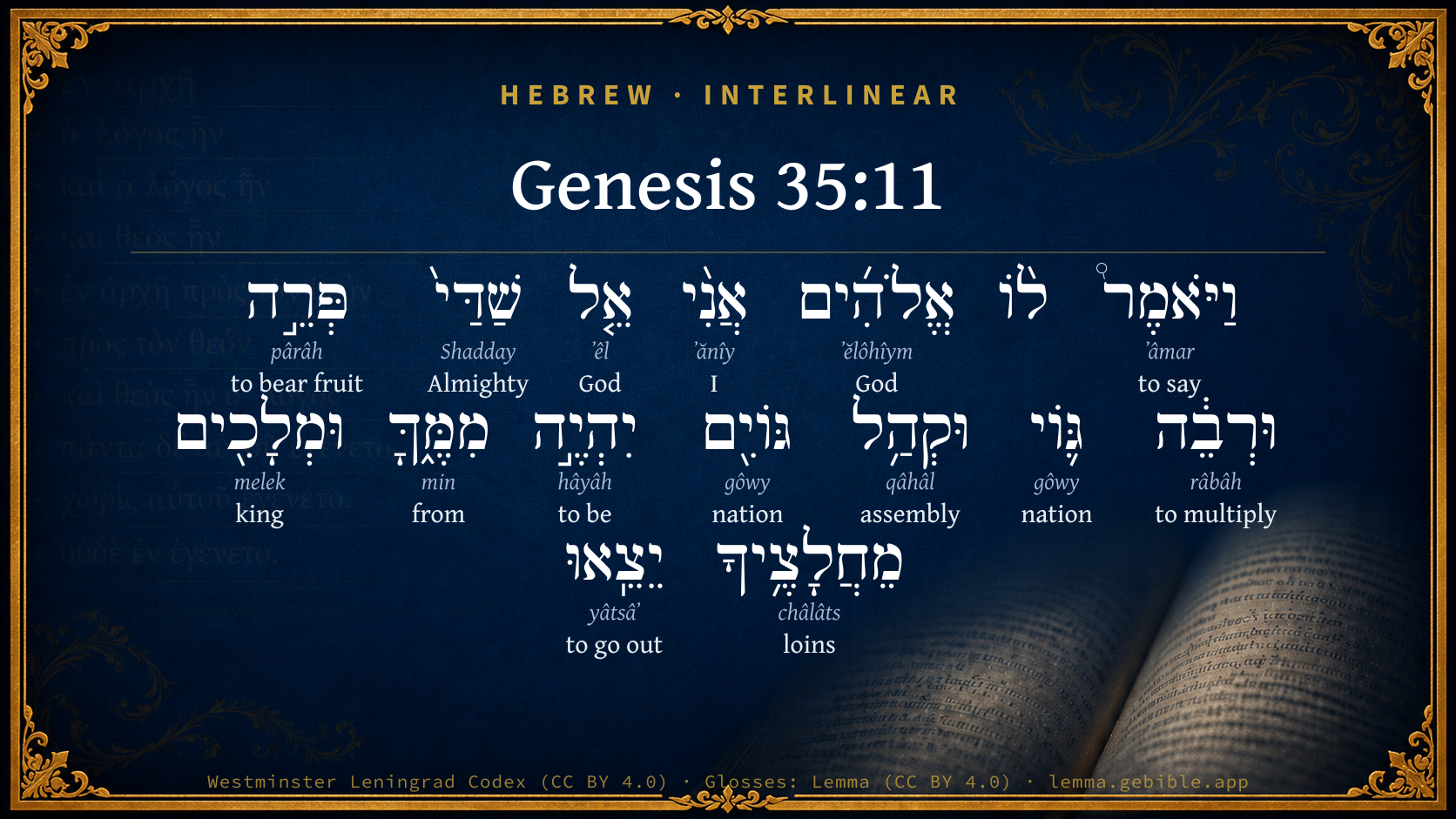
  1. וַיֹּאמֶר֩ ʼâmar H559 “and · to say” Conjunction + Verb, Qal, Sequential Imperfect, 3rd Person, Masculine, Singular
  2. אֱלֹהִ֜ים ʼĕlôhîym H430 “God(s)” Noun, Common, Masculine, Plural, Absolute
  3. אֲנִ֨י ʼănîy H589 “I” Pronoun, Personal, 1st Person, Common, Singular
  4. אֵ֤ל ʼêl H410 “God of” Noun, Common, Masculine, Singular, Construct
  5. שַׁדַּי֙ Shadday H7706 “Almighty” Noun, Proper
  6. פְּרֵ֣ה pârâh H6509 “bear fruit” Verb, Qal, Imperative, 2nd Person, Masculine, Singular
  7. וּרְבֵ֔ה râbâh H7235 “and · multiply” Conjunction + Verb, Qal, Imperative, 2nd Person, Masculine, Singular
  8. גּ֛וֹי gôwy H1471 “nation” Noun, Common, Masculine, Singular, Absolute
  9. וּקְהַ֥ל qâhâl H6951 “and · assembly of” Conjunction + Noun, Common, Masculine, Singular, Construct
  10. גּוֹיִ֖ם gôwy H1471 “nations” Noun, Common, Masculine, Plural, Absolute
  11. יִהְיֶ֣ה hâyâh H1961 “to be” Verb, Qal, Imperfect, 3rd Person, Masculine, Singular
  12. מִמֶּ֑ךָּ min H4480 “from · you” Preposition + Suffix, Personal, 2nd Person, Masculine, Singular
  13. וּמְלָכִ֖ים melek H4428 “and · kings” Conjunction + Noun, Common, Masculine, Plural, Absolute
  14. יֵצֵֽאוּ yâtsâʼ H3318 “to go out” Verb, Qal, Imperfect, 3rd Person, Masculine, Plural

About this verse

These counts appear in no published source. They are computed here, from the morphology-tagged text and Lemma’s own curated glosses. What Lemma adds →

16
words
14
distinct lemmas
Pentateuch
section

Notable vocabulary

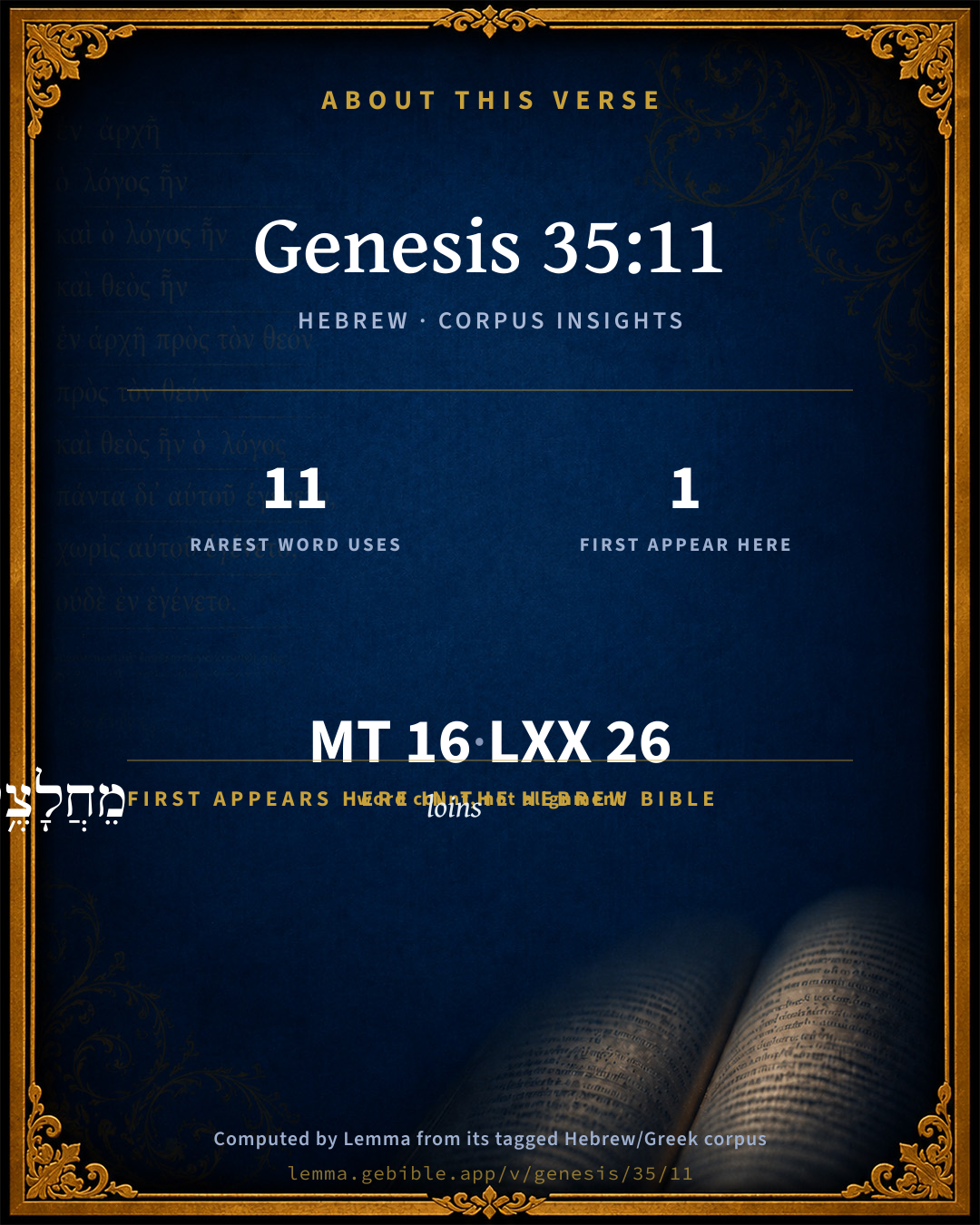
The rarest word here is מֵחֲלָצֶ֥יךָ loins H2504 — appearing just 11 times in the whole Hebrew Bible.

First appearance in Scripture

This word makes its first canonical appearance in the Hebrew Bible here:

  • מֵחֲלָצֶ֥יךָ loins H2504

Shared distinctive vocabulary

מֵחֲלָצֶ֥יךָ loins H2504 occurs in 10 verses of the Hebrew Bible. Also found in:

Grammatical profile

  • 5 verbs
  • 8 nouns
  • 1 pronoun
  • 2 prepositions

Verb forms

  • וַיֹּאמֶר֩ Qal · Sequential Imperfect
  • פְּרֵ֣ה Qal · Imperative
  • וּרְבֵ֔ה Qal · Imperative
  • יִהְיֶ֣ה Qal · Imperfect
  • יֵצֵֽאוּ Qal · Imperfect

Repetition

A word recurs within this verse — often emphatic in Hebrew:

  • גּ֛וֹי nation H1471 ×2

Hebrew & Septuagint length

In English translation the verse runs 31 words from the Hebrew and 30 from the Septuagint (LXX English) — closely comparable.

A rough comparison of the two English renderings, which tokenize alike — not a word-level alignment.

Word counts can differ between the Hebrew and the Greek without any difference in meaning — e.g. the Hebrew direct-object marker אֵת has no separate Greek word, and Greek often adds the article ὁ.

In the original languages it is 16 Hebrew tokens and 26 Greek tokens — but the two are counted differently (Hebrew bundles its prefixes and suffixes into one token; the Greek is in lemma form), so that isn’t a like-for-like length.

Cross-references

20

Topical passages linked to Genesis 35:11 in the Treasury of Scripture Knowledge — connected by theme and wording, ordered by reader-vote popularity; previews shown in the World English Bible.

  • Genesis 17:1 When Abram was ninety-nine years old, Yahweh appeared to Abram, and said to him, "I am God Almighty. Walk before me, and be blameless.
  • Genesis 9:1 God blessed Noah and his sons, and said to them, "Be fruitful, and multiply, and replenish the earth.
  • Genesis 22:17 that in blessing I will bless you, and in multiplying I will multiply your seed as the stars of the heavens, and as the sand which is on the seashore. Your seed will possess the gate of his enemies.
  • Genesis 17:5–7 Neither will your name any more be called Abram, but your name will be Abraham; for the father of a multitude of nations have I made you.
  • Exodus 6:3 and I appeared to Abraham, to Isaac, and to Jacob, as God Almighty; but by my name Yahweh I was not known to them.
  • 2 Corinthians 6:18 I will be to you a Father. You will be to me sons and daughters,' says the Lord Almighty."
  • Genesis 17:16 I will bless her, and moreover I will give you a son by her. Yes, I will bless her, and she will be a mother of nations. Kings of peoples will come from her."
  • Genesis 28:3–4 May God Almighty bless you, and make you fruitful, and multiply you, that you may be a company of peoples,
  • Genesis 12:2 I will make of you a great nation. I will bless you, and make your name great. You will be a blessing.
  • Genesis 15:5 Yahweh brought him outside, and said, "Look now toward the sky, and count the stars, if you are able to count them." He said to Abram, "So shall your seed be."
  • Genesis 18:18 seeing that Abraham has surely become a great and mighty nation, and all the nations of the earth will be blessed in him?
  • Genesis 28:14 Your seed will be as the dust of the earth, and you will spread abroad to the west, and to the east, and to the north, and to the south. In you and in your seed will all the families of the earth be blessed.
  • Genesis 32:12 You said, 'I will surely do you good, and make your seed as the sand of the sea, which can't be numbered because there are so many.'"
  • Genesis 43:14 May God Almighty give you mercy before the man, that he may release to you your other brother and Benjamin. If I am bereaved of my children, I am bereaved."
  • Exodus 1:7 The children of Israel were fruitful, and increased abundantly, and multiplied, and grew exceedingly mighty; and the land was filled with them.
  • Numbers 1:1–26 Yahweh spoke to Moses in the wilderness of Sinai, in the Tent of Meeting, on the first day of the second month, in the second year after they had come out of the land of Egypt, saying,
  • 1 Samuel 1:1–28 Now there was a certain man of Ramathaim Zophim, of the hill-country of Ephraim, and his name was Elkanah, the son of Jeroham, the son of Elihu, the son of Tohu, the son of Zuph, an Ephraimite:
  • Genesis 13:16 I will make your offspring as the dust of the earth, so that if a man can number the dust of the earth, then your seed may also be numbered.
  • Genesis 18:14 Is anything too hard for Yahweh? At the set time I will return to you, when the season comes round, and Sarah will have a son."
  • Genesis 48:3–4 Jacob said to Joseph, "God Almighty appeared to me at Luz in the land of Canaan, and blessed me,

Cross-references courtesy of OpenBible.info (CC BY 4.0).

Hebrew and Greek witnesses Masoretic Hebrew ↔ Greek Septuagint

The same verse in the two great witnesses to the Old Testament, shown verse-for-verse.

These are two independent witnesses, not word-aligned to each other, and the Septuagint is shown in lemma (dictionary) form.

Hebrew Genesis 35:11 Masoretic · Westminster Leningrad Codex

וַיֹּאמֶר֩ ל֨וֹ אֱלֹהִ֜ים אֲנִ֨י אֵ֤ל שַׁדַּי֙ פְּרֵ֣ה וּרְבֵ֔ה גּ֛וֹי וּקְהַ֥ל גּוֹיִ֖ם יִהְיֶ֣ה מִמֶּ֑ךָּ וּמְלָכִ֖ים מֵחֲלָצֶ֥יךָ יֵצֵֽאוּ

God said to him, "I am God Almighty. Be fruitful and multiply. A nation and a company of nations will be from you, and kings will come out of your loins.

World English Bible · Public Domain

Greek LXX Genesis 35:11 Septuagint · lemma form

εἶπον δέ αὐτός ὁ θεός ἐγώ ὁ θεός σύ αὐξάνω καί πληθύνω ἔθνος καί συναγωγή ἔθνος εἰμί ἐκ σύ καί βασιλεύς ἐκ ὁ ὀσφύς σύ ἐκἔρχομαι

And God said to him, I am your God; increase and multiply; for nations and gatherings of nations shall be of you, and kings shall come out of your loins.

LXX2012 (modern English Septuagint) · Public Domain

Hebrew: Westminster Leningrad Codex (CC BY 4.0). Greek: Septuagint (public domain); English from LXX2012 (modern English Septuagint) (Public Domain). How the Septuagint differs from the Hebrew →

Targum (Aramaic paraphrase)

2

The Targum is the ancient Jewish Aramaic paraphrase of the Hebrew Scriptures — an interpretive translation, not the Hebrew text itself. Onkelos (literal) and Pseudo-Jonathan (expansive) render the Torah, and Jonathan the Prophets. Coverage is partial: where no permissively-licensed English translation exists for a verse, only the Aramaic is shown. This is verse-level text, not a word-by-word alignment to the Hebrew.

  1. Targum Onkelos Torah (Genesis–Deuteronomy)
    וַאֲמַר לֵהּ יְיָ אֲנָא אֵל שַׁדַּי פּוּשׁ וּסְגֵי עַם וְכִנְשַׁת שִׁבְטִּין יְהֵא מִנָּךְ וּמַלְכִין דְשַׁלִּיטִין בְּעַמְמַיָּא מִנָּךְ יִפְקוּן

    (no public-domain English translation for this verse)

    Targum Onkelos — Aramaic: “Onkelos Genesis” (public domain); “Onkelos Exodus” (public domain); “Onkelos Leviticus” (public domain); “Onkelos Numbers” (public domain); “Onkelos Deuteronomy” (public domain). English: “Sefaria Community Translation” (CC0 1.0 (public-domain dedication)); “J.W. Etheridge. The Targums of Onkelos and Jonathan Ben Uzziel on the Pentateuch. London: Longmans, Green, 1862” (public domain). Text via Sefaria.

  2. Targum Pseudo-Jonathan Torah (Genesis–Deuteronomy)
    וַאֲמַר לֵיהּ יְיָ אֲנָא אֵל שַׁדַי פּוּשׁ וּסְגִי עַם קַדִישׁ וְכִינְשַׁן נְבִיאִין וְכַהֲנִין יְהוֹן מִבְּנָךְ דְאוֹלֵידְתָּא וּתְרֵין מַלְכִין תּוּב מִינָךְ יִפְקוּן

    And the Lord said to him, I am El Shadai: spread forth and multiply; a holy people, and a congregation of prophets and priests, shall be from thy sons whom thou hast begotten, and two kings shall yet from thee go forth.

    Targum Pseudo-Jonathan — Aramaic: “Targum Jonathan on Genesis” (public domain); “Targum Jonathan on Exodus” (public domain); “Targum Jonathan on Leviticus” (public domain); “Targum Jonathan on Numbers” (public domain); “Targum Jonathan on Deuteronomy” (public domain). English: “The Targum of Jonathan ben Uzziel, trans. J. W. Etheridge, London, 1862” (public domain). Text via Sefaria.

Commentary

Notes on Genesis 35:11 from classic Christian and Jewish commentators (each source and its license shown beneath its notes). The classic Christian expositions comment on the surrounding passage and are grouped to its opening verse, so a note may address several verses; the Jewish commentaries on the Tanakh (Rashi and others) are per-verse, so they appear only where the commentator wrote on this verse.

Lemma curates 59 commentaries, every one of them public domain or Creative Commons licensed, each selected and text-cleaned for this edition rather than reprinted as found. About our sources →

Trapp's Complete Commentary

John Trapp

Gen 35:11 And God said unto him, I [am] God Almighty: be fruitful and multiply; a nation and a company of nations shall be of thee, and kings shall come out of thy loins;

Ver. 11. I am God Almighty.] This is hardly persuaded; and yet it is the ground of all true comfort and spiritual security. We are apt to measure things according to our own model, as to think God so powerful as our understanding can reach, &c. But, for a finite creature to believe the infinite all-sufficiency of God, he is not able to do it thoroughly without supernatural grace; nor can he be soundly comforted till he comes to comprehend it. Of his will to do us good we doubt not, till, in some measure, we doubt of his power to help.

John Trapp, A Commentary or Exposition upon All the Books of the Old and New Testament (1647–1656) — public domain. Text from a community e-Sword module.

The Biblical Illustrator

Joseph S. Exell

Gen_35:11

I am God Almighty

Gods arm sufficient

In like manner God has spoken to Abraham: He had said, I am the Almighty God; walk before Me and be thou upright.

The declaration of almightiness is, according to the sacred narrative, the first declaration of God concerning Himself. A sense of power is one of the first endowments to which we awaken. Almightiness is power without limit. God cannot lie, He cannot be tempted with evil, He cannot act contrary to His own nature, but He can do all that He wills to do.

1. God can create. He can create what He wills, when He pleases, as He will, and for His own pleasure. He has created all things--all matter, all spirit.

2. God can create, and He can make, that is, adapt, fashion, mould, and organise all these materials. We can make, but we cannot create; God can do both.

3. God can control all He makes and creates. God can over-rule; He can create, and make, and control, and He can over-rule. For example, He can permit His image on earth to be broken, and then repair the ruin, and make the ruined image much more glorious than the primitive likeness. This is over-ruling. He can allow sin to enter the world without Himself being chargeable with the entrance of that sin; and He can take it away by an all-sufficient sacrifice. He can suffer all nations to walk for a time in their own ways, and then He can restore them to the paths of righteousness.

4. God can destroy. He can blot out all races and classes of creatures, as He has done on our planet. He can reduce the world to chaos, or burn it with fire, and resolve it into its original elements. He can cause them to fly as vapours through space afterwards. Often has He destroyed cities, and their memorial has perished with them, and perhaps has He destroyed worlds.

5. God can retain His own life from everlasting to everlasting. I am, saith He, that I am. There is no limit put to Gods power by decay or by death, or by any prospect or fear of such dissolution. No plan is contracted, no work is interrupted.

6. Every attribute of God is a power. His infinity is the fulness of power; His eternity the continuance of power; His spirituality the highest kind of power, power inexhaustible and incapable of weariness. There is power in His knowledge. If there is power in our limited information, what power there must be in the knowledge that embraces all things. There is power in His wisdom, power in His love, power in His blessedness, power in the happiness, and power in the peace of God. There is power in Gods own sense of power. There is power in all that constitutes His goodness. God has no weakness, or shadow of impotency; none from the presence of any evil, and none from the absence of any good; no fear, no remorse, no doubt, no hesitance, no suspicion, no imperfection. To God all things are possible. Is anything too hard for Him?

7. God can redeem. Such was the sufficiency of God for this work, that He so loved the world as to give His only Son, that whosoever believeth on Him should not perish, but have everlasting life. And in the application of the provisions of this redemption, what do we see? We see men born again; so great is Gods power, that we find in connection with the Christian dispensation, there is new creation--old things passing away, all thing becoming new. This dispensation finds men dead in sin; it leaves them quickened. It finds them grovelling on the earth like wounded worms; and it fits them to fly in the heavens as with the wings of the eagle. Brethren, fear to rebel against this God Almighty. How vain is your resistance and your defiance. What if you set Him at naught! You may judge as to the issue; who will prevail--you, a mortal, dust and ashes, or this God Almighty; (S. Martin.)

The Biblical Illustrator, edited by Joseph S. Exell (c. 1880s–1900s) — public domain. Text from a community e-Sword module.

Tyndale Open Study Notes

Tyndale Open Resources

35:11-12 God’s reference to himself as God Almighty assured Jacob that his promise could and would be fulfilled. At Bethel, God had promised that Jacob would have descendants in the land (cp. 28:13-14); here he added that his descendants would include kings (see 17:6).

Tyndale Open Study Notes — © Tyndale Open Resources, licensed CC BY-SA 4.0. Text via the HelloAO Bible API.

Geneva Bible (1599)

Geneva Bible translators

Or, almighty.

Geneva Bible (1599) marginal notes — public domain. Text via Bolls.life.

John Calvin's Commentaries

11. I am God Almighty. God here, as elsewhere, proclaims his own might, in order that Jacob may the more certainly rely on his faithfulness. He then promises that he will cause Jacob to increase and multiply, not only into one nation, but into a multitude of nations. When he speaks of “a nation,” he no doubt means that the offspring of Jacob should become sufficiently numerous to acquire the body and the name of one great people. But that follows concerning “nations” may appear absurd; for if we wish it to refer to the nations which, by gratuitous adoption, are inserted into the race of Abraham, the form of expression is improper: but if it be understood of sons by naturals descent, then it would be a curse rather shall a blessing, that the Church, the safety of which depends on its unity, should be divided into many distinct nations. But to me it appears that the Lord, in these words, comprehended both these benefits; for when, under Joshua, the people was apportioned into tribes, as if the seed of Abraham was propagated into so many distinct nations; yet the body was not thereby divided; it is called an assembly of nations, for this reason, because in connection with that distinction a sacred unity yet flourished. The language also is not improperly extended to the Gentiles, who, having been before dispersed, are collected into one congregation by the bond of faith; and although they were not born of Jacob according to the flesh; yet, because faith was to them the commencement of a new birth, and the covenant of salvation, which is the seed of spiritual birth, flowed from Jacob, all believers are rightly reckoned among his sons, according to the declaration, I have constituted thee a father of many nations.

And kings shall come out of thy loins. This, in my judgment, ought properly to be referred to David and his posterity; for God did not approve of the kingdom of Saul, and therefore it was not established; and the kingdom of Israel was but a corruption of the legitimate kingdom. I acknowledge truly that, sometimes, those things which have sprung from evil sources are numbered among God’s benefits; but because here the simple and pure benediction of God is spoken of, I willingly understand it of David’s successors only. Finally; Jacob is constituted the lord of the land, as the sole heir of his grandfather Abraham, and of his father Isaac; for the Lord manifestly excludes Esau from the holy family, when he transfers the dominion of the land, by hereditary right, to the posterity of Jacob alone.

John Calvin's Commentaries (1540-1563) — public domain. Text from the Calvin Translation Society English edition (1840s-50s) via the Christian Classics Ethereal Library (ccel.org). Calvin's coverage is partial (roughly two-thirds of the Bible); uncommented books and verses are honest gaps, never fabricated. The 19th-century editor's footnotes and remarks are omitted so the notes are faithfully Calvin's own voice.

Ellicott's Commentary for English Readers

(11) God Almighty.—Heb., El-shaddai, the name by which God had entered into the covenant with Abraham (Gen_17:1).

A company.—Heb., a congregation of nations. (See Gen_28:3, where it is “a congregation,” or church, “of peoples.”)

A Bible Commentary for English Readers, edited by Charles John Ellicott (1878–1897) — public domain. Text from a community e-Sword module.

The Cambridge Bible for Schools and Colleges

gen. ed. J. J. S. Perowne

11. God Almighty] Heb. El Shaddai. See note on Gen_17:1. The phrases in this verse, “God Almighty,” “be fruitful and multiply,” “company of nations,” are characteristic of P’s style.

a nation, &c.] Cf. the promises in Gen_17:5-6; Gen_17:16. Here the mention of “kings” renews the promise to Sarah in Gen_17:16 (P).

The Cambridge Bible for Schools and Colleges (gen. ed. J. J. S. Perowne; Cambridge University Press, 1878–1918) — public domain. Text from a community e-Sword module.

John Gill's Exposition

And God said unto him, I am God Almighty,.... And so able to protect and defend him, and to fulfil all promises made to him, and to supply him with everything he wanted; being, as some choose to render the word, "God all sufficient", having a sufficiency of all good things in him to communicate to his people:

be fruitful and multiply; which carries in it a promise or prophecy that he should increase and multiply, though not he himself personally, he having but one son born after this, yet in his posterity:

a nation, and a company of nations, shall be of thee; the nation of Israel, called so after his name, and the twelve tribes, which were as so many nations, of which the above nation consisted:

and kings shall come out of thy loins; as Saul, David, Solomon, and, many others, who were kings of Israel and of Judah, and especially the King Messiah; yea, all his posterity were kings and priests, or a kingdom of priests, Exo 19:6.

John Gill's Exposition of the Whole Bible (1746–1763) — public domain (CC PDM 1.0). Text via the HelloAO Bible API.

Matthew Poole's English Annotations

A company of nations, tribes, for number and power, equal to so many nations,

shall come out of thy loins, i.e. shall be begotten by thee, as this phrase is taken also in Gen 46:26; 1Ki 8:19; Act 2:30.

Matthew Poole's English Annotations on the Holy Bible (1683–1685) — public domain. Text from a community e-Sword/MySword module.

The Pulpit Commentary

Vers. 11, 12. And God said unto him (repeating substantially the promises made to Abraham), I am God Almighty: El Shaddai (cf. Gen_17:1) be fruitful and multiply; and Isaac had each only one son of promise; but now the time of increase was come" (Murphy; cf. Gen_1:28) a nation and a company of nations shall be of thee (cf., Gen_17:5 Gen_28:3) and kings shall come out of thy loins (cf.; Gen_17:6, Gen_17:16) and the land which I gave Abraham and Isaac, (vide Gen_12:7 Gen_13:15 Gen_26:3, Gen_26:4) to thee I will give it, (cf. Gen_28:13) and to thy seed after thee will I give the land. The time of their entering on possession was specified to Abraham. (Gen_15:16)

The Pulpit Commentary (1880–1919), ed. H.D.M. Spence-Jones & Joseph S. Exell — public domain. Text from a community e-Sword module.

John Wesley's Explanatory Notes

He renewed and ratified the covenant with him, by the name of El-Shaddai, I am God Almighty. God All-sufficient, able to make good the promise in due time, and to support thee and provide for thee. Two things are promised him. 1. That he should be the father of a great nation: great in number, a company of nations shall be of thee - Every tribe of Israel was a nation, and all the twelve, a company of nations: great in honour and power, kings shall come out of thy loins. 2. That he should be master of a good land, ver. 12. The land that was given to Abraham and Isaac is here entailed on Jacob and his seed. These two promises had also a spiritual signification, which we may suppose Jacob himself had some notion of: for without doubt Christ is the promised seed, and heaven is the promised land; the former is the foundation, and the latter the top-stone of all God's favours.

John Wesley, Explanatory Notes Upon the Whole Bible (1754–1765) — public domain. Text via the GEBible commentary corpus.

unfoldingWord translationNotes

Door43 World Missions Community

God said to him

"God said to Jacob"

Be fruitful and multiply

God told Jacob to produce children so that there would be many of them. The word "multiply" explains how he was to be "fruitful." See how you translated this in Genesis 1:22. (See: Doublet and Idiom)

A nation and a company of nations will come from you

Here "nation" and "nations" refer to Jacob's descendants who will establish these nations. (See: Metonymy)

God went up from him

Here "went up" is used because where God dwells is typically thought of as being up or above the world. AT: "God left him"

translationWords

Almighty

fruit

multiply

nation

king

descend

Abraham

Isaac

unfoldingWord translationNotes — © Distant Shores Media and the Door43 World Missions Community, licensed CC BY-SA 4.0. Source: git.door43.org/Door43/en_tn.

Rashi

Rabbi Shlomo Yitzchaki (Rashi)

אני אל שדי I AM GOD, ALMIGHTY, for I have the power to bless because the blessings are Mine.

פרה ורבה BE FRUITFUL AND MULTIPLY — God said this in allusion to the fact that Benjamin was not yet born although she (Rachel) was soon to give birth to him (Genesis Rabbah 82:4).

גוי A NATION — referring to Benjamin. (Genesis Rabbah 82:4)

גוים NATIONS — referring to Manasseh and Ephraim who would come from Joseph — and these actually were counted as tribes.

ומלכים AND KINGS — referring to Saul and Ishbosheth who were of the tribe of Benjamin and these were not yet born. This verse Abner explained in this sense when he made Ishbosheth king, and the tribes of Israel also explained it thus and therefore became friendly again with the tribe of Benjamin. For so it is written (Judges 21:1) “They said there shall not any of us give his daughter unto Benjamin to wife”. Afterwards they retracted this, saying, “If, indeed, he was not to be counted among the tribes), the Holy One, blessed be He would not have said to Jacob in reference to Benjamin and kings shall come out of thy loins” (and since there have not yet been kings of the tribe of Benjamin that tribe must not be exterminated). Genesis Rabbah 82:4

גוי וקהל גוים “A NATION AND AN ASSEMBLAGE OF NATIONS” — this means that his sons are destined to become nations the same in number as the nations (of the ancient world) which was seventy. So, too, the whole Sanhedrin consisted of seventy. Another explanation is that it signifies that his children will sacrifice on high places at a time when this practice is forbidden, as other nations always did — this refers to the days of Elijah (Genesis Rabbah 82:5). From “This verse” is found in an old text of Rashi.)

Rashi on the Tanakh — English translations: “The Judaica Press complete Tanach with Rashi, translated by A. J. Rosenberg” (CC BY 4.0); “Pentateuch with Rashi's commentary by M. Rosenbaum and A.M. Silbermann, 1929-1934” (public domain); “The Metsudah Tanach series, Lakewood, N.J” (CC BY 4.0); and “The Book of Joshua, Metsudah Publications, 1997” (CC BY 4.0). Text via Sefaria.

Sforno

Rabbi Ovadia Sforno

Be fruitful and increase. Do not be afraid that your offspring will be destroyed, even if they are imperfect, because the name “Almighty Shakkai” indicates that I keep My word even to the unworthy.

Sforno on the Tanakh — English translation: “Yalkut, Sifsei Chachomim Chumash, Metsudah Publications, 2009” (CC BY 4.0). Text via Sefaria.

Radak

Rabbi David Kimhi (Radak)

ויאמר...אני א-ל שדי; strong and self-sufficient, able to guide all of history, in charge of all developments. We explained this on 17,1. The three matriarchs had all been genetically barren, and G’d overcame their genetic handicaps so that each bore children. This was a display of the attribute א-ל שדי at work.

פרה ורבה, (a promise) you will be fruitful and you will multiply. We explained this in connection with Genesis 1,22. G’d gave a similar promise to Avraham in 17,7 where the promise applied to Avraham’s offspring. Seeing that Yaakov did not have another child after this blessing was pronounced, it is clear that in his case just as in Avraham’s case the promise applied to the next generation, i.e. all of Yaakov’s children were included in this blessing.

גוי וקהל גוים, they will all belong to one distinctive nation. This is stated in Chronicles I 17,21 ומי כעמך ישראל גוי אחד בארץ, “and who is like Your people Israel, a unique nation on earth?” This nation will develop into a community of nations i.e. 12 tribes including the son that is about to be born to you now. ומלכים, as per its plain meaning, i.e. “kings.” Basically G’d blessed Yaakov with the same blessing as the one He had bestowed on Avraham, seeing Yaakov was Avraham’s special seed. [of Avraham’s 8 sons, only Yaakov carried on the tradition. Ed.] In Bereshit Rabbah 82,4 our verse is understood as referring specifically to Rachel’s sons. The word גוי is understood as referring to Binyamin, whereas the words קהל גוים are understood as referring to Menashe and Ephrayin, whereas the word מלכים is understood as referring to the two kings from the tribe of Binyamin, Sha-ul and Ish Boshet. Is it possible that Avner who was a righteous man should have rejected the Kingdom of David and appointed Ish Boshet instead? We must answer that he found this Midrash and based himself on that, appointing a king who was a descendant of Binyaim. [and who would be putty in his hands. Ed.]

Radak on the Tanakh — English translations: “Sefaria Community Translation” (CC0 1.0 (public-domain dedication)); “Eliyahu Munk, HaChut Hameshulash” (CC BY 4.0); “Rabbi Mike Feuer, Jerusalem Anthology” (CC BY 4.0); and “R. David Kimhi on the first book of Psalms, Translated by R.G. Finch, London, 1919” (public domain). Text via Sefaria.

Lesson kit

Teaching starters — assembled from the data on this page, not authored interpretation. Every prompt links to the verse data it draws on. Edit before teaching.

Genesis, in the Pentateuch, opens this verse with 16 words (14 distinct Hebrew lemmas). Its most distinctive word is châlâts (“loins”). A historical commentator’s framing appears above. Read the whole chapter for the surrounding context.

Discussion questions

  1. How does “loins” (châlâts) shape what this verse is saying?
  2. The word “loins” first appears here in Scripture. What is being introduced at this debut?
  3. 1 Kings 8:19 shares the word «loins» with this verse. How do the two illuminate each other?
  4. “nation” occurs 2× in this one verse. What is the effect of the repetition?
  5. These translations render this verse differently. What is at stake in choosing one wording over another?
  6. The verb «וַיֹּאמֶר֩» is Qal Sequential Imperfect. How does its form color the action?
  7. Reading how Trapp's Complete Commentary and The Biblical Illustrator read this verse, where do the two commentators agree and where do they part?

Things to notice

Reading settings

Reading text

Shown beneath each verse's original-language words.

Old Testament
Old Testament edition

Read the OT as the Masoretic Hebrew (MT) or the Greek Septuagint (LXX).

English shown for the Greek Septuagint (in the Hebrew ↔ Greek comparison).

Comparing translations? Open the Compare panel on any verse page to stack up to four side by side.