
Leviticus 23:22

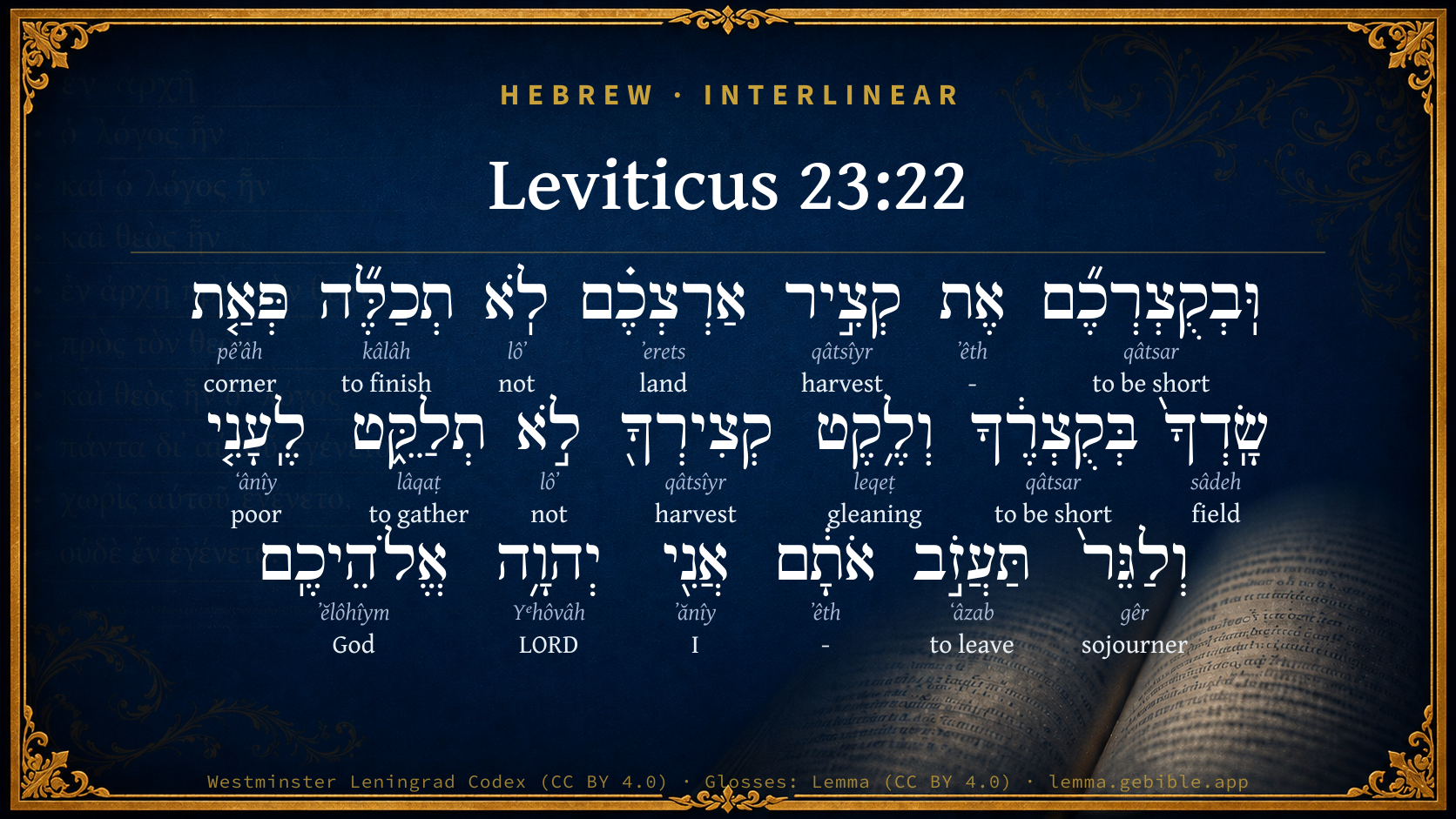
Hebrew (Westminster Leningrad Codex) Leviticus 23:22 appears in the Hebrew Old Testament. The text above is from the Westminster Leningrad Codex. Each word links to its Strong’s number, a concise gloss, and parsing drawn from the Open Scriptures Hebrew Bible morphology. Click any word for its full Brown-Driver-Briggs (BDB) entry.
Download image
Cite this verse

Leviticus 23:22 (World English Bible). Public Domain. Lemma interlinear Bible study tool, https://lemma.gebible.app/v/leviticus/23/22.

Show BibTeX & RIS
BibTeX
RIS
English Translation
"'When you reap the harvest of your land, you shall not wholly reap into the corners of your field, neither shall you gather the gleanings of your harvest: you shall leave them for the poor, and for the foreigner. I am Yahweh your God.'"
World English Bible · Public Domain
Download a study sheet

One document with this verse’s original text, its word-by-word gloss line, the meaning frame, cross-references with their text, attributed commentary, and full source and license credits — printable, and it pastes into notes with its structure intact.

This verse Autodidact and up

Study sheet (.html) Plain text (.txt)

A passage Seminary Student

Up to 50 verses in one chapter. A passage sheet keeps up to 6 commentary sources and 12 cross-references per verse, in the order this page ranks them, and says so on the sheet whenever that leaves anything out. Ask for a single verse and you get the Autodidact verse sheet above.

Everything on this page stays free to read, with no account — the sheet is a download of what is already on screen, not access to it.

Want to remove ads? Support Godless Engineer
Compare translations 3

The same verse in 3 English versions, stacked beneath the original-language interlinear above. Click any original word for its lexicon entry.

Each is an independent rendering of the whole verse — the interlinear is not word-aligned to these translations.

Highlighted words mark where these versions differ — a whole-verse word diff, not a word-by-word alignment.

  • World English Bible Public Domain
    "'When you reap the harvest of your land, you shall not wholly reap into the corners of your field, neither shall you gather the gleanings of your harvest: you shall leave them for the poor, and for the foreigner. I am Yahweh your God.'"
  • King James Version Public Domain
    And when ye reap the harvest of your land, thou shalt not make clean riddance of the corners of thy field when thou reapest, neither shalt thou gather any gleaning of thy harvest: thou shalt leave them unto the poor, and to the stranger: I am the LORD your God.
  • unfoldingWord Literal Text CC BY-SA 4.0
    And when you harvest the harvest of your land, you shall not finish the edge of your field in your harvesting, and you shall not glean the gleaning of your harvest. For the poor and for the foreigner you shall leave them. I Yahweh your God.’”

unfoldingWord Literal Text — © unfoldingWord, licensed CC BY-SA 4.0. Word-aligned USFM3 via Door43 (git.door43.org/unfoldingWord/en_ult).

Versions to compare (up to 4)

3 of 4 selected

Show all 18 translations

Every available English version of this verse, each an independent rendering of the whole verse.

  • World English Bible Public Domain
    "'When you reap the harvest of your land, you shall not wholly reap into the corners of your field, neither shall you gather the gleanings of your harvest: you shall leave them for the poor, and for the foreigner. I am Yahweh your God.'"
  • Berean Standard Bible Public Domain
    When you reap the harvest of your land, do not reap all the way to the edges of your field or gather the gleanings of your harvest. Leave them for the poor and the foreign resident. I am the LORD your God.’”
  • Majority Standard Bible Public Domain
    When you reap the harvest of your land, do not reap all the way to the edges of your field or gather the gleanings of your harvest. Leave them for the poor and the foreign resident. I am the LORD your God.’”
  • King James Version Public Domain
    And when ye reap the harvest of your land, thou shalt not make clean riddance of the corners of thy field when thou reapest, neither shalt thou gather any gleaning of thy harvest: thou shalt leave them unto the poor, and to the stranger: I am the LORD your God.
  • American Standard Version (1901) Public Domain
    And when ye reap the harvest of your land, thou shalt not wholly reap the corners of thy field, neither shalt thou gather the gleaning of thy harvest: thou shalt leave them for the poor, and for the sojourner: I am Jehovah your God.
  • Revised Version (1885) Public Domain
    And when ye reap the harvest of your land, thou shalt not wholly reap the corners of thy field, neither shalt thou gather the gleaning of thy harvest: thou shalt leave them for the poor, and for the stranger: I am the LORD your God.
  • Geneva Bible (1599) Public Domain
    And when you reape the haruest of your land, thou shalt not rid cleane the corners of thy field when thou reapest, neither shalt thou make any aftergathering of thy haruest, but shalt leaue them vnto the poore and to the stranger: I am the Lord your God.
  • Douay-Rheims (1899) Public Domain
    And when you reap the corn of your land, you shall not cut it to the very ground: neither shall you gather the ears that remain; but you shall leave them for the poor and for the strangers. I am the Lord your God.
  • Young's Literal Translation Public Domain
    `And in your reaping the harvest of your land thou dost not complete the corner of thy field in thy reaping, and the gleaning of thy harvest thou dost not gather, to the poor and to the sojourner thou dost leave them; I Jehovah `am' your God.'
  • Literal Standard Version CC BY-SA 4.0
    And in your reaping the harvest of your land you do not complete the corner of your field in your reaping, and you do not gather the gleaning of your harvest, you leave them for the poor and for the sojourner; I [am] your God YHWH.”
  • Unlocked Literal Bible CC BY-SA 4.0
    When you reap the harvest of your land, you must not completely reap the corners of your fields, and you must not gather the gleanings of your harvest. You must leave them for the poor and for the foreigner. I am Yahweh your God.'”
  • unfoldingWord Literal Text CC BY-SA 4.0
    And when you harvest the harvest of your land, you shall not finish the edge of your field in your harvesting, and you shall not glean the gleaning of your harvest. For the poor and for the foreigner you shall leave them. I Yahweh your God.’”
  • Darby Bible Public Domain
    And when ye reap the harvest of your land, thou shalt not in thy harvest entirely reap the corners of thy field, and the gleaning of thy harvest shalt thou not gather: thou shalt leave them unto the poor and to the stranger: I am Jehovah your God.
  • World Messianic Bible Public Domain
    “‘When you reap the harvest of your land, you must not wholly reap into the corners of your field. You must not gather the gleanings of your harvest. You must leave them for the poor and for the foreigner. I am the LORD your God.’”
  • Webster's Bible Public Domain
    And when ye reap the harvest of your land, thou shalt not make clean riddance of the corners of thy field when thou reapest, neither shalt thou gather any gleaning of thy harvest: thou shalt leave them to the poor, and to the stranger: I am the LORD your God.
  • Free Bible Version CC BY-SA 4.0
    When you harvest the crops grown on your land, don't harvest right up to the edges of your field, or collect what has been missed. Leave them for the poor people and foreigners. I am the Lord your God.”
  • Bible in Basic English Public Domain
    And when you get in the grain from your land, do not let all the grain at the edges of the field be cut, and do not take up the grain which has been dropped in the field; let that be for the poor, and for the man from another country: I am the Lord your God.
  • JPS Tanakh (1917) Public Domain
    And when ye reap the harvest of your land, thou shalt not wholly reap the corner of thy field, neither shalt thou gather the gleaning of thy harvest; thou shalt leave them for the poor, and for the stranger: I am the LORD your God.

Literal Standard Version (2020), Covenant Press — licensed CC BY-SA 4.0. Text via the HelloAO Bible API (eBible.org). Unlocked Literal Bible (unfoldingWord) — licensed CC BY-SA 4.0. Text via the HelloAO Bible API (eBible.org). unfoldingWord Literal Text — © unfoldingWord, licensed CC BY-SA 4.0. Word-aligned USFM3 via Door43 (git.door43.org/unfoldingWord/en_ult). Free Bible Version, Dr. Jonathan Gallagher — licensed CC BY-SA 4.0. Text via the HelloAO Bible API (eBible.org).

Word by word

More ways to search: Search by grammar → Find every occurrence → Compare this word →

Practice this passage: Drill this verse → Learn its vocabulary →

וְלֶ֥קֶט
leqeṭ
H3951
“and · gleaning of”
Conjunction + Noun, Common, Masculine, Singular, Construct
Part of Speech
Conjunction + Noun
Type
Common
Gender
Masculine
Number
Singular
State
Construct
Full BDB Definition

Origin: from H3950

TWOT: 1125a

gleaning
  1. וּֽבְקֻצְרְכֶ֞ם qâtsar H7114 “and · in/at · to be short · you” Conjunction + Preposition + Verb, Qal, Infinitive Construct + Suffix, Personal, 2nd Person, Masculine, Plural
  2. אֶת ʼêth H853 “-” Particle, Direct Object
  3. קְצִ֣יר qâtsîyr H7105 “harvest of” Noun, Common, Masculine, Singular, Construct
  4. אַרְצְכֶ֗ם ʼerets H776 “land · your” Noun, Common, Both, Singular, Construct + Suffix, Personal, 2nd Person, Masculine, Plural
  5. לֹֽא lôʼ H3808 “not” Particle, Negative
  6. תְכַלֶּ֞ה kâlâh H3615 “to finish” Verb, Piel, Imperfect, 2nd Person, Masculine, Singular
  7. פְּאַ֤ת pêʼâh H6285 “corner of” Noun, Common, Feminine, Singular, Construct
  8. שָֽׂדְךָ֙ sâdeh H7704 “field · your” Noun, Common, Masculine, Singular, Construct + Suffix, Personal, 2nd Person, Masculine, Singular
  9. בְּקֻצְרֶ֔ךָ qâtsar H7114 “in/at · to be short · you” Preposition + Verb, Qal, Infinitive Construct + Suffix, Personal, 2nd Person, Masculine, Singular
  10. קְצִירְךָ֖ qâtsîyr H7105 “harvest · your” Noun, Common, Masculine, Singular, Construct + Suffix, Personal, 2nd Person, Masculine, Singular
  11. לֹ֣א lôʼ H3808 “not” Particle, Negative
  12. תְלַקֵּ֑ט lâqaṭ H3950 “to gather” Verb, Piel, Imperfect, 2nd Person, Masculine, Singular
  13. לֶֽעָנִ֤י ʻânîy H6041 “to/for the · poor” Preposition, Determined + Adjective, Adjective, Masculine, Singular, Absolute
  14. וְלַגֵּר֙ gêr H1616 “and · to/for the · sojourner” Conjunction + Preposition, Determined + Noun, Common, Masculine, Singular, Absolute
  15. תַּעֲזֹ֣ב ʻâzab H5800 “to leave” Verb, Qal, Imperfect, 2nd Person, Masculine, Singular
  16. אֹתָ֔ם ʼêth H853 “- · them” Particle, Direct Object + Suffix, Personal, 3rd Person, Masculine, Plural
  17. אֲנִ֖י ʼănîy H589 “I” Pronoun, Personal, 1st Person, Common, Singular
  18. יְהוָ֥ה Yᵉhôvâh H3068 “LORD” Noun, Proper
  19. אֱלֹהֵיכֶֽם ʼĕlôhîym H430 “God(s) · your” Noun, Common, Masculine, Plural, Construct + Suffix, Personal, 2nd Person, Masculine, Plural

About this verse

These counts appear in no published source. They are computed here, from the morphology-tagged text and Lemma’s own curated glosses. What Lemma adds →

20
words
16
distinct lemmas
Pentateuch
section

Notable vocabulary

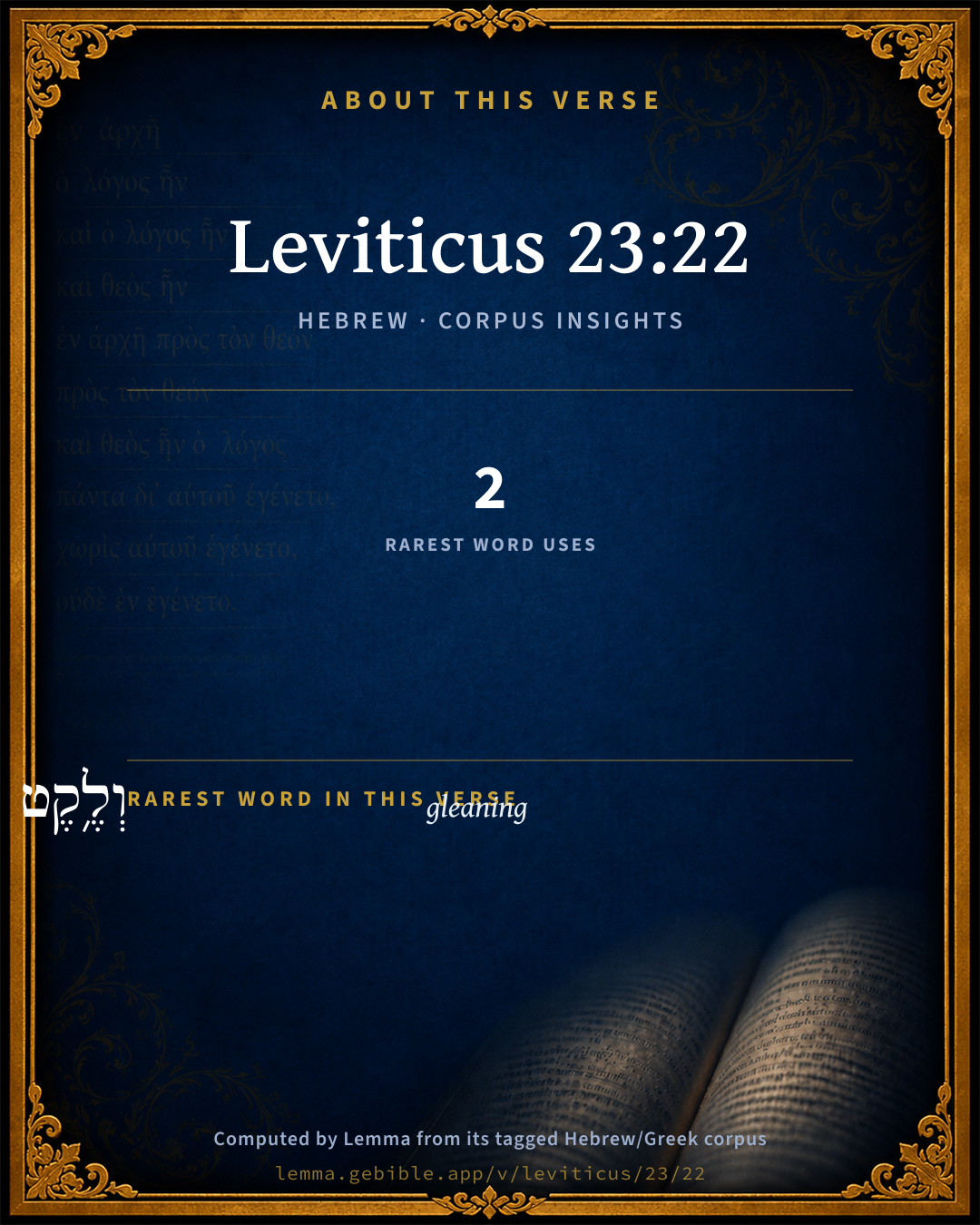
The rarest word here is וְלֶ֥קֶט gleaning H3951 — appearing just 2 times in the whole Hebrew Bible.

Shared distinctive vocabulary

וְלֶ֥קֶט gleaning H3951 occurs in 2 verses of the Hebrew Bible. Also found in:

Grammatical profile

  • 5 verbs
  • 9 nouns
  • 1 adjective
  • 1 pronoun
  • 4 particles

Verb forms

  • וּֽבְקֻצְרְכֶ֞ם Qal · Infinitive Construct
  • תְכַלֶּ֞ה Piel · Imperfect
  • בְּקֻצְרֶ֔ךָ Qal · Infinitive Construct
  • תְלַקֵּ֑ט Piel · Imperfect
  • תַּעֲזֹ֣ב Qal · Imperfect

Repetition

Words recur within this verse — often emphatic in Hebrew:

  • וּֽבְקֻצְרְכֶ֞ם to be short H7114 ×2
  • קְצִ֣יר harvest H7105 ×2
  • לֹֽא not H3808 ×2

Hebrew & Septuagint length

In English translation the verse runs 44 words from the Hebrew and 53 from the Septuagint (LXX English) — closely comparable.

A rough comparison of the two English renderings, which tokenize alike — not a word-level alignment.

Word counts can differ between the Hebrew and the Greek without any difference in meaning — e.g. the Hebrew direct-object marker אֵת has no separate Greek word, and Greek often adds the article ὁ.

Cross-references

13

Topical passages linked to Leviticus 23:22 in the Treasury of Scripture Knowledge — connected by theme and wording, ordered by reader-vote popularity; previews shown in the World English Bible.

  • Leviticus 19:9–10 "'When you reap the harvest of your land, you shall not wholly reap the corners of your field, neither shall you gather the gleanings of your harvest.
  • Deuteronomy 24:19–21 When you reap your harvest in your field, and have forgot a sheaf in the field, you shall not go again to get it: it shall be for the foreigner, for the fatherless, and for the widow; that Yahweh your God may bless you in all the work of your hands.
  • Proverbs 11:24–25 There is one who scatters, and increases yet more. There is one who withholds more than is appropriate, but gains poverty.
  • Isaiah 58:10 and if you draw out your soul to the hungry, and satisfy the afflicted soul: then shall your light rise in darkness, and your obscurity be as the noonday;
  • Ruth 2:15–23 When she was risen up to glean, Boaz commanded his young men, saying, Let her glean even among the sheaves, and don't reproach her.
  • 2 Corinthians 9:5–12 I thought it necessary therefore to entreat the brothers that they would go before to you, and arrange ahead of time the generous gift that you promised before, that the same might be ready as a matter of generosity, and not of greediness.
  • Deuteronomy 16:11–14 and you shall rejoice before Yahweh your God, you, and your son, and your daughter, and your man-servant, and your maid-servant, and the Levite who is within your gates, and the foreigner, and the fatherless, and the widow, who are in the midst of you, in the place which Yahweh your God shall choose, to cause his name to dwell there.
  • Ruth 2:3–7 She went, and came and gleaned in the field after the reapers: and she happened to come to the portion of the field belonging to Boaz, who was of the family of Elimelech.
  • Isaiah 58:7–8 Isn't it to deal your bread to the hungry, and that you bring the poor who are cast out to your house? when you see the naked, that you cover him; and that you not hide yourself from your own flesh?
  • Luke 11:41 But give for gifts to the needy those things which are within, and behold, all things will be clean to you.
  • Job 31:16–21 "If I have withheld the poor from their desire, Or have caused the eyes of the widow to fail,
  • Psalms 41:1–3 Blessed is he who considers the poor: Yahweh will deliver him in the day of evil.
  • Psalms 112:9 He has dispersed, he has given to the poor. His righteousness endures forever. His horn will be exalted with honor.

Cross-references courtesy of OpenBible.info (CC BY 4.0).

Hebrew and Greek witnesses Masoretic Hebrew ↔ Greek Septuagint

The same verse in the two great witnesses to the Old Testament, shown verse-for-verse.

These are two independent witnesses, not word-aligned to each other, and the Septuagint is shown in lemma (dictionary) form.

Hebrew Leviticus 23:22 Masoretic · Westminster Leningrad Codex

וּֽבְקֻצְרְכֶ֞ם אֶת קְצִ֣יר אַרְצְכֶ֗ם לֹֽא תְכַלֶּ֞ה פְּאַ֤ת שָֽׂדְךָ֙ בְּקֻצְרֶ֔ךָ וְלֶ֥קֶט קְצִירְךָ֖ לֹ֣א תְלַקֵּ֑ט לֶֽעָנִ֤י וְלַגֵּר֙ תַּעֲזֹ֣ב אֹתָ֔ם אֲנִ֖י יְהוָ֥ה אֱלֹהֵיכֶֽם

"'When you reap the harvest of your land, you shall not wholly reap into the corners of your field, neither shall you gather the gleanings of your harvest: you shall leave them for the poor, and for the foreigner. I am Yahweh your God.'"

World English Bible · Public Domain

Greek LXX Leviticus 23:22 Septuagint · lemma form

καί ὅταν θερίζω ὁ θερισμός ὁ γῆ σύ οὐ συντελέω ὁ λοιπός ὁ θερισμός ὁ ἀγρός σύ ἐν ὁ θερίζω σύ καί ὁ ἀποπίπτω ὁ θερισμός σύ οὐ συνλέγω ὁ πτωχός καί ὁ προσήλυτος ὑπολείπω αὐτός ἐγώ κύριος ὁ θεός σύ

And when you⌃ shall reap the harvest of your land, you⌃ shall not fully reap the remainder of the harvest of your field when you reap, and you shall not gather that which falls from your reaping; you shall leave it for the poor and the stranger: I am the Lord your God.

LXX2012 (modern English Septuagint) · Public Domain

Hebrew: Westminster Leningrad Codex (CC BY 4.0). Greek: Septuagint (public domain); English from LXX2012 (modern English Septuagint) (Public Domain). How the Septuagint differs from the Hebrew →

Targum (Aramaic paraphrase)

2

The Targum is the ancient Jewish Aramaic paraphrase of the Hebrew Scriptures — an interpretive translation, not the Hebrew text itself. Onkelos (literal) and Pseudo-Jonathan (expansive) render the Torah, and Jonathan the Prophets. Coverage is partial: where no permissively-licensed English translation exists for a verse, only the Aramaic is shown. This is verse-level text, not a word-by-word alignment to the Hebrew.

  1. Targum Onkelos Torah (Genesis–Deuteronomy)
    וּבְמֶחֱצָדְכוֹן יָת חֲצָדָא דְאַרְעֲכוֹן לָא תְשֵׁיצֵי פָּאתָא דְחַקְלָךְ בְּמֶחֱצָדָךְ וּלְקָטָא דַחֲצָדָךְ לָא תְלַקֵט לְעַנְיֵי וּלְגִיוֹרֵי תִּשְׁבּוֹק יָתְהוֹן אֲנָא יְיָ אֱלָהֲכוֹן

    (no public-domain English translation for this verse)

    Targum Onkelos — Aramaic: “Onkelos Genesis” (public domain); “Onkelos Exodus” (public domain); “Onkelos Leviticus” (public domain); “Onkelos Numbers” (public domain); “Onkelos Deuteronomy” (public domain). English: “Sefaria Community Translation” (CC0 1.0 (public-domain dedication)); “J.W. Etheridge. The Targums of Onkelos and Jonathan Ben Uzziel on the Pentateuch. London: Longmans, Green, 1862” (public domain). Text via Sefaria.

  2. Targum Pseudo-Jonathan Torah (Genesis–Deuteronomy)
    וּבִזְמַן מֵחַצְדְכוֹן יַת חֲצַד אַרְעֲכוֹן לָא תְסַיְיפוּן אוּמָנָא חֲדָא דְאִית בְּחַקְלָךְ בְּחַצְדָךְ וּלְקָטָא דְחַצְדָךְ לָא תְלַקֵט לַעֲנִיֵי וּלְגִיוֹרֵי תִּשְׁבּוֹק יַתְהוֹן אֲנָא הוּא יְיָ אֳלָהָכוֹן

    And when you reap the harvest of the ground, you shall not finish one corner that is in thy field at thy reaping nor shalt thou gather the gleanings of thy harvest, but leave them for the poor and the strangers: I am the Lord thy God.

    Targum Pseudo-Jonathan — Aramaic: “Targum Jonathan on Genesis” (public domain); “Targum Jonathan on Exodus” (public domain); “Targum Jonathan on Leviticus” (public domain); “Targum Jonathan on Numbers” (public domain); “Targum Jonathan on Deuteronomy” (public domain). English: “The Targum of Jonathan ben Uzziel, trans. J. W. Etheridge, London, 1862” (public domain). Text via Sefaria.

Commentary

Notes on Leviticus 23:22 from classic Christian and Jewish commentators (each source and its license shown beneath its notes). The classic Christian expositions comment on the surrounding passage and are grouped to its opening verse, so a note may address several verses; the Jewish commentaries on the Tanakh (Rashi and others) are per-verse, so they appear only where the commentator wrote on this verse.

Lemma curates 59 commentaries, every one of them public domain or Creative Commons licensed, each selected and text-cleaned for this edition rather than reprinted as found. About our sources →

Trapp's Complete Commentary

John Trapp

Lev 23:22 And when ye reap the harvest of your land, thou shalt not make clean riddance of the corners of thy field when thou reapest, neither shalt thou gather any gleaning of thy harvest: thou shalt leave them unto the poor, and to the stranger: I [am] the LORD your God.

Ver. 22. And when ye reap.] See Lev 19:9. In these we entertain Christum convivam, Christ a guest, saith Jerome.

John Trapp, A Commentary or Exposition upon All the Books of the Old and New Testament (1647–1656) — public domain. Text from a community e-Sword module.

The Biblical Illustrator

Joseph S. Exell

Lev_23:22

Not make clean riddance.

Gleaning

The benevolent provision made in our text for the poor and stranger proclaims its author: even God, whose tender mercies are over all His works, who is the Friend of the friendless, and has enjoined that even fragments are to be gathered, that nothing may be lost.

I. Let such as have fields to glean pay attention to the letter and the spirit of this injunction, together with the motive on which obedience is enforced.

1. The letter of this benevolent precept establishes the propriety of permitting persons to glean in your lands; but it does not prohibit clearing your fields of all the sheaves, and carrying them not only to a place of safety, but out of the way of temptation to the gleaners. Is not this evidently implied in the following explanatory directions of the law (Deu_24:19), where not taking away the entire crop is imputed to inadvertence, rather than intention. Neither does it forbid the judicious exercise of this permission as to the persons who may glean, as is clear from the history of Ruth. It rested with the proprietor or occupier of the land to grant or deny the privilege to certain individuals. Yet the command strictly enjoins the duty of leaving what is not thus carried for the poor and strangers, and frowns on the inhuman and selfish practice of turning cattle of any description into the fields until some reasonable time for the gleaning has been allowed to elapse. In some foreign countries the law specifies twenty-four hours after the crop has been carted, but circumstances and conscience must decide for each farmer.

2. We have, however, less to do with the letter than the spirit of this precept. Does it not breathe kindness to the poor, pity to the needy, and cherish the disposition to let fall purposely a few ears of corn rather than collect all with extreme exactitude? Right too rigid, hardens into wrong. The sentiment of this direction should transfuse itself into every part of our conduct, and pervade all our transactions with the poor.

3. The motive subjoined for your obedience: I am the Lord your God--God, who raiseth up one and putteth down another, who maketh the rich and the poor, who has borne with your ingratitude and rebellion, and who has, notwithstanding, given you another and an abundant crop--yes, He is your God whom you profess to obey, and whose authority you wish to regard.

4. Recollect that to obedience is the reward annexed (Deu_24:19).

II. Advice to such as are gleaners. Remember that God, who has ordained this permission, and guarded it by His command, must be honoured by you in the enjoyment.

1. Unless you are poor, you neither might nor would glean: let me then guard you against those snares which always attend poverty. It is a temptation, when afar from human notice, to defraud: lest I be poor and steal. Forget not the old proverb, He that will steal a pin, will steal a greater thing. When opportunity and importunity press, the hand that loosed the band of a sheaf will not forbear to break through the barn and steal.

2. You go into the fields to glean: then do not idle away your time, or what was intended for your good will be an injury to you.

3. Persons generally glean in numbers; then pray avoid bad company and they will soon avoid you. Like always associates with its like--lions with lions, sheep with sheep--a man may be known by the company he keeps. Choose society in your work who will do you good rather than harm; better conversation will cheer you under the heat of the sun and the toil of out-door work, to which you may perhaps not be accustomed.

4. Let me caution you also against what is too common on these occasions--immodest behaviour. Indecent language and coarse manners are disgraceful and dangerous. Use your authority to prevent your children seeing or hearing what is so wrong and easily learnt and but seldom forgotten.

5. It is mentioned to the praise of a most excellent daughter and industrious but poor female that she came home early from gleaning. Be not the last to leave the fields; late hours in every station of life are injurious; works of darkness are always suspicious, often criminal. Many love darkness rather than light, because their deeds are evil.

6. I wish you to notice that the Scriptures say that the stranger may glean. In some places the poor will not permit this. Are they right? Does not the same verse which permits you allow them? Moreover, perhaps your children, or remoter descendants, may be cast where they are not known, and have no settlement; and often God retributes in this life; as we have done to others He allows or disposes others to deal with us.

Lessons:

1. From the whole of this subject, primarily, let us learn our obligation to God for His invaluable Word--a standard of unerring rectitude, and wherein is contained every thing necessary for life and godliness.

2. We may infer that if God has condescended to regulate smaller concerns, He will not overlook greater matters. Has He thus cared for your bodies and temporal interests, and will He be less provident about your immortal spirits?

3. Let us remember that the evening of our life draweth on; when, as she who gleaned in the fields of Boaz returned to her inquiring parent and reported her success, we shall return to the dust from whence we sprang; and must say to corruption, Thou art my mother. It shall then be asked of us, Were have ye gleaned to-day? where wroughtest thou? What reply shall we make? (W. Clayton.)

The Biblical Illustrator, edited by Joseph S. Exell (c. 1880s–1900s) — public domain. Text from a community e-Sword module.

Joseph Benson's Commentary

Lev 23:22. When ye reap, thou — From the plural, ye, he comes to the singular, thou, because he would press this duty upon every person who had a harvest to reap, that none might plead exemption from it. And it is observable, that, though the present business is only concerning the worship of God, yet he makes a kind of excursion to repeat a former law of providing for the poor, to show that our devotion to God is little esteemed by him if it be not accompanied with acts of charity to men.

Joseph Benson's Commentary on the Old and New Testaments (1811–1818) — public domain. Text from a community e-Sword module.

Whedon's Commentary on the Bible

Daniel D. Whedon

THE LAW OF CHARITY, Lev_23:22.

22. The corners of thy field — This provision for the poor was more ample than the Authorized Version shows. The borders of the field were to be left. How wide a border, was to be determined by the owner, thus affording scope for the exercise of his benevolent affections, or for the manifestation of avarice. In Deu_24:19, the overlooked sheaf is mercifully set apart for the needy gleaners. Thus the spirit of unselfish love, the very essence of Judaism and Christianity, was carefully enjoined upon the Israelites.

The stranger — This term signifies about the same as our expression “naturalized foreigner,” inasmuch as it implies a certain political status in the country in which he resides. The civil rights of the stranger were not very accurately defined. That he was eligible to all civil offices except that of king we infer from Deu_17:15, on the principle that the prohibition of the greater is not a prohibition of the less. In Lev_25:23, Jehovah says to his people, “The land is mine; for ye are strangers and sojourners with me.” This plainly implies that the stranger could not be a landowner. This fact will account for his poverty. The landless, as a class, must ever be on the borders of starvation. The origin of these “aliens to the covenant” is evident. They were the remnant of the Canaanites, “the mixed multitude” which accompanied Israel from Egypt, captives taken in war, political refugees, fugitive slaves, hired servants, and merchants. The census of them in Solomon’s time gave a return of one hundred and fifty-three thousand six hundred males, about a tenth of the whole population. 2Ch_2:17. They were required not to infringe any fundamental law of the State, such as relates to the sabbath, the hal-lowed Name, food during passover, marriage laws, worship of Moloch, and eating blood. They could offer sin offerings, and enjoy the blessings of the day of atonement. The enactments of the Mosaic law respecting resident aliens were conceived in a spirit of liberality which is not surpassed by any of the most enlightened Christian nations of modern times.

Daniel D. Whedon (gen. ed.), Commentary on the Old and New Testaments (1874–1909) — public domain. Text from a community e-Sword module.

Jamieson, Fausset & Brown

Robert Jamieson, A. R. Fausset & David Brown

thou shalt not make clean riddance of the corners of thy field when thou reapest, &c.--(See on Lev 19:9). The repetition of this law here probably arose from the priests reminding the people, at the presentation of the first-fruits, to unite piety to God with charity to the poor.

Jamieson, Fausset & Brown — Commentary Critical and Explanatory on the Whole Bible (1871) — public domain (CC PDM 1.0). Text via the HelloAO Bible API.

Adam Clarke's Commentary

Verse 22. Neither shalt thou gather any gleaning] See Clarke on Le 19:9.

Adam Clarke's Commentary on the Bible (1810–1826) — public domain. Text from a community e-Sword/MySword module.

Ellicott's Commentary for English Readers

(22) Thou shalt not make a clean riddance.—Better, thou shalt not wholly reap, as the Authorised version translates the same phrase in Lev_19:9. In the midst of rejoicing and thankfulness to God for a bountiful harvest, the Lawgiver again inculcates the duty of remembering the poor, and reminds the proprietors of the land that the needy have legally a share in the produce, as has been enacted in Lev_19:9.

A Bible Commentary for English Readers, edited by Charles John Ellicott (1878–1897) — public domain. Text from a community e-Sword module.

The Cambridge Bible for Schools and Colleges

gen. ed. J. J. S. Perowne

22. And when … harvest] Probably inserted here from Lev_19:9 (also H), with which it is verbally identical.

The Cambridge Bible for Schools and Colleges (gen. ed. J. J. S. Perowne; Cambridge University Press, 1878–1918) — public domain. Text from a community e-Sword module.

John Gill's Exposition

And when ye reap the harvest of your land,.... This law is repeated from Lev 19:9; and as Aben Ezra observes, the feast of weeks being the feast of the firstfruits of the wheat harvest, it is repeated, that they might not forget what God had commanded them to do at that time, namely, to leave somewhat for the poor; and the Jewish writers (a) observe, that this law, being put among the solemn feasts of the passover, pentecost, and tabernacles, and the beginning of the year, and the day of atonement, teaches, that he that observes it, and leaves the corner of the field and the gleanings to the poor, it is as if he built the sanctuary, and offered his sacrifices in the midst of it; but a much better reason may be given for it, which was, to teach them that when they expressed their thankfulness to God, they should exercise charity and liberality to the poor:

thou shalt not make clean riddance of the corners of thy field when thou reapest, neither shalt thou gather any gleaning of thy harvest: See Gill on Lev 19:9,

thou shalt leave them unto the poor, and to the stranger: I am the Lord your God; See Gill on Lev 19:10.

(a) In Torat Cohenim, apud Yalkut in loc. & Jarchi.

John Gill's Exposition of the Whole Bible (1746–1763) — public domain (CC PDM 1.0). Text via the HelloAO Bible API.

Matthew Poole's English Annotations

From the plural ye he comes to the singular thou, because he would press this duty upon every person who hath a harvest to reap, that none might plead exemption from it. And it is observable, that though the present business is only concerning the worship of God, yet he makes a kind of excursion to repeat a former law of providing for the poor, to show that our piety and devotion to God is little esteemed by him, if it be not accompanied with acts of charity to men.

Matthew Poole's English Annotations on the Holy Bible (1683–1685) — public domain. Text from a community e-Sword/MySword module.

John Wesley's Explanatory Notes

When ye reap, thou - From the plural, ye, he comes to the singular, thou, because he would press this duty upon every person who hath an harvest to reap, that none might plead exemption from it. And it is observable, that though the present business is only concerning the worship of God, yet he makes a kind of excursion to repeat a former law of providing for the poor, to shew that our devotion to God is little esteemed by him if it be not accompanied with acts of charity to men.

John Wesley, Explanatory Notes Upon the Whole Bible (1754–1765) — public domain. Text via the GEBible commentary corpus.

unfoldingWord translationNotes

Door43 World Missions Community

General Information:

Yahweh continues telling Moses what the people must do.

When you reap the harvest of your land, you must not completely reap the corners of your fields

"When you gather your crops, do not gather them all the way to the edges of your fields"

translationWords

reap

harvest

glean

alien

Yahweh

God

unfoldingWord translationNotes — © Distant Shores Media and the Door43 World Missions Community, licensed CC BY-SA 4.0. Source: git.door43.org/Door43/en_tn.

Rashi

Rabbi Shlomo Yitzchaki (Rashi)

ובקצרכם AND WHEN YE REAP [THE HARVEST OF YOUR LAND, THOU SHALT NOT MAKE CLEAR RIDDANCE OF THE CORNER OF THE FIELD] — Scripture repeats the prohibition here (although it has already been mentioned above, 19:9) in order to make one who transgresses this law infringe two negative commands. R. Abdima the son of R. Joseph said: What reason had Scripture to place it (the law concerning the corner of the field) amidst those regarding the festival-sacrifices — those of Passover and Pentecost on this side of it, and those of the New Year, Day of Atonement and “the Feast” (Tabernacles) following on that side of it? To teach you that he who leaves the gleanings, the forgotten sheaf and the corner of the field to the poor as it ought to be, is regarded as though he had built the Temple and offered his sacrifices therein (cf. Sifra, Emor, Chapter 13 11).

תעזב THOU SHALT LEAVE [THEM UNTO THE POOR] — leave these in front of them and they shall gather: you are not allowed to assist one of them to the injury of another poor man (Sifra, Kedoshim, Chapter 3 5; Mishnah Peah 5:6).

אני ה' אלהיכם I AM THE LORD YOUR GOD, Who am faithful to pay you your reward.

Rashi on the Tanakh — English translations: “The Judaica Press complete Tanach with Rashi, translated by A. J. Rosenberg” (CC BY 4.0); “Pentateuch with Rashi's commentary by M. Rosenbaum and A.M. Silbermann, 1929-1934” (public domain); “The Metsudah Tanach series, Lakewood, N.J” (CC BY 4.0); and “The Book of Joshua, Metsudah Publications, 1997” (CC BY 4.0). Text via Sefaria.

Ramban (Nachmanides)

Rabbi Moshe ben Nachman (Ramban / Nachmanides)

AND WHEN YE REAP THE HARVEST OF YOUR LAND, THOU SHALT NOT WHOLLY REAP THE CORNER OF THY FIELD, NEITHER SHALT THOU GATHER THY GLEANING OF THY HARVEST: THOU SHALT LEAVE THEM FOR THE POOR. Rashi comments: “He repeats once more these prohibitions [although they have been mentioned above, 19:9] in order to make one liable for transgressing two negative commandments [in each case].” And Rabbi Abraham ibn Ezra said that the reason [for the repetition] is because the Festival of Weeks is the day on which the first-fruits of wheat harvest [are brought as a meal-offering, in the form of the two leavened loaves], therefore He warned that “you should not forget what I have commanded you to do in those days.” The correct interpretation appears to me to be that the expression, And when ye reap the harvest of your Land alludes to “the harvest” mentioned at the beginning of this section, thus stating that when you will come into the Land and you reap the sheaf, the first-fruits of your harvest, thou shalt not wholly r,eap the corner of that field for the sake of the sheaf, neither shall you gather the gleaning, meaning to say that this commandment [of bringing the omer,” and on the fiftieth day is the Festival of Weeks. Thus it is clear that the time of this festival is dependent upon the omer.] does not override these negative commandments.

Ramban (Nachmanides) on the Tanakh — English translation: “Commentary on the Torah by Ramban (Nachmanides). Translated and annotated by Charles B. Chavel. New York, Shilo Pub. House, 1971-1976” (CC BY 4.0). Text via Sefaria.

Lesson kit

Teaching starters — assembled from the data on this page, not authored interpretation. Every prompt links to the verse data it draws on. Edit before teaching.

Leviticus, in the Pentateuch, opens this verse with 20 words (16 distinct Hebrew lemmas). Its most distinctive word is leqeṭ (“gleaning”). A historical commentator’s framing appears above. Read the whole chapter for the surrounding context.

Discussion questions

  1. How does “gleaning” (leqeṭ) shape what this verse is saying?
  2. How does Leviticus 19:9, which shares the word «gleaning», read alongside this verse?
  3. What does the repetition of “to be short” (2× in this one verse) do in this verse?
  4. The translations on this page render this verse differently — a whole-verse word diff, not a word-by-word alignment. What might account for the different wordings?
  5. «וּֽבְקֻצְרְכֶ֞ם» is a Qal Infinitive Construct verb. How does that grammatical form shape the action described?
  6. Compare how Trapp's Complete Commentary and The Biblical Illustrator read this verse. Where do they agree or differ?

Things to notice

Reading settings

Reading text

Shown beneath each verse's original-language words.

Old Testament
Old Testament edition

Read the OT as the Masoretic Hebrew (MT) or the Greek Septuagint (LXX).

English shown for the Greek Septuagint (in the Hebrew ↔ Greek comparison).

Comparing translations? Open the Compare panel on any verse page to stack up to four side by side.