
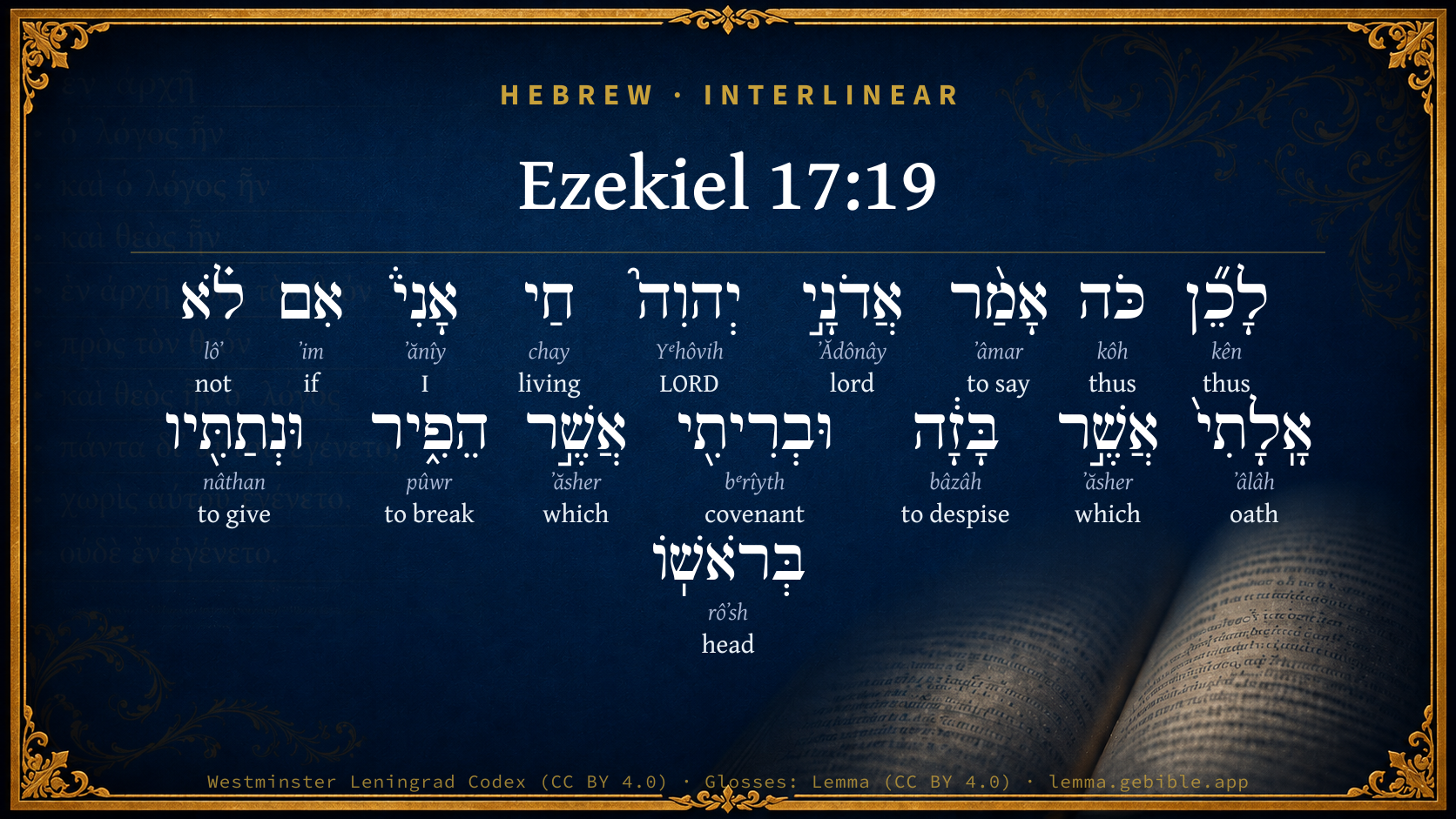
Ezekiel 17:19

Hebrew (Westminster Leningrad Codex) Ezekiel 17:19 appears in the Hebrew Old Testament. The text above is from the Westminster Leningrad Codex. Each word links to its Strong’s number, a concise gloss, and parsing drawn from the Open Scriptures Hebrew Bible morphology. Click any word for its full Brown-Driver-Briggs (BDB) entry.
Download image
Cite this verse

Ezekiel 17:19 (World English Bible). Public Domain. Lemma interlinear Bible study tool, https://lemma.gebible.app/v/ezekiel/17/19.

Show BibTeX & RIS
BibTeX
RIS
English Translation
Therefore thus says the Lord Yahweh: As I live, surely my oath that he has despised, and my covenant that he has broken, I will even bring it on his own head.
World English Bible · Public Domain
Download a study sheet

One document with this verse’s original text, its word-by-word gloss line, the meaning frame, cross-references with their text, attributed commentary, and full source and license credits — printable, and it pastes into notes with its structure intact.

This verse Autodidact and up

Study sheet (.html) Plain text (.txt)

A passage Seminary Student

Up to 50 verses in one chapter. A passage sheet keeps up to 6 commentary sources and 12 cross-references per verse, in the order this page ranks them, and says so on the sheet whenever that leaves anything out. Ask for a single verse and you get the Autodidact verse sheet above.

Everything on this page stays free to read, with no account — the sheet is a download of what is already on screen, not access to it.

Want to remove ads? Support Godless Engineer
Compare translations 3

The same verse in 3 English versions, stacked beneath the original-language interlinear above. Click any original word for its lexicon entry.

Each is an independent rendering of the whole verse — the interlinear is not word-aligned to these translations.

Highlighted words mark where these versions differ — a whole-verse word diff, not a word-by-word alignment.

  • World English Bible Public Domain
    Therefore thus says the Lord Yahweh: As I live, surely my oath that he has despised, and my covenant that he has broken, I will even bring it on his own head.
  • King James Version Public Domain
    Therefore thus saith the Lord GOD; As I live, surely mine oath that he hath despised, and my covenant that he hath broken, even it will I recompense upon his own head.
  • unfoldingWord Literal Text CC BY-SA 4.0
    Therefore the Lord Yahweh says this: As I live, was it not my oath that he despised and my covenant that he broke? So I will bring his punishment on his head!

unfoldingWord Literal Text — © unfoldingWord, licensed CC BY-SA 4.0. Word-aligned USFM3 via Door43 (git.door43.org/unfoldingWord/en_ult).

Versions to compare (up to 4)

3 of 4 selected

Show all 18 translations

Every available English version of this verse, each an independent rendering of the whole verse.

  • World English Bible Public Domain
    Therefore thus says the Lord Yahweh: As I live, surely my oath that he has despised, and my covenant that he has broken, I will even bring it on his own head.
  • Berean Standard Bible Public Domain
    Therefore this is what the Lord GOD says: ‘As surely as I live, I will bring down upon his head My oath that he despised and My covenant that he broke.
  • Majority Standard Bible Public Domain
    Therefore this is what the Lord GOD says: ‘As surely as I live, I will bring down upon his head My oath that he despised and My covenant that he broke.
  • King James Version Public Domain
    Therefore thus saith the Lord GOD; As I live, surely mine oath that he hath despised, and my covenant that he hath broken, even it will I recompense upon his own head.
  • American Standard Version (1901) Public Domain
    Therefore thus saith the Lord Jehovah: As I live, surely mine oath that he hath despised, and my covenant that he hath broken, I will even bring it upon his own head.
  • Revised Version (1885) Public Domain
    Therefore thus saith the Lord GOD: As I live, surely mine oath that he hath despised, and my covenant that he hath broken, I will even bring it upon his own head.
  • Geneva Bible (1599) Public Domain
    Therefore, thus sayth the Lord God, As I liue, I wil surely bring mine othe that he hath despised, and my couenant that he hath broken vpon his owne head.
  • Douay-Rheims (1899) Public Domain
    Therefore thus saith the Lord God: As I live, I will lay upon his head the oath he hath despised, and the covenant he hath broken.
  • Young's Literal Translation Public Domain
    Therefore, thus said the Lord Jehovah: I live -- Mine oath that he hath despised, And My covenant that he hath broken, Have I not put it on his head?
  • Literal Standard Version CC BY-SA 4.0
    Therefore, thus said Lord YHWH: [As] I live—My oath that he has despised, || And My covenant that he has broken, || Have I not put it on his head?
  • Unlocked Literal Bible CC BY-SA 4.0
    Therefore the Lord Yahweh says this: As I live, was it not my oath that he despised and my covenant that he broke? So I will bring his punishment on his head!
  • unfoldingWord Literal Text CC BY-SA 4.0
    Therefore the Lord Yahweh says this: As I live, was it not my oath that he despised and my covenant that he broke? So I will bring his punishment on his head!
  • Darby Bible Public Domain
    Therefore thus saith the Lord Jehovah: [As] I live, verily, mine oath which he hath despised, and my covenant which he hath broken, even it will I recompense upon his head.
  • World Messianic Bible Public Domain
    “Therefore the Lord GOD says: ‘As I live, I will surely bring on his own head my oath that he has despised and my covenant that he has broken.
  • Webster's Bible Public Domain
    Therefore thus saith the Lord GOD; As I live, surely my oath that he hath despised, and my covenant that he hath broken, even that will I recompense upon his own head.
  • Free Bible Version CC BY-SA 4.0
    So this is what the Lord God says: As I live, I will punish him for disregarding my oath and for breaking my agreement.
  • Bible in Basic English Public Domain
    And so the Lord has said, By my life, truly, for my oath which he put on one side, and my agreement which has been broken, I will send punishment on his head.
  • JPS Tanakh (1917) Public Domain
    Therefore thus saith the Lord GOD: As I live, surely Mine oath that he hath despised, and My covenant that he hath broken, I will even bring it upon his own head.

Literal Standard Version (2020), Covenant Press — licensed CC BY-SA 4.0. Text via the HelloAO Bible API (eBible.org). Unlocked Literal Bible (unfoldingWord) — licensed CC BY-SA 4.0. Text via the HelloAO Bible API (eBible.org). unfoldingWord Literal Text — © unfoldingWord, licensed CC BY-SA 4.0. Word-aligned USFM3 via Door43 (git.door43.org/unfoldingWord/en_ult). Free Bible Version, Dr. Jonathan Gallagher — licensed CC BY-SA 4.0. Text via the HelloAO Bible API (eBible.org).

Word by word

More ways to search: Search by grammar → Find every occurrence → Compare this word →

Practice this passage: Drill this verse → Learn its vocabulary →

הֵפִ֑יר
pûwr
H6331
“to break”
Verb, Hiphil, Perfect, 3rd Person, Masculine, Singular
Part of Speech
Verb
Stem
Hiphil
Form
Perfect
Person
3rd Person
Gender
Masculine
Number
Singular
Full BDB Definition

Origin: a primitive root

TWOT: 1750

(Hiphil) to break, crush
  1. לָכֵ֞ן kên H3651 “to/for · thus” Preposition + Adverb
  2. כֹּה kôh H3541 “thus” Adverb
  3. אָמַ֨ר ʼâmar H559 “to say” Verb, Qal, Perfect, 3rd Person, Masculine, Singular
  4. אֲדֹנָ֣י ʼĂdônây H136 “Lord · my” Noun, Common, Masculine, Plural, Construct + Suffix, Personal, 1st Person, Common, Singular
  5. יְהוִה֮ Yᵉhôvih H3069 “LORD” Noun, Proper
  6. חַי chay H2416 “living” Adjective, Adjective, Masculine, Singular, Absolute
  7. אָנִי֒ ʼănîy H589 “I” Pronoun, Personal, 1st Person, Common, Singular
  8. אִם ʼim H518 “if” Conjunction
  9. לֹ֗א lôʼ H3808 “not” Particle, Negative
  10. אָֽלָתִי֙ ʼâlâh H423 “oath · my” Noun, Common, Feminine, Singular, Construct + Suffix, Personal, 1st Person, Common, Singular
  11. אֲשֶׁ֣ר ʼăsher H834 “which” Particle, Relative
  12. בָּזָ֔ה bâzâh H959 “to despise” Verb, Qal, Perfect, 3rd Person, Masculine, Singular
  13. וּבְרִיתִ֖י bᵉrîyth H1285 “and · covenant · my” Conjunction + Noun, Common, Feminine, Singular, Construct + Suffix, Personal, 1st Person, Common, Singular
  14. אֲשֶׁ֣ר ʼăsher H834 “which” Particle, Relative
  15. וּנְתַתִּ֖יו nâthan H5414 “and · to give · him” Conjunction + Verb, Qal, Sequential Perfect, 1st Person, Common, Singular + Suffix, Personal, 3rd Person, Masculine, Singular
  16. בְּרֹאשֽׁוֹ rôʼsh H7218 “in/at · head · his” Preposition + Noun, Common, Masculine, Singular, Construct + Suffix, Personal, 3rd Person, Masculine, Singular

About this verse

These counts appear in no published source. They are computed here, from the morphology-tagged text and Lemma’s own curated glosses. What Lemma adds →

17
words
16
distinct lemmas
Prophets
section

Notable vocabulary

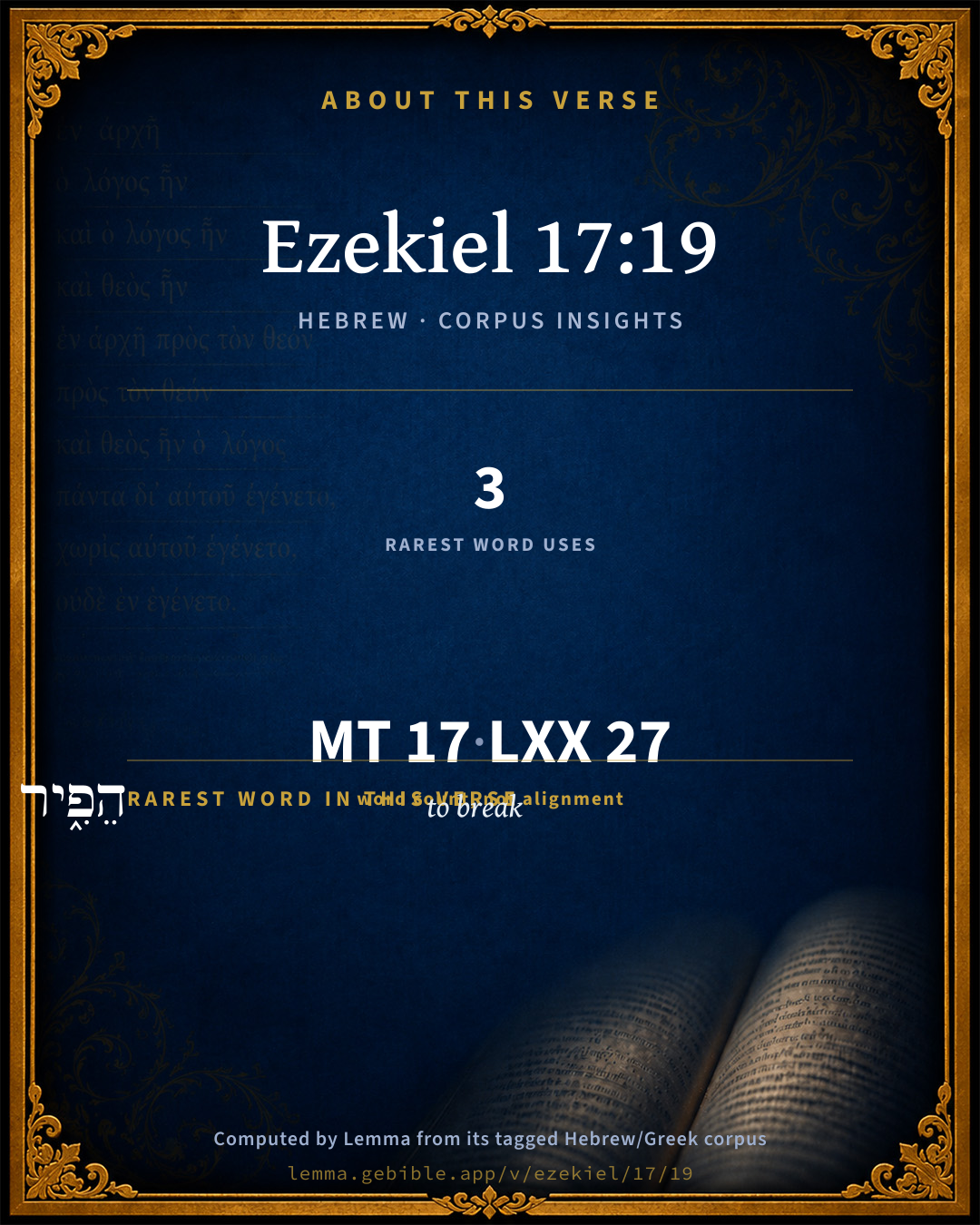
The rarest word here is הֵפִ֑יר to break H6331 — appearing just 3 times in the whole Hebrew Bible.

Shared distinctive vocabulary

הֵפִ֑יר to break H6331 occurs in 3 verses of the Hebrew Bible. Also found in:

Grammatical profile

  • 4 verbs
  • 5 nouns
  • 1 adjective
  • 1 pronoun
  • 1 conjunction
  • 2 adverbs
  • 3 particles

Verb forms

  • אָמַ֨ר Qal · Perfect
  • בָּזָ֔ה Qal · Perfect
  • הֵפִ֑יר Hiphil · Perfect
  • וּנְתַתִּ֖יו Qal · Sequential Perfect

Repetition

A word recurs within this verse — often emphatic in Hebrew:

  • אֲשֶׁ֣ר which H834 ×2

Hebrew & Septuagint length

In English translation the verse runs 32 words from the Hebrew and 31 from the Septuagint (LXX English) — closely comparable.

A rough comparison of the two English renderings, which tokenize alike — not a word-level alignment.

Word counts can differ between the Hebrew and the Greek without any difference in meaning — e.g. the Hebrew direct-object marker אֵת has no separate Greek word, and Greek often adds the article ὁ.

In the original languages it is 17 Hebrew tokens and 27 Greek tokens — but the two are counted differently (Hebrew bundles its prefixes and suffixes into one token; the Greek is in lemma form), so that isn’t a like-for-like length.

Cross-references

5

Topical passages linked to Ezekiel 17:19 in the Treasury of Scripture Knowledge — connected by theme and wording, ordered by reader-vote popularity; previews shown in the World English Bible.

  • Deuteronomy 5:11 "You shall not take the name of Yahweh your God in vain: for Yahweh will not hold him guiltless who takes his name in vain.
  • Jeremiah 5:2 Though they say, As Yahweh lives; surely they swear falsely.
  • Jeremiah 5:9 Shall I not visit for these things? says Yahweh; and shall not my soul be avenged on such a nation as this?
  • Jeremiah 7:9–15 Will you steal, murder, and commit adultery, and swear falsely, and burn incense to Baal, and walk after other gods that you have not known,
  • Ezekiel 21:23–27 It shall be to them as a false divination in their sight, who have sworn oaths to them; but he brings iniquity to memory, that they may be taken.

Cross-references courtesy of OpenBible.info (CC BY 4.0).

Hebrew and Greek witnesses Masoretic Hebrew ↔ Greek Septuagint

The same verse in the two great witnesses to the Old Testament, shown verse-for-verse.

These are two independent witnesses, not word-aligned to each other, and the Septuagint is shown in lemma (dictionary) form.

Hebrew Ezekiel 17:19 Masoretic · Westminster Leningrad Codex

לָכֵ֞ן כֹּה אָמַ֨ר אֲדֹנָ֣י יְהוִה֮ חַי אָנִי֒ אִם לֹ֗א אָֽלָתִי֙ אֲשֶׁ֣ר בָּזָ֔ה וּבְרִיתִ֖י אֲשֶׁ֣ר הֵפִ֑יר וּנְתַתִּ֖יו בְּרֹאשֽׁוֹ

Therefore thus says the Lord Yahweh: As I live, surely my oath that he has despised, and my covenant that he has broken, I will even bring it on his own head.

World English Bible · Public Domain

Greek LXX Ezekiel 17:19 Septuagint · lemma form

διά οὗτος εἶπον ὅδε λέγω κύριος ζάω ἐγώ ἐάν μή ὁ διαθήκη ἐγώ ὅς παραβαίνω καί ὁ ὁρκωμοσία ἐγώ ὅς ἀτιμόω καί δίδωμι αὐτός εἰς κεφαλή αὐτός

Therefore say, Thus says the Lord; As I live, surely my oath which he has profaned, and my covenant which he has transgressed, I will even recompense it upon his head.

LXX2012 (modern English Septuagint) · Public Domain

Hebrew: Westminster Leningrad Codex (CC BY 4.0). Greek: Septuagint (public domain); English from LXX2012 (modern English Septuagint) (Public Domain). How the Septuagint differs from the Hebrew →

Targum (Aramaic paraphrase)

1

The Targum is the ancient Jewish Aramaic paraphrase of the Hebrew Scriptures — an interpretive translation, not the Hebrew text itself. Onkelos (literal) and Pseudo-Jonathan (expansive) render the Torah, and Jonathan the Prophets. Coverage is partial: where no permissively-licensed English translation exists for a verse, only the Aramaic is shown. This is verse-level text, not a word-by-word alignment to the Hebrew.

  1. Targum Jonathan Prophets (Joshua–Malachi)
    בְּכֵן כִּדְנַן אֲמַר יְיָ אֱלֹהִים קַיָם אֲנָא אִם לָא מוֹמָתִי דִבְסַר וּקְיָמִי דְשַׁנִי וְאֶתֵּן פּוּרְעֲנוּת אוֹרְחֵהּ בְּרֵישֵׁהּ:

    (no public-domain English translation for this verse)

    Targum Jonathan — Aramaic: “Mikraot Gedolot” (public domain). English: “Sefaria Community Translation” (CC0 1.0 (public-domain dedication)); “London "Chaldee Paraphrase," 1871” (public domain). Text via Sefaria.

Commentary

Notes on Ezekiel 17:19 from classic Christian and Jewish commentators (each source and its license shown beneath its notes). The classic Christian expositions comment on the surrounding passage and are grouped to its opening verse, so a note may address several verses; the Jewish commentaries on the Tanakh (Rashi and others) are per-verse, so they appear only where the commentator wrote on this verse.

Lemma curates 59 commentaries, every one of them public domain or Creative Commons licensed, each selected and text-cleaned for this edition rather than reprinted as found. About our sources →

Trapp's Complete Commentary

John Trapp

Eze 17:19 Therefore thus saith the Lord GOD; [As] I live, surely mine oath that he hath despised, and my covenant that he hath broken, even it will I recompense upon his own head.

Ver. 19. Surely mine oath.] Because taken by my name, so that I am deeply engaged, highly concerned in it.

John Trapp, A Commentary or Exposition upon All the Books of the Old and New Testament (1647–1656) — public domain. Text from a community e-Sword module.

Tyndale Open Study Notes

Tyndale Open Resources

17:19-21 God would punish Israel’s king for breaking his covenant with treason against the Lord who had planted him in the land of promise. • I will bring him to Babylon and put him on trial: See 2 Kgs 25:5-7.

Tyndale Open Study Notes — © Tyndale Open Resources, licensed CC BY-SA 4.0. Text via the HelloAO Bible API.

Jamieson, Fausset & Brown

Robert Jamieson, A. R. Fausset & David Brown

mine oath--The "covenant" being sworn in God's name was really His covenant; a new instance in relation to man of the treacherous spirit which had been so often betrayed in relation to God. God Himself must therefore avenge the violation of His covenant "on the head" of the perjurer (compare Psa 7:16).

Jamieson, Fausset & Brown — Commentary Critical and Explanatory on the Whole Bible (1871) — public domain (CC PDM 1.0). Text via the HelloAO Bible API.

John Calvin's Commentaries

The former sentence is confirmed. The Prophet had spoken after the usually received manner when he said that Zedekiah’s perfidy would not be unrevenged; but he now brings forward God as the speaker, because, unless he appeared as an avenger of perfidy, mankind would scarcely ever be seriously persuaded that punishment was prepared for perjurers and truce-breakers. As I have said that this opinion was fixed in the hearts of all, so it must be understood that this opinion was received, and that men were fully persuaded of it: but persuasions which are called “common” vanish away; there are common thoughts which are almost born with us, and follow nature, but they are not firm, because the profane do not hold the principal point, that God is the judge of the world: this sentence, therefore, is added of necessity. Now God swears that Zedekiah should suffer punishment, because he had despised the oath and rendered the covenant void. But we must notice the epithet; for God calls the oath and the covenant his own: he has despised, says he, not simply the oath, but mine: he has violated my treaty. The reason of this language is, that God wishes fidelity between man and man to be cultivated: and so he detests all perjury and all frauds. Now, since there is no more sacred method of contracting a treaty than by solemn rites, there also God shows his judgment in a peculiar manner. In fine, we may deservedly call him the guardian of treaties; for when heathens entered into treaties, they were accustomed to bring forward the name of Jupiter the supreme, because they thought he would inflict vengeance on all who violated their pledge. But God here comes forward, not like an imaginary Jupiter, but because he wished confidence to flourish in human society; since, unless men act sincerely to each other, all society would be broken up. This, then, is the reason why Ezekiel says that the treaty struck with King Nebuchadnezzar was divine, since God would be its vindicator. Meanwhile we must remark that this treaty was lawful and pleasing to God. (Jeremiah 27:17.) And we see from Jeremiah 28 and Jeremiah 29., that God wished the Jews to suffer under this disgrace for a time. For King Zedekiah, if he had truly discharged his office, was an image of the Messiah, the first-born among the kings of the earth: Hence it was unworthy of him to become tributary to a profane monarch and a cruel tyrant. But since God had so imposed slavery on his own people, Zedekiah ought to be under the yoke, as it is there said, Be you servants to King Nebuchadnezzar and live; that is, there is no other method of obtaining safety, unless you suffer the Chaldaeans to rule over you, and you bear their sway calmly, since Nebuchadnezzar is God’s scourge. This covenant, as I have said, was approved by God, otherwise he could not have been its avenger. We know that there are three kinds of treaties. When there has been war between two kings, if the conqueror wishes to spare his enemy, he receives him into covenant, but imposes conditions at his own discretion. We know that the Romans followed that custom, since it was too difficult for them to hold in subjection all whom they had subdued, and especially at the beginning; and thus they entered into treaties with many tribes under many circumstances. Another sort of agreement is, that between either kings or people when at variance with each other; but before they actually engage, they make a truce with each other, and so remove the occasion of the war — this is another kind. Lastly, those who never were enemies enter into an alliance; and such was the treaty between Zedekiah and the king of Egypt. For they wished to be cautious, and to anticipate the danger which he feared from the Chaldaeans; and hence he entered into the agreement,. Thus the Israelites were formerly joined with the Syrians, and afterwards with the Assyrians. So we saw that the Jews committed adultery when they ran about first to Egypt, then to Assyria, and then to Chaldaea. But this treaty, of which mention is now made, was necessary; for Zedekiah could not escape from embracing the conditions imposed on him by King Nebuchadnezzar. For this reason God pronounces himself the avenger of perfidy.

It is now asked, Whether we may never break our word when any one has been violently attacked, and promised what was otherwise unjust? The reply is at hand, that God’s name is more precious than all human advantages. If any one, therefore, object that he was deceived, and oppressed by unjust conditions, still God’s name must prevail. Hence we must always weigh what is due to the name of God; and hence we shall readily conclude that those can never be excused who violate their engagements on the pretext of being violently compelled, or induced by fraud, or not allowed the liberty of considering whether their promise was according to equity. For this reason, also, it is said in the 15th Psalm, (Psalm 15:4,) that the sons of God swear and suffer loss, because when God’s, name has been interposed, no utility ought to be of such importance as to outweigh the oath that has been taken. And so not without reason God now pronounces that he would avenge the perjury which Zedekiah had committed, since, in truth, we cannot depart from promises which have been sanctioned by an oath in God’s name, without seeming to slight the Almighty himself. Meanwhile, it is certain that there was another reason why God punished the Jews; but here, as I have previously shown, the Prophet mentions what was more familiar to men. The first cause of the destruction of the city and of the whole kingdom, was idolatry, as we saw before, and then the many crimes of the people were added. For from the period of the corruption of true religion, the pollution of many vices increased through the city and the whole land. Hence it happened that God destined his people to destruction; hence also King Zedekiah was deprived of sight. For, as the sacred history testifies, God wished to destroy the whole people: for this reason Zedekiah fell, and provoked the Chaldaeans against him. We see, therefore, that there is a continued series of causes in the eternal providence of God, but not as the Stoics supposed; for they concocted their fate from complex windings or implicit causes, without any will of Deity in that confusion. But God, as I have said, has different reasons why he does one thing or another. Some causes are remote and incomprehensible to us, and others manifest to us: so the proximate cause of the destruction of the people was the revolt of Zedekiah from King Nebuchadnezzar; but there was another more important reason, namely, that the people deserved to perish. Hence Zedekiah was rendered blind by the just judgment of God, since he passed over perfidiously to the king of Egypt, and so armed himself against King Nebuchadnezzar. But we must hold that the reason universally manifest is here reviewed. It follows —

John Calvin's Commentaries (1540-1563) — public domain. Text from the Calvin Translation Society English edition (1840s-50s) via the Christian Classics Ethereal Library (ccel.org). Calvin's coverage is partial (roughly two-thirds of the Bible); uncommented books and verses are honest gaps, never fabricated. The 19th-century editor's footnotes and remarks are omitted so the notes are faithfully Calvin's own voice.

Ellicott's Commentary for English Readers

(19) Mine oath . . . my covenant.—Zedekiah’s oath and covenant to Nebuchadnezzar are called the Lord’s, because made in the Lord’s name, and also because He had commanded them. Rebellion against Nebuchadnezzar was, therefore, under the circumstances, apostasy from the Lord Himself.

With Eze_17:21 the explanation of the parable ends. What follows is a distinct Messianic prophecy, which, although couched in the same figurative language, has nothing corresponding to it either in the parable or in its explanation.

A Bible Commentary for English Readers, edited by Charles John Ellicott (1878–1897) — public domain. Text from a community e-Sword module.

John Gill's Exposition

And all his fugitives with all his bands shall fall by the sword,.... So those of his army that fled, and attempted to make their escape, when the city of Jerusalem was taken, as many as fell into the Chaldean army, which was round about the city, at least a great number of them, fell by the sword of the Chaldeans, Jer 52:7;

and they that remain shall be scattered towards all winds; and so it was, that such that escaped the sword were either carried captive into Babylon, or fled some one way, and some another, even into all parts, east, west, north, and south:

and ye shall know that I the Lord have spoken it; the Targum adds, by my word, and will do it; who is the Lord God omniscient and omnipotent, just and righteous; faithful and true, as to his word of promise, so of threatening.

John Gill's Exposition of the Whole Bible (1746–1763) — public domain (CC PDM 1.0). Text via the HelloAO Bible API.

Matthew Poole's English Annotations

As I live: see Eze 16:48.

Mine oath; made in my name, and of which I am both witness and avenger.

Hath despised: see Eze 16:59; 17:18.

I will recompense; I will punish, as it deserveth, and it shall appear by the punishment that my hand doth execute it.

Upon his own head; it is probable some courtiers might advise to it, but this will not excuse Zedekiah, his perjury was his own act; and on his own head, as I charge, so I will punish it.

Matthew Poole's English Annotations on the Holy Bible (1683–1685) — public domain. Text from a community e-Sword/MySword module.

Whedon's Commentary on the Bible

Daniel D. Whedon

19. Mine oath that he hath despised — Not only against Nebuchadnezzar has Zedekiah rebelled, but against Jehovah. The oath was no doubt taken in Jehovah’s name, and it certainly had the approval of God’s prophet (Jer_25:9-11; Jer_27:9-17). The calamity falls upon Israel, not chiefly because of its lack of political acumen, but because of its sin against God. Compare the style of this utterance with that of the Arabians, who rebelled against Assur-banipal and explained their subsequent humiliation by saying, “It was because we broke the great oath of Assur and have sinned against the goodness of Assur-banipal.” — Ezekiel Studien, p. 62.

Daniel D. Whedon (gen. ed.), Commentary on the Old and New Testaments (1874–1909) — public domain. Text from a community e-Sword module.

unfoldingWord translationNotes

Door43 World Missions Community

was it not my oath that he despised and my covenant that he broke?

Yahweh asks this leading question to emphasize the affirmative answer. This question can be translated as a statement. AT: "it was my oath that the king of Jerusalem despised and my covenant that he broke." (See: Rhetorical Question)

I will bring his punishment on his head

The idiom "bring ... on his head" means that he will experience this punishment. See how you translated this idiom in Ezekiel 11:21. AT: "I will cause him to suffer his punishment" (See: Idiom)

I will spread my net out over him, and he will be caught in my hunting net

Yahweh speaks of enabling the enemy army to capture the king as if he were trapping the king in a net. (See: Metaphor)

he will be caught in my hunting net

This can be translated in active form. AT: "I will catch him in my hunting net" (See: Active or Passive)

All of his refugees ... armies will fall by the sword

The word "fall" is a euphemism for "die." Here the word "sword" is a metonym for soldiers who kill people with swords. AT: "Soldiers will kill all his refugees ... armies" (See: Metonymy)

the ones who remain will be scattered in every direction

This can be stated in active form. AT: "the ones who remain alive will flee in every direction" or "the enemy soldiers will scatter in every directions the ones who remain alive" (See: Active or Passive)

know that I am Yahweh

When Yahweh says that people will know that he is Yahweh, he is implying that they will know that he is the one true God who has supreme authority and power. See how you translated this in Ezekiel 6:7. AT: "understand that I am Yahweh, the one true God" or "realize that I, Yahweh, have supreme power and authority" (See: Assumed Knowledge and Implicit Information)

translationWords

Lord Yahweh

life

oath

covenant

punish

Babylon

judge

betray

sword

declare

unfoldingWord translationNotes — © Distant Shores Media and the Door43 World Missions Community, licensed CC BY-SA 4.0. Source: git.door43.org/Door43/en_tn.

Rashi

Rabbi Shlomo Yitzchaki (Rashi)

I will bring it upon his head [lit. put it in his head.] That is the blinding of his eyes.

Rashi on the Tanakh — English translations: “The Judaica Press complete Tanach with Rashi, translated by A. J. Rosenberg” (CC BY 4.0); “Pentateuch with Rashi's commentary by M. Rosenbaum and A.M. Silbermann, 1929-1934” (public domain); “The Metsudah Tanach series, Lakewood, N.J” (CC BY 4.0); and “The Book of Joshua, Metsudah Publications, 1997” (CC BY 4.0). Text via Sefaria.

Lesson kit

Teaching starters — assembled from the data on this page, not authored interpretation. Every prompt links to the verse data it draws on. Edit before teaching.

Ezekiel, in the Prophets, opens this verse with 17 words (16 distinct Hebrew lemmas). Its most distinctive word is pûwr (“to break”). A historical commentator’s framing appears above. Read the whole chapter for the surrounding context.

Discussion questions

  1. How does “to break” (pûwr) shape what this verse is saying?
  2. How does Psalms 33:10, which shares the word «to break», read alongside this verse?
  3. What does the repetition of “which” (2× in this one verse) do in this verse?
  4. These translations render this verse differently. What is at stake in choosing one wording over another?
  5. «אָמַ֨ר» is a Qal Perfect verb. How does that grammatical form shape the action described?
  6. Compare how Trapp's Complete Commentary and Tyndale Open Study Notes read this verse. Where do they agree or differ?

Things to notice

Reading settings

Reading text

Shown beneath each verse's original-language words.

Old Testament
Old Testament edition

Read the OT as the Masoretic Hebrew (MT) or the Greek Septuagint (LXX).

English shown for the Greek Septuagint (in the Hebrew ↔ Greek comparison).

Comparing translations? Open the Compare panel on any verse page to stack up to four side by side.