Exodus 14:18

Hebrew (Westminster Leningrad Codex) Exodus 14:18 appears in the Hebrew Old Testament. The text above is from the Westminster Leningrad Codex. Each word links to its Strong’s number, a concise gloss, and parsing drawn from the Open Scriptures Hebrew Bible morphology. Click any word for its full Brown-Driver-Briggs (BDB) entry.
Download image
Cite this verse

Exodus 14:18 (World English Bible). Public Domain. Lemma interlinear Bible study tool, https://lemma.gebible.app/v/exodus/14/18.

Show BibTeX & RIS
BibTeX
RIS
English Translation
The Egyptians shall know that I am Yahweh, when I have gotten myself honor over Pharaoh, over his chariots, and over his horsemen."
World English Bible · Public Domain
Download a study sheet

One document with this verse’s original text, its word-by-word gloss line, the meaning frame, cross-references with their text, attributed commentary, and full source and license credits — printable, and it pastes into notes with its structure intact.

This verse Autodidact and up

Study sheet (.html) Plain text (.txt)

A passage Seminary Student

Up to 50 verses in one chapter. A passage sheet keeps up to 6 commentary sources and 12 cross-references per verse, in the order this page ranks them, and says so on the sheet whenever that leaves anything out. Ask for a single verse and you get the Autodidact verse sheet above.

Everything on this page stays free to read, with no account — the sheet is a download of what is already on screen, not access to it.

Want to remove ads? Support Godless Engineer
Compare translations 3

The same verse in 3 English versions, stacked beneath the original-language interlinear above. Click any original word for its lexicon entry.

Each is an independent rendering of the whole verse — the interlinear is not word-aligned to these translations.

Highlighted words mark where these versions differ — a whole-verse word diff, not a word-by-word alignment.

  • World English Bible Public Domain
    The Egyptians shall know that I am Yahweh, when I have gotten myself honor over Pharaoh, over his chariots, and over his horsemen."
  • King James Version Public Domain
    And the Egyptians shall know that I am the LORD, when I have gotten me honor upon Pharaoh, upon his chariots, and upon his horsemen.
  • unfoldingWord Literal Text CC BY-SA 4.0
    And the Egyptians will know that I am Yahweh when I am glorified because of Pharaoh, because of his chariots and because of his horsemen.”

unfoldingWord Literal Text — © unfoldingWord, licensed CC BY-SA 4.0. Word-aligned USFM3 via Door43 (git.door43.org/unfoldingWord/en_ult).

Versions to compare (up to 4)

3 of 4 selected

Show all 18 translations

Every available English version of this verse, each an independent rendering of the whole verse.

  • World English Bible Public Domain
    The Egyptians shall know that I am Yahweh, when I have gotten myself honor over Pharaoh, over his chariots, and over his horsemen."
  • Berean Standard Bible Public Domain
    The Egyptians will know that I am the LORD when I am honored through Pharaoh, his chariots, and his horsemen.”
  • Majority Standard Bible Public Domain
    The Egyptians will know that I am the LORD when I am honored through Pharaoh, his chariots, and his horsemen.”
  • King James Version Public Domain
    And the Egyptians shall know that I am the LORD, when I have gotten me honor upon Pharaoh, upon his chariots, and upon his horsemen.
  • American Standard Version (1901) Public Domain
    And the Egyptians shall know that I am Jehovah, when I have gotten me honor upon Pharaoh, upon his chariots, and upon his horsemen.
  • Revised Version (1885) Public Domain
    And the Egyptians shall know that I am the LORD, when I have gotten me honour upon Pharaoh, upon his chariots, and upon his horsemen.
  • Geneva Bible (1599) Public Domain
    Then the Egyptians shall know that I am the Lord, when I haue gotten me honour vpon Pharaoh, vpon his charets, and vpon his horsemen.
  • Douay-Rheims (1899) Public Domain
    And the Egyptians shall know that I am the Lord, when I shall be glorified in Pharao, and in his chariots and in his horsemen.
  • Young's Literal Translation Public Domain
    and the Egyptians have known that I `am' Jehovah, in My being honoured on Pharaoh, on his chariots, and on his horsemen.'
  • Literal Standard Version CC BY-SA 4.0
    and the Egyptians have known that I [am] YHWH, in My being honored by Pharaoh, by his chariots, and by his horsemen.”
  • Unlocked Literal Bible CC BY-SA 4.0
    Then the Egyptians will know that I am Yahweh when I have gotten honor because of Pharaoh, his chariots, and his horsemen.”
  • unfoldingWord Literal Text CC BY-SA 4.0
    And the Egyptians will know that I am Yahweh when I am glorified because of Pharaoh, because of his chariots and because of his horsemen.”
  • Darby Bible Public Domain
    And the Egyptians shall know that I am Jehovah, when I have glorified myself in Pharaoh, in his chariots and in his horsemen.
  • World Messianic Bible Public Domain
    The Egyptians shall know that I am the LORD when I have gotten myself honor over Pharaoh, over his chariots, and over his horsemen.”
  • Webster's Bible Public Domain
    And the Egyptians shall know that I am the LORD, when I have gotten me honor upon Pharaoh, upon his chariots, and upon his horsemen.
  • Free Bible Version CC BY-SA 4.0
    The Egyptians will know that I am the Lord when I gain respect through Pharaoh, his chariots, and his horsemen.”
  • Bible in Basic English Public Domain
    And the Egyptians will see that I am the Lord, when I get honour over Pharaoh and his war-carriages and his horsemen.
  • JPS Tanakh (1917) Public Domain
    And the Egyptians shall know that I am the LORD, when I have gotten Me honour upon Pharaoh, upon his chariots, and upon his horsemen.'

Literal Standard Version (2020), Covenant Press — licensed CC BY-SA 4.0. Text via the HelloAO Bible API (eBible.org). Unlocked Literal Bible (unfoldingWord) — licensed CC BY-SA 4.0. Text via the HelloAO Bible API (eBible.org). unfoldingWord Literal Text — © unfoldingWord, licensed CC BY-SA 4.0. Word-aligned USFM3 via Door43 (git.door43.org/unfoldingWord/en_ult). Free Bible Version, Dr. Jonathan Gallagher — licensed CC BY-SA 4.0. Text via the HelloAO Bible API (eBible.org).

Word by word

More ways to search: Search by grammar → Find every occurrence → Compare this word →

Practice this passage: Drill this verse → Learn its vocabulary →

וּבְפָרָשָֽׁיו
pârâsh
H6571
“and · in/at · horses · his”
Conjunction + Preposition + Noun, Common, Masculine, Plural, Construct + Suffix, Personal, 3rd Person, Masculine, Singular
Part of Speech
Conjunction + Preposition + Noun
Type
Common
Gender
Masculine
Number
Plural
State
Construct
Full BDB Definition

Origin: from H6567

TWOT: 1836a

horse, steed, warhorse - horseman
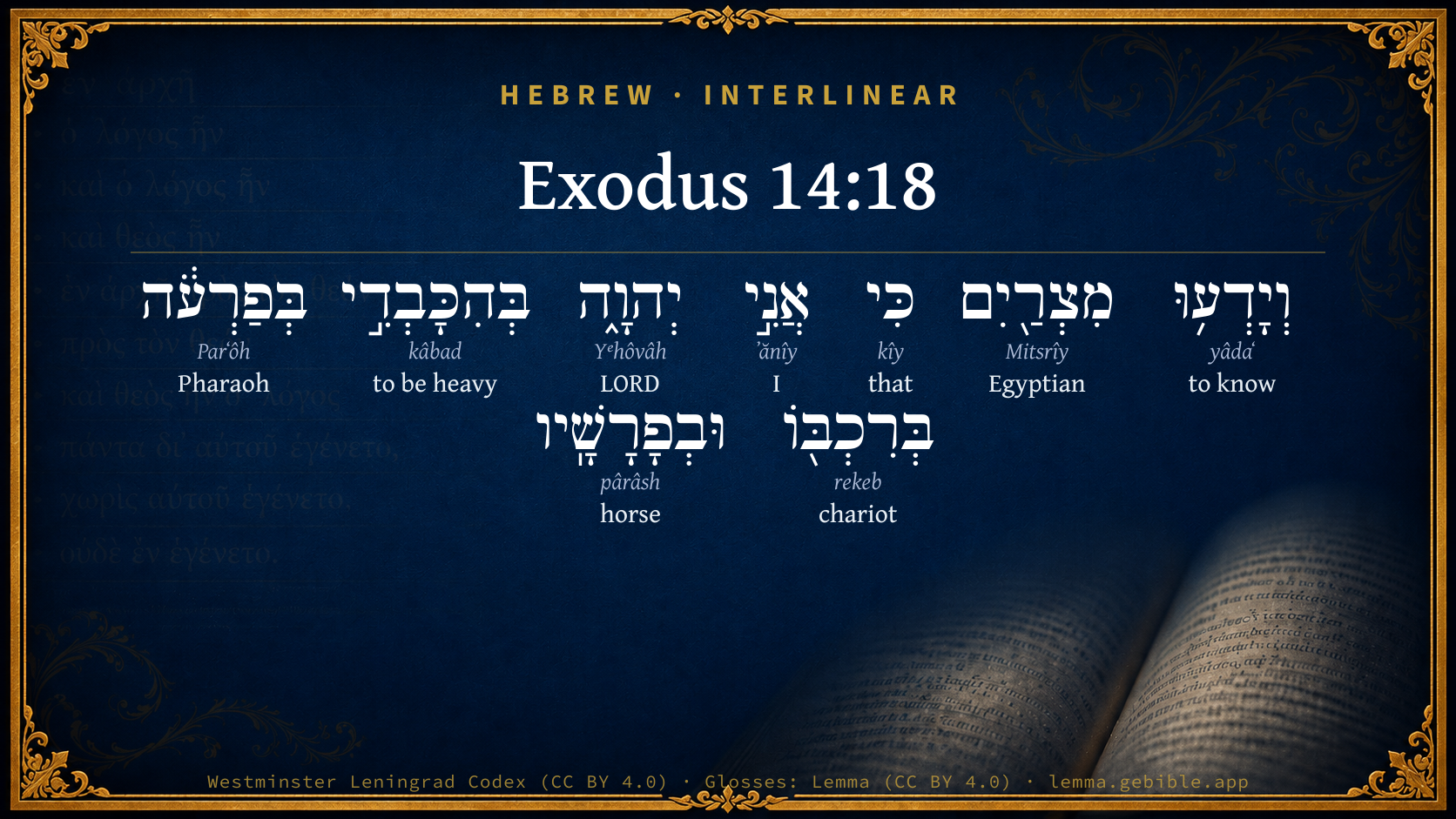
  1. וְיָדְע֥וּ yâdaʻ H3045 “and · to know” Conjunction + Verb, Qal, Sequential Perfect, 3rd Person, Common, Plural
  2. מִצְרַ֖יִם Mitsrîy H4713 “Egyptian” Noun, Proper
  3. כִּי kîy H3588 “that” Conjunction
  4. אֲנִ֣י ʼănîy H589 “I” Pronoun, Personal, 1st Person, Common, Singular
  5. יְהוָ֑ה Yᵉhôvâh H3068 “LORD” Noun, Proper
  6. בְּהִכָּבְדִ֣י kâbad H3513 “in/at · to be heavy · me” Preposition + Verb, Niphal, Infinitive Construct + Suffix, Personal, 1st Person, Common, Singular
  7. בְּפַרְעֹ֔ה Parʻôh H6547 “in/at · Pharaoh” Preposition + Noun, Proper
  8. בְּרִכְבּ֖וֹ rekeb H7393 “in/at · chariot · his” Preposition + Noun, Common, Masculine, Singular, Construct + Suffix, Personal, 3rd Person, Masculine, Singular

About this verse

These counts appear in no published source. They are computed here, from the morphology-tagged text and Lemma’s own curated glosses. What Lemma adds →

9
words
9
distinct lemmas
Pentateuch
section

Shared distinctive vocabulary

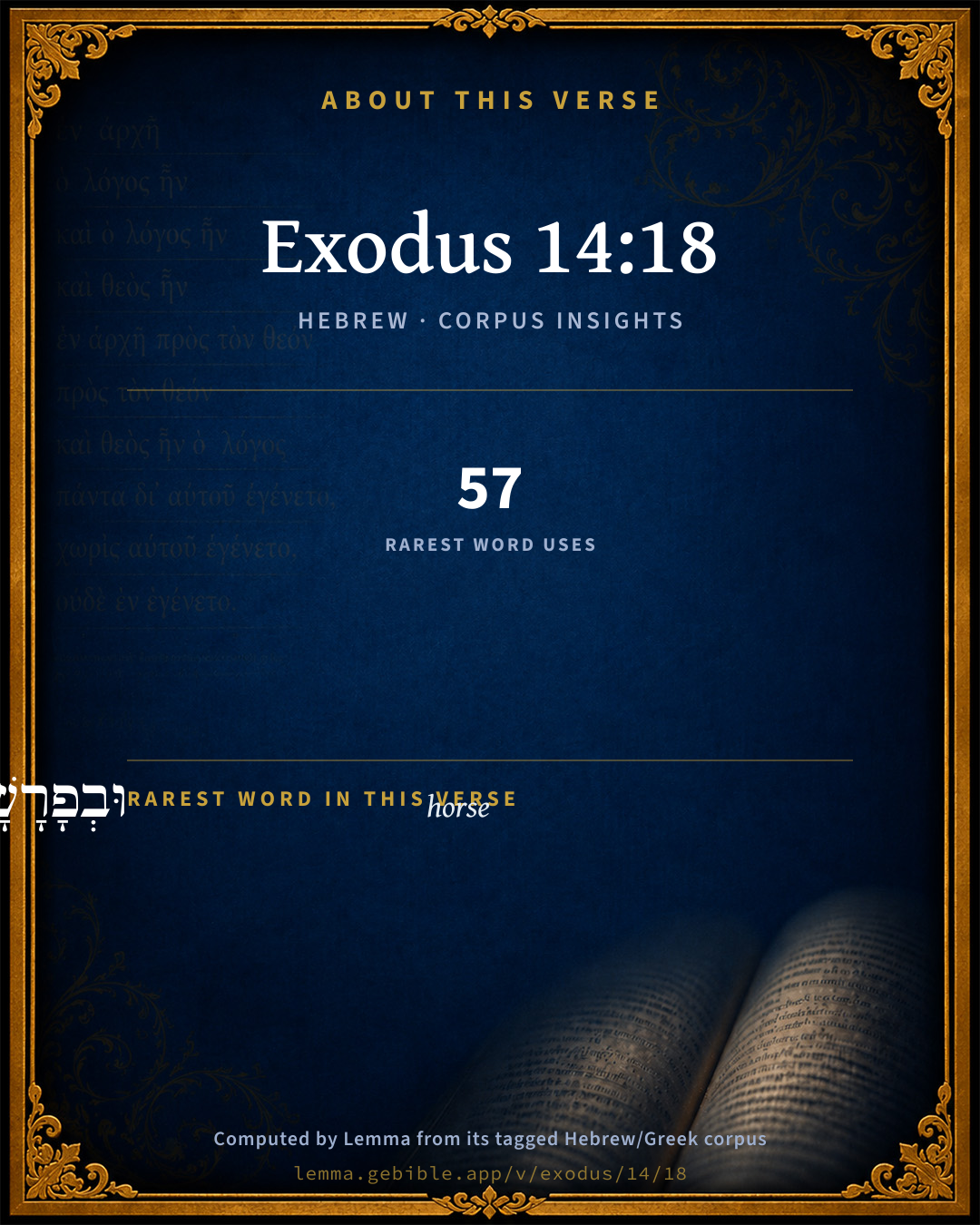
וּבְפָרָשָֽׁיו horse H6571 occurs in 54 verses of the Hebrew Bible. Also found in:

Grammatical profile

  • 2 verbs
  • 5 nouns
  • 1 pronoun
  • 1 conjunction

Verb forms

  • וְיָדְע֥וּ Qal · Sequential Perfect
  • בְּהִכָּבְדִ֣י Niphal · Infinitive Construct

Hebrew & Septuagint length

In English translation the verse runs 23 words from the Hebrew and 24 from the Septuagint (LXX English) — closely comparable.

A rough comparison of the two English renderings, which tokenize alike — not a word-level alignment.

Word counts can differ between the Hebrew and the Greek without any difference in meaning — e.g. the Hebrew direct-object marker אֵת has no separate Greek word, and Greek often adds the article ὁ.

Cross-references

3

Topical passages linked to Exodus 14:18 in the Treasury of Scripture Knowledge — connected by theme and wording, ordered by reader-vote popularity; previews shown in the World English Bible.

  • Exodus 7:5 The Egyptians shall know that I am Yahweh, when I stretch forth my hand on Egypt, and bring out the children of Israel from among them."
  • Exodus 7:17 Thus says Yahweh, "In this you shall know that I am Yahweh. Behold, I will strike with the rod that is in my hand on the waters which are in the river, and they shall be turned to blood.
  • Exodus 14:4 I will harden Pharaoh's heart, and he will follow after them; and I will get honor over Pharaoh, and over all his host; and the Egyptians shall know that I am Yahweh." They did so.

Cross-references courtesy of OpenBible.info (CC BY 4.0).

Hebrew and Greek witnesses Masoretic Hebrew ↔ Greek Septuagint

The same verse in the two great witnesses to the Old Testament, shown verse-for-verse.

These are two independent witnesses, not word-aligned to each other, and the Septuagint is shown in lemma (dictionary) form.

Hebrew Exodus 14:18 Masoretic · Westminster Leningrad Codex

וְיָדְע֥וּ מִצְרַ֖יִם כִּי אֲנִ֣י יְהוָ֑ה בְּהִכָּבְדִ֣י בְּפַרְעֹ֔ה בְּרִכְבּ֖וֹ וּבְפָרָשָֽׁיו

The Egyptians shall know that I am Yahweh, when I have gotten myself honor over Pharaoh, over his chariots, and over his horsemen."

World English Bible · Public Domain

Greek LXX Exodus 14:18 Septuagint · lemma form

καί γιγνώσκω πᾶς ὁ αἰγύπτιος ὅτι ἐγώ εἰμί κύριος ἐνδοξάζω ἐγώ ἐν φαραώ καί ἐν ὁ ἅρμα καί ἵππος αὐτός

And all the Egyptians shall know that I am the Lord, when I am glorified upon Pharao and upon his chariots and his horses.

LXX2012 (modern English Septuagint) · Public Domain

Hebrew: Westminster Leningrad Codex (CC BY 4.0). Greek: Septuagint (public domain); English from LXX2012 (modern English Septuagint) (Public Domain). How the Septuagint differs from the Hebrew →

Targum (Aramaic paraphrase)

2

The Targum is the ancient Jewish Aramaic paraphrase of the Hebrew Scriptures — an interpretive translation, not the Hebrew text itself. Onkelos (literal) and Pseudo-Jonathan (expansive) render the Torah, and Jonathan the Prophets. Coverage is partial: where no permissively-licensed English translation exists for a verse, only the Aramaic is shown. This is verse-level text, not a word-by-word alignment to the Hebrew.

  1. Targum Onkelos Torah (Genesis–Deuteronomy)
    וְיִדְּעוּן מִצְרָאֵי אֲרֵי אֲנָא יְיָ בְּאִתְיַקָרוּתִי בְּפַרְעֹה בִּרְתִכּוֹהִי וּבְפָרָשׁוֹהִי:

    (no public-domain English translation for this verse)

    Targum Onkelos — Aramaic: “Onkelos Genesis” (public domain); “Onkelos Exodus” (public domain); “Onkelos Leviticus” (public domain); “Onkelos Numbers” (public domain); “Onkelos Deuteronomy” (public domain). English: “Sefaria Community Translation” (CC0 1.0 (public-domain dedication)); “J.W. Etheridge. The Targums of Onkelos and Jonathan Ben Uzziel on the Pentateuch. London: Longmans, Green, 1862” (public domain). Text via Sefaria.

  2. Targum Pseudo-Jonathan Torah (Genesis–Deuteronomy)
    וְיֵדְעוּן מִצְרָאֵי אֲרוּם אֲנָא הוּא יְיָ בְּאִתְיַקָּרוּתִי בְּפַרְעה בִּרְתִיכוֹי וּבְפָרָשׁוֹי

    that the Mizraee may know that I am the Lord, when I am glorified upon Pharoh, upon his chariots and horsemen.

    Targum Pseudo-Jonathan — Aramaic: “Targum Jonathan on Genesis” (public domain); “Targum Jonathan on Exodus” (public domain); “Targum Jonathan on Leviticus” (public domain); “Targum Jonathan on Numbers” (public domain); “Targum Jonathan on Deuteronomy” (public domain). English: “The Targum of Jonathan ben Uzziel, trans. J. W. Etheridge, London, 1862” (public domain). Text via Sefaria.

Commentary

Notes on Exodus 14:18 from classic Christian and Jewish commentators (each source and its license shown beneath its notes). The classic Christian expositions comment on the surrounding passage and are grouped to its opening verse, so a note may address several verses; the Jewish commentaries on the Tanakh (Rashi and others) are per-verse, so they appear only where the commentator wrote on this verse.

Lemma curates 59 commentaries, every one of them public domain or Creative Commons licensed, each selected and text-cleaned for this edition rather than reprinted as found. About our sources →

Trapp's Complete Commentary

John Trapp

Exo 14:18 And the Egyptians shall know that I [am] the LORD, when I have gotten me honour upon Pharaoh, upon his chariots, and upon his horsemen.

Ver. 18. When I have gotten me honour.] Made me "a name as at this day." {Neh 9:10} For this he was famous in far countries. Jethro, the first proselyte to the Jewish Church, was hereby converted, say the Rabbins. And the Philistines cry, "Woe unto us! these are the gods that smote the Egyptians with all the plagues in the wilderness." {1Sa 4:8}

John Trapp, A Commentary or Exposition upon All the Books of the Old and New Testament (1647–1656) — public domain. Text from a community e-Sword module.

Adam Clarke's Commentary

Verse 18. Shall know that I am the Lord] Pharaoh had just recovered from the consternation and confusion with which the late plagues had overwhelmed him, and now he is emboldened to pursue after Israel; and God is determined to make his overthrow so signal by such an exertion of omnipotence, that he shall get himself honour by this miraculous act, and that the Egyptians shall know, i.e., acknowledge, that he is Jehovah, the omnipotent, self-existing, eternal God.

Adam Clarke's Commentary on the Bible (1810–1826) — public domain. Text from a community e-Sword/MySword module.

The Cambridge Bible for Schools and Colleges

gen. ed. J. J. S. Perowne

18. when I have gotten, &c.] For the form of sentence, cf. Exo_7:5.

The Cambridge Bible for Schools and Colleges (gen. ed. J. J. S. Perowne; Cambridge University Press, 1878–1918) — public domain. Text from a community e-Sword module.

John Gill's Exposition

And the Egyptians shall know that I am the Lord,.... Acknowledge him to be Jehovah, the self-existent, eternal, and immutable Being, the one only living and true God, who is wise and powerful, faithful, just, and true; that is, those Egyptians that were left behind in Egypt, hearing what was done at the Red sea; for as for those that came with Pharaoh, they all perished to a man:

when I have gotten me honour upon Pharaoh, upon his chariots, and upon his horsemen; by casting them into the sea, and drowning them there, thereby showing himself to be mightier than he.

John Gill's Exposition of the Whole Bible (1746–1763) — public domain (CC PDM 1.0). Text via the HelloAO Bible API.

The Pulpit Commentary

The Egyptians shall know that I am the Lord. All Egypt would learn the destruction of the host, and the circumstances under which it occurred, whose miraculous nature could not be concealed. And the consequence would be a wide recognition of the superior might of Jehovah, the God of Israel, over that of any of the Egyptian deities. More than this the Egyptians were not likely to admit under any circumstances.

The Pulpit Commentary (1880–1919), ed. H.D.M. Spence-Jones & Joseph S. Exell — public domain. Text from a community e-Sword module.

Sforno

Rabbi Ovadia Sforno

The Egyptians will know. That is, the Egyptians who remained behind will hear of this and repent, for Hashem does not desire the death of the wicked.

Sforno on the Tanakh — English translation: “Yalkut, Sifsei Chachomim Chumash, Metsudah Publications, 2009” (CC BY 4.0). Text via Sefaria.

Lesson kit

Teaching starters — assembled from the data on this page, not authored interpretation. Every prompt links to the verse data it draws on. Edit before teaching.

Exodus, in the Pentateuch, opens this verse with 9 words (9 distinct Hebrew lemmas). Its most distinctive word is pârâsh (“horse”). A historical commentator’s framing appears above. Read the whole chapter for the surrounding context.

Discussion questions

  1. What does “horse” (pârâsh) contribute to the verse as a whole?
  2. Genesis 50:9 shares the word «horse» with this verse. How do the two illuminate each other?
  3. These translations render this verse differently. What is at stake in choosing one wording over another?
  4. The verb «וְיָדְע֥וּ» is Qal Sequential Perfect. How does its form color the action?
  5. Reading how Trapp's Complete Commentary and Adam Clarke's Commentary read this verse, where do the two commentators agree and where do they part?

Things to notice

Reading settings

Reading text

Shown beneath each verse's original-language words.

Old Testament
Old Testament edition

Read the OT as the Masoretic Hebrew (MT) or the Greek Septuagint (LXX).

English shown for the Greek Septuagint (in the Hebrew ↔ Greek comparison).

Comparing translations? Open the Compare panel on any verse page to stack up to four side by side.