
Exodus 16:12

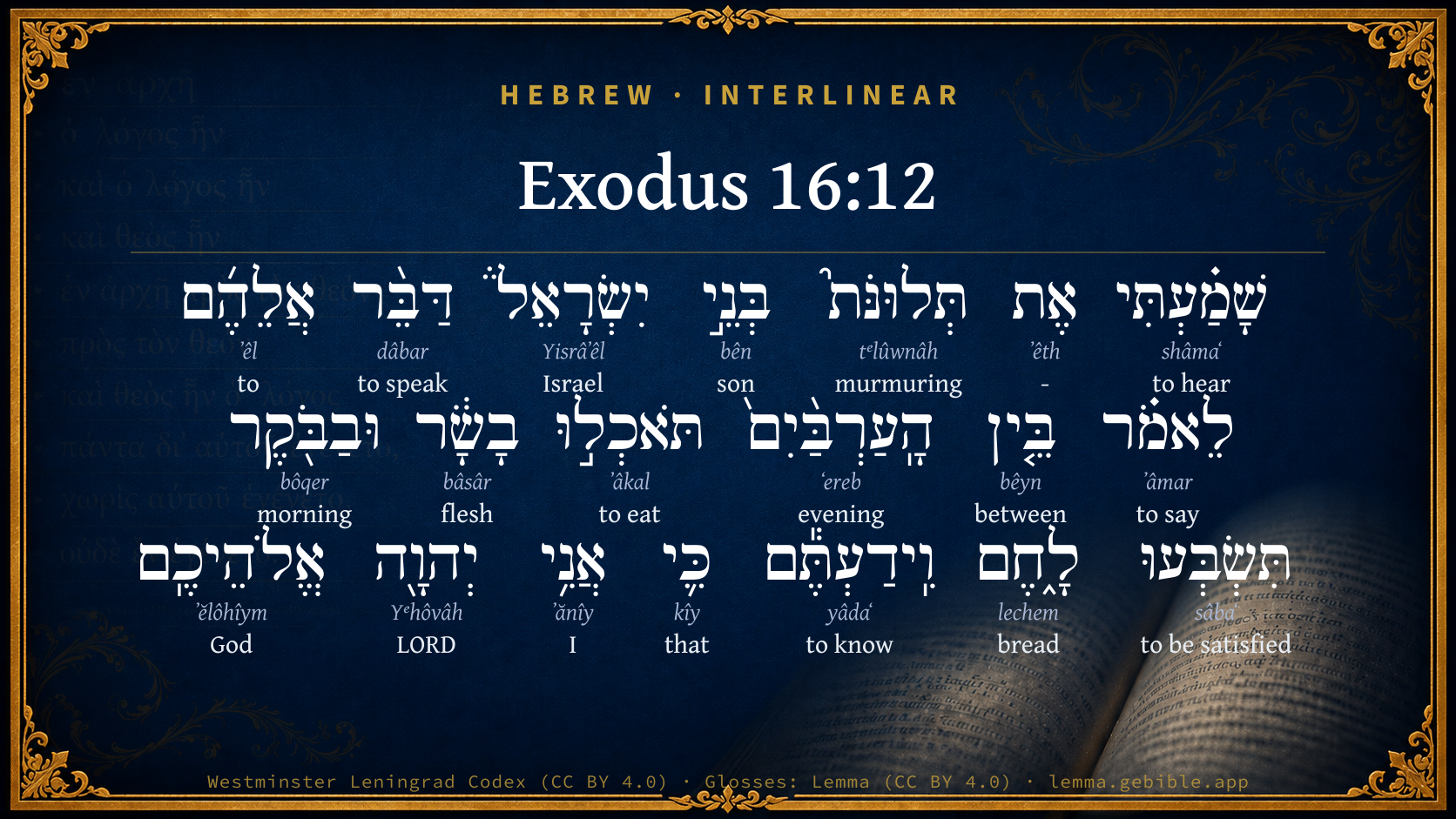
Hebrew (Westminster Leningrad Codex) Exodus 16:12 appears in the Hebrew Old Testament. The text above is from the Westminster Leningrad Codex. Each word links to its Strong’s number, a concise gloss, and parsing drawn from the Open Scriptures Hebrew Bible morphology. Click any word for its full Brown-Driver-Briggs (BDB) entry.
Download image
Cite this verse

Exodus 16:12 (World English Bible). Public Domain. Lemma interlinear Bible study tool, https://lemma.gebible.app/v/exodus/16/12.

Show BibTeX & RIS
BibTeX
RIS
English Translation
"I have heard the murmurings of the children of Israel. Speak to them, saying, 'At evening you shall eat meat, and in the morning you shall be filled with bread: and you shall know that I am Yahweh your God.'"
World English Bible · Public Domain
Download a study sheet

One document with this verse’s original text, its word-by-word gloss line, the meaning frame, cross-references with their text, attributed commentary, and full source and license credits — printable, and it pastes into notes with its structure intact.

This verse Autodidact and up

Study sheet (.html) Plain text (.txt)

A passage Seminary Student

Up to 50 verses in one chapter. A passage sheet keeps up to 6 commentary sources and 12 cross-references per verse, in the order this page ranks them, and says so on the sheet whenever that leaves anything out. Ask for a single verse and you get the Autodidact verse sheet above.

Everything on this page stays free to read, with no account — the sheet is a download of what is already on screen, not access to it.

Want to remove ads? Support Godless Engineer
Compare translations 3

The same verse in 3 English versions, stacked beneath the original-language interlinear above. Click any original word for its lexicon entry.

Each is an independent rendering of the whole verse — the interlinear is not word-aligned to these translations.

Highlighted words mark where these versions differ — a whole-verse word diff, not a word-by-word alignment.

  • World English Bible Public Domain
    "I have heard the murmurings of the children of Israel. Speak to them, saying, 'At evening you shall eat meat, and in the morning you shall be filled with bread: and you shall know that I am Yahweh your God.'"
  • King James Version Public Domain
    I have heard the murmurings of the children of Israel: speak unto them, saying, At even ye shall eat flesh, and in the morning ye shall be filled with bread; and ye shall know that I am the LORD your God.
  • unfoldingWord Literal Text CC BY-SA 4.0
    “I have heard the murmurings of the sons of Israel. Speak to them saying, ‘Between the evenings you will eat meat, and in the morning you will be satisfied with bread. And you will know that I am Yahweh your God.’”

unfoldingWord Literal Text — © unfoldingWord, licensed CC BY-SA 4.0. Word-aligned USFM3 via Door43 (git.door43.org/unfoldingWord/en_ult).

Versions to compare (up to 4)

3 of 4 selected

Show all 18 translations

Every available English version of this verse, each an independent rendering of the whole verse.

  • World English Bible Public Domain
    "I have heard the murmurings of the children of Israel. Speak to them, saying, 'At evening you shall eat meat, and in the morning you shall be filled with bread: and you shall know that I am Yahweh your God.'"
  • Berean Standard Bible Public Domain
    “I have heard the grumbling of the Israelites. Tell them, ‘At twilight you will eat meat, and in the morning you will be filled with bread. Then you will know that I am the LORD your God.’”
  • Majority Standard Bible Public Domain
    “I have heard the grumbling of the Israelites. Tell them, ‘At twilight you will eat meat, and in the morning you will be filled with bread. Then you will know that I am the LORD your God.’”
  • King James Version Public Domain
    I have heard the murmurings of the children of Israel: speak unto them, saying, At even ye shall eat flesh, and in the morning ye shall be filled with bread; and ye shall know that I am the LORD your God.
  • American Standard Version (1901) Public Domain
    I have heard the murmurings of the children of Israel: speak unto them, saying, At even ye shall eat flesh, and in the morning ye shall be filled with bread: and ye shall know that I am Jehovah your God.
  • Revised Version (1885) Public Domain
    I have heard the murmurings of the children of Israel: speak unto them, saying, At even ye shall eat flesh, and in the morning ye shall be filled with bread; and ye shall know that I am the LORD your God.
  • Geneva Bible (1599) Public Domain
    I haue heard the murmurings of the children of Israel: tell them therefore, and say, At euen ye shall eate flesh, and in the morning ye shall be filled with bread, and ye shall knowe that I am the Lord your God)
  • Douay-Rheims (1899) Public Domain
    I have heard the murmuring of the children of Israel: say to them: In the evening you shall eat flesh, and in the morning you shall have your fill of bread: and you shall know that I am the Lord your God.
  • Young's Literal Translation Public Domain
    `I have heard the murmurings of the sons of Israel; speak unto them, saying, Between the evenings ye eat flesh, and in the morning ye are satisfied `with' bread, and ye have known that I `am' Jehovah your God.'
  • Literal Standard Version CC BY-SA 4.0
    “I have heard the murmurings of the sons of Israel; speak to them, saying, Between the evenings you eat flesh, and in the morning you are satisfied [with] bread, and you have known that I [am] your God YHWH.”
  • Unlocked Literal Bible CC BY-SA 4.0
    “I have heard the complaints of the people of Israel. Speak to them and say, 'In the evening you will eat meat, and in the morning you will be filled with bread. Then you will know that I am Yahweh your God.'”
  • unfoldingWord Literal Text CC BY-SA 4.0
    “I have heard the murmurings of the sons of Israel. Speak to them saying, ‘Between the evenings you will eat meat, and in the morning you will be satisfied with bread. And you will know that I am Yahweh your God.’”
  • Darby Bible Public Domain
    I have heard the murmurings of the children of Israel: speak to them, saying, Between the two evenings ye shall eat flesh, and in the morning ye shall be filled with bread; and ye shall know that I am Jehovah your God.
  • World Messianic Bible Public Domain
    “I have heard the murmurings of the children of Israel. Speak to them, saying, ‘At evening you shall eat meat, and in the morning you shall be filled with bread. Then you will know that I am the LORD your God.’”
  • Webster's Bible Public Domain
    I have heard the murmurings of the children of Israel; Speak to them, saying, At evening ye shall eat flesh, and in the morning ye shall be filled with bread: and ye shall know that I am the LORD your God.
  • Free Bible Version CC BY-SA 4.0
    “I have heard the complaints of the Israelites. Tell them, ‘In the evening you will eat meat, and in the morning you will have as much bread as you want. Then you will know that I am the Lord your God.’”
  • Bible in Basic English Public Domain
    The outcry of the children of Israel has come to my ears: say to them now, At nightfall you will have meat for your food, and in the morning bread in full measure; and you will see that I am the Lord your God.
  • JPS Tanakh (1917) Public Domain
    'I have heard the murmurings of the children of Israel. Speak unto them, saying: At dusk ye shall eat flesh, and in the morning ye shall be filled with bread; and ye shall know that I am the LORD your God.'

Literal Standard Version (2020), Covenant Press — licensed CC BY-SA 4.0. Text via the HelloAO Bible API (eBible.org). Unlocked Literal Bible (unfoldingWord) — licensed CC BY-SA 4.0. Text via the HelloAO Bible API (eBible.org). unfoldingWord Literal Text — © unfoldingWord, licensed CC BY-SA 4.0. Word-aligned USFM3 via Door43 (git.door43.org/unfoldingWord/en_ult). Free Bible Version, Dr. Jonathan Gallagher — licensed CC BY-SA 4.0. Text via the HelloAO Bible API (eBible.org).

Word by word

More ways to search: Search by grammar → Find every occurrence → Compare this word →

Practice this passage: Drill this verse → Learn its vocabulary →

תְּלוּנֹּת֮
tᵉlûwnâh
H8519
“murmurings of”
Noun, Common, Feminine, Plural, Construct
Part of Speech
Noun
Type
Common
Gender
Feminine
Number
Plural
State
Construct
Full BDB Definition

Origin: from H3885 in the sense of obstinacy

TWOT: 1097a

murmuring
  1. שָׁמַ֗עְתִּי shâmaʻ H8085 “to hear” Verb, Qal, Perfect, 1st Person, Common, Singular
  2. אֶת ʼêth H853 “-” Particle, Direct Object
  3. בְּנֵ֣י bên H1121 “sons of” Noun, Common, Masculine, Plural, Construct
  4. יִשְׂרָאֵל֒ Yisrâʼêl H3478 “Israel” Noun, Proper
  5. דַּבֵּ֨ר dâbar H1696 “speak” Verb, Piel, Imperative, 2nd Person, Masculine, Singular
  6. אֲלֵהֶ֜ם ʼêl H413 “to · them” Preposition + Suffix, Personal, 3rd Person, Masculine, Plural
  7. לֵאמֹ֗ר ʼâmar H559 “to say” Preposition + Verb, Qal, Infinitive Construct
  8. בֵּ֤ין bêyn H996 “between” Preposition
  9. הָֽעַרְבַּ֨יִם֙ ʻereb H6153 “the · evenings” Particle, Definite Article + Noun, Common, Masculine, Dual, Absolute
  10. תֹּאכְל֣וּ ʼâkal H398 “to eat” Verb, Qal, Imperfect, 2nd Person, Masculine, Plural
  11. בָשָׂ֔ר bâsâr H1320 “flesh” Noun, Common, Masculine, Singular, Absolute
  12. וּבַבֹּ֖קֶר bôqer H1242 “and · in/at the · morning” Conjunction + Preposition, Determined + Noun, Common, Masculine, Singular, Absolute
  13. תִּשְׂבְּעוּ sâbaʻ H7646 “to be satisfied” Verb, Qal, Imperfect, 2nd Person, Masculine, Plural
  14. לָ֑חֶם lechem H3899 “bread” Noun, Common, Both, Singular, Absolute
  15. וִֽידַעְתֶּ֕ם yâdaʻ H3045 “and · to know” Conjunction + Verb, Qal, Sequential Perfect, 2nd Person, Masculine, Plural
  16. כִּ֛י kîy H3588 “that” Conjunction
  17. אֲנִ֥י ʼănîy H589 “I” Pronoun, Personal, 1st Person, Common, Singular
  18. יְהוָ֖ה Yᵉhôvâh H3068 “LORD” Noun, Proper
  19. אֱלֹהֵיכֶֽם ʼĕlôhîym H430 “God(s) · your” Noun, Common, Masculine, Plural, Construct + Suffix, Personal, 2nd Person, Masculine, Plural

About this verse

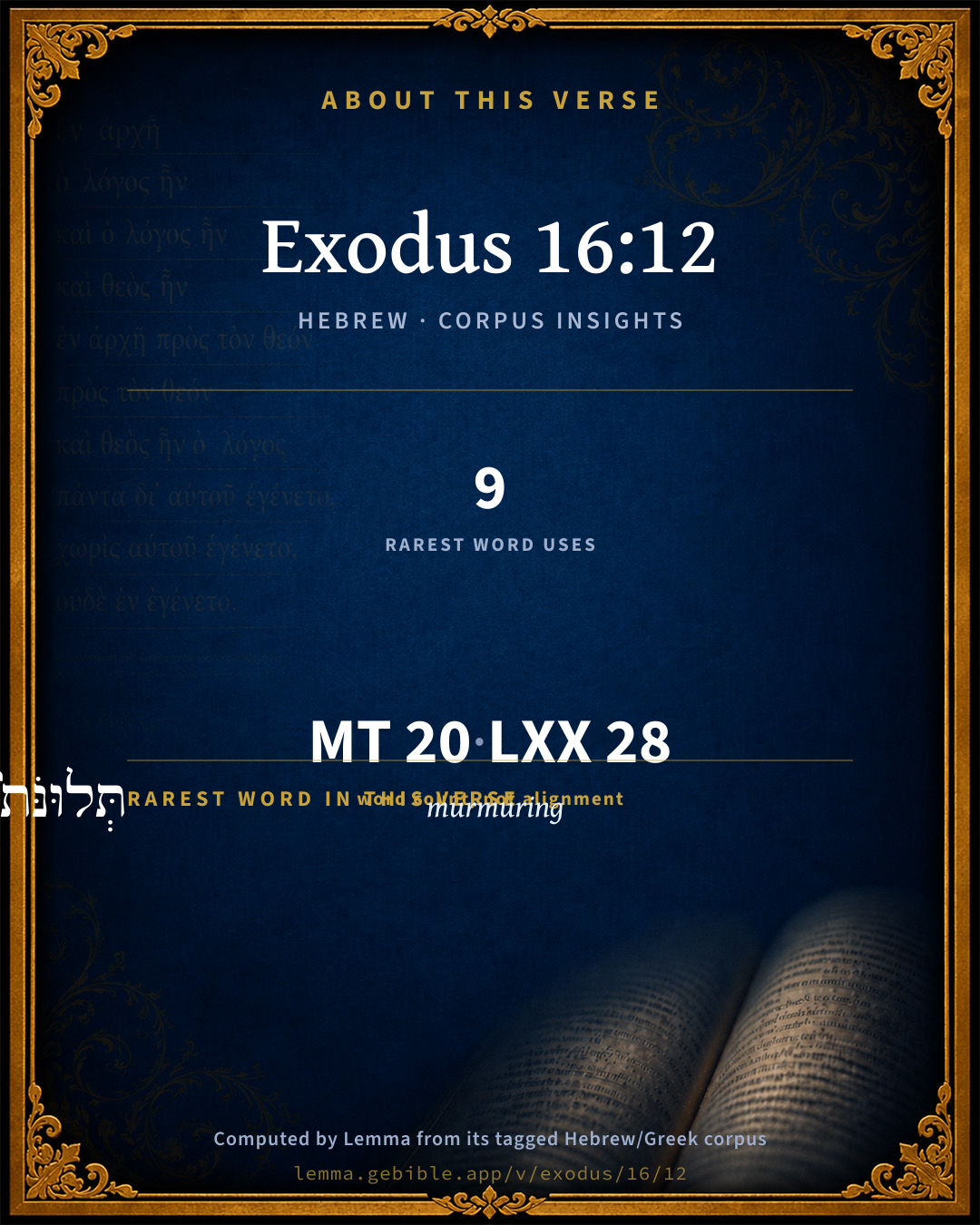
These counts appear in no published source. They are computed here, from the morphology-tagged text and Lemma’s own curated glosses. What Lemma adds →

20
words
20
distinct lemmas
Pentateuch
section

Notable vocabulary

The rarest word here is תְּלוּנֹּת֮ murmuring H8519 — appearing just 9 times in the whole Hebrew Bible.

Shared distinctive vocabulary

תְּלוּנֹּת֮ murmuring H8519 occurs in 7 verses of the Hebrew Bible. Also found in:

Grammatical profile

  • 6 verbs
  • 9 nouns
  • 1 pronoun
  • 2 prepositions
  • 1 conjunction
  • 1 particle

Verb forms

  • שָׁמַ֗עְתִּי Qal · Perfect
  • דַּבֵּ֨ר Piel · Imperative
  • לֵאמֹ֗ר Qal · Infinitive Construct
  • תֹּאכְל֣וּ Qal · Imperfect
  • תִּשְׂבְּעוּ Qal · Imperfect
  • וִֽידַעְתֶּ֕ם Qal · Sequential Perfect

Hebrew & Septuagint length

In English translation the verse runs 40 words from the Hebrew and 41 from the Septuagint (LXX English) — closely comparable.

A rough comparison of the two English renderings, which tokenize alike — not a word-level alignment.

Word counts can differ between the Hebrew and the Greek without any difference in meaning — e.g. the Hebrew direct-object marker אֵת has no separate Greek word, and Greek often adds the article ὁ.

In the original languages it is 20 Hebrew tokens and 28 Greek tokens — but the two are counted differently (Hebrew bundles its prefixes and suffixes into one token; the Greek is in lemma form), so that isn’t a like-for-like length.

Cross-references

9

Topical passages linked to Exodus 16:12 in the Treasury of Scripture Knowledge — connected by theme and wording, ordered by reader-vote popularity; previews shown in the World English Bible.

  • Joel 3:17 "So you will know that I am Yahweh, your God, Dwelling in Zion, my holy mountain. Then Jerusalem will be holy, And no strangers will pass through her any more.
  • Exodus 6:7 and I will take you to me for a people, and I will be to you a God; and you shall know that I am Yahweh your God, who brings you out from under the burdens of the Egyptians.
  • Exodus 16:7–8 and in the morning, then you shall see the glory of Yahweh; because he hears your murmurings against Yahweh. Who are we, that you murmur against us?"
  • Ezekiel 39:22 So the house of Israel shall know that I am Yahweh their God, from that day and forward.
  • Exodus 4:5 "That they may believe that Yahweh, the God of their fathers, the God of Abraham, the God of Isaac, and the God of Jacob, has appeared to you."
  • Exodus 7:17 Thus says Yahweh, "In this you shall know that I am Yahweh. Behold, I will strike with the rod that is in my hand on the waters which are in the river, and they shall be turned to blood.
  • Jeremiah 31:24 Judah and all the cities of it shall dwell therein together, the farmers, and those who go about with flocks.
  • Ezekiel 34:30 They shall know that I, Yahweh, their God am with them, and that they, the house of Israel, are my people, says the Lord Yahweh.
  • Zechariah 13:9 I will bring the third part into the fire, And will refine them as silver is refined, And will test them like gold is tested. They will call on my name, and I will hear them. I will say, 'It is my people;' And they will say, 'Yahweh is my God.'"

Cross-references courtesy of OpenBible.info (CC BY 4.0).

Hebrew and Greek witnesses Masoretic Hebrew ↔ Greek Septuagint

The same verse in the two great witnesses to the Old Testament, shown verse-for-verse.

These are two independent witnesses, not word-aligned to each other, and the Septuagint is shown in lemma (dictionary) form.

Hebrew Exodus 16:12 Masoretic · Westminster Leningrad Codex

שָׁמַ֗עְתִּי אֶת תְּלוּנֹּת֮ בְּנֵ֣י יִשְׂרָאֵל֒ דַּבֵּ֨ר אֲלֵהֶ֜ם לֵאמֹ֗ר בֵּ֤ין הָֽעַרְבַּ֨יִם֙ תֹּאכְל֣וּ בָשָׂ֔ר וּבַבֹּ֖קֶר תִּשְׂבְּעוּ לָ֑חֶם וִֽידַעְתֶּ֕ם כִּ֛י אֲנִ֥י יְהוָ֖ה אֱלֹהֵיכֶֽם

"I have heard the murmurings of the children of Israel. Speak to them, saying, 'At evening you shall eat meat, and in the morning you shall be filled with bread: and you shall know that I am Yahweh your God.'"

World English Bible · Public Domain

Greek LXX Exodus 16:12 Septuagint · lemma form

εἰςἀκούω ὁ γογγυσμός ὁ υἱός ἰσραήλ λαλέω πρός αὐτός λέγω ὁ πρός ἑσπέρα ἐσθίω κρέας καί ὁ πρωΐ πίμπλημι ἄρτος καί γιγνώσκω ὅτι ἐγώ κύριος ὁ θεός σύ

I have heard the murmuring of the children of Israel: speak to them, saying, Towards evening you⌃ shall eat flesh, and in the morning you⌃ shall be satisfied with bread; and you⌃ shall know that I am the Lord your God.

LXX2012 (modern English Septuagint) · Public Domain

Hebrew: Westminster Leningrad Codex (CC BY 4.0). Greek: Septuagint (public domain); English from LXX2012 (modern English Septuagint) (Public Domain). How the Septuagint differs from the Hebrew →

Targum (Aramaic paraphrase)

2

The Targum is the ancient Jewish Aramaic paraphrase of the Hebrew Scriptures — an interpretive translation, not the Hebrew text itself. Onkelos (literal) and Pseudo-Jonathan (expansive) render the Torah, and Jonathan the Prophets. Coverage is partial: where no permissively-licensed English translation exists for a verse, only the Aramaic is shown. This is verse-level text, not a word-by-word alignment to the Hebrew.

  1. Targum Onkelos Torah (Genesis–Deuteronomy)
    שְׁמִיעַ קֳדָמַי יָת תֻּרְעֲמַת בְּנֵי יִשְּׂרָאֵל מַלֵיל עִמְהוֹן לְמֵימַר בֵּין שִׁמְשַׁיָא תֵּיכְלּוּן בִּסְרָא וּבְצַפְרָא תִּשְׂבְּעוּן לַחְמָא וְתִדְעוּן אֲרֵי אֲנָא יְיָ אֱלָהָכוֹן:

    (no public-domain English translation for this verse)

    Targum Onkelos — Aramaic: “Onkelos Genesis” (public domain); “Onkelos Exodus” (public domain); “Onkelos Leviticus” (public domain); “Onkelos Numbers” (public domain); “Onkelos Deuteronomy” (public domain). English: “Sefaria Community Translation” (CC0 1.0 (public-domain dedication)); “J.W. Etheridge. The Targums of Onkelos and Jonathan Ben Uzziel on the Pentateuch. London: Longmans, Green, 1862” (public domain). Text via Sefaria.

  2. Targum Pseudo-Jonathan Torah (Genesis–Deuteronomy)
    שְׁמִיעַ קֳדָמַי יַת תּוּרְעֲמוּת בְּנֵי יִשְרָאֵל מַלֵּיל עִמְהוֹן לְמֵימַר בֵּינֵי שִׁמְשְׁתָא תֵיכְלוּן בִּשְרָא וּבְצַפְרָא תֵיכְלוּן לַחְמָא וְתִנְדְּעוּן אֲרוּם אֲנָא הוּא יְיָ אֱלָהָכוֹן

    Hearing I have heard the murmurings of the sons of Israel before Me. Speak thou with them, saying, Between the evenings (suns) you shall eat flesh, and in the morning shall you eat bread, and shall know that I am the Lord your God.

    Targum Pseudo-Jonathan — Aramaic: “Targum Jonathan on Genesis” (public domain); “Targum Jonathan on Exodus” (public domain); “Targum Jonathan on Leviticus” (public domain); “Targum Jonathan on Numbers” (public domain); “Targum Jonathan on Deuteronomy” (public domain). English: “The Targum of Jonathan ben Uzziel, trans. J. W. Etheridge, London, 1862” (public domain). Text via Sefaria.

Commentary

Notes on Exodus 16:12 from classic Christian and Jewish commentators (each source and its license shown beneath its notes). The classic Christian expositions comment on the surrounding passage and are grouped to its opening verse, so a note may address several verses; the Jewish commentaries on the Tanakh (Rashi and others) are per-verse, so they appear only where the commentator wrote on this verse.

Lemma curates 59 commentaries, every one of them public domain or Creative Commons licensed, each selected and text-cleaned for this edition rather than reprinted as found. About our sources →

Trapp's Complete Commentary

John Trapp

Exo 16:12 I have heard the murmurings of the children of Israel: speak unto them, saying, At even ye shall eat flesh, and in the morning ye shall be filled with bread; and ye shall know that I [am] the LORD your God.

Ver. 12. And in the morning.] Theyhave their flesh at even, and bread in the morning. God will be waited on, and give the consummation of his blessings at his leisure. The cloud empties not itself at a sudden burst, but dissolves upon the earth drop after drop.

John Trapp, A Commentary or Exposition upon All the Books of the Old and New Testament (1647–1656) — public domain. Text from a community e-Sword module.

Joseph Benson's Commentary

Exo 16:12. Ye shall know that I am the Lord your God — This gave proof of his power as the Lord, and his particular favour to them as their God; when God plagued the Egyptians, it was to make them know that he is the Lord; when he provided for the Israelites, it was to make them know that he was their God.

Joseph Benson's Commentary on the Old and New Testaments (1811–1818) — public domain. Text from a community e-Sword module.

Geneva Bible (1599)

Geneva Bible translators

Or, in the twilight.

Geneva Bible (1599) marginal notes — public domain. Text via Bolls.life.

The Cambridge Bible for Schools and Colleges

gen. ed. J. J. S. Perowne

12. Between the two evenings] see on Exo_12:6.

and ye shall know, &c.] see on Exo_6:7.

After v. 12, vv. 6–8 should follow: see above.

The Cambridge Bible for Schools and Colleges (gen. ed. J. J. S. Perowne; Cambridge University Press, 1878–1918) — public domain. Text from a community e-Sword module.

John Gill's Exposition

I have heard the murmurings of the children of Israel,.... This Moses and Aaron had often affirmed, and now the Lord confirms what they had said, and lets them know that he took notice of their murmurings, and disapproved of them, and was displeased with them; though he did not think fit to resent them in an angry way, but dealt kindly and graciously with them; and since he had brought them into a wilderness, which was his own act, he would take care of them, and provide for them; which they might reasonably conclude he would, since he had done so many great and good things for them, in bringing them out of Egypt, and through the Red sea, and had slain all their enemies, and had given them water when in distress, and therefore need not have murmured nor have doubted but that he would give them bread also:

speak unto them, saying, at even ye shall eat flesh; meaning that very evening, when the quails came up, as the following verse shows:

and in the morning ye shall be filled with bread; the next morning, when the manna fell around their camp, so that they had bread, and fulness of it:

and ye shall know that I am the Lord your God; good and gracious, kind and merciful, ever mindful of his covenant and promises, able to supply their wants, and provide them with everything necessary and sufficient for them.

John Gill's Exposition of the Whole Bible (1746–1763) — public domain (CC PDM 1.0). Text via the HelloAO Bible API.

Haydock's Catholic Bible Commentary

Say. Similar promises are often repeated, to appease the seditious mob. (Haydock)

George Leo Haydock (1774–1849), Haydock's Catholic Family Bible and Commentary, 1859 edition — public domain. Excludes Psalms (Douay-Rheims chapter numbering differs from Protestant) and Deuterocanonical books (Catholic canon only).

Matthew Poole's English Annotations

God chooseth the proper time for each kind of provision; the evening for the quails, which being brought from remote parts, by their day’s flight, about evening came thither; and the morning for manna, which usually falls at that time.

Matthew Poole's English Annotations on the Holy Bible (1683–1685) — public domain. Text from a community e-Sword/MySword module.

The Pulpit Commentary

At even. Literally, "between the two evenings." For the meaning of the phrase, see the comment on, Exo_12:6. Ye shall eat flesh. The quails, as appears by the subsequent narrative, were supplied, not regularly, but only on rare occasions; in fact (so far as appears) only here in the wilderness of Sin, and at Kibroth-hattaavah in the wilderness of. (Num_11:31-34) They were not a necessary, but an indulgence. Ye shall know that I am the Lord. The miracle of the manna, and the timely appearance of the quails at the hour announced, will sufficiently show that it is God himself who has you under his charge and watches over you.

The Pulpit Commentary (1880–1919), ed. H.D.M. Spence-Jones & Joseph S. Exell — public domain. Text from a community e-Sword module.

John Wesley's Explanatory Notes

And ye shall know that I am the Lord your God - This gave proof of his power as the Lord, and his particular favour to them as their God; when God plagued the Egyptians, it was to make them know that he is the Lord; when he provided for the Israelites, it was to make them know that he was their God.

John Wesley, Explanatory Notes Upon the Whole Bible (1754–1765) — public domain. Text via the GEBible commentary corpus.

Ramban (Nachmanides)

Rabbi Moshe ben Nachman (Ramban / Nachmanides)

I HAVE HEARD THE MURMURINGS OF THE CHILDREN OF ISRAEL. SPEAK UNTO THEM, SAYING: AT DUSK YE SHALL EAT FLESH. This communication [at dusk ye shall eat, etc.], had already been conveyed by Moses to Israel, but it is repeated here only because of that which He said I have heard the murmurings of the children of Israel. At first, He had said, Behold, I will cause to rain bread from heaven to you;, Verse 4. He would willingly do it for them as an act of kindness or because of their merits. But now He said that [their murmuring] is accounted to them as sin, and yet because of the very nature of the murmuring, He will do such things for them so that they might know thereby that I am the Eternal your G-d. Until now ye do not believe the Eternal your G-d; this is why you murmur against His prophets.It is possible that at first He did not promise them the manna for all the time that they would be in the wilderness. Thus they thought that perhaps it would be for one day or two, as long as they stayed in that place, and that when they would leave it, they would come to a place of food. But now He said to them, “At dusk ye shall eat flesh always, and in every morning ye shall be filled with bread as long as you will be in the wilderness.” And so also is the opinion of our Rabbis, that the quail were with them from that day on, just like the manna. It is logically so, for they expressed discontent about the two things — [flesh and bread]. — and He hearkened to their murmurings on both matters, and He gave them that which they craved. What would He give them, and what more, 120:3. if He supplied them with meat for only one day or two?The reason that the chapter [of the Torah] speaks at length about the matter of the manna is that everything about it was of a wondrous nature, whereas with reference to the matter of the quail, it just writes briefly, And it came to pass at even, that the quail came up, because it came in a natural way. [Although the quail were a daily occurrence], the subject of the second [incident of] quail at Kibroth-hata’avah [is singled out for mention in Scripture] because right now [in the wilderness of Sin], they did not receive of them to the full, just as He always says here, flesh to eat, and bread to the full.. This clearly indicates that bread they had to the full, but not flesh.It is possible that only the adults gathered the quail — or it may be that they were marked by chance for the pious ones — while the young craved and hungered for them, since Scripture does not relate concerning the quail, “and they gathered some more, some less,” as it does concerning the manna. It is for this reason that Scripture says there [in the narrative of the second quail]: And the mixed multitude that was among them fell a lusting, and it further says, and the children of Israel also wept on their part, meaning that some of the children of Israel were also weeping for it, but not all. He then gave them in great quantity, as it says, He that gathered least gathered ten heaps, Verse 32. and out of that abundance, they ate for a month’s time, Verse 20. and then the quail reverted to their first state.In line with the plain meaning of Scripture, the whole affair with the quail happened only at intervals, but since the manna was their staple food, they always had it, for their chief murmuring concerned it, as it is written, for ye have brought us forth into this wilderness, to put to death this whole assembly by famine.

Ramban (Nachmanides) on the Tanakh — English translation: “Commentary on the Torah by Ramban (Nachmanides). Translated and annotated by Charles B. Chavel. New York, Shilo Pub. House, 1971-1976” (CC BY 4.0). Text via Sefaria.

Lesson kit

Teaching starters — assembled from the data on this page, not authored interpretation. Every prompt links to the verse data it draws on. Edit before teaching.

Exodus, in the Pentateuch, opens this verse with 20 words (20 distinct Hebrew lemmas). Its most distinctive word is tᵉlûwnâh (“murmuring”). A historical commentator’s framing appears above. Read the whole chapter for the surrounding context.

Discussion questions

  1. The word tᵉlûwnâh carries the sense “murmuring.” How does it shape the verse?
  2. Exodus 16:7 shares the word «murmuring» with this verse. How do the two illuminate each other?
  3. These translations render this verse differently; the difference is in the English rendering, not the original. What questions does that raise?
  4. The verb «שָׁמַ֗עְתִּי» is Qal Perfect. How does its form color the action?
  5. Reading how Trapp's Complete Commentary and Joseph Benson's Commentary read this verse, where do the two commentators agree and where do they part?

Things to notice

Reading settings

Reading text

Shown beneath each verse's original-language words.

Old Testament
Old Testament edition

Read the OT as the Masoretic Hebrew (MT) or the Greek Septuagint (LXX).

English shown for the Greek Septuagint (in the Hebrew ↔ Greek comparison).

Comparing translations? Open the Compare panel on any verse page to stack up to four side by side.