
Leviticus 20:22

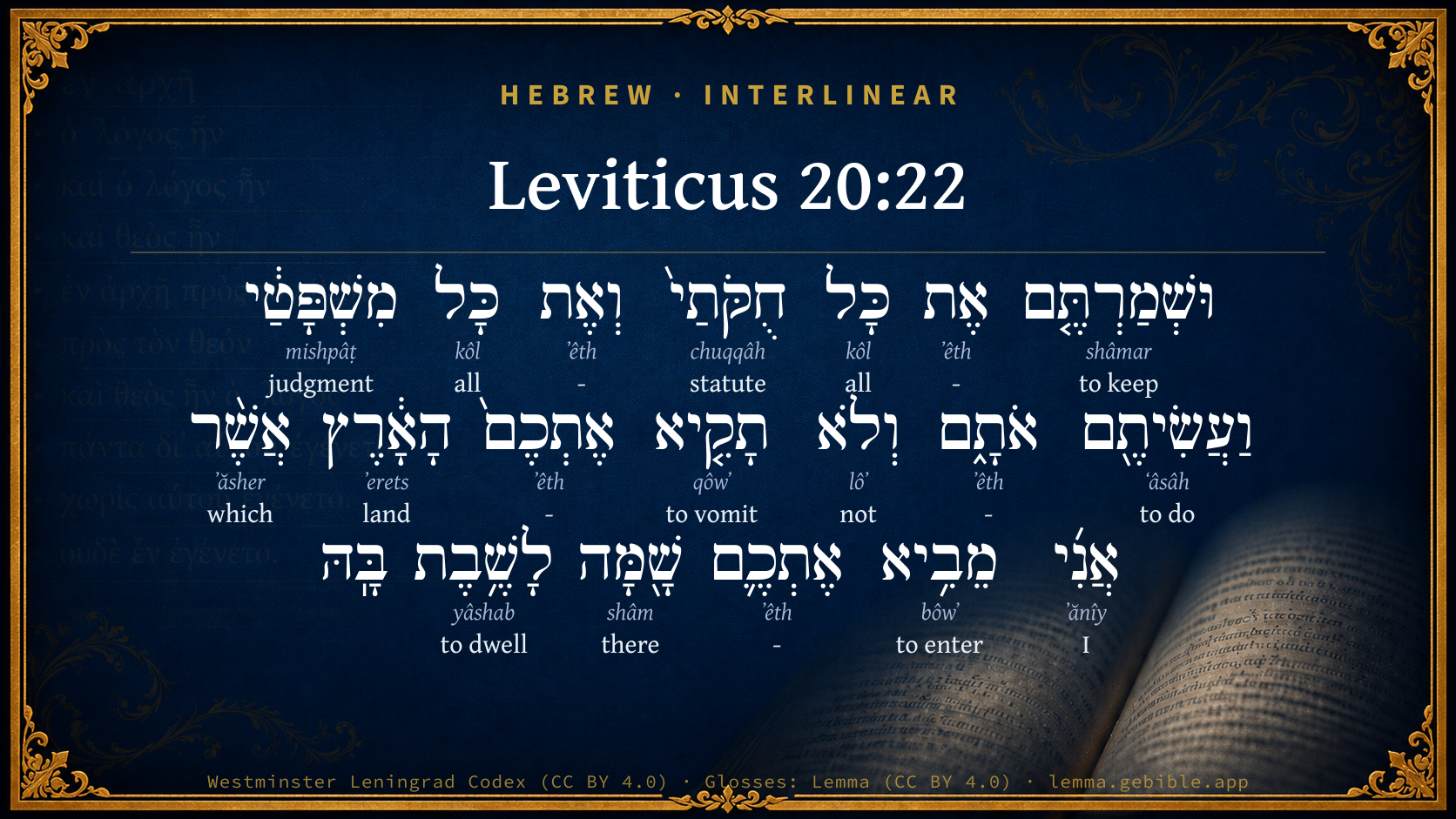
Hebrew (Westminster Leningrad Codex) Leviticus 20:22 appears in the Hebrew Old Testament. The text above is from the Westminster Leningrad Codex. Each word links to its Strong’s number, a concise gloss, and parsing drawn from the Open Scriptures Hebrew Bible morphology. Click any word for its full Brown-Driver-Briggs (BDB) entry.
Download image
Cite this verse

Leviticus 20:22 (World English Bible). Public Domain. Lemma interlinear Bible study tool, https://lemma.gebible.app/v/leviticus/20/22.

Show BibTeX & RIS
BibTeX
RIS
English Translation
"'You shall therefore keep all my statutes, and all my ordinances, and do them; that the land, where I am bringing you to dwell, may not vomit you out.
World English Bible · Public Domain
Download a study sheet

One document with this verse’s original text, its word-by-word gloss line, the meaning frame, cross-references with their text, attributed commentary, and full source and license credits — printable, and it pastes into notes with its structure intact.

This verse Autodidact and up

Study sheet (.html) Plain text (.txt)

A passage Seminary Student

Up to 50 verses in one chapter. A passage sheet keeps up to 6 commentary sources and 12 cross-references per verse, in the order this page ranks them, and says so on the sheet whenever that leaves anything out. Ask for a single verse and you get the Autodidact verse sheet above.

Everything on this page stays free to read, with no account — the sheet is a download of what is already on screen, not access to it.

Want to remove ads? Support Godless Engineer
Compare translations 3

The same verse in 3 English versions, stacked beneath the original-language interlinear above. Click any original word for its lexicon entry.

Each is an independent rendering of the whole verse — the interlinear is not word-aligned to these translations.

Highlighted words mark where these versions differ — a whole-verse word diff, not a word-by-word alignment.

  • World English Bible Public Domain
    "'You shall therefore keep all my statutes, and all my ordinances, and do them; that the land, where I am bringing you to dwell, may not vomit you out.
  • King James Version Public Domain
    Ye shall therefore keep all my statutes, and all my judgments, and do them: that the land, whither I bring you to dwell therein, spue you not out.
  • unfoldingWord Literal Text CC BY-SA 4.0
    And you shall keep all my statutes and all my judgments. And you shall do them, and the land that I am bringing you there to dwell in it will not vomit you out.

unfoldingWord Literal Text — © unfoldingWord, licensed CC BY-SA 4.0. Word-aligned USFM3 via Door43 (git.door43.org/unfoldingWord/en_ult).

Versions to compare (up to 4)

3 of 4 selected

Show all 18 translations

Every available English version of this verse, each an independent rendering of the whole verse.

  • World English Bible Public Domain
    "'You shall therefore keep all my statutes, and all my ordinances, and do them; that the land, where I am bringing you to dwell, may not vomit you out.
  • Berean Standard Bible Public Domain
    You are therefore to keep all My statutes and ordinances, so that the land where I am bringing you to live will not vomit you out.
  • Majority Standard Bible Public Domain
    You are therefore to keep all My statutes and ordinances, so that the land where I am bringing you to live will not vomit you out.
  • King James Version Public Domain
    Ye shall therefore keep all my statutes, and all my judgments, and do them: that the land, whither I bring you to dwell therein, spue you not out.
  • American Standard Version (1901) Public Domain
    Ye shall therefore keep all my statutes, and all mine ordinances, and do them; that the land, whither I bring you to dwell therein, vomit you not out.
  • Revised Version (1885) Public Domain
    Ye shall therefore keep all my statutes, and all my judgments, and do them: that the land, whither I bring you to dwell therein, vomit you not out.
  • Geneva Bible (1599) Public Domain
    Ye shall keepe therefore all mine ordinances and all my iudgements, and doe them, that the land, whither I bring you to dwel therein, spue you not out.
  • Douay-Rheims (1899) Public Domain
    Keep my laws and my judgments, and do them: lest the land into which you are to enter to dwell therein, vomit you also out.
  • Young's Literal Translation Public Domain
    `And ye have kept all My statutes, and all My judgments, and have done them, and the land vomiteth you not out whither I am bringing you in to dwell in it;
  • Literal Standard Version CC BY-SA 4.0
    And you have kept all My statutes and all My judgments, and have done them, and the land does not vomit you out to where I am bringing you in to dwell in it;
  • Unlocked Literal Bible CC BY-SA 4.0
    You must therefore keep all my statutes and all my decrees; you must obey them so that the land into which I am bringing you to live will not vomit you up.
  • unfoldingWord Literal Text CC BY-SA 4.0
    And you shall keep all my statutes and all my judgments. And you shall do them, and the land that I am bringing you there to dwell in it will not vomit you out.
  • Darby Bible Public Domain
    And ye shall observe all my statutes, and all mine ordinances, and do them, that the land whither I bring you to dwell therein vomit you not out.
  • World Messianic Bible Public Domain
    “‘You shall therefore keep all my statutes and all my ordinances, and do them, that the land where I am bringing you to dwell may not vomit you out.
  • Webster's Bible Public Domain
    Ye shall therefore keep all my statutes, and all my judgments, and do them: that the land whither I bring you to dwell therein, may not vomit you out.
  • Free Bible Version CC BY-SA 4.0
    So keep all my rules and regulations, so that the land where I'm taking you to live won't vomit you out.
  • Bible in Basic English Public Domain
    So then, keep my rules and my decisions and do them, so that the land which I am giving you as your resting-place may not violently send you out again.
  • JPS Tanakh (1917) Public Domain
    Ye shall therefore keep all My statutes, and all Mine ordinances, and do them, that the land, whither I bring you to dwell therein, vomit you not out.

Literal Standard Version (2020), Covenant Press — licensed CC BY-SA 4.0. Text via the HelloAO Bible API (eBible.org). Unlocked Literal Bible (unfoldingWord) — licensed CC BY-SA 4.0. Text via the HelloAO Bible API (eBible.org). unfoldingWord Literal Text — © unfoldingWord, licensed CC BY-SA 4.0. Word-aligned USFM3 via Door43 (git.door43.org/unfoldingWord/en_ult). Free Bible Version, Dr. Jonathan Gallagher — licensed CC BY-SA 4.0. Text via the HelloAO Bible API (eBible.org).

Word by word

More ways to search: Search by grammar → Find every occurrence → Compare this word →

Practice this passage: Drill this verse → Learn its vocabulary →

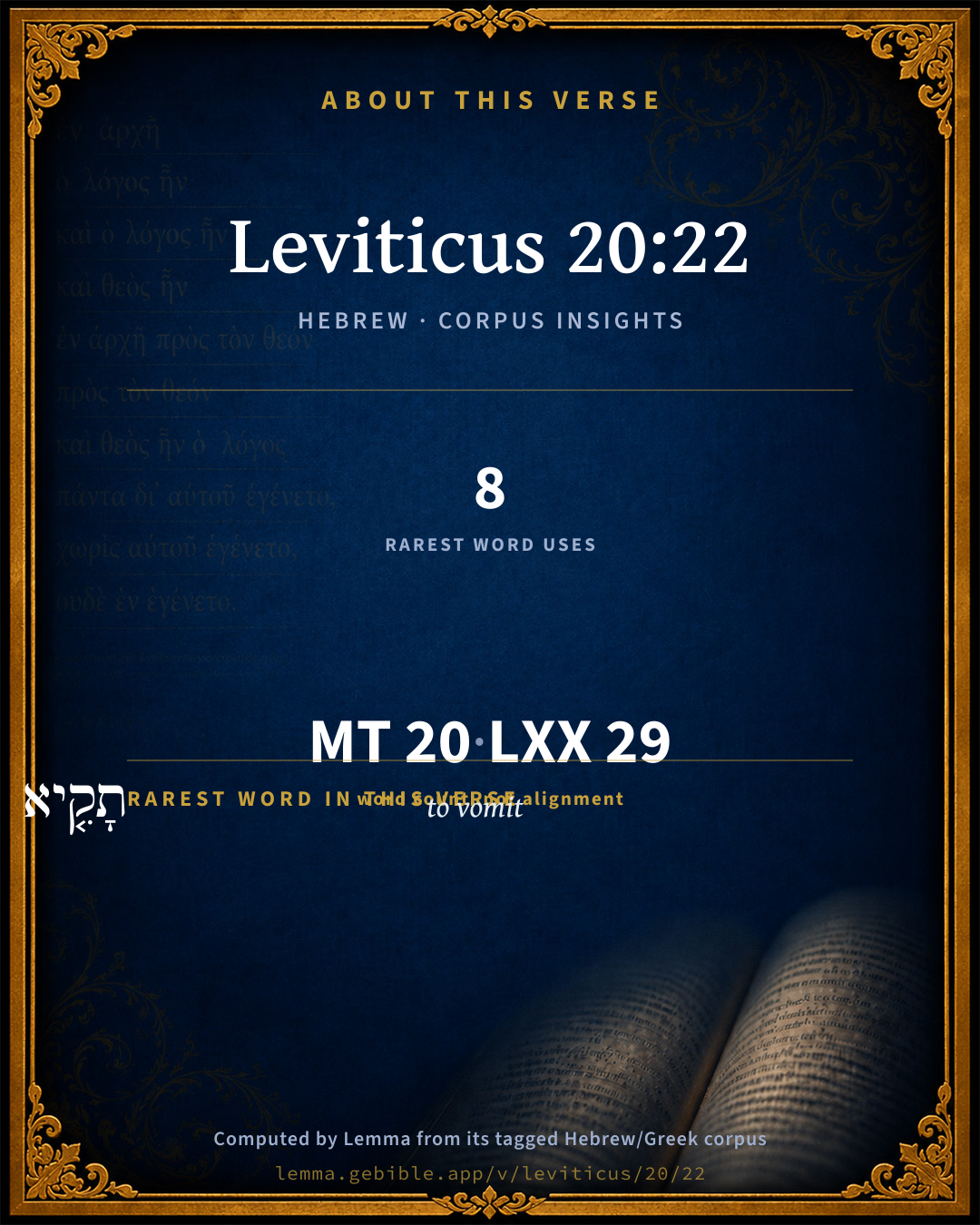
תָקִ֤יא
qôwʼ
H6958
“to vomit”
Verb, Hiphil, Imperfect, 3rd Person, Feminine, Singular
Part of Speech
Verb
Stem
Hiphil
Form
Imperfect
Person
3rd Person
Gender
Feminine
Number
Singular
Full BDB Definition

Origin: a primitive root

TWOT: 2014

to vomit up, spue out, disgorge - (Qal) to vomit - (Hiphil) to vomit up - of land spewing out its inhabitants (figuratively) - vomiting, disgorging
  1. וּשְׁמַרְתֶּ֤ם shâmar H8104 “and · to keep” Conjunction + Verb, Qal, Sequential Perfect, 2nd Person, Masculine, Plural
  2. אֶת ʼêth H853 “-” Particle, Direct Object
  3. כָּל kôl H3605 “all of” Noun, Common, Masculine, Singular, Construct
  4. חֻקֹּתַי֙ chuqqâh H2708 “statutes · my” Noun, Common, Both, Plural, Construct + Suffix, Personal, 1st Person, Common, Singular
  5. וְאֶת ʼêth H853 “and · -” Conjunction + Particle, Direct Object
  6. כָּל kôl H3605 “all of” Noun, Common, Masculine, Singular, Construct
  7. מִשְׁפָּטַ֔י mishpâṭ H4941 “judgments · my” Noun, Common, Masculine, Plural, Construct + Suffix, Personal, 1st Person, Common, Singular
  8. וַעֲשִׂיתֶ֖ם ʻâsâh H6213 “and · to do” Conjunction + Verb, Qal, Sequential Perfect, 2nd Person, Masculine, Plural
  9. אֹתָ֑ם ʼêth H853 “- · them” Particle, Direct Object + Suffix, Personal, 3rd Person, Masculine, Plural
  10. וְלֹא lôʼ H3808 “and · not” Conjunction + Particle, Negative
  11. אֶתְכֶם֙ ʼêth H853 “- · you” Particle, Direct Object + Suffix, Personal, 2nd Person, Masculine, Plural
  12. הָאָ֔רֶץ ʼerets H776 “the · land” Particle, Definite Article + Noun, Common, Both, Singular, Absolute
  13. אֲשֶׁ֨ר ʼăsher H834 “which” Particle, Relative
  14. אֲנִ֜י ʼănîy H589 “I” Pronoun, Personal, 1st Person, Common, Singular
  15. מֵבִ֥יא bôwʼ H935 “entering” Verb, Hiphil, Participle Active, Masculine, Singular, Absolute
  16. אֶתְכֶ֛ם ʼêth H853 “- · you” Particle, Direct Object + Suffix, Personal, 2nd Person, Masculine, Plural
  17. שָׁ֖מָּה shâm H8033 “there · toward” Adverb + Suffix, Demonstrative
  18. לָשֶׁ֥בֶת yâshab H3427 “to dwell” Preposition + Verb, Qal, Infinitive Construct

About this verse

These counts appear in no published source. They are computed here, from the morphology-tagged text and Lemma’s own curated glosses. What Lemma adds →

20
words
14
distinct lemmas
Pentateuch
section

Notable vocabulary

The rarest word here is תָקִ֤יא to vomit H6958 — appearing just 8 times in the whole Hebrew Bible.

Shared distinctive vocabulary

תָקִ֤יא to vomit H6958 occurs in 7 verses of the Hebrew Bible. Also found in:

Grammatical profile

  • 5 verbs
  • 5 nouns
  • 1 pronoun
  • 1 preposition
  • 1 adverb
  • 7 particles

Verb forms

  • וּשְׁמַרְתֶּ֤ם Qal · Sequential Perfect
  • וַעֲשִׂיתֶ֖ם Qal · Sequential Perfect
  • תָקִ֤יא Hiphil · Imperfect
  • מֵבִ֥יא Hiphil · Participle Active
  • לָשֶׁ֥בֶת Qal · Infinitive Construct

Repetition

A word recurs within this verse — often emphatic in Hebrew:

Hebrew & Septuagint length

In English translation the verse runs 29 words from the Hebrew and 32 from the Septuagint (LXX English) — closely comparable.

A rough comparison of the two English renderings, which tokenize alike — not a word-level alignment.

Word counts can differ between the Hebrew and the Greek without any difference in meaning — e.g. the Hebrew direct-object marker אֵת has no separate Greek word, and Greek often adds the article ὁ.

In the original languages it is 20 Hebrew tokens and 29 Greek tokens — but the two are counted differently (Hebrew bundles its prefixes and suffixes into one token; the Greek is in lemma form), so that isn’t a like-for-like length.

Cross-references

20

Topical passages linked to Leviticus 20:22 in the Treasury of Scripture Knowledge — connected by theme and wording, ordered by reader-vote popularity; previews shown in the World English Bible.

  • Leviticus 18:25–28 The land was defiled: therefore I punished its iniquity, and the land vomitted out her inhabitants.
  • Ezekiel 36:27 I will put my Spirit within you, and cause you to walk in my statutes, and you shall keep my ordinances, and do them.
  • Leviticus 18:4–5 You shall do my ordinances, and you shall keep my statutes, and walk in them: I am Yahweh your God.
  • Psalms 105:45 That they might keep his statutes, And observe his laws. Praise Yah!
  • Psalms 119:20 My soul is consumed with longing for your ordinances at all times.
  • Psalms 119:80 Let my heart be blameless toward your decrees, That I may not be disappointed.
  • Psalms 119:145 I have called with my whole heart. Answer me, Yahweh! I will keep your statutes.
  • Psalms 119:160 All of your words are truth. Every one of your righteous ordinances endures forever.
  • Exodus 21:1 "Now these are the ordinances which you shall set before them.
  • Leviticus 19:37 You shall observe all my statutes, and all my ordinances, and do them. I am Yahweh.'"
  • Leviticus 26:33 I will scatter you among the nations, and I will draw out the sword after you: and your land will be a desolation, and your cities shall be a waste.
  • Deuteronomy 4:45 these are the testimonies, and the statutes, and the ordinances, which Moses spoke to the children of Israel, when they came forth out of Egypt,
  • Deuteronomy 5:1 Moses called to all Israel, and said to them, Hear, Israel, the statutes and the ordinances which I speak in your ears this day, that you may learn them, and observe to do them.
  • Deuteronomy 28:25–26 Yahweh will cause you to be struck before your enemies; you shall go out one way against them, and shall flee seven ways before them: and you shall be tossed back and forth among all the kingdoms of the earth.
  • Psalms 19:8–11 Yahweh's precepts are right, rejoicing the heart. Yahweh's commandment is pure, enlightening the eyes.
  • Psalms 119:171 Let my lips utter praise, For you teach me your statutes.
  • Psalms 119:175 Let my soul live, that I may praise you. Let your ordinances help me.
  • Isaiah 26:8–9 Yes, in the way of your judgments, Yahweh, have we waited for you; to your name, even to your memorial [name], is the desire of our soul.
  • Psalms 119:106 I have sworn, and have confirmed it, That I will obey your righteous ordinances.
  • Psalms 119:164 Seven times a day, I praise you, Because of your righteous ordinances.

Cross-references courtesy of OpenBible.info (CC BY 4.0).

Hebrew and Greek witnesses Masoretic Hebrew ↔ Greek Septuagint

The same verse in the two great witnesses to the Old Testament, shown verse-for-verse.

These are two independent witnesses, not word-aligned to each other, and the Septuagint is shown in lemma (dictionary) form.

Hebrew Leviticus 20:22 Masoretic · Westminster Leningrad Codex

וּשְׁמַרְתֶּ֤ם אֶת כָּל חֻקֹּתַי֙ וְאֶת כָּל מִשְׁפָּטַ֔י וַעֲשִׂיתֶ֖ם אֹתָ֑ם וְלֹא תָקִ֤יא אֶתְכֶם֙ הָאָ֔רֶץ אֲשֶׁ֨ר אֲנִ֜י מֵבִ֥יא אֶתְכֶ֛ם שָׁ֖מָּה לָשֶׁ֥בֶת בָּֽהּ

"'You shall therefore keep all my statutes, and all my ordinances, and do them; that the land, where I am bringing you to dwell, may not vomit you out.

World English Bible · Public Domain

Greek LXX Leviticus 20:22 Septuagint · lemma form

καί φυλάσσω πᾶς ὁ πρόσταγμα ἐγώ καί ὁ κρίμα ἐγώ καί ποιέω αὐτός καί οὐ μή προςὀχθίζω σύ ὁ γῆ εἰς ὅς ἐγώ εἰςἄγω σύ ἐκεῖ καταοἰκέω ἐπί αὐτός

And keep you⌃ all my ordinances, and my judgments; and you⌃ shall do them, and the land shall not be aggrieved with you, into which I bring you to dwell upon it.

LXX2012 (modern English Septuagint) · Public Domain

Hebrew: Westminster Leningrad Codex (CC BY 4.0). Greek: Septuagint (public domain); English from LXX2012 (modern English Septuagint) (Public Domain). How the Septuagint differs from the Hebrew →

Targum (Aramaic paraphrase)

2

The Targum is the ancient Jewish Aramaic paraphrase of the Hebrew Scriptures — an interpretive translation, not the Hebrew text itself. Onkelos (literal) and Pseudo-Jonathan (expansive) render the Torah, and Jonathan the Prophets. Coverage is partial: where no permissively-licensed English translation exists for a verse, only the Aramaic is shown. This is verse-level text, not a word-by-word alignment to the Hebrew.

  1. Targum Onkelos Torah (Genesis–Deuteronomy)
    וְתִטְרוּן יָת כָּל קְיָמַי וְיָת כָּל דִינַי וְתַעְבְּדוּן יָתְהוֹן וְלָא תְרוֹקֵן יָתְכוֹן אַרְעָא דִי אֲנָא מָעֵיל יָתְכוֹן תַּמָן לְמִתַּב בַּהּ

    (no public-domain English translation for this verse)

    Targum Onkelos — Aramaic: “Onkelos Genesis” (public domain); “Onkelos Exodus” (public domain); “Onkelos Leviticus” (public domain); “Onkelos Numbers” (public domain); “Onkelos Deuteronomy” (public domain). English: “Sefaria Community Translation” (CC0 1.0 (public-domain dedication)); “J.W. Etheridge. The Targums of Onkelos and Jonathan Ben Uzziel on the Pentateuch. London: Longmans, Green, 1862” (public domain). Text via Sefaria.

  2. Targum Pseudo-Jonathan Torah (Genesis–Deuteronomy)
    וְתִיטְרוּן אַתּוּן כְּנִישְׁתָּא דְיִשְרָאֵל יַת כָּל קְיָימַי וְיַת כָּל סִדְרֵי דִינַיי וְתַעַבְדוּן יַתְהוֹן וְלָא תִפְלוֹט יַתְכוֹן אַרְעָא דַאֲנָא מָעִיל יַתְכוֹן לְתַמָן לְמֵיתַב בָּהּ

    But you, the congregation of Israel, shall observe all My statutes, and all the ordinations of My judgments, and do them; that the land into which I am to bring you to dwell in it may not cast you out:

    Targum Pseudo-Jonathan — Aramaic: “Targum Jonathan on Genesis” (public domain); “Targum Jonathan on Exodus” (public domain); “Targum Jonathan on Leviticus” (public domain); “Targum Jonathan on Numbers” (public domain); “Targum Jonathan on Deuteronomy” (public domain). English: “The Targum of Jonathan ben Uzziel, trans. J. W. Etheridge, London, 1862” (public domain). Text via Sefaria.

Commentary

Notes on Leviticus 20:22 from classic Christian and Jewish commentators (each source and its license shown beneath its notes). The classic Christian expositions comment on the surrounding passage and are grouped to its opening verse, so a note may address several verses; the Jewish commentaries on the Tanakh (Rashi and others) are per-verse, so they appear only where the commentator wrote on this verse.

Lemma curates 59 commentaries, every one of them public domain or Creative Commons licensed, each selected and text-cleaned for this edition rather than reprinted as found. About our sources →

Matthew Henry's Commentary

The last verse is a particular law, which comes in after the general conclusion, as if omitted in its proper place: it is for the putting of those to death that dealt with familiar spirits, Lev 20:27. It would be an affront to God and to his lively oracles, a scandal to the country, and a temptation to ignorant bad people, to consult them, if such were known and suffered to live among them. Those that are in league with the devil have in effect made a covenant with death and an agreement with hell, and so shall their doom be.

The rest of these verses repeat and inculcate what had been said before; for to that unthinking forgetful people it was requisite that there should be line upon line, and that general rules, with their reasons, should be frequently insisted on, for the enforcement of particular laws, and making them more effectual. Three things we are here reminded of:-

I. Their dignity. 1. They had the Lord for their God, Lev 20:24. They were his, his care, his choice, his treasure, his jewels, his kingdom of priests (Lev 20:26): That you should be mine. Happy the people, and truly great, that are in such a case. 2. Their God was a holy God (Lev 20:26), infinitely advanced above all others. His holiness is his glory, and it was their honour to be related to him, while their neighbours were the infamous worshippers of impure and filthy spirits. 3. The great God had separated them from other people (Lev 20:24), and again, Lev 20:26. Other nations were the common; they were the enclosure, beautified and enriched with peculiar privileges, and designed for peculiar honours; let them therefore value themselves accordingly, preserve their honour, and not lay it in the dust, by walking in the way of the heathen.

II. Their duty; this is inferred from their dignity. God had done more for them than for others, and therefore expected more from them than from others. And what is it that the Lord their God requires, in consideration of the great things done and designed? 1. You shall keep all my statutes (Lev 20:22); and there was all the reason in the world that they should, for the statutes were their honour, and obedience to them would be their lasting comfort. 2. You shall not walk in the manners of nations, Lev 20:23. Being separated from them, they must not associate with them, nor learn their ways. The manners of the nations were bad enough in them, but would be much worse in God's people. 3. You shall put a difference between clean and unclean, Lev 20:25. This is holiness, to discern between things that differ, not to live at large, as if we might say and do any thing, but to speak and act with caution. 4. You shall not make your souls abominable, Lev 20:25. Our constant care must be to preserve the honour, by preserving the purity, of our own souls, and never to do any thing to make them abominable to God and to our own consciences.

III. Their danger. 1. They were going into an infected place (Lev 20:24): You shall inherit their land, a land flowing with milk and honey, which they would have the comfort of if they kept their integrity; but, withal, it was a land full of idols, idolatries, and superstitious usages, which they would be apt to fall in love with, having brought from Egypt with them a strange disposition to take that infection. 2. If they took the infection, it would be of pernicious consequence to them. The Canaanites were to be expelled for these very sins: They committed all these things, therefore I abhorred them, Lev 20:23. See what an evil thing sin is; it provokes God to abhor his own creatures, whereas otherwise he delights in the work of his hands. And, if the Israelites trod in the steps of their impiety, they must expect that the land would spue them out (Lev 20:22), as he had told them before, Lev 18:28. If God spared not the natural branches, but broke them off, neither would he spare those who were grafted in, if they degenerated. Thus the rejection of the Jews stands for a warning to all Christian churches to take heed lest the kingdom of God be taken from them. Those that sin like others must expect to smart like them; and their profession of relation to God will be no security to them.

Matthew Henry's Commentary on the Whole Bible (1708–1710) — public domain (CC PDM 1.0). Text via the HelloAO Bible API.

Trapp's Complete Commentary

John Trapp

Lev 20:22 Ye shall therefore keep all my statutes, and all my judgments, and do them: that the land, whither I bring you to dwell therein, spue you not out.

Ver. 22. See on Lev 18:1-30

John Trapp, A Commentary or Exposition upon All the Books of the Old and New Testament (1647–1656) — public domain. Text from a community e-Sword module.

Adam Clarke's Commentary

Verse 22. The land, whither I bring you to dwell therein, spue you not out.] See this energetic prosopopoeia explained in the note on Le 18:25. From this we learn that the cup of the iniquities of the Canaanitish nations was full; and that, consistently with Divine justice, they could be no longer spared.

Adam Clarke's Commentary on the Bible (1810–1826) — public domain. Text from a community e-Sword/MySword module.

Ellicott's Commentary for English Readers

(22) Ye shall therefore keep all my statutes.—Like the prohibitions (see Lev_18:26-30), the penalties here enacted for transgressing them conclude with an appeal to the Israelites to keep the Divine precepts, and not to be guilty of the crimes for which the former inhabitants of the land have been cast out.

That the land . . . spue you not out.—Better, lest the land . . . vomit you out, as in Lev_18:28. For this figure of speech see Lev_20:25 of the same chapter.

A Bible Commentary for English Readers, edited by Charles John Ellicott (1878–1897) — public domain. Text from a community e-Sword module.

The Cambridge Bible for Schools and Colleges

gen. ed. J. J. S. Perowne

22–24. An exhortation fundamentally in agreement with Lev_18:24-30.

The idea of a separation from other nations is prominent in connexion with that of holiness.

The Cambridge Bible for Schools and Colleges (gen. ed. J. J. S. Perowne; Cambridge University Press, 1878–1918) — public domain. Text from a community e-Sword module.

John Gill's Exposition

Ye shall therefore keep all my statutes,.... All the ordinances, institutions, and appointments of God, whether observed in this chapter or elsewhere, but particularly those concerning incestuous marriages and unlawful copulations:

and all my judgments, and do them; all the laws and commandments of God, founded injustice and judgment, and according to the rules thereof; or else, as Aben Ezra, the judgments of punishment, or the penalties annexed to the above laws, which were carefully to be observed, and put into execution, to deter from the transgression of them:

that the land, whither I bring you to dwell therein, spew you not out; as the stomach does its food when it is loathsome and nauseous to it, and it cannot bear it; see Lev 18:25.

John Gill's Exposition of the Whole Bible (1746–1763) — public domain (CC PDM 1.0). Text via the HelloAO Bible API.

Albert Barnes' Notes on the Bible

The ground is here again stated on which all these laws of holiness should be obeyed. See Lev 18:24-30 note.

Lev 20:24

Compare the margin reference.

Lev 20:25, Lev 20:26

The distinction between clean and unclean for the whole people, and not for any mere section of it, was one great typical mark of “the kingdom of priests, the holy nation.” See the Lev 11:42 note.

Lev 20:25

Any manner of living thing that creepeth - Rather, any creeping thing; that is, any vermin. See Lev 11:20-23. The reference in this verse is to dead animals, not to the creatures when alive.

Albert Barnes' Notes on the Bible (1834–1885) — public domain. Text from a community e-Sword/MySword module.

Whedon's Commentary on the Bible

Daniel D. Whedon

22. Spew you not out — See Lev_18:25; Lev_18:28, notes.

Daniel D. Whedon (gen. ed.), Commentary on the Old and New Testaments (1874–1909) — public domain. Text from a community e-Sword module.

The Pulpit Commentary

Vers. 22, 23. The fact of the nations of Canaan being abhorred by God because they committed all these things shows that the Levitical code forbidding all these things was no part of any special law for that nation alone, hut a republication of that Law which is binding on all nations because written on the conscience. The prohibited degrees in the Book of Leviticus form a part of the moral, not of the ceremonial, law, and are, therefore, of permanent and universal, not only of temporary and national, obligation.

The Pulpit Commentary (1880–1919), ed. H.D.M. Spence-Jones & Joseph S. Exell — public domain. Text from a community e-Sword module.

Keil & Delitzsch

C. F. Keil & F. Delitzsch

The list of punishments concludes, like the prohibitions in Lev 18:24., with exhortations to observe the commandments and judgments of the Lord, and to avoid such abominations (on Lev 18:22 cf. Lev 18:3-5, Lev 18:26, Lev 18:28, Lev 18:30; and on Lev 18:23 cf. Lev 18:3 and Lev 18:24). The reason assigned for the exhortations is, that Jehovah was about to give them for a possession the fruitful land, whose inhabitants He had driven out because of their abominations, and that Jehovah was their God, who had separated Israel from the nations. For this reason (Lev 18:25) they were also to sever (make distinctions) between clean and unclean cattle and birds, and not make their souls (i.e., their persons) abominable through unclean animals, with which the earth swarmed, and which God had "separated to make unclean," i.e., had prohibited them from eating or touching when dead, because they defiled (see ch. 11). For (Lev 18:26) they were to be holy, because Jehovah their God was holy, who had severed them from the nations, to belong to Him, i.e., to be the nation of His possession (see Exo 19:4-6).

Keil & Delitzsch — Biblical Commentary on the Old Testament (1861–1891) — public domain (CC PDM 1.0). Text via the HelloAO Bible API. (Old Testament only.)

Kretzmann's Popular Commentary

Paul E. Kretzmann

Admonition to Holiness

v. 22. Ye shall therefore keep all My statutes and all My judgments, both general and special, and do them, that the land whither I bring you to dwell therein spue you not out, Lev 18:25-28.

v. 23. And ye shall not walk in the manners of the nation which I cast out before you, the nation of the Canaanites with all its branches; for they committed all these things, and therefore I abhorred them. This implies that the sins enumerated in the list above were offenses against the natural law, against the summary of God’s will as it was implanted in the hearts of men at the beginning. They were unnatural sins and vices.

v. 24. But I have said unto you, Ye shall inherit their land, and I will give it unto you to possess it, a land that floweth with milk and honey, of unusual fruitfulness. I am the Lord, your God, which have separated you from other people, to be a peculiar people, and one distinguished in His service.

v. 25. Ye shall therefore put difference between clean beasts and unclean, and between unclean fowls and clean, observe the distinctions set forth in Chapter 11; and ye shall not make your souls abominable by beast or by fowl or by any manner of living thing that creepeth on the ground, which I have separated from, you as unclean.

v. 26. And ye shall be holy unto Me; for I, the Lord, am holy, and have severed you from other people that ye should be Mine. "The sacred observance of the laws of food was thus a constant reminder for Israel of its theocratic sanctity and dignity. " (Lange. )

v. 27. A man also or woman that hath a familiar spirit, or that is a wizard, that consults with the spirits of the dead or practices necromancy, shall surely be put to death; they shall stone them with stones; their blood shall be upon them. In this way every defilement through idolatrous abominations was prevented, and Israel was kept consecrated for the service of the Lord.

Paul E. Kretzmann, Popular Commentary of the Bible (1921–1924) — public domain. Text from a community e-Sword module.

unfoldingWord translationNotes

Door43 World Missions Community

the land into which I am bringing you to live will not vomit you up

This phrase describes the land as a vomiting person who needs to reject bad food. Instead of rejecting bad food, the land rejects the people and removes them. See how you translated this metaphor in Leviticus 18:25. AT: "the land to which I am bringing you will not reject you" (See: Metaphor and Personification)

You must not walk in

Doing the actions of idol worshipers is spoken of as walking in their ways. AT: "you must not follow" (See: Metaphor)

drive out

"remove"

translationWords

statute

obey

walk

nation

cast out

unfoldingWord translationNotes — © Distant Shores Media and the Door43 World Missions Community, licensed CC BY-SA 4.0. Source: git.door43.org/Door43/en_tn.

Lesson kit

Teaching starters — assembled from the data on this page, not authored interpretation. Every prompt links to the verse data it draws on. Edit before teaching.

Leviticus, in the Pentateuch, opens this verse with 20 words (14 distinct Hebrew lemmas). Its most distinctive word is qôwʼ (“to vomit”). A historical commentator’s framing appears above. Read the whole chapter for the surrounding context.

Discussion questions

  1. The word qôwʼ carries the sense “to vomit.” How does it shape the verse?
  2. Leviticus 18:25 shares the word «to vomit» with this verse. How do the two illuminate each other?
  3. “all” occurs 2× in this one verse. What is the effect of the repetition?
  4. The translations on this page render this verse differently — a whole-verse word diff, not a word-by-word alignment. What might account for the different wordings?
  5. The verb «וּשְׁמַרְתֶּ֤ם» is Qal Sequential Perfect. How does its form color the action?
  6. Reading how Matthew Henry's Commentary and Trapp's Complete Commentary read this verse, where do the two commentators agree and where do they part?

Things to notice

Reading settings

Reading text

Shown beneath each verse's original-language words.

Old Testament
Old Testament edition

Read the OT as the Masoretic Hebrew (MT) or the Greek Septuagint (LXX).

English shown for the Greek Septuagint (in the Hebrew ↔ Greek comparison).

Comparing translations? Open the Compare panel on any verse page to stack up to four side by side.