1 Samuel 17:10

Hebrew (Westminster Leningrad Codex) 1 Samuel 17:10 appears in the Hebrew Old Testament. The text above is from the Westminster Leningrad Codex. Each word links to its Strong’s number, a concise gloss, and parsing drawn from the Open Scriptures Hebrew Bible morphology. Click any word for its full Brown-Driver-Briggs (BDB) entry.
Download image
Cite this verse

1 Samuel 17:10 (World English Bible). Public Domain. Lemma interlinear Bible study tool, https://lemma.gebible.app/v/1-samuel/17/10.

Show BibTeX & RIS
BibTeX
RIS
English Translation
The Philistine said, I defy the armies of Israel this day; give me a man, that we may fight together.
World English Bible · Public Domain
Download a study sheet

One document with this verse’s original text, its word-by-word gloss line, the meaning frame, cross-references with their text, attributed commentary, and full source and license credits — printable, and it pastes into notes with its structure intact.

This verse Autodidact and up

Study sheet (.html) Plain text (.txt)

A passage Seminary Student

Up to 50 verses in one chapter. A passage sheet keeps up to 6 commentary sources and 12 cross-references per verse, in the order this page ranks them, and says so on the sheet whenever that leaves anything out. Ask for a single verse and you get the Autodidact verse sheet above.

Everything on this page stays free to read, with no account — the sheet is a download of what is already on screen, not access to it.

Want to remove ads? Support Godless Engineer
Compare translations 3

The same verse in 3 English versions, stacked beneath the original-language interlinear above. Click any original word for its lexicon entry.

Each is an independent rendering of the whole verse — the interlinear is not word-aligned to these translations.

Highlighted words mark where these versions differ — a whole-verse word diff, not a word-by-word alignment.

  • World English Bible Public Domain
    The Philistine said, I defy the armies of Israel this day; give me a man, that we may fight together.
  • King James Version Public Domain
    And the Philistine said, I defy the armies of Israel this day; give me a man, that we may fight together.
  • unfoldingWord Literal Text CC BY-SA 4.0
    And the Philistine said, “I myself taunt the arrays of Israel this day! Give to me a man, and let us fight together!”

unfoldingWord Literal Text — © unfoldingWord, licensed CC BY-SA 4.0. Word-aligned USFM3 via Door43 (git.door43.org/unfoldingWord/en_ult).

Versions to compare (up to 4)

3 of 4 selected

Show all 18 translations

Every available English version of this verse, each an independent rendering of the whole verse.

  • World English Bible Public Domain
    The Philistine said, I defy the armies of Israel this day; give me a man, that we may fight together.
  • Berean Standard Bible Public Domain
    Then the Philistine said, “I defy the ranks of Israel this day! Give me a man to fight!”
  • Majority Standard Bible Public Domain
    Then the Philistine said, “I defy the ranks of Israel this day! Give me a man to fight!”
  • King James Version Public Domain
    And the Philistine said, I defy the armies of Israel this day; give me a man, that we may fight together.
  • American Standard Version (1901) Public Domain
    And the Philistine said, I defy the armies of Israel this day; give me a man, that we may fight together.
  • Revised Version (1885) Public Domain
    And the Philistine said, I defy the armies of Israel this day; give me a man, that we may fight together.
  • Geneva Bible (1599) Public Domain
    Also the Philistim saide, I defie the hoste of Israel this day: giue mee a man, that we may fight together.
  • Douay-Rheims (1899) Public Domain
    And the Philistine said: I have defied the bands of Israel this day: Give me a man, and let him fight with me hand to hand.
  • Young's Literal Translation Public Domain
    And the Philistine saith, `I have reproached the ranks of Israel this day; give to me a man, and we fight together.'
  • Literal Standard Version CC BY-SA 4.0
    And the Philistine says, “I have reproached the ranks of Israel this day; give a man to me and we fight together!”
  • Unlocked Literal Bible CC BY-SA 4.0
    Again the Philistine said, “I challenge the ranks of Israel today. Give me a man so we may fight together.”
  • unfoldingWord Literal Text CC BY-SA 4.0
    And the Philistine said, “I myself taunt the arrays of Israel this day! Give to me a man, and let us fight together!”
  • Darby Bible Public Domain
    And the Philistine said, I have defied the ranks of Israel this day; give me a man, that we may fight together.
  • World Messianic Bible Public Domain
    The Philistine said, “I defy the armies of Israel today! Give me a man, that we may fight together!”
  • Webster's Bible Public Domain
    And the Philistine said, I defy the armies of Israel this day; give me a man, that we may fight together.
  • Free Bible Version CC BY-SA 4.0
    Then the Philistine said, “I mock the battle lines of Israel today! Give me a man so we can fight each other!”
  • Bible in Basic English Public Domain
    And the Philistine said, I have put to shame the armies of Israel this day; give me a man so that we may have a fight together.
  • JPS Tanakh (1917) Public Domain
    And the Philistine said: 'I do taunt the armies of Israel this day; give me a man, that we may fight together.'

Literal Standard Version (2020), Covenant Press — licensed CC BY-SA 4.0. Text via the HelloAO Bible API (eBible.org). Unlocked Literal Bible (unfoldingWord) — licensed CC BY-SA 4.0. Text via the HelloAO Bible API (eBible.org). unfoldingWord Literal Text — © unfoldingWord, licensed CC BY-SA 4.0. Word-aligned USFM3 via Door43 (git.door43.org/unfoldingWord/en_ult). Free Bible Version, Dr. Jonathan Gallagher — licensed CC BY-SA 4.0. Text via the HelloAO Bible API (eBible.org).

Word by word

More ways to search: Search by grammar → Find every occurrence → Compare this word →

Practice this passage: Drill this verse → Learn its vocabulary →

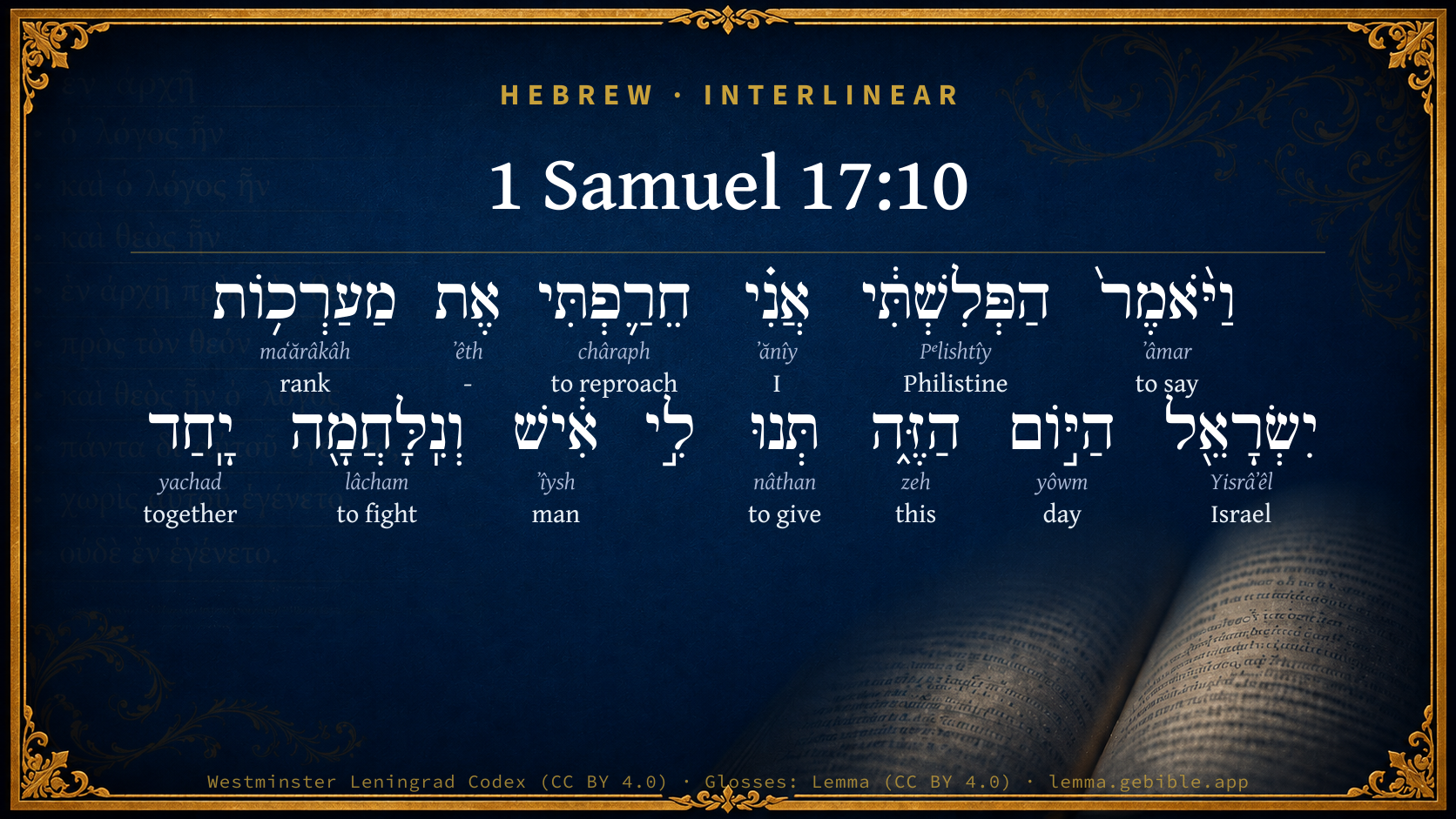
מַעַרְכ֥וֹת
maʻărâkâh
H4634
“ranks of”
Noun, Common, Feminine, Plural, Construct
Part of Speech
Noun
Type
Common
Gender
Feminine
Number
Plural
State
Construct
Full BDB Definition

Origin: from H4633

TWOT: 1694d

row, rank, battle-line - battle-line - rank - row
  1. וַיֹּ֨אמֶר֙ ʼâmar H559 “and · to say” Conjunction + Verb, Qal, Sequential Imperfect, 3rd Person, Masculine, Singular
  2. הַפְּלִשְׁתִּ֔י Pᵉlishtîy H6430 “the · Philistine” Particle, Definite Article + Noun, Gentilic, Masculine, Singular, Absolute
  3. אֲנִ֗י ʼănîy H589 “I” Pronoun, Personal, 1st Person, Common, Singular
  4. חֵרַ֛פְתִּי châraph H2778 “to reproach” Verb, Piel, Perfect, 1st Person, Common, Singular
  5. אֶת ʼêth H853 “-” Particle, Direct Object
  6. יִשְׂרָאֵ֖ל Yisrâʼêl H3478 “Israel” Noun, Proper
  7. הַיּ֣וֹם yôwm H3117 “the · day” Particle, Definite Article + Noun, Common, Masculine, Singular, Absolute
  8. הַזֶּ֑ה zeh H2088 “the · this” Particle, Definite Article + Pronoun, Demonstrative, Masculine, Singular
  9. תְּנוּ nâthan H5414 “give” Verb, Qal, Imperative, 2nd Person, Masculine, Plural
  10. אִ֔ישׁ ʼîysh H376 “man” Noun, Common, Masculine, Singular, Absolute
  11. וְנִֽלָּחֲמָ֖ה lâcham H3898 “and · to fight” Conjunction + Verb, Niphal, Cohortative, 1st Person, Common, Plural
  12. יָֽחַד yachad H3162 “together” Noun, Common, Masculine, Singular, Absolute

About this verse

These counts appear in no published source. They are computed here, from the morphology-tagged text and Lemma’s own curated glosses. What Lemma adds →

14
words
13
distinct lemmas
Historical
section

Notable vocabulary

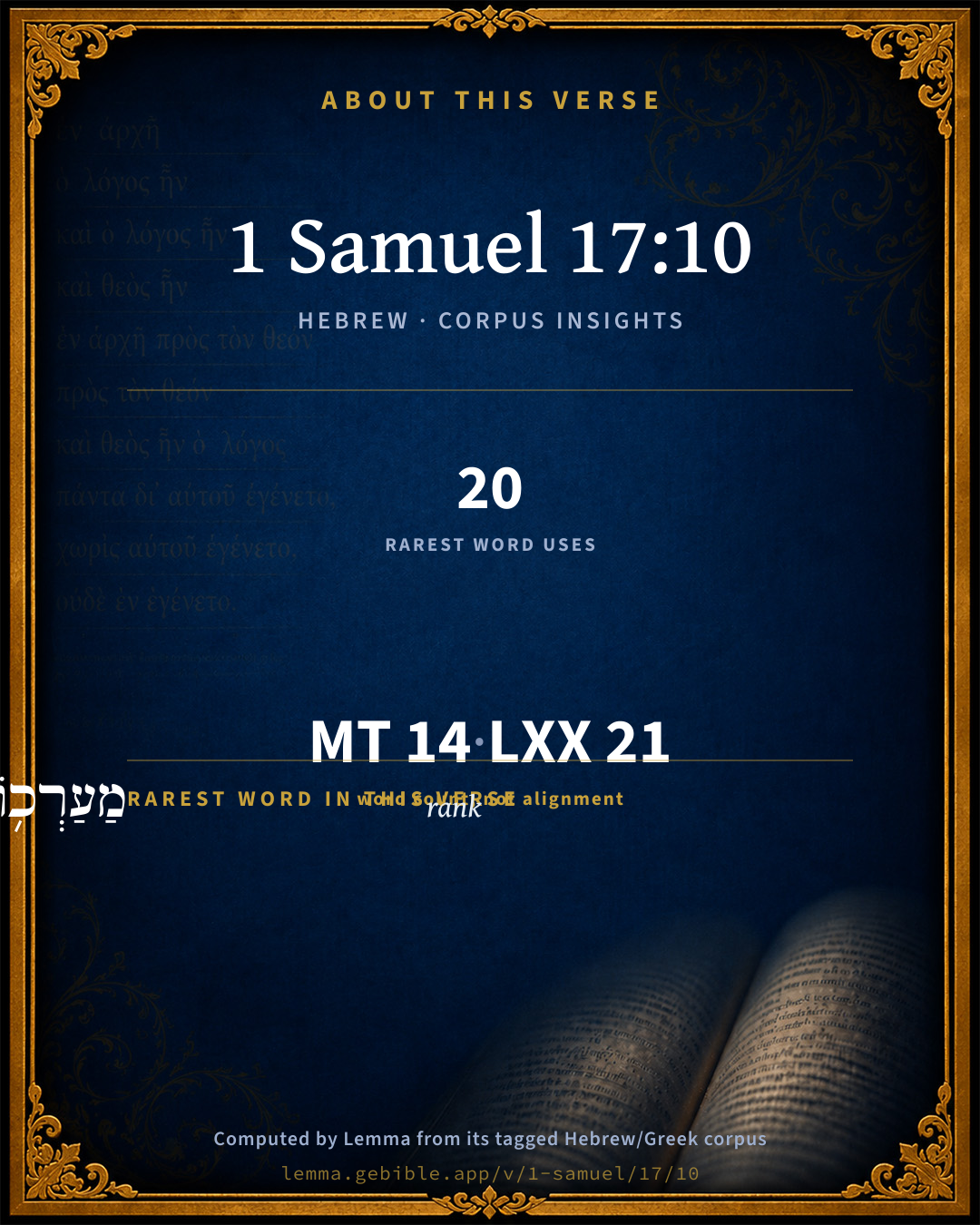
The rarest word here is מַעַרְכ֥וֹת rank H4634 — appearing just 20 times in the whole Hebrew Bible.

Shared distinctive vocabulary

מַעַרְכ֥וֹת rank H4634 occurs in 18 verses of the Hebrew Bible. Also found in:

Grammatical profile

  • 4 verbs
  • 6 nouns
  • 2 pronouns
  • 1 preposition
  • 1 particle

Verb forms

  • וַיֹּ֨אמֶר֙ Qal · Sequential Imperfect
  • חֵרַ֛פְתִּי Piel · Perfect
  • תְּנוּ Qal · Imperative
  • וְנִֽלָּחֲמָ֖ה Niphal · Cohortative

Hebrew & Septuagint length

In English translation the verse runs 20 words from the Hebrew and 29 from the Septuagint (LXX English) — the Septuagint runs noticeably longer here. See the side-by-side →

A rough comparison of the two English renderings, which tokenize alike — not a word-level alignment.

Word counts can differ between the Hebrew and the Greek without any difference in meaning — e.g. the Hebrew direct-object marker אֵת has no separate Greek word, and Greek often adds the article ὁ.

In the original languages it is 14 Hebrew tokens and 21 Greek tokens — but the two are counted differently (Hebrew bundles its prefixes and suffixes into one token; the Greek is in lemma form), so that isn’t a like-for-like length.

Cross-references

12

Topical passages linked to 1 Samuel 17:10 in the Treasury of Scripture Knowledge — connected by theme and wording, ordered by reader-vote popularity; previews shown in the World English Bible.

  • 1 Samuel 17:25–26 The men of Israel said, Have you seen this man who is come up? surely to defy Israel is he come up: and it shall be, that the man who kills him, the king will enrich him with great riches, and will give him his daughter, and make his father's house free in Israel.
  • 1 Samuel 17:36 Your servant struck both the lion and the bear: and this uncircumcised Philistine shall be as one of them, seeing he has defied the armies of the living God.
  • 1 Samuel 17:45 Then said David to the Philistine, You come to me with a sword, and with a spear, and with a javelin: but I come to you in the name of Yahweh of hosts, the God of the armies of Israel, whom you have defied.
  • Numbers 23:7–8 He took up his parable, and said, From Aram has Balak brought me, The king of Moab from the mountains of the East: Come, curse me Jacob, Come, defy Israel.
  • 2 Samuel 21:21 When he defied Israel, Jonathan the son of Shimei, David's brother, killed him.
  • Nehemiah 2:19 But when Sanballat the Horonite, and Tobiah the servant, the Ammonite, and Geshem the Arabian, heard it, they ridiculed us, and despised us, and said, What is this thing that you do? will you rebel against the king?
  • Job 40:9–12 Or have you an arm like God? Can you thunder with a voice like him?
  • Psalms 9:4–5 For you have maintained my just cause. You sit on the throne judging righteously.
  • Proverbs 16:18 Pride goes before destruction, And a haughty spirit before a fall.
  • Jeremiah 9:23 Thus says Yahweh, Don't let the wise man glory in his wisdom, neither let the mighty man glory in his might, don't let the rich man glory in his riches;
  • Daniel 4:37 Now I, Nebuchadnezzar, praise and extol and honor the King of heaven; for all his works are truth, and his ways justice; and those who walk in pride he is able to abase.
  • 2 Samuel 23:9 After him was Eleazar the son of Dodai the son of an Ahohite, one of the three mighty men with David, when they defied the Philistines who were there gathered together to battle, and the men of Israel were gone away.

Cross-references courtesy of OpenBible.info (CC BY 4.0).

Hebrew and Greek witnesses Masoretic Hebrew ↔ Greek Septuagint

The same verse in the two great witnesses to the Old Testament, shown verse-for-verse.

Here the Septuagint runs noticeably longer than the Hebrew — LXX2012 (modern English Septuagint) 29 words vs World English Bible 20. A rough length comparison of the two English translations, not a word-level alignment — read both below.

These are two independent witnesses, not word-aligned to each other, and the Septuagint is shown in lemma (dictionary) form.

Hebrew 1 Samuel 17:10 Masoretic · Westminster Leningrad Codex

וַיֹּ֨אמֶר֙ הַפְּלִשְׁתִּ֔י אֲנִ֗י חֵרַ֛פְתִּי אֶת מַעַרְכ֥וֹת יִשְׂרָאֵ֖ל הַיּ֣וֹם הַזֶּ֑ה תְּנוּ לִ֣י אִ֔ישׁ וְנִֽלָּחֲמָ֖ה יָֽחַד

The Philistine said, I defy the armies of Israel this day; give me a man, that we may fight together.

World English Bible · Public Domain

Greek LXX 1 Samuel 17:10 Septuagint · lemma form

καί εἶπον ὁ ἀλλόφυλος ἰδού ἐγώ ὀνειδίζω ὁ παράταξις ἰσραήλ σήμερον ἐν ὁ ἡμέρα οὗτος δίδωμι ἐγώ ἀνήρ καί μονομαχέω ἀμφότεροι

And the Philistine said, Behold, I have defied the armies of Israel this very day: give me a man, and we will both of us fight in single combat.

LXX2012 (modern English Septuagint) · Public Domain

Hebrew: Westminster Leningrad Codex (CC BY 4.0). Greek: Septuagint (public domain); English from LXX2012 (modern English Septuagint) (Public Domain). How the Septuagint differs from the Hebrew →

Targum (Aramaic paraphrase)

1

The Targum is the ancient Jewish Aramaic paraphrase of the Hebrew Scriptures — an interpretive translation, not the Hebrew text itself. Onkelos (literal) and Pseudo-Jonathan (expansive) render the Torah, and Jonathan the Prophets. Coverage is partial: where no permissively-licensed English translation exists for a verse, only the Aramaic is shown. This is verse-level text, not a word-by-word alignment to the Hebrew.

  1. Targum Jonathan Prophets (Joshua–Malachi)
    וַאֲמַר פְּלִשְׁתָּאָה אֲנָא חֲסָדִית יַת סִדְרֵי יִשְׂרָאֵל יוֹמָא דֵין לְמֵימָר אַיְתוֹ לִי גַבְרָא וְנַגִיחַ קְרָבָא כַּחֲדָא:

    (no public-domain English translation for this verse)

    Targum Jonathan — Aramaic: “Mikraot Gedolot” (public domain). English: “Sefaria Community Translation” (CC0 1.0 (public-domain dedication)); “London "Chaldee Paraphrase," 1871” (public domain). Text via Sefaria.

Commentary

Notes on 1 Samuel 17:10 from classic Christian and Jewish commentators (each source and its license shown beneath its notes). The classic Christian expositions comment on the surrounding passage and are grouped to its opening verse, so a note may address several verses; the Jewish commentaries on the Tanakh (Rashi and others) are per-verse, so they appear only where the commentator wrote on this verse.

Lemma curates 59 commentaries, every one of them public domain or Creative Commons licensed, each selected and text-cleaned for this edition rather than reprinted as found. About our sources →

Trapp's Complete Commentary

John Trapp

1Sa 17:10 And the Philistine said, I defy the armies of Israel this day; give me a man, that we may fight together.

Ver. 10. I defy the armies of Israel.] This man’s insolence and self-confidence do plainly prove his heart to be nothing else but a piece of proud flesh. But God will shortly cut off those arrogant lips, and the "tongue that speaketh proud things." {Psa 12:3-4}

John Trapp, A Commentary or Exposition upon All the Books of the Old and New Testament (1647–1656) — public domain. Text from a community e-Sword module.

Geneva Bible (1599)

Geneva Bible translators

Or, hand to hand.

Geneva Bible (1599) marginal notes — public domain. Text via Bolls.life.

Adam Clarke's Commentary

Verse 10. I defy] אני חרפתי ani cheraphti, "I strip and make bare," the armies of Israel; for none dared to fight him. From the Dhunoor Veda Shastra it appears that, among the Hindoos, it was common, before the commencement of an engagement, to challenge the enemy by throwing out some terms of abuse, similar to those used by Goliath. We find this also in Homer: his heroes scold each other heartily before they begin to fight. See on 1Sa 17:43.

Adam Clarke's Commentary on the Bible (1810–1826) — public domain. Text from a community e-Sword/MySword module.

John Gill's Exposition

And the Philistine said, I defy the armies of Israel this day,.... Or "reproach" (s) them; that is, should they not accept his challenge, and send down a man to fight with them, he should then upbraid them with cowardice; and now he disdained them, as if there was not a man among them that dared to encounter with him:

give me a man that we may fight together; and so decide the controversy between us; such as were those duels fought between Paris and Menelaus in the Trojan war, and between the Lacedemonians and the Argives in the times of Orthryades, and between the Athenians and Romans by the Horatii and Curiatii, as Grotius observes.

(s) "exprobravo". V. L. Pagninus, Montanus; "probro affeci", Tigurine version; "probro affecero", Junius & Tremellius.

John Gill's Exposition of the Whole Bible (1746–1763) — public domain (CC PDM 1.0). Text via the HelloAO Bible API.

Whedon's Commentary on the Bible

Daniel D. Whedon

10. I defy the armies of Israel this day — Hebrew, I have reproached the armies of Israel this day. He heaps upon them scorn and contempt for their supposed inability to cope with a single warrior.

Daniel D. Whedon (gen. ed.), Commentary on the Old and New Testaments (1874–1909) — public domain. Text from a community e-Sword module.

unfoldingWord translationNotes

Door43 World Missions Community

I challenge the ranks of Israel

"I challenge the army of Israel"

all Israel

This refers to the Israelite soldiers who were there.

they were discouraged and greatly afraid

The words "discouraged" and "greatly afraid" mean basically the same thing and emphasize the intensity of their fear. (See: Doublet)

translationWords

Philistines

Israel

Saul (OT)

fear

unfoldingWord translationNotes — © Distant Shores Media and the Door43 World Missions Community, licensed CC BY-SA 4.0. Source: git.door43.org/Door43/en_tn.

Lesson kit

Teaching starters — assembled from the data on this page, not authored interpretation. Every prompt links to the verse data it draws on. Edit before teaching.

1 Samuel, in the Historical, opens this verse with 14 words (13 distinct Hebrew lemmas). Its most distinctive word is maʻărâkâh (“rank”). The Greek Septuagint runs longer here. A historical commentator’s framing appears above. Read the whole chapter for the surrounding context.

Discussion questions

  1. How does “rank” (maʻărâkâh) shape what this verse is saying?
  2. How does Exodus 39:37, which shares the word «rank», read alongside this verse?
  3. The Septuagint runs longer here than the Hebrew. What might account for the difference?
  4. These translations render this verse differently; the difference is in the English rendering, not the original. What questions does that raise?
  5. «וַיֹּ֨אמֶר֙» is a Qal Sequential Imperfect verb. How does that grammatical form shape the action described?
  6. Compare how Trapp's Complete Commentary and Geneva Bible (1599) read this verse. Where do they agree or differ?

Things to notice

Reading settings

Reading text

Shown beneath each verse's original-language words.

Old Testament
Old Testament edition

Read the OT as the Masoretic Hebrew (MT) or the Greek Septuagint (LXX).

English shown for the Greek Septuagint (in the Hebrew ↔ Greek comparison).

Comparing translations? Open the Compare panel on any verse page to stack up to four side by side.