
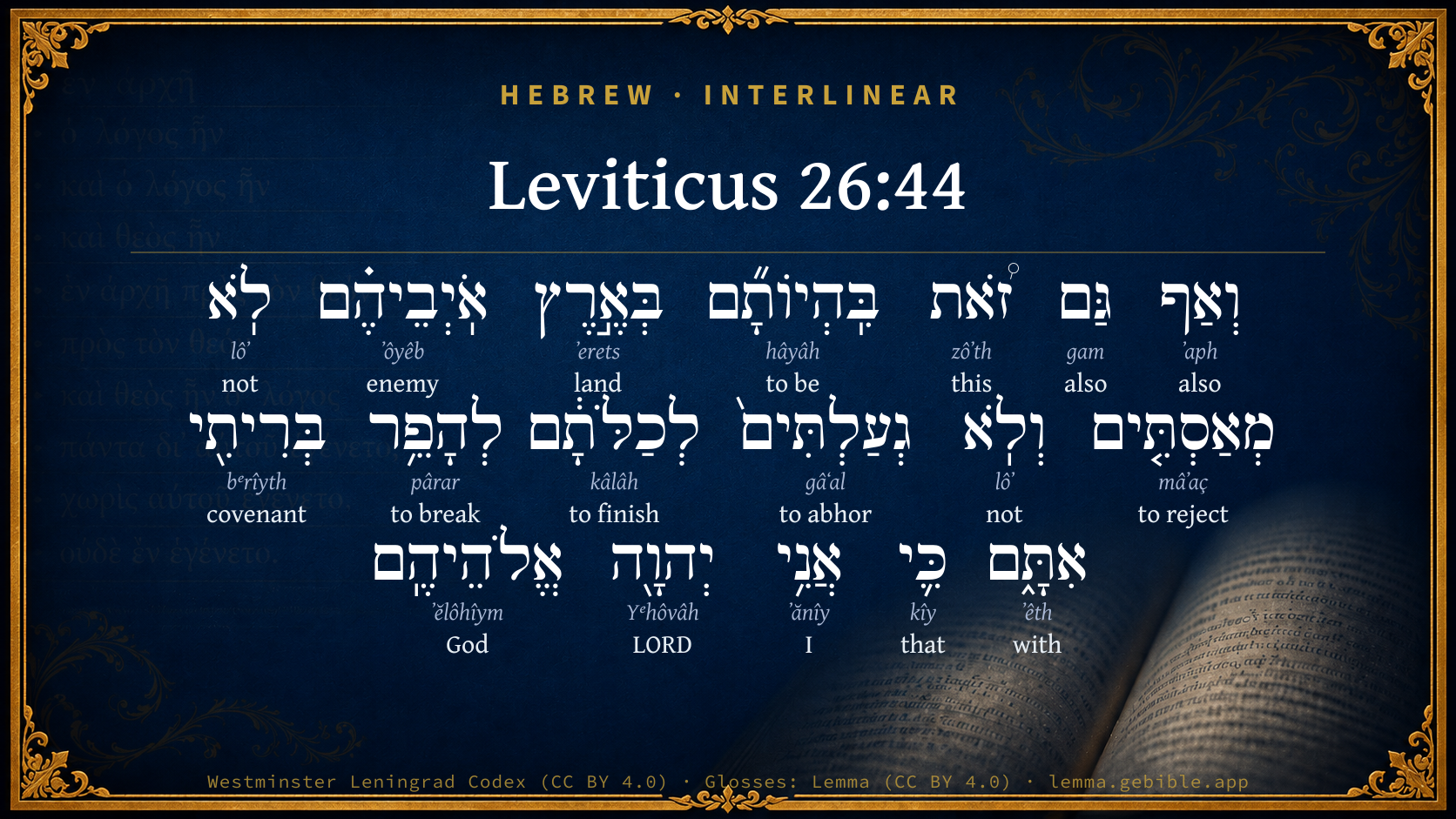
Leviticus 26:44

Hebrew (Westminster Leningrad Codex) Leviticus 26:44 appears in the Hebrew Old Testament. The text above is from the Westminster Leningrad Codex. Each word links to its Strong’s number, a concise gloss, and parsing drawn from the Open Scriptures Hebrew Bible morphology. Click any word for its full Brown-Driver-Briggs (BDB) entry.
Download image
Cite this verse

Leviticus 26:44 (World English Bible). Public Domain. Lemma interlinear Bible study tool, https://lemma.gebible.app/v/leviticus/26/44.

Show BibTeX & RIS
BibTeX
RIS
English Translation
Yet for all that, when they are in the land of their enemies, I will not reject them, neither will I abhor them, to destroy them utterly, and to break my covenant with them; for I am Yahweh their God;
World English Bible · Public Domain
Download a study sheet

One document with this verse’s original text, its word-by-word gloss line, the meaning frame, cross-references with their text, attributed commentary, and full source and license credits — printable, and it pastes into notes with its structure intact.

This verse Autodidact and up

Study sheet (.html) Plain text (.txt)

A passage Seminary Student

Up to 50 verses in one chapter. A passage sheet keeps up to 6 commentary sources and 12 cross-references per verse, in the order this page ranks them, and says so on the sheet whenever that leaves anything out. Ask for a single verse and you get the Autodidact verse sheet above.

Everything on this page stays free to read, with no account — the sheet is a download of what is already on screen, not access to it.

Want to remove ads? Support Godless Engineer
Compare translations 3

The same verse in 3 English versions, stacked beneath the original-language interlinear above. Click any original word for its lexicon entry.

Each is an independent rendering of the whole verse — the interlinear is not word-aligned to these translations.

Highlighted words mark where these versions differ — a whole-verse word diff, not a word-by-word alignment.

  • World English Bible Public Domain
    Yet for all that, when they are in the land of their enemies, I will not reject them, neither will I abhor them, to destroy them utterly, and to break my covenant with them; for I am Yahweh their God;
  • King James Version Public Domain
    And yet for all that, when they be in the land of their enemies, I will not cast them away, neither will I abhor them, to destroy them utterly, and to break my covenant with them: for I am the LORD their God.
  • unfoldingWord Literal Text CC BY-SA 4.0
    And yet for all that, when they are in the land of their enemies, I will not reject them, nor will I detest them to destroy them completely, to break my covenant with them, for I Yahweh their God.

unfoldingWord Literal Text — © unfoldingWord, licensed CC BY-SA 4.0. Word-aligned USFM3 via Door43 (git.door43.org/unfoldingWord/en_ult).

Versions to compare (up to 4)

3 of 4 selected

Show all 18 translations

Every available English version of this verse, each an independent rendering of the whole verse.

  • World English Bible Public Domain
    Yet for all that, when they are in the land of their enemies, I will not reject them, neither will I abhor them, to destroy them utterly, and to break my covenant with them; for I am Yahweh their God;
  • Berean Standard Bible Public Domain
    Yet in spite of this, when they are in the land of their enemies, I will not reject or despise them so as to destroy them and break My covenant with them; for I am the LORD their God.
  • Majority Standard Bible Public Domain
    Yet in spite of this, when they are in the land of their enemies, I will not reject or despise them so as to destroy them and break My covenant with them; for I am the LORD their God.
  • King James Version Public Domain
    And yet for all that, when they be in the land of their enemies, I will not cast them away, neither will I abhor them, to destroy them utterly, and to break my covenant with them: for I am the LORD their God.
  • American Standard Version (1901) Public Domain
    And yet for all that, when they are in the land of their enemies, I will not reject them, neither will I abhor them, to destroy them utterly, and to break my covenant with them; for I am Jehovah their God;
  • Revised Version (1885) Public Domain
    And yet for all that, when they be in the land of their enemies, I will not reject them, neither will I abhor them, to destroy them utterly, and to break my covenant with them: for I am the LORD their God:
  • Geneva Bible (1599) Public Domain
    Yet notwithstanding this, when they shalbe in the lande of their enemies, I wil not cast them away, neither will I abhorre them, to destroy them vtterly, nor to breake my couenant with them: for I am the Lord their God:
  • Douay-Rheims (1899) Public Domain
    And yet for all that when they were in the land of their enemies, I did not cast them off altogether, neither did I so despise them that they should be quite consumed, and I should make void my covenant with them. For I am the Lord their God.
  • Young's Literal Translation Public Domain
    and also even this, in their being in the land of their enemies, I have not rejected them, nor have I loathed them, to consume them, to break My covenant with them; for I `am' Jehovah their God; --
  • Literal Standard Version CC BY-SA 4.0
    and also even this, in their being in the land of their enemies, I have not rejected them, nor have I loathed them, to consume them, to break My covenant with them; for I [am] their God YHWH—
  • Unlocked Literal Bible CC BY-SA 4.0
    Yet despite all this, when they are in their enemies' land, I will not reject them, neither will I detest them so as to completely destroy them and do away with my covenant with them, for I am Yahweh their God.
  • unfoldingWord Literal Text CC BY-SA 4.0
    And yet for all that, when they are in the land of their enemies, I will not reject them, nor will I detest them to destroy them completely, to break my covenant with them, for I Yahweh their God.
  • Darby Bible Public Domain
    And yet for all that, when they are in the land of their enemies, I will not despise them, and will not abhor them, to make an end of them utterly, to break my covenant with them, for I am Jehovah their God.
  • World Messianic Bible Public Domain
    Yet for all that, when they are in the land of their enemies, I will not reject them, neither will I abhor them, to destroy them utterly and to break my covenant with them; for I am the LORD their God.
  • Webster's Bible Public Domain
    And yet for all that, when they shall be in the land of their enemies, I will not cast them away, neither will I abhor them, to destroy them utterly, and to break my covenant with them; for I am the LORD their God.
  • Free Bible Version CC BY-SA 4.0
    But despite all this, even while they are living in land of their enemies, I will not reject or hate them so much as to destroy them and break my agreement with them, because I am the Lord their God.
  • Bible in Basic English Public Domain
    But for all that, when they are in the land of their haters I will not let them go, or be turned away from them, or give them up completely; my agreement with them will not be broken, for I am the Lord their God.
  • JPS Tanakh (1917) Public Domain
    And yet for all that, when they are in the land of their enemies, I will not reject them, neither will I abhor them, to destroy them utterly, and to break My covenant with them; for I am the LORD their God.

Literal Standard Version (2020), Covenant Press — licensed CC BY-SA 4.0. Text via the HelloAO Bible API (eBible.org). Unlocked Literal Bible (unfoldingWord) — licensed CC BY-SA 4.0. Text via the HelloAO Bible API (eBible.org). unfoldingWord Literal Text — © unfoldingWord, licensed CC BY-SA 4.0. Word-aligned USFM3 via Door43 (git.door43.org/unfoldingWord/en_ult). Free Bible Version, Dr. Jonathan Gallagher — licensed CC BY-SA 4.0. Text via the HelloAO Bible API (eBible.org).

Word by word

More ways to search: Search by grammar → Find every occurrence → Compare this word →

Practice this passage: Drill this verse → Learn its vocabulary →

גְעַלְתִּים֙
gâʻal
H1602
“to abhor · them”
Verb, Qal, Perfect, 1st Person, Common, Singular + Suffix, Personal, 3rd Person, Masculine, Plural
Part of Speech
Verb
Stem
Qal
Form
Perfect
Person
1st Person
Gender
Common
Number
Singular
Full BDB Definition

Origin: a primitive root

TWOT: 369

to abhor, loathe, be vilely cast away, fall - (Qal) to abhor, loathe - (Niphal) to be defiled - (Hiphil) to reject as loathsome, show aversion
  1. וְאַף ʼaph H637 “and · also” Conjunction + Adverb
  2. גַּם gam H1571 “also” Particle, Accusative
  3. זֹ֠את zôʼth H2063 “this” Pronoun, Demonstrative, Feminine, Singular
  4. בִּֽהְיוֹתָ֞ם hâyâh H1961 “in/at · to be · them” Preposition + Verb, Qal, Infinitive Construct + Suffix, Personal, 3rd Person, Masculine, Plural
  5. בְּאֶ֣רֶץ ʼerets H776 “in/at · land of” Preposition + Noun, Common, Both, Singular, Construct
  6. אֹֽיְבֵיהֶ֗ם ʼôyêb H341 “enemy · them” Verb, Qal, Participle Active, Masculine, Plural, Construct + Suffix, Personal, 3rd Person, Masculine, Plural
  7. לֹֽא lôʼ H3808 “not” Particle, Negative
  8. מְאַסְתִּ֤ים mâʼaç H3988 “to reject · them” Verb, Qal, Perfect, 1st Person, Common, Singular + Suffix, Personal, 3rd Person, Masculine, Plural
  9. וְלֹֽא lôʼ H3808 “and · not” Conjunction + Particle, Negative
  10. לְכַלֹּתָ֔ם kâlâh H3615 “to finish · them” Preposition + Verb, Piel, Infinitive Construct + Suffix, Personal, 3rd Person, Masculine, Plural
  11. לְהָפֵ֥ר pârar H6565 “to break” Preposition + Verb, Hiphil, Infinitive Construct
  12. בְּרִיתִ֖י bᵉrîyth H1285 “covenant · my” Noun, Common, Feminine, Singular, Construct + Suffix, Personal, 1st Person, Common, Singular
  13. אִתָּ֑ם ʼêth H854 “with · them” Preposition + Suffix, Personal, 3rd Person, Masculine, Plural
  14. כִּ֛י kîy H3588 “that” Conjunction
  15. אֲנִ֥י ʼănîy H589 “I” Pronoun, Personal, 1st Person, Common, Singular
  16. יְהוָ֖ה Yᵉhôvâh H3068 “LORD” Noun, Proper
  17. אֱלֹהֵיהֶֽם ʼĕlôhîym H430 “God(s) · their” Noun, Common, Masculine, Plural, Construct + Suffix, Personal, 3rd Person, Masculine, Plural

About this verse

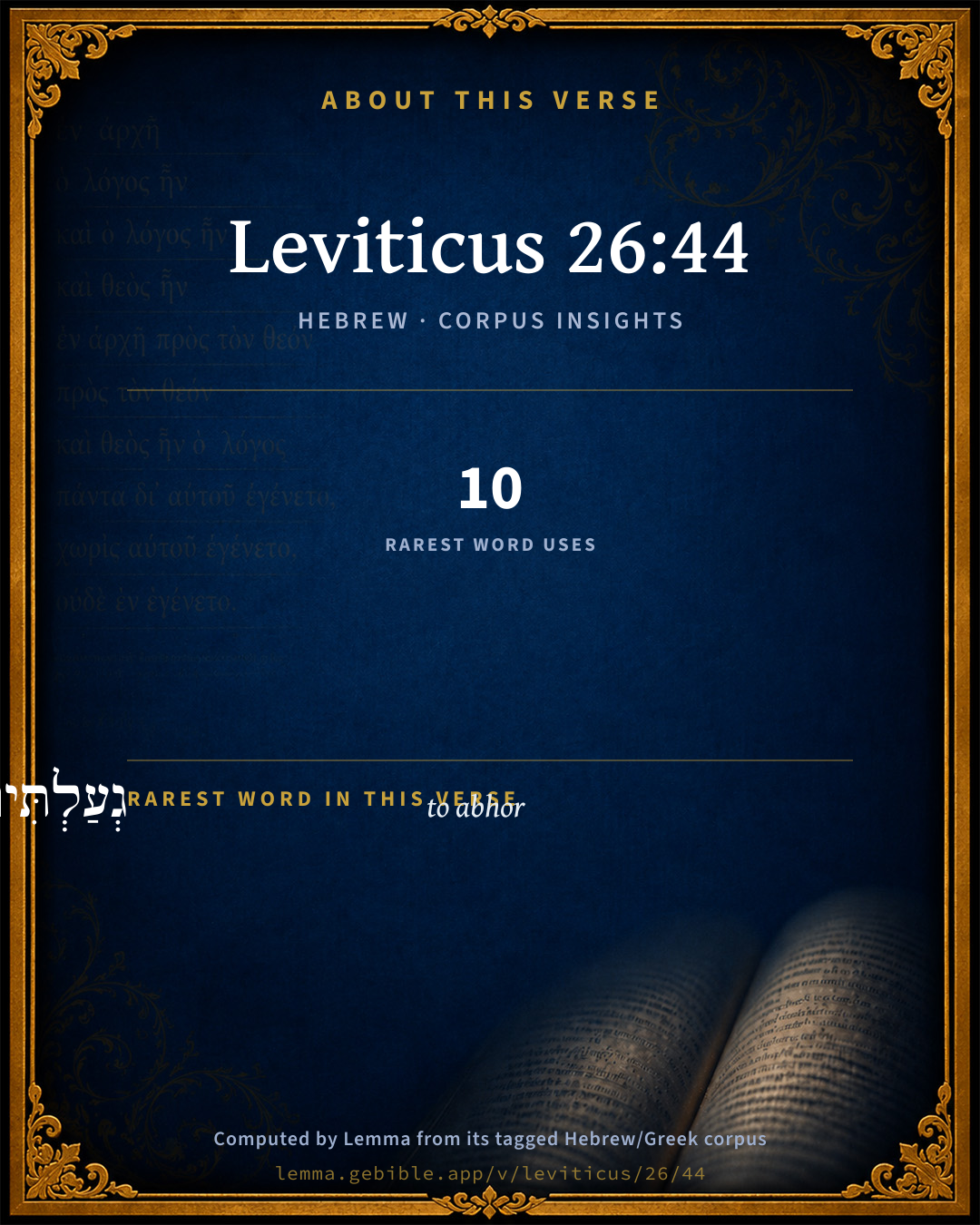
These counts appear in no published source. They are computed here, from the morphology-tagged text and Lemma’s own curated glosses. What Lemma adds →

18
words
17
distinct lemmas
Pentateuch
section

Notable vocabulary

The rarest word here is גְעַלְתִּים֙ to abhor H1602 — appearing just 10 times in the whole Hebrew Bible.

Shared distinctive vocabulary

גְעַלְתִּים֙ to abhor H1602 occurs in 9 verses of the Hebrew Bible. Also found in:

Grammatical profile

  • 6 verbs
  • 4 nouns
  • 2 pronouns
  • 1 preposition
  • 1 conjunction
  • 1 adverb
  • 3 particles

Verb forms

  • בִּֽהְיוֹתָ֞ם Qal · Infinitive Construct
  • אֹֽיְבֵיהֶ֗ם Qal · Participle Active
  • מְאַסְתִּ֤ים Qal · Perfect
  • גְעַלְתִּים֙ Qal · Perfect
  • לְכַלֹּתָ֔ם Piel · Infinitive Construct
  • לְהָפֵ֥ר Hiphil · Infinitive Construct

Repetition

A word recurs within this verse — often emphatic in Hebrew:

Hebrew & Septuagint length

In English translation the verse runs 40 words from the Hebrew and 42 from the Septuagint (LXX English) — closely comparable.

A rough comparison of the two English renderings, which tokenize alike — not a word-level alignment.

Word counts can differ between the Hebrew and the Greek without any difference in meaning — e.g. the Hebrew direct-object marker אֵת has no separate Greek word, and Greek often adds the article ὁ.

Cross-references

13

Topical passages linked to Leviticus 26:44 in the Treasury of Scripture Knowledge — connected by theme and wording, ordered by reader-vote popularity; previews shown in the World English Bible.

  • Nehemiah 9:31 Nevertheless in your manifold mercies you did not make a full end of them, nor forsake them; for you are a gracious and merciful God.
  • Romans 11:2 God didn't reject his people, which he foreknew. Or don't you know what the Scripture says about Elijah? How he pleads with God against Israel:
  • Deuteronomy 4:29–31 But from there you shall seek Yahweh your God, and you shall find him, when you search after him with all your heart and with all your soul.
  • 2 Kings 13:23 But Yahweh was gracious to them, and had compassion on them, and had respect to them, because of his covenant with Abraham, Isaac, and Jacob, and would not destroy them, neither cast he them from his presence as yet.
  • Psalms 94:14 For Yahweh won't reject his people, Neither will he forsake his inheritance.
  • Psalms 89:33 But I will not completely take my loving kindness from him, Nor allow my faithfulness to fail.
  • Jeremiah 14:21 Do not abhor [us], for your name's sake; do not disgrace the throne of your glory: remember, don't break your covenant with us.
  • Jeremiah 30:11 For I am with you, says Yahweh, to save you: for I will make a full end of all the nations where I have scattered you, but I will not make a full end of you; but I will correct you in measure, and will in no way leave you unpunished.
  • Jeremiah 33:20–21 Thus says Yahweh: If you can break my covenant of the day, and my covenant of the night, so that there shall not be day and night in their season;
  • Jeremiah 33:26 then will I also cast away the seed of Jacob, and of David my servant, so that I will not take of his seed to be rulers over the seed of Abraham, Isaac, and Jacob: for I will cause their captivity to return, and will have mercy on them.
  • Ezekiel 14:22–23 Yet, behold, therein shall be left a remnant that shall be carried forth, both sons and daughters: behold, they shall come forth to you, and you shall see their way and their doings; and you shall be comforted concerning the evil that I have brought on Jerusalem, even concerning all that I have brought on it.
  • Ezekiel 16:60 Nevertheless I will remember my covenant with you in the days of your youth, and I will establish to you an everlasting covenant.
  • Romans 11:26 and so all Israel will be saved. Even as it is written, "There will come out of Zion the Deliverer, And he will turn away ungodliness from Jacob.

Cross-references courtesy of OpenBible.info (CC BY 4.0).

Hebrew and Greek witnesses Masoretic Hebrew ↔ Greek Septuagint

The same verse in the two great witnesses to the Old Testament, shown verse-for-verse.

These are two independent witnesses, not word-aligned to each other, and the Septuagint is shown in lemma (dictionary) form.

Hebrew Leviticus 26:44 Masoretic · Westminster Leningrad Codex

וְאַף גַּם זֹ֠את בִּֽהְיוֹתָ֞ם בְּאֶ֣רֶץ אֹֽיְבֵיהֶ֗ם לֹֽא מְאַסְתִּ֤ים וְלֹֽא גְעַלְתִּים֙ לְכַלֹּתָ֔ם לְהָפֵ֥ר בְּרִיתִ֖י אִתָּ֑ם כִּ֛י אֲנִ֥י יְהוָ֖ה אֱלֹהֵיהֶֽם

Yet for all that, when they are in the land of their enemies, I will not reject them, neither will I abhor them, to destroy them utterly, and to break my covenant with them; for I am Yahweh their God;

World English Bible · Public Domain

Greek LXX Leviticus 26:44 Septuagint · lemma form

καί οὐδέ ὡς εἰμί αὐτός ἐν ὁ γῆ ὁ ἐχθρός αὐτός οὐ ὑπερὁράω αὐτός οὐδέ προςὀχθίζω αὐτός ὥστε ἐκ ἀναἁλίσκω αὐτός ὁ διασκεδάζω ὁ διαθήκη ἐγώ ὁ πρός αὐτός ὅτι ἐγώ εἰμί κύριος ὁ θεός αὐτός

And yet not even thus, while they were in the land of their enemies, did I overlook them, nor did I loathe them so as to consume them, to break my covenant made with them; for I am the Lord their God.

LXX2012 (modern English Septuagint) · Public Domain

Hebrew: Westminster Leningrad Codex (CC BY 4.0). Greek: Septuagint (public domain); English from LXX2012 (modern English Septuagint) (Public Domain). How the Septuagint differs from the Hebrew →

Targum (Aramaic paraphrase)

2

The Targum is the ancient Jewish Aramaic paraphrase of the Hebrew Scriptures — an interpretive translation, not the Hebrew text itself. Onkelos (literal) and Pseudo-Jonathan (expansive) render the Torah, and Jonathan the Prophets. Coverage is partial: where no permissively-licensed English translation exists for a verse, only the Aramaic is shown. This is verse-level text, not a word-by-word alignment to the Hebrew.

  1. Targum Onkelos Torah (Genesis–Deuteronomy)
    וְאַף בְּרַם דָא בְּמֶהֱוֵיהוֹן בְּאַרַע בַּעֲלֵי דְבָבֵיהוֹן לָא אַרְטֵשִׁנוּן וְלָא אַרְחֵקִנוּן לְשֵׁיצָיוּתְהוֹן לְאַשְׁנָאָה קְיָמִי עִמְהוֹן אֲרֵי אֲנָא יְיָ אֱלָהֲהוֹן

    (no public-domain English translation for this verse)

    Targum Onkelos — Aramaic: “Onkelos Genesis” (public domain); “Onkelos Exodus” (public domain); “Onkelos Leviticus” (public domain); “Onkelos Numbers” (public domain); “Onkelos Deuteronomy” (public domain). English: “Sefaria Community Translation” (CC0 1.0 (public-domain dedication)); “J.W. Etheridge. The Targums of Onkelos and Jonathan Ben Uzziel on the Pentateuch. London: Longmans, Green, 1862” (public domain). Text via Sefaria.

  2. Targum Pseudo-Jonathan Torah (Genesis–Deuteronomy)
    וְאוּף עַל כָּל דָא אֲרַחִים יַתְהוֹן בְּמֵימְרִי כַּד יֶהֶוְויָין גַלְיָין בְּאַרַע בַּעֲלֵי דְבָבֵיהוֹן לָא אֶמְאָסִינוּן בְּמַלְכוּתָא דְבָבֶל וְלָא יִרְחַק מֵימְרִי יַתְהוֹן בְּמַלְכוּתָא דְמָדַי לִמְשֵׁיצַיָא יַתְהוֹן בְּמַלְכוּתָא דְיָוָן לְמִפְסוֹק קְיָימִי עִמְהוֹן בְּמַלְכוּתָא דֶאֱדוֹם אֲרוּם אֲנָא הוּא יְיָ אֱלָהָכוֹן בְּיוֹמוֹי דְגוֹג

    Yet for all this I will have mercy upon them by My Word, when they are captives in the land of their enemies, I will not spurn them away in the kingdom of Babel; nor shall My Word abhor them. in the kingdom of Madai, to destroy them in the kingdom of Javan, or to abolish My covenant with them in the kingdom of Edom; for I am the Lord in the days of Gog.

    Targum Pseudo-Jonathan — Aramaic: “Targum Jonathan on Genesis” (public domain); “Targum Jonathan on Exodus” (public domain); “Targum Jonathan on Leviticus” (public domain); “Targum Jonathan on Numbers” (public domain); “Targum Jonathan on Deuteronomy” (public domain). English: “The Targum of Jonathan ben Uzziel, trans. J. W. Etheridge, London, 1862” (public domain). Text via Sefaria.

Commentary

Notes on Leviticus 26:44 from classic Christian and Jewish commentators (each source and its license shown beneath its notes). The classic Christian expositions comment on the surrounding passage and are grouped to its opening verse, so a note may address several verses; the Jewish commentaries on the Tanakh (Rashi and others) are per-verse, so they appear only where the commentator wrote on this verse.

Lemma curates 59 commentaries, every one of them public domain or Creative Commons licensed, each selected and text-cleaned for this edition rather than reprinted as found. About our sources →

Joseph Benson's Commentary

Lev 26:44. For I am the Lord their God — Therefore neither the desperateness of their condition, nor the greatness of their sins, shall cause me wholly to make void my covenant with them and their ancestors, but I will in due time remember them for good, and for my covenant’s sake return to them in mercy. From this place the Jews take great comfort, and assure themselves of deliverance out of their present servitude and misery. And from this, and such other places, St. Paul concludes that the Israelitish nation, though then rejected and ruined, should be gathered again and restored.

Joseph Benson's Commentary on the Old and New Testaments (1811–1818) — public domain. Text from a community e-Sword module.

Adam Clarke's Commentary

Verse 44. Neither will I abhor them to destroy them utterly] Though God has literally fulfilled all his threatenings upon this people in dispossessing them of their land, destroying their polity, overturning their city, demolishing their temple, and scattering themselves over the face of the whole earth; yet he has, in his providence, strangely preserved them as a distinct people, and in very considerable numbers also. He still remembers the covenant of their ancestors, and in his providence and grace he has some very important design in their favour. All Israel shall yet be saved, and, with the Gentiles, they shall all be restored to his favour; and under Christ Jesus, the great Shepherd; become, with them, one grand everlasting fold.

Adam Clarke's Commentary on the Bible (1810–1826) — public domain. Text from a community e-Sword/MySword module.

Ellicott's Commentary for English Readers

(44) And yet for all that.—Better, And yet even so, that is, even if it be so that they remain exiles in foreign lands for a long time, this is no proof that God has finally cast them off, has given them over to destruction, and abrogated His covenant with them. He is always their God, and will keep His covenant for ever.

A Bible Commentary for English Readers, edited by Charles John Ellicott (1878–1897) — public domain. Text from a community e-Sword module.

John Gill's Exposition

But I will for their sakes remember the covenant of their ancestors,.... Or rather, "remember to them" (g), to their good and benefit, for their profit and advantage, not for their desert and merit, for any worth or worthiness in them; this covenant respects not the covenant made with Abraham, Isaac, and Jacob, as in Lev 26:42; but with their fathers, either at Sinai, or rather in the plains of Moab, Deu 29:1, for it follows:

whom I brought forth out of the land of Egypt in the sight of the Heathen, that I might be their God; whom he brought out of great bondage and distress in Egypt, with an high hand and outstretched arm, and in the sight of the Egyptians, who were not able to oppose it, yea, because of their plagues, were urgent for it; and in the sight of all the nations round about, who heard of the wonderful power of God in the deliverance of his people; and this he did that he might appear to be their covenant God, who had taken them into covenant with him, and had taken them under his care and protection, and would be still their King and their God; and who also, in like manner, it may be here suggested, would deliver the people of the Jews out of their present exiled and captive state and condition in the sight of the whole world, and declare himself their covenant God and Father:

I am the Lord; whose will is sovereign, whose power is uncontrollable, who is a covenant keeping God, faithful to his promises, and able to perform them.

(g) "et recordabor eis", Pagninus, Montanus, Drusius; "erga eos", Junius & Tremellius, Piscator.

John Gill's Exposition of the Whole Bible (1746–1763) — public domain (CC PDM 1.0). Text via the HelloAO Bible API.

Haydock's Catholic Bible Commentary

I did not. He speaks of a future event, which he sees will certainly come to pass, as if it had already happened. As God had preserved his people, in Egypt, conformably to his covenant with the patriarchs, so he will be reconciled to them, after they shall have done penance, and acknowledged all their excesses, in the captivity of Babylon. (Haydock) --- The church never ceases all together. (Worthington)

George Leo Haydock (1774–1849), Haydock's Catholic Family Bible and Commentary, 1859 edition — public domain. Excludes Psalms (Douay-Rheims chapter numbering differs from Protestant) and Deuterocanonical books (Catholic canon only).

Matthew Poole's English Annotations

Neither the desperateness of their condition, nor the greatness of their sins, shall make me wholly make void my covenant with them and their ancestors, but I will in due time remember them for good, and for my covenant’s sake return to them in mercy. From this place the Jews take great comfort, and assure themselves of deliverance out of their present servitude and misery. And from this, and such other places, St. Paul concludes that the Israelitish nation, though then rejected and ruined, should be gathered again and restored.

Matthew Poole's English Annotations on the Holy Bible (1683–1685) — public domain. Text from a community e-Sword/MySword module.

Whedon's Commentary on the Bible

Daniel D. Whedon

44. Neither will I abhor them, to destroy them utterly — The purpose of Jehovah embraced the ultimate conversion to the Lord Jesus of that generation of Jews who should be on the earth when the fulness of the Gentiles has been brought to Christ. Towards this end the marvellous continuance of the Jews in their world-wide dispersion manifestly looks. See Luk_21:24; Rom_11:25-26, notes. After the fulness of the Gentiles has been brought into the kingdom of Christ, so strong will be the faith of the Church that an era of great spiritual illumination will come, in which the seed of Abraham will be as powerfully converted as was Saul of Tarsus.

Daniel D. Whedon (gen. ed.), Commentary on the Old and New Testaments (1874–1909) — public domain. Text from a community e-Sword module.

John Wesley's Explanatory Notes

For I am the Lord their God - Therefore neither the desperateness of their condition, nor the greatness of their sins, shall make me wholly make void my covenant with them and their ancestors, but I will in due time remember them for good, and for my covenant's sake return to them in mercy. From this place the Jews take great comfort, and assure themselves of deliverance out of their present servitude and misery. And from this, and such other places, St. Paul concludes, that the Israelitish nation, tho' then rejected and ruined, should be gathered again and restored.

John Wesley, Explanatory Notes Upon the Whole Bible (1754–1765) — public domain. Text via the GEBible commentary corpus.

Keil & Delitzsch

C. F. Keil & F. Delitzsch

"And yet, even with regard to this, when they shall be in the land of their enemies, have I not despised them." That is to say, if it shall have come even so far as that they are in the land of their enemies (the words גּם־זאת stand first in an absolute sense, and are strengthened or intensified by ואף and more fully explained by בּהיותם וגו), I have not rejected them, to destroy them and break My covenant with them. For I am Jehovah their God, who, as the absolutely existing and unchangeably faithful One, keeps His promises and does not repent of His calling (Rom 11:29).

Keil & Delitzsch — Biblical Commentary on the Old Testament (1861–1891) — public domain (CC PDM 1.0). Text via the HelloAO Bible API. (Old Testament only.)

unfoldingWord translationNotes

Door43 World Missions Community

General Information:

This concludes Yahweh's message to Moses at Mount Sinai regarding the blessings for obedience and the punishments for disobedience.

I will call to mind the covenant with their ancestors

"Call to mind" here is an idiom meaning "intentionally remember." Here it represents fulfilling his covenant. AT: "I will fulfill the covenant with their ancestors" (See: Idiom and Metonymy)

in the sight of the nations

This represents the knowledge of the nations. AT: "in the knowledge of the nations" or "and the nations knew about it" (See: Metonymy)

the nations

This represents the people of the nations. AT: "the people of the nations" (See: Metonymy)

translationWords

reject

Yahweh

God

Egypt

unfoldingWord translationNotes — © Distant Shores Media and the Door43 World Missions Community, licensed CC BY-SA 4.0. Source: git.door43.org/Door43/en_tn.

Rashi

Rabbi Shlomo Yitzchaki (Rashi)

ואף גם זאת AND YET FOR ALL THIS — i. e., but also (אף) even though (גם) I shall execute on them this (זאת) punishment which I have mentioned when they shall be in the land of their enemies, I will not reject them to make an end of them and to make void My covenant which has thus far been with them (viz., the covenant 'כי אני ה‎‎ אלהיהם that I, the Lord, would be their God).

Rashi on the Tanakh — English translations: “The Judaica Press complete Tanach with Rashi, translated by A. J. Rosenberg” (CC BY 4.0); “Pentateuch with Rashi's commentary by M. Rosenbaum and A.M. Silbermann, 1929-1934” (public domain); “The Metsudah Tanach series, Lakewood, N.J” (CC BY 4.0); and “The Book of Joshua, Metsudah Publications, 1997” (CC BY 4.0). Text via Sefaria.

Lesson kit

Teaching starters — assembled from the data on this page, not authored interpretation. Every prompt links to the verse data it draws on. Edit before teaching.

Leviticus, in the Pentateuch, opens this verse with 18 words (17 distinct Hebrew lemmas). Its most distinctive word is gâʻal (“to abhor”). A historical commentator’s framing appears above. Read the whole chapter for the surrounding context.

Discussion questions

  1. The word gâʻal carries the sense “to abhor.” How does it shape the verse?
  2. Leviticus 26:11 shares the word «to abhor» with this verse. How do the two illuminate each other?
  3. “not” occurs 2× in this one verse. What is the effect of the repetition?
  4. These translations render this verse differently. What is at stake in choosing one wording over another?
  5. The verb «בִּֽהְיוֹתָ֞ם» is Qal Infinitive Construct. How does its form color the action?
  6. Reading how Joseph Benson's Commentary and Adam Clarke's Commentary read this verse, where do the two commentators agree and where do they part?

Things to notice

Reading settings

Reading text

Shown beneath each verse's original-language words.

Old Testament
Old Testament edition

Read the OT as the Masoretic Hebrew (MT) or the Greek Septuagint (LXX).

English shown for the Greek Septuagint (in the Hebrew ↔ Greek comparison).

Comparing translations? Open the Compare panel on any verse page to stack up to four side by side.