Leviticus 19:28

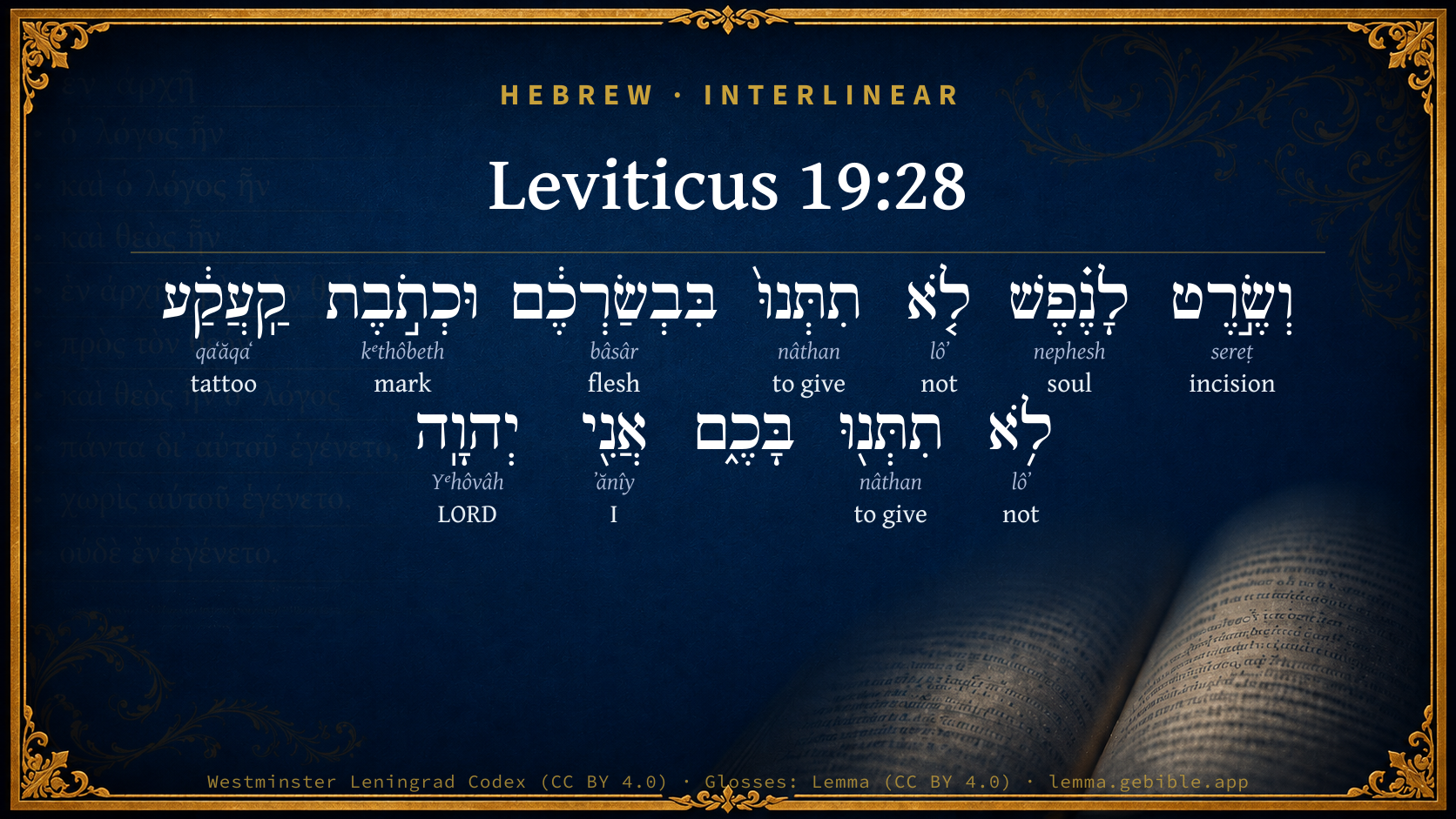
Hebrew (Westminster Leningrad Codex) Leviticus 19:28 appears in the Hebrew Old Testament. The text above is from the Westminster Leningrad Codex. Each word links to its Strong’s number, a concise gloss, and parsing drawn from the Open Scriptures Hebrew Bible morphology. Click any word for its full Brown-Driver-Briggs (BDB) entry.
Download image
Cite this verse

Leviticus 19:28 (World English Bible). Public Domain. Lemma interlinear Bible study tool, https://lemma.gebible.app/v/leviticus/19/28.

Show BibTeX & RIS
BibTeX
RIS
English Translation
"'You shall not make any cuttings in your flesh for the dead, nor tattoo any marks on you. I am Yahweh.
World English Bible · Public Domain
Highlights
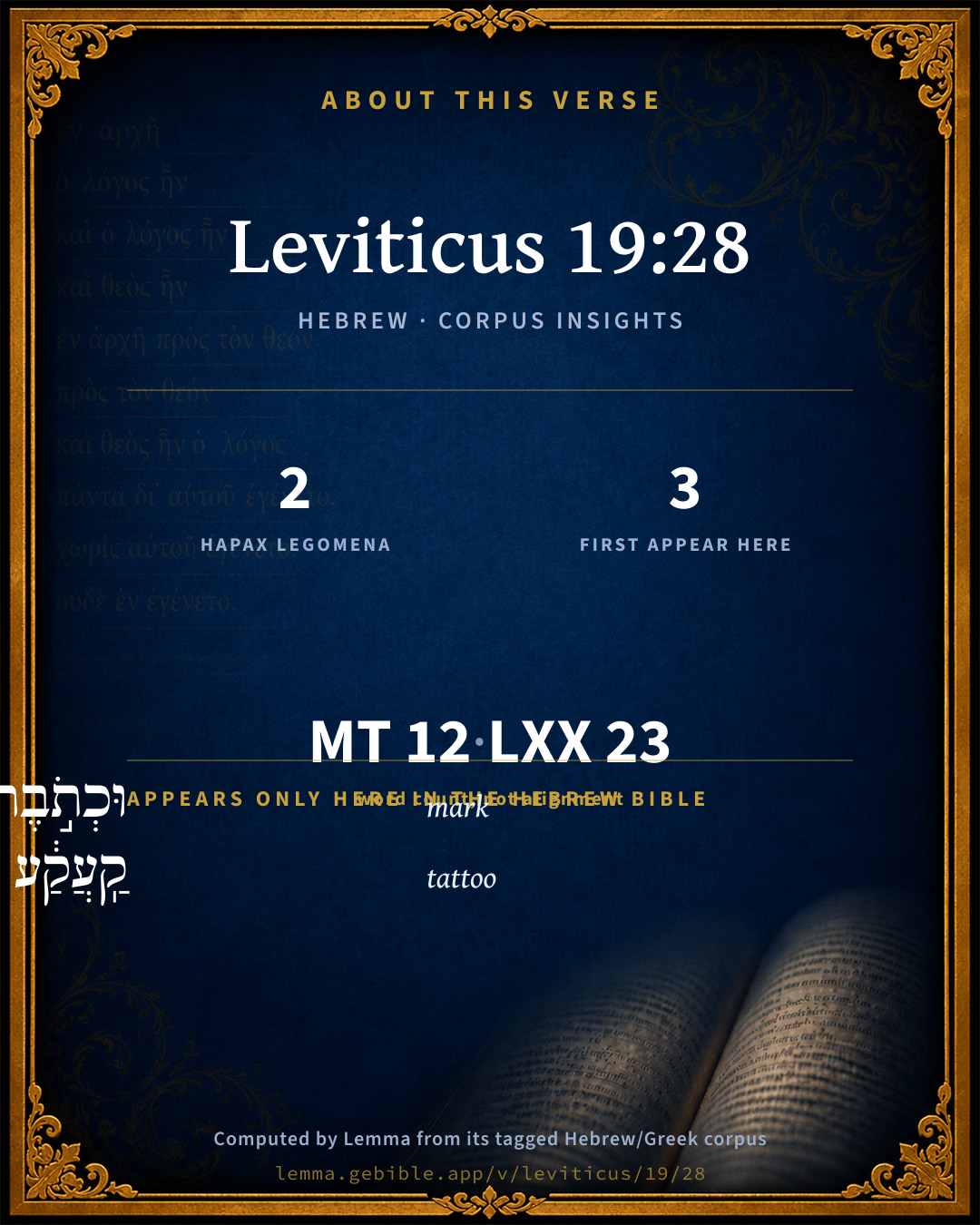
  • 2 hapax legomena — only here in the Hebrew Bible
  • 3 first appearances in the Hebrew Bible
Full analysis ↓
Download a study sheet

One document with this verse’s original text, its word-by-word gloss line, the meaning frame, cross-references with their text, attributed commentary, and full source and license credits — printable, and it pastes into notes with its structure intact.

This verse Autodidact and up

Study sheet (.html) Plain text (.txt)

A passage Seminary Student

Up to 50 verses in one chapter. A passage sheet keeps up to 6 commentary sources and 12 cross-references per verse, in the order this page ranks them, and says so on the sheet whenever that leaves anything out. Ask for a single verse and you get the Autodidact verse sheet above.

Everything on this page stays free to read, with no account — the sheet is a download of what is already on screen, not access to it.

Want to remove ads? Support Godless Engineer
Compare translations 3

The same verse in 3 English versions, stacked beneath the original-language interlinear above. Click any original word for its lexicon entry.

Each is an independent rendering of the whole verse — the interlinear is not word-aligned to these translations.

Highlighted words mark where these versions differ — a whole-verse word diff, not a word-by-word alignment.

  • World English Bible Public Domain
    "'You shall not make any cuttings in your flesh for the dead, nor tattoo any marks on you. I am Yahweh.
  • King James Version Public Domain
    Ye shall not make any cuttings in your flesh for the dead, nor print any marks upon you: I am the LORD.
  • unfoldingWord Literal Text CC BY-SA 4.0
    And a cut for the spirit you shall not put on your flesh, and a writing of a tattoo you shall not put on yourselves. I Yahweh.

unfoldingWord Literal Text — © unfoldingWord, licensed CC BY-SA 4.0. Word-aligned USFM3 via Door43 (git.door43.org/unfoldingWord/en_ult).

Versions to compare (up to 4)

3 of 4 selected

Show all 18 translations

Every available English version of this verse, each an independent rendering of the whole verse.

  • World English Bible Public Domain
    "'You shall not make any cuttings in your flesh for the dead, nor tattoo any marks on you. I am Yahweh.
  • Berean Standard Bible Public Domain
    You must not make any cuts in your bodies for the dead or put tattoo marks on yourselves. I am the LORD.
  • Majority Standard Bible Public Domain
    You must not make any cuts in your bodies for the dead or put tattoo marks on yourselves. I am the LORD.
  • King James Version Public Domain
    Ye shall not make any cuttings in your flesh for the dead, nor print any marks upon you: I am the LORD.
  • American Standard Version (1901) Public Domain
    Ye shall not make any cuttings in your flesh for the dead, nor print any marks upon you: I am Jehovah.
  • Revised Version (1885) Public Domain
    Ye shall not make any cuttings in your flesh for the dead, nor print any marks upon you: I am the LORD.
  • Geneva Bible (1599) Public Domain
    Ye shall not cut your flesh for the dead, nor make any print of a marke vpon you: I am the Lord,
  • Douay-Rheims (1899) Public Domain
    You shall not make any cuttings in your flesh, for the dead, neither shall you make in yourselves any figures or marks: I am the Lord.
  • Young's Literal Translation Public Domain
    `And a cutting for the soul ye do not put in your flesh; and a writing, a cross-mark, ye do not put on you; I `am' Jehovah.
  • Literal Standard Version CC BY-SA 4.0
    And you do not put a cutting for the soul in your flesh; and a writing, a cross-mark, you do not put on yourself; I [am] YHWH.
  • Unlocked Literal Bible CC BY-SA 4.0
    Do not cut your body for the dead or put tattoo marks on your body. I am Yahweh.
  • unfoldingWord Literal Text CC BY-SA 4.0
    And a cut for the spirit you shall not put on your flesh, and a writing of a tattoo you shall not put on yourselves. I Yahweh.
  • Darby Bible Public Domain
    And cuttings for a dead person shall ye not make in your flesh, nor put any tattoo writing upon you: I am Jehovah.
  • World Messianic Bible Public Domain
    “‘You shall not make any cuttings in your flesh for the dead, nor tattoo any marks on you. I am the LORD.
  • Webster's Bible Public Domain
    Ye shall not make any cuttings in your flesh for the dead, nor print any marks upon you: I am the LORD.
  • Free Bible Version CC BY-SA 4.0
    don't cut your bodies in some pagan ritual for the dead, and don't get yourselves tattoos. I am the Lord.
  • Bible in Basic English Public Domain
    You may not make cuts in your flesh in respect for the dead, or have marks printed on your bodies: I am the Lord.
  • JPS Tanakh (1917) Public Domain
    Ye shall not make any cuttings in your flesh for the dead, nor imprint any marks upon you: I am the LORD.

Literal Standard Version (2020), Covenant Press — licensed CC BY-SA 4.0. Text via the HelloAO Bible API (eBible.org). Unlocked Literal Bible (unfoldingWord) — licensed CC BY-SA 4.0. Text via the HelloAO Bible API (eBible.org). unfoldingWord Literal Text — © unfoldingWord, licensed CC BY-SA 4.0. Word-aligned USFM3 via Door43 (git.door43.org/unfoldingWord/en_ult). Free Bible Version, Dr. Jonathan Gallagher — licensed CC BY-SA 4.0. Text via the HelloAO Bible API (eBible.org).

Word by word

More ways to search: Search by grammar → Find every occurrence → Compare this word →

Practice this passage: Drill this verse → Learn its vocabulary →

וּכְתֹ֣בֶת
kᵉthôbeth
H3793
“and · mark of”
Conjunction + Noun, Common, Feminine, Singular, Construct
Part of Speech
Conjunction + Noun
Type
Common
Gender
Feminine
Number
Singular
State
Construct
Full BDB Definition

Origin: from H3789

TWOT: 1053b

impression, inscription, mark - in the flesh, perhaps a tattoo
  1. וְשֶׂ֣רֶט sereṭ H8296 “and · incision” Conjunction + Noun, Common, Masculine, Singular, Absolute
  2. לָנֶ֗פֶשׁ nephesh H5315 “to/for · soul” Preposition + Noun, Common, Both, Singular, Absolute
  3. לֹ֤א lôʼ H3808 “not” Particle, Negative
  4. תִתְּנוּ֙ nâthan H5414 “to give” Verb, Qal, Imperfect, 2nd Person, Masculine, Plural
  5. בִּבְשַׂרְכֶ֔ם bâsâr H1320 “in/at · flesh · your” Preposition + Noun, Common, Masculine, Singular, Construct + Suffix, Personal, 2nd Person, Masculine, Plural
  6. קַֽעֲקַ֔ע qaʻăqaʻ H7085 “tattoo” Noun, Common, Masculine, Singular, Absolute
  7. לֹ֥א lôʼ H3808 “not” Particle, Negative
  8. תִתְּנ֖וּ nâthan H5414 “to give” Verb, Qal, Imperfect, 2nd Person, Masculine, Plural
  9. אֲנִ֖י ʼănîy H589 “I” Pronoun, Personal, 1st Person, Common, Singular
  10. יְהוָֽה Yᵉhôvâh H3068 “LORD” Noun, Proper

About this verse

These counts appear in no published source. They are computed here, from the morphology-tagged text and Lemma’s own curated glosses. What Lemma adds →

12
words
9
distinct lemmas
Pentateuch
section

Notable vocabulary

2 hapax legomena — words that appear only here in the entire Hebrew Bible:

  • וּכְתֹ֣בֶת mark H3793
  • קַֽעֲקַ֔ע tattoo H7085

First appearance in Scripture

These words make their first canonical appearance in the Hebrew Bible here:

  • וְשֶׂ֣רֶט incision H8296
  • וּכְתֹ֣בֶת mark H3793
  • קַֽעֲקַ֔ע tattoo H7085

Shared distinctive vocabulary

וְשֶׂ֣רֶט incision H8296 occurs in 2 verses of the Hebrew Bible. Also found in:

Grammatical profile

  • 2 verbs
  • 6 nouns
  • 1 pronoun
  • 1 preposition
  • 2 particles

Verb forms

  • תִתְּנוּ֙ Qal · Imperfect
  • תִתְּנ֖וּ Qal · Imperfect

Repetition

Words recur within this verse — often emphatic in Hebrew:

  • תִתְּנוּ֙ to give H5414 ×2
  • לֹ֤א not H3808 ×2

Hebrew & Septuagint length

In English translation the verse runs 21 words from the Hebrew and 28 from the Septuagint (LXX English) — closely comparable.

A rough comparison of the two English renderings, which tokenize alike — not a word-level alignment.

Word counts can differ between the Hebrew and the Greek without any difference in meaning — e.g. the Hebrew direct-object marker אֵת has no separate Greek word, and Greek often adds the article ὁ.

In the original languages it is 12 Hebrew tokens and 23 Greek tokens — but the two are counted differently (Hebrew bundles its prefixes and suffixes into one token; the Greek is in lemma form), so that isn’t a like-for-like length.

Cross-references

14

Topical passages linked to Leviticus 19:28 in the Treasury of Scripture Knowledge — connected by theme and wording, ordered by reader-vote popularity; previews shown in the World English Bible.

  • Deuteronomy 14:1 You are the children of Yahweh your God: you shall not cut yourselves, nor make any baldness between your eyes for the dead.
  • 1 Kings 18:28 They cried aloud, and cut themselves after their manner with knives and lances, until the blood gushed out on them.
  • Leviticus 21:5 "'They shall not shave their heads, neither shall they shave off the corners of their beards, nor make any cuttings in their flesh.
  • Leviticus 21:1 Yahweh said to Moses, "Speak to the priests, the sons of Aaron, and say to them, 'A priest shall not defile himself for the dead among his people;
  • Jeremiah 16:6 Both great and small shall die in this land; they shall not be buried, neither shall men lament for them, nor cut themselves, nor make themselves bald for them;
  • Jeremiah 48:37 For every head is bald, and every beard clipped: on all the hands are cuttings, and on the loins sackcloth.
  • Mark 5:5 Always, night and day, in the tombs and in the mountains, he was crying out, and cutting himself with stones.
  • Revelation 13:16–17 He causes all, the small and the great, the rich and the poor, and the free and the slave, to be given marks on their right hands, or on their foreheads;
  • Revelation 20:4 I saw thrones, and they sat on them, and judgment was given to them. I saw the souls of those who had been beheaded for the testimony of Jesus, and for the word of God, and such as didn't worship the beast nor his image, and didn't receive the mark on their forehead and on their hand. They lived, and reigned with Christ for the thousand years.
  • Revelation 15:2 I saw something like a sea of glass mixed with fire, and those who overcame the beast, his image, and the number of his name, standing on the sea of glass, having harps of God.
  • Revelation 16:2 The first went, and poured out his bowl into the earth, and it became a harmful and evil sore on the people who had the mark of the beast, and who worshiped his image.
  • Revelation 14:9 Another angel, a third, followed them, saying with a great voice, "If anyone worships the beast and his image, and receives a mark on his forehead, or on his hand,
  • Revelation 14:11 The smoke of their torment goes up forever and ever. They have no rest day and night, those who worship the beast and his image, and whoever receives the mark of his name.
  • Revelation 19:20 The beast was taken, and with him the false prophet who worked the signs in his sight, with which he deceived those who had received the mark of the beast and those who worshiped his image. These two were thrown alive into the lake of fire that burns with sulfur.

Cross-references courtesy of OpenBible.info (CC BY 4.0).

Hebrew and Greek witnesses Masoretic Hebrew ↔ Greek Septuagint

The same verse in the two great witnesses to the Old Testament, shown verse-for-verse.

These are two independent witnesses, not word-aligned to each other, and the Septuagint is shown in lemma (dictionary) form.

Hebrew Leviticus 19:28 Masoretic · Westminster Leningrad Codex

וְשֶׂ֣רֶט לָנֶ֗פֶשׁ לֹ֤א תִתְּנוּ֙ בִּבְשַׂרְכֶ֔ם וּכְתֹ֣בֶת קַֽעֲקַ֔ע לֹ֥א תִתְּנ֖וּ בָּכֶ֑ם אֲנִ֖י יְהוָֽה

"'You shall not make any cuttings in your flesh for the dead, nor tattoo any marks on you. I am Yahweh.

World English Bible · Public Domain

Greek LXX Leviticus 19:28 Septuagint · lemma form

καί ἐντομίς ἐπί ψυχή οὐ ποιέω ἐν ὁ σῶμα σύ καί γράμμα στικτός οὐ ποιέω ἐν σύ ἐγώ εἰμί κύριος ὁ θεός σύ

And you⌃ shall not make cuttings in your body for a dead body, and you⌃ shall not inscribe on yourselves any marks. I am the Lord your God.

LXX2012 (modern English Septuagint) · Public Domain

Hebrew: Westminster Leningrad Codex (CC BY 4.0). Greek: Septuagint (public domain); English from LXX2012 (modern English Septuagint) (Public Domain). How the Septuagint differs from the Hebrew →

Targum (Aramaic paraphrase)

2

The Targum is the ancient Jewish Aramaic paraphrase of the Hebrew Scriptures — an interpretive translation, not the Hebrew text itself. Onkelos (literal) and Pseudo-Jonathan (expansive) render the Torah, and Jonathan the Prophets. Coverage is partial: where no permissively-licensed English translation exists for a verse, only the Aramaic is shown. This is verse-level text, not a word-by-word alignment to the Hebrew.

  1. Targum Onkelos Torah (Genesis–Deuteronomy)
    וְחִבּוּל עַל מִית לָא תִתְּנוּן בְּבִסְרְכוֹן וְרוּשְׁמִין חֲרִיתִין לָא תִתְּנוּן בְכוֹן אֲנָא יְיָ

    (no public-domain English translation for this verse)

    Targum Onkelos — Aramaic: “Onkelos Genesis” (public domain); “Onkelos Exodus” (public domain); “Onkelos Leviticus” (public domain); “Onkelos Numbers” (public domain); “Onkelos Deuteronomy” (public domain). English: “Sefaria Community Translation” (CC0 1.0 (public-domain dedication)); “J.W. Etheridge. The Targums of Onkelos and Jonathan Ben Uzziel on the Pentateuch. London: Longmans, Green, 1862” (public domain). Text via Sefaria.

  2. Targum Pseudo-Jonathan Torah (Genesis–Deuteronomy)
    וְשׁוֹרְטַת חִיבוּל עַל נְפַשׁ דְמִית לָא תִתְּנוּן בִּבְשַרְכוֹן וּכְתַב חָקִיק לִרְשַׁם חָרִית צִיוּרָא לָא תִתְּנוּן בְּכוֹן אֲנָא יְיָ

    And a corrupting incision for the soul of the dead thou shalt not make in thy flesh, neither set upon yourselves an inscription by the incutting of any figurated sign: I am the Lord.

    Targum Pseudo-Jonathan — Aramaic: “Targum Jonathan on Genesis” (public domain); “Targum Jonathan on Exodus” (public domain); “Targum Jonathan on Leviticus” (public domain); “Targum Jonathan on Numbers” (public domain); “Targum Jonathan on Deuteronomy” (public domain). English: “The Targum of Jonathan ben Uzziel, trans. J. W. Etheridge, London, 1862” (public domain). Text via Sefaria.

Commentary

Notes on Leviticus 19:28 from classic Christian and Jewish commentators (each source and its license shown beneath its notes). The classic Christian expositions comment on the surrounding passage and are grouped to its opening verse, so a note may address several verses; the Jewish commentaries on the Tanakh (Rashi and others) are per-verse, so they appear only where the commentator wrote on this verse.

Lemma curates 59 commentaries, every one of them public domain or Creative Commons licensed, each selected and text-cleaned for this edition rather than reprinted as found. About our sources →

John Gill's Exposition

Ye shall not make any cuttings in your flesh for the dead,.... Either with their nails, tearing their cheeks and other parts, or with any instrument, knife, razor, &c. Jarchi says, it was the custom of the Amorites, when anyone died, to cut their flesh, as it was of the Scythians, as Herodotus (d) relates, even those of the royal family; for a king they cut off a part of the ear, shaved the hair round about, cut the arms about, wounded the forehead and nose, and transfixed the left hand with arrows; and so the Carthaginians, who might receive it from the Phoenicians, being a colony of theirs, used to tear their hair and mouths in mourning, and beat their breasts (e); and with the Romans the women used to tear their cheeks in such a manner that it was forbid by the law of the twelve tables, which some have thought was taken from hence: and all this was done to appease the infernal deities, and to give them satisfaction for the deceased, and to make them propitious to them, as Varro (f) affirms; and here it is said to be made "for the soul", for the soul of the departed, to the honour of it, and for its good, though the word is often used for a dead body: now, according to the Jewish canons (g), whosoever made but one cutting for a dead person was guilty, and to be scourged; and he that made one for five dead men, or five cuttings for one dead man, was obliged to scourging for everyone of them:

nor print any marks upon you; Aben Ezra observes, there are some that say this is in connection with the preceding clause, for there were who marked their bodies with a known figure, by burning, for the dead; and he adds, and there are to this day such, who are marked in their youth in their faces, that they may be known; these prints or marks were made with ink or black lead, or, however, the incisions in the flesh were filled up therewith; but this was usually done as an idolatrous practice; so says Ben Gersom, this was the custom of the Gentiles in ancient times, to imprint upon themselves the mark of an idol, to show that they were his servants; and the law cautions from doing this, as he adds, to the exalted name (the name of God): in the Misnah it is said (h), a man is not guilty unless he writes the name, as it is said, Lev 19:28; which the Talmudists (i) and the commentators (k) interpret of the name of an idol, and not of God:

I am the Lord; who only is to be acknowledged as such, obeyed and served, and not any strange god, whose mark should be imprinted on them.

(d) Melpomene, sive, l. 4. c. 71. (e) Alex. ab Alex. Genial. Dier. l. 3. c. 7. (f) Apud Servium in Virgil. Aeneid. 3. (g) Misn. Maccot, c. 3. sect. 5. (h) Ibid. sect. 6. (i) T. Bab. Maccot, fol. 21. 1. (k) Jarchi, Maimon. Bartenora, & Ez Chayim in Misn. ut supra. (g))

John Gill's Exposition of the Whole Bible (1746–1763) — public domain (CC PDM 1.0). Text via the HelloAO Bible API.

Trapp's Complete Commentary

John Trapp

Lev 19:28 Ye shall not make any cuttings in your flesh for the dead, nor print any marks upon you: I [am] the LORD.

Ver. 28. Ye shall not make any cuttings.] Another heathenish custom, of such as mourned without hope. {a} Plutarch tells of some barbarians that did tear their hair, rend their flesh, slit their ears and nose for the dead. {Jer 16:6}

{a} Consol., ad Apol.

John Trapp, A Commentary or Exposition upon All the Books of the Old and New Testament (1647–1656) — public domain. Text from a community e-Sword module.

Matthew Poole's English Annotations

Any cuttings in your flesh, which the Gentiles commonly did both in the worship of their idols, and in their solemn mournings, Jer 16:6.

For the dead; Heb. for a soul, i.e. either,

1. Improperly, for a dead body; as that word is sometimes used, as Lev 19:28; 21:1; Num 6:6; or,

2. Properly, for the soul; Ye shall not cut your flesh or your bodies, for your souls, or upon pretence of doing your souls any good, either in way of mortification, or in the worship of God, as they did, 1Ki 18:28, in like manner as others were willing to give to God the fruit of their body for the sin of their soul, Mic 6:7.

Matthew Poole's English Annotations on the Holy Bible (1683–1685) — public domain. Text from a community e-Sword/MySword module.

The Biblical Illustrator

Joseph S. Exell

Lev_19:28

Cuttings in your flesh for the dead.

The wild and frantic demonstrations of grief so common among eastern dud southern nations, included cuts and incisions in the body, among the Hebrews, the Philistines, and the Moabites, the Arabs and Ethiopians, the Babylonians and Armenians; among the early Greeks and Romaus, people in bereavement, especially women, indulged in the hideous practice of lacerating their cheeks; and when the king of the Seythians died, those of his subjects who received his body for burial, cut off a part of their ears, shaved off their hair, wounded themselves on the arms, and drove arrows through their left hands. Such acts, which are still customary among some tribes of Persia, Arabia, and Abyssinia, were to be shunned by the Hebrews, not only because immoderate grief is unbecoming a nation of priests, but because cuts and incisions, usually made by persons while engaged in prayer or other religious exercises, were meant as substitutes for self-immolation, and the blood thus shed was supposed to ensure atonement: such notions were held in abhorrence by the advanced Levitical writers, who attributed the power of expiation to the blood of clean sacrificial animals, but not to human blood. More widespread still was the custom of inscribing upon the body, by means of a caustic, words or short maxims, or of marking the forehead and cheeks, the hands, the arms, and the neck, with figures and emblems. It prevailed, and partially still prevails, in many countries of the old and the new world, both among savage and more civilised nations; and though in many cases it is in itself harmless, beingmerely intended for ornament, or for identification, as when a slave bears the name or the initials of his master, or the soldier those of his general, it was, in many instances, a very efficient mode of strengthening the most dangerous superstitions. It was so common for idolaters to have the name or image of their chief deities, or some other significant symbol associated with their faith, engraved upon their bodies, that even the earlier religious legislators of the Hebrews deemed it necessary to devise some substitute for that custom in harmony with their new creed, and they introduced the phylacteries, which the Hebrews were to bind as a sign upon their head, and as a memorial between their eyes, that the law of the Lord might be in their mouths. Thus more than one advantage was gained; the sign or memorial was known to refer to none else but the One and true God of the Hebrews, and it was understood not as an amulet, which in itself is a shield against danger and misfortune, but as an emblem meant to remind the Israelite of his duties, and of their faithful accomplishment by his own zeal and vigilant exertion. Yet it was even after the exile considered unobjectionable to cover with such symbols the body itself, as is manifest from allusions of Isaiah (Isa_44:5; Isa_49:16). The Levitical writers prohibited, therefore, tattooing of any kind and for whatever purpose, well aware how imperceptibly that practice might lead again to the heathen rites and notions. Christians in some parts of the East, and European sailors, were long in the habit of marking, by means of punctures and a black dye, their arms and other members of the body with the sign of the crucifix, or the image of the Virgin; the Mohammedans mark them with the name of Allah, and Orientals generally with the outlines of celebrated towns and places. A traveller relates that, as a preparation for an Arabian wedding, the women tattoo the bride with figures of flowers, houses, cypresses, antelopes, and other animals. Among the Thraeians tattooing was considered as a mark and privilege of noble birth. The branding of prisoners and malefactors, extensively practised to this day, is included in the interdiction of our verse. (M. M. Kalisch, Ph. D.)

The Biblical Illustrator, edited by Joseph S. Exell (c. 1880s–1900s) — public domain. Text from a community e-Sword module.

Joseph Benson's Commentary

Lev 19:28. Cuttings in your flesh — Which the Gentiles commonly did, both in the worship of their idols and in their solemn mournings, Jer 16:6.

Joseph Benson's Commentary on the Old and New Testaments (1811–1818) — public domain. Text from a community e-Sword module.

Tyndale Open Study Notes

Tyndale Open Resources

19:28 cut your bodies: Cutting oneself was associated with Canaanite mourning practices (21:5; Deut 14:1). The word translated tattoo might refer to painting the body, a practice also associated with paganism.

Tyndale Open Study Notes — © Tyndale Open Resources, licensed CC BY-SA 4.0. Text via the HelloAO Bible API.

Geneva Bible (1599)

Geneva Bible translators

Hebrew, soul or person.

By whipping your bodies or burning marks therein.

Geneva Bible (1599) marginal notes — public domain. Text via Bolls.life.

Jamieson, Fausset & Brown

Robert Jamieson, A. R. Fausset & David Brown

Ye shall not make any cuttings in your flesh for the dead--The practice of making deep gashes on the face and arms and legs, in time of bereavement, was universal among the heathen, and it was deemed a becoming mark of respect for the dead, as well as a sort of propitiatory offering to the deities who presided over death and the grave. The Jews learned this custom in Egypt, and though weaned from it, relapsed in a later and degenerate age into this old superstition (Isa 15:2; Jer 16:6; Jer 41:5).

nor print any marks upon you--by tattooing, imprinting figures of flowers, leaves, stars, and other fanciful devices on various parts of their person. The impression was made sometimes by means of a hot iron, sometimes by ink or paint, as is done by the Arab females of the present day and the different castes of the Hindus. It is probable that a strong propensity to adopt such marks in honor of some idol gave occasion to the prohibition in this verse; and they were wisely forbidden, for they were signs of apostasy; and, when once made, they were insuperable obstacles to a return. (See allusions to the practice, Isa 44:5; Rev 13:17; Rev 14:1).

Jamieson, Fausset & Brown — Commentary Critical and Explanatory on the Whole Bible (1871) — public domain (CC PDM 1.0). Text via the HelloAO Bible API.

Adam Clarke's Commentary

Verse 28. Any cuttings in your flesh for the dead] That the ancients were very violent in their grief, tearing the hair and face, beating the breast, c., is well known. Virgil represents the sister of Dido "tearing her face with her nails, and beating her breast with her fists."

"Unguibus ora soror foedans, et pectora pugnis."

AEn., l. iv., ver. 672.

Nor print any marks upon you] It was a very ancient and a very general custom to carry marks on the body in honour of the object of their worship. All the castes of the Hindoos bear on their foreheads or elsewhere what are called the sectarian marks, which distinguish them, not only in a civil but also in a religious point of view, from each other.

Most of the barbarous nations lately discovered have their faces, arms, breasts, c., curiously carved or tattooed, probably for superstitious purposes. Ancient writers abound with accounts of marks made on the face, arms, &c., in honour of different idols and to this the inspired penman alludes, Re 13:16-17; Re 14:9, Re 14:11; Re 15:2; Re 16:2; Re 19:20; Re 20:4, where false worshippers are represented as receiving in their hands and in their forehead the marks of the beast. These were called στιγματα stigmata among the Greeks, and to these St. Paul refers when he says, I bear about in my body the MARKS (stigmata) of the Lord Jesus; Ga 6:17. I have seen several cases where persons have got the figure of the cross, the Virgin Mary, &c., made on their arms, breasts, &c., the skin being first punctured, and then a blue colouring matter rubbed in, which is never afterward effaced. All these were done for superstitious purposes, and to such things probably the prohibition in this verse refers. Calmet, on this verse, gives several examples. See also Mariner's Tonga Islands, vol. i. p. 311-313.

Adam Clarke's Commentary on the Bible (1810–1826) — public domain. Text from a community e-Sword/MySword module.

Ellicott's Commentary for English Readers

(28) Cuttings in your flesh for the dead.—It was not only the custom for mourners to let their hair grow long and wear it in a disorderly manner (see Lev_10:6), but the bereaved in the East to this day make cuts and incisions in their bodies in mourning for the dead. The Israelite, however, who is created in the image of God, and who is to be as holy as the Lord is holy, must not thus disfigure his body (see Lev_21:6; Deu_14:1, &c.); he must not sorrow as others which have no hope. For transgressing this law the offender received forty stripes save one.

Nor print any marks upon you.—This, according to the ancient authorities, was effected by making punctures in the skin to impress certain figures or words, and then filling the cut places with stibium, ink, or some other colour. The practice of tattooing prevailed among all nations of antiquity, both among savages and civilised nations, The slave had impressed upon his body the initials of his master, the soldier those of his general, and the worshipper the image of his tutelar deity. To obviate this disfiguration of the body which bore the impress of God’s image, and yet to exhibit the emblem of his creed, the Mosaic Law enacted that the Hebrew should have phylacteries which he is to bind as “a sign” upon his hand, and as “a memorial” between his eyes “that the Lord’s law may be in his mouth” (Exo_13:9; Exo_13:16; Deu_6:8; Deu_11:18).

A Bible Commentary for English Readers, edited by Charles John Ellicott (1878–1897) — public domain. Text from a community e-Sword module.

Haydock's Catholic Bible Commentary

Dead. Adonis or Osiris; as if you were mourning for them, in which sense the former verse may be explained. At funerals it was customary to cut off the hair. Achilles and his soldiers did so at the death of Patroclus. (Homer) --- The Persians also cut the manes of their horses, to shew their grief for the loss of Masistius, (Herod. ix. 24,) as Alexander did when Hephæstion died. (Plutarch) --- The Egyptians, Assyrians, &c., cut their hair on the like occasions, and the Hebrews did so too; whether they neglected this law, or it was rather designed only to hinder them from joining in a superstitious lamentation for some idol. They also cut their bodies, Genesis l, and Jeremias xli. 5. The pagans did so, intending thereby to appease the anger of the infernal deities: ut sanguine....inferis satisfaciant, (Varro, Servius): or to please the deceased. (Plutarch, de consol.) Thus Virgil represents Anna, Æneid iv.: Unguibus ora soror fædans & pectora pugnis. The Roman and Athenian laws restrained this cruelty of women towards themselves. But in Persia, the children and servants of great men still make an incision upon their arms, when their father or master dies. The women in Greece also observe a solemn mourning, with loud lamentations, tearing their cheeks and hair, and reciting the memorable actions of the deceased. The Christians and Jews of Syria inflict still more serious wounds upon themselves. The latter have always esteemed it lawful to adopt the customs of the nations with whom they lived, provided they were not attended with superstition; which makes us conclude, that what Moses here forbids was done in honour of some idol. --- Marks, made with a hot iron, representing false gods, as if to declare that they would serve them forever. (Philo) --- The Assyrians had generally such characters upon their bodies. Philopator ordered the converts from the Jewish religion to be marked with ivy, in honour of Bacchus. (3 Macchabees) Theodoret (q. 18) mentions, that the pagans were accustomed to cut their cheeks, and to prick themselves with needles, infusing some black matter, out of respect for the dead, and for demons. Allusion is made to these customs, Apocalypse xiii. 16, and Isaias xlix. 15. Christians have sometimes marked their arms with the cross, or name of Jesus. (Procopius in Isai. xliv. 5.) (Calmet) --- As St. Jane Frances de Chantal did her breast. (Breviary, August 21.) Nomen pectori insculpsit. St. Paul says, I bear the marks of the Lord Jesus in my body, Galatians vi. 17. The Church historians relate, that St. Francis and St. Catharine received miraculously the prints of his wounds. (Haydock)

George Leo Haydock (1774–1849), Haydock's Catholic Family Bible and Commentary, 1859 edition — public domain. Excludes Psalms (Douay-Rheims chapter numbering differs from Protestant) and Deuterocanonical books (Catholic canon only).

Whedon's Commentary on the Bible

Daniel D. Whedon

28. Cuttings in your flesh — The excitable Oriental nations were accustomed to scratch the arms, hands, and face in their passionate outbursts of mourning for the dead. The practice was associated with idolatrous rites. See Jer_16:6; Jer_41:5, where it was practised notwithstanding this prohibition. See Lev_21:5, note.

Nor print any marks — Tattooing, almost universal with savages, is still found in Arabia. It mars that which the Creator has made perfect, and thus degrades both the work and the Workman.

Daniel D. Whedon (gen. ed.), Commentary on the Old and New Testaments (1874–1909) — public domain. Text from a community e-Sword module.

John Wesley's Explanatory Notes

Cuttings in your flesh - Which the Gentiles commonly did both in the worship of their idols, and in their solemn mournings, Jer. xvi, 6.

John Wesley, Explanatory Notes Upon the Whole Bible (1754–1765) — public domain. Text via the GEBible commentary corpus.

Rashi

Rabbi Shlomo Yitzchaki (Rashi)

‎ ‎‎‎‎ושרט לנפש‏‎ ‎[YE SHALL NOT MAKE] ANY CUTTINGS [IN YOUR FLESH] FOR THE DEAD — This was the practice of the Amorites (a general term for heathens) to make cuttings in their flesh when someone belonging to them died.

וכתבת קעקע [NOR SHALL YE IMPRESS] ANY WRITING BY ETCHING [UPON YOU] — i. e. a writing engraved (more lit., dug into) and sunk into the flesh and which can never be erased because it is pricked in with a needle and remains black forever.

קעקע (root יקע) is an expression connected in sense with והוקע in (Numbers 25:4) “and hang them (והוקע אותם)" and with (II Samuel 21:6) "and we will hang them (הוקענום)". They drove poles into the ground and hanged them upon these — consequently they themselves, as the poles, were, so to speak, dug in and inserted in the ground; pourpoint in O. F.

Rashi on the Tanakh — English translations: “The Judaica Press complete Tanach with Rashi, translated by A. J. Rosenberg” (CC BY 4.0); “Pentateuch with Rashi's commentary by M. Rosenbaum and A.M. Silbermann, 1929-1934” (public domain); “The Metsudah Tanach series, Lakewood, N.J” (CC BY 4.0); and “The Book of Joshua, Metsudah Publications, 1997” (CC BY 4.0). Text via Sefaria.

Lesson kit

Teaching starters — assembled from the data on this page, not authored interpretation. Every prompt links to the verse data it draws on. Edit before teaching.

Leviticus, in the Pentateuch, opens this verse with 12 words (9 distinct Hebrew lemmas). Its most distinctive word is kᵉthôbeth (“mark”). A historical commentator’s framing appears above. Read the whole chapter for the surrounding context.

Discussion questions

  1. What does “mark” (kᵉthôbeth) contribute to the verse as a whole?
  2. This verse holds 2 words here found nowhere else in the Hebrew Bible. What might the rare words draw attention to?
  3. 3 words here appear for the first time in Scripture. What is being introduced at this debut?
  4. Leviticus 21:5 shares the word «incision» with this verse. How do the two illuminate each other?
  5. “to give” occurs 2× in this one verse. What is the effect of the repetition?
  6. The translations on this page render this verse differently — a whole-verse word diff, not a word-by-word alignment. What might account for the different wordings?
  7. The verb «תִתְּנוּ֙» is Qal Imperfect. How does its form color the action?
  8. Reading how John Gill's Exposition and Trapp's Complete Commentary read this verse, where do the two commentators agree and where do they part?

Things to notice

  • 2 words in this verse appear nowhere else in the Hebrew Bible.
  • 3 words make their first canonical appearance in Scripture here.
  • This verse counts 12 Hebrew ↔ 23 Greek words.
  • These translations choose different wording for 16 words in this verse.
  • “to give” occurs 2× in this single verse.

Reading settings

Reading text

Shown beneath each verse's original-language words.

Old Testament
Old Testament edition

Read the OT as the Masoretic Hebrew (MT) or the Greek Septuagint (LXX).

English shown for the Greek Septuagint (in the Hebrew ↔ Greek comparison).

Comparing translations? Open the Compare panel on any verse page to stack up to four side by side.