Ezekiel 18:3

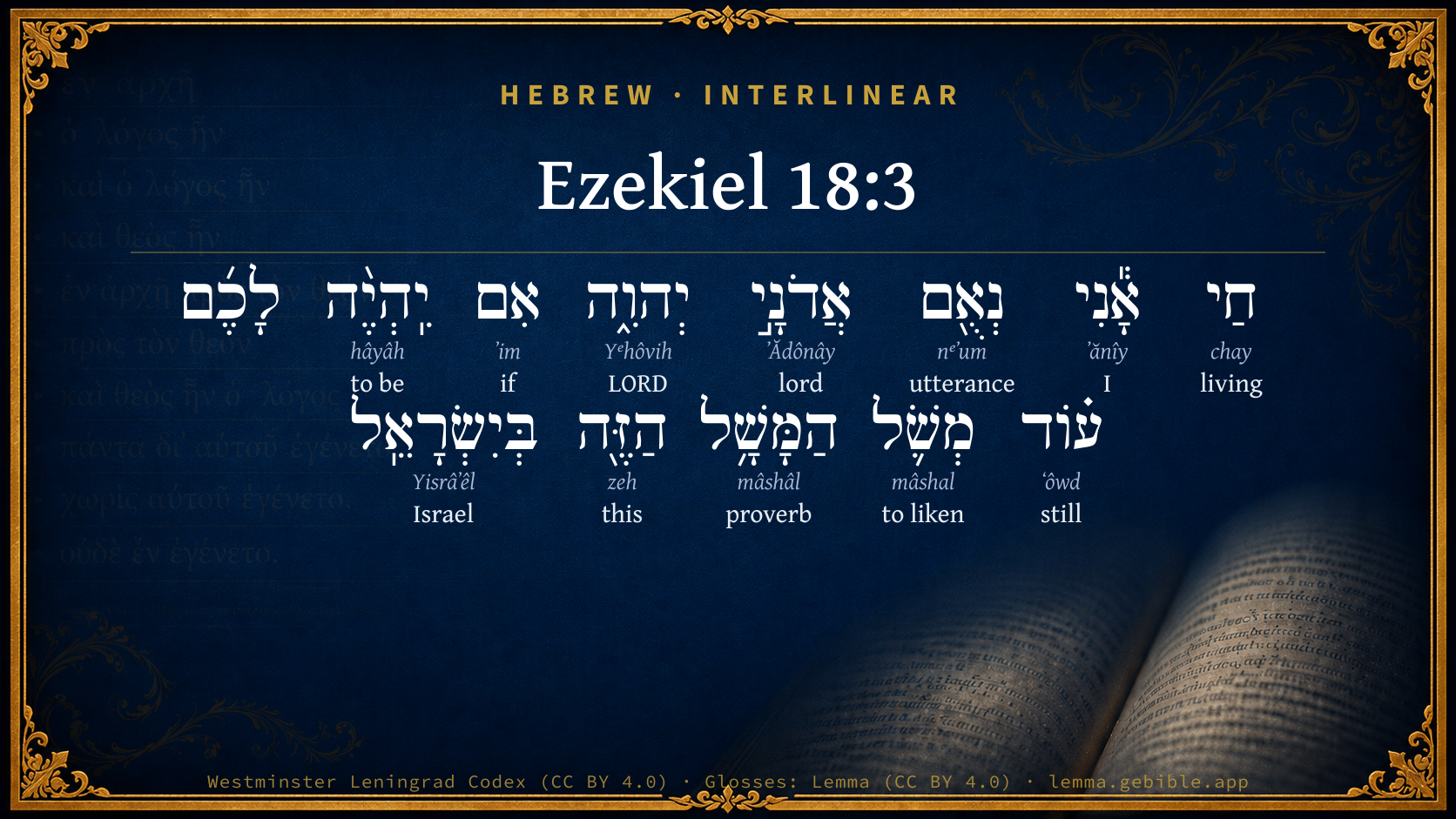
Hebrew (Westminster Leningrad Codex) Ezekiel 18:3 appears in the Hebrew Old Testament. The text above is from the Westminster Leningrad Codex. Each word links to its Strong’s number, a concise gloss, and parsing drawn from the Open Scriptures Hebrew Bible morphology. Click any word for its full Brown-Driver-Briggs (BDB) entry.
Download image
Cite this verse

Ezekiel 18:3 (World English Bible). Public Domain. Lemma interlinear Bible study tool, https://lemma.gebible.app/v/ezekiel/18/3.

Show BibTeX & RIS
BibTeX
RIS
English Translation
As I live, says the Lord Yahweh, you shall not have [occasion] any more to use this proverb in Israel.
World English Bible · Public Domain
Download a study sheet

One document with this verse’s original text, its word-by-word gloss line, the meaning frame, cross-references with their text, attributed commentary, and full source and license credits — printable, and it pastes into notes with its structure intact.

This verse Autodidact and up

Study sheet (.html) Plain text (.txt)

A passage Seminary Student

Up to 50 verses in one chapter. A passage sheet keeps up to 6 commentary sources and 12 cross-references per verse, in the order this page ranks them, and says so on the sheet whenever that leaves anything out. Ask for a single verse and you get the Autodidact verse sheet above.

Everything on this page stays free to read, with no account — the sheet is a download of what is already on screen, not access to it.

Want to remove ads? Support Godless Engineer
Compare translations 3

The same verse in 3 English versions, stacked beneath the original-language interlinear above. Click any original word for its lexicon entry.

Each is an independent rendering of the whole verse — the interlinear is not word-aligned to these translations.

Highlighted words mark where these versions differ — a whole-verse word diff, not a word-by-word alignment.

  • World English Bible Public Domain
    As I live, says the Lord Yahweh, you shall not have [occasion] any more to use this proverb in Israel.
  • King James Version Public Domain
    As I live, saith the Lord GOD, ye shall not have occasion any more to use this proverb in Israel.
  • unfoldingWord Literal Text CC BY-SA 4.0
    As I live—this is the Lord Yahweh’s declaration—there will certainly no longer be any occasion for you to use this proverb in Israel.

unfoldingWord Literal Text — © unfoldingWord, licensed CC BY-SA 4.0. Word-aligned USFM3 via Door43 (git.door43.org/unfoldingWord/en_ult).

Versions to compare (up to 4)

3 of 4 selected

Show all 18 translations

Every available English version of this verse, each an independent rendering of the whole verse.

  • World English Bible Public Domain
    As I live, says the Lord Yahweh, you shall not have [occasion] any more to use this proverb in Israel.
  • Berean Standard Bible Public Domain
    As surely as I live, declares the Lord GOD, you will no longer quote this proverb in Israel.
  • Majority Standard Bible Public Domain
    As surely as I live, declares the Lord GOD, you will no longer quote this proverb in Israel.
  • King James Version Public Domain
    As I live, saith the Lord GOD, ye shall not have occasion any more to use this proverb in Israel.
  • American Standard Version (1901) Public Domain
    As I live, saith the Lord Jehovah, ye shall not have `occasion' any more to use this proverb in Israel.
  • Revised Version (1885) Public Domain
    As I live, saith the Lord GOD, ye shall not have occasion any more to use this proverb in Israel.
  • Geneva Bible (1599) Public Domain
    As I liue, sayth the Lord God, ye shall vse this prouerbe no more in Israel.
  • Douay-Rheims (1899) Public Domain
    As I live, saith the Lord God, this parable shall be no more to you a proverb in Israel.
  • Young's Literal Translation Public Domain
    I live -- an affirmation of the Lord Jehovah, Ye have no more the use of this simile in Israel.
  • Literal Standard Version CC BY-SA 4.0
    [As] I live,” a declaration of Lord YHWH, “You no longer have the use of this allegory in Israel.
  • Unlocked Literal Bible CC BY-SA 4.0
    As I live—this is the Lord Yahweh's declaration—there will certainly no longer be any occasion for you to use this proverb in Israel.
  • unfoldingWord Literal Text CC BY-SA 4.0
    As I live—this is the Lord Yahweh’s declaration—there will certainly no longer be any occasion for you to use this proverb in Israel.
  • Darby Bible Public Domain
    [As] I live, saith the Lord Jehovah, ye shall not have any more to use this proverb in Israel.
  • World Messianic Bible Public Domain
    “As I live,” says the Lord GOD, “you shall not use this proverb any more in Israel.
  • Webster's Bible Public Domain
    As I live, saith the Lord GOD, ye shall not have occasion any more to use this proverb in Israel.
  • Free Bible Version CC BY-SA 4.0
    As I live, declares the Lord God, you won't quote this proverb in Israel any more.
  • Bible in Basic English Public Domain
    By my life, says the Lord, you will no longer have this saying in Israel.
  • JPS Tanakh (1917) Public Domain
    As I live, saith the Lord GOD, ye shall not have occasion any more to use this proverb in Israel.

Literal Standard Version (2020), Covenant Press — licensed CC BY-SA 4.0. Text via the HelloAO Bible API (eBible.org). Unlocked Literal Bible (unfoldingWord) — licensed CC BY-SA 4.0. Text via the HelloAO Bible API (eBible.org). unfoldingWord Literal Text — © unfoldingWord, licensed CC BY-SA 4.0. Word-aligned USFM3 via Door43 (git.door43.org/unfoldingWord/en_ult). Free Bible Version, Dr. Jonathan Gallagher — licensed CC BY-SA 4.0. Text via the HelloAO Bible API (eBible.org).

Word by word

More ways to search: Search by grammar → Find every occurrence → Compare this word →

Practice this passage: Drill this verse → Learn its vocabulary →

מְשֹׁ֛ל
mâshal
H4911
“to liken”
Verb, Qal, Infinitive Construct
Part of Speech
Verb
Stem
Qal
Form
Infinitive Construct
Full BDB Definition

Origin: denominative from H4912

TWOT: 1258 , 1258b

to represent, liken, be like - (Niphal) to liken, be like, be similar - (Hiphil) to compare - (Hithpael) to become like - to speak in a proverb, use a proverb, speak in parables, speak in sentences of poetry - (Qal) to use a proverb, speak a parable or proverb - (Piel) to make a parable - maker of parables (participle)
  1. חַי chay H2416 “living” Adjective, Adjective, Masculine, Singular, Absolute
  2. אָ֕נִי ʼănîy H589 “I” Pronoun, Personal, 1st Person, Common, Singular
  3. נְאֻ֖ם nᵉʼum H5002 “utterance of” Noun, Common, Masculine, Singular, Construct
  4. אֲדֹנָ֣י ʼĂdônây H136 “Lord · my” Noun, Common, Masculine, Plural, Construct + Suffix, Personal, 1st Person, Common, Singular
  5. יְהוִ֑ה Yᵉhôvih H3069 “LORD” Noun, Proper
  6. אִם ʼim H518 “if” Conjunction
  7. יִֽהְיֶ֨ה hâyâh H1961 “to be” Verb, Qal, Imperfect, 3rd Person, Masculine, Singular
  8. ע֗וֹד ʻôwd H5750 “still” Adverb
  9. הַמָּשָׁ֥ל mâshâl H4912 “the · proverb” Particle, Definite Article + Noun, Common, Masculine, Singular, Absolute
  10. הַזֶּ֖ה zeh H2088 “the · this” Particle, Definite Article + Pronoun, Demonstrative, Masculine, Singular
  11. בְּיִשְׂרָאֵֽל Yisrâʼêl H3478 “in/at · Israel” Preposition + Noun, Proper

About this verse

These counts appear in no published source. They are computed here, from the morphology-tagged text and Lemma’s own curated glosses. What Lemma adds →

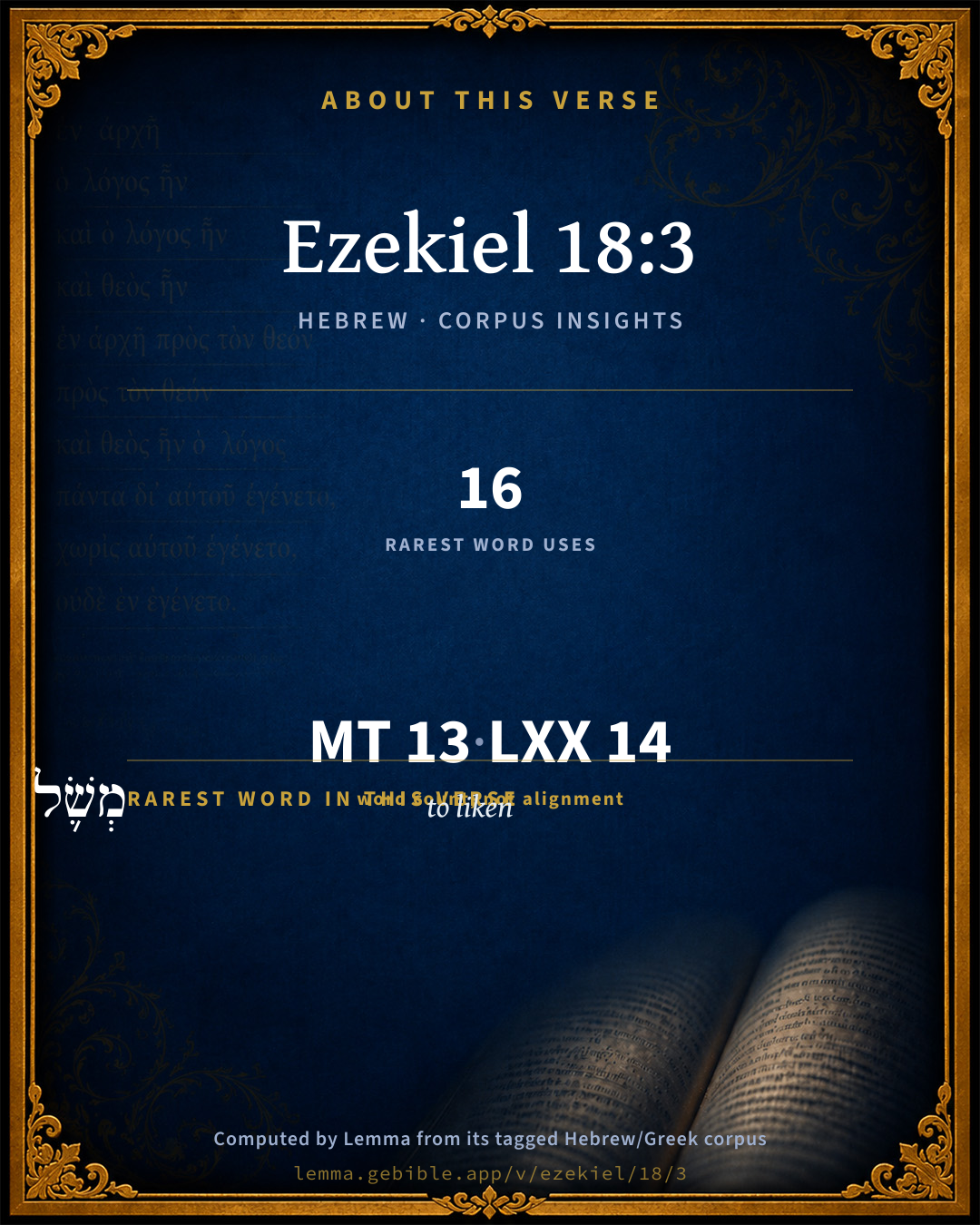
13
words
12
distinct lemmas
Prophets
section

Notable vocabulary

The rarest word here is מְשֹׁ֛ל to liken H4911 — appearing just 16 times in the whole Hebrew Bible.

Shared distinctive vocabulary

מְשֹׁ֛ל to liken H4911 occurs in 15 verses of the Hebrew Bible. Also found in:

Grammatical profile

  • 2 verbs
  • 5 nouns
  • 1 adjective
  • 2 pronouns
  • 1 preposition
  • 1 conjunction
  • 1 adverb

Verb forms

  • יִֽהְיֶ֨ה Qal · Imperfect
  • מְשֹׁ֛ל Qal · Infinitive Construct

Hebrew & Septuagint length

In English translation the verse runs 20 words from the Hebrew and 16 from the Septuagint (LXX English) — closely comparable.

A rough comparison of the two English renderings, which tokenize alike — not a word-level alignment.

Word counts can differ between the Hebrew and the Greek without any difference in meaning — e.g. the Hebrew direct-object marker אֵת has no separate Greek word, and Greek often adds the article ὁ.

In the original languages it is 13 Hebrew tokens and 14 Greek tokens — but the two are counted differently (Hebrew bundles its prefixes and suffixes into one token; the Greek is in lemma form), so that isn’t a like-for-like length.

Cross-references

5

Topical passages linked to Ezekiel 18:3 in the Treasury of Scripture Knowledge — connected by theme and wording, ordered by reader-vote popularity; previews shown in the World English Bible.

  • Ezekiel 18:19–20 Yet say you, Why does not the son bear the iniquity of the father? when the son has done that which is lawful and right, and has kept all my statutes, and has done them, he shall surely live.
  • Ezekiel 18:30 Therefore I will judge you, house of Israel, everyone according to his ways, says the Lord Yahweh. Return you, and turn yourselves from all your transgressions; so iniquity shall not be your ruin.
  • Ezekiel 33:11–20 Tell them, As I live, says the Lord Yahweh, I have no pleasure in the death of the wicked; but that the wicked turn from his way and live: turn you, turn you from your evil ways; for why will you die, house of Israel?
  • Ezekiel 36:31–32 Then shall you remember your evil ways, and your doings that were not good; and you shall loathe yourselves in your own sight for your iniquities and for your abominations.
  • Romans 3:19 Now we know that whatever things the law says, it speaks to those who are under the law, that every mouth may be closed, and all the world may be brought under the judgment of God.

Cross-references courtesy of OpenBible.info (CC BY 4.0).

Hebrew and Greek witnesses Masoretic Hebrew ↔ Greek Septuagint

The same verse in the two great witnesses to the Old Testament, shown verse-for-verse.

These are two independent witnesses, not word-aligned to each other, and the Septuagint is shown in lemma (dictionary) form.

Hebrew Ezekiel 18:3 Masoretic · Westminster Leningrad Codex

חַי אָ֕נִי נְאֻ֖ם אֲדֹנָ֣י יְהוִ֑ה אִם יִֽהְיֶ֨ה לָכֶ֜ם ע֗וֹד מְשֹׁ֛ל הַמָּשָׁ֥ל הַזֶּ֖ה בְּיִשְׂרָאֵֽל

As I live, says the Lord Yahweh, you shall not have [occasion] any more to use this proverb in Israel.

World English Bible · Public Domain

Greek LXX Ezekiel 18:3 Septuagint · lemma form

ζάω ἐγώ λέγω κύριος ἐάν γίγνομαι ἔτι λέγω ὁ παραβολή οὗτος ἐν ὁ ἰσραήλ

As I live, says the Lord, surely this parable shall no more be spoken in Israel.

LXX2012 (modern English Septuagint) · Public Domain

Hebrew: Westminster Leningrad Codex (CC BY 4.0). Greek: Septuagint (public domain); English from LXX2012 (modern English Septuagint) (Public Domain). How the Septuagint differs from the Hebrew →

Targum (Aramaic paraphrase)

1

The Targum is the ancient Jewish Aramaic paraphrase of the Hebrew Scriptures — an interpretive translation, not the Hebrew text itself. Onkelos (literal) and Pseudo-Jonathan (expansive) render the Torah, and Jonathan the Prophets. Coverage is partial: where no permissively-licensed English translation exists for a verse, only the Aramaic is shown. This is verse-level text, not a word-by-word alignment to the Hebrew.

  1. Targum Jonathan Prophets (Joshua–Malachi)
    קַיָם אֲנָא אֲמַר יְיָ אֱלֹהִים אִם יְהֵי לְכוֹן עוֹד מְתֵיל מַתְלָא הָדֵין בְּיִשְׂרָאֵל:

    (no public-domain English translation for this verse)

    Targum Jonathan — Aramaic: “Mikraot Gedolot” (public domain). English: “Sefaria Community Translation” (CC0 1.0 (public-domain dedication)); “London "Chaldee Paraphrase," 1871” (public domain). Text via Sefaria.

Commentary

Notes on Ezekiel 18:3 from classic Christian and Jewish commentators (each source and its license shown beneath its notes). The classic Christian expositions comment on the surrounding passage and are grouped to its opening verse, so a note may address several verses; the Jewish commentaries on the Tanakh (Rashi and others) are per-verse, so they appear only where the commentator wrote on this verse.

Lemma curates 59 commentaries, every one of them public domain or Creative Commons licensed, each selected and text-cleaned for this edition rather than reprinted as found. About our sources →

Trapp's Complete Commentary

John Trapp

Eze 18:3 [As] I live, saith the Lord GOD, ye shall not have [occasion] any more to use this proverb in Israel.

Ver. 3. Ye shall not have occasion any more.] For I will shortly take an order with you; and not by words, but by blows, vindicate my just judgments from your cavils and scurrilities.

John Trapp, A Commentary or Exposition upon All the Books of the Old and New Testament (1647–1656) — public domain. Text from a community e-Sword module.

Joseph Benson's Commentary

Eze 18:3. As I live; saith the Lord, ye shall not have occasion to use this proverb any more in Israel — I will make such a visible discrimination between the righteous and the wicked, between those that tread in the steps of their forefathers and those who take warning by their examples, that you shall not have any further room to use this proverb among you. God threatens, it must be acknowledged, to visit the sins of the fathers upon the children, both in the Old Testament and the New: see Exo 20:5; Mat 23:35. But this is to be understood only, 1st, With respect to the temporal punishments of this world, not with respect to the eternal punishments of the next; and, 2d, When the children walk in the wicked steps of their parents, and so by degrees fill up the measure of national iniquity: see notes on Jer 15:4; Jer 31:29, where this matter is more fully explained. “The Scripture takes notice of a certain measure of iniquity, which is filling up from one generation to another, till at last it makes a nation or family ripe for destruction. And although those persons on whom this vengeance falls suffer no more than their own personal sins deserved, yet, because the sins of former generations, which they equal or outdo, make it time for God utterly to destroy them, the punishments due to the sins of many ages and generations are said to fall upon them.” — Dr. Sherlock.

Joseph Benson's Commentary on the Old and New Testaments (1811–1818) — public domain. Text from a community e-Sword module.

Tyndale Open Study Notes

Tyndale Open Resources

18:3-4 The Lord’s response to the proverb of 18:1-2 was to categorically deny that it fit the situation. To the contrary, the Lord consistently punishes only those who are guilty (Deut 24:16). God is unswervingly just.

Tyndale Open Study Notes — © Tyndale Open Resources, licensed CC BY-SA 4.0. Text via the HelloAO Bible API.

Jamieson, Fausset & Brown

Robert Jamieson, A. R. Fausset & David Brown

ye shall not have occasion any more to use this proverb--because I will let it be seen by the whole world in the very fact that you are not righteous, as ye fancy yourselves, but wicked, and that you suffer only the just penalty of your guilt; while the elect righteous remnant alone escapes.

Jamieson, Fausset & Brown — Commentary Critical and Explanatory on the Whole Bible (1871) — public domain (CC PDM 1.0). Text via the HelloAO Bible API.

Adam Clarke's Commentary

Verse 3. As I live, saith the Lord God, ye shall not have occasion any more to use this proverb in Israel.] I will now, by this present declaration, settle this question for ever. And hence God has sworn to what follows. After this, who will dare to doubt the judgment pronounced?

Adam Clarke's Commentary on the Bible (1810–1826) — public domain. Text from a community e-Sword/MySword module.

John Calvin's Commentaries

Ye, says he, use this proverb; but as I live, says the Lord Jehovah, you shall not use this proverb anymore. He does not mean, by these words, that the Jews should repent and become more modest, and not dare to vomit forth such blasphemy against him; for he is not treating of repentance here; but it is just as if he said, I will strike from under you this boasting, since your iniquity shall be made manifest, and the whole world shall acknowledge the justice of your punishment, and that you have deserved it yourselves, and cannot throw it upon your fathers, as you have hitherto endeavored to do. The Jews indeed did not cease their rebellion against God, and there is no doubt that they were more and more exasperated, so as to expostulate with audacity against him; but because their wickedness was really apparent, and God was not hostile to them in vain, or for trifling reasons; and although he was severe, yet they had arrived at the highest pitch of impiety, so that no punishment could be sufficient or too oppressive. We now understand the meaning of the Prophet, or rather of the Holy Spirit, since God took away all pretense for shuffling from the Jews when he detected their impiety, and made it conspicuous that they were only suffering the due reward of their crimes. But God swears by himself, whence we gather how abominable was their blasphemy; and truly men cannot absolve themselves without condemning God; for God’s glory then shines forth, when every mouth is stopped, as we saw before. (Ezekiel 16:63; Romans 3:19.) As soon as men descend into that arena, through wishing to show their innocence, it is just as if they wished to reduce God’s justice to nothing. Hence it is not surprising that God is very angry when he is despoiled of his justice; for he cannot exist without this attribute.

John Calvin's Commentaries (1540-1563) — public domain. Text from the Calvin Translation Society English edition (1840s-50s) via the Christian Classics Ethereal Library (ccel.org). Calvin's coverage is partial (roughly two-thirds of the Bible); uncommented books and verses are honest gaps, never fabricated. The 19th-century editor's footnotes and remarks are omitted so the notes are faithfully Calvin's own voice.

The Cambridge Bible for Schools and Colleges

gen. ed. J. J. S. Perowne

3. ye shall not have occasion] Or, it shall not be permitted you.

The Cambridge Bible for Schools and Colleges (gen. ed. J. J. S. Perowne; Cambridge University Press, 1878–1918) — public domain. Text from a community e-Sword module.

John Gill's Exposition

But if a man be just,.... Not legally, as to be wholly free from sin, for there is no such just man, Ecc 7:20; but evangelically, through the imputation of the righteousness of Christ unto him; and who has a principle of grace and holiness wrought in him; a man of a just principle and good conscience; who is disposed by the grace of God to that which is just and right; for this seems to refer to the inward frame of the mind, as distinct from actions, and as the source of them, as follows:

and do that which is lawful and right; or "judgment" (c) and "justice"; true judgment and justice, as the Targum; that which is just and right by the law of God, and is so between man and man; the particulars of which follow:

(c) "judiciam et justitiam", V. L. Pagninus, Montanus, &c.

John Gill's Exposition of the Whole Bible (1746–1763) — public domain (CC PDM 1.0). Text via the HelloAO Bible API.

Matthew Poole's English Annotations

Either you who use it shall die for it, or because I will vindicate my proceedings so that all who consider your punishments shall see you deserve all that you suffer.

Matthew Poole's English Annotations on the Holy Bible (1683–1685) — public domain. Text from a community e-Sword/MySword module.

Whedon's Commentary on the Bible

Daniel D. Whedon

3. Ye shall not have occasion — Or, ye shall not be permitted. Their own guilt shall now be made so plain to them (and the close connection between guilt and punishment) that they will no longer dare to blame their fathers and excuse themselves.

Daniel D. Whedon (gen. ed.), Commentary on the Old and New Testaments (1874–1909) — public domain. Text from a community e-Sword module.

The Pulpit Commentary

Stress is laid on the fact that the proverb which implied unrighteousness in God is no longer to be used in Israel. There, among the, people in whom he was manifesting his righteousness for the education of mankind, it should be seen to have no force whatever. The thought was an essentially heathen thought a half-truth distorted into a falsehood.

The Pulpit Commentary (1880–1919), ed. H.D.M. Spence-Jones & Joseph S. Exell — public domain. Text from a community e-Sword module.

unfoldingWord translationNotes

Door43 World Missions Community

As I live

"As surely as I am alive." Yahweh uses this expression to show that what he says next is certainly true. This is a way of making a solemn promise. See how you translated this in Ezekiel 5:11. AT: "I solemnly swear" (See: Idiom)

this is the Lord Yahweh's declaration

Yahweh speaks of himself by name to express the certainty of what he is declaring. See how you translated this in Ezekiel 5:11. AT: "this is what the Lord Yahweh has declared" or "this is what I, the Lord Yahweh, have declared" (See: First, Second, or Third Person)

Behold!

The word "Behold" here alerts us to pay attention to the surprising information that follows.

The soul who sins

Here the word "soul" represents the person. AT: "The person who sins" (See: Synecdoche)

translationWords

life

Lord Yahweh

declare

proverb

Israel

ancestor

son

sin

die

unfoldingWord translationNotes — © Distant Shores Media and the Door43 World Missions Community, licensed CC BY-SA 4.0. Source: git.door43.org/Door43/en_tn.

Rashi

Rabbi Shlomo Yitzchaki (Rashi)

shall no longer use this parable Heb. מְשֹּׁל, like לִמְשֹּׁל [the infinitive].

Rashi on the Tanakh — English translations: “The Judaica Press complete Tanach with Rashi, translated by A. J. Rosenberg” (CC BY 4.0); “Pentateuch with Rashi's commentary by M. Rosenbaum and A.M. Silbermann, 1929-1934” (public domain); “The Metsudah Tanach series, Lakewood, N.J” (CC BY 4.0); and “The Book of Joshua, Metsudah Publications, 1997” (CC BY 4.0). Text via Sefaria.

Lesson kit

Teaching starters — assembled from the data on this page, not authored interpretation. Every prompt links to the verse data it draws on. Edit before teaching.

Ezekiel, in the Prophets, opens this verse with 13 words (12 distinct Hebrew lemmas). Its most distinctive word is mâshal (“to liken”). A historical commentator’s framing appears above. Read the whole chapter for the surrounding context.

Discussion questions

  1. The word mâshal carries the sense “to liken.” How does it shape the verse?
  2. How does Numbers 21:27, which shares the word «to liken», read alongside this verse?
  3. These translations render this verse differently. What is at stake in choosing one wording over another?
  4. «יִֽהְיֶ֨ה» is a Qal Imperfect verb. How does that grammatical form shape the action described?
  5. Compare how Trapp's Complete Commentary and Joseph Benson's Commentary read this verse. Where do they agree or differ?

Things to notice

Reading settings

Reading text

Shown beneath each verse's original-language words.

Old Testament
Old Testament edition

Read the OT as the Masoretic Hebrew (MT) or the Greek Septuagint (LXX).

English shown for the Greek Septuagint (in the Hebrew ↔ Greek comparison).

Comparing translations? Open the Compare panel on any verse page to stack up to four side by side.