
Exodus 33:19

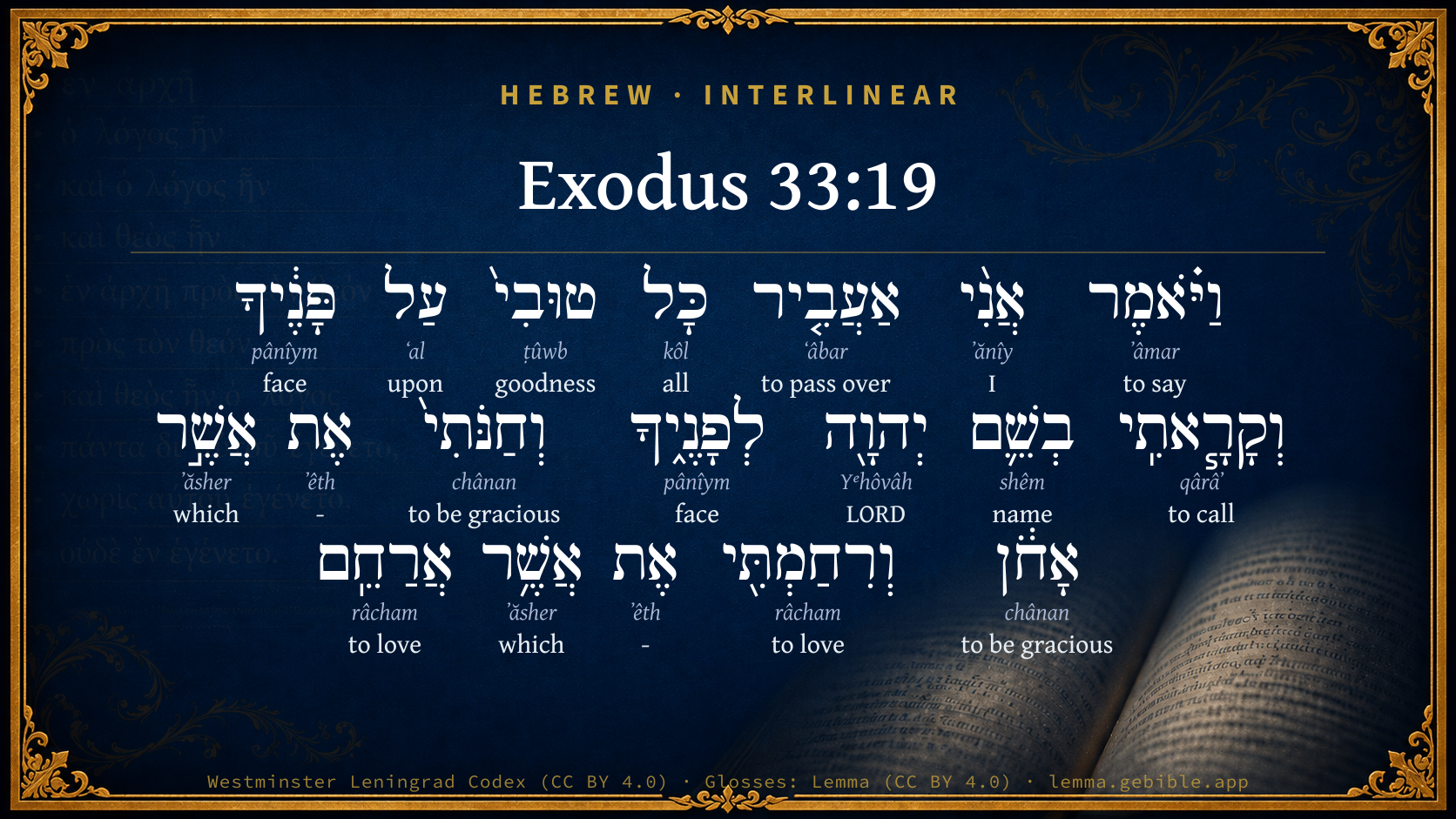
Hebrew (Westminster Leningrad Codex) Exodus 33:19 appears in the Hebrew Old Testament. The text above is from the Westminster Leningrad Codex. Each word links to its Strong’s number, a concise gloss, and parsing drawn from the Open Scriptures Hebrew Bible morphology. Click any word for its full Brown-Driver-Briggs (BDB) entry.
Download image
Cite this verse

Exodus 33:19 (World English Bible). Public Domain. Lemma interlinear Bible study tool, https://lemma.gebible.app/v/exodus/33/19.

Show BibTeX & RIS
BibTeX
RIS
English Translation
He said, "I will make all my goodness pass before you, and will proclaim the name of Yahweh before you. I will be gracious to whom I will be gracious, and will show mercy on whom I will show mercy."
World English Bible · Public Domain
Highlights
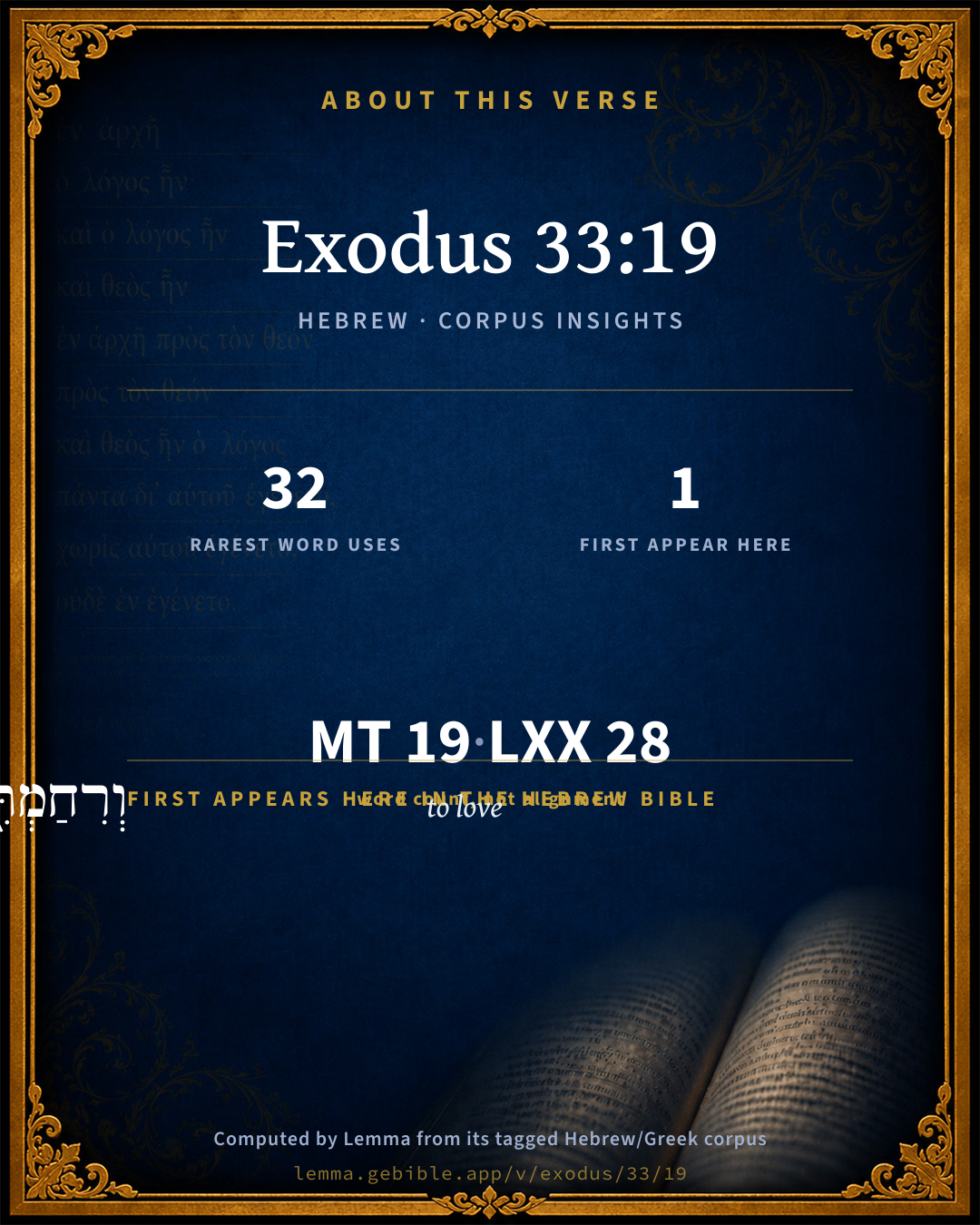
  • 1 first appearance in the Hebrew Bible
Full analysis ↓
Download a study sheet

One document with this verse’s original text, its word-by-word gloss line, the meaning frame, cross-references with their text, attributed commentary, and full source and license credits — printable, and it pastes into notes with its structure intact.

This verse Autodidact and up

Study sheet (.html) Plain text (.txt)

A passage Seminary Student

Up to 50 verses in one chapter. A passage sheet keeps up to 6 commentary sources and 12 cross-references per verse, in the order this page ranks them, and says so on the sheet whenever that leaves anything out. Ask for a single verse and you get the Autodidact verse sheet above.

Everything on this page stays free to read, with no account — the sheet is a download of what is already on screen, not access to it.

Want to remove ads? Support Godless Engineer
Compare translations 3

The same verse in 3 English versions, stacked beneath the original-language interlinear above. Click any original word for its lexicon entry.

Each is an independent rendering of the whole verse — the interlinear is not word-aligned to these translations.

Highlighted words mark where these versions differ — a whole-verse word diff, not a word-by-word alignment.

  • World English Bible Public Domain
    He said, "I will make all my goodness pass before you, and will proclaim the name of Yahweh before you. I will be gracious to whom I will be gracious, and will show mercy on whom I will show mercy."
  • King James Version Public Domain
    And he said, I will make all my goodness pass before thee, and I will proclaim the name of the LORD before thee; and will be gracious to whom I will be gracious, and will show mercy on whom I will show mercy.
  • unfoldingWord Literal Text CC BY-SA 4.0
    And he said, “I myself will cause all my goodness to pass over above your face, and I will proclaim in the name of Yahweh before your face: and I will favor whom I will favor, and I will be compassionate to whom I will be compassionate.”

unfoldingWord Literal Text — © unfoldingWord, licensed CC BY-SA 4.0. Word-aligned USFM3 via Door43 (git.door43.org/unfoldingWord/en_ult).

Versions to compare (up to 4)

3 of 4 selected

Show all 18 translations

Every available English version of this verse, each an independent rendering of the whole verse.

  • World English Bible Public Domain
    He said, "I will make all my goodness pass before you, and will proclaim the name of Yahweh before you. I will be gracious to whom I will be gracious, and will show mercy on whom I will show mercy."
  • Berean Standard Bible Public Domain
    “I will cause all My goodness to pass before you,” the LORD replied, “and I will proclaim My name—the LORD—in your presence. I will have mercy on whom I have mercy, and I will have compassion on whom I have compassion.”
  • Majority Standard Bible Public Domain
    “I will cause all My goodness to pass before you,” the LORD replied, “and I will proclaim My name—the LORD—in your presence. I will have mercy on whom I have mercy, and I will have compassion on whom I have compassion.”
  • King James Version Public Domain
    And he said, I will make all my goodness pass before thee, and I will proclaim the name of the LORD before thee; and will be gracious to whom I will be gracious, and will show mercy on whom I will show mercy.
  • American Standard Version (1901) Public Domain
    And he said, I will make all my goodness pass before thee, and will proclaim the name of Jehovah before thee; and I will be gracious to whom I will be gracious, and will show mercy on whom I will show mercy.
  • Revised Version (1885) Public Domain
    And he said, I will make all my goodness pass before thee, and will proclaim the name of the LORD before thee; and I will be gracious to whom I will be gracious, and will shew mercy on whom I will shew mercy.
  • Geneva Bible (1599) Public Domain
    And he answered, I wil make all my good go before thee, and I wil proclaime the Name of the Lord before thee: for I will shewe mercy to whom I will shewe mercy, and will haue compassion on whom I will haue compassion.
  • Douay-Rheims (1899) Public Domain
    He answered: I will shew thee all good, and I will proclaim in the name of the Lord before thee: and I will have mercy on whom I will, and I will be merciful to whom it shall please me.
  • Young's Literal Translation Public Domain
    and He saith, `I cause all My goodness to pass before thy face, and have called concerning the Name of Jehovah before thee, and favoured him whom I favour, and loved him whom I love.'
  • Literal Standard Version CC BY-SA 4.0
    and He says, “I cause all My goodness to pass before your face, and have called concerning the Name of YHWH before you, and favored him whom I favor, and loved him whom I love.”
  • Unlocked Literal Bible CC BY-SA 4.0
    Yahweh said, “I will make all my goodness pass before you, and I will proclaim my name 'Yahweh' before you. I will be gracious to whom I will be gracious, and I will show mercy on whom I will show mercy.”
  • unfoldingWord Literal Text CC BY-SA 4.0
    And he said, “I myself will cause all my goodness to pass over above your face, and I will proclaim in the name of Yahweh before your face: and I will favor whom I will favor, and I will be compassionate to whom I will be compassionate.”
  • Darby Bible Public Domain
    And he said, I will make all my goodness pass before thy face, and I will proclaim the name of Jehovah before thee; and I will be gracious to whom I will be gracious, and I will shew mercy on whom I will shew mercy.
  • World Messianic Bible Public Domain
    He said, “I will make all my goodness pass before you, and will proclaim the LORD’s name before you. I will be gracious to whom I will be gracious, and will show mercy on whom I will show mercy.”
  • Webster's Bible Public Domain
    And he said, I will make all my goodness pass before thee, and I will proclaim the name of the LORD before thee; and will be gracious to whom I will be gracious, and will show mercy on whom I will show mercy.
  • Free Bible Version CC BY-SA 4.0
    “I will make all the goodness of my character pass in front of you, I will call out the name ‘Yahweh,’ I will show grace to those I want to show grace, and I will show mercy to those I want to show mercy.
  • Bible in Basic English Public Domain
    And he said, I will make all the light of my being come before you, and will make clear to you what I am; I will be kind to those to whom I will be kind, and have mercy on those on whom I will have mercy.
  • JPS Tanakh (1917) Public Domain
    And He said: 'I will make all My goodness pass before thee, and will proclaim the name of the LORD before thee; and I will be gracious to whom I will be gracious, and will show mercy on whom I will show mercy.'

Literal Standard Version (2020), Covenant Press — licensed CC BY-SA 4.0. Text via the HelloAO Bible API (eBible.org). Unlocked Literal Bible (unfoldingWord) — licensed CC BY-SA 4.0. Text via the HelloAO Bible API (eBible.org). unfoldingWord Literal Text — © unfoldingWord, licensed CC BY-SA 4.0. Word-aligned USFM3 via Door43 (git.door43.org/unfoldingWord/en_ult). Free Bible Version, Dr. Jonathan Gallagher — licensed CC BY-SA 4.0. Text via the HelloAO Bible API (eBible.org).

Word by word

More ways to search: Search by grammar → Find every occurrence → Compare this word →

Practice this passage: Drill this verse → Learn its vocabulary →

טוּבִי֙
ṭûwb
H2898
“goodness · my”
Noun, Common, Masculine, Singular, Construct + Suffix, Personal, 1st Person, Common, Singular
Part of Speech
Noun
Type
Common
Gender
Masculine
Number
Singular
State
Construct
Full BDB Definition

Origin: from H2895

TWOT: 793b

goods, good things, goodness - good things - goods, property - fairness, beauty, joy, prosperity, goodness (abstract) - goodness (of taste, discernment) - goodness (of God) (abstract)
  1. וַיֹּ֗אמֶר ʼâmar H559 “and · to say” Conjunction + Verb, Qal, Sequential Imperfect, 3rd Person, Masculine, Singular
  2. אֲנִ֨י ʼănîy H589 “I” Pronoun, Personal, 1st Person, Common, Singular
  3. אַעֲבִ֤יר ʻâbar H5674 “to pass over” Verb, Hiphil, Imperfect, 1st Person, Common, Singular
  4. כָּל kôl H3605 “all of” Noun, Common, Masculine, Singular, Construct
  5. עַל ʻal H5921 “upon” Preposition
  6. פָּנֶ֔יךָ pânîym H6440 “face(s) · your” Noun, Common, Both, Plural, Construct + Suffix, Personal, 2nd Person, Masculine, Singular
  7. וְקָרָ֧אתִֽי qârâʼ H7121 “and · to call” Conjunction + Verb, Qal, Sequential Perfect, 1st Person, Common, Singular
  8. בְשֵׁ֛ם shêm H8034 “in/at · name of” Preposition + Noun, Common, Masculine, Singular, Construct
  9. יְהוָ֖ה Yᵉhôvâh H3068 “LORD” Noun, Proper
  10. לְפָנֶ֑יךָ pânîym H6440 “to/for · face(s) · your” Preposition + Noun, Common, Both, Plural, Construct + Suffix, Personal, 2nd Person, Masculine, Singular
  11. וְחַנֹּתִי֙ chânan H2603 “and · to be gracious” Conjunction + Verb, Qal, Sequential Perfect, 1st Person, Common, Singular
  12. אֶת ʼêth H853 “-” Particle, Direct Object
  13. אֲשֶׁ֣ר ʼăsher H834 “which” Particle, Relative
  14. אָחֹ֔ן chânan H2603 “to be gracious” Verb, Qal, Imperfect, 1st Person, Common, Singular
  15. וְרִחַמְתִּ֖י râcham H7355 “and · to love” Conjunction + Verb, Piel, Sequential Perfect, 1st Person, Common, Singular
  16. אֶת ʼêth H853 “-” Particle, Direct Object
  17. אֲשֶׁ֥ר ʼăsher H834 “which” Particle, Relative
  18. אֲרַחֵֽם râcham H7355 “to love” Verb, Piel, Imperfect, 1st Person, Common, Singular

About this verse

These counts appear in no published source. They are computed here, from the morphology-tagged text and Lemma’s own curated glosses. What Lemma adds →

19
words
14
distinct lemmas
Pentateuch
section

First appearance in Scripture

This word makes its first canonical appearance in the Hebrew Bible here:

  • וְרִחַמְתִּ֖י to love H7355

Shared distinctive vocabulary

טוּבִי֙ goodness H2898 occurs in 31 verses of the Hebrew Bible. Also found in:

Grammatical profile

  • 7 verbs
  • 6 nouns
  • 1 pronoun
  • 1 preposition
  • 4 particles

Verb forms

  • וַיֹּ֗אמֶר Qal · Sequential Imperfect
  • אַעֲבִ֤יר Hiphil · Imperfect
  • וְקָרָ֧אתִֽי Qal · Sequential Perfect
  • וְחַנֹּתִי֙ Qal · Sequential Perfect
  • אָחֹ֔ן Qal · Imperfect
  • וְרִחַמְתִּ֖י Piel · Sequential Perfect
  • אֲרַחֵֽם Piel · Imperfect

Repetition

Words recur within this verse — often emphatic in Hebrew:

  • פָּנֶ֔יךָ face H6440 ×2
  • וְחַנֹּתִי֙ to be gracious H2603 ×2
  • וְרִחַמְתִּ֖י to love H7355 ×2
  • אֲשֶׁ֣ר which H834 ×2

Hebrew & Septuagint length

In English translation the verse runs 40 words from the Hebrew and 44 from the Septuagint (LXX English) — closely comparable.

A rough comparison of the two English renderings, which tokenize alike — not a word-level alignment.

Word counts can differ between the Hebrew and the Greek without any difference in meaning — e.g. the Hebrew direct-object marker אֵת has no separate Greek word, and Greek often adds the article ὁ.

In the original languages it is 19 Hebrew tokens and 28 Greek tokens — but the two are counted differently (Hebrew bundles its prefixes and suffixes into one token; the Greek is in lemma form), so that isn’t a like-for-like length.

Cross-references

15

Topical passages linked to Exodus 33:19 in the Treasury of Scripture Knowledge — connected by theme and wording, ordered by reader-vote popularity; previews shown in the World English Bible.

  • Romans 9:15–18 For he said to Moses, "I will have mercy on whom I have mercy, and I will have compassion on whom I have compassion."
  • Ephesians 1:6–8 to the praise of the glory of his grace, by which he freely bestowed favor on us in the Beloved,
  • Jeremiah 31:14 I will satiate the soul of the priests with fatness, and my people shall be satisfied with my goodness, says Yahweh.
  • Exodus 34:5–7 Yahweh descended in the cloud, and stood with him there, and proclaimed the name of Yahweh.
  • Isaiah 7:14 Therefore the Lord himself will give you a sign. Behold, the virgin will conceive, and bear a son, and shall call his name Immanuel.
  • Jeremiah 31:12 They shall come and sing in the height of Zion, and shall flow to the goodness of Yahweh, to the grain, and to the new wine, and to the oil, and to the young of the flock and of the herd: and their soul shall be as a watered garden; and they shall not sorrow any more at all.
  • Exodus 3:13–15 Moses said to God, "Behold, when I come to the children of Israel, and tell them, 'The God of your fathers has sent me to you;' and they ask me, 'What is his name?' What should I tell them?"
  • Isaiah 9:6 For to us a child is born, to us a son is given; and the government shall be on his shoulder: and his name shall be called Wonderful, Counselor, Mighty God, Everlasting Father, Prince of Peace.
  • Isaiah 12:4 In that day you will say, "Give thanks to Yahweh! Call on his name. Declare his doings among the peoples. Proclaim that his name is exalted!
  • Zechariah 9:17 For how great is his goodness, And how great is his beauty! Grain will make the young men flourish, And new wine the virgins.
  • Nehemiah 9:25 They took fortified cities, and a fat land, and possessed houses full of all good things, cisterns hewn out, vineyards, and olive groves, and fruit trees in abundance: so they ate, and were filled, and became fat, and delighted themselves in your great goodness.
  • Psalms 65:4 Blessed is one whom you choose, and cause to come near, That he may live in your courts. We will be filled with the goodness of your house, Your holy temple.
  • Romans 2:4 Or do you despise the riches of his goodness, forbearance, and patience, not knowing that the goodness of God leads you to repentance?
  • Romans 9:23 and that he might make known the riches of his glory on vessels of mercy, which he prepared beforehand for glory,
  • Psalms 25:13 His soul shall dwell at ease. His seed shall inherit the land.

Cross-references courtesy of OpenBible.info (CC BY 4.0).

Hebrew and Greek witnesses Masoretic Hebrew ↔ Greek Septuagint

The same verse in the two great witnesses to the Old Testament, shown verse-for-verse.

These are two independent witnesses, not word-aligned to each other, and the Septuagint is shown in lemma (dictionary) form.

Hebrew Exodus 33:19 Masoretic · Westminster Leningrad Codex

וַיֹּ֗אמֶר אֲנִ֨י אַעֲבִ֤יר כָּל טוּבִי֙ עַל פָּנֶ֔יךָ וְקָרָ֧אתִֽי בְשֵׁ֛ם יְהוָ֖ה לְפָנֶ֑יךָ וְחַנֹּתִי֙ אֶת אֲשֶׁ֣ר אָחֹ֔ן וְרִחַמְתִּ֖י אֶת אֲשֶׁ֥ר אֲרַחֵֽם

He said, "I will make all my goodness pass before you, and will proclaim the name of Yahweh before you. I will be gracious to whom I will be gracious, and will show mercy on whom I will show mercy."

World English Bible · Public Domain

Greek LXX Exodus 33:19 Septuagint · lemma form

καί εἶπον ἐγώ παραἔρχομαι πρότερος σύ ὁ δόξα ἐγώ καί καλέω ἐπί ὁ ὄνομα ἐγώ κύριος ἐναντίον σύ καί ἐλεέω ὅς ἄν ἐλεέω καί οἰκτείρω ὅς ἄν οἰκτείρω

And God said, I will pass by before you with my glory, and I will call by my name, the Lord, before you; and I will have mercy on whom I will have mercy, and will have pity on whom I will have pity.

LXX2012 (modern English Septuagint) · Public Domain

On this verse, The Cambridge Bible for Schools and Colleges discusses the Septuagint’s reading. Read the note in Commentary ↓

Hebrew: Westminster Leningrad Codex (CC BY 4.0). Greek: Septuagint (public domain); English from LXX2012 (modern English Septuagint) (Public Domain). How the Septuagint differs from the Hebrew →

Targum (Aramaic paraphrase)

2

The Targum is the ancient Jewish Aramaic paraphrase of the Hebrew Scriptures — an interpretive translation, not the Hebrew text itself. Onkelos (literal) and Pseudo-Jonathan (expansive) render the Torah, and Jonathan the Prophets. Coverage is partial: where no permissively-licensed English translation exists for a verse, only the Aramaic is shown. This is verse-level text, not a word-by-word alignment to the Hebrew.

  1. Targum Onkelos Torah (Genesis–Deuteronomy)
    וַאֲמַר אֲנָא אַעְבַּר כָּל טוּבִי עַל אַפָּיךְ וְאֶקְרֵי בִשְׁמָא דַיְיָ קֳדָמָךְ וְאֵחוֹן לְמָן דְאֵחוֹן וְאֵרַחֵם עַל מָן דְאֵרַחֵם:

    (no public-domain English translation for this verse)

    Targum Onkelos — Aramaic: “Onkelos Genesis” (public domain); “Onkelos Exodus” (public domain); “Onkelos Leviticus” (public domain); “Onkelos Numbers” (public domain); “Onkelos Deuteronomy” (public domain). English: “Sefaria Community Translation” (CC0 1.0 (public-domain dedication)); “J.W. Etheridge. The Targums of Onkelos and Jonathan Ben Uzziel on the Pentateuch. London: Longmans, Green, 1862” (public domain). Text via Sefaria.

  2. Targum Pseudo-Jonathan Torah (Genesis–Deuteronomy)
    וַאֲמַר אֲנָא מַעֲבֵר כָּל מְכִילַת טוּבִי קֳדָמָךְ וְאֵיקְרֵי בְּשׁוּם מֵימְרֵיהּ דַּיְיָ קֳדָמָךְ וְאֵיחוּס עַל מַאן דְּחָמֵי לֵיהּ לְמֵיחוּס וְאֵירְחֵים עַל מַאן דְּחָמֵי לֵיהּ לְמִתְרַחֲמָא

    but He said, Behold, I will make all the measure of My goodness pass before thee, and I will give utterance in the good name of the Word of the Lord before thee; and I will have compassion upon whom I see it right to have compassion, and will be merciful to whom I see it right to have mercy.

    Targum Pseudo-Jonathan — Aramaic: “Targum Jonathan on Genesis” (public domain); “Targum Jonathan on Exodus” (public domain); “Targum Jonathan on Leviticus” (public domain); “Targum Jonathan on Numbers” (public domain); “Targum Jonathan on Deuteronomy” (public domain). English: “The Targum of Jonathan ben Uzziel, trans. J. W. Etheridge, London, 1862” (public domain). Text via Sefaria.

Commentary

Notes on Exodus 33:19 from classic Christian and Jewish commentators (each source and its license shown beneath its notes). The classic Christian expositions comment on the surrounding passage and are grouped to its opening verse, so a note may address several verses; the Jewish commentaries on the Tanakh (Rashi and others) are per-verse, so they appear only where the commentator wrote on this verse.

Lemma curates 59 commentaries, every one of them public domain or Creative Commons licensed, each selected and text-cleaned for this edition rather than reprinted as found. About our sources →

Trapp's Complete Commentary

John Trapp

Exo 33:19 And he said, I will make all my goodness pass before thee, and I will proclaim the name of the LORD before thee; and will be gracious to whom I will be gracious, and will shew mercy on whom I will shew mercy.

Ver. 19. I will make all my goodness.] My glorious goodness. Thus Moses may have what he will of God. "The king is not he that can do anything against you," said Zedekiah to his courtiers. {Jer 38:5}

John Trapp, A Commentary or Exposition upon All the Books of the Old and New Testament (1647–1656) — public domain. Text from a community e-Sword module.

Albert Barnes' Notes on the Bible

But his request could not be granted in accordance with the conditions of human existence. The glory of the Almighty in its fulness is not to be revealed to the eye of man. Compare Jdg 6:22; Isa 6:5. A further revelation of the divine goodness was however possible (see Exo 33:6-7).

It was vouchsafed to Paul, as it had been to Moses, to have special “visions and revelations of the Lord” 2Co 12:1-4. But he had, also like Moses, to find the narrow reach of the intellect of man in the region of Godhead 1Ti 6:16. However intimate may be our communion with the Holy One, we are still, as long as we are in the flesh, “to see through a glass darkly,” waiting for the time when we shall see, with no figure of speech, “face to face” 1Co 13:12. Then we know “that we shall be like Him, for we shall see Him as He is” 1Jo 3:2.

Exo 33:19

Will be gracious ... - Yahweh declares His own will to be the ground of the grace which He is going to show the nation. Paul applies these words to the election of Jacob in order to overthrow the self-righteous boasting of the Jews Rom 9:15.

Exo 33:20

Such passages as this, being clearly in accordance with what we know of the relation of spiritual existence to the human senses, show how we are to interpret the expressions “face to face” Exo 33:11; Deu 34:10, “mouth to mouth” Num 12:8, and others of the like kind. See Exo 24:10; Isa 6:1; and compare Joh 14:9.

Albert Barnes' Notes on the Bible (1834–1885) — public domain. Text from a community e-Sword/MySword module.

The Biblical Illustrator

Joseph S. Exell

Exo_33:19

I will be gracious.

Election no discouragement to seeking souls

Because God is the Maker, and Creator, and Sustainer of all things, He has a right to do as He wills with all His works.

I. Let us begin with this assertion, which we are absolutely sure is correct: this doctrine does not oppose any comfort derived from other scriptural truths. There is not the slightest shadow of a conflict between Gods sovereignty and Gods goodness. He may be a sovereign, and yet it may be absolutely certain that He will always act in the way of goodness and love. It is true that He will do as He wills; and yet it is quite certain that He always wills to do that which, in the widest view of it, is good and gracious.

II. That this doctrine has a most salutary effect upon sinners. To the awakened sinner, next to the doctrine of the Cross, the doctrine of distinguishing grace is perhaps the most fraught with blessings and comfort.

1. In the first place, the doctrine of election, applied by the Holy Ghost, strikes dead for ever all the efforts of the flesh.

2. Again, this doctrine gives the greatest hope to the really awakened sinner.

3. Moreover, do not you see how the doctrine of election comforts the sinner in the matter of power. His complaint is, I find I have no power to believe; I have no spiritual power of any kind. Election stoops down and whispers in his ear But if God wills to save you, He gives the power, gives the life, and gives the grace; and therefore since He has given that power and might to others as weak as you, why not to you? Have courage, look to the Cross of Christ and live. And oh! what emotions of gratitude, what throbbings of love does this doctrine cause in human hearts. I wanted to have said a word as to the effect of this gospel upon incorrigible sinners. If you are ever to be pardoned, God must do it. (C. H, Spurgeon.)

Moral glory

How precious is the thought suggested by this--that when God is seen to be most good to His creatures, He is then seen to be most glorious in the universe; that the glory and the goodness of God are so connected together that where the one is most revealed, the other shines in its richest splendour. Not power in creating, not justice in punishing, but goodness in saving, sets forth most the glory of God. Creation is the mirror of His power; Sinai is the pedestal of His justice; but Calvary is the scene of His goodness, and therefore of His great glory. And we all know that great genius may make us wonder, great riches may make us envy, great strength may startle us; but great goodness rises upon the soul with an influence like the sun in his shining light, making us love as well as admire, and reverence, and esteem. Lost as man is, goodness is still most impressive on the heart of the very worst. Even with all our depravity, who does not admire Howard, the philanthropist, vastly more than Byron, the poet? There may have been little genius in Howard, as the world calls genius, but there was a beneficence that went into the retreats of fever, into the lairs of vice, shut its eyes to monumental remains of ancient days, and opened his heart only to the cry of them that were appointed to die. And when one hears what he did, and what he dared under the inspiration of goodness, one is not awed, but charmed and delighted, with the character of Howard. But when we see, on the other hand, great genius--and one cannot but admire such a genius as that gifted nobleman had--we wonder at the greatness and the versatility of intellect; but when that intellect was used only to scathe, and to wither, and to blast, we look upon it in the same way as upon the sirocco in the desert, we are rather terrified at it, or retreat from it, or would rather wish we should not see it at all. But how complete is the contrast between goodness in a Howard, and mere power in a Byron! And is there one in this assembly that would not infinitely rather take the example of Howard as his model, than wish the power of Byron to be his possession? But this is in the human, and I quote it in the human only to show you more clearly the truth I am trying to teach; that not the manifestation of power, not the manifestation of justice, but the manifestation of goodness, is the most impressive on the heart. (J. Caroming, D. D.)

The Biblical Illustrator, edited by Joseph S. Exell (c. 1880s–1900s) — public domain. Text from a community e-Sword module.

Joseph Benson's Commentary

Exo 33:19. I will make my goodness pass before thee — Moses’s request was to see God’s glory, and God answers him by promising to show him his goodness; intimating that, however, in themselves, all God’s attributes are glorious, yet he glories most in the manifestation of his goodness, and that his creatures need this most. Pass before thee — So that thou mayest at least have a transient view of it. I will be gracious to whom I will be gracious — I will show this peculiar favour to thee, and I will also be gracious to the people thou pleadest for; but not promiscuously to all: some, namely, such as turn to me in true repentance, I will pardon and save; but others, even all that are finally impenitent, I will eternally punish.

Joseph Benson's Commentary on the Old and New Testaments (1811–1818) — public domain. Text from a community e-Sword module.

Tyndale Open Study Notes

Tyndale Open Resources

33:19 In his positive reply, God subtly changed the terms. He would grant Moses a glorious experience, but he would not show Moses his face. Rather, he would show him his goodness and express his character (my name), marked above all by mercy and compassion (see Rom 9:14-16). • Yahweh: Here God is emphasizing his own personal name.

Tyndale Open Study Notes — © Tyndale Open Resources, licensed CC BY-SA 4.0. Text via the HelloAO Bible API.

Geneva Bible (1599)

Geneva Bible translators

My mercy and fatherly care.

Read Exod. 34:6,7.

For finding nothing in man that can deserve mercy, he will freely save his.

Geneva Bible (1599) marginal notes — public domain. Text via Bolls.life.

Adam Clarke's Commentary

Verse 19. I will make all my goodness pass before thee] Thou shalt not have a sight of my justice, for thou couldst not bear the infinite splendour of my purity: but I shall show myself to thee as the fountain of inexhaustible compassion, the sovereign Dispenser of my own mercy in my own way, being gracious to whom I will be gracious, and showing mercy on whom I will show mercy.

I will proclaim the name of the Lord.] See Clarke on Ex 34:6.

Adam Clarke's Commentary on the Bible (1810–1826) — public domain. Text from a community e-Sword/MySword module.

Ellicott's Commentary for English Readers

(19) I will make all my goodness pass before thee.—It is not clear how this was fulfilled. Perhaps, as God announced His name—“the Lord, the Lord God, merciful and gracious, long-suffering, and abundant in goodness and truth,” &c. (Exo_34:6-7)—a revelation of God’s ineffable goodness was miraculously flashed into his inmost soul, and the thousand instances of it which he had known brought distinctly to his recollection, so as to “pass before him.”

And will be gracious to whom I will be gracious.—It is not meant that God’s favour is bestowed arbitrarily, but only that it is in any case favour—a free gift, not earned nor merited.

A Bible Commentary for English Readers, edited by Charles John Ellicott (1878–1897) — public domain. Text from a community e-Sword module.

The Cambridge Bible for Schools and Colleges

gen. ed. J. J. S. Perowne

19. goodness] goodliness or comeliness, viz. of the Divine appearance; cf. Hos_10:11 (lit. ‘the goodness, i.e. comeliness, of her neck’). ‘It is to be a spectacle of outward beauty as a visible sign of His moral perfection’ (McNeile).

proclaim the name of Jehovah] and so manifest the character implied in it—here, in particular, Jehovah’s moral character. The name was regarded by the Hebrews as the expression of the character of the person denoted by it: see e.g. Isa_1:26; Isa_4:3; Isa_61:3 b (the names here mentioned are to be given to Zion or Israel, because they will possess the qualities denoted by them).

and I will be gracious, &c.] In virtue of the graciousness implicit in His name (Exo_34:6 f.), He will shew grace and mercy to such as deserve it. Who these are, is not expressly stated; but fallen and penitent Israel is what is intended. For the form of sentence called the idem per idem construction, which is idiomatic in both Heb. and Arabic, where the means, or the desire, to be more explicit does not exist, cf. Exo_3:14, Exo_4:13, Exo_16:23, 1Sa_23:13 (lit. and they went where they went), 2Sa_15:20 (‘seeing I am going whither I am going’), 2Ki_8:1 (‘and sojourn where thou wilt sojourn’); and see the writer’s Notes on Samuel, on 1 S. l.c. The second ‘will’ in each sentence is a simple future: it must not be emphasized as though it meant ‘wish to’ (θέλω). The quotation (from LXX.) in Rom_9:15 (‘I will have mercy on whom I have mercy &c.’) expresses the sense exactly. All that is said here is that God is gracious to those to whom He is gracious: on the motives which may prompt Him to be gracious, the passage is silent. See further p. 54.

The Cambridge Bible for Schools and Colleges (gen. ed. J. J. S. Perowne; Cambridge University Press, 1878–1918) — public domain. Text from a community e-Sword module.

John Gill's Exposition

And he said, I will make all my goodness pass before thee,.... Which is his glory; the glory of the Lord lies in his goodness, and that appears in the works of his hands, in the methods of his providence, especially in the distribution of his sovereign grace and mercy, and particularly in his pardoning grace and mercy, through the blood of Christ; for as it is "the glory" of a man "to pass over a transgression", Pro 19:11 much more it is the glory of God, of which this goodness is afterwards interpreted; and may be understood of Christ himself, who is the goodness of God itself, is not only good, but the Lord's good One, emphatically good; as he is called his holy One, so his good One; because all his goodness is laid up in him, is prevented and filled as Mediator, with the blessings of his goodness; all are proclaimed in him, displayed through him, and communicated by him; and he is that glorious Personage that Moses might be desirous of having a view of, and was favoured with; however, with a view of the divine goodness, as it is conspicuous in him, in what he is, and has done for his people; for God has shown forth the exceeding riches of his grace and goodness in him:

and I will proclaim the name of the Lord before thee: his name and his nature, his perfections, and the glory of them, as displayed in Christ; or when he is about to pass, or while he is passing by, lest he should pass by unobserved, I will proclaim aloud and give thee notice that he is now passing by thee, whose name is Jehovah, and whose nature, glory, and goodness, are as follow:

and will be gracious to whom I will be gracious, and will show mercy on whom I will show mercy: signifying that notwithstanding the children of Israel had sinned against him in such a manner as they had, yet he should show favour, grace, and mercy to them, in pardoning their sins; and it should be distributed, not according to any merits of theirs, but according to his sovereign will and pleasure, and not to all, but to whomsoever he thought fit; and in this would be seen his glory: and so it is with respect to grace and mercy, as displayed in Christ to sinful men; it is not in proportion to their deserts, but according to the purpose and good will of God, and that not unto all, but unto some whom he has appointed, not unto wrath, but unto salvation by Jesus Christ, and which is to the glory of his grace; and the more enlarged view men have of this, the more clearly and fully does the goodness and glory of God pass before them.

John Gill's Exposition of the Whole Bible (1746–1763) — public domain (CC PDM 1.0). Text via the HelloAO Bible API.

Haydock's Catholic Bible Commentary

All good, that could reasonably be desired. "I will pass before thee in all my glory," (Septuagint) and principally in my beneficence, chap. xxxiv. 6, 7. (Calmet) --- I will shew thee what great favours I have in reserve for Israel. Divines dispute whether Moses saw the divine essence. (St. Thomas Aquinas, [Summa Theologiae] 1, p. q. 12, a. 11.) (Menochius) --- If he requested to do so now, it seems to be denied, ver. 20. and John i. 17. (Tirinus) --- Proclaim, &c. When I pass, I will repeat some of my glorious titles, and particularly that I am merciful. (Menochius) --- Yet I will shew mercy with discretion, and will punish some of you. (Calmet)

George Leo Haydock (1774–1849), Haydock's Catholic Family Bible and Commentary, 1859 edition — public domain. Excludes Psalms (Douay-Rheims chapter numbering differs from Protestant) and Deuterocanonical books (Catholic canon only).

Matthew Poole's English Annotations

All my goodness, or, my beauty; for so that Hebrew word is sometimes used, Gen 6:2; 1Sa 9:2; or my excellency, or my glory, as appears from Exo 33:22, which was the thing Moses desired to see; and the difference between his request and God’s answer doth not lie

in glory and goodness, but in showing his glory so as Moses might gaze upon it, and making it only, as it follows, to

pass before him, to wit, in a sudden and very transitory vision; though it may be understood properly of God’s goodness and kindness to men, of which the following words speak, and that was the great, if not the only thing ascribed to God, Exo 34:6,7.

The name of the Lord, i.e. my name; the noun for the pronoun, as is very frequent. I will give thee notice when I come, that thou mayst attend; I will not surprise thee, nor steal by thee. Or will proclaim, or publish of the name of the Lord, or of my name, i.e. some part of it, especially my goodness, which may seem to be here principally intended,

1. By comparing this with Exo 34:6,7.

2. By the following words, which seem a limitation of this general expression: q.d. I will proclaim, manifest, and impart my goodness, but with a difference, not to all men, but to whom I please.

3. By other places, where the

name of the Lord is principally, if not solely, understood of his goodness, as Isa 1:10, and in many places of the Psalms. I will be gracious to whom I will be gracious: this may seem to be added, with reference to the people for whom Moses is interceding, lest Moses should misunderstand or misapply what is said here, and Exo 34:6,7. The sense is, I will show this peculiar favour to thee, I will also be gracious towards the people thou pleadest for, but not promiscuously. Some of them I will severely and eternally punish for this and their other sins; and some of them I will pardon and save, not because they are righteous, or innocent, or less sinners than the rest, but merely out of my own good pleasure and most free grace, whereby I will show mercy to some, when I will not show mercy to others. Thus this place is interpreted by the apostle, Rom 9:16, &c.

Matthew Poole's English Annotations on the Holy Bible (1683–1685) — public domain. Text from a community e-Sword/MySword module.

Whedon's Commentary on the Bible

Daniel D. Whedon

19-23. Even this great request is in part granted, for these verses contain the promise that, so far as mortal man may be permitted to see the divine glory, Moses shall witness a most sublime theophany. As Jehovah willed to blot the sinful Israelite out of his book, (Exo_32:33,) and for manifest reason, so he will show mercy on whom he will show mercy, namely, on Moses as an example, who by persistent prayer obtains the gracious favour of his Lord. See Whedon’s note on Rom_9:15. But here appears the statement that no man can behold Jehovah’s face and live. This profound truth underlies the entire divine revelation, and shows the necessity of the incarnation of the Word of God. “No man hath seen God at any time; the only begotten Son, which is in the bosom of the Father, he hath declared him.” In harmony with this great truth, Moses is promised a vision of the glory of Israel’s God. He will place him in a cleft of the rock when he again goes up into the mountain, and will pass by so as to exhibit, as it were, his back, but not his face. So shall he behold and hear what will infix forever in his soul the holiest conception of the name and nature of Jehovah. For the fulfilment of this promise, see Exo_34:5-8.

Daniel D. Whedon (gen. ed.), Commentary on the Old and New Testaments (1874–1909) — public domain. Text from a community e-Sword module.

The Pulpit Commentary

I will make all my goodness pass before thee. It is not quite clear what this means, or how it was fulfilled whether the reference is to the revelation of God"s goodness in Exo_34:7, or to the entire experience that Moses would have of God in his later life. It is against the former view, that, if we take it, we can assign to the ensuing clause no distinct and separate sense. I will proclaim the name of the Lord before thee. See Exo_34:5, Exo_34:6. And I will be gracious to whom I will be graciousi.e. , I am not bound to do all this for thee. It is of my free grace that I do it. I intend, however, to be gracious, and show mercy to thee, because thou hast found favour in my eyes.

Divine sovereignty.

On this note

I GOD IS SOVEREIGN IN THE EXERCISE OF HIS MERCY. He dispenses it to whom he will. He is free and unconstrained in its bestowal. The sinner cannot claim it as a right. He is not entitled to reckon upon it, save as the free promise of God gives him a warrant to do so. He dare not dictate to God what he shall do. God is sovereign as respects

(1) The objects,

(2) The time,

(3) The manner,

(4) The measure of his mercy.

He gives no account of his matters to any one. He allows none to challenge him.

II GOD"S SOVEREIGNTY IS BEST STUDIED ON ITS SIDE OF MERCY. This is the easier and more approachable side. It is the least disputable. It does not raise the same dark and knotty problems as the other side he will he hardeneth". (Rom_9:18) The contemplation of it is purely delightful and consolatory. It is, besides, the side to which the other the side of judgment is subordinate. See this sovereignty of God illustrated in the history of Israel

(1) In the initial choice of the nation in Abraham.

(2) In the deliverance from Egypt, with its attendant circumstances.

(3) In the forming of the covenant at Sinai.

(4) In the restoration of the people to favour after the covenant had been broken.

III GOD"S SOVEREIGNTY IN THE EXERCISE OF MERCY IS NOT ARBITRARINESS. (See on Exo_6:14-28) It has, as there shown, its self-imposed limitations and inherent laws of operation. It is holy, wise, and good. It aims, we may believe, at the ultimate salvation of the largest number possible, consistently with all the interests involved. J.O.

The Pulpit Commentary (1880–1919), ed. H.D.M. Spence-Jones & Joseph S. Exell — public domain. Text from a community e-Sword module.

unfoldingWord translationNotes

Door43 World Missions Community

I will make all my goodness pass before you

God speaks of walking past Moses so that Moses can see his goodness as if only his goodness would go past Moses. AT: "I will move past you so that you may see my goodness" (See: Metonymy)

translationWords

Yahweh

good

preach

name

grace

mercy

face

life

unfoldingWord translationNotes — © Distant Shores Media and the Door43 World Missions Community, licensed CC BY-SA 4.0. Source: git.door43.org/Door43/en_tn.

Rashi

Rabbi Shlomo Yitzchaki (Rashi)

ויאמר אגי אעביר וגו׳ AND HE SAID, I WILL MAKE ALL MY GOODNESS PASS [BEFORE YOU] — The time has arrived when you shall see of My Glory so much as I will allow you to see according as I wish, and therefore I find it necessary to teach you a set form of prayer. Just now when you felt the need to pray for mercy on Israel’s behalf you besought Me to remember the merits of the patriarchs and you thought that if the merits of the patriarchs are exhausted there is no more hope — I will therefore cause all the attribute of My goodness to pass before you on the rock whilst you are placed in the cave.

וקראתי בשם ה׳ לפניך AND I WILL CALL ON THE NAME OF THE LORD BEFORE THEE, to teach you the formula when praying for mercy even though the merits of the patriarchs should be exhausted. And according to the manner in which you see Me doing this, cloaked — as it were — in the Talith and proclaiming the thirteen attributes of mercy, do you teach Israel to do. And because that they will make mention before Me of the attributes: “Merciful”, “Gracious!” thereby proclaiming that My mercies do not fail (even though the merits of the patriarchs are exhausted) (Rosh Hashanah 17b).

וחנתי את אשר אחון I WILL BE GRACIOUS TO WHOM I WILL BE GRACIOUS i. e. in times when I shall be disposed to be gracious,

ורחמתי AND I WILL SHEW MERCY — those times that I shall desire to show mercy (Midrash Tanchuma 3:9:27). For the time being He only gave him (Moses) the promise: At times I will answer your prayer, at times I will not answer it. But at the time this was carried out (i. e. when He proclaimed the Attributes) He said to him (Exodus 34:10) “Behold, I make a covenant…” (I make this irrevocable) — thus assuring him that they (the 13 Attributes of Mercy when invoked in time of need) will never prove ineffective (Rosh Hashanah 17b).

Rashi on the Tanakh — English translations: “The Judaica Press complete Tanach with Rashi, translated by A. J. Rosenberg” (CC BY 4.0); “Pentateuch with Rashi's commentary by M. Rosenbaum and A.M. Silbermann, 1929-1934” (public domain); “The Metsudah Tanach series, Lakewood, N.J” (CC BY 4.0); and “The Book of Joshua, Metsudah Publications, 1997” (CC BY 4.0). Text via Sefaria.

Ramban (Nachmanides)

Rabbi Moshe ben Nachman (Ramban / Nachmanides)

AND I WILL PROCLAIM THE NAME OF THE ETERNAL BEFORE THEE. I will proclaim before you the Great Name, for you will not be able to see Him. AND I WILL BE GRACIOUS [through it] TO WHOM I WILL BE GRACIOUS, AND WILL SHOW MERCY [through it] TO WHOM I WILL SHOW MERCY. This means that by this proclamation you will know the attributes of graciousness and mercy, by which people are shown grace and mercy through My name and through My goodness. It is with reference to this [knowledge received by Moses] that G-d said of him, he is trusted in all My house, for a man’s goodness is in his house.

Ramban (Nachmanides) on the Tanakh — English translation: “Commentary on the Torah by Ramban (Nachmanides). Translated and annotated by Charles B. Chavel. New York, Shilo Pub. House, 1971-1976” (CC BY 4.0). Text via Sefaria.

Lesson kit

Teaching starters — assembled from the data on this page, not authored interpretation. Every prompt links to the verse data it draws on. Edit before teaching.

Exodus, in the Pentateuch, opens this verse with 19 words (14 distinct Hebrew lemmas). Its most distinctive word is ṭûwb (“goodness”). A historical commentator’s framing appears above. Read the whole chapter for the surrounding context.

Discussion questions

  1. The word ṭûwb carries the sense “goodness.” How does it shape the verse?
  2. The word “to love” first appears here in Scripture. What is being introduced at this debut?
  3. Genesis 24:10 shares the word «goodness» with this verse. How do the two illuminate each other?
  4. “face” occurs 2× in this one verse. What is the effect of the repetition?
  5. These translations render this verse differently. What is at stake in choosing one wording over another?
  6. The verb «וַיֹּ֗אמֶר» is Qal Sequential Imperfect. How does its form color the action?
  7. Reading how Trapp's Complete Commentary and Albert Barnes' Notes on the Bible read this verse, where do the two commentators agree and where do they part?

Things to notice

Reading settings

Reading text

Shown beneath each verse's original-language words.

Old Testament
Old Testament edition

Read the OT as the Masoretic Hebrew (MT) or the Greek Septuagint (LXX).

English shown for the Greek Septuagint (in the Hebrew ↔ Greek comparison).

Comparing translations? Open the Compare panel on any verse page to stack up to four side by side.