
Ecclesiastes 2:13

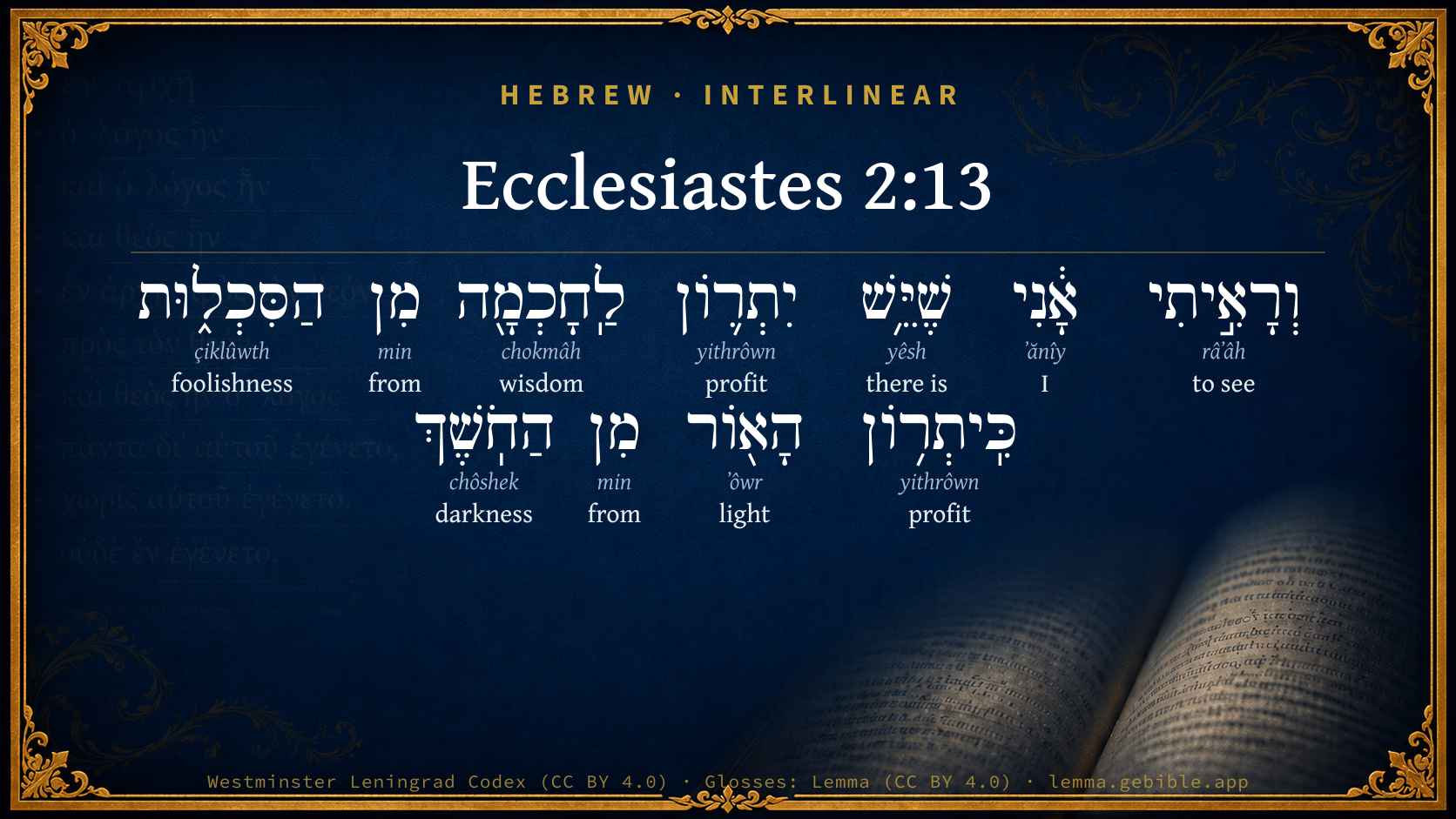
Hebrew (Westminster Leningrad Codex) Ecclesiastes 2:13 appears in the Hebrew Old Testament. The text above is from the Westminster Leningrad Codex. Each word links to its Strong’s number, a concise gloss, and parsing drawn from the Open Scriptures Hebrew Bible morphology. Click any word for its full Brown-Driver-Briggs (BDB) entry.
Download image
Cite this verse

Ecclesiastes 2:13 (World English Bible). Public Domain. Lemma interlinear Bible study tool, https://lemma.gebible.app/v/ecclesiastes/2/13.

Show BibTeX & RIS
BibTeX
RIS
English Translation
Then I saw that wisdom excels folly, as far as light excels darkness.
World English Bible · Public Domain
Download a study sheet

One document with this verse’s original text, its word-by-word gloss line, the meaning frame, cross-references with their text, attributed commentary, and full source and license credits — printable, and it pastes into notes with its structure intact.

This verse Autodidact and up

Study sheet (.html) Plain text (.txt)

A passage Seminary Student

Up to 50 verses in one chapter. A passage sheet keeps up to 6 commentary sources and 12 cross-references per verse, in the order this page ranks them, and says so on the sheet whenever that leaves anything out. Ask for a single verse and you get the Autodidact verse sheet above.

Everything on this page stays free to read, with no account — the sheet is a download of what is already on screen, not access to it.

Want to remove ads? Support Godless Engineer
Compare translations 3

The same verse in 3 English versions, stacked beneath the original-language interlinear above. Click any original word for its lexicon entry.

Each is an independent rendering of the whole verse — the interlinear is not word-aligned to these translations.

Highlighted words mark where these versions differ — a whole-verse word diff, not a word-by-word alignment.

  • World English Bible Public Domain
    Then I saw that wisdom excels folly, as far as light excels darkness.
  • King James Version Public Domain
    Then I saw that wisdom excelleth folly, as far as light excelleth darkness.
  • unfoldingWord Literal Text CC BY-SA 4.0
    And I saw, I, that there is a profit for wisdom more than folly, as a profit of the light more than the darkness.

unfoldingWord Literal Text — © unfoldingWord, licensed CC BY-SA 4.0. Word-aligned USFM3 via Door43 (git.door43.org/unfoldingWord/en_ult).

Versions to compare (up to 4)

3 of 4 selected

Show all 18 translations

Every available English version of this verse, each an independent rendering of the whole verse.

  • World English Bible Public Domain
    Then I saw that wisdom excels folly, as far as light excels darkness.
  • Berean Standard Bible Public Domain
    And I saw that wisdom exceeds folly, just as light exceeds darkness:
  • Majority Standard Bible Public Domain
    And I saw that wisdom exceeds folly, just as light exceeds darkness:
  • King James Version Public Domain
    Then I saw that wisdom excelleth folly, as far as light excelleth darkness.
  • American Standard Version (1901) Public Domain
    Then I saw that wisdom excelleth folly, as far as light excelleth darkness.
  • Revised Version (1885) Public Domain
    Then I saw that wisdom excelleth folly, as far as light excelleth darkness.
  • Geneva Bible (1599) Public Domain
    Then I saw that there is profite in wisdome, more then in follie: as the light is more excellent then darkenes.
  • Douay-Rheims (1899) Public Domain
    And I saw that wisdom excelled folly, as much as light differeth from darkness.
  • Young's Literal Translation Public Domain
    And I saw that there is an advantage to wisdom above folly, like the advantage of the light above the darkness.
  • Literal Standard Version CC BY-SA 4.0
    And I saw that there is an advantage to wisdom above folly, like the advantage of the light above the darkness.
  • Unlocked Literal Bible CC BY-SA 4.0
    Then I began to understand that wisdom has advantages over folly, just as light is better than darkness.
  • unfoldingWord Literal Text CC BY-SA 4.0
    And I saw, I, that there is a profit for wisdom more than folly, as a profit of the light more than the darkness.
  • Darby Bible Public Domain
    And I saw that wisdom excelleth folly, as light excelleth darkness.
  • World Messianic Bible Public Domain
    Then I saw that wisdom excels folly, as far as light excels darkness.
  • Webster's Bible Public Domain
    Then I saw that wisdom excelleth folly, as far as light excelleth darkness.
  • Free Bible Version CC BY-SA 4.0
    I recognized that wisdom is better than foolishness just as light is better than darkness.
  • Bible in Basic English Public Domain
    Then I saw that wisdom is better than foolish ways--as the light is better than the dark.
  • JPS Tanakh (1917) Public Domain
    Then I saw that wisdom excelleth folly, as far as light excelleth darkness.

Literal Standard Version (2020), Covenant Press — licensed CC BY-SA 4.0. Text via the HelloAO Bible API (eBible.org). Unlocked Literal Bible (unfoldingWord) — licensed CC BY-SA 4.0. Text via the HelloAO Bible API (eBible.org). unfoldingWord Literal Text — © unfoldingWord, licensed CC BY-SA 4.0. Word-aligned USFM3 via Door43 (git.door43.org/unfoldingWord/en_ult). Free Bible Version, Dr. Jonathan Gallagher — licensed CC BY-SA 4.0. Text via the HelloAO Bible API (eBible.org).

Word by word

More ways to search: Search by grammar → Find every occurrence → Compare this word →

Practice this passage: Drill this verse → Learn its vocabulary →

הַסִּכְל֑וּת
çiklûwth
H5531
“the · foolishness”
Particle, Definite Article + Noun, Common, Feminine, Singular, Absolute
Part of Speech
Particle + Noun
Type
Common
Gender
Feminine
Number
Singular
State
Absolute
Full BDB Definition

Origin: from H5528

TWOT: 1493c , 1493d

folly, foolishness
  1. וְרָאִ֣יתִי râʼâh H7200 “and · to see” Conjunction + Verb, Qal, Perfect, 1st Person, Common, Singular
  2. אָ֔נִי ʼănîy H589 “I” Pronoun, Personal, 1st Person, Common, Singular
  3. שֶׁיֵּ֥שׁ yêsh H3426 “who/which · there is” Particle, Relative + Particle, Demonstrative
  4. יִתְר֛וֹן yithrôwn H3504 “profit” Noun, Common, Masculine, Singular, Absolute
  5. לַֽחָכְמָ֖ה chokmâh H2451 “to/for the · wisdom” Preposition, Determined + Noun, Common, Feminine, Singular, Absolute
  6. מִן min H4480 “from” Preposition
  7. כִּֽיתְר֥וֹן yithrôwn H3504 “like/as · profit of” Preposition + Noun, Common, Masculine, Singular, Construct
  8. הָא֖וֹר ʼôwr H216 “the · light” Particle, Definite Article + Noun, Common, Both, Singular, Absolute
  9. מִן min H4480 “from” Preposition
  10. הַחֹֽשֶׁךְ chôshek H2822 “the · darkness” Particle, Definite Article + Noun, Common, Masculine, Singular, Absolute

About this verse

These counts appear in no published source. They are computed here, from the morphology-tagged text and Lemma’s own curated glosses. What Lemma adds →

11
words
9
distinct lemmas
Wisdom
section

Notable vocabulary

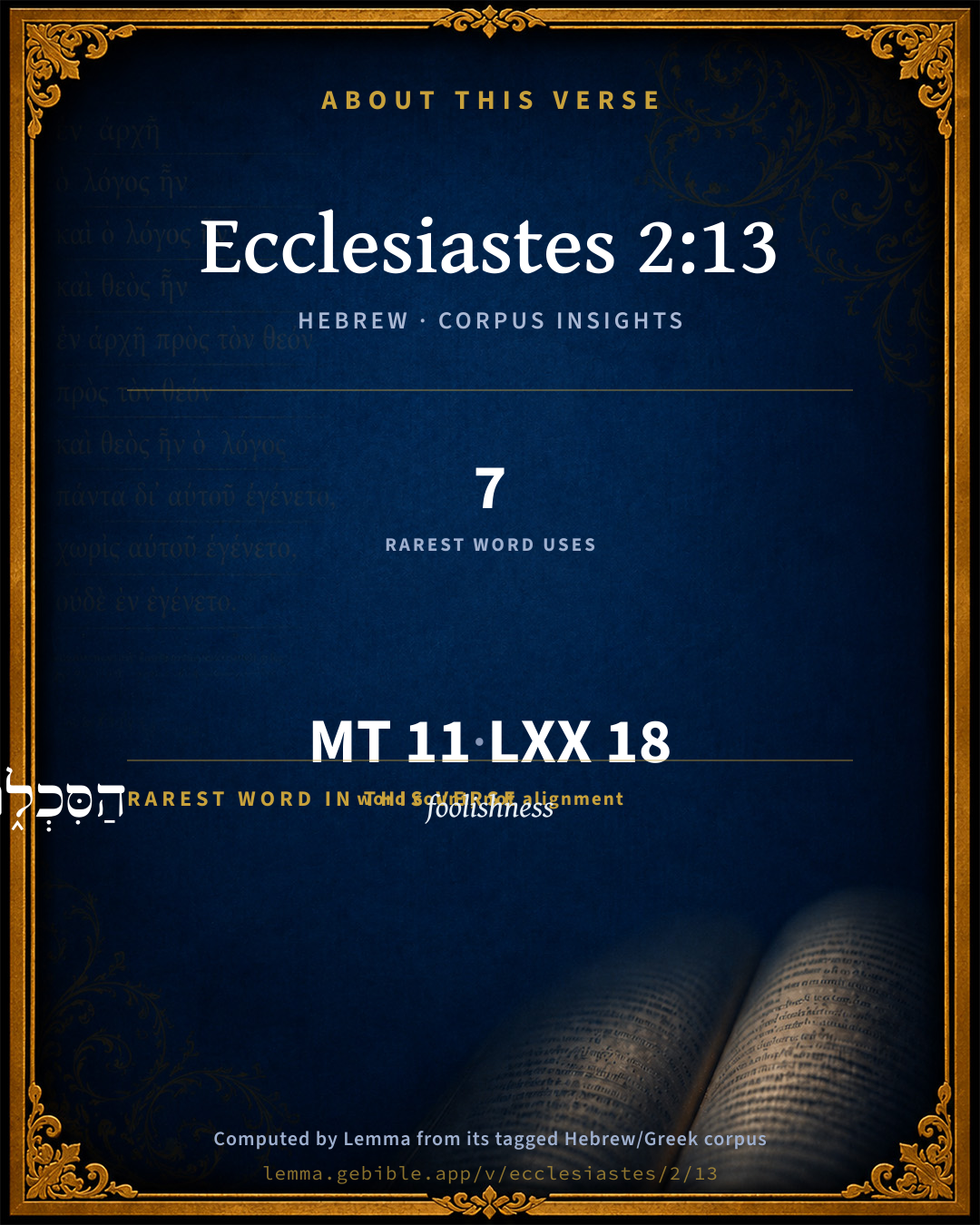
The rarest word here is הַסִּכְל֑וּת foolishness H5531 — appearing just 7 times in the whole Hebrew Bible.

Shared distinctive vocabulary

הַסִּכְל֑וּת foolishness H5531 occurs in 7 verses of the Hebrew Bible. Also found in:

Grammatical profile

  • 1 verb
  • 6 nouns
  • 1 pronoun
  • 2 prepositions
  • 1 particle

Verb forms

  • וְרָאִ֣יתִי Qal · Perfect

Repetition

Words recur within this verse — often emphatic in Hebrew:

  • יִתְר֛וֹן profit H3504 ×2
  • מִן from H4480 ×2

Hebrew & Septuagint length

In English translation the verse runs 13 words from the Hebrew and 13 from the Septuagint (LXX English) — the same length.

A rough comparison of the two English renderings, which tokenize alike — not a word-level alignment.

Word counts can differ between the Hebrew and the Greek without any difference in meaning — e.g. the Hebrew direct-object marker אֵת has no separate Greek word, and Greek often adds the article ὁ.

In the original languages it is 11 Hebrew tokens and 18 Greek tokens — but the two are counted differently (Hebrew bundles its prefixes and suffixes into one token; the Greek is in lemma form), so that isn’t a like-for-like length.

Cross-references

14

Topical passages linked to Ecclesiastes 2:13 in the Treasury of Scripture Knowledge — connected by theme and wording, ordered by reader-vote popularity; previews shown in the World English Bible.

  • Ephesians 5:8 For you were once darkness, but are now light in the Lord. Walk as children of light,
  • Ecclesiastes 7:11–12 Wisdom is as good as an inheritance. Yes, it is more excellent for those who see the sun.
  • Ecclesiastes 11:7 Truly the light is sweet, And a pleasant thing it is for the eyes to see the sun.
  • Matthew 6:23 But if your eye is evil, your whole body will be full of darkness. If therefore the light that is in you is darkness, how great is the darkness!
  • Psalms 119:105 Your word is a lamp to my feet, And a light for my path.
  • Malachi 3:18–4:2 Then you shall return and discern between the righteous and the wicked, between him who serves God and him who doesn't serve him.
  • Luke 11:34–35 The lamp of the body is the eye. Therefore when your eye is good, your whole body is also full of light; but when it is evil, your body also is full of darkness.
  • Psalms 119:130 The entrance of your words gives light. It gives understanding to the simple.
  • Proverbs 4:5–7 Get wisdom. Get understanding. Don't forget, neither swerve from the words of my mouth.
  • Proverbs 4:18–19 But the path of the righteous is like the dawning light, That shines more and more until the perfect day.
  • Proverbs 16:16 How much better it is to get wisdom than gold! Yes, to get understanding is to be chosen rather than silver.
  • Ecclesiastes 7:19 Wisdom is a strength to the wise man more than ten rulers who are in a city.
  • Ecclesiastes 9:16 Then said I, Wisdom is better than strength. Nevertheless the poor man's wisdom is despised, and his words are not heard.
  • Ecclesiastes 9:18 Wisdom is better than weapons of war; but one sinner destroys much good.

Cross-references courtesy of OpenBible.info (CC BY 4.0).

Hebrew and Greek witnesses Masoretic Hebrew ↔ Greek Septuagint

The same verse in the two great witnesses to the Old Testament, shown verse-for-verse.

These are two independent witnesses, not word-aligned to each other, and the Septuagint is shown in lemma (dictionary) form.

Hebrew Ecclesiastes 2:13 Masoretic · Westminster Leningrad Codex

וְרָאִ֣יתִי אָ֔נִי שֶׁיֵּ֥שׁ יִתְר֛וֹן לַֽחָכְמָ֖ה מִן הַסִּכְל֑וּת כִּֽיתְר֥וֹן הָא֖וֹר מִן הַחֹֽשֶׁךְ

Then I saw that wisdom excels folly, as far as light excels darkness.

World English Bible · Public Domain

Greek LXX Ecclesiastes 2:13 Septuagint · lemma form

καί ὁράω ἐγώ ὅτι εἰμί περισσεία ὁ σοφία ὑπέρ ὁ ἀφροσύνη ὡς περισσεία ὁ φῶς ὑπέρ ὁ σκότος

And I saw that wisdom excels folly, as much as light excels darkness.

LXX2012 (modern English Septuagint) · Public Domain

On this verse, The Pulpit Commentary discusses the Septuagint’s reading. Read the note in Commentary ↓

Hebrew: Westminster Leningrad Codex (CC BY 4.0). Greek: Septuagint (public domain); English from LXX2012 (modern English Septuagint) (Public Domain). How the Septuagint differs from the Hebrew →

Commentary

Notes on Ecclesiastes 2:13 from classic Christian and Jewish commentators (each source and its license shown beneath its notes). The classic Christian expositions comment on the surrounding passage and are grouped to its opening verse, so a note may address several verses; the Jewish commentaries on the Tanakh (Rashi and others) are per-verse, so they appear only where the commentator wrote on this verse.

Lemma curates 59 commentaries, every one of them public domain or Creative Commons licensed, each selected and text-cleaned for this edition rather than reprinted as found. About our sources →

Trapp's Complete Commentary

John Trapp

Ecc 2:13 Then I saw that wisdom excelleth folly, as far as light excelleth darkness.

Ver. 13. Then I saw that wisdom excelleth folly,] i.e., Philosophy and human wisdom, though it cannot perfect the mind, nor make a man happy, yet it is as far beyond sensuality and brutishness as light is beyond darkness. Those that seek for the philosopher’s stone, though they miss their end, yet they find many excellent things by the way. So philosophers, politicians, moralists, though they missed the "pearl of price," yet they sought out other "goodly pearls" (with that wise merchant, Mat 13:45), for the which they have their just praise and profit:

John Trapp, A Commentary or Exposition upon All the Books of the Old and New Testament (1647–1656) — public domain. Text from a community e-Sword module.

Joseph Benson's Commentary

Ecc 2:13-14. I saw that wisdom — I allowed thus much. Although wisdom is not sufficient to make men happy, yet it is of far greater use than vain pleasures, or any other follies. The wise man’s eyes are in his head — In their proper place. He hath the use of his eyes and reason, and foresees, and so avoids, many dangers and mischiefs. But the fool walketh in darkness — Manages his affairs ignorantly, rashly, and foolishly, whereby he shows that his eyes are not in his head, or are not used aright. And, or yet, I myself perceived also, &c. — That, notwithstanding this excellence of wisdom above folly, at last they both come to one end. Both are subject to the same calamities, and to death itself, which takes away all difference between them.

Joseph Benson's Commentary on the Old and New Testaments (1811–1818) — public domain. Text from a community e-Sword module.

Tyndale Open Study Notes

Tyndale Open Resources

2:13-14 Wisdom is better than foolishness: Wisdom has value in navigating life successfully. It cannot, however, save one from the fate of death or provide meaning (2:15-16).

Tyndale Open Study Notes — © Tyndale Open Resources, licensed CC BY-SA 4.0. Text via the HelloAO Bible API.

Jamieson, Fausset & Brown

Robert Jamieson, A. R. Fausset & David Brown

(Pro 17:24). The worldly "wise" man has good sense in managing his affairs, skill and taste in building and planting, and keeps within safe and respectable bounds in pleasure, while the "fool" is wanting in these respects ("darkness," equivalent to fatal error, blind infatuation), yet one event, death, happens to both (Job 21:26).

Jamieson, Fausset & Brown — Commentary Critical and Explanatory on the Whole Bible (1871) — public domain (CC PDM 1.0). Text via the HelloAO Bible API.

Adam Clarke's Commentary

Verse 13. Then I saw that wisdom excelleth folly] Though in none of these pursuits I found the supreme good, the happiness my soul longed after; yet I could easily perceive that wisdom excelled the others, as far as light excels darkness. And he immediately subjoins the reasons.

Adam Clarke's Commentary on the Bible (1810–1826) — public domain. Text from a community e-Sword/MySword module.

Ellicott's Commentary for English Readers

(13) Wisdom surely has an advantage over folly, yet how full of “vanity” is that advantage. Let the wise man have done his best, soon death comes; the wise man is forgotten, and all he has gained by his labour passes, without labour, into the hands of one who may be no inheritor of his wisdom.

Excelleth.—There is profit in wisdom more than in folly. The same word “profit” is used as in Ecc_5:11. (See Note on Ecc_1:3.)

A Bible Commentary for English Readers, edited by Charles John Ellicott (1878–1897) — public domain. Text from a community e-Sword module.

The Cambridge Bible for Schools and Colleges

gen. ed. J. J. S. Perowne

13. I saw that wisdom excelleth folly] Better, as keeping up, in the English as in the Hebrew, the characteristic word of the book, There is profit in wisdom more than in folly, and so in the second clause. Something then had been gained by the experience. In language like that of the Stoics he sings the praises of wisdom. Even the wisdom that brings sorrow (ch. Ecc_1:13) is better than the mirth of fools. A man is conscious of being more truly man when he looks before and after, and knows how to observe. Light is, after all, better than darkness, even if it only shews us that we are treading the path that leads to nothingness. The human heart obeys its instincts when it cries out with Aias,

ἐν δὲ φάει καὶ ὄλεσσον.

“And if our fate be death, give light, and let us die.”

Hom. Il. xvii. 647.

The Cambridge Bible for Schools and Colleges (gen. ed. J. J. S. Perowne; Cambridge University Press, 1878–1918) — public domain. Text from a community e-Sword module.

John Gill's Exposition

Then I sat that wisdom excelleth folly,.... However, this upon a review of things he could not but own, that natural wisdom and knowledge, though there was no true happiness and satisfaction in them, yet they greatly exceeded folly and madness;

as far as light excelleth darkness; as the light of the day the darkness of the night; the one is pleasant and delightful, the other very uncomfortable; the one useful to direct in walking, the other very unsafe to walk in: light sometimes signifies joy and prosperity, and darkness adversity; the one is used to express the light of grace, and the other the darkness of sin and ignorance; now as the natural light exceeds darkness, and prosperity exceeds adversity and calamities, and a state of grace exceeds a state of sin and wickedness, so wisdom exceeds folly.

John Gill's Exposition of the Whole Bible (1746–1763) — public domain (CC PDM 1.0). Text via the HelloAO Bible API.

Matthew Poole's English Annotations

Then I saw; or, yet I saw; for this is added to prevent an Objection or mistake.

Wisdom excelleth folly; although wisdom is not sufficient to make men truly and perfectly happy, yet it is of a far greater use and excellency than vain pleasures, or any other follies.

As far as light excelleth darkness, i.e. vastly and unspeakably. Light is very pleasant and comfortable, and withal of great necessity and singular use to discover the differences of persons and things, to prevent mistakes and dangers, and to direct all a man’s paths in the right way; whereas darkness is in itself doleful, and leads men into innumerable confusions, and errors, and miseries.

Matthew Poole's English Annotations on the Holy Bible (1683–1685) — public domain. Text from a community e-Sword/MySword module.

Whedon's Commentary on the Bible

Daniel D. Whedon

13. Wisdom excelleth folly — The verdict follows the comparison. While culture and study cannot bring abiding good, or freedom from sorrow, yet they yield a noble and delightful joy as compared with the indulgences of passions which we share with the brutes.

Light excelleth darkness — Wisdom is here compared to the genial light of the morning, and folly to the heavy night that hangs dark and blinding upon one’s way and upon one’s eyes. Of course, the “light excelleth.”

Daniel D. Whedon (gen. ed.), Commentary on the Old and New Testaments (1874–1909) — public domain. Text from a community e-Sword module.

The Pulpit Commentary

Then (and) I saw that wisdom excelleth folly, as far as light excelleth darkness; or, there is profit, advantage (perisseia Septuagint, Ecc_1:3) to wisdom over folly, as the advantage of light over darkness. This result, at any rate, was obtained he learned that wisdom had a certain value, that it was as much superior to folly, in its effects on men, as light is more beneficial than darkness. It is a natural metaphor to represent spiritual and intellectual development as light, and mental and moral depravity as darkness (comp. Eph_5:8; 1Th_5:5)

The Pulpit Commentary (1880–1919), ed. H.D.M. Spence-Jones & Joseph S. Exell — public domain. Text from a community e-Sword module.

John Wesley's Explanatory Notes

I saw - I allowed thus much. Although wisdom is not sufficient to make men happy, yet it is of a far greater use than vain pleasures, or any other follies.

John Wesley, Explanatory Notes Upon the Whole Bible (1754–1765) — public domain. Text via the GEBible commentary corpus.

Keil & Delitzsch

C. F. Keil & F. Delitzsch

"And I saw that wisdom has the advantage over folly, as light has the advantage over darkness. The wise man has eyes in his head; but the fool walketh in darkness." In the sacred Scriptures, "light" is generally the symbol of grace, Psa 43:3, but also the contrast of an intellectually and morally darkened state, Isa 51:4. To know a thing is equivalent to having light on it, and seeing it in its true light (Psa 36:10); wisdom is thus compared to light; folly is once, Job 38:19, directly called "darkness." Thus wisdom stands so much higher than folly, as light stands above darkness.יתרון, which hitherto denoted actual result, enduring gain, signifies here preference; along with כּיתרון

(Note: Thus written, according to J and other authorities.)

there is also found the form כּיתרון

(Note: Thus Ven. 1515, 1521; vid., Comm. under Gen 27:28-29; Psa 45:10.)

(vid., Pro 30:17). The fool walks in darkness: he is blind although he has eyes (Isa 43:8), and thus has as good as none, - he wants the spiritual eye of understanding (Job 10:3); the wise man, on the other hand, his eyes are in his head, or, as we also say: he has eyes in his head, - eyes truly seeing, looking at and examining persons and things. That is the one side of the relation of wisdom to folly as put to the test.

The other side of the relation is the sameness of the result in which the elevation of wisdom above folly terminates.

"And I myself perceived that one experience happeneth to them all. And I said in my heart, As it will happen to the fool, it will happen also to me; and why have I then been specially wise? Thus I spake then in my heart, that this also is vain." Zckler gives to גּם an adversative sense; but this gam (= ὃμως, similiter) stands always at the beginning of the clause, Ewald, 354a. Gam-ani corresponds to the Lat. ego idem, which gives two predicates to one subject; while et ipse predicates the same of the one of two subjects as it does of the other (Zumpt, 697). The second gam-ani serves for the giving of prominence to the object, and here precedes, after the manner of a substantival clause (cf. Isa 45:12; Eze 33:17; Ch2 28:10), as at Gen 24:27; cf. Gesen. 121. 3. Miqrěh (from קרה, to happen, to befall) is quiquid alicui accidit (in the later philosoph. terminol. accidens; Venet. συμβεβεεκός); but here, as the connection shows, that which finally puts an end to life, the final event of death. By the word יד the author expresses what he had observed on reflection; by בּל...אם, what he said inwardly to himself regarding it; and by דּבּ דל, what sentence he passed thereon with himself. Lammah asks for the design, as maddu'a for the reason. אז is either understood temporally: then when it is finally not better with me than with the fool (Hitz. from the standpoint of the dying hour), or logically: if yet one and the same event happeneth to the wise man and to the fool (Eslt.); in the consciousness of the author both are taken together.The זה of the conclusion refers, not, as at Ecc 1:17, to the endeavouring after and the possession of wisdom, but to this final result making no difference between wise men and fools. This fate, happening to all alike, is הבל, a vanity rendering all vain, a nullity levelling down all to nothing, something full of contradictions, irrational. Paul also (Rom 8:20) speaks of this destruction, which at last comes upon all, as a ματαιότης.

The author now assigns the reason for this discouraging result.

Keil & Delitzsch — Biblical Commentary on the Old Testament (1861–1891) — public domain (CC PDM 1.0). Text via the HelloAO Bible API. (Old Testament only.)

unfoldingWord translationNotes

Door43 World Missions Community

wisdom has advantages over folly, just as light is better than darkness

This speaks of how wisdom is better than folly by comparing it to how light is better than darkness. (See: Simile)

The wise man uses his eyes in his head to see where he is going

This speaks of a wise man making wise decisions as walking and paying attention to where he is going. AT: "The wise man is like a person who uses his eyes to see where he is going" (See: Metaphor)

uses his eyes in his head to see

This is an idiom. AT: "pays attention and looks to see" (See: Idiom)

the fool walks in darkness

This compares a fool making bad decisions to someone walking in darkness. AT: "the fool is like a person who walks in the dark" (See: Metaphor)

the same event

death

translationWords

understand

wise

fool

light

darkness

destine

unfoldingWord translationNotes — © Distant Shores Media and the Door43 World Missions Community, licensed CC BY-SA 4.0. Source: git.door43.org/Door43/en_tn.

Rashi

Rabbi Shlomo Yitzchaki (Rashi)

over folly That is wickedness.

Rashi on the Tanakh — English translations: “The Judaica Press complete Tanach with Rashi, translated by A. J. Rosenberg” (CC BY 4.0); “Pentateuch with Rashi's commentary by M. Rosenbaum and A.M. Silbermann, 1929-1934” (public domain); “The Metsudah Tanach series, Lakewood, N.J” (CC BY 4.0); and “The Book of Joshua, Metsudah Publications, 1997” (CC BY 4.0). Text via Sefaria.

Lesson kit

Teaching starters — assembled from the data on this page, not authored interpretation. Every prompt links to the verse data it draws on. Edit before teaching.

Ecclesiastes, in the Wisdom, opens this verse with 11 words (9 distinct Hebrew lemmas). Its most distinctive word is çiklûwth (“foolishness”). A historical commentator’s framing appears above. Read the whole chapter for the surrounding context.

Discussion questions

  1. How does “foolishness” (çiklûwth) shape what this verse is saying?
  2. Ecclesiastes 1:17 shares the word «foolishness» with this verse. How do the two illuminate each other?
  3. “profit” occurs 2× in this one verse. What is the effect of the repetition?
  4. These translations render this verse differently; the difference is in the English rendering, not the original. What questions does that raise?
  5. The verb «וְרָאִ֣יתִי» is Qal Perfect. How does its form color the action?
  6. Reading how Trapp's Complete Commentary and Joseph Benson's Commentary read this verse, where do the two commentators agree and where do they part?

Things to notice

Reading settings

Reading text

Shown beneath each verse's original-language words.

Old Testament
Old Testament edition

Read the OT as the Masoretic Hebrew (MT) or the Greek Septuagint (LXX).

English shown for the Greek Septuagint (in the Hebrew ↔ Greek comparison).

Comparing translations? Open the Compare panel on any verse page to stack up to four side by side.