
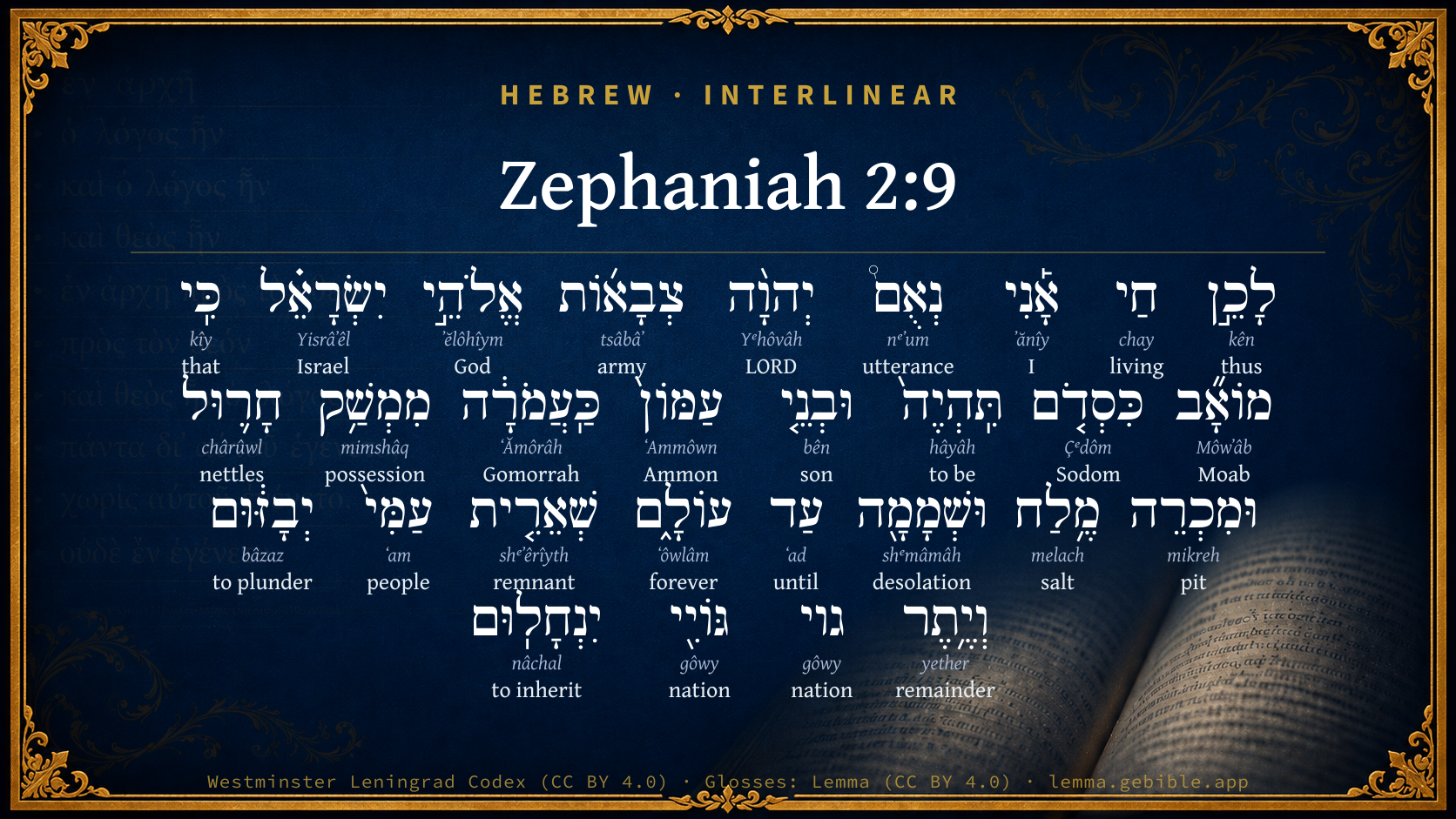
Zephaniah 2:9

Hebrew (Westminster Leningrad Codex) Zephaniah 2:9 appears in the Hebrew Old Testament. The text above is from the Westminster Leningrad Codex. Each word links to its Strong’s number, a concise gloss, and parsing drawn from the Open Scriptures Hebrew Bible morphology. Click any word for its full Brown-Driver-Briggs (BDB) entry.
Download image
Cite this verse

Zephaniah 2:9 (World English Bible). Public Domain. Lemma interlinear Bible study tool, https://lemma.gebible.app/v/zephaniah/2/9.

Show BibTeX & RIS
BibTeX
RIS
English Translation
Therefore as I live, says Yahweh of Hosts, the God of Israel, surely Moab will be as Sodom, and the children of Ammon as Gomorrah, a possession of nettles, and salt pits, and a perpetual desolation. The remnant of my people will plunder them, and the survivors of my nation will inherit them.
World English Bible · Public Domain
Highlights
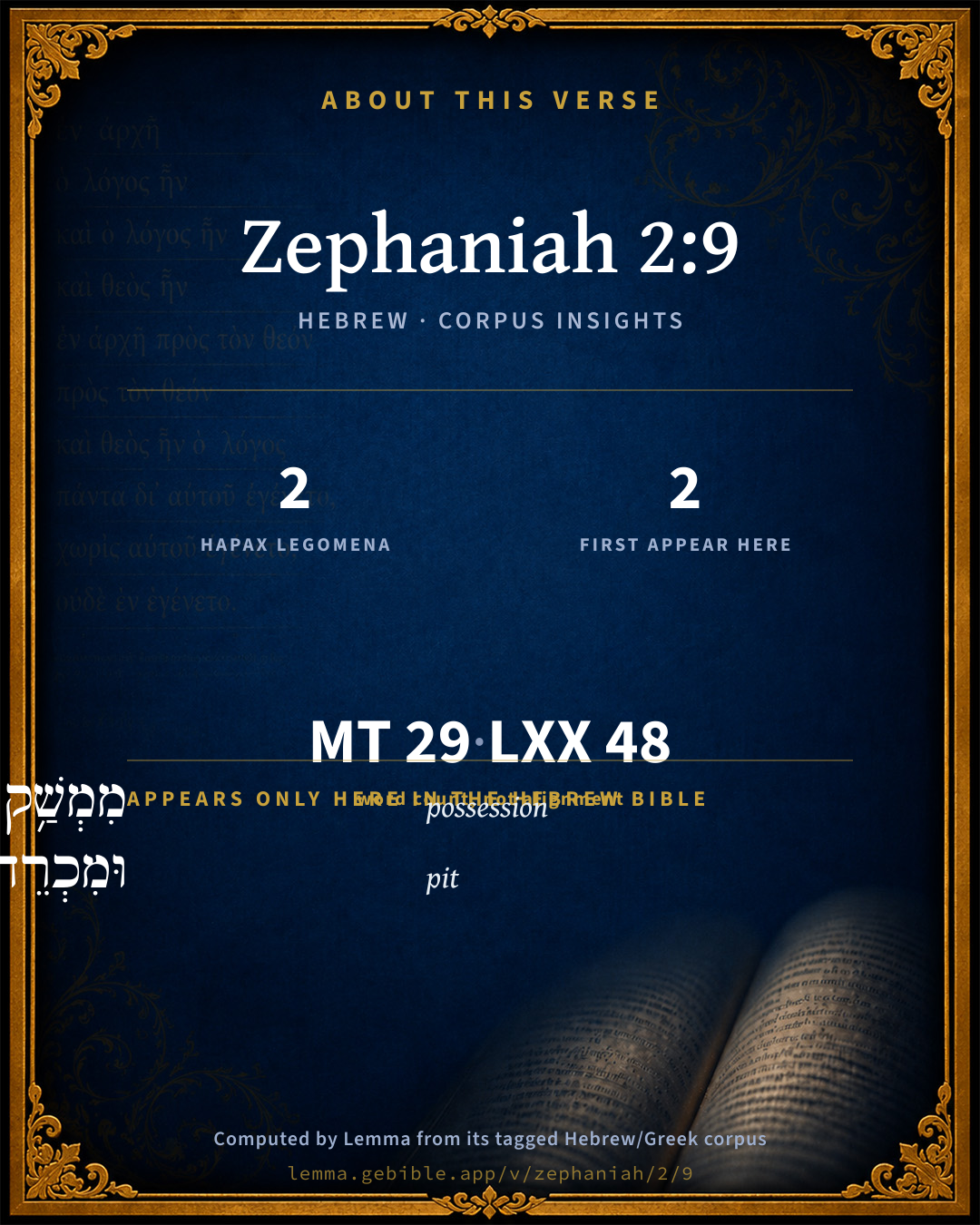
  • 2 hapax legomena — only here in the Hebrew Bible
  • 2 first appearances in the Hebrew Bible
Full analysis ↓
Download a study sheet

One document with this verse’s original text, its word-by-word gloss line, the meaning frame, cross-references with their text, attributed commentary, and full source and license credits — printable, and it pastes into notes with its structure intact.

This verse Autodidact and up

Study sheet (.html) Plain text (.txt)

A passage Seminary Student

Up to 50 verses in one chapter. A passage sheet keeps up to 6 commentary sources and 12 cross-references per verse, in the order this page ranks them, and says so on the sheet whenever that leaves anything out. Ask for a single verse and you get the Autodidact verse sheet above.

Everything on this page stays free to read, with no account — the sheet is a download of what is already on screen, not access to it.

Want to remove ads? Support Godless Engineer
Compare translations 3

The same verse in 3 English versions, stacked beneath the original-language interlinear above. Click any original word for its lexicon entry.

Each is an independent rendering of the whole verse — the interlinear is not word-aligned to these translations.

Highlighted words mark where these versions differ — a whole-verse word diff, not a word-by-word alignment.

  • World English Bible Public Domain
    Therefore as I live, says Yahweh of Hosts, the God of Israel, surely Moab will be as Sodom, and the children of Ammon as Gomorrah, a possession of nettles, and salt pits, and a perpetual desolation. The remnant of my people will plunder them, and the survivors of my nation will inherit them.
  • King James Version Public Domain
    Therefore as I live, saith the LORD of hosts, the God of Israel, Surely Moab shall be as Sodom, and the children of Ammon as Gomorrah, even the breeding of nettles, and saltpits, and a perpetual desolation: the residue of my people shall spoil them, and the remnant of my people shall possess them.
  • unfoldingWord Literal Text CC BY-SA 4.0
    Therefore, I alive”— the declaration of Yahweh of Armies, the God of Israel— “that Moab will become like Sodom, and the sons of Ammon like Gomorrah, a possession of the nettle and the pit of salt and a ruin forever. The remnant of my people will plunder them, and the remainder of my nation will occupy them.”

unfoldingWord Literal Text — © unfoldingWord, licensed CC BY-SA 4.0. Word-aligned USFM3 via Door43 (git.door43.org/unfoldingWord/en_ult).

Versions to compare (up to 4)

3 of 4 selected

Show all 18 translations

Every available English version of this verse, each an independent rendering of the whole verse.

  • World English Bible Public Domain
    Therefore as I live, says Yahweh of Hosts, the God of Israel, surely Moab will be as Sodom, and the children of Ammon as Gomorrah, a possession of nettles, and salt pits, and a perpetual desolation. The remnant of my people will plunder them, and the survivors of my nation will inherit them.
  • Berean Standard Bible Public Domain
    Therefore, as surely as I live,” declares the LORD of Hosts, the God of Israel, “surely Moab will be like Sodom and the Ammonites like Gomorrah—a place of weeds and salt pits, a perpetual wasteland. The remnant of My people will plunder them; the remainder of My nation will dispossess them.”
  • Majority Standard Bible Public Domain
    Therefore, as surely as I live,” declares the LORD of Hosts, the God of Israel, “surely Moab will be like Sodom and the Ammonites like Gomorrah—a place of weeds and salt pits, a perpetual wasteland. The remnant of My people will plunder them; the remainder of My nation will dispossess them.”
  • King James Version Public Domain
    Therefore as I live, saith the LORD of hosts, the God of Israel, Surely Moab shall be as Sodom, and the children of Ammon as Gomorrah, even the breeding of nettles, and saltpits, and a perpetual desolation: the residue of my people shall spoil them, and the remnant of my people shall possess them.
  • American Standard Version (1901) Public Domain
    Therefore as I live, saith Jehovah of hosts, the God of Israel, Surely Moab shall be as Sodom, and the children of Ammon as Gomorrah, a possession of nettles, and saltpits, and a perpetual desolation: the residue of my people shall make a prey of them, and the remnant of my nation shall inherit them.
  • Revised Version (1885) Public Domain
    Therefore as I live, saith the LORD of hosts, the God of Israel, Surely Moab shall be as Sodom, and the children of Ammon as Gomorrah, a possession of nettles, and saltpits, and a perpetual desolation: the residue of my people shall spoil them, and the remnant of my nation shall inherit them.
  • Geneva Bible (1599) Public Domain
    Therefore, as I liue, saith the Lord of hostes, the God of Israel, Surely Moab shall bee as Sodom, and the children of Ammon as Gomorah, euen the breeding of nettels and salt pittes, and a perpetuall desolation: the residue of my folke shall spoyle them, and the remnant of my people shall possesse them.
  • Douay-Rheims (1899) Public Domain
    Therefore as I live, saith the Lord of hosts the God of Israel, Moab shall be as Sodom, and the children of Ammon as Gomorrha, the dryness of thorns, and heaps of salt, and a desert even for ever: the remnant of my people shall make a spoil of them, and the residue of my nation shall possess them.
  • Young's Literal Translation Public Domain
    Therefore, I live, An affirmation of Jehovah of Hosts, God of Israel, Surely, Moab is as Sodom, And the sons of Ammon as Gomorrah, An overrunning of nettles and salt-pits, And a desolation -- unto the age. A residue of My people do seize them, And a remnant of My nation inherit them.
  • Literal Standard Version CC BY-SA 4.0
    Therefore, [as] I live,” || A declaration of YHWH of Hosts, God of Israel, || “Surely Moab is as Sodom, || And the sons of Ammon as Gomorrah, || An overrunning of nettles and salt-pits, || And a desolation for all time. A remnant of My people seizes them, || And a remnant of My nation inherits them.”
  • Unlocked Literal Bible CC BY-SA 4.0
    Therefore, as I live—this is the declaration of Yahweh of hosts, God of Israel— Moab will become like Sodom, and the people of Ammon like Gomorrah; a place of nettles and a salt pit, deserted forever. But the remnant of my people will plunder them, and the remainder of my nation will take possession of them.”
  • unfoldingWord Literal Text CC BY-SA 4.0
    Therefore, I alive”— the declaration of Yahweh of Armies, the God of Israel— “that Moab will become like Sodom, and the sons of Ammon like Gomorrah, a possession of the nettle and the pit of salt and a ruin forever. The remnant of my people will plunder them, and the remainder of my nation will occupy them.”
  • Darby Bible Public Domain
    Therefore, [as] I live, saith Jehovah of hosts, the God of Israel, Moab shall certainly be as Sodom, and the children of Ammon as Gomorrah, a possession of nettles, and salt-pits, and a perpetual desolation; the remnant of my people shall spoil them, and the residue of my nation shall possess them.
  • World Messianic Bible Public Domain
    Therefore, as I live, says the LORD of Hosts, the God of Israel, surely Moab will be as Sodom, and the children of Ammon as Gomorrah, a possession of nettles and salt pits, and a perpetual desolation. The remnant of my people will plunder them, and the survivors of my nation will inherit them.
  • Webster's Bible Public Domain
    Therefore as I live, saith the LORD of hosts, the God of Israel, Surely Moab shall be as Sodom, and the children of Ammon as Gomorrah, even the breeding of nettles, and salt-pits, and a perpetual desolation: the residue of my people shall lay them waste, and the remnant of my people shall possess them.
  • Free Bible Version CC BY-SA 4.0
    Consequently, as I live, declares the Lord Almighty, the God of Israel, the Moabites will become like Sodom, and the Ammonites like Gomorrah. Their land will become a place of weeds and salt pits and ruins forever. Those who remain of my people will plunder them and occupy their land.
  • Bible in Basic English Public Domain
    For this cause, by my life, says the Lord of armies, the God of Israel, truly Moab will become like Sodom and the children of Ammon like Gomorrah, given up to waste plants and salt pools and unpeopled for ever: the rest of my people will take their property, the overflow of my nation will take their heritage.
  • JPS Tanakh (1917) Public Domain
    Therefore as I live, saith the LORD of hosts, the God of Israel: Surely Moab shall be as Sodom, and the children of Ammon as Gomorrah, even the breeding-place of nettles, and saltpits, and a desolation, for ever; the residue of My people shall spoil them, and the remnant of My nation shall inherit them.

Literal Standard Version (2020), Covenant Press — licensed CC BY-SA 4.0. Text via the HelloAO Bible API (eBible.org). Unlocked Literal Bible (unfoldingWord) — licensed CC BY-SA 4.0. Text via the HelloAO Bible API (eBible.org). unfoldingWord Literal Text — © unfoldingWord, licensed CC BY-SA 4.0. Word-aligned USFM3 via Door43 (git.door43.org/unfoldingWord/en_ult). Free Bible Version, Dr. Jonathan Gallagher — licensed CC BY-SA 4.0. Text via the HelloAO Bible API (eBible.org).

Word by word

More ways to search: Search by grammar → Find every occurrence → Compare this word →

Practice this passage: Drill this verse → Learn its vocabulary →

מִמְשַׁ֥ק
mimshâq
H4476
“possession of”
Noun, Common, Masculine, Singular, Construct
Part of Speech
Noun
Type
Common
Gender
Masculine
Number
Singular
State
Construct
Full BDB Definition

Origin: from the same as H4943

TWOT: 1261b

possession, place possessed
  1. לָכֵ֣ן kên H3651 “to/for · thus” Preposition + Adverb
  2. חַי chay H2416 “living” Adjective, Adjective, Masculine, Singular, Absolute
  3. אָ֡נִי ʼănîy H589 “I” Pronoun, Personal, 1st Person, Common, Singular
  4. נְאֻם֩ nᵉʼum H5002 “utterance of” Noun, Common, Masculine, Singular, Construct
  5. יְהוָ֨ה Yᵉhôvâh H3068 “LORD” Noun, Proper
  6. צְבָא֜וֹת tsâbâʼ H6635 “armies” Noun, Common, Both, Plural, Absolute
  7. אֱלֹהֵ֣י ʼĕlôhîym H430 “God(s) of” Noun, Common, Masculine, Plural, Construct
  8. יִשְׂרָאֵ֗ל Yisrâʼêl H3478 “Israel” Noun, Proper
  9. כִּֽי kîy H3588 “that” Conjunction
  10. מוֹאָ֞ב Môwʼâb H4124 “Moab” Noun, Proper
  11. כִּסְדֹ֤ם Çᵉdôm H5467 “like/as · Sodom” Preposition + Noun, Proper
  12. תִּֽהְיֶה֙ hâyâh H1961 “to be” Verb, Qal, Imperfect, 3rd Person, Feminine, Singular
  13. וּבְנֵ֤י bên H1121 “and · sons of” Conjunction + Noun, Common, Masculine, Plural, Construct
  14. עַמּוֹן֙ ʻAmmôwn H5983 “Ammon” Noun, Proper
  15. כַּֽעֲמֹרָ֔ה ʻĂmôrâh H6017 “like/as · Gomorrah” Preposition + Noun, Proper
  16. חָר֛וּל chârûwl H2738 “nettles” Noun, Common, Masculine, Singular, Absolute
  17. וּמִכְרֵה mikreh H4379 “and · pit of” Conjunction + Noun, Common, Masculine, Singular, Construct
  18. מֶ֥לַח melach H4417 “salt” Noun, Common, Masculine, Singular, Absolute
  19. וּשְׁמָמָ֖ה shᵉmâmâh H8077 “and · desolation” Conjunction + Noun, Common, Feminine, Singular, Absolute
  20. עַד ʻad H5704 “until” Preposition
  21. עוֹלָ֑ם ʻôwlâm H5769 “forever” Noun, Common, Masculine, Singular, Absolute
  22. שְׁאֵרִ֤ית shᵉʼêrîyth H7611 “remnant of” Noun, Common, Feminine, Singular, Construct
  23. עַמִּי֙ ʻam H5971 “people · my” Noun, Common, Masculine, Singular, Construct + Suffix, Personal, 1st Person, Common, Singular
  24. יְבָזּ֔וּם bâzaz H962 “to plunder · them” Verb, Qal, Imperfect, 3rd Person, Masculine, Plural + Suffix, Personal, 3rd Person, Masculine, Plural
  25. וְיֶ֥תֶר yether H3499 “and · remainder of” Conjunction + Noun, Common, Masculine, Singular, Construct
  26. גוי gôwy H1471 “nation” Noun, Common, Masculine, Singular, Absolute
  27. גּוֹיִ֖י gôwy H1471 “nation · my” Noun, Common, Masculine, Singular, Construct + Suffix, Personal, 1st Person, Common, Singular
  28. יִנְחָלֽוּם nâchal H5157 “to inherit · them” Verb, Qal, Imperfect, 3rd Person, Masculine, Plural + Suffix, Personal, 3rd Person, Masculine, Plural

About this verse

These counts appear in no published source. They are computed here, from the morphology-tagged text and Lemma’s own curated glosses. What Lemma adds →

29
words
28
distinct lemmas
Prophets
section

Notable vocabulary

2 hapax legomena — words that appear only here in the entire Hebrew Bible:

  • מִמְשַׁ֥ק possession H4476
  • וּמִכְרֵה pit H4379

First appearance in Scripture

These words make their first canonical appearance in the Hebrew Bible here:

  • מִמְשַׁ֥ק possession H4476
  • וּמִכְרֵה pit H4379

Shared distinctive vocabulary

חָר֛וּל nettles H2738 occurs in 3 verses of the Hebrew Bible. Also found in:

Grammatical profile

  • 3 verbs
  • 21 nouns
  • 1 adjective
  • 1 pronoun
  • 1 preposition
  • 1 conjunction
  • 1 adverb

Verb forms

  • תִּֽהְיֶה֙ Qal · Imperfect
  • יְבָזּ֔וּם Qal · Imperfect
  • יִנְחָלֽוּם Qal · Imperfect

Repetition

A word recurs within this verse — often emphatic in Hebrew:

  • גוי nation H1471 ×2

Hebrew & Septuagint length

In English translation the verse runs 53 words from the Hebrew and 59 from the Septuagint (LXX English) — closely comparable.

A rough comparison of the two English renderings, which tokenize alike — not a word-level alignment.

Word counts can differ between the Hebrew and the Greek without any difference in meaning — e.g. the Hebrew direct-object marker אֵת has no separate Greek word, and Greek often adds the article ὁ.

In the original languages it is 29 Hebrew tokens and 48 Greek tokens — but the two are counted differently (Hebrew bundles its prefixes and suffixes into one token; the Greek is in lemma form), so that isn’t a like-for-like length.

Cross-references

21

Topical passages linked to Zephaniah 2:9 in the Treasury of Scripture Knowledge — connected by theme and wording, ordered by reader-vote popularity; previews shown in the World English Bible.

  • Isaiah 15:1–9 The burden of Moab. For in a night Ar of Moab is laid waste, [and] brought to nothing; for in a night Kir of Moab is laid waste, [and] brought to nothing.
  • Isaiah 11:14 They shall fly down on the shoulder of the Philistines on the west; together shall they despoil the children of the east: they shall put forth their hand on Edom and Moab; and the children of Ammon shall obey them.
  • Deuteronomy 29:23 [and that] the whole land of it is sulfur, and salt, [and] a burning, [that] it is not sown, nor bears, nor any grass grows therein, like the overthrow of Sodom and Gomorrah, Admah and Zeboiim, which Yahweh overthrew in his anger, and in his wrath:
  • Isaiah 25:10 For in this mountain will the hand of Yahweh rest; and Moab shall be trodden down in his place, even as straw is trodden down in the water of the dung-hill.
  • Isaiah 49:18 Lift up your eyes round about, and see: all these gather themselves together, and come to you. As I live, says Yahweh, you shall surely clothe you with them all as with an ornament, and gird yourself with them, like a bride.
  • Jeremiah 48:1–49:6 Of Moab. Thus says Yahweh of Hosts, the God of Israel: Woe to Nebo! for it is laid waste; Kiriathaim is disappointed, it is taken; Misgab is put to shame and broken down.
  • Genesis 19:24–25 Then Yahweh rained on Sodom and on Gomorrah sulfur and fire from Yahweh out of the sky.
  • Isaiah 13:19–20 Babylon, the glory of kingdoms, the beauty of the Chaldeans' pride, shall be as when God overthrew Sodom and Gomorrah.
  • Isaiah 34:9–13 The streams of [Edom] shall be turned into pitch, and the dust of it into sulfur, and the land of it shall become burning pitch.
  • Jeremiah 46:18 As I live, says the King, whose name is Yahweh of Hosts, surely like Tabor among the mountains, and like Carmel by the sea, so shall he come.
  • Jeremiah 49:18 As in the overthrow of Sodom and Gomorrah and the neighbor cities of it, says Yahweh, no man shall dwell there, neither shall any son of man sojourn therein.
  • Ezekiel 25:1–17 The word of Yahweh came to me, saying,
  • Joel 3:19–20 Egypt will be a desolation, And Edom will be a desolate wilderness, For the violence done to the children of Judah, Because they have shed innocent blood in their land.
  • Amos 1:13–2:3 Thus says Yahweh: "For three transgressions of the children of Ammon, yes, for four, I will not turn away its punishment; Because they have ripped open the pregnant women of Gilead, That they may enlarge their border.
  • Micah 5:7–8 The remnant of Jacob will be in the midst of many peoples, Like dew from Yahweh, Like showers on the grass, That don't wait for man, Nor wait for the sons of men.
  • Zephaniah 2:7 The coast will be for the remnant of the house of Judah. They will find pasture. In the houses of Ashkelon, they will lie down in the evening, for Yahweh, their God, will visit them, and restore them.
  • Zephaniah 2:14 Herds will lie down in the midst of her, all the animals of the nations. Both the pelican and the porcupine will lodge in its capitals. Their calls will echo through the windows. Desolation will be in the thresholds, for he has laid bare the cedar beams.
  • Zephaniah 3:13 The remnant of Israel will not do iniquity, nor speak lies, neither will a deceitful tongue be found in their mouth, for they will feed and lie down, and no one will make them afraid."
  • Numbers 14:21 but in very deed, as I live, and as all the earth shall be filled with the glory of Yahweh;
  • Jeremiah 50:40 As when God overthrew Sodom and Gomorrah and the neighbor cities of it, says Yahweh, so shall no man dwell there, neither shall any son of man sojourn therein.
  • Romans 14:11 For it is written, "'As I live,' says the Lord, 'to me every knee will bow. Every tongue will confess to God.'"

Cross-references courtesy of OpenBible.info (CC BY 4.0).

Hebrew and Greek witnesses Masoretic Hebrew ↔ Greek Septuagint

The same verse in the two great witnesses to the Old Testament, shown verse-for-verse.

These are two independent witnesses, not word-aligned to each other, and the Septuagint is shown in lemma (dictionary) form.

Hebrew Zephaniah 2:9 Masoretic · Westminster Leningrad Codex

לָכֵ֣ן חַי אָ֡נִי נְאֻם֩ יְהוָ֨ה צְבָא֜וֹת אֱלֹהֵ֣י יִשְׂרָאֵ֗ל כִּֽי מוֹאָ֞ב כִּסְדֹ֤ם תִּֽהְיֶה֙ וּבְנֵ֤י עַמּוֹן֙ כַּֽעֲמֹרָ֔ה מִמְשַׁ֥ק חָר֛וּל וּמִכְרֵה מֶ֥לַח וּשְׁמָמָ֖ה עַד עוֹלָ֑ם שְׁאֵרִ֤ית עַמִּי֙ יְבָזּ֔וּם וְיֶ֥תֶר גוי גּוֹיִ֖י יִנְחָלֽוּם

Therefore as I live, says Yahweh of Hosts, the God of Israel, surely Moab will be as Sodom, and the children of Ammon as Gomorrah, a possession of nettles, and salt pits, and a perpetual desolation. The remnant of my people will plunder them, and the survivors of my nation will inherit them.

World English Bible · Public Domain

Greek LXX Zephaniah 2:9 Septuagint · lemma form

διά οὗτος ζάω ἐγώ λέγω κύριος ὁ δύναμις ὁ θεός ἰσραήλ διότι μωαβ ὡς σοδομα εἰμί καί ὁ υἱός αμμων ὡς γομορρα καί δαμασκός ἐκλείπω ὡς θημονία ἅλων καί ἀπο ἀναἵζω εἰς ὁ αἰών καί ὁ κατάλοιπος λαός ἐγώ διαἁρπάζω αὐτός καί ὁ κατάλοιπος ἔθνος ἐγώ κληρονομέω αὐτός

Therefore, as I live, says the Lord of hosts, the God of Israel, Moab shall be as Sodoma, and the children of Ammon as Gomorrha; and Damascus shall be left as a heap of the threshing floor, and desolate for ever: and the remnant of my people shall plunder them, and the remnant of my nations shall inherit them.

LXX2012 (modern English Septuagint) · Public Domain

On this verse, Haydock's Catholic Bible Commentary discusses the Septuagint’s reading. Read the note in Commentary ↓

Hebrew: Westminster Leningrad Codex (CC BY 4.0). Greek: Septuagint (public domain); English from LXX2012 (modern English Septuagint) (Public Domain). How the Septuagint differs from the Hebrew →

Targum (Aramaic paraphrase)

1

The Targum is the ancient Jewish Aramaic paraphrase of the Hebrew Scriptures — an interpretive translation, not the Hebrew text itself. Onkelos (literal) and Pseudo-Jonathan (expansive) render the Torah, and Jonathan the Prophets. Coverage is partial: where no permissively-licensed English translation exists for a verse, only the Aramaic is shown. This is verse-level text, not a word-by-word alignment to the Hebrew.

  1. Targum Jonathan Prophets (Joshua–Malachi)
    בְּכֵן קַיָם אֲנָא אֲמַר יְיָ צְבָאוֹת אֱלָהָא דְיִשְׂרָאֵל אֲרֵי מוֹאָב כִּסְדוֹם תְּהֵא וּבְנֵי עַמוֹן כַּעֲמוֹרָה מַשְׁמַט מִלוּחִין וּמַחֲפוּרִין דִמְלַח וְצָדוּ עַד עַלְמָא שְׁאָרָא דְעַמִי יִבְזוּנוּנוּן וּשְׁאַר שִׁבְטַיָא יַחְסְנוּנוּן:

    (no public-domain English translation for this verse)

    Targum Jonathan — Aramaic: “Mikraot Gedolot” (public domain). English: “Sefaria Community Translation” (CC0 1.0 (public-domain dedication)); “London "Chaldee Paraphrase," 1871” (public domain). Text via Sefaria.

Commentary

Notes on Zephaniah 2:9 from classic Christian and Jewish commentators (each source and its license shown beneath its notes). The classic Christian expositions comment on the surrounding passage and are grouped to its opening verse, so a note may address several verses; the Jewish commentaries on the Tanakh (Rashi and others) are per-verse, so they appear only where the commentator wrote on this verse.

Lemma curates 59 commentaries, every one of them public domain or Creative Commons licensed, each selected and text-cleaned for this edition rather than reprinted as found. About our sources →

Trapp's Complete Commentary

John Trapp

Zep 2:9 Therefore [as] I live, saith the LORD of hosts, the God of Israel, Surely Moab shall be as Sodom, and the children of Ammon as Gomorrah, [even] the breeding of nettles, and saltpits, and a perpetual desolation: the residue of my people shall spoil them, and the remnant of my people shall possess them.

Ver. 9. Therefore as I live] This is God’s oath; so, As true as I live, Num 14:21 cf. Psa 95:10, therefore they are to blame that use it in their common talk.

Surely Moab shall be as Sodom, &c.] Whereas they think that I either hear not their revilings or regard them not, I shall make Moab and Ammon smart and smoke for them.

Even the breeding of nettles and salt pits] They shall not indeed be consumed with fire from heaven; but their land shall lie waste for a long season. Nettles grow in barren places, and are good for nothing, unless it be the buds at first coming. Pliny writeth, that where salt is digged little good else groweth, see Jdg 9:45 Psa 107:34.

For a perpetual desolation] Certain it is that those nations carried captive by Nebuchadnezzar were never restored; but that in later times a mixed multitude of vagrants out of many nations met there, taking upon them the old title of Arabians, and living by rapine and robbery. Out of these came Mahomet, founder of the Turkish empire and superstition, who overturned the Christian Churches, there planted by the apostles (as was here afore prophesied, "The residue of my people shall spoil them," &c., see Zep 2:7; confer Gal 1:17, and soon overrun all the east and south, as Popery did all the west and north, at the same time.)

John Trapp, A Commentary or Exposition upon All the Books of the Old and New Testament (1647–1656) — public domain. Text from a community e-Sword module.

Tyndale Open Study Notes

Tyndale Open Resources

2:9 The destruction of Sodom and Gomorrah serves as an example of God’s severe judgment of sin, both in the Old Testament (Deut 29:23; Isa 1:9; Jer 23:14; Amos 4:11) and in the New Testament (Luke 10:12; Rom 9:29; 2 Pet 2:6). • salt pits: A ruinous waste (Deut 29:23; Ps 107:34; Jer 17:6). Sowing the earth with salt was a mark of permanent judgment (see Judg 9:45) because it made the ground barren.

Tyndale Open Study Notes — © Tyndale Open Resources, licensed CC BY-SA 4.0. Text via the HelloAO Bible API.

Jamieson, Fausset & Brown

Robert Jamieson, A. R. Fausset & David Brown

the breeding of nettles--or, the overspreading of nettles, that is, a place overrun with them.

salt pits--found at the south of the Dead Sea. The water overflows in the spring, and salt is left by the evaporation. Salt land is barren (Jdg 9:45; Psa 107:34, Margin).

possess them--that is, their land; in retribution for their having occupied Judah's land.

Jamieson, Fausset & Brown — Commentary Critical and Explanatory on the Whole Bible (1871) — public domain (CC PDM 1.0). Text via the HelloAO Bible API.

Adam Clarke's Commentary

Verse 9. The breeding of nettles] That is, their land shall become desolate, and be a place for nettles, thorns, &c., to flourish in, for want of cultivation.

Adam Clarke's Commentary on the Bible (1810–1826) — public domain. Text from a community e-Sword/MySword module.

John Calvin's Commentaries

In order to cheer the miserable Jews by some consolation, God said, in what we considered yesterday, that the wantonness of Moab was known to him; he now adds, that he would visit with punishment the reproaches which had been mentioned. For it would have availed them but little that their wrongs had been observed by God, if no punishment had been prepared. Hence the Prophet reminds them that God is no idle spectator, who only observes what takes place in the world; but that there is a reward laid up for all the ungodly. And these verses are to be taken in connection, that the faithful may know that their wrongs are not unknown to God, and also that he will be their defender. But that the Jews might have a more sure confidence that God would be their deliverer, he interposes an oath. God at the same time shows that he is really touched when he sees his people so cruelly and immoderately harassed, when the ungodly seem to think that an unbridled license is permitted them. God therefore shows here, that not only the salvation of his people is an object of his care, but that he undertakes their cause as though his anger was kindled; not that passions belong to him but such a form of speaking is adopted in order to express what the faithful could never otherwise conceive an idea of, that is, to express the unspeakable love of God towards them, and his care for them.

He then says that he lives, as though he had sworn by his own life. As we have elsewhere seen that he swears by his life, so he speaks now. Live do I, that is, As I am God, so will I avenge these wrongs by which my people are now oppressed. And for the same reason he calls himself Jehovah of hosts, and the God of Israel. In the first clause he exalts his own power, that the Jews might know that he was endued with power; and then he mentions his goodness, because he had adopted them as his people. The meaning then is that God swears by his own life; and that the Jews might not think that this was done in vain, his power is brought before them, and then his favor is added.

Moab, he says, shall be like Sodom, and the sons of Ammon like Gomorrah, even for the production of the nettle and for a mire of salt; that is, their lands should be reduced to a waste, or should become wholly barren, so that nothing was to grow there but nettles, as the case is with desert places. As to the expression, the mine (fodina) or quarry of salt, it often occurs in scripture: a salt-pit denotes sterility in Hebrew. And the Prophet adds, that this would not be for a short time only; It shall be (he says) a perpetual desolation. He also adds, that this would be for the advantage of the Church; for the residue of my people shall plunder them, and the remainder of my nation shall possess them. He ever speaks of the residue; for as it was said yesterday, it was necessary for that people to be cleansed from their dregs, so that a small portion only would remain; and we know that not many of them returned from exile.

The import of the whole is, that though God determined to diminish his Church, so that a few only survived, yet these few would be the heirs of the whole land, and possess the kingdom, when God had taken vengeance on all their enemies.

It hence follows, according to the Prophet, that this shall be to them for their pride. We see that the Prophet’s object is, to take away whatever bitterness the Jews might feel when insolently slandered by their enemies. As then there was danger of desponding, since nothing, as it was said yesterday, is more grievous to be borne than reproach, God does here expressly declare, that the proud triumph of their neighbors over the Jews would be their own ruin; for, as Solomon says, ‘Pride goes before destruction.’ Proverbs 16:18. And he again confirms what he had already referred to—that the Jews would not be wronged with impunity, for God had taken them under his guardianship, and was their protector: Because they have reproached, he says, and triumphed over the people of Jehovah of hosts. He might have said, over my people, as in the last verse; but there is something implied in these words, as though the Prophet had said, that they carried on war not with mortals but with God himself, whose majesty was insulted, when the Jews were so unjustly oppressed. It follows—

John Calvin's Commentaries (1540-1563) — public domain. Text from the Calvin Translation Society English edition (1840s-50s) via the Christian Classics Ethereal Library (ccel.org). Calvin's coverage is partial (roughly two-thirds of the Bible); uncommented books and verses are honest gaps, never fabricated. The 19th-century editor's footnotes and remarks are omitted so the notes are faithfully Calvin's own voice.

Ellicott's Commentary for English Readers

(9) The breeding of nettles.—Better, an inheritance of nettles. The propriety of illustrating the fate of Moab and Ammon by that of the cities of the plain is the greater in that Lot, the ancestor of these nationalities, was an inhabitant of Sodom, and narrowly escaped sharing its destruction. Ravages in Moab and Ammon were effected by Nebuchadnezzar in B.C. 582, probably in revenge for the murder of Gedaliah, the ruler of his appointment (Jos., Ant. x. 9 § 7). But the allusion here is to some later and more permanent work of destruction. The national existence of both Moab and Ammon appears to have ceased long before the Christian era. Josephus’ assertion (Ant. i. 11 § 5.) that in his own time the Moabites were “a very great nation.” is simply unintelligible. The extraordinary number of ruined towns in Moab has been noticed by every modern explorer.

A Bible Commentary for English Readers, edited by Charles John Ellicott (1878–1897) — public domain. Text from a community e-Sword module.

The Cambridge Bible for Schools and Colleges

gen. ed. J. J. S. Perowne

9. Jehovah’s oath by Himself, as I live, is rare in early writings, but very common in Ezekiel.

Moab shall be as Sodom] The vicinity of the two peoples or at least of Moab to the Dead Sea may have suggested the threat that the fate of the cities of the plain shall overtake them.

the breeding of nettles] a possession of nettles, which overgrow uncultivated places, Pro_24:31; Job_30:7; Isa_34:13.

and saltpits] These were common around the Dead Sea: Deu_29:23; cf. Isa_13:19; Jer_49:18. The idea suggested is that of utter barrenness. To sow with salt was a symbolical act, signifying to doom to perpetual unfruitfulness and desolation (Jdg_9:45). Eze_47:11 predicts that, though the waters of the Dead Sea shall be sweetened when Israel is finally restored, the miry places and marshes about it shall be used for salt.

shall spoil them] i.e. make a spoil of them, viz. Moab and Ammon. There is a certain inconsistency in the verse, which is not to be removed by drawing a distinction between the country of Moab and Ammon and the peoples themselves, and fancying that the country shall share the fate of Sodom, while the peoples become the servants of Israel (Hitzig). It is better to consider the prophet’s predictions to be ideal, and to threaten two fates to Moab and Ammon, one, destruction like Sodom and Gomorrah, and the other, absorption by Israel.

remnant of my people] As R.V., my nation.

The Cambridge Bible for Schools and Colleges (gen. ed. J. J. S. Perowne; Cambridge University Press, 1878–1918) — public domain. Text from a community e-Sword module.

John Gill's Exposition

Therefore [as] I live, saith the Lord of hosts, the God of Israel The Lord here swears by himself, by his life; partly to show how provoked he was at, and how grievously he resented, the injuries done to his people; and partly to observe the certain fulfilment of what is after declared; and it might be depended upon it would surely be done, not only because of his word and oath, which are immutable; but because of his ability to do it, as "the Lord of hosts", of armies above and below; and because of the covenant relation that subsisted between him and Israel, being their God; and therefore would avenge the insults and injuries done them: surely Moab shall be as Sodom, and the children of Ammon as Gomorrah; that is, should be utterly destroyed, as these cities were; whose destruction is often made use of to express the utter ruin and destruction of any other people; otherwise it is not to be supposed that these countries were to be destroyed, or were destroyed, in like manner, by fire from heaven; the similitude lies in other things after expressed: [even] the breeding of nettles; or "left to nettles" F17; or rather to "thorns", as the Targum: and so the Vulgate Latin version renders it "the dryness of thorns", though to a very poor sense. In general the meaning of the phrase is, that those countries should be very barren and desolate, like such places as are overrun with nettles, thorns, briers, and brambles; and these so thick, that there is no passing through them without a man's tearing his garments and his flesh: for Schultens F18, from the use of the word F19 in the Arabic language, shows that the words are to be rendered a "thicket of thorns which tear"; and cut the feet of those that pass through them; and even their whole body, as well as their clothes; and, wherever these grow in such plenty, it is a plain sign of a barren land, as well as what follow: and saltpits, and a perpetual desolation; signifying that the countries of Moab and Ammon should be waste, barren, and uncultivated, as the above places were, where nothing but nettles grew, as do in great abundance in desolate places; and where saltpits should be, or heaps of salt, as Kimchi interprets it; and wherever salt is found, as Pliny F20 says, it is a barren place, and produces nothing; though Herodotus F21 speaks of places where were hillocks of salt, and very fruitful; and where the people used salt in manuring and improving their ground; which must be accounted for by the difference of climate and soil: this passage is produced by Reland F23 to prove that the lake Asphaltites is not the place, as is commonly believed, where Sodom and Gomorrah stood; since those cities were not overflown, or immersed in and covered with water, but were destroyed by fire and brimstone, and so became desolate; and had no herbs and plants, but nettles, and such like things; and such these countries of Moab and Ammon should be, and ever remain so, at least for a long time; and especially should be desolate and uninhabited by the former possessors of it; see ( Deuteronomy 29:23 ) this was fulfilled about five years after the destruction of Jerusalem, when Nebuchadnezzar, as Josephus F24 relates, led his army into Coelesyria, and made war upon the Ammonites and Moabites, and subjected them to him, who were the inhabitant of it, as the same writer says F25: the residue of my people shall spoil them, and the remnant of my people shall possess them; that is, the Jews, the remnant of them that returned from Babylon: now these, in the times of the Maccabees, and those that descended from them, seized on several places in these countries, and possessed them; for, after these countries had been subdued and made desolate by Nebuchadnezzar, they became considerable nations again. Josephus F26 says the Moabites in his time were a great nation; though in the third century, as Origen F1 relates, they went under the common name of Arabians; and, even long before the times of Josephus, they were called Arabian Moabites, as he himself observes; when he tells us that Alexander Jannaeus subdued them, and imposed a tribute on them; and who also gives us an account of the cities of the Moabites, which were taken and demolished by them, as Essebon, Medaba, Lemba, Oronas, Telithon, Zara, the valley of the Cilicians, and Pella; these he destroyed, because the inhabitants would not promise to conform to the rites and customs of the Jews F2; though Josephus ben Gorion, who also makes mention of these cities as taken by the same prince, says F3 he did not demolish them, because they entered into a covenant and were circumcised; and he speaks of ten fortified cities of the king of Syria, added at the same time to the kingdom of Israel, not destroyed: likewise the children of Ammon, after their captivity by Nebuchadnezzar, became a powerful people: we read of the country of the Ammonites in ``Then Jason, who had undermined his own brother, being undermined by another, was compelled to flee into the country of the Ammonites.'' (2 Maccabees 4:26) and, in the times of Judas Maccabeus, Timotheus, their general, got together a strong and numerous army, which being worsted by Judas, he took their city Jasoron, or Jaser, ``Afterward he passed over to the children of Ammon, where he found a mighty power, and much people, with Timotheus their captain.'' (1 Maccabees 5:6) carried their wives and children captive, and burnt their city F4; and this people, as well as the Moabites in the third century, as before observed, were swallowed up under the general name of Arabians; and neither of them are any more; all which has fulfilled this prophecy, and those of Jeremiah and Amos concerning them: this, likewise, in a spiritual sense, might have a further accomplishment in the first times of the Gospel, when it was preached in these countries by the apostles, and churches were formed in them; and may be still further accomplished in the latter day, when those parts of the world shall be possessed by converted Jews and by Gentile Christians. Kimchi owns it may be interpreted as future, of what shall be in the times of the Messiah. FOOTNOTES: F17 (lwrx qvmm) "locus urticae derelictus", Bochart. Hierozoic. par. 1. col. 872. Stockius, p. 629.; "derelictio urticae", Burkius. So R. Sol. Urbin. Ohel Moed, fol. 68. 2. F18 De Defect. Hodiern. Ling. Heb. p. 32. F19 "laceravit, laceratus est", Golius, col. 2231. Castel. col. 2165. F20 Nat. Hist. l. 31. c. 7. "Salsa autem tellus----frugibus infelix." Virgil. Georgic. l. 2. F21 Melpomene, sive l. 4. c. 182, 183. F23 Palestina Illustrata, l. 1. c. 38. p. 254, 255. F24 Antiqu. l. 10. c. 9. sect. 7. F25 Ibid. l. 1. c. 11. sect. 5. F26 Antiqu. l. 1. c. 11. sect. 5. F1 Comment. in Job, fol. 2. 1. A. F2 Antiqu. l. 13. c. 13. sect. 5. c. 15. sect. 4. De Bello Jud. l. 1. c. 4. sect. 2. F3 Hist. Heb. l. 4. c. 12. p. 297. F4 Joseph. Antiqu. l. 12. c. 8. sect. 1. 1 Maccab. v. 6.

John Gill's Exposition of the Whole Bible (1746–1763) — public domain (CC PDM 1.0). Text via the HelloAO Bible API.

Albert Barnes' Notes on the Bible

Therefore as I live, saith the Lord of hosts - Life especially belongs to God, since He Alone is Underived Life. “He hath life in Himself” Joh 5:26. He is entitled “the living God,” as here, in tacit contrast with the dead idols of the Philistines 1Sa 17:26, 1Sa 17:36, with idols generally Jer 10:10; or against the blasphemies of Sennacherib 2Ki 19:4, 2Ki 19:16, the mockeries of scoffers Jer 23:36, of the awe of His presence (Deu 5:25 (Deu 5:26 in Hebrew)), His might for His people Jos 3:10; as the object of the soul’s longings , the nearness in the Gospel, “children of the living God” (Hos 1:10 (Hos 2:1 in Hebrew)). “Since He can swear by no greater, He sware by Himself” Heb 6:13. Since mankind are ready mostly to believe that God means well with them, but are slow to think that He is in earnest in His threats, God employs this sanction of what He says, twice only in regard to His promises or His mercy Isa 49:18; Eze 33:10; everywhere else to give solemnity to His threats Num 14:28; Deu 32:40, (adding לעולס) Jer 22:24; Eze 5:11; Eze 14:16, Eze 14:18, Eze 14:20; Eze 16:48; (as Judge) Eze 17:16, Eze 17:19; Eze 18:3; (in rebuke) Eze 20:3, Eze 20:31, Eze 20:33; Eze 33:27; Eze 34:8; Eze 35:11. In the same sense, I swear by Myself, Jer 22:5; Jer 49:13; hath sworn by Himself, Amo 6:8; by the excellency of Jacob, Amo 8:7). The appeal to the truth of His own being in support of the truth of His words is part of the grandeur el the prophet Ezekiel in whom it chiefly occurs. God says in the same meaning, by Myself have I sworn, of promises which required strong faith .

Saith the Lord of Hosts - Their blasphemies had denied the very being of God, as God, to whom they preferred or likened their idols; they had denied His power or that He could avenge, so He names His Name of power, “the Lord of the hosts” of heaven against their array against His border, I, “the Lord of hosts” who can fulfill what I threaten, and “the God of Israel” who Myself am wronged in My people, will make “Moab as Sodom, and the children of Ammon as Gomorrah.” Sodom and Gomorrah had once been flourishing cities, on the borders of that land, which Israel had won from the Amorite, and of which Moab and Ammon at different times possessed themselves, and to secure which Ammon carried on that exterminating war. For they were to the east of the plain “between Bethel and Ai,” where Lot made his choice, “in the plain or circle of Jordan” Gen 13:1, Gen 13:3, Gen 13:11, the well known title of the tract, through which the Jordan flowed into the Dead Sea. Near this, lay Zoar, (Ziara) beneath the caves whither Lot, at whose prayer it had been spared, escaped from its wickedness.

Moab and Ammon had settled and in time spread from the spot, wherein their forefathers had received their birth. Sodom, at least, must have been in that part of the plain, which is to the east of the Jordan, since Lot was bidden to flee to the mountains, with his wife and daughters, and there is no mention of the river, which would have been a hindrance Gen 19:17-23. Then it lay probably in that “broad belt of desolation” in the plain of Shittim, as Gomorrah and others of the Pentapolis may have lain in “the sulphur-sprinkled expanse” between El Riha (on the site of Jericho) and the dead sea, “covered with layers of salt and gypsum which overlie the loamy subsoil, literally, fulfilling the descriptions of Holy Writ (says an eye-witness), “Brimstone and salt and burning, that it is not sown nor beareth, nor any grass groweth therein” Deu 29:23 : “a fruitful land turned into salthess” Psa 107:34. “No man shall abide there, neither shall a son of man dwell in it” Jer 49:18. An elaborate system of artificial irrigation was carried through that cis-Jordanic tract, which decayed when it was desolated of man, and that desolation prevents its restoration.

The doom of Moab and Ammon is rather of entire destruction beyond all recovery, than of universal barrenness. For the imagery, that it should be the “breeding” (literally, ‘possession’) “of nettles” would not be literally compatible, except in different localities, with that of “saltpits,” which exclude all vegetation. Yet both are united in Moab. The soil continues, as of old, of exuberant fertility; yet in part, from the utter neglect and insecurity of agriculture it is abandoned to a rank and encumbering vegetation; elsewhere, from the neglect of the former artiticial system of irrigation, it is wholly barren. The plant named is one of rank growth, since outcasts could lie concealed under it Job 30:7. The preponderating authority seems to be for “mollach,” the Bedouin name of the “mallow,” Prof. E. H. Palmer says , “which,” he adds, “I have seen growing in rank luxuriance in Moab, especially in the sides of deserted Arab camps.”

The residue of My people shall spoil them, and the remnant of My people shall possess them - Again, a remnant only, but even these shall prevail against them, as was first fulfilled in Judas Maccabaeus (1 Macc. 5:6-8).

Albert Barnes' Notes on the Bible (1834–1885) — public domain. Text from a community e-Sword/MySword module.

Haydock's Catholic Bible Commentary

Dryness. Septuagint, "Damascus shall be abandoned as a heap on the barn-floor, and disappearing for an age." (Haydock) --- This city is threatened with the rest, Isaias xvii. 1. (Calmet) --- Ever. Septuagint refer this to Damascus, others to Ammon, &c. (Haydock) --- The latter nations were in desolation for a long time; but had re-established themselves, when the Machabees reduced them again, Jeremias xlviii., and 1 Machabees v. 6.

George Leo Haydock (1774–1849), Haydock's Catholic Family Bible and Commentary, 1859 edition — public domain. Excludes Psalms (Douay-Rheims chapter numbering differs from Protestant) and Deuterocanonical books (Catholic canon only).

Matthew Poole's English Annotations

As I live; the most solemn oath, fit for none but God himself to use: see Eze 14:16.

Saith the Lord of hosts, who have all things at my disposal, and can arm all creatures against these proud revilers.

The God of Israel, who by covenant am Israel’s God, and Israel is my people, in whose reproaches I am reproached.

Shall be as Sodom: this is a proverbial speech in Scripture phrase to speak great destruction, as Isa 1:9. Moab and Ammon were not destroyed by fire, as Sodom and Gomorrah; but the next words are an explication of these.

The breeding of nettles; not cultivated, but run over with nettles, as if it were only to breed them.

And salt-pits; a salt, dry, barren earth, fit only to dig salt out of.

A perpetual desolation; never more to be manured and inhabited, or not for a long, a very long time.

The residue; either the few left with Gedaliah, or the remnant that returned out of Babylon.

Shall spoil them; provoked by the injuries of Moab and Ammon, shall take arms, overcome, and spoil them.

Shall possess them; settle upon their lands, and dwell in those parts that are fit for habitation.

Matthew Poole's English Annotations on the Holy Bible (1683–1685) — public domain. Text from a community e-Sword/MySword module.

The Pulpit Commentary

As I live. This is a common formulary to express certainty, God, as it were, pledging his existence to the truth of his declaration. (Deu_32:40 Isa_49:18, etc.) God calls himself, The Lord of hosts , therefore able to fulfil his threats; and the God of Israel, and therefore ready to punish wrongs done to his chosen people. As Sodom. This threat came home with particular force to the Moabites and Am. monites who dwelt in the neighbourhood of the Dead Sea, and had before their eyes this awful proof of the chastisement with which sin meets, and which had happened in the time of their forefather Lot. "There are no settled inhabitants," says Dr. Porter, writing of Moab, "but the hillsides and glens are studded with the ruins of ancient towns and villages. We at length pitched our tents by the lonely fountain of Heshbon. The site of this royal city is commanding a rounded hilt on the edge of a vast plateau, which extends on the south and east to the horizon, and on the west breaks down in steep slopes, jagged cliffs, and wild ravines, to the Dead Sea and Jordan valley, nearly four thousand feet below. The hill was the nucleus of the city. Its sides are covered with ruins, and remains of houses, temples, and other buildings are strewn over a considerable section of the adjoining plain. All is desolate. Not a building, and scarcely a fragment of a wall, is standing; yet, though deserted for centuries, it bears its ancient name. I looked from Heshbon far and wide over the ancient territory of the Moabites, and saw desolation everywhere. The old towns and villages are all deserted and in ruins. In fact, there is not at this moment a single inhabited town or village in Moab, except Kerak, which stands on the extreme southern border. The sites of many were visible grey mounds dotting the plain" ("Illust. of Bible Proph.," pp. 24, 25). "The cities, towns, villages, are all in ruins. ... And no attempt is ever made to rebuild or repair; no man ventures to seek even a temporary abode among the ruined cities of Moab. The local Arab avoids the old sites, and seeks rest and security amid rocks and ravines; the powerful desert tribes sweep over the country periodically, and devour and destroy all in their track" (ibid., p. 28). Even the breeding of nettles; rather, a possession of nettles; a place where nettles only grow. Vulgate, siccitas spinarum. The identification of the plant kharul is uncertain. In Job (Job_30:7) it is represented as of sufficient growth to conceal fugitives; hence some think it is the wild mustard. Dr. Pusey, relying on a notice of Professor Palmer, considers it to be the mallow, which grows in rank luxuriance in Moab. The LXX, reading daleth instead of mem in the apax legomenon mimshaq, rendered "breeding," has Damaskonh , "Damascus shall be left." Salt pits. All travellers note the abundance of rock salt in the vicinity of the Dead Sea. (see Deu_29:23; and comp. Psa_107:34 Jer_17:6) A perpetual desolation. The prophecy intimates that this country should never recover its prosperity. (comp. Eze 25) The residue of my people shall spoil them. A partial fulfilment of this prophecy occurred when Judas Maccabaeus smote Ammon, (RAPC 1Ma 5:6, etc.) and Alexander Jannaeus subdued the Moabites (Josephus, "Ant.," 13:13. 5); but the prophet looks forward to a spiritual fulfilment under the Messiah, as we see from ver. 11.The (comp. Isa_14:1, 2 49:23, etc.) faithful remnant shall win possession of the heathen strongholds, and convert the nations to Christ, and incorporate them in the Church.

The Pulpit Commentary (1880–1919), ed. H.D.M. Spence-Jones & Joseph S. Exell — public domain. Text from a community e-Sword module.

John Wesley's Explanatory Notes

Of nettles - Not cultivated, but over-run with nettles. Salt-pits - A dry, barren earth, fit only to dig salt out of. The residue - That return out of Babylon. Possess them - Settle upon those parts of their lands, that are fit for habitation.

John Wesley, Explanatory Notes Upon the Whole Bible (1754–1765) — public domain. Text via the GEBible commentary corpus.

Rashi

Rabbi Shlomo Yitzchaki (Rashi)

for Moab shall be like Sodom You, too, shall return to your previous dwelling. Was not your father, Lot, from Sodom?

a rattling of nettles The sound made by the nettles growing there because there are no passersby, and they knock against each other and make sounds.

and a salt mine a place for digging salt.

Rashi on the Tanakh — English translations: “The Judaica Press complete Tanach with Rashi, translated by A. J. Rosenberg” (CC BY 4.0); “Pentateuch with Rashi's commentary by M. Rosenbaum and A.M. Silbermann, 1929-1934” (public domain); “The Metsudah Tanach series, Lakewood, N.J” (CC BY 4.0); and “The Book of Joshua, Metsudah Publications, 1997” (CC BY 4.0). Text via Sefaria.

Lesson kit

Teaching starters — assembled from the data on this page, not authored interpretation. Every prompt links to the verse data it draws on. Edit before teaching.

Zephaniah, in the Prophets, opens this verse with 29 words (28 distinct Hebrew lemmas). Its most distinctive word is mimshâq (“possession”). A historical commentator’s framing appears above. Read the whole chapter for the surrounding context.

Discussion questions

  1. What does “possession” (mimshâq) contribute to the verse as a whole?
  2. 2 words here appear nowhere else in the Hebrew Bible. Why might the author reach for such rare wording?
  3. 2 words make their first appearance in Scripture here. What does this debut establish?
  4. How does Job 30:7, which shares the word «nettles», read alongside this verse?
  5. What does the repetition of “nation” (2× in this one verse) do in this verse?
  6. The translations on this page render this verse differently — a whole-verse word diff, not a word-by-word alignment. What might account for the different wordings?
  7. «תִּֽהְיֶה֙» is a Qal Imperfect verb. How does that grammatical form shape the action described?
  8. Compare how Trapp's Complete Commentary and Tyndale Open Study Notes read this verse. Where do they agree or differ?

Things to notice

  • 2 words in this verse appear nowhere else in the Hebrew Bible.
  • 2 words make their first canonical appearance in Scripture here.
  • This verse counts 29 Hebrew ↔ 48 Greek words.
  • These translations choose different wording for 37 words in this verse.
  • “nation” occurs 2× in this single verse.

Reading settings

Reading text

Shown beneath each verse's original-language words.

Old Testament
Old Testament edition

Read the OT as the Masoretic Hebrew (MT) or the Greek Septuagint (LXX).

English shown for the Greek Septuagint (in the Hebrew ↔ Greek comparison).

Comparing translations? Open the Compare panel on any verse page to stack up to four side by side.