
Leviticus 22:3

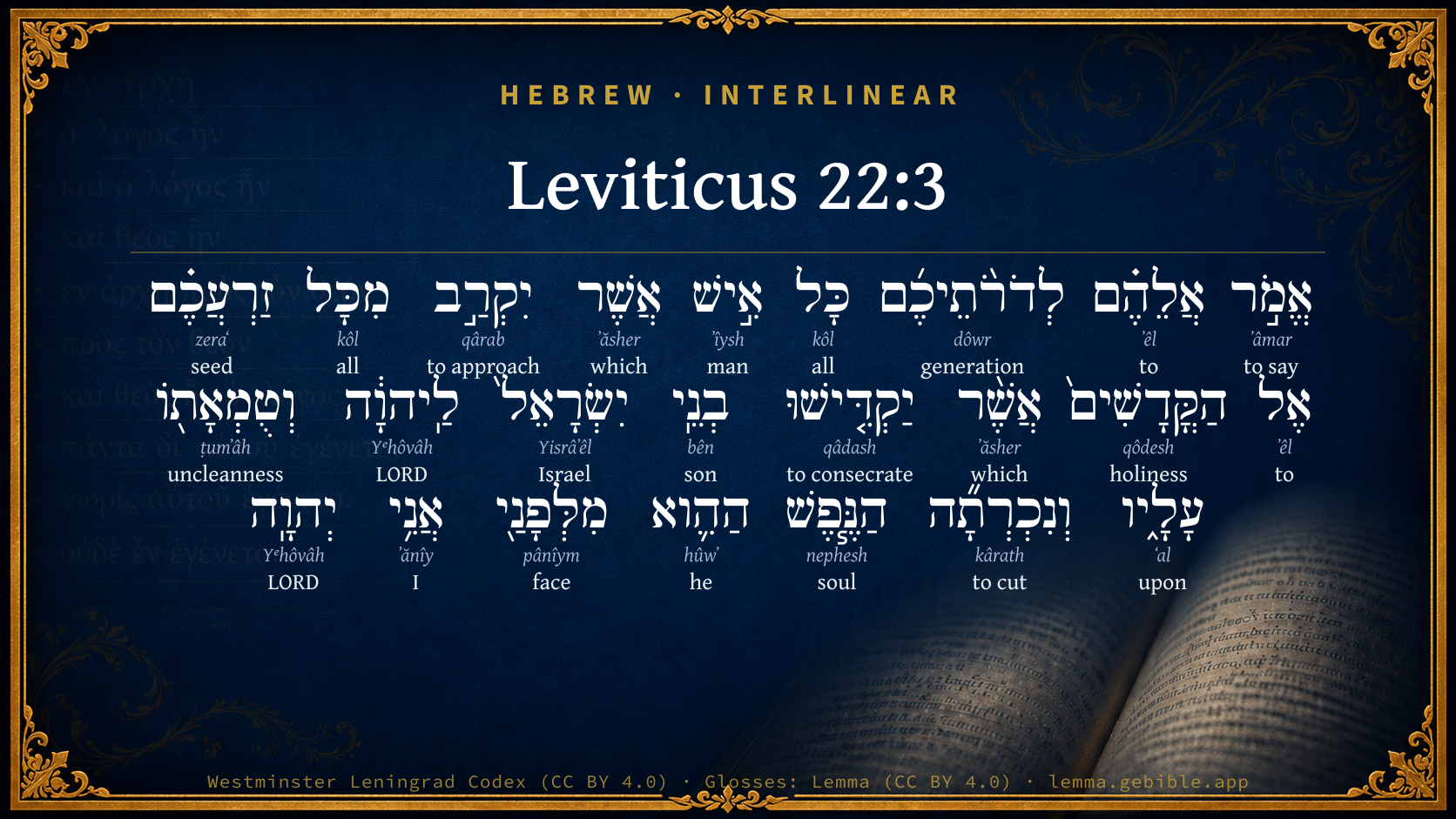
Hebrew (Westminster Leningrad Codex) Leviticus 22:3 appears in the Hebrew Old Testament. The text above is from the Westminster Leningrad Codex. Each word links to its Strong’s number, a concise gloss, and parsing drawn from the Open Scriptures Hebrew Bible morphology. Click any word for its full Brown-Driver-Briggs (BDB) entry.
Download image
Cite this verse

Leviticus 22:3 (World English Bible). Public Domain. Lemma interlinear Bible study tool, https://lemma.gebible.app/v/leviticus/22/3.

Show BibTeX & RIS
BibTeX
RIS
English Translation
Tell them, 'If anyone of all your seed throughout your generations approaches the holy things, which the children of Israel make holy to Yahweh, having his uncleanness on him, that soul shall be cut off from before me. I am Yahweh.
World English Bible · Public Domain
Download a study sheet

One document with this verse’s original text, its word-by-word gloss line, the meaning frame, cross-references with their text, attributed commentary, and full source and license credits — printable, and it pastes into notes with its structure intact.

This verse Autodidact and up

Study sheet (.html) Plain text (.txt)

A passage Seminary Student

Up to 50 verses in one chapter. A passage sheet keeps up to 6 commentary sources and 12 cross-references per verse, in the order this page ranks them, and says so on the sheet whenever that leaves anything out. Ask for a single verse and you get the Autodidact verse sheet above.

Everything on this page stays free to read, with no account — the sheet is a download of what is already on screen, not access to it.

Want to remove ads? Support Godless Engineer
Compare translations 3

The same verse in 3 English versions, stacked beneath the original-language interlinear above. Click any original word for its lexicon entry.

Each is an independent rendering of the whole verse — the interlinear is not word-aligned to these translations.

Highlighted words mark where these versions differ — a whole-verse word diff, not a word-by-word alignment.

  • World English Bible Public Domain
    Tell them, 'If anyone of all your seed throughout your generations approaches the holy things, which the children of Israel make holy to Yahweh, having his uncleanness on him, that soul shall be cut off from before me. I am Yahweh.
  • King James Version Public Domain
    Say unto them, Whosoever he be of all your seed among your generations, that goeth unto the holy things, which the children of Israel hallow unto the LORD, having his uncleanness upon him, that soul shall be cut off from my presence: I am the LORD.
  • unfoldingWord Literal Text CC BY-SA 4.0
    Say to them, ‘To your generations, any man who draws near from all your seed to the holy things that the sons of Israel have made holy to Yahweh and his uncleanness on him, that person shall be cut off from before my face. I Yahweh.

unfoldingWord Literal Text — © unfoldingWord, licensed CC BY-SA 4.0. Word-aligned USFM3 via Door43 (git.door43.org/unfoldingWord/en_ult).

Versions to compare (up to 4)

3 of 4 selected

Show all 18 translations

Every available English version of this verse, each an independent rendering of the whole verse.

  • World English Bible Public Domain
    Tell them, 'If anyone of all your seed throughout your generations approaches the holy things, which the children of Israel make holy to Yahweh, having his uncleanness on him, that soul shall be cut off from before me. I am Yahweh.
  • Berean Standard Bible Public Domain
    Tell them that for the generations to come, if any of their descendants in a state of uncleanness approaches the sacred offerings that the Israelites consecrate to the LORD, that person must be cut off from My presence. I am the LORD.
  • Majority Standard Bible Public Domain
    Tell them that for the generations to come, if any of their descendants in a state of uncleanness approaches the sacred offerings that the Israelites consecrate to the LORD, that person must be cut off from My presence. I am the LORD.
  • King James Version Public Domain
    Say unto them, Whosoever he be of all your seed among your generations, that goeth unto the holy things, which the children of Israel hallow unto the LORD, having his uncleanness upon him, that soul shall be cut off from my presence: I am the LORD.
  • American Standard Version (1901) Public Domain
    Say unto them, Whosoever he be of all your seed throughout your generations, that approacheth unto the holy things, which the children of Israel hallow unto Jehovah, having his uncleanness upon him, that soul shall be cut off from before me: I am Jehovah.
  • Revised Version (1885) Public Domain
    Say unto them, Whosoever he be of all your seed throughout your generations, that approacheth unto the holy things, which the children of Israel hallow unto the LORD, having his uncleanness upon him, that soul shall be cut off from before me: I am the LORD.
  • Geneva Bible (1599) Public Domain
    Say vnto them, Whosoeuer he be of all your seede among your generations after you, that toucheth the holy things which the children of Israel hallowe vnto the Lord, hauing his vncleannesse vpon him, euen that person shall be cut off from my sight: I am the Lord.
  • Douay-Rheims (1899) Public Domain
    Say to them and to their posterity: Every man of your race, that approacheth to those things that are consecrated, and which the children of Israel have offered to the Lord, in whom there is uncleanness, shall perish before the Lord. I am the Lord.
  • Young's Literal Translation Public Domain
    `Say unto them, To your generations, any man who draweth near, out of all your seed, unto the holy things which the sons of Israel do sanctify to Jehovah, and his uncleanness on him -- even that person hath been cut off from before Me; I `am' Jehovah.
  • Literal Standard Version CC BY-SA 4.0
    Say to them: Throughout your generations, any man who draws near, out of all your seed, to the holy things which the sons of Israel sanctify to YHWH, and his uncleanness [is] on him—indeed, that person has been cut off from before My face; I [am] YHWH.
  • Unlocked Literal Bible CC BY-SA 4.0
    Say to them, 'If any of your descendants throughout your generations approaches the holy things that the people of Israel have set apart to Yahweh, while he is unclean, that person must be cut off from before me: I am Yahweh.
  • unfoldingWord Literal Text CC BY-SA 4.0
    Say to them, ‘To your generations, any man who draws near from all your seed to the holy things that the sons of Israel have made holy to Yahweh and his uncleanness on him, that person shall be cut off from before my face. I Yahweh.
  • Darby Bible Public Domain
    Say unto them, Every one of all your seed, throughout your generations, that approacheth the holy things, which the children of Israel hallow unto Jehovah, having his uncleanness upon him, that soul shall be cut off from before me: I am Jehovah.
  • World Messianic Bible Public Domain
    “Tell them, ‘If anyone of all your offspring throughout your generations approaches the holy things which the children of Israel make holy to the LORD, having his uncleanness on him, that soul shall be cut off from before me. I am the LORD.
  • Webster's Bible Public Domain
    Say to them, Whoever he may be of all your seed among your generations, that approacheth the holy things, which the children of Israel hallow to the LORD, having his uncleanness upon him, that soul shall be cut off from my presence: I am the LORD.
  • Free Bible Version CC BY-SA 4.0
    Tell them: These rules apply for all future generations. If any of your descendants in an unclean state comes close to the holy offerings that the Israelites dedicate to honor the Lord, that person must be expelled from my presence. I am the Lord.
  • Bible in Basic English Public Domain
    Say to them, If any man of all your seed through all your generations, being unclean, comes near the holy things which the children of Israel make holy to the Lord, he will be cut off from before me: I am the Lord.
  • JPS Tanakh (1917) Public Domain
    Say unto them: Whosoever he be of all your seed throughout your generations, that approacheth unto the holy things, which the children of Israel hallow unto the LORD, having his uncleanness upon him, that soul shall be cut off from before Me: I am the LORD.

Literal Standard Version (2020), Covenant Press — licensed CC BY-SA 4.0. Text via the HelloAO Bible API (eBible.org). Unlocked Literal Bible (unfoldingWord) — licensed CC BY-SA 4.0. Text via the HelloAO Bible API (eBible.org). unfoldingWord Literal Text — © unfoldingWord, licensed CC BY-SA 4.0. Word-aligned USFM3 via Door43 (git.door43.org/unfoldingWord/en_ult). Free Bible Version, Dr. Jonathan Gallagher — licensed CC BY-SA 4.0. Text via the HelloAO Bible API (eBible.org).

Word by word

More ways to search: Search by grammar → Find every occurrence → Compare this word →

Practice this passage: Drill this verse → Learn its vocabulary →

וְטֻמְאָת֖וֹ
ṭumʼâh
H2932
“and · uncleanness · his”
Conjunction + Noun, Common, Feminine, Singular, Construct + Suffix, Personal, 3rd Person, Masculine, Singular
Part of Speech
Conjunction + Noun
Type
Common
Gender
Feminine
Number
Singular
State
Construct
Full BDB Definition

Origin: from H2930

TWOT: 809b

uncleanness - sexual - of filthy mass - ethical and religious - ritual - local (of nations)
  1. אֱמֹ֣ר ʼâmar H559 “say” Verb, Qal, Imperative, 2nd Person, Masculine, Singular
  2. אֲלֵהֶ֗ם ʼêl H413 “to · them” Preposition + Suffix, Personal, 3rd Person, Masculine, Plural
  3. לְדֹרֹ֨תֵיכֶ֜ם dôwr H1755 “to/for · generations · your” Preposition + Noun, Common, Masculine, Plural, Construct + Suffix, Personal, 2nd Person, Masculine, Plural
  4. כָּל kôl H3605 “all of” Noun, Common, Masculine, Singular, Construct
  5. אִ֣ישׁ ʼîysh H376 “man” Noun, Common, Masculine, Singular, Absolute
  6. אֲשֶׁר ʼăsher H834 “which” Particle, Relative
  7. יִקְרַ֣ב qârab H7126 “to approach” Verb, Qal, Imperfect, 3rd Person, Masculine, Singular
  8. מִכָּל kôl H3605 “from · all of” Preposition + Noun, Common, Masculine, Singular, Construct
  9. זַרְעֲכֶ֗ם zeraʻ H2233 “seed · your” Noun, Common, Masculine, Singular, Construct + Suffix, Personal, 2nd Person, Masculine, Plural
  10. אֶל ʼêl H413 “to” Preposition
  11. הַקֳּדָשִׁים֙ qôdesh H6944 “the · holy things” Particle, Definite Article + Noun, Common, Masculine, Plural, Absolute
  12. אֲשֶׁ֨ר ʼăsher H834 “which” Particle, Relative
  13. יַקְדִּ֤ישׁוּ qâdash H6942 “to consecrate” Verb, Hiphil, Imperfect, 3rd Person, Masculine, Plural
  14. בְנֵֽי bên H1121 “sons of” Noun, Common, Masculine, Plural, Construct
  15. יִשְׂרָאֵל֙ Yisrâʼêl H3478 “Israel” Noun, Proper
  16. לַֽיהוָ֔ה Yᵉhôvâh H3068 “to/for · LORD” Preposition + Noun, Proper
  17. עָלָ֑יו ʻal H5921 “upon · him” Preposition + Suffix, Personal, 3rd Person, Masculine, Singular
  18. וְנִכְרְתָ֞ה kârath H3772 “and · to cut” Conjunction + Verb, Niphal, Sequential Perfect, 3rd Person, Feminine, Singular
  19. הַנֶּ֧פֶשׁ nephesh H5315 “the · soul” Particle, Definite Article + Noun, Common, Both, Singular, Absolute
  20. הַהִ֛וא hûwʼ H1931 “the · he” Particle, Definite Article + Pronoun, Personal, 3rd Person, Feminine, Singular
  21. מִלְּפָנַ֖י pânîym H6440 “from · to/for · face(s) · my” Preposition + Preposition + Noun, Common, Both, Plural, Construct + Suffix, Personal, 1st Person, Common, Singular
  22. אֲנִ֥י ʼănîy H589 “I” Pronoun, Personal, 1st Person, Common, Singular
  23. יְהוָֽה Yᵉhôvâh H3068 “LORD” Noun, Proper

About this verse

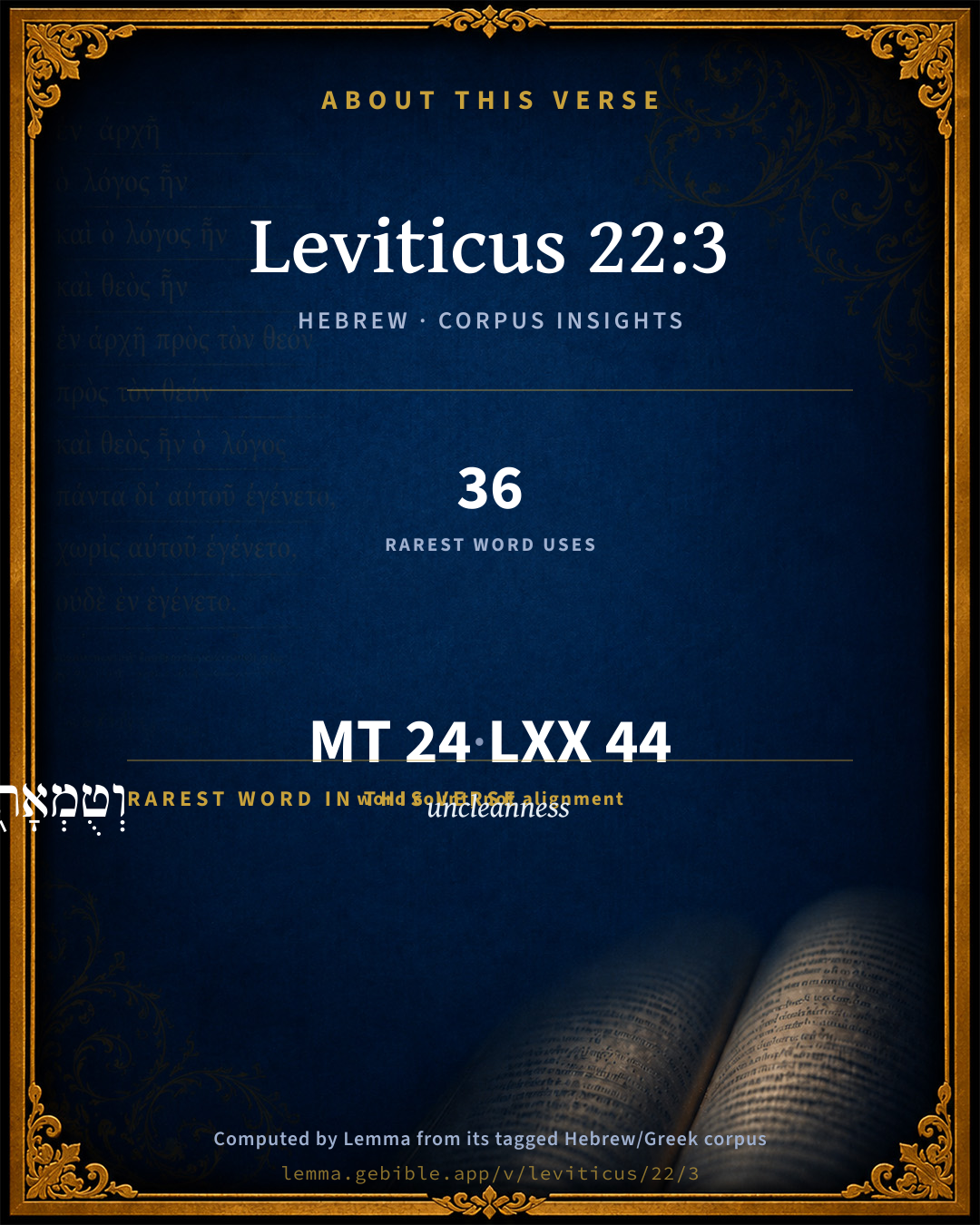
These counts appear in no published source. They are computed here, from the morphology-tagged text and Lemma’s own curated glosses. What Lemma adds →

24
words
20
distinct lemmas
Pentateuch
section

Shared distinctive vocabulary

וְטֻמְאָת֖וֹ uncleanness H2932 occurs in 31 verses of the Hebrew Bible. Also found in:

Grammatical profile

  • 4 verbs
  • 13 nouns
  • 2 pronouns
  • 3 prepositions
  • 2 particles

Verb forms

  • אֱמֹ֣ר Qal · Imperative
  • יִקְרַ֣ב Qal · Imperfect
  • יַקְדִּ֤ישׁוּ Hiphil · Imperfect
  • וְנִכְרְתָ֞ה Niphal · Sequential Perfect

Repetition

Words recur within this verse — often emphatic in Hebrew:

  • כָּל all H3605 ×2
  • לַֽיהוָ֔ה LORD H3068 ×2
  • אֲלֵהֶ֗ם to H413 ×2
  • אֲשֶׁר which H834 ×2

Hebrew & Septuagint length

In English translation the verse runs 41 words from the Hebrew and 49 from the Septuagint (LXX English) — closely comparable.

A rough comparison of the two English renderings, which tokenize alike — not a word-level alignment.

Word counts can differ between the Hebrew and the Greek without any difference in meaning — e.g. the Hebrew direct-object marker אֵת has no separate Greek word, and Greek often adds the article ὁ.

In the original languages it is 24 Hebrew tokens and 44 Greek tokens — but the two are counted differently (Hebrew bundles its prefixes and suffixes into one token; the Greek is in lemma form), so that isn’t a like-for-like length.

Cross-references

7

Topical passages linked to Leviticus 22:3 in the Treasury of Scripture Knowledge — connected by theme and wording, ordered by reader-vote popularity; previews shown in the World English Bible.

  • Leviticus 7:20–21 but the soul who eats of the flesh of the sacrifice of peace offerings, that belongs to Yahweh, having his uncleanness on him, that soul shall be cut off from his people.
  • Exodus 33:14–15 He said, "My presence will go with you, and I will give you rest."
  • Numbers 19:13 Whoever touches a dead person, the body of a man who has died, and doesn't purifies himself, defiles the tent of Yahweh; and that soul shall be cut off from Israel: because the water for impurity was not sprinkled on him, he shall be unclean; his uncleanness is yet on him.
  • Psalms 16:11 You will show me the path of life. In your presence is fullness of joy. In your right hand there are pleasures forevermore.
  • Psalms 51:11 Don't throw me from your presence, And don't take your holy Spirit from me.
  • Matthew 25:41 Then he will say also to those on the left hand, 'Depart from me, you cursed, into the eternal fire which is prepared for the devil and his angels;
  • 2 Thessalonians 1:9 who will pay the penalty: eternal destruction from the face of the Lord and from the glory of his might,

Cross-references courtesy of OpenBible.info (CC BY 4.0).

Hebrew and Greek witnesses Masoretic Hebrew ↔ Greek Septuagint

The same verse in the two great witnesses to the Old Testament, shown verse-for-verse.

These are two independent witnesses, not word-aligned to each other, and the Septuagint is shown in lemma (dictionary) form.

Hebrew Leviticus 22:3 Masoretic · Westminster Leningrad Codex

אֱמֹ֣ר אֲלֵהֶ֗ם לְדֹרֹ֨תֵיכֶ֜ם כָּל אִ֣ישׁ אֲשֶׁר יִקְרַ֣ב מִכָּל זַרְעֲכֶ֗ם אֶל הַקֳּדָשִׁים֙ אֲשֶׁ֨ר יַקְדִּ֤ישׁוּ בְנֵֽי יִשְׂרָאֵל֙ לַֽיהוָ֔ה וְטֻמְאָת֖וֹ עָלָ֑יו וְנִכְרְתָ֞ה הַנֶּ֧פֶשׁ הַהִ֛וא מִלְּפָנַ֖י אֲנִ֥י יְהוָֽה

Tell them, 'If anyone of all your seed throughout your generations approaches the holy things, which the children of Israel make holy to Yahweh, having his uncleanness on him, that soul shall be cut off from before me. I am Yahweh.

World English Bible · Public Domain

Greek LXX Leviticus 22:3 Septuagint · lemma form

εἶπον αὐτός εἰς ὁ γενεά σύ πᾶς ἄνθρωπος ὅς ἄν προςἔρχομαι ἀπό πᾶς ὁ σπέρμα σύ πρός ὁ ἅγιος ὅσος ἄν ἁγιάζω ὁ υἱός ἰσραήλ ὁ κύριος καί ὁ ἀκαθαρσία αὐτός ἐπί αὐτός ἐκὀλεθρεύω ὁ ψυχή ἐκεῖνος ἀπό ἐγώ ἐγώ κύριος ὁ θεός σύ

Say to them, Every man throughout your generations, whoever of all your seed shall approach to the holy things, whatever the children of Israel shall consecrate to the Lord, while his uncleanness is upon him, that soul shall be cut off from me: I am the Lord your God.

LXX2012 (modern English Septuagint) · Public Domain

Hebrew: Westminster Leningrad Codex (CC BY 4.0). Greek: Septuagint (public domain); English from LXX2012 (modern English Septuagint) (Public Domain). How the Septuagint differs from the Hebrew →

Targum (Aramaic paraphrase)

2

The Targum is the ancient Jewish Aramaic paraphrase of the Hebrew Scriptures — an interpretive translation, not the Hebrew text itself. Onkelos (literal) and Pseudo-Jonathan (expansive) render the Torah, and Jonathan the Prophets. Coverage is partial: where no permissively-licensed English translation exists for a verse, only the Aramaic is shown. This is verse-level text, not a word-by-word alignment to the Hebrew.

  1. Targum Onkelos Torah (Genesis–Deuteronomy)
    אֱמַר לְהוֹן לְדָרֵיכוֹן כָּל גְבַר דִי יִקְרַב מִכָּל בְּנֵיכוֹן לְקוּדְשַׁיָא דִי יְקַדְשׁוּן בְּנֵי יִשְׂרָאֵל קֳדָם יְיָ וְסֹאבְתֵיהּ עֲלוֹהִי וְיִשְׁתֵּיצֵי אֲנָשָׁא הַהִיא מִן קֳדָמַי אֲנָא יְיָ

    (no public-domain English translation for this verse)

    Targum Onkelos — Aramaic: “Onkelos Genesis” (public domain); “Onkelos Exodus” (public domain); “Onkelos Leviticus” (public domain); “Onkelos Numbers” (public domain); “Onkelos Deuteronomy” (public domain). English: “Sefaria Community Translation” (CC0 1.0 (public-domain dedication)); “J.W. Etheridge. The Targums of Onkelos and Jonathan Ben Uzziel on the Pentateuch. London: Longmans, Green, 1862” (public domain). Text via Sefaria.

  2. Targum Pseudo-Jonathan Torah (Genesis–Deuteronomy)
    אֵימַר לְהוֹן אִזְדַהֲרִין לְדָרֵיכוֹן כָּל גְבַר דְיִקְרַב מִכָּל בְּנֵיכוֹן לְקוּדְשַׁיָא דִי יְקַדְשׁוּן בְּנֵי יִשְרָאֵל קֳדָם יְיָ וְסוּבְתֵּיהּ עֲלוֹי וְיִשְׁתֵּיצֵי בַּר נְשָׁא הַהוּא בְּמוֹתָנָא מִן קֳדָמַי אֲנָא יְיָ

    Say to them, Take heed in your generations: whatever man of all your sons who shall offer things hallowed, which the children of Israel have consecrated before the Lord, having his uncleanness upon him, that man shall be destroyed with a stroke of death before Me: I am the Lord.

    Targum Pseudo-Jonathan — Aramaic: “Targum Jonathan on Genesis” (public domain); “Targum Jonathan on Exodus” (public domain); “Targum Jonathan on Leviticus” (public domain); “Targum Jonathan on Numbers” (public domain); “Targum Jonathan on Deuteronomy” (public domain). English: “The Targum of Jonathan ben Uzziel, trans. J. W. Etheridge, London, 1862” (public domain). Text via Sefaria.

Commentary

Notes on Leviticus 22:3 from classic Christian and Jewish commentators (each source and its license shown beneath its notes). The classic Christian expositions comment on the surrounding passage and are grouped to its opening verse, so a note may address several verses; the Jewish commentaries on the Tanakh (Rashi and others) are per-verse, so they appear only where the commentator wrote on this verse.

Lemma curates 59 commentaries, every one of them public domain or Creative Commons licensed, each selected and text-cleaned for this edition rather than reprinted as found. About our sources →

Trapp's Complete Commentary

John Trapp

Lev 22:3 Say unto them, Whosoever [he be] of all your seed among your generations, that goeth unto the holy things, which the children of Israel hallow unto the LORD, having his uncleanness upon him, that soul shall be cut off from my presence: I [am] the LORD.

Ver. 3. Cut off from my presence.] Who am omnipresent: Postea nullus erit. Where shall the ungodly and the wicked appear? Surely, nowhere.

John Trapp, A Commentary or Exposition upon All the Books of the Old and New Testament (1647–1656) — public domain. Text from a community e-Sword module.

Joseph Benson's Commentary

Lev 22:3. Goeth unto the holy things — To eat them, or to touch them; for if the touch of one of the people — having his uncleanness upon him defiled the thing he touched, much more was it so in the priest. Cut off — From my ordinances by excommunication: he shall be excluded both from the administration and from the participation of them. Le Clerc takes it for cutting off by death.

Joseph Benson's Commentary on the Old and New Testaments (1811–1818) — public domain. Text from a community e-Sword module.

Geneva Bible (1599)

Geneva Bible translators

To eat thereof.

Geneva Bible (1599) marginal notes — public domain. Text via Bolls.life.

Jamieson, Fausset & Brown

Robert Jamieson, A. R. Fausset & David Brown

Whosoever he be . . . that goeth unto the holy things--The multitude of minute restrictions to which the priests, from accidental defilement, were subjected, by keeping them constantly on their guard lest they should be unfit for the sacred service, tended to preserve in full exercise the feeling of awe and submission to the authority of God. The ideas of sin and duty were awakened in their breasts by every case to which either an interdict or an injunction was applied. But why enact an express statute for priests disqualified by the leprosy or polluting touch of a carcass [Lev 22:4], when a general law was already in force which excluded from society all persons in that condition? Because priests might be apt, from familiarity, to trifle with religion, and in committing irregularities or sins, to shelter themselves under the cloak of the sacred office. This law, therefore, was passed, specifying the chief forms of temporary defilement which excluded from the sanctuary, that priests might not deem themselves entitled to greater license than the rest of the people; and that so far from being in any degree exempted from the sanctions of the law, they were under greater obligations, by their priestly station, to observe it in its strict letter and its smallest enactments.

Jamieson, Fausset & Brown — Commentary Critical and Explanatory on the Whole Bible (1871) — public domain (CC PDM 1.0). Text via the HelloAO Bible API.

Ellicott's Commentary for English Readers

(3) Whosoever he be of all your seed, among your generations.—Better, throughout your generations, every man. So the Authorised version properly renders the expression here translated “among your generations” in Lev_23:14; Lev_23:21. (See Lev_3:17; Lev_21:17.)

That goeth unto the holy things.—That is, who approaches the sacrifices to eat them, as is stated in Lev_22:4; Lev_22:6; Lev_22:12.

Having his uncleanness upon him.—Not having first submitted to the prescribed lustrations (see Lev_7:20), the defilement which he contracted rests upon him.

That soul shall be cut off from my presence.—This phrase, with the expression “from my presence,” does not occur again in the Pentateuch when the Lord threatens with the penalty of excision. In Leviticus, where, besides the passage before us, the penalty is enacted six times, the formula is always, “that soul shall be cut off from his people” (Lev_7:20-21; Lev_7:25; Lev_7:27; Lev_19:8; Lev_23:29). Its exceptional form here may therefore have reference to the peculiar circumstances. If the priest ventures to approach the altar presumptuously to partake in a defiled state of the holy sacrifices, God himself will banish him from His presence as He did Nadab and Abihu.

A Bible Commentary for English Readers, edited by Charles John Ellicott (1878–1897) — public domain. Text from a community e-Sword module.

The Cambridge Bible for Schools and Colleges

gen. ed. J. J. S. Perowne

3. your seed] For this expression, and ‘seed of Aaron,’ in Lev_22:4, see introd. note on chs. 21, 22.

your generations] See latter part of the same note.

4–7 may be compared with Lev_21:11-15.

The Cambridge Bible for Schools and Colleges (gen. ed. J. J. S. Perowne; Cambridge University Press, 1878–1918) — public domain. Text from a community e-Sword module.

John Gill's Exposition

Say unto them, whosoever he be of all your seed among your generations,.... Whether male or female, in all succeeding ages, as long as the ceremonial law lasted; for females as well as males of the families of the priests ate of the holy things, provided they had no uncleanness on them, but if they had, they might not:

that goeth unto the holy things, which the children of Israel hallow unto the Lord: that approaches to any of the sacrifices which the children of Israel have devoted to the Lord, either to offer them, or even to touch them, and particularly to eat of them; and so Jarchi and Ben Gersom observe, that this going or drawing near is no other than eating; for touching only, a man was not guilty of cutting off:

having his uncleanness upon him; through a leprosy, or running issue, or touching any unclean person or thing, as the following words explain it:

that soul shall be cut off from my presence; excluded from the sanctuary, and the service of it, where the presence of God was; or be removed out of the world by death, either by the civil magistrate, or by the hand of God, by an immediate death, by the pestilence, as the Targum of Jonathan:

I am the Lord; that will avenge the breach of such a law, able to inflict such punishment, and faithful to accomplish every word of his, whether in a way of threatening or promise.

John Gill's Exposition of the Whole Bible (1746–1763) — public domain (CC PDM 1.0). Text via the HelloAO Bible API.

Albert Barnes' Notes on the Bible

Cut off from my presence - i. e. excluded from the sanctuary. See Lev 20:17.

Albert Barnes' Notes on the Bible (1834–1885) — public domain. Text from a community e-Sword/MySword module.

Haydock's Catholic Bible Commentary

Approacheth, &c. This is to give us to understand, with what purity of soul we are to approach to the blessed sacrament, of which these meats that had been offered in sacrifice were a figure. (Challoner) --- Such as were unclean either fasted till the evening, or ate unconsecrated meats till they were purified. --- Perish. The Rabbins say, by the hands of the other priests. The judges could only condemn him to be whipped. If his crime were secret, the punishment was left to God. (Selden, syn. ii. 1.)

George Leo Haydock (1774–1849), Haydock's Catholic Family Bible and Commentary, 1859 edition — public domain. Excludes Psalms (Douay-Rheims chapter numbering differs from Protestant) and Deuterocanonical books (Catholic canon only).

Matthew Poole's English Annotations

Unto the holy things, to eat them or to touch them; for if the touch of one of the people having his uncleanness upon him defiled the thing he touched, much more was it so in the priest.

From my presence; either from the place of my presence and from my ordinances by excommunication: he shall be excluded both from the administration and from the participation of them. Or, from the people, among whom I am present, which commonly is expressed by

cutting off from his people. Or, from the land of the living.

Matthew Poole's English Annotations on the Holy Bible (1683–1685) — public domain. Text from a community e-Sword/MySword module.

Whedon's Commentary on the Bible

Daniel D. Whedon

3. That soul shall be cut off — The wilful approach to the altar to discharge the functions of the priest’s office, while conscious of ceremonial impurity, evinced such irreverence and disobedience as to call down either the severe punishment of death, by some sudden stroke, or exclusion from the sacred office, as some understand, from my presence. The latter opinion is strengthened by 2Ch_26:21, while the former is strongly confirmed by Lev_22:9.

Daniel D. Whedon (gen. ed.), Commentary on the Old and New Testaments (1874–1909) — public domain. Text from a community e-Sword module.

The Pulpit Commentary

HOMILIES BY W. CLARKSON Ver. 3. The service of abstention.

There were certain bodily conditions which, under the Levitical institutions, were suggestive of spiritual impurity, and those who suffered from them were accounted ceremonially unclean. Priests thus affected were disqualified for the ministry of the tabernacle, and were deprived, for a time, of sacerdotal privileges: they might not "go unto the holy things." Any priest who was disobedient to this precept would be "cut off from the presence of the Lord." To those who were thus unfortunate there was one service left, the service of obedient abstention. They would be disappointed; they might feel somewhat humiliated; but there was left to them the opportunity of fulfilling the acceptable service of offering not or eating not "unto the Lord". (see Rom_14:6)

It often happens to us that by some misfortune perhaps, as here, some bodily affliction we are disabled and detained from active service: it may be from

(1) Christian work, or

(2) public worship, or

(3) daily duty (business or household activities).

That which is unavoidable and for which we are not responsible may shut us out from many valued privileges. In this case we must render the service of abstention. We can

I SUBMIT IN PATIENCE.

II BELIEVE WITH CHEERFUL CONFIDENCE: have faith to accept the truth that "they also serve who only stand and wait;" that God is as well pleased with the passive service of those whom he desires to "be still," as with those who"...at his bidding speed, And post o"er land and ocean without rest.

III WAIT IN HOPE. The hour will come, here or hereafter, sooner or later, when all bodily disabilities will have disappeared, and fullest access be given to the presence of the Lord. C.

The Pulpit Commentary (1880–1919), ed. H.D.M. Spence-Jones & Joseph S. Exell — public domain. Text from a community e-Sword module.

John Wesley's Explanatory Notes

Goeth unto the holy things - To eat them, or to touch them; for if the touch of one of the people having his uncleanness upon him defiled the thing he touched, much more was it so in the priest. Cut off - From my ordinances by excommunication: He shall be excluded both from the administration, and from the participation of them.

John Wesley, Explanatory Notes Upon the Whole Bible (1754–1765) — public domain. Text via the GEBible commentary corpus.

Rashi

Rabbi Shlomo Yitzchaki (Rashi)

‎כל איש אשר יקרב WHOSOEVER HE BE THAT GOETH UNTO [THE HOLY THINGS… SHALL BE CUT OFF etc.] — This “approaching" unto the holy things signifies nothing else but eating of them. Similarly we find that the prohibition of eating holy things in a state of uncleanness is expressed by the term נגע, (which means, as does קרב, “approaching”): (Leviticus 12:4) “she shall approach near to nothing that is holy" — which is explained as a prohibition addressed to one who would eat of the holy things (cf. Rashi on Leviticus 12:4). And our Rabbis derived it (the fact that לא תגע means: she shall not eat) from a verbal analogy. It is indeed impossible to say that one is punishable for touching holy things in a state of uncleanness, because the penalty of excision for eating holy things in such a state is mentioned in the section commencing צו את אהרן (Leviticus 7:20, 21) — twice is the punishment of כרת mentioned there, one immediately after the other; and if one really becomes liable to punishment for the mere touching of holy things it is unnecessary to pronounce him liable to punishment for eating them! In this sense also is it (our passage) expounded in Torath Cohanim (Sifra, Emor, Section 4 7): But is a priest who merely touches holy things when he is unclean really liable to the punishment of excision? Surely not, since Scripture expressly states in the following verse that an unclean priest who eats of the holy things is liable to excision and this latter statement would be unnecessary since eating without touching is impossible. But if this be so, why does Scripture use the term יקרב and not יאכל which means "eating”? It is in order to intimate that this law applies only when an unclean priest eats of it after it becomes fit לקרב, “to be offered” — that one does not become liable on account of his uncleanness until its מתירין (its “permitting portions”) have been offered, and he then eats of it. And if you ask, “Why are three mentions of the כרת-punishment (Leviticus 7:21 and here) necessary in respect to priestly uncleanness? then I reply, they have already been interpreted in Treatise Shevuot 7a, one as being intended as a generalisation, the other as a specification, etc. (see Rashi on Leviticus 7:20).

וטומאתו עליו means, AND THE MAN'S UNCLEANNESS IS UPON HIM (the first word meaning "and his uncleanness”). I might, however, think that Scripture is speaking of the flesh — "the uncleanness of the flesh is upon it” (the first word meaning “and its uncleanness, the word בשר being implied in the term הקדשים that precedes) and that Scripture is thus speaking of a clean person who ate holy things which have become unclean! You must needs admit that from what is implied in it (in the phrase) you must learn that Scripture is speaking of one whose state of uncleanness can fly (pass) away therefrom (since the phrase implies: “whilst the טומאה is still present", presupposing that there is a possibility of the טומאה passing away), and this can only refer to a human being who has a means of purification through immersion in a ritual bath whilst unclean food can never again become clean (Sifra, Emor, Section 4 8; Zevachim 43b).

ונכרתה [THAT SOUL] SHALL BE CUT OFF — I might think that this implies merely that he will be removed from one region (lit., side) to another region — that he will be cut off from his native place but may settle down in another place! Scripture however states, “[that soul shall be cut off from My presence] I am the Lord” — I am everywhere (Sifra, Emor, Section 4 6; cf. Rashi on Exodus 12:15.)

Rashi on the Tanakh — English translations: “The Judaica Press complete Tanach with Rashi, translated by A. J. Rosenberg” (CC BY 4.0); “Pentateuch with Rashi's commentary by M. Rosenbaum and A.M. Silbermann, 1929-1934” (public domain); “The Metsudah Tanach series, Lakewood, N.J” (CC BY 4.0); and “The Book of Joshua, Metsudah Publications, 1997” (CC BY 4.0). Text via Sefaria.

Lesson kit

Teaching starters — assembled from the data on this page, not authored interpretation. Every prompt links to the verse data it draws on. Edit before teaching.

Leviticus, in the Pentateuch, opens this verse with 24 words (20 distinct Hebrew lemmas). Its most distinctive word is ṭumʼâh (“uncleanness”). A historical commentator’s framing appears above. Read the whole chapter for the surrounding context.

Discussion questions

  1. The word ṭumʼâh carries the sense “uncleanness.” How does it shape the verse?
  2. How does Leviticus 5:3, which shares the word «uncleanness», read alongside this verse?
  3. What does the repetition of “all” (2× in this one verse) do in this verse?
  4. These translations render this verse differently; the difference is in the English rendering, not the original. What questions does that raise?
  5. «אֱמֹ֣ר» is a Qal Imperative verb. How does that grammatical form shape the action described?
  6. Compare how Trapp's Complete Commentary and Joseph Benson's Commentary read this verse. Where do they agree or differ?

Things to notice

Reading settings

Reading text

Shown beneath each verse's original-language words.

Old Testament
Old Testament edition

Read the OT as the Masoretic Hebrew (MT) or the Greek Septuagint (LXX).

English shown for the Greek Septuagint (in the Hebrew ↔ Greek comparison).

Comparing translations? Open the Compare panel on any verse page to stack up to four side by side.