Genesis 18:13

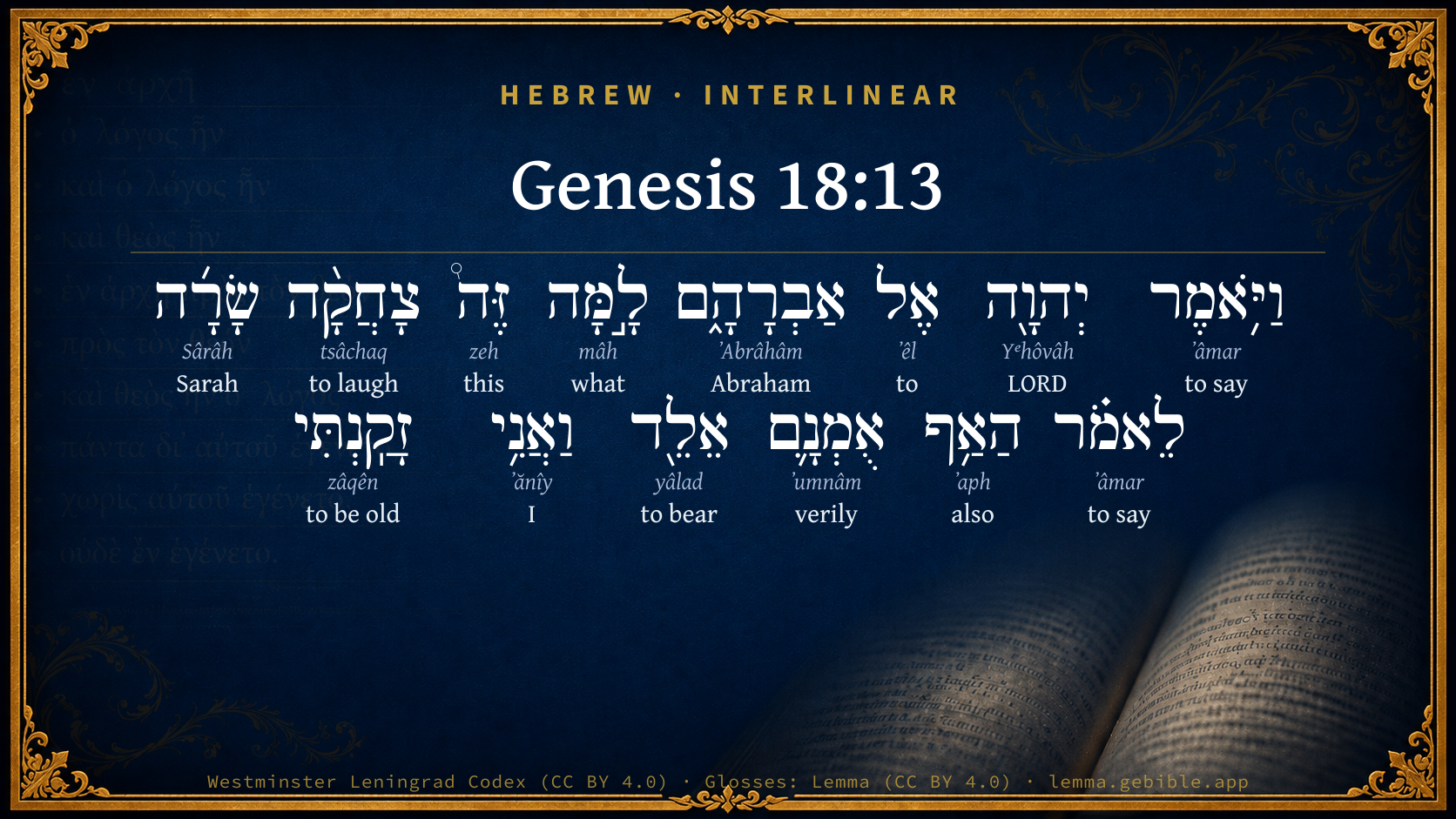
Hebrew (Westminster Leningrad Codex) Genesis 18:13 appears in the Hebrew Old Testament. The text above is from the Westminster Leningrad Codex. Each word links to its Strong’s number, a concise gloss, and parsing drawn from the Open Scriptures Hebrew Bible morphology. Click any word for its full Brown-Driver-Briggs (BDB) entry.
Download image
Cite this verse

Genesis 18:13 (World English Bible). Public Domain. Lemma interlinear Bible study tool, https://lemma.gebible.app/v/genesis/18/13.

Show BibTeX & RIS
BibTeX
RIS
English Translation
Yahweh said to Abraham, "Why did Sarah laugh, saying, 'Will I really bear a child, yet I am old?'
World English Bible · Public Domain
Highlights
  • 1 first appearance in the Hebrew Bible
Full analysis ↓
Download a study sheet

One document with this verse’s original text, its word-by-word gloss line, the meaning frame, cross-references with their text, attributed commentary, and full source and license credits — printable, and it pastes into notes with its structure intact.

This verse Autodidact and up

Study sheet (.html) Plain text (.txt)

A passage Seminary Student

Up to 50 verses in one chapter. A passage sheet keeps up to 6 commentary sources and 12 cross-references per verse, in the order this page ranks them, and says so on the sheet whenever that leaves anything out. Ask for a single verse and you get the Autodidact verse sheet above.

Everything on this page stays free to read, with no account — the sheet is a download of what is already on screen, not access to it.

Want to remove ads? Support Godless Engineer
Compare translations 3

The same verse in 3 English versions, stacked beneath the original-language interlinear above. Click any original word for its lexicon entry.

Each is an independent rendering of the whole verse — the interlinear is not word-aligned to these translations.

Highlighted words mark where these versions differ — a whole-verse word diff, not a word-by-word alignment.

  • World English Bible Public Domain
    Yahweh said to Abraham, "Why did Sarah laugh, saying, 'Will I really bear a child, yet I am old?'
  • King James Version Public Domain
    And the LORD said unto Abraham, Wherefore did Sarah laugh, saying, Shall I of a surety bear a child, which am old?
  • unfoldingWord Literal Text CC BY-SA 4.0
    Then Yahweh said to Abraham, “Why that Sarah laughed, saying, ‘Will I really bear when I am old?’

unfoldingWord Literal Text — © unfoldingWord, licensed CC BY-SA 4.0. Word-aligned USFM3 via Door43 (git.door43.org/unfoldingWord/en_ult).

Versions to compare (up to 4)

3 of 4 selected

Show all 18 translations

Every available English version of this verse, each an independent rendering of the whole verse.

  • World English Bible Public Domain
    Yahweh said to Abraham, "Why did Sarah laugh, saying, 'Will I really bear a child, yet I am old?'
  • Berean Standard Bible Public Domain
    And the LORD asked Abraham, “Why did Sarah laugh and say, ‘Can I really bear a child when I am old?’
  • Majority Standard Bible Public Domain
    And the LORD asked Abraham, “Why did Sarah laugh and say, ‘Can I really bear a child when I am old?’
  • King James Version Public Domain
    And the LORD said unto Abraham, Wherefore did Sarah laugh, saying, Shall I of a surety bear a child, which am old?
  • American Standard Version (1901) Public Domain
    And Jehovah said unto Abraham, Wherefore did Sarah laugh, saying, Shall I of a surety bear a child, who am old?
  • Revised Version (1885) Public Domain
    And the LORD said unto Abraham, Wherefore did Sarah laugh, saying, Shall I of a surety bear a child, which am old?
  • Geneva Bible (1599) Public Domain
    And ye Lord saide vnto Abraham, Wherefore did Sarah thus laugh, saying, Shall I certainely beare a childe, which am olde?
  • Douay-Rheims (1899) Public Domain
    And she laughed secretly, saying: After I am grown old
  • Young's Literal Translation Public Domain
    and Sarah laugheth in her heart, saying, `After I have waxed old I have had pleasure! -- my lord also `is' old!'
  • Literal Standard Version CC BY-SA 4.0
    And YHWH says to Abraham, “Why [is] this? Sarah has laughed, saying, Is it really true—I bear—and I am aged?
  • Unlocked Literal Bible CC BY-SA 4.0
    Yahweh said to Abraham, “Why did Sarah laugh and say, 'Will I really bear a child, when I am old'?
  • unfoldingWord Literal Text CC BY-SA 4.0
    Then Yahweh said to Abraham, “Why that Sarah laughed, saying, ‘Will I really bear when I am old?’
  • Darby Bible Public Domain
    And Jehovah said to Abraham, Why is this, that Sarah laughs, saying, Shall I indeed bear, when I am become old?
  • World Messianic Bible Public Domain
    The LORD said to Abraham, “Why did Sarah laugh, saying, ‘Will I really bear a child when I am old?’
  • Webster's Bible Public Domain
    And the LORD said to Abraham, Why did Sarah laugh, saying, Shall I certainly bear a child, who am old?
  • Free Bible Version CC BY-SA 4.0
    The Lord asked Abraham, “Why did Sarah laugh and ask, ‘How could it possibly be true that I'll have a child now I'm so old?’
  • Bible in Basic English Public Domain
    And the Lord said, Why was Sarah laughing and saying, Is it possible for me, being old, to give birth to a child?
  • JPS Tanakh (1917) Public Domain
    And the LORD said unto Abraham: 'Wherefore did Sarah laugh, saying: Shall I of a surety bear a child, who am old?

Literal Standard Version (2020), Covenant Press — licensed CC BY-SA 4.0. Text via the HelloAO Bible API (eBible.org). Unlocked Literal Bible (unfoldingWord) — licensed CC BY-SA 4.0. Text via the HelloAO Bible API (eBible.org). unfoldingWord Literal Text — © unfoldingWord, licensed CC BY-SA 4.0. Word-aligned USFM3 via Door43 (git.door43.org/unfoldingWord/en_ult). Free Bible Version, Dr. Jonathan Gallagher — licensed CC BY-SA 4.0. Text via the HelloAO Bible API (eBible.org).

Word by word

More ways to search: Search by grammar → Find every occurrence → Compare this word →

Practice this passage: Drill this verse → Learn its vocabulary →

About this verse

These counts appear in no published source. They are computed here, from the morphology-tagged text and Lemma’s own curated glosses. What Lemma adds →

14
words
13
distinct lemmas
Pentateuch
section

Notable vocabulary

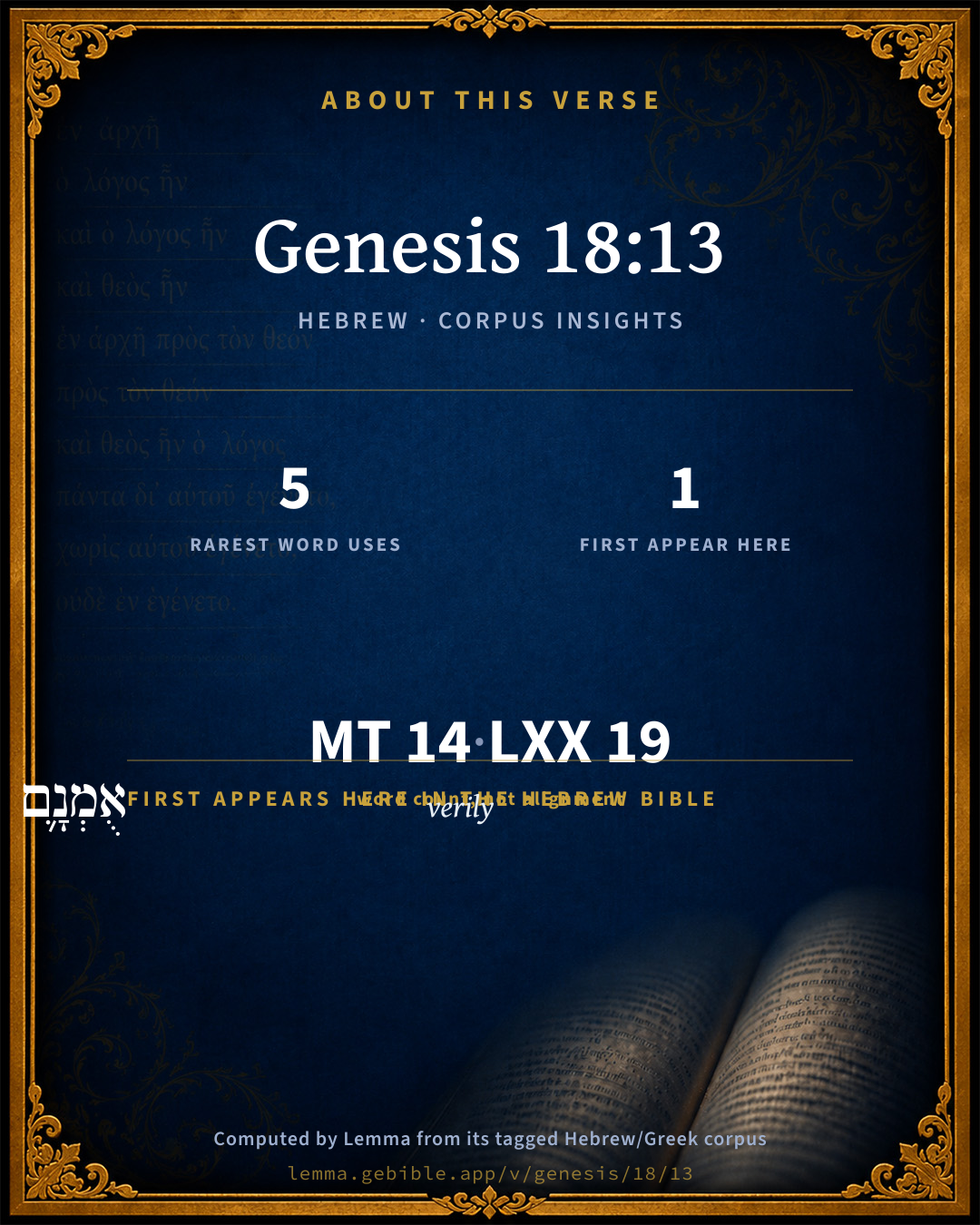
The rarest word here is אֻמְנָ֛ם verily H552 — appearing just 5 times in the whole Hebrew Bible.

First appearance in Scripture

This word makes its first canonical appearance in the Hebrew Bible here:

  • אֻמְנָ֛ם verily H552

Shared distinctive vocabulary

אֻמְנָ֛ם verily H552 occurs in 5 verses of the Hebrew Bible. Also found in:

Grammatical profile

  • 5 verbs
  • 3 nouns
  • 2 pronouns
  • 1 preposition
  • 2 adverbs
  • 1 particle

Verb forms

  • וַיֹּ֥אמֶר Qal · Sequential Imperfect
  • צָחֲקָ֨ה Qal · Perfect
  • לֵאמֹ֗ר Qal · Infinitive Construct
  • אֵלֵ֖ד Qal · Imperfect
  • זָקַֽנְתִּי Qal · Perfect

Repetition

A word recurs within this verse — often emphatic in Hebrew:

  • וַיֹּ֥אמֶר to say H559 ×2

Hebrew & Septuagint length

In English translation the verse runs 19 words from the Hebrew and 26 from the Septuagint (LXX English) — closely comparable.

A rough comparison of the two English renderings, which tokenize alike — not a word-level alignment.

Word counts can differ between the Hebrew and the Greek without any difference in meaning — e.g. the Hebrew direct-object marker אֵת has no separate Greek word, and Greek often adds the article ὁ.

In the original languages it is 14 Hebrew tokens and 19 Greek tokens — but the two are counted differently (Hebrew bundles its prefixes and suffixes into one token; the Greek is in lemma form), so that isn’t a like-for-like length.

Cross-references

1

Topical passages linked to Genesis 18:13 in the Treasury of Scripture Knowledge — connected by theme and wording, ordered by reader-vote popularity; previews shown in the World English Bible.

  • John 2:25 and because he didn't need for anyone to testify concerning man; for he himself knew what was in man.

Cross-references courtesy of OpenBible.info (CC BY 4.0).

Hebrew and Greek witnesses Masoretic Hebrew ↔ Greek Septuagint

The same verse in the two great witnesses to the Old Testament, shown verse-for-verse.

These are two independent witnesses, not word-aligned to each other, and the Septuagint is shown in lemma (dictionary) form.

Hebrew Genesis 18:13 Masoretic · Westminster Leningrad Codex

וַיֹּ֥אמֶר יְהוָ֖ה אֶל אַבְרָהָ֑ם לָ֣מָּה זֶּה֩ צָחֲקָ֨ה שָׂרָ֜ה לֵאמֹ֗ר הַאַ֥ף אֻמְנָ֛ם אֵלֵ֖ד וַאֲנִ֥י זָקַֽנְתִּי

Yahweh said to Abraham, "Why did Sarah laugh, saying, 'Will I really bear a child, yet I am old?'

World English Bible · Public Domain

Greek LXX Genesis 18:13 Septuagint · lemma form

καί εἶπον κύριος πρός αβρααμ τίς ὅτι γελάω σαρρα ἐν ἑαυτοῦ λέγω ἆρα γέ ἀληθῶς τίκτω ἐγώ δέ γηράσκω

And the Lord said to Abraam, Why is it that Sarrha has laughed in herself, saying, Shall I then indeed bear? but I am grown old.

LXX2012 (modern English Septuagint) · Public Domain

Hebrew: Westminster Leningrad Codex (CC BY 4.0). Greek: Septuagint (public domain); English from LXX2012 (modern English Septuagint) (Public Domain). How the Septuagint differs from the Hebrew →

Targum (Aramaic paraphrase)

2

The Targum is the ancient Jewish Aramaic paraphrase of the Hebrew Scriptures — an interpretive translation, not the Hebrew text itself. Onkelos (literal) and Pseudo-Jonathan (expansive) render the Torah, and Jonathan the Prophets. Coverage is partial: where no permissively-licensed English translation exists for a verse, only the Aramaic is shown. This is verse-level text, not a word-by-word alignment to the Hebrew.

  1. Targum Onkelos Torah (Genesis–Deuteronomy)
    וַאֲמַר יְיָ לְאַבְרָהָם לְמָּא דְנָן חַיְכַת שָׂרָה לְמֵימַר הַבְרַם בְּקוּשְׁטָא אוֹלִיד וַאֲנָא סֵיבִית

    (no public-domain English translation for this verse)

    Targum Onkelos — Aramaic: “Onkelos Genesis” (public domain); “Onkelos Exodus” (public domain); “Onkelos Leviticus” (public domain); “Onkelos Numbers” (public domain); “Onkelos Deuteronomy” (public domain). English: “Sefaria Community Translation” (CC0 1.0 (public-domain dedication)); “J.W. Etheridge. The Targums of Onkelos and Jonathan Ben Uzziel on the Pentateuch. London: Longmans, Green, 1862” (public domain). Text via Sefaria.

  2. Targum Pseudo-Jonathan Torah (Genesis–Deuteronomy)
    וַאֲמַר יְיָ לְאַבְרָהָם לָמָה דְנַן גַחְכַת שָרָה לְמֵימַר הַבְּרַם בִּקְשׁוֹט אוֹלִיד וַאֲנָא סָבִית

    And the Lord said to Abraham, Why hath Sarah so laughed, saying, Can it be in truth that I shall bear, being old?

    Targum Pseudo-Jonathan — Aramaic: “Targum Jonathan on Genesis” (public domain); “Targum Jonathan on Exodus” (public domain); “Targum Jonathan on Leviticus” (public domain); “Targum Jonathan on Numbers” (public domain); “Targum Jonathan on Deuteronomy” (public domain). English: “The Targum of Jonathan ben Uzziel, trans. J. W. Etheridge, London, 1862” (public domain). Text via Sefaria.

Commentary

Notes on Genesis 18:13 from classic Christian and Jewish commentators (each source and its license shown beneath its notes). The classic Christian expositions comment on the surrounding passage and are grouped to its opening verse, so a note may address several verses; the Jewish commentaries on the Tanakh (Rashi and others) are per-verse, so they appear only where the commentator wrote on this verse.

Lemma curates 59 commentaries, every one of them public domain or Creative Commons licensed, each selected and text-cleaned for this edition rather than reprinted as found. About our sources →

Trapp's Complete Commentary

John Trapp

Gen 18:13 And the LORD said unto Abraham, Wherefore did Sarah laugh, saying, Shall I of a surety bear a child, which am old?

Ver. 13. Said to Abraham, Wherefore did Sarah laugh?] The wife’s sin reflects upon the husband. But Solomon shows that some wives are so intemperate and wilful, that a man may as well hide the wind in his fist, or oil in his hand, as restrain them from ill doing. {Pro 27:15-16} Liberum arbitrium, pro quo tantopere contenditur, viri amiserunt, uxores arripuerunt , saith one {a} wittily.

{a} Heidfeld.

John Trapp, A Commentary or Exposition upon All the Books of the Old and New Testament (1647–1656) — public domain. Text from a community e-Sword module.

Joseph Benson's Commentary

Gen 18:13; Gen 18:15. And the Lord (Hebrews, Jehovah) said, Wherefore did Sarah laugh? — By showing that he knew what Sarah did secretly, in another apartment of the tent, he manifested that he could accomplish his word, however contrary to the ordinary course of nature.

Joseph Benson's Commentary on the Old and New Testaments (1811–1818) — public domain. Text from a community e-Sword module.

Tyndale Open Study Notes

Tyndale Open Resources

18:13-15 Sarah thought her disbelieving laughter was hidden, but God knows human hearts (see Ps 69:5; Prov 20:27; Mark 4:22; Luke 8:43-48; Heb 4:13), whether they stagger at the promises or step out in faith (see Heb 11:11-12).

Tyndale Open Study Notes — © Tyndale Open Resources, licensed CC BY-SA 4.0. Text via the HelloAO Bible API.

Adam Clarke's Commentary

Verse 13. And the LORD (Jehovah) said, c.] So it appears that one of those three persons was Jehovah, and as this name is never given to any created being, consequently the ever-blessed God is intended and as he was never seen in any bodily shape, consequently the great Angel of the covenant, Jesus Christ, must be meant. See Clarke on Ge 16:7.

Adam Clarke's Commentary on the Bible (1810–1826) — public domain. Text from a community e-Sword/MySword module.

John Calvin's Commentaries

13. And the Lord said. Because the majesty of God had now been manifested in the angels, Moses expressly mentions his Name. We have before declared, in what sense the name of God is transferred to the angel; it is not, therefore, now necessary to repeat it: except, as it is always important to remark, that the word of the Lord is so precious to himself, that he would be regarded by us as present, whenever he speaks through his ministers. Again, whenever he manifested himself to the fathers, Christ was the Mediator between him and them; who not only personates God in proclaiming his word, but is also truly and essentially God. And because the laughter of Sarah had not been detected by the eye of man, therefore Moses expressly declares that she was reprehended by God. And to this point belong the following circumstances, that the angel had his back turned to the tent, and that Sarah laughed within herself, and not before others. The censure also shows that the laughter of Sarah was joined with incredulity. For there is no little weight in this sentence, ‘Can anything be wonderful with God?’ But the angel chides Sarah, because she limited the power of God within the bounds of her own sense. An antithesis is therefore implied between the immense power of God, and the contracted measure which Sarah imagined to herself, through her carnal reason. Some translate the word פלא (pala,) hidden, as if the angel meant that nothing was hidden from God: but the sense is different; namely, that the power of God ought not to be estimated by human reason. It is not surprising, that in arduous affairs we fail, or that we succumb to difficulties: but God’s way is far otherwise, for he looks down with contempt, from above, upon those things which alarm us by their lofty elevation. We now see what was the sin of Sarah; namely, that she did wrong to God, by not acknowledging the greatness of his power. And truly, we also attempt to rob God of his power, whenever we distrust his word. At the first sight, Paul seems to give cold praise to the faith of Abraham, in saying, that he did not consider his body, now dead, but gave glory to God, because he was persuaded that he could fulfill what he had promised. (Romans 4:19.) But if we thoroughly investigate the source of distrust, we shall find that the reason why we doubt of God’s promises is, because we sinfully detract from his power. For as soon as any extraordinary difficulty occurs, then, whatever God has promised, seems to us fabulous; yea, the moment he speaks, the perverse thought insinuates itself, How will he fulfill what he promises? Being bound down, and preoccupied by such narrow thoughts, we exclude his power, the knowledge of which is better to us than a thousand worlds. In short, he who does not expect more from God than he is able to comprehend in the scanty measure of his own reason, does him grievous wrong. Meanwhile, the word of the Lord ought to be inseparably joined with his power; for nothing is more preposterous, than to inquire what God can do, to the setting aside of his declared will. In this way the Papists plunge themselves into a profound labyrinth, when they dispute concerning the absolute power of God. Therefore, unless we are willing to be involved in absurd dotings, it is necessary that the word should precede us like a lamp; so that his power and his will may be conjoined by an inseparable bond. This rule the Apostle prescribes to us, when he says,

‘Being certainly persuaded, that what he has promised, he is able to perform,’ (Romans 4:21.)

The angel again repeats the promise that he would come ‘according to the time of life,’ that is, in the revolving of the year, when the full time of bringing forth should have arrived.

John Calvin's Commentaries (1540-1563) — public domain. Text from the Calvin Translation Society English edition (1840s-50s) via the Christian Classics Ethereal Library (ccel.org). Calvin's coverage is partial (roughly two-thirds of the Bible); uncommented books and verses are honest gaps, never fabricated. The 19th-century editor's footnotes and remarks are omitted so the notes are faithfully Calvin's own voice.

The Cambridge Bible for Schools and Colleges

gen. ed. J. J. S. Perowne

13. Wherefore did Sarah laugh?] The Divine nature of Abraham’s guest is shewn in His knowledge of Sarah’s thought, cf. Gen_17:19. Here, for the first time, Abraham’s Visitant is identified with Jehovah.

The Cambridge Bible for Schools and Colleges (gen. ed. J. J. S. Perowne; Cambridge University Press, 1878–1918) — public domain. Text from a community e-Sword module.

John Gill's Exposition

And the Lord said unto Abraham,.... This discovers who the person was that had been conversing with Abraham, that he was a divine Person, as appears by his name "Jehovah", as well as by his knowledge of Sarah's behaviour; he did not turn himself to her, that it might be more manifest that it was not upon the sight of her he judged she laughed, but from his own omniscience; and he chose rather to speak to her husband than to her, appearing as a stranger, and that he might reprove her:

wherefore did Sarah laugh, saying, shall I of a surety bear a child,

which am old? suggesting there was no reason for it, and signifying his displeasure and indignation at it.

John Gill's Exposition of the Whole Bible (1746–1763) — public domain (CC PDM 1.0). Text via the HelloAO Bible API.

Haydock's Catholic Bible Commentary

Indeed. This was the import of Sara’s words. By thus revealing what was secretly done in the tent, he shewed himself to be more than man.

George Leo Haydock (1774–1849), Haydock's Catholic Family Bible and Commentary, 1859 edition — public domain. Excludes Psalms (Douay-Rheims chapter numbering differs from Protestant) and Deuterocanonical books (Catholic canon only).

Whedon's Commentary on the Bible

Daniel D. Whedon

13. The Lord said — Here the speaker is expressly called Jehovah. He also shows his knowledge of the thoughts of Sarah, and in the next verse identifies himself with Jehovah, saying: “Is any thing too hard for Jehovah? At the time appointed I will return,” etc. All this is incompatible with the idea that the speaker merely personates Jehovah.

Daniel D. Whedon (gen. ed.), Commentary on the Old and New Testaments (1874–1909) — public domain. Text from a community e-Sword module.

The Pulpit Commentary

And the Lord said unto Abraham, Wherefore did Sarah laugh, a question which must have convinced Abraham of the Speaker"s omniscience. Not only had he heard the silent, inaudible, inward cachinnation of Sarah"s spirit, but he knew the tenor of her thoughts, and the purport of her dubitationssaying, Shall I of a surely bear a child, whilst (literally, and I) am old? Sarah s mental cogitations clearly showed that the temporary obscuration of her faith proceeded from a strong realization of the weakness of nature, which made conception and pregnancy impossible to one like her, who was advanced in years; and accordingly her attention, as well as that of her husband, was directed to the Divine omnipotence as the all-sufficient guarantee for the accomplishment of the promise.

The Pulpit Commentary (1880–1919), ed. H.D.M. Spence-Jones & Joseph S. Exell — public domain. Text from a community e-Sword module.

unfoldingWord translationNotes

Door43 World Missions Community

Why did Sarah laugh and say, 'Will I really bear a child, when I am old'?

God used this rhetorical question to show that he knew what Sarah was thinking and that he was not pleased with it. He repeats Sarah's rhetorical question (Genesis 18:12) using different words. AT: "Sarah was wrong to laugh and say, 'I will not bear a child because I am too old!'"(See: Rhetorical Question)

Is anything too hard for Yahweh?

"Is there anything that Yahweh cannot do?" Yahweh speaks of himself as if he were speaking of someone else to remind Abraham that he, Yahweh, is great and can do anything. AT: "There is nothing that I, Yahweh, cannot do!" (See: First, Second, or Third Person and Rhetorical Question)

At the time appointed by me, in the spring

"At the time I have appointed, which is in the spring"

Then Sarah denied it and said

"The Sarah denied it by saying"

He replied

"Yahweh replied"

No, you did laugh

"Yes, you did laugh." This means "No, that is not true; you did in fact laugh."

translationWords

Yahweh

Abraham

Sarah

unfoldingWord translationNotes — © Distant Shores Media and the Door43 World Missions Community, licensed CC BY-SA 4.0. Source: git.door43.org/Door43/en_tn.

Rashi

Rabbi Shlomo Yitzchaki (Rashi)

האף אמנם means SHALL I REALLY BEAR?

ואני זקנתי I BEING OLD — Scripture (God) in relating her words to her husband alters them for the sake of peace, for she had said (v. 12) “my lord is old” (Genesis Rabbah 48:18).

Rashi on the Tanakh — English translations: “The Judaica Press complete Tanach with Rashi, translated by A. J. Rosenberg” (CC BY 4.0); “Pentateuch with Rashi's commentary by M. Rosenbaum and A.M. Silbermann, 1929-1934” (public domain); “The Metsudah Tanach series, Lakewood, N.J” (CC BY 4.0); and “The Book of Joshua, Metsudah Publications, 1997” (CC BY 4.0). Text via Sefaria.

Ramban (Nachmanides)

Rabbi Moshe ben Nachman (Ramban / Nachmanides)

I BEING OLD. This is the explanation of Sarah’s words, after I am waxed old. And G-d’s words [that Sarah had said, “I being old“], were true, but for the sake of peace He did not reveal what she also said, namely, My lord being old also, for [if He were quoting Sarah], He should have said, “I and my lord are old,” as Sarah had laughed concerning both of them.

Ramban (Nachmanides) on the Tanakh — English translation: “Commentary on the Torah by Ramban (Nachmanides). Translated and annotated by Charles B. Chavel. New York, Shilo Pub. House, 1971-1976” (CC BY 4.0). Text via Sefaria.

Radak

Rabbi David Kimhi (Radak)

'ויאמר ה, the angel is accorded the name of his Master, something that we find also in connection with Gideon in Judges 6,16.

?האף אמנם אלד, will such a miracle indeed occur on my behalf even though I am that old? Even though the angel did not answer her point by point, he did answer her with an overall statement that there simply is nothing which is beyond G’d’s power to accomplish if he so desires. Our author uses a similar approach when examining the words Eliezer used in explaining his mission in Genesis 24,39. There too, the fact that he conveyed the content of what he had asked Avraham before undertaking his mission was important, the exact wording was not the issue. The angel did not even bother to reply to Sarah’s statement that her husband too was too old to impregnate her with semen. The reason he did not do so was that Sarah having had her menopause was the far greater natural impediment to her becoming pregnant. It is not altogether unknown for old men to father children even in their advanced old age.

Radak on the Tanakh — English translations: “Sefaria Community Translation” (CC0 1.0 (public-domain dedication)); “Eliyahu Munk, HaChut Hameshulash” (CC BY 4.0); “Rabbi Mike Feuer, Jerusalem Anthology” (CC BY 4.0); and “R. David Kimhi on the first book of Psalms, Translated by R.G. Finch, London, 1919” (public domain). Text via Sefaria.

Lesson kit

Teaching starters — assembled from the data on this page, not authored interpretation. Every prompt links to the verse data it draws on. Edit before teaching.

Genesis, in the Pentateuch, opens this verse with 14 words (13 distinct Hebrew lemmas). Its most distinctive word is ʼumnâm (“verily”). A historical commentator’s framing appears above. Read the whole chapter for the surrounding context.

Discussion questions

  1. The word ʼumnâm carries the sense “verily.” How does it shape the verse?
  2. This is the first place “verily” appears in Scripture (first appears here). What does its debut here establish?
  3. How does Numbers 22:37, which shares the word «verily», read alongside this verse?
  4. What does the repetition of “to say” (2× in this one verse) do in this verse?
  5. These translations render this verse differently; the difference is in the English rendering, not the original. What questions does that raise?
  6. «וַיֹּ֥אמֶר» is a Qal Sequential Imperfect verb. How does that grammatical form shape the action described?
  7. Compare how Trapp's Complete Commentary and Joseph Benson's Commentary read this verse. Where do they agree or differ?

Things to notice

Reading settings

Reading text

Shown beneath each verse's original-language words.

Old Testament
Old Testament edition

Read the OT as the Masoretic Hebrew (MT) or the Greek Septuagint (LXX).

English shown for the Greek Septuagint (in the Hebrew ↔ Greek comparison).

Comparing translations? Open the Compare panel on any verse page to stack up to four side by side.